Sample Category Title
XAU/USD Analysis: Continues To Move Downwards
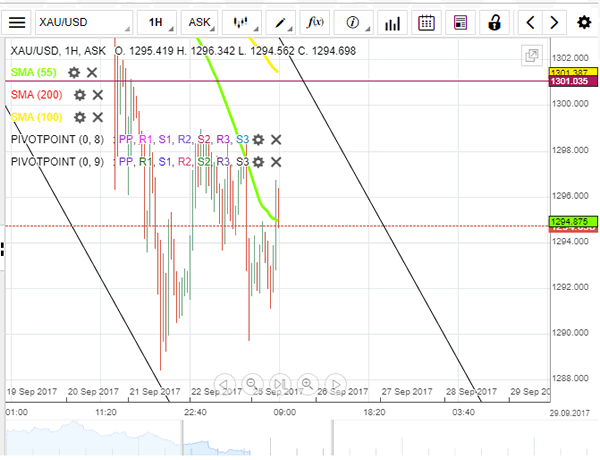
In accordance with expectations, the surge of the gold price did not last for long, as the pair was turned around by the monthly PP located at the 1,300.00 level, which transformed from support into resistance.
At the moment, there are certain signs that the rate is going to try to climb to the top again. However, this new attempt is expected to fail due to presence of the 55- and 100-hour SMAs plus the updated weekly PP, which altogether additionally strengthen the above resistance level.
In addition to that, the further deprecation of the bullion against the gold is expected from a daily perspective, as the rate is fluctuating in a junior descending channel, which forms a part of a larger long-term ascending channel.
EUR/USD: EZ Composite PMI, FOMC Williams Speech
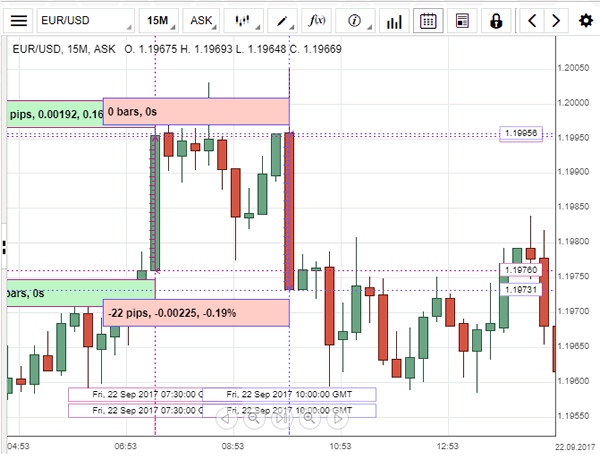
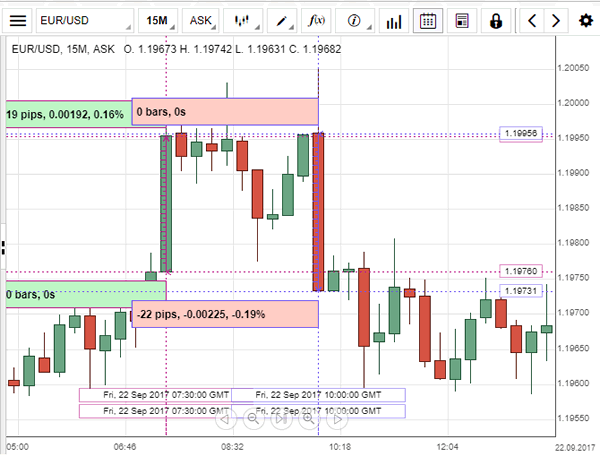
Stronger-than-expected economic reports for the Euro zone put the EUR/USD currency pair in the 1.1995 area for a while. The Euro rose against the Greenback by 19 base points or 0.16%, though an increase was offset by bearish reaction on the FOMC member's speech.
Markit preliminary report showed on Friday that the composite PMI registered the strongest gain in six years, as the index rose to the 56.7 in the month of September, up from 55.7 points seen in August. Then, the Euro held steady, while Mr. Draghi avoided commenting any policy-sensitive issues during his speech. From the US side, the FOMC Member John Williams said that he expected the Fed to raise rates gradually depending on the US economic performance.
USD/CAD: Canadian Consumer Price Index
The Canadian Dollar weakened significantly against the American counterpart, after the country's economic data missed expectations. Following the release, the USD/CAD jumped 53 base points or 0.43% to proceed strengthening to touch the intraday peak of 1.2351.
Statistics Canada revealed that the headline CPI for the country climbed 0.1% over the course of August, below expectations for a 0.2% gain, while the yearly rate increased 1.4% in the same period. Another report showed that Canadian retail sales rose more than anticipated 0.4% in July, as consumers spent more on cars, food and alcohol. Though, some disappointing data in the future could be to the detriment of Canadian dollar and BoC rate hike forecasts.
Political Uncertainty Dominates Currency Moves
Monday September 25: Five things the markets are talking about
Weekend political results dominate Monday’s financial markets.
In Germany Sunday, Angela Merkel won her fourth term as Chancellor, but her Christian Democrats did not do as well as anticipated, while support for the far right AfD party surged. Her CDU party will now have to form a different coalition; most likely with the liberal FDP party and the Greens, after the SPD said it would not form another grand coalition.
Down-under, New Zealand’s general election on Saturday failed to deliver a clear result. Party leaders now have to forge alliances to achieve a ruling coalition, which could result in either another term for the current center-right National Party, or a win for the center-left Labour Party.
Note: On Thursday, Reserve Bank of New Zealand (RBNZ) is expected to leave the official cash rate on hold (+1.75%), to provide continuity given the current election-impasse and with a new RBNZ Governor at the helm.
Elsewhere, among the economic data to be released is August consumer-spending data for Germany and France, while in Japan there is a plethora of data out – consumer prices, household spending and retail sales, unemployment and industrial production – all for August.
Note: PM Abe is expected to dissolve the lower house of parliament at the start of the extraordinary session on Thursday, paving the way for a snap election for the lower house.
Stateside, the market will be focusing on the U.S consumer spending last month, data on Wednesday is expected to post the smallest gain in six-months.
Central bank speakers will also be keeping the market on its toes this week. ECB’s Draghi addresses EU lawmakers in Brussels this morning. Fed Chair Yellen speaks in Cleveland on Tuesday. Bank of Canada (BoC) Governor Poloz appears on Wednesday, while Bank of England (BoE) Governor Carney speaks Thursday, as does soon-to-depart Fed Vice Chair Fischer.
1. Stocks soft start to the week
In Japan, the Nikkei share average rallied overnight (+0.5%) as a weaker yen (¥112.15) again lifted exporters, while expectations of economic stimulus measures after an election next month supported overall sentiment. The broader Topix index also advanced +0.5% at the close.
Down-under, Australia’s S&P/ASX 200 Index ended unchanged, while South Korea’s Kospi index slid -0.4%.
In Hong Kong, the Hang Seng Index fell -1.4%, pressured by Chinese property developers slumping after several cities on the mainland tightened rules on home sales.
In China, a new round of government curbs to rein in the heated housing market hurt stocks. The blue-chip CSI300 index fell -0.5%, while the Shanghai Composite Index lost -0.3%.
In Europe, regional stocks are drifting higher as the session progresses, but political uncertainty following election results is weighing on sentiment. FTSE in focus after Moody’s cut the country’s risk rating late Friday (see below).
U.S stocks are set to open in the red (-0.1%).
Indices: Stoxx50 +0.1% at 3,546, FTSE -0.2% at 7,298, DAX +0.3% at 12,627, CAC-40 flat at 5,281, IBEX-35 -0.6% at 10,245, FTSE MIB +0.1% at 22,544, SMI +0.2% at 9,158, S&P 500 Futures -0.1%
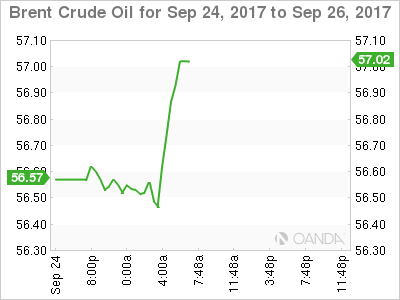
2. Oil steady as market rebalances, gold lower
Oil prices have come under pressure from a stronger dollar, but have managed to retain most of their recent gains, supported by Friday’s OPEC meeting where producers said that they were making progress towards rebalancing.
Brent crude for November delivery is up +1c at +$56.87 a barrel, its highest since March, while U.S light crude (WTI) is down -20c at +$50.46, but not far off its recent four-month highs.
OPEC said Friday that output curbs were helping cut global crude inventories to their five-year average stated target.
Note: Production curbs have faced rising U.S shale oil output, while U.S energy firms have cut the number of oil rigs operating for a third consecutive week as a 14-month drilling recovery stalled.
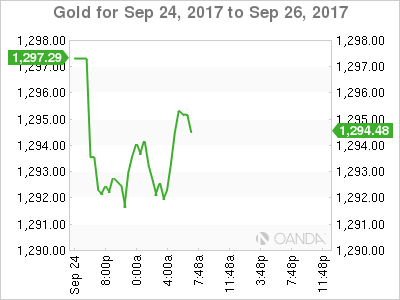
Ahead of the U.S open, gold prices remain under pressure, trading atop of their one-month lows hit last week, as the U.S dollar finds some support and concerns over the Korean peninsula ease a tad. Spot gold is down -0.4% at +$1,291.60 per ounce. Prices of the yellow metal dropped about -1.7% last week.
3. Central bank speak to influence yield direction
U.K 10-year Gilt yields are little changed at around +1.365% following the British sovereign’s downgrade at Moody’s late Friday. The rating company cut the U.K’s rating to Aa2 from Aa1, citing a weaker outlook for public finances and “the erosion of the U.K.’s medium-term economic strength that is likely to result from the manner of its departure from the E.U.”
Note: Gilt yields have been surging from levels of around +1% in recent weeks on anticipation that the BoE will raise its policy rate as early as November.
In the Eurozone, periphery government-bond yield spreads are trading slightly wider following the German election. The 10-year Italian BTP-German bund yield spread trades +3 bps wider at +168 basis points, while the Spanish and Portuguese spreads over bunds are both +2 bps at +108 bps and +199 bps.
Elsewhere, the yield on 10-year Treasuries fell less than -1 bps to +2.25%.
4. Dollar gains some ground
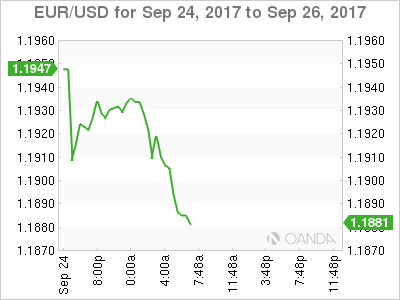
Political results have dominated currency moves in the overnight session. The EUR (€1.1885) is trading down -0.4% after a strong showing by the far-right AfD party, even as Chancellor Merkel looks set to continue in the role. A three-way “Jamaica” coalition of Merkel’s Christian Democrats, the Free Democrats (FDP) and the Green party is expected, but negotiations could take some time.
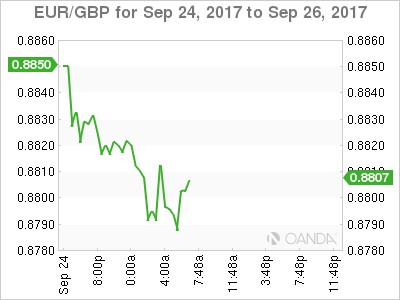
Sterling has opened up a tad stronger, up +0.2% at £1.3535, as investors correct its weakness from Friday. However, expect gains to be capped after Moody’s downgraded the U.K to Aa2 late last week.
Note: PM May’s speech Friday does not seem to be an issue for the pound thus far – the PM really did not say much, but her tone seems to have definitely changed and is a tad more conciliatory.
The New Zealand dollar trades down -0.6% at NZ$0.7273 outright after an inconclusive election in New Zealand.
5. German business sentiment slips in September
Data this morning shows that German business sentiment slipped last month, albeit from a high level, as companies lowered their outlook, according to the Ifo Institute’s monthly survey, which was conducted ahead of yesterday’s German general election.
German Ifo business climate index fell to 115.2 points from 115.9 points in August. The market was expecting an unchanged result.
Lacking a majority in parliament, Ms. Merkel will need to build a governing coalition, and many political observers warn that the process could drag on for weeks.
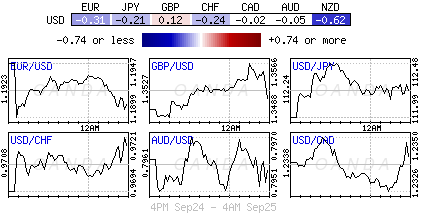
Merkel Wins, But EU Reforms Appear Less Likely
In Germany, Angela Merkel won a fourth term as Chancellor. However, her party (CDU) did worse than most opinion polls suggested. The pro-EU SPD, Germany's second largest party, also gained less seats than anticipated. Critically, the SPD ruled out another 'Grand coalition' with Merkel's CDU immediately after the election. This suggests that Merkel will most likely have to form a coalition that includes the liberal FDP, which is against vital EU reforms such as a euro-budget, or any other form of risk-sharing across EU countries.
In our view, this outcome lowers the likelihood that EU reforms materialize, as any coalition government that includes the FDP will probably have reservations against deeper EU integration. The common currency opened with a modest negative gap, though it quickly recovered most of its losses in the next hours.
Even if the EUR remains under some pressure over the next days, considering the elevated speculation that the ECB is set to unveil a QE-exit plan next month, we doubt that any retracement in EUR pairs will be major or prolonged. The argument for a near-term correction lower in EUR/USD in particular is supported by the prospect of a small recovery in USD, as the Trump administration is expected to reveal an outline of its highly-anticipated tax plan this week.
EUR/USD opened with a negative gap, but the rate hit support near the 1.1890 (S1) level and the medium-term uptrend line taken from the low of the 17th of April, and then it rebounded. As long as the rate continues to trade above that trend line, the medium-term outlook remains somewhat positive. At the time of writing, the pair is testing the 1.1940 (R1) line, where an upside break may open the way for another test near the 1.2025 (R2) hurdle. Having said that, given that we have negative divergence between both our short-term oscillators and the price action, we would stay careful of a possible downside correction. A clear dip below 1.1830 (S2) may be the trigger for something like that and could initially aim for our next support of 1.1775 (S3).
NZD drops as political uncertainty mounts
In New Zealand, the incumbent National Party won the most seats as per the consensus, but fell short of establishing a majority in order to govern alone. At this point, it appears that the Nationals may have to form a coalition with the populist New Zealand First Party, which is anti-immigration and wants to renegotiate free trade deals. Adding to the uncertainty, is the fact that even though the Nationals gained the biggest percentage with 46% against Labor's 36%, a Labor - New Zealand First - Greens coalition could still be the next government if those parties manage to strike an accord.
The Kiwi opened with a negative gap and may remain under selling interest for a while on this uncertain outcome. The next possible market mover for the currency may be the RBNZ gathering during the Asian morning Thursday. Given the lack of major developments since the last meeting, we look for the Bank to remain on hold and keep its language broadly unchanged. Another round of concerns over the exchange rate could add more fuel to the NZD's pullback.
NZD/USD gapped down in the aftermath of New Zealand's election. The pair tumbled after it found resistance at the strong barrier of 0.7340 (R2), it fell below the support (now turned into resistance) of 0.7280 (R1), and hit support near 0.7245 (S1). Taking into account the election outcome and the rejection from above 0.7400 (R3) on Wednesday, we believe that the pair is poised to continue trading south. A decisive dip below 0.7245 (S1) could set the stage for more bearish extensions, perhaps towards our next support of 0.7190 (S2).
Today's highlights:
The economic calendar is relatively light, as we only get Germany's Ifo survey for September. That said, we have a plethora of speakers on the agenda. During the European day, we will hear from ECB President Draghi, Vice President Constancio, as well as Executive Board members Mersh and Coeure.
Market focus may be on any hints as to whether the ECB is headed for a 'dovish tapering'. Over in the US, New York Fed President William Dudley and Chicago Fed President Charles Evans are due to deliver remarks.
As for the rest of the week:
On Tuesday, we have no major events. On Wednesday, we get US durable goods orders for August, while on Thursday, during the Asian morning, the RBNZ will announce its rate decision as we noted above. During the European day, Germany's preliminary CPI data for September are due out. Finally on
Friday, we get Japan's CPIs for August, Eurozone's preliminary CPIs for September, as well as US personal income and spending for August.
EUR/USD
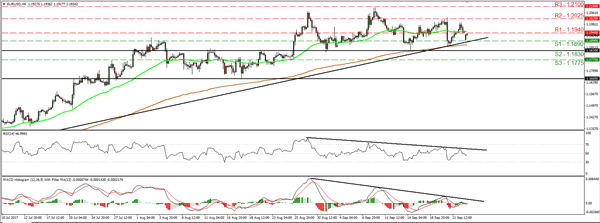
Support: 1.1890 (S1), 1.1830 (S2), 1.1775 (S3)
Resistance: 1.1940 (R1), 1.2025 (R2), 1.2100 (R3)
NZD/USD
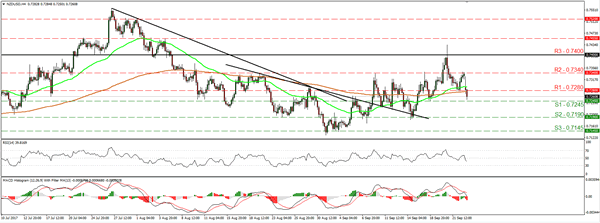
Support: 0.7245 (S1), 0.7190 (S2), 0.7145 (S3)
Resistance: 0.7280 (R1), 0.7340 (R2), 0.7400 (R3)
CRUDE OIL Buying Demand
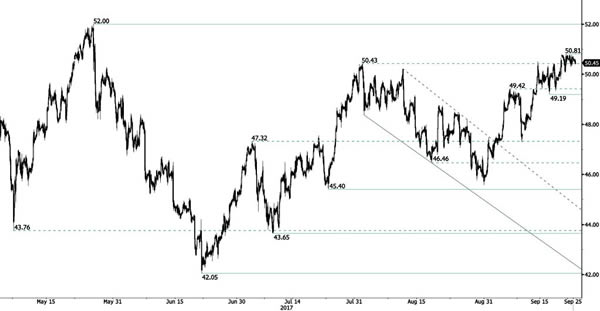
Crude oil is edging higher above the $50 level. Key support is given at 45.40 (17/08/2017 high). Strong resistance found at 50.43 (31/07/2017) has been broken. Expected to show another leg higher.
In the long-term, crude oil has recovered after its sharp decline last year. However, we consider that further weakness are very likely. Strong support lies at 35.24 (05/04/2016) while resistance can now be found at 55.24 (03/01/2017 high).
SILVER Continued Decline
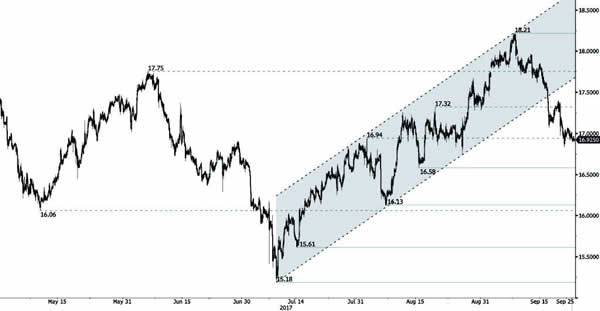
Silver has reversed and has broken uptrend channel by breaking support implied by its lower bound. Strong resistance is given at 18.65 (17/04/2017 high) while support can be found at 16.58 (15/08/2017 high). Expected to show further bearish move.
In the long-term, the trend is rater negative. Further downsides are very likely. Resistance is located at 25.11 (28/08/2013 high). Strong support can be found at 11.75 (20/04/2009).
GOLD Downside Momentum Accelerates
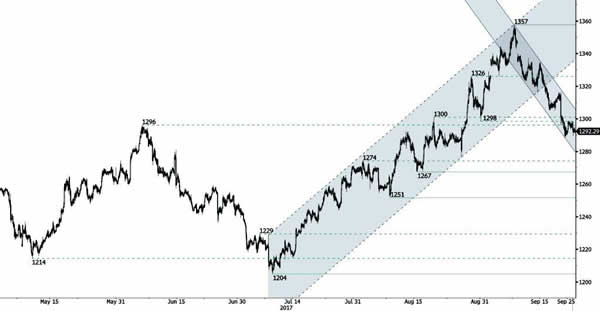
Gold is consolidating below 1300. Hourly support is now given at 1288 (21/08/2017 low). Hourly resistance is located at 1357 (08/09/2016). Stronger support lies at 1204 (10/07/2017 high). Expected to show further bearish move.
In the long-term, the technical structure suggests that there is a growing upside momentum. A break of 1392 (17/03/2014) is necessary ton confirm it, A major support can be found at 1045 (05/02/2010 low)
BITCOIN Downside Pressures Are Still There
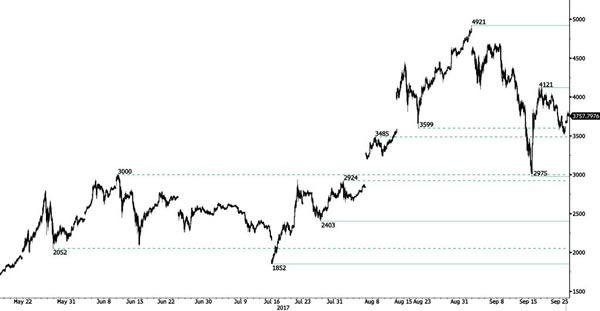
Bitcoin has taken a dive after strong interest over the summer. The digital currency has set up a new support at 2975 (22/08/2017 low). Hourly resistance is given at 4121 (18/09/2017 low). Key resistance can be located at 4921 (01/09/2017 high). The road is wide open for further shortterm decline.
In the long-term, the digital currency has had an exponential growth. There are decent likelihood that the asset will reach $10'000.
EUR/CHF Strong Bullish Pressures
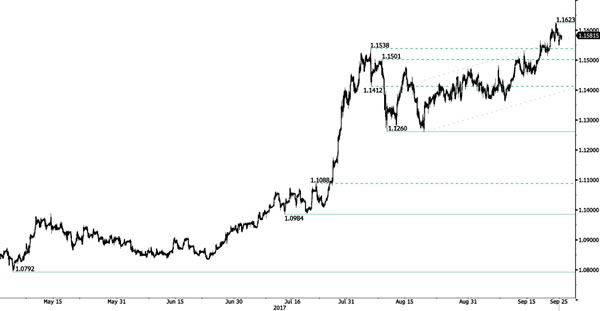
EUR/CHF's buying pressures are going up and the pair has broken resistance area between 1.1356 and 1.1472. The pair has also broken resistance at 1.1538 (04/08/2017 high). Expected to show continued bullish pressures.
In the longer term, the technical structure has reversed. Strong resistance is given at 1.20 (level before the unpeg). Yet, the ECB's QE programme is likely to cause persistent selling pressures on the euro, which should weigh on EUR/CHF. Supports can be found at 1.0184 (28/01/2015 low) and 1.0082 (27/01/2015 low).