Sample Category Title
USD/JPY Monitoring Resistance Area
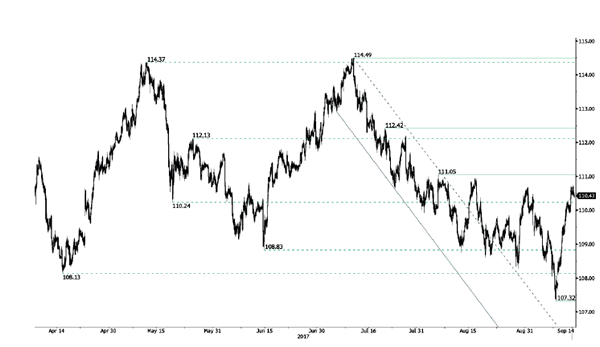
USD/JPY is now monitoring resistance area around 111. Strong support is located at 107.32 (08/09/2017 high). Expected to show further downside pressures if the pair fails to break resistance at 111.05 (04/08/2017 high).
We favor a long-term bearish bias. Support is now given at 99.02 (10/08/2013 low). A gradual rise towards the major resistance at 125.86 (05/06/2015 high) seems unlikely. Expected to decline further support at 93.79 (13/06/2013 low).
GBP/USD Short-Term Consolidation
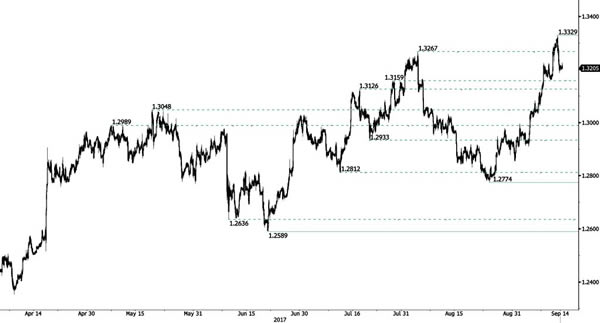
GBP/USD is consolidating lower. The pair has set up new hourly resistance at 1.3329 (13/09/2017 high). Strong support is given at 1.2774 (24/08/2017 low). Expected to show continued short-term bullish pressures.
The long-term technical pattern is even more negative since the Brexit vote has paved the way for further decline. Long-term support can be found at 1.1841 (07/10/2017 low). Long-term resistance is given around 1.35 and would indicate a long-term reversal in the negative trend. Yet, it is very unlikely at the moment.
EUR/USD Short-Term Weakness
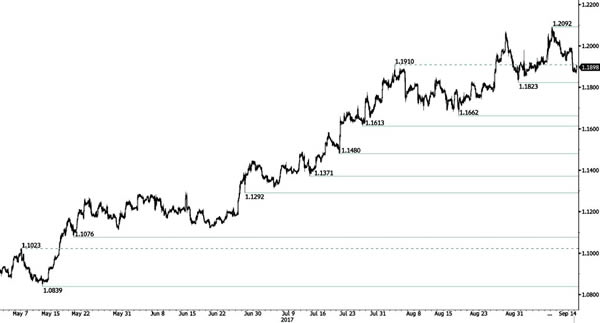
EUR/USD lies in a bullish trend despite consolidation. Hourly resistance can be found at 1.2092 (08/09/2017 high) while hourly support lies at 1.1823 (31/08/2017 low). Stronger support is given at a distance at 1.1662 (17/08/2017 low). Expected to show renewed bullish pressures.
In the longer term, the momentum is now turning largely positive. We favour a continued bullish bias. Key resistance is holding at 1.2252 (25/12/2014 high) while strong support lies at 1.0341 (03/01/2017 low).
EUR/USD – Euro Steady, U.S. CPI Next
The euro has steadied on Thursday, after sustaining losses in the Wednesday session. Currently, the pair is trading at 1.1901, up 0.13% on the day. On the release front, the sole eurozone indicator was French Final CPI, which posted a gain of 0.5%, matching the forecast. Later in the day, Deutsche Bundesbank President Jens Weidmann will speak about monetary policy. The US will release CPI and Core CPI, which are expected to edge up to 0.3% and 0.2%, respectively. As well, unemployment claims are expected to rise to 303 thousand. On Friday, the US publishes retail sales and consumer confidence reports.
The German economy, the largest in Europe, has been the locomotive for improved growth in the eurozone in 2017. Still, Germany has not been immune to stubbornly low inflation, which has also been a chronic problem in major economies such as the US and Japan. On Wednesday, German inflation indicators were mixed. Final CPI, the primary gauge of consumer inflation, slowed to 0.1% in September, down from 0.4% in the August release. There was better news from WPI, which rebounded to 0.3%. This beat the forecast and marked the first gain in four months. On the employment front, there was positive news as Eurozone Employment Change posted a second straight gain of 0.4%. This reflects stronger employment numbers in the eurozone, as stronger economic conditions have improved the labor market and pushed unemployment rates lower.
The German economy continues to impress. Unemployment levels remain low, growth is steady, and the country even has a budget surplus. However, analysts are divided on the extent of the momentum. The German Economy Ministry is predicting that the economy could slow in the second half of 2017, and is holding to its forecast of 1.5% growth this year. The BDI Group is projecting an expansion of just above 2.0%, while the International Monetary Fund has pegged growth at 1.8% for 2017. Strong German growth in the second half would be good news for the streaking euro.
Super Thursday Is Here While BOE Under Pressure | Gold Open Interest Increases
Sterling is facing a hard cold reality
The Bank of England will have no other option but to let the inflation run higher
Don't be fooled by the current sell-off in the gold price
European markets are extending their sell-off from yesterday and picking up the momentum where Asia left off. The Chinese industrial production number was poor and it triggered alarms about the health of the second biggest economy in the world. The fixed asset investment and retail sales data both failed to provide any support. Nonetheless, today is all about the Super Thursday and the BOE will deliver its decision on their monetary policy. US Futures are also trading lower despite some optimism around the US tax overhaul.
After a strong move, the Sterling is facing a hard cold reality. The surge in inflation which the UK’s economy is experiencing is not something that can make the Bank of England change its stance towards their monetary policy. The wage growth is embarrassing and increasing the interest rate under this environment (where consumers are largely feeling the pinch due to the higher prices) is not going to resolve the issue.
The Bank will have no other option but to let the inflation run higher than its current target and this is pretty much what we are expecting from the MPC minutes on Thursday. The monetary policy committee needs to overcome its divided view on the inflation which is only creating noise. It is Mark Carney’s (the governor of the Bank of England) job to send a clear message to the market which could ease off such anxieties.
The US PPI data released on Wednesday was soft, however traders took the number with a pinch of salt as the odds for another rate hike for this year are still at 40 percent. This is thanks to Paul Ryan’s (the speaker of the House of Representatives) comment who thinks that the tax overhaul plan could be released by the end of September.
This has given hopes to the dollar bulls as this tax overhaul could provide some of the tailwind for the US economy which many have been expected since the Trump’s inauguration. It appears that Washington is working more towards getting things done now rather than letting them high and dry.
Later today, we also have the US Core CPI and CPI m/m numbers due and the forecasts are at 0.2% and 0.3% respectively.
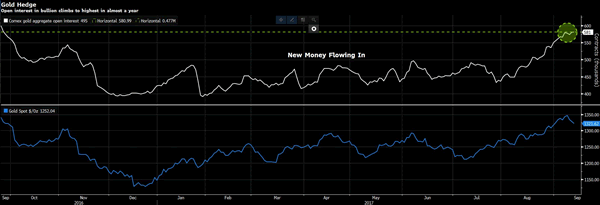
The precious metal is suffering from profit taking and the retracement continues. The fading geopolitical tensions are also weighing on the price and investors are using a calmer approach towards the risk on trade. Don't be fooled by the current sell-off in the gold price, the open interest (the higher number confirms a new fund flow) shows that the price would bounce. We maintain a year end target at 1400.
Technical Outlook: EURUSD Remains Bearishly Aligned After Yesterday’s Fall, US CPI Data In Focus For Fresh Signals
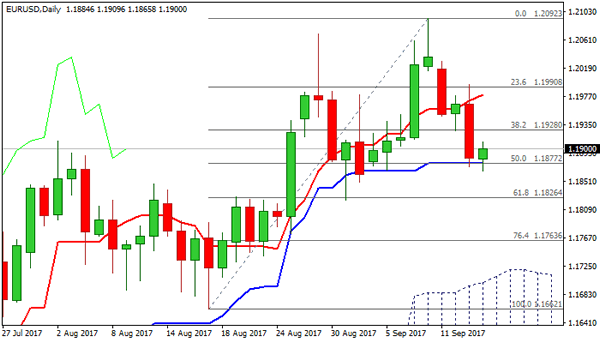
The Euro bounces above 1.1900 handle on Thursday, consolidating after strong fall on Wednesday.
Bearish acceleration was contained by daily Kijun-sen (1.1877) which now acts as initial support.
Bulls on daily chart studies are losing traction and showing increasing risk for further extension of pullback. Sustained break below Kijun-sen pivot would open support at 1.1826 (Fibo 61.8% of 1.1662/1.2092 rally) with stronger bearish acceleration seen on violation.
Initial resistance at 1.1920 remains intact for now, with stronger recovery attempts to open 10SMA at 1.1934 and pivotal daily Tenkan-sen at 1.1979.
US inflation data are expected to be the key driver today.
Res: 1.1920, 1.1934, 1.1979, 1.2000
Sup: 1.1877, 1.1826, 1.1800, 1.1763
Elliott Wave Analysis: GBPJPY And GBPUSD
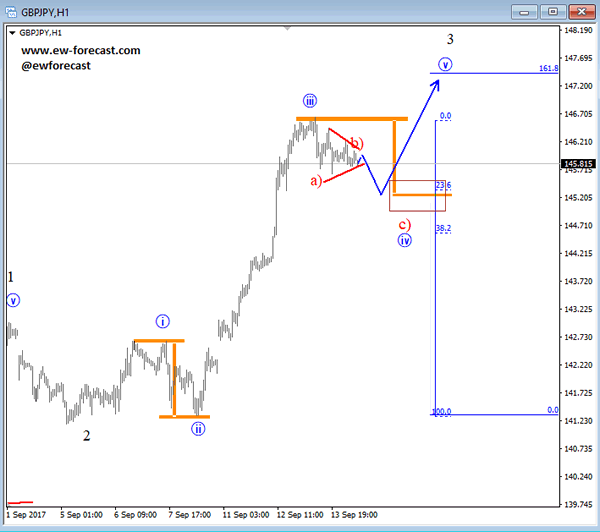
GBPJPY is trading nicely bullish, however now in a corrective retracement of wave four. Ideally wave four will unfold only a three-wave move, before new gains may again show up. The support for the corrective wave four can be around the Fibonacci ratio of 23.6 and 38.2.
GBPJPY, 1H
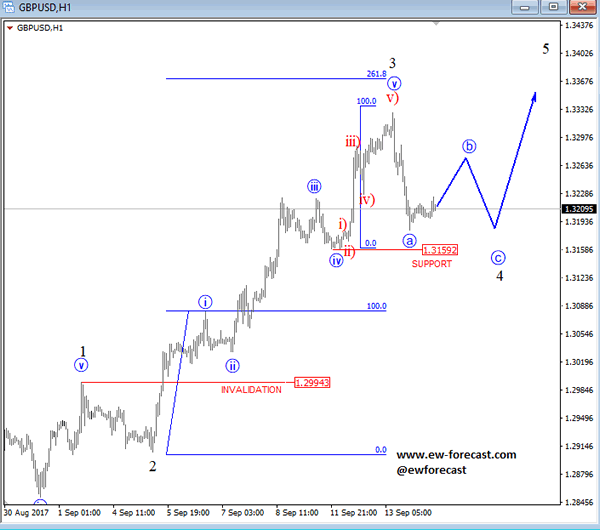
GBPUSD made a new drop overnight, away from the 1.3350 region where bigger degree wave 3 had ended. This drop now represent sub-wave a as part of a three-wave retrecement within wave 4. Ideally once the remaining two sub-waves show up, a new rally higher into bigger wave 5 will come in play. The region of support for the corrective wave 4 is near the former wave four at the 1.316 level.
GBPUSD, 1H
NZDUSD Consolidates After Recent Bounce Above 0.72 But Downside Risk Remains
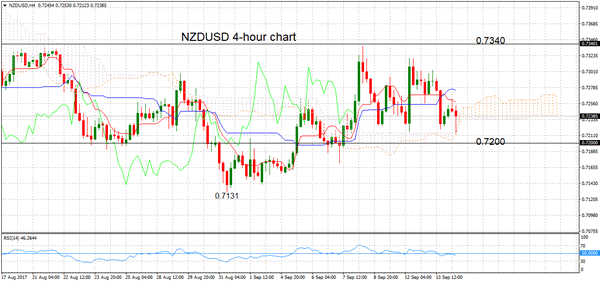
NZDUSD is consolidating between 0.7200 and 0.7340. The bounce from the August 31 low of 0.7131 lost steam and failed to rise above what has been a key resistance level at 0.7340. The intra-day risk is to the downside as the Tenkan-sen line has crossed below the Kijun-sen line on the 4-hour chart. RSI is in bearish territory after dipping below 50 but downside momentum has weakened as the oscillator is now flat. The Ichimoku-cloud analysis on the 4-hour chart shows the market is still above the cloud which is expected to provide support in the near term. Price action is essential sideways since the beginning of this week above the key 0.7200 level. Breaking below this support would increase downside pressure to open the way to the August 31 low of 0.7131. Such a move would place a short-term top at the September 8 high of 0.7337 and strengthen the longer-term downtrend that started from the 0.7557 July peak. NZDUSD would need to regain the 0.73-handle to ease downside pressure. Breaching 0.7337 resistance (September 8 high) would shift focus to the upside to target 0.7390. From here the odds increase for a move to re-test the 0.7557 peak. The market maintains its underlying trend to the downside on the longer run timeframe. For now, the bounce from 0.7131 could be seen as a corrective move unless there is a sustained rise above 0.7340.
Firmly On Hold, But A Slightly More Hawkish Tone?
Today, the main event will be the Bank of England policy decision. As always, besides the rate decision, we will also get the minutes of the meeting. The consensus is for the Bank to keep its policy unchanged via a 7-2 vote. At its latest gathering, the Bank signaled little urgency for a rate hike in the next months, while it revised lower its inflation and economic growth forecasts. We think that the focus of this meeting will be initially on the vote count and subsequently, on what signals policymakers send regarding the likelihood of a near-term hike.
A few months ago, Governor Carney noted that a hike may depend mainly on firming wages and improving business investment. Given that business investment for Q2 was stagnant and that wages failed to accelerate in July, we doubt that an actual rate hike is looming. However, we have to note that the latest CPI data showed both the headline and the core inflation rates surging by more than anticipated in August, pushing the implied probability for a hike this year to 48%, according to the UK OIS. As such, even though we don’t expect an actual hike, we would not rule out the possibility of a slightly more hawkish narrative by the BoE, or even a 3rd policymaker voting for a hike. Bearing these in mind, we view the risks surrounding GBP today as being tilted to the upside. Any optimistic signals regarding a hike in coming months could add further fuel to the pound’s recent rally.
EUR/GBP traded in a consolidative manner yesterday, staying between the support of 0.8985 (S1) and the resistance of 0.9035 (R1). Having said that, given that the rate continues to trade below the short-term downtrend line taken from the peak of the 29th or August, we consider the short-term outlook to be negative. If indeed the BoE sounds more hawkish than previously today, or if we see another member joining those voting for a hike, the pair could break below 0.8985 (S1) and perhaps aim for our next support of 0.8920 (S2). On the other hand, softer language could be the trigger for a rebound. Nevertheless, as long as such a rebound remains limited below the aforementioned downtrend line, we would treat it as a corrective move and as a renewed opportunity for the bears to take charge at better levels.
USD continues to recover on the prospect of bipartisan tax reform
Yesterday, US President Trump met with leaders of the Democratic Party to discuss tax reform. Later, both sides stated that the talks were “constructive”. Meanwhile, House Speaker Paul Ryan said that the outline of a tax plan would be unveiled as soon as the 25th of September. Both the dollar and US stock indices jumped on the news, possibly because investors interpreted these developments as raising the odds of tax changes actually materializing sooner rather than later.
Today, we get the nation’s CPI data for August. The forecast is for the headline rate to have ticked up and for the core rate to have ticked down. We view the risks surrounding the core forecast as likely being tilted to the upside, given that the Markit services PMI for the month showed output charges rising at a 35-month high. If our view is correct, this could ease somewhat the concerns of FOMC policymakers regarding subdued inflation, and perhaps revive market expectations for another rate hike this year. At the time of writing, the probability for another hike by year-end is 45% according to the Fed funds futures.
A potential positive surprise in inflation could lift that percentage notably and thereby, help the dollar to recover even further.
EUR/USD tumbled on Wednesday, following the encouraging tax talks. The pair fell after it hit resistance at 1.2000 (R2) to break below the 1.1930 (R1) barrier. At the time of writing, the pair is testing the 1.1870 (S1) line, where a dip could bring into play the crossroads of the 1.1830 (S2) key support and the medium-term uptrend line taken from the low of the 17th of April. However, as long as the pair continues to trade above that critical territory, we believe that there is still the likelihood for a rebound. We would like to see a clear close below the aforementioned crossroads before we turn our gaze to the downside. This could happen if we see a positive surprise in US inflation today.
As for the rest of today’s highlights:
In Switzerland, the SNB will announce its rate decision as well and the forecast is for this Bank to take no action too. Policymakers could repeat the usual mantra – that the franc remains significantly overvalued and that the Bank will remain active in the FX market as necessary. Thus, if any reaction in CHF today, it may be lower.
We have just one speaker on the agenda: ECB Governing Council member Jens Weidman.
EUR/GBP
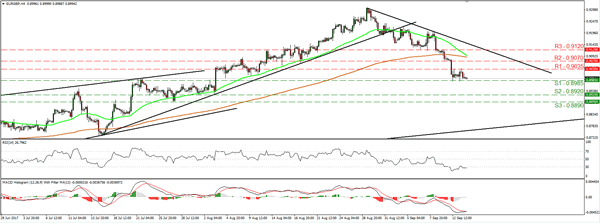
Support: 0.8985 (S1), 0.8920 (S2), 0.8890 (S3)
Resistance: 0.9035 (R1), 0.9070 (R2), 0.9120 (R3)
EUR/USD
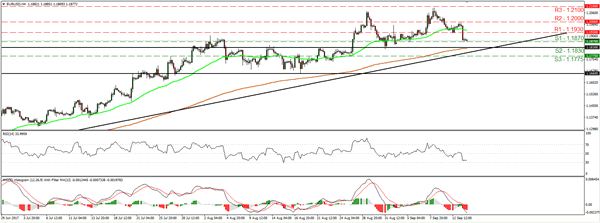
Support: 1.1870 (S1), 1.1830 (S2), 1.1775 (S3)
Resistance: 1.1930 (R1), 1.2000 (R2), 1.2100 (R3)
Daily Technical Analysis: EURUSD, GBPUSD, USDJPY, USDCHF
EURUSD
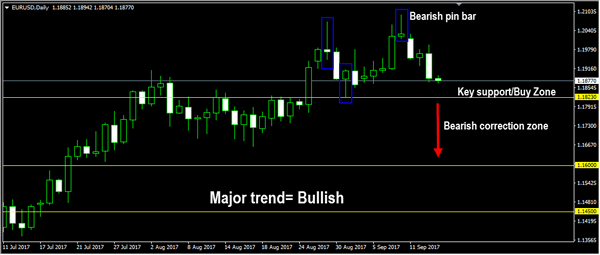
The EURUSD had a bearish momentum yesterday bottomed at 1.1873 as a part of the bearish correction phase after printed a bearish pin bar on Friday as you can see on my daily chart below. The bias is bearish in nearest term testing 1.1823 key support which is a good place to buy. Immediate resistance is seen around 1.1925. A clear break above that area could lead price to neutral zone in nearest term testing 1.2000 region. Overall I remain bullish but a clear break and daily close below 1.1823 key support could trigger further bearish correction scenario testing 1.1700 – 1.1600 support area. On the upside, we need a clear break at least above 1.2000 to continue the bullish scenario targeting 1.2175 region.
GBPUSD
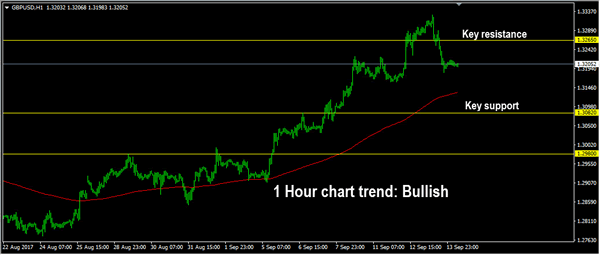
The GBPUSD failed to continue its bullish momentum yesterday bottomed at 1.3184. Price is still moving above the EMA 200 as you can see on my H1 chart below suggests a valid bullish trend, but we may have a false breakout (above 1.3265) bearish scenario here, at least in short-term time frame. The bias is bearish in nearest term testing 1.3160 – 1.3082 support area. Immediate resistance is seen around 1.3265. A clear break and daily close above that area would keep the H1 chart bullish bias remain strong testing 1.3350 – 1.3400 area before targeting 1.3500 region
USDJPY
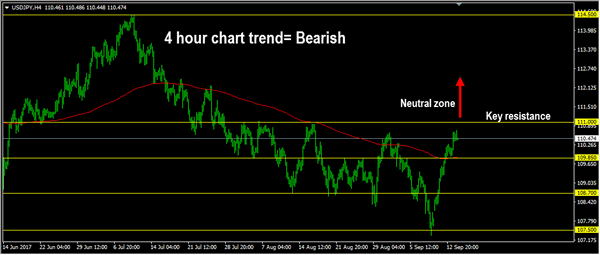
The USDJPY continued its bullish momentum yesterday topped at 110.68 and hit 110.73 earlier today in Asian session. The bias remains bullish in nearest term testing 111.00 key resistance. Immediate support is seen around 109.85. A clear break below that area could lead price to neutral zone in nearest term testing 109.25 or lower. The 4H chart technical bias remains bearish but a clear break and daily close above 111.000 key resistance would change the 4H chart bias to a neutral condition. Overall I remain neutral.
USDCHF
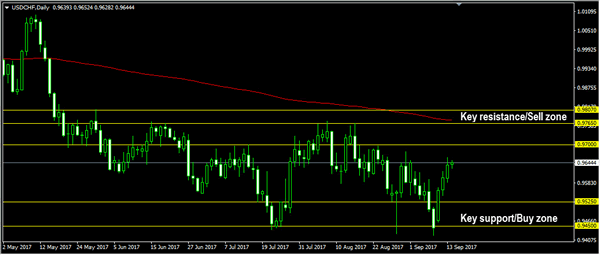
The USDCHF continued its bullish momentum yesterday topped at 0.9660. The bias remains bullish in nearest term testing 0.9700 area. Immediate support is seen around 0.9585 area. A clear break below that area could lead price to neutral zone in nearest term testing 0.9525 region but key support remains at 0.9450 area. On the upside, a clear break and daily close above 0.9700 would expose 0.9765 – 0.9807 key resistance which is a good place to sell with a tight stop loss.