Sample Category Title
GBP/USD: Manufacturing Production
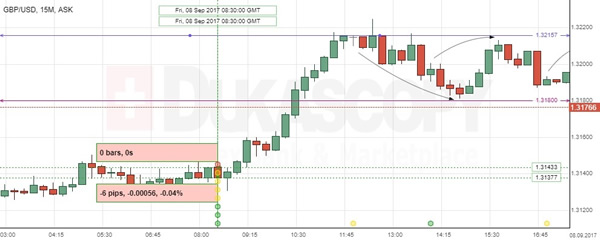
The GBP/USD currency pair showed modest reaction on the UK economic releases on Friday, as the reports revealed mixed results for July. However, a small impact from British macroeconomic data as well as the weakening US Dollar were not interfering the Sterling to extend gains by the mid-Friday session, where after post-data drop of 0.04% the British Pound rose to the highest level in five weeks to start trading in the 1.318-1.321 area.
The Office for National Statistics stated that the UK manufacturing output increased 0.5% over the month of July, showing the strongest gain this year. Coming along with weaker construction output, data suggested the UK economy to expand at a modest pace in the Q3.
EUR/JPY Daily Outlook
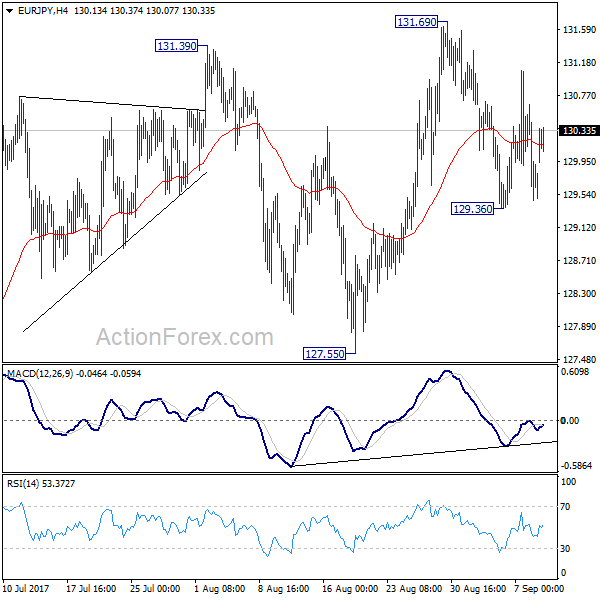
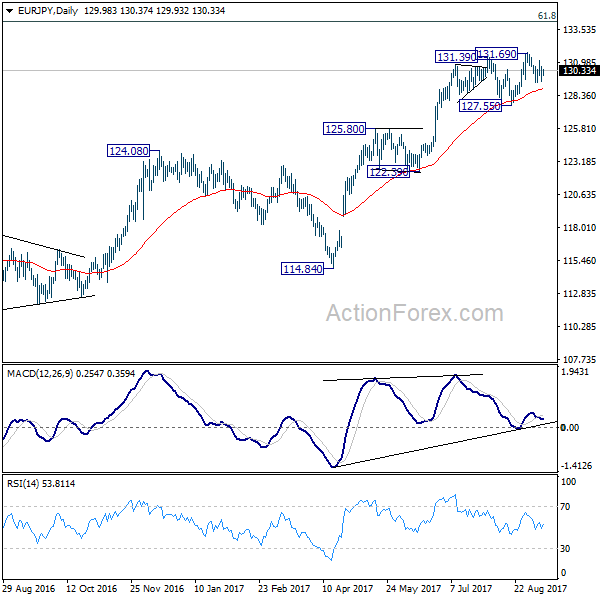
Daily Pivots: (S1) 129.26; (P) 129.96; (R1) 130.45; More...
Intraday bias in EUR/JPY remains neutral for the moment. On the downside, break of 129.36 will turn bias to the downside for 127.55 support first. Firm break there will indicate near term reversal and deeper fall would be seen back to 122.39/125.80 support zone. In any case, we'd expect more corrective trading with risk of another fall, as long as 131.69 holds.
In the bigger picture, current rise from 109.03 is seen as at the same degree as the down trend from 149.76 (2014 high) to 109.03 (2016 low). as long as 124.08 resistance turned support holds, further rise is expected to 61.8% retracement of 149.76 to 109.03 at 134.20. Sustained break there will pave the way to key long term resistance zone at 141.04/149.76. However, firm break of 124.08 will argue that rise from 109.03 is completed and turn outlook bearish.
U.S. Dollar – Further Sell-Off, Or Set For A Rebound?
The dollar's weakness and a surge in safe havens were the central themes in the markets last week. The dollar index fell 1.4% in the past five trading days, taking the overall losses to 10.8% for the year so far. With market expectations of a U.S. rate hike in December falling below 40%, according to CME's FedWatch, it appears that investors believe the tightening course for 2017 is over. Even Bond markets are showing more pessimism, with U.S. 10-year treasury yields dropping to 2.02% on Friday; the lowest since Trump's election.
Despite the extension of the debt ceiling for three months and Fed officials being optimistic about the economy, the greenback still failed to rally. The resignation of the Fed Vice Chair, Stanley Fischer, is likely to be playing a significant role in keeping the dollar under pressure. His departure leaves four of the seven Board of Governors' seats vacant, meaning that Trump can reshape the Fed's policy, if he decided to bring more doves into the central bank. It's probably still too early to start speculating, and we will have to wait a little longer for clarity, when Trump nominates new governors. However, Fischer's resignation will remain a negative factor for the dollar in the weeks and months to come.
Hurricanes Harvey and Irma are now expected to cost the U.S. economy up to $290 billion, according to the latest estimates from AccuWeather. While natural disasters have an immediate negative impact on the economy and will be reflected in Q3 and Q4 GDP figures, the long run will see an uplift in growth due to spending on infrastructure and rebuilding; however, it's difficult to assess the exact short and longterm impact on U.S. growth.
North Korea's decision to hold a celebration instead of launching another nuclear bomb, helped risk assets and the dollar to recover slightly early Monday, with safe havens such as the gold, yen, and the Swiss franc feeling most of the pressure. Comments from North Korea's foreign ministry earlier today, stating that "the forthcoming measures to be taken by the DPRK, will cause the U.S. the greatest pain and suffering it had ever gone through in its entire history," were not taken seriously. However, tensions will likely escalate further, if the U.S. is successful in imposing new sanctions. That's why the gains in the U.S. dollar and fall in safe havens are likely to be limited.
On the U.S. data front, consumer prices and retail sales are of great importance, with the FOMC meeting to follow next week (20 September). Despite interest rates remaining unchanged, and the only new announcement likely to be the beginning of the balance sheet reduction, the CPI figures will shape the expectations for December's meeting. Rising gasoline prices will likely push headline inflation higher, from 1.7% to 1.8% YoY. However, core inflation should be given special attention, as any upside surprise will lift December's rate hike expectations above 50%, thus, providing the dollar short-term relief.
Trade Idea : GBP/USD – Buy at 1.3125
GBP/USD - 1.3188
Most recent candlesticks pattern : N/A
Trend : Near term up
Tenkan-Sen level : 1.3183
Kijun-Sen level : 1.3177
Ichimoku cloud top : 1.3107
Ichimoku cloud bottom : 1.3085
Original strategy :
Buy at 1.3125, Target: 1.3225, Stop: 1.3090
Position : -
Target : -
Stop : -
New strategy :
Buy at 1.3125, Target: 1.3225, Stop: 1.3090
Position : -
Target : -
Stop : -
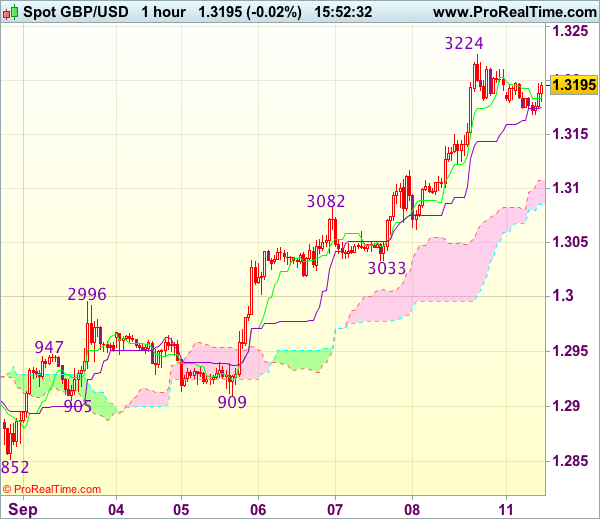
Last week’s rally to 1.3224 adds credence to our bullish view that recent upmove from 1.2774 is still in progress and upside bias remains for further gain to 1.3225-30, then towards 1.3250, however, loss of near term upward momentum should prevent sharp move beyond latter level and price should falter below recent high at 1.3269, bring retreat later.
In view of this, would not chase this rise at current level and would be prudent to buy cable on subsequent pullback as 1.3120-25 should limit downside. Only below 1.3082 (previous resistance turned support) would abort ad suggest top is possibly formed, risk test of 1.3062 but reckon support at 1.3033 would hold.
EURO Tests 1.2000 Support
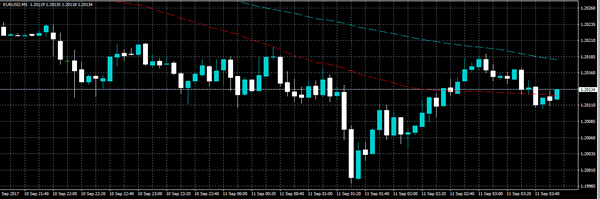
The euro has pulled back towards the key 1.2000 level against the U.S dollar, as the greenback opens the week on stronger footing. Price-action has so far moved to test the calculated weekly pivot point, located at the 1.1999 level.
Technical selling is also taking place in EURUSD, after the pair failed to close the week above the former yearly price high, found at the 1.2069 level.
A higher-time frame price close above the 1.2040 level should see a further attempt towards the 1.2092 level, whilst a higher time frame price close below the 1.1845 level should encourage selling towards 1.1665.
Key intraday support for the EURUSD pair is located at the weekly pivot point at 1.1999, the 100-hour moving average, at 1.1958, and the Thursday price low, located at 1.1914.
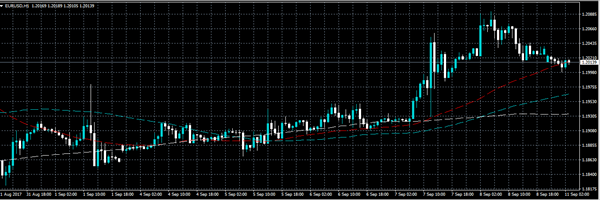
To the upside, key intraday resistance is located at 1.2030, 1.2040, and the former 2017 price high, at 1.2069. Above the 1.2092 level, euro buying should accelerate towards 1.2130 and 1.2160.
EUR/GBP Daily Outlook
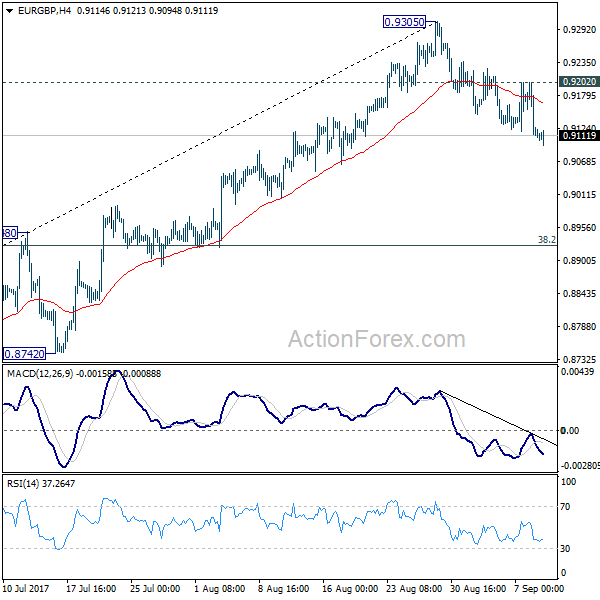
Daily Pivots: (S1) 0.9084; (P) 0.9143; (R1) 0.9177; More
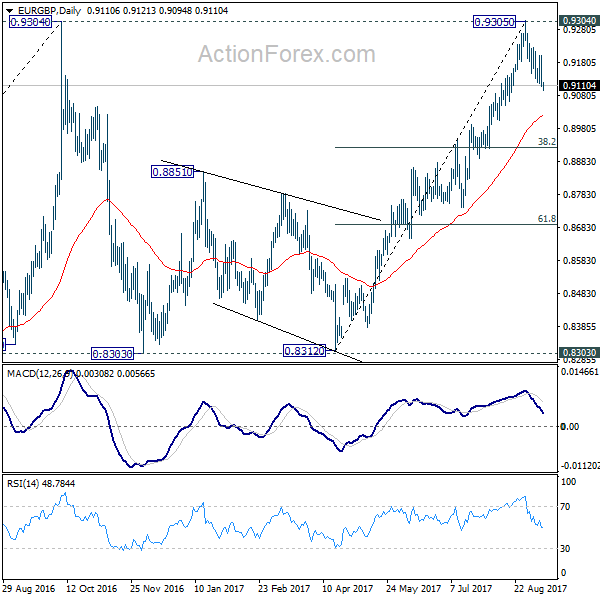
Intraday bias in EUR/GBP remains on the downside for the moment. Fall from 0.9305 should target 55 day EMA (now at 0.9021). Sustained trading below there will likely start the third leg of the consolidation from 0.9304 and target 38.2% retracement of 0.8312 to 0.9305 at 0.8926 first. On the upside, above 0.9202 minor resistance will turn bias back to the upside for 0.9305 resistance instead.
In the bigger picture, price actions from 0.9304 are viewed as a medium term corrective pattern. It's uncertain whether it is finished yet. But in case of another fall, we'd expect strong support from 0.8116 cluster support (50% retracement of 0.6935 to 0.9304 at 0.8120) to contain downside and bring rebound. Whole up trend from 0.6935 is expected to resume after consolidation from 0.9304 completes. Firm break of 0.9799 high will target 61.8% projection of 0.5680 to 0.9799 from 0.6935 at 1.1054.
USDJPY Tests Key Resistance
The USDJPY pair is gaining strength as the new trading week begins, with price-action moving towards key resistance, at 108.56, marking a one-hundred and twenty-five pips rebound from the fourteen-month trading low, set last week, at 107.31.
So far, the yen currency has overlooked stronger than expected domestic economic data out earlier today, which showed an eight-percent monthly increase in Japanese machine orders.
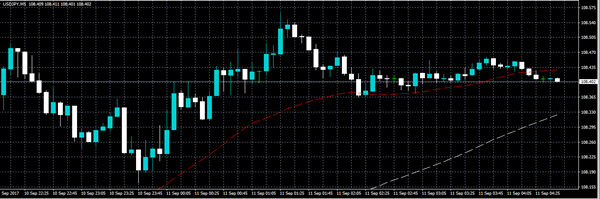
The USDJPY pair remains strongly bearish in the medium and long-term whilst trading below the 111.50 level. In the short-term, the pair remains intraday bullish whilst trading above the 108.37 level.
Key intraday technical support is located at the weekly USDJPY pivot point, at 108.37, the former yearly price low, at 108.13, and the daily pivot point, at 107.80.
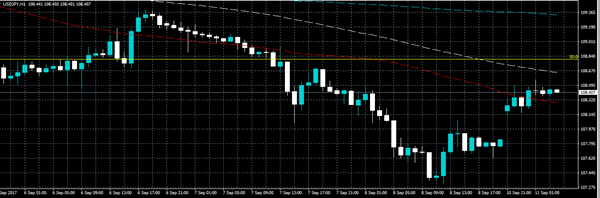
Key USDJPY technical resistance is located at the 100-hour moving average, at 108.60, with further long-term Fibonacci resistance at 108.80.
Above the 108.80 level, buyers may look to target the 109.05 level, and 200-hour moving average, at 109.32.
Trade Idea : EUR/USD – Buy at 1.1985
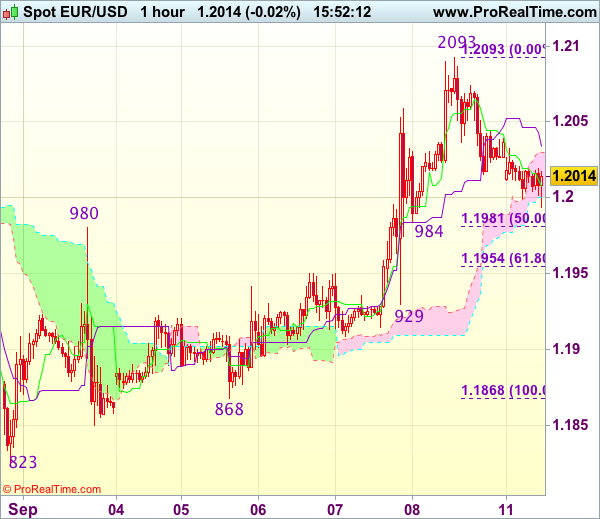
EUR/USD - 1.2014
Most recent candlesticks pattern : N/A
Trend : Up
Tenkan-Sen level : 1.2007
Kijun-Sen level : 1.2034
Ichimoku cloud top : 1.2030
Ichimoku cloud bottom : 1.2000
Original strategy :
Buy at 1.1985, Target: 1.2090, Stop: 1.1950
Position : -
Target : -
Stop : -
New strategy :
Buy at 1.1985, Target: 1.2090, Stop: 1.1950
Position : -
Target : -
Stop : -
Euro’s retreat after rising to 1.2093 late last week suggests consolidation below this level would be seen and pullback to 1.1981-84 (50% Fibonacci retracement of 1.1868-1.2093 and previous minor support) is likely, however, reckon downside would be limited and bring another rise later, above 1.2070-75 would bring retest of said resistance at 1.2093 but break there is needed to extend recent upmove to 1.2130-40, having said that, loss of upward momentum should limit upside to 1.2150-55 (61.8% projection of 1.1119-1.1910 measuring from 1.1662), bring correction later.
In view of this, would be prudent to buy euro on further subsequent pullback as support at 1.1980-84 should limit downside and bring another upmove later. Below 1.1950 (previous resistance turned support) would signal a temporary top is formed instead bring weakness to 1.1925-30 first.
Investors Track Hurricane Irma Amid Quiet Release Schedule
Deadly Hurricane Irma ripped through Florida on Sunday, causing widespread damage to the state. The storm ravaged the Caribbean region last week before making its way north toward the Florida Keys.
The storm, which has been downgraded to a Category 2 hurricane, is expected to cause more than $135 billion in damages. Some estimates show the total damages could reach $200 billion. Irma is expected to make its way through Florida in the coming days en route to Georgia.
US stock futures were surprisingly buoyant amid the storm, with the Dow Jones mini gaining more than 100 points in Asian trading. The US benchmarks finished mixed-to-lower on Friday.
Demand for riskier assets triggered a sharp slide in precious metals on Monday, with gold prices falling 0.7%. Silver was also down more than 1% on the Comex division of the New York Mercantile Exchange.
Gold has been one of the best performers in recent weeks, as geopolitical unrest and a plunging dollar boosted demand for bullion.
The US dollar index (DXY) was up 0.2% at the beginning of the week after crashing to more than two-and-a-half year lows. The DXY basket has shed 10.5% since the start of 2017.
The economic calendar has a light release schedule on Monday. The Japanese government begins the day with its Tertiary Index, which provides a snapshot of the country’s vast services sector. Separately, the Japan Machine Tool Builders’ Association will report on machine orders for the month of August.
In Europe, Portugal will release its latest batch of inflation data at 10:00 GMT. The consumer price index (CPI) fell 0.7% month-on-month in July.
Shifting gears to North America, the Canadian government will report on August housing starts at 12:15 GMT. Currency traders will likely brush off the report.
EUR/USD
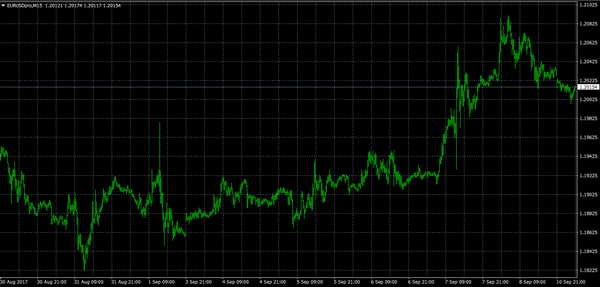
Europe’s common currency was a chief benefactor of the dollar’s multi-week slump. The EUR/USD pair has come off its recent highs, but continues to trade above 1.2000. The market remains strongly bullish, with long positions aiming for 1.2100.
USD/CAD
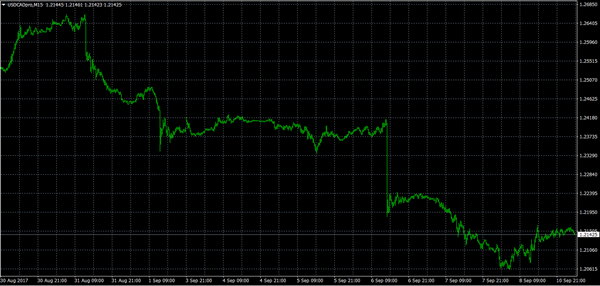
The USD/CAD retook the 1.2100 handle on Friday after a precipitous decline earlier in the week that was stoked by a surprise rate hike by the Bank of Canada. The pair is holding on to immediate support at 1.2130. While a short-covering rally is expected to continue, the pair could face strong resistance at 1.2200.
GOLD
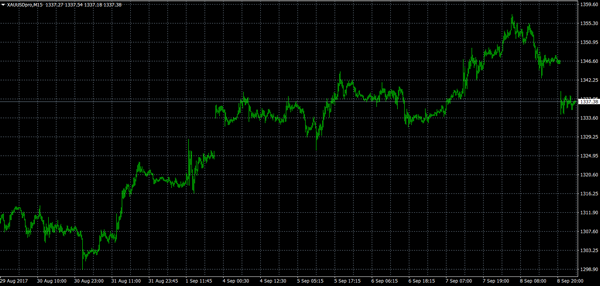
Bullion has been on a tear in recent weeks, with prices reaching 12-month highs on the heels of a plunging US dollar. Spot gold prices were last seen trading around $1,337.00 a troy ounce. The precious metal faces immediate resistance at $1,350.00, a level that it failed to penetrate last week. The general trend shows strong support for bullion. However, the path higher is expected to be choppy.
EUR/AUD Daily Outlook
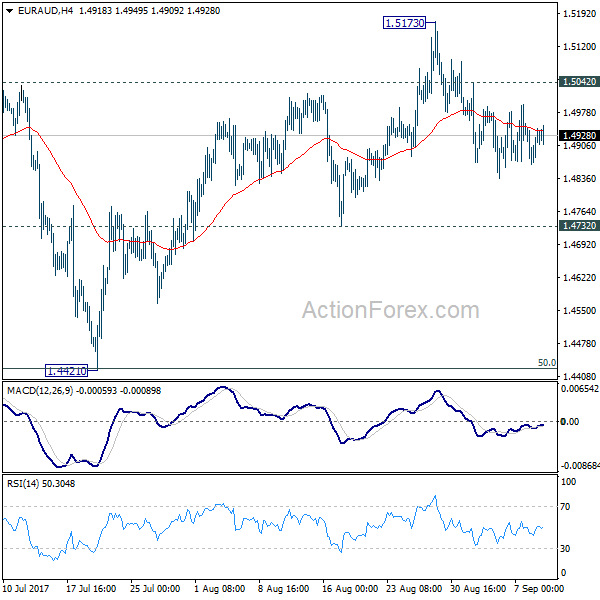
Daily Pivots: (S1) 1.4888; (P) 1.4915; (R1) 1.4967; More....
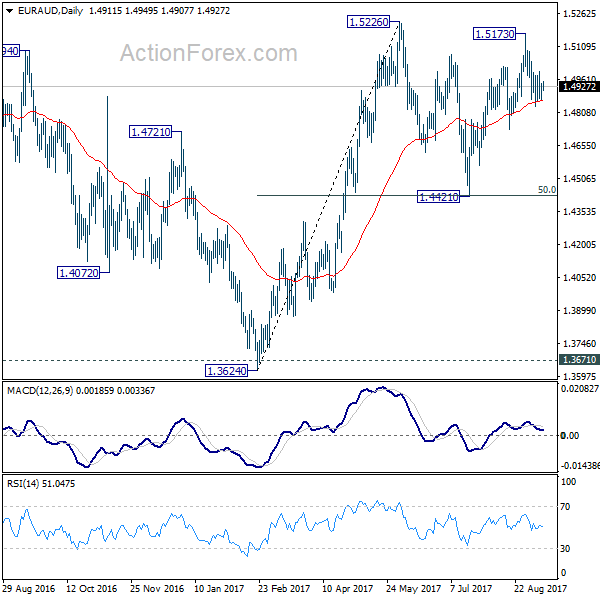
No change in EUR/AUD's outlook. With 1.5042 minor resistance intact, deeper decline is expected to 1.4732 support. Decisive break there confirm that fall from 1.5173 is the third leg of consolidation pattern from 1.5226. In that case, further fall should be seen to 1.4421 again. But we'd expect strong support from there to contain downside and bring rebound. On the upside, above 1.5042 minor resistance will turn bias back to the upside for 1.5173/5226 resistance zone instead.
In the bigger picture, we're holding on to the view that corrective decline from 1.6587 medium term has completed at 1.3624. Rise from 1.3624 is expected to extend to retest 1.6587. The corrective structure of the price actions from 1.5226 is affirming this view. Above 1.5226 will target a test on 1.6587 key resistance. However, break of 1.4421 support will dampen our view and would drag EUR/AUD lower to retest key support zone around 1.3624.