

Sample Category Title
Weekly Market Outlook: FOMC & RBA Meeting Minutes, Key Data in Focus
Next week's market movers
- In the US, the minutes of the July FOMC meeting could provide some specific details as to when the Committee is set to announce a normalization of the Fed's enormous balance sheet.
- In Australia, wage data for Q2 will be closely monitored, as they could determine whether the RBA will turn hawkish anytime soon. The minutes of the latest RBA gathering may also attract attention, as investors try to gauge how big of a concern the strong AUD is for policymakers.
- e also get key economic data from China, New Zealand, Australia, Sweden, the UK, the US, and Canada.
On Monday, during the Asian morning, focus will be on China's retail sales, industrial production and fixed asset investment, all for July. The forecast is for retail sales as well as industrial production to have slowed in yearly terms, while fixed asset investment is expected to have grown at the same pace as previously. We view the risks surrounding the industrial production forecast as skewed to the upside, perhaps for a more or less unchanged rate. We base our view on the nation's official and Caixin manufacturing PMIs for July, both of which showed that output growth was faster compared to a year ago.
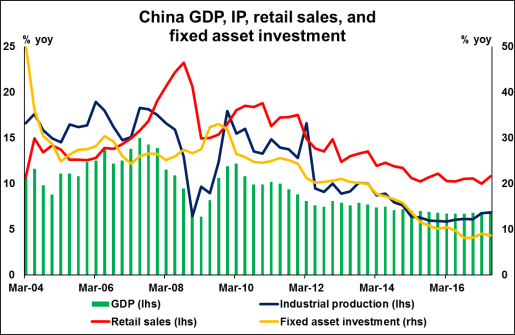
In New Zealand, retail sales for Q2 will be released. Without any forecast available, we see the case for retail sales to have slowed somewhat in yearly terms. Our view is supported by the New Zealand electronic card transactions indicator, which showed that electronic sales slowed on a yoy basis throughout the quarter. What's more, the underperformance of the labor market during Q2 supports further the case for a slowdown in retail sales.
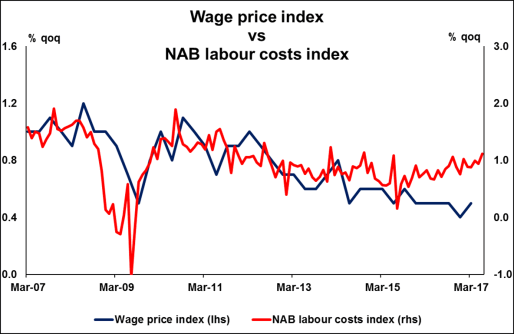
On Tuesday, during the Asian morning, the RBA releases the minutes of its latest policy gathering. At that meeting, the Bank acknowledged once again the latest strength in employment growth, but maintained its concerns regarding subdued wage growth. Perhaps the most noteworthy point was the officials' discomfort with the latest AUD appreciation. Even though the currency reacted little to these signals at the time, Governor Lowe recently raised the stakes by reminding the investing community that direct FX intervention is always on the table if needed. As such, we expect these minutes to be closely watched for more details regarding how big of a concern the strong AUD is for policymakers. As for policy signals, we doubt investors will find much in these minutes, as officials had little new data to work with at this meeting. We think that the main determinants of whether the Bank will begin to appear hawkish soon are the wage price index for Q2 and average weekly earnings for H1, out on Wednesday and Thursday respectively.
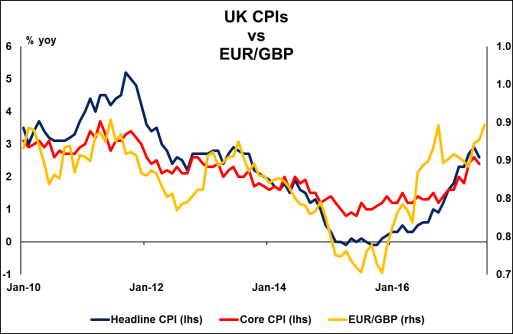
In the UK, CPI data for July will take center stage. The forecast is for both the headline and core CPI rates to have rebounded somewhat, something that is supported by the nation's services PMI for July, which indicated that prices charged rebounded from June's 11-month low. Even though a rebound in the CPI rates could keep alive some speculation regarding a BoE rate hike in the near-term, we remain skeptical on the prospect. Policymakers showed little urgency for a hike at the latest meeting, and we don't blame them considering the still-lackluster economic growth and wage prints.
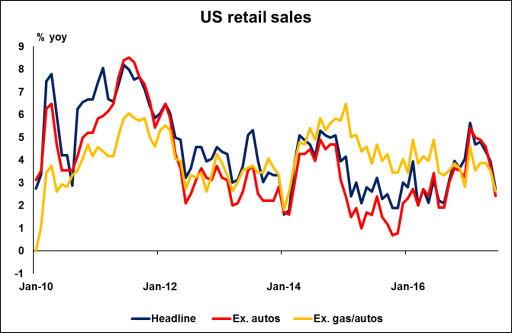
From the US, we get retail sales for July and expectations are for both the headline and the core rates to have rebounded, after declining for two consecutive months. However, the nation's consumer sentiment indices did not paint a clear picture in July. Even though the Conference Board index rose notably, the U of M print declined, making us hesitant to place too much faith in the forecast.
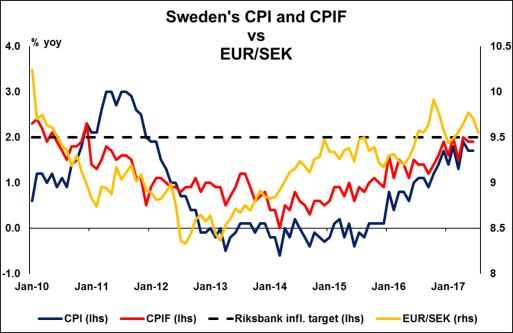
In Sweden, CPI data for July are due to be released, though no forecast is available yet. We expect these prints to be closely watched, as investors try to gauge whether and when the Riksbank will follow in the footsteps of the Norges Bank and the ECB and remove its interest rate easing bias. At its latest meeting, the Riksbank showed no hurry to do so, indicating that it does not rule out repo rate cuts in the period ahead and that it remains prepared to implement further easing if necessary to safeguard the return of inflation to target. Markets will probably focus on any potential moves in the underlying CPI rate (CPIF) rather than the headline, as the Bank tends to pay more attention to that measure.
On Wednesday, during the Asian day, Australia's wage price index for Q2 is due out and subsequently on Thursday, we get the nation's average weekly earnings for H1 2017. Without any forecast available for these figures, we see the case for the wage price index to have accelerated from Q1. We base this view on the NAB business survey for Q2, which showed that growth in labor costs accelerated to +2.1% yoy from +1.3% yoy the previously quarter. A material acceleration in wages would probably be very encouraging news for RBA policymakers, especially considering that the NAB survey also showed that firms expect wages to pick up further in the next months. Strong prints could alleviate some of the RBA's concerns regarding subdued wages and would likely be another set of data entering the basket of those supporting that the Bank could begin shifting to a more hawkish stance soon.
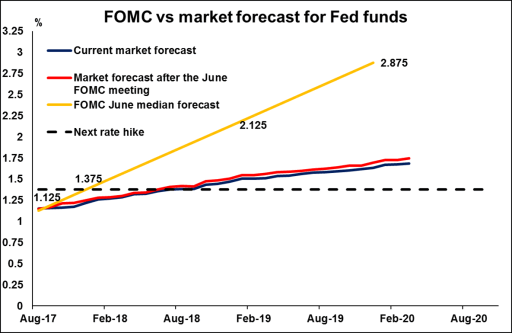
In the US, dollar traders will have their gaze locked on the minutes of the latest FOMC meeting. The statement accompanying that decision had few changes compared to the previous one. The only changes related to the inflation outlook and the timing of the balance sheet normalization. Our view is that the financial community will dig into the minutes looking for more precise clues on the timing of the B/S normalization, than the "relatively soon" part of the statement. The statement was not clear on the inflation front either. The acknowledgment of inflation "running below 2%" was a downgrade from the previous description that it was "running somewhat below 2%". However, officials still expect it to stabilize around the target over the medium term. In our view, this doesn't paint a crystal clear picture of the Committee's view on inflation. The minutes of the June meeting showed a split Committee, with some members attributing the recent softness in prices to idiosyncratic factors, while others expressed concerns that this weakness may persist. Up until the July gathering, the latter camp appeared to be right as inflation continued to drift lower. As such, it will be interesting to scan the minutes and see whether this camp has grown.
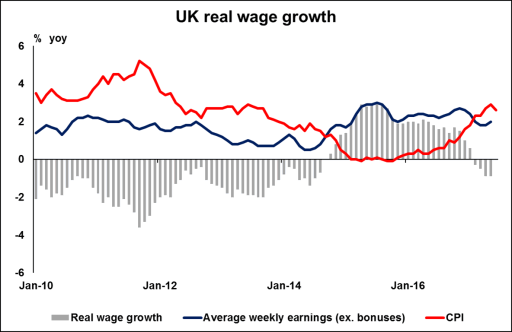
In the UK, employment data for June will attract attention. The forecast is for the unemployment rate to have remained unchanged, while wages are anticipated to have risen at the same pace as previously. The forecasts are supported by the services PMI for June, which showed that the increase in employment was the strongest since April 2016, and that service firms continued to report rising staff salaries. We think market focus will be primarily on wages, which have remained subdued in recent months despite the notable pickup in inflation, keeping real wage growth in the UK negative and thereby, dampening the outlook for household spending and economic growth in general.
On Thursday, during the Asian morning, Australia's employment data for July are due out. Our own view is that the labor market may have posted another month of solid employment gains, something supported by the ANZ job ads indicator, which showed advertisements rising for the 5th consecutive month. Even though further tightening in the labor market would probably be very encouraging for the RBA, we think that market focus will be mainly on the wage data. As we already outlined, they could play the biggest role in determining the Bank's policy stance over the next months.
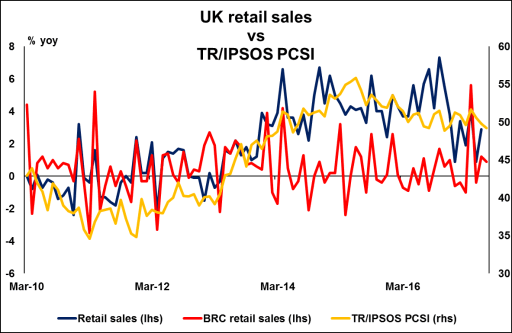
During the European day, we get the UK retail sales for July and expectations are for both the headline and the core figures to have slowed from the previous month. The forecasts are supported by the declines in the TR/IPSOS and the Gfk consumer sentiment indices for July. In addition, the BRC retail sales monitor showed a slight slowdown, enhancing the case.
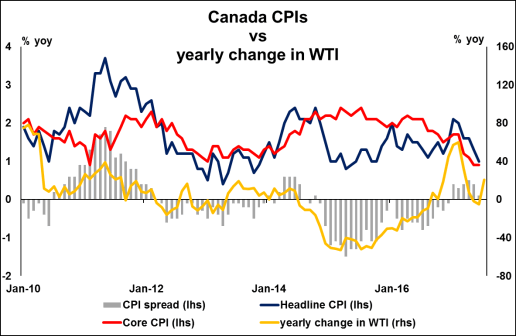
Finally on Friday, we get Canada's CPI data for July. In the absence of any forecast, we see the case for the core inflation rate (at least) to have declined. We base our view on the fact that the Markit manufacturing PMI for the month showed that output-charge inflation moderated for the third month. With regards to the headline rate, we believe that it may have remained unchanged as the rebound in the yearly changes of oil prices may have offset some of the aforementioned softness. In any case, even if core inflation slows further, we doubt that it will alter expectations for another BoC hike this year. In the latest Monetary Policy Report, which was released when the Bank raised rates, the Bank anticipated inflation to slow somewhat further in Q3, before picking up again. As such, we believe that Q4 inflation data will play a much bigger role on whether the Bank will indeed decide to proceed with another rate increase this year. At this stage, we think that it would take a truly dreadful inflation report to stop the BoC from hiking again.
Weekly Market Outlook: USD Rally Delayed Amid Weak Data
- NZD Tumbles As Economic Outlook Weakens - Arnaud Masset
- Banxico Is Opting For Caution On Monetary Policy - Yann Quelenn
- USD Rally Delayed Amid Weak Data - Arnaud Masset
- Gold & Metal Miners
Economics - NZD Tumbles As Economic Outlook Weakens
Among the G10 complex, the New Zealand dollar was the worst performer last week, falling the most against safe haven currencies such as the Japanese yen and the Swiss franc - down 3.10% and 2.85%, respectively. The rapid collapse of the Kiwi is due to the accumulation of disappointing economic data together with the unwinding of large speculative positions and a somewhat renewed interest in the US dollar that was triggered by an encouraging NFP report.
On the data front, the last RBNZ's survey showed that one-year inflation expectations slid to 1.77%y/y from 1.92% three months ago, while twoyear ahead inflation expectations fell to 2.09%, down from 2.17% previous reading. This setback came on the back of a worse-than-expected second quarter jobs report that highlighted the anaemic employment growth and poor wages pressure.
Last but not least, at the occasion if its latest monetary policy meeting, the Reserve Bank of New Zealand made a dramatic shift in its language as it made clear it is not happy, at all, with the current strength of the Kiwi. Assistant Governor McDermott suggested for a second that the bank could move back to intervention should the circumstances require so. However, he added as he tried to allay an overreaction of markets that it was just a little nudge, rather than "a slap across the face".
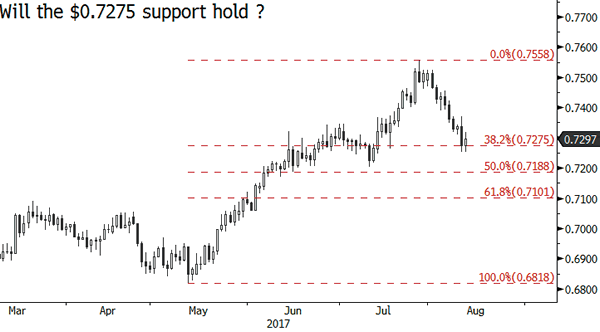
After topping $0.7558 on July 27th, NZD/USD has returned at around 0.7275 (Fibonacci 50% on May-July rally) and has been sitting there since Thursday as investors kept wondering whether further weakness is reasonable. In the short-term, the continuous flow of lacklustre data from the US will probably spur investors to maintain their negative USD bias, which should prevent the Kiwie to depreciate further.
.In the medium-term, this is a different however as the Federal Reserve is expected to go a step further towards tightening. Even a baby step could ignite a dollar rally.
Economies - Banxico Is Opting For Caution On Monetary Policy
It was widely expected by financial markets that Banxico would maintain, earlier last week, its rate differential with the Fed. The Mexican central bank keeps trying to avoid capital outflow that would result from a narrower rate differential. As a result Banxico decided to hold its overnight rate to 7%. We remember that Banxico changed in 2015 the agenda of its meeting to carefully follow Fed meetings.
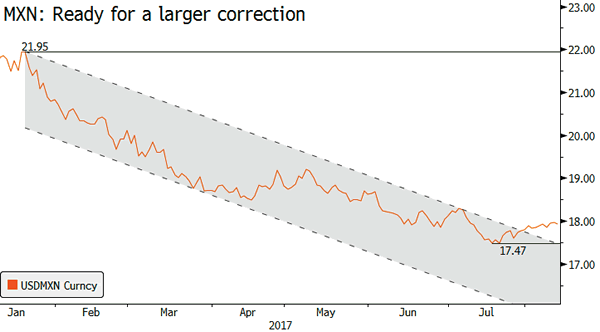
This year the central bank has increased four times its overnight rate triggering the strengthening of the MXN. But now, we see things are slowing down. When looking towards the Fed, we believe the US private institution will have more difficulties to deliver further rate hike before 2018 and that the promised shrinking of the balance sheet could provoke further turmoil. This is why we see Banxico cooling down its aggressive hawkish monetary policy and lower its interest rates before year-end.
However, Banxico has definitely some time to do it. Indeed, for example Mexican exports have largely increased in 2017 despite the MXN strengthening which went from 22MXN to almost 17MXN in 7 months against the greenback. This is mostly due to the oil prices jump this year but also to the uncertainties regarding the free trade agreement between US and Mexico that should be renegotiated - Trump estimates that the deal favours low-wage countries.
Other than that, the fundamentals of Mexico are still on the soft side and renewed lower oil prices could very easily reveal all underlying difficulties of the countries. We are turning bearish on the MXN as we believe that Banxico will likely not let the currency appreciate forever knowing that the US giant recovery may take some more time.
Economics - USD Rally Delayed Amid Weak Data
Despite a consolidation in the US dollar last week, the greenback has been unable to reverse for good the negative trend. Yet the July jobs report, which was released the previous Friday, seemed to have marked a turning point. But it was without counting on a few Fed members who talked down the dollar and the release of - once again - disappointing data from the world's largest economy.
The dovish comments from two Fed members were one among several factors that prevented the dollar to recover firmly. Both Bullard and Kashkari emphasized that the weak inflationary pressures were still a problem and added that it cannot be solved by an improving job market. St. Louis Fed President Bullard declared that "the current level of the policy rate is likely to remain appropriate over the near term," and added that the weak inflation reading were concerning because it suggests this setback is not due to temporary factors.
Finally, the July inflation report released on Friday did not allow for excess optimism. Indeed, once again, the data came in on the soft side. Headline CPI printed at 1.7%y/y, while the market was expecting a reading of 1.8%. The core gauge, which excludes the most volatile components, held steady at 1.7%, matching expectation. The report a not a game changer as the weakening inflation pressures is no secret. Unfortunately, this is again a warning bell which is calling the Fed to take it easy with tightening. According to the last hard data from the US economy, there is no reason to expect a sustained dollar in the short-term.
For some time we have been defending the idea that the dollar's debasement was coming to an end, arguing that this moment has been approaching fast. This assessment is not fundamentally altered as the Federal Reserve is the best placed amonf central banks to tighten monetary conditions. However, faltering economic data doesn't allow for excess optimism. We are therefore forced to adjust our assessment, especially the timing of a potential dollar recovery. We still advocate that such a recovery is underway but we may have to wait until the last moment, most likely the end of the month, just before the Fed meeting, to start building long USD position.
Title - Gold & Metal Miners
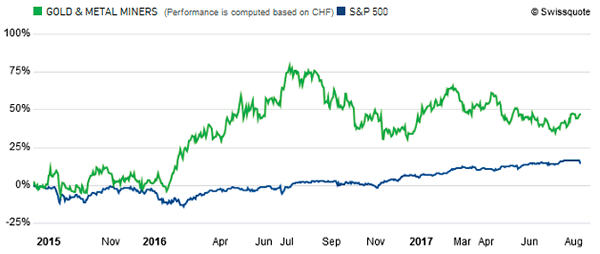
The sudden collapse in commodity prices in 2014 sent mining stocks into free fall. In the long term, however, precious metals - and gold in particular - are the perennial go-to sources of protection against inflation and economic downturns, something investors should be looking out for. The gold market is dynamic, and there are compelling reasons why gold producers could rally. Consumer demand remains solid, with around 2,500 tons of gold mined worldwide every year. Over the long haul, gold as a commodity has appreciated by more than 287% over the past 15 years; by comparison, the S&P 500 has gained less than 44% over the same period. In a period of central bank policy shifts, it is reasonable to envisage a rebound in metal prices - something mining stocks will benefit from. Gold miners are a good way to tap into the benefits of precious metals without paying storage costs.
Japan GDP, UK and US Retail Sales, Aussie Jobs in Focus
Major data releases next week should help divert some of the attention away from the geopolitical risks back to the outlook for monetary policy. Second quarter GDP growth figures out of Japan will be the main item to watch, followed by retail sales releases in the UK, the US, and China. Inflation data will be out in Canada, the Eurozone and the UK, while the latest employment numbers are due in Australia and the UK.
Chinese industrial output and retail sales growth to slow in July
The economic calendar will kick off with a batch of data releases out of China on Monday. Industrial output growth was unexpectedly strong in June, sharply beating expectations. It is expected to slow however in July, from 7.6% to 7.2% year-on-year. Retail sales also rose by more than expected in June, expanding by the most in one and a half years. It is forecast to ease slightly to 10.8% in July from the prior 11.0%. Also out on Monday is the closely watched indicator of business spending. Urban investment in China is forecast to remain unchanged at 8.6% y/y between January and July.
Australian wage and jobless data to be watched
An improving Australian labour market has contributed to the aussie's impressive gains this year, which even after the declines seen over the past three weeks, the Australian dollar has appreciated more than 9% against its US counterpart in the year-to-date. Employment data released on Thursday should show whether the solid jobs growth since the start of the year is continuing. Also important will be wage growth figures a day earlier on Wednesday. Like in many other advanced economies, earnings growth has been very sluggish in Australia, despite falling unemployment, acting as a drag on consumer prices.
Canadian inflation remains muted
The Bank of Canada raised interest rates for the first time in seven years in July even though inflation has been on a downward path since January. The Bank has blamed the weakness on temporary factors, and given the lag time between policy action and future inflation, it decided to tighten policy as the economy is absorbing spare capacity at a faster pace than anticipated. July inflation data out on Friday (forecast at 1.2% y/y) may provide more clues as to whether another rate hike is forthcoming this year. Any prolonged weakness in inflation would be negative for the Canadian dollar, which has rallied strongly since the BoC's hawkish turn.
Eurozone GDP and inflation eyed
It will be another relatively quiet week for the Eurozone next week, with the second estimate of GDP growth for the second quarter and the final CPI release for July unlikely to capture as much attention as the first readings. First up though is June industrial production data on Monday. Eurozone industrial output is forecast to decline by 0.5% month-on-month in June, while the annual rate is forecast to moderate from 4% to 2.8%. The second estimate of second quarter GDP is out on Wednesday. The quarterly rate is not forecast to be revised from the 0.6% figure of the preliminary reading. Final inflation numbers are also not expected to see any revision from the 1.3% and 1.2% y/y rates seen for CPI and core CPI respectively in the flash estimates.
Japan's economy to grow for sixth straight quarter
Another country reporting GDP data next week is Japan. Growth figures out on Monday will likely show the Japanese economy expanded by 0.6% quarter-on-quarter in the three months to June, twice the rate of the first quarter and the sixth consecutive quarter of positive growth This will be followed by trade data on Wednesday. Exports are forecast to accelerate in July from 9.7% to 13.6% y/y. However, there are fears the yen's sharp gains this week may hurt exporters. In addition, there are signs of slowing capital spending by businesses. Data on core machinery orders out this week came in below expectations, contracting for the second consecutive quarter.
US retail sales in focus
Retail sales figures out of the US on Tuesday may provide the greenback some much needed respite from its recent hammering, especially against the yen. After two straight months of declines, retail sales are expected to bounce back by rising 0.3% m/m in July. Business inventories numbers for the same month are also due the same day. Housing data will follow on Wednesday in the form of building permits and housing starts, while the Philly Fed manufacturing index is released on Thursday, along with July industrial output. On Friday, the University of Michigan's preliminary reading of the consumer sentiment gauge should give the first indication as to how well consumer confidence is holding up in August. The index is forecast to edge up to 94.0.
UK data under spotlight amid growth fears
Economic indicators out of the UK next week will shed some more light on the strength of the British economy as evidence continues to point to a weakening picture for consumer spending. CPI data is out first on Tuesday and the annual rate is forecast to tick up to 2.7% in July, after a surprise big drop to 2.6% in June. Unemployment data will follow on Wednesday, with the jobless rate expected to stay unchanged at 4.5% in the three months to June. However, there is still no sign of wage pressures building up and average weekly earnings growth is forecast to remain steady at 1.8% during the same period. Finally, retail sales data are due on Thursday. Retail sales rose by a bigger-than-expected 0.6% in June but is expected to ease to 0.2% m/m in July. The annual rate is forecast to slow to just 1.4%.
With British consumers continuing to face a pay squeeze as real incomes drop, the Bank of England is unlikely to rush into a decision to raise interest rates, unless inflation beats the Bank's forecast that it will peak at around 3% in October. A weaker dollar has so far helped support the pound around the $1.30 level even as expectations of a rate hike by the BoE in 2017 recede. Any downside surprises to next week's data could add further pressure on the pound.
Weekly Focus: Market Concern Grows as North Korea Tension Rises
Market movers ahead
- We expect the ECB minutes released on Thursday to shed more light on how the discussion within the Governing Council on extending QE evolved.
- FOMC minutes are due for release next week. We expect focus to be on the timing of quantitative tightening and the committee's view on the lack of inflation.
- We expect the decline in US consumer confidence to continue, in light of increasing tension between the US and North Korea.
- We expect UK CPI inflation to draw attention next week, as it will provide some guidance on the Bank of England's decision on whether or not to hike rates in 2018.
- We expect Chinese industrial production, released on Monday, to post solid growth, as pointed to by the recent month's strong PMI postings.
- The focus in Scandinavia will be on the release of Swedish inflation data. We expect Swedish inflation to pick up, reaching 2% cent in July - above the current Riksbank forecast. We expect the Danish GDP indicator to show healthy growth of 0.5% for the second quarter.
Global macro and market themes
- Tensions have risen between North Korea and the US. In our view, a military confrontation between the US and North Korea is a low-probability but high-impact event for markets.
- Yields of US and German government bonds declined this week but we believe current risk aversion is likely to be temporary, although it is set to be bumpy and headline driven.
- A pickup in US growth suggests that US yields and equities should head higher when North Korean tensions fade.
Australia & New Zealand Weekly: Australian Dollar Supported in 2017, But to Fall to 70¢ in 2018
Week beginning 14 August 2017
- Australian dollar supported in 2017, but to fall to 70¢ in 2018.
- RBA: August minutes and assistant governors Kent and Ellis speak.
- Australia: employment, wage price index, Westpac-MI Leading Index.
- NZ: retail sales.
- China: retail sales, fixed asset investment, industrial production, property prices.
- Euro Area: ECB July minutes.
- US: FOMC July minutes and retail sales.
- Key economic & financial forecasts.
Information contained in this report was current as at 11 August 2017.
Australian Dollar Supported in 2017, But to Fall to 70¢ in 2018
The past two months have seen a substantial rally in commodity prices. Since mid-June, iron ore has risen from USD53 per tonne to USD76 currently.
Also supportive has been a lift in coal prices, thermal coal increasing from USD81 per tonne to USD99, as well as a rally in crude oil, the Brent benchmark rising from a mid-June low of USD45 per barrel to around USD52 currently.
As a result of this broad-based rally, our Australian commodities index currently sits at 234, 10% above its level at the time of the release of our June Market Outlook publication.
Foreign exchange markets have, unsurprisingly, reacted quickly to this shift, with the Australian dollar rallying from USD0.75 to USD0.785 currently following a peak of USD0.80 in late July. The rally in commodity prices and associated currency market reaction has seen us revise our near-term outlook for the Australian dollar higher.
At September, we now look for the Australian dollar to trade at USD0.78, a touch below the current spot level. Past this point, we rely on our assessment of the global economy and our structural fair value model to guide our forecast for the currency.
The key inputs to our fair value model are commodity prices (denominated in USD); US/AUD short term interest rate differentials; and Australia's net debt (as a share of GDP).
We continue to expect that growth in China (our key commodity export market) will slow through the remainder of the year and in 2018 as the authorities continue to tighten credit and, particularly in 2018, ease up on government sponsored infrastructure programs.
However, in retrospect, our expectations for the extent of the reversal in commodity prices were overdone with the expected falls in 2018 in line with the proportional corrections we saw in 2015, when the authorities took a particularly hard line against corruption and debt fuelled excess.
The ferocity of the policy reversal in 2016 now indicates that Chinese authorities recognise that the policies through 2014 and 2015 were excessively tight and would be unlikely to repeat such an exercise. Further, we expect that through the remainder of 2017, policy will continue to tighten but at a modest pace.
Evidence on the pace of the China slowdown in 2015 can be assessed by the change in investment growth. The slowdown in real estate investment was the stand out with annual growth slowing from 14% in 2014 to 1% in 2015. Manufacturing growth slowed from 15% to 8%; with total investment growth slowing from 17% to 10%.
In 2016, in response to renewed stimulus, housing investment growth recovered to a solid 7% growth pace while house prices in Tier 1 cities surged by 30% following a 5% fall in the previous year.
Our Australian commodities index is expected to fall by only 7% by the end of 2017. As a result, we now expect the Australian dollar to end the year at USD0.76, previously USD0.73. However, as discussed, the bigger change to our commodity and Australian dollar view comes in 2018.
Previously we had anticipated a 30% decline in commodity prices, in part associated with a policy-induced pull back in investment in China. That 30% was in line with the falls we saw in 2015. Based on the 2015/2016 experience, we now expect the policy tightening will be more in line with around a 20% fall in commodity prices.
Other key factors in our thinking are unchanged. In particular, we see quite a different configuration for US/AUD interest rate differentials by the end of next year than is currently priced into the market.
Markets are anticipating only one more hike by the Federal Reserve through end 2018 while we are maintaining our call for three, with the next move coming in December to be followed by June and December next year.
In our opinion markets are overreacting to the inertia in core inflation and negativity around Trump. The FED has confirmed consistently that it expects inflation to approach 2% in the medium term. It emphasises considerable lags between tight labour markets and wage pressures. Both the unemployment rate and U6 (measure of underutilisation in the US labour market) have converged on pre GFC lows. Labour force participation has recently lifted from a low of 58.2% to 60.3% still below the pre GFC level of 63.3% but much of this shortfall can be attributed to the ageing of the population.
However, from my perspective the outstanding opportunity for the FED is that despite rate hikes in December; March and June, financial conditions have eased. The Chicago FED's index of financial conditions has fallen from -0.6 a year ago to -0.9 and is now easier than pre GFC levels of -0.78.
The USD has also fallen around 10% in 2017 despite these rate hikes. We know the FED gauges policy "opportunities" partly in terms of prevailing financial conditions. With these "easy" conditions, the Chair must be sorely tempted to use the opportunity to lift rates further towards neutral and away from "emergency" levels. We are surprised that markets are only attributing a 40% chance of a December rate move.
On the other hand, markets are pricing in around one 0.25% rate hike by the RBA next year whereas we expect rates to remain on hold.
As discussed in last week's note, our growth outlook is pointing to below trend growth in 2018 precluding the opportunity to raise rates.
The net effect of these differences is that we see AUD rates around 0.4% below US rates by end 2018 whereas markets are expecting AUD rates to remain around the current configuration of 0.4% above US rates.
Accordingly, taking all these factors into account, we have revised up our target level for the AUD by the end of 2018 from USD0.65 to USD0.70.
Bill Evans, Chief Economist
Data wrap
Jul NAB business survey
- Conditions elevated, confidence lifts. Conditions: up 1pt to +15. Confidence: up 4pts to +12.
- The NAB business survey reported that business conditions remained elevated in July and that business confidence increased. The survey was conducted from July 25 to 31.
- In July, the conditions index rose 1pt to +15. This is well above the long-run average for this series, of +1 (dating from 1989), but below the highs of 2007 ahead of the GFC.
- The components of business conditions for July were: trading conditions down 1pt to +20; profitability up 4pts to +18; and employment conditions held onto earlier gains, steady at +7.
- Business confidence moved higher, up 4pts to +12. Business confidence has improved since 2016, mirroring the global trend, and is at above average levels, although it continues to trail actual conditions.
- How to interpret the survey? The elevated level of the business conditions index is overstating actual conditions across the broader economy, as it has tended to do since the GFC (see chart overleaf).
- Directionally, the survey suggests that the Australian economy is experiencing a trend improvement in underlying conditions after the slowdown in mid-2016, associated with the July Federal election.
- The official data was mixed early in 2017, impacted by weather disruptions. More recently, partial indicators have improved (retail sales, exports, jobs), lending support to our view that the economy will rebound in 2017 from these temporary disruptions, although consumer spending is likely to be constrained by weak wages growth.
- On employment growth, the previously weak official data has fallen into line with the positive signal from the private business surveys, meeting our expectations. The survey suggests that the recent trend improvement in employment will be sustained in coming months.
- On investment, the outlook is less certain, with the survey's capex measure pulling back in July (see chart overleaf).
- By industry, a strengthening of conditions in 2017 relative to 2016H2 is evident in: construction; manufacturing; and mining. Construction has strengthened on an upswing in public investment; a lift in commercial building; elevated home building activity (ahead of a 2018 downturn); and the waning of the mining investment drag. Mining is enjoying better cash flows associated with higher commodity prices. Manufacturing is benefitting from strength in construction, mining, agriculture and the lower AUD. Positive spillover effects are also evident in wholesale and in transport & utilities.
- Retail conditions reportedly dipped in July, possibly in part due to a mild winter, with Sydney experiencing its 2nd warmest July on record. Official data reports that real retail sales jumped in Q2, up 1.5%, after a weather disrupted 0.2% gain in Q1. The uncertainty is around the strength of consumer spending over the second half of 2017 and beyond.
- By state, business conditions for July are positive in all states, with the exception of WA. Trend conditions are most favourable in the major non-mining state of NSW and Victoria. In NSW conditions jumped in July, to +22, possibly in part due to unseasonably mild and dry weather conditions. Looking through month to month volatility, the improvement in overall conditions between 2016H2 and 2017H1 is largely driven by the mining states of WA and Qld, as well as SA.
Aug Westpac-MI Consumer Sentiment
- The Westpac Melbourne Institute Index of Consumer Sentiment declined by 1.2% in August from 96.6 in July to 95.5 in August. The consumer mood has deteriorated over the last year with August marking the ninth consecutive month where pessimists are outnumbering optimists. We have not seen such a succession of weak reads since 2008.
- The survey detail suggests increased pressures on family finances; concerns around interest rates; and housing affordability in NSW and Victoria are more than outweighing increased confidence around jobs.
- The further weakening in consumer sentiment comes despite some positives leading into this month's survey. The RBA again opted to leave interest rates unchanged at its August meeting while the Governor sent a clear signal in a recent speech that rates were on hold in the immediate future. Other positives include: a continued improvement in labour market conditions; lower petrol prices (average pump prices down 15c/litre nationally since early June) and a booming Australian dollar, which briefly touched USD 0.80.
- The Index components point to clear pressure on family finances. The sub-index tracking views on 'finances vs a year ago' fell 5.1% to 78.1, the lowest level since June 2014, when consumers were shocked by the Abbott government's first Budget. Much of the weakness is likely to reflect a mix of weak growth in wages; increases in key costs such as electricity and emerging concerns about rising interest rates.
- Despite the bleak picture around current finances, consumer expectations are more upbeat. The sub-index tracking expectations for 'finances over the next 12 months' firmed 2.1% to 100.4 in August. A reading over 100 indicates that optimists slightly outnumber pessimists. Consumers were also a touch more positive on the economy: the 'economic conditions, next 12 months' sub-index nudged up 0.4%; and the 'economic conditions, next 5 years' sub-index posted a stronger 2.3% gain, though coming off a sharp 9.6% drop over the previous two months.
- However the weak picture on current finances appears to be affecting consumer attitudes towards major purchases. The 'time to buy major a household item' sub-index fell 4.9%, unwinding most of the 6% improvement seen over June- July. Notably, the pull-back has come despite increasingly aggressive price discounting amongst retailers and a likely further improvement in purchasing power from a higher Australian dollar - up over 6c US from its low in May to nearly US 0.80.
- Some of the softening in sentiment in August may be a delayed reaction to recent mortgage rate increases - the major banks raised rates on 'interest only' mortgages in late June. After posting a surprisingly firm 4.7% rise in July, sentiment amongst consumers with a mortgage fell 6.3% in August. Note that despite the increase in 'interest only' rates, the average standard variable mortgage rate declined a little between June and August.
- Perhaps more importantly, most consumers expect rates to move higher over the next year. Responses to an extra question this month around the outlook for mortgage rates show that, of those consumers with a view, 71% expect rates to be higher in 12 months; 27% expect rates to be steady; and just 2.6% expect further rate cuts. That compares to 60% expecting higher rates when the question was last run in February and just 37% this time last year.
- The one relative bright spot for consumers continues to be around jobs. The Westpac Melbourne Institute Unemployment Expectations Index declined 2.6% to 132.5 in August (recall that lower reads mean fewer consumers expect unemployment to rise in the year ahead). The Index is now at its lowest level since November 2011.
- Sentiment around housing improved slightly in August. The 'time to buy a dwelling' index edged 0.8% higher but remained at a low level by historical standards. The detail shows mixed moves across different regions with buyer sentiment falling towards very low levels in Sydney and Melbourne - where affordability pressures remain acute - but surging in Western Australia, where affordability has improved markedly.
- Consumer expectations for house prices also firmed slightly overall. The Westpac Melbourne Institute Index of House Price Expectations rose 0.6%, extending last month's 8.6% bounce. Expectations consolidated in the major eastern states but rose strongly in WA which posted its second strongest reading since late 2014.
Jul housing finance
- Australian housing finance approvals surprisingly firm Owner- occupiers (no.) +0.5%mth, -4.0%yr; Investors (value): +1.6%mth, +5.7%yr; Total ex refi (value): +1.5%mth, +7.1%yr
- Australian housing finance approvals to owner occupiers edged up 0.5% in June, undershooting market expectations of a 1.5% gain. However, the detail was considerably more positive: approvals ex-refinancing posted a much stronger 1.9% gain to be up 3.4%yr with both the value of investor loans and construction-related loans also posting solid rises.
- Note that the macro prudential tightening measures introduced in late March and associated increases in rates for investor and 'interest only' loans have likely given indirect support to owner occupier loan activity. That said, the value of investor loans was stronger than expected, posting a 1.6% gain to be up 5.7%yr. The total value of loans was up 0.8%mth - ex refi up 1.5%mth, 7.1%yr. The latest round of mortgage rate increases for 'interest only' loans came in late June and is likely to impact in Q3.
- The owner occupier loan detail showed a continued surge in construction-related finance approvals - the number of finance approvals for construction up 3.6%mth, 8.9%yr and approvals for the purchase of newly built dwellings (which includes for settlement of 'off the plan' apartment purchases) up 3.5%mth, 10.2%yr. The latter is related to settlements on the massive wave of new high rise apartments now reaching completion. The lift in finance for construction however bears close watching - the rise is consistent with a recent firming in non high rise dwelling approvals and although other indicators such as consumer views on 'time to buy a dwelling' suggest this will give way to a renewed weakening over the second half of the year, the links between home buyer sentiment and new home building can often be loose.
- The detail also shows a notable lift in first home buyer approvals - up 8.8%mth, 6.7%yr. Although the levels are still very low, this may be an early sign that the various increases in state government policy assistance for first time buyers in recent months may be generating some traction.
- The state detail is of somewhat limited use as investor loans are not split out in this release. However for owner occupier approvals (ex refi) a dip in NSW (-3.1%) was offset by small gains across other states (Qld up 3.6%, Vic up 1.6%). Notably the lift in construction finance is coming across all major states.
- Overall, the numbers will be disappointing for regulators looking for a more material slowing in investor activity although the full impact of macro-prudential measures has yet to come through.
New Zealand: Week ahead & Data Wrap
The Reserve Bank left the Official Cash Rate unchanged at 1.75% in its August Monetary Policy Statement, and the guidance that it provided was very similar to its previous reviews. Monetary policy will need to remain accommodative for a long time, in order to support growth and guide inflation towards the RBNZ's target on a sustained basis.
Other than updating for recent data outturns, the RBNZ made few changes to its economic forecasts compared to the May MPS. The weaker than expected consumer prices in the June quarter were treated as temporary, though they will linger in the annual inflation rate calculations over the coming year. As a result, the RBNZ now expects inflation to briefly drop below 1% in the March 2018 quarter, before rising back to the 2% midpoint of the target by early 2019.
Similarly, the softer than expected GDP growth over the last two quarters was viewed as temporary. The RBNZ expects GDP to grow by 3.4% over this year and 3.6% next year, both of which would be well above the country's potential growth rate. This implies a shift from a zero to a positive output gap over the next couple of years, and a subsequent lift in the pace of non- tradables inflation.
That lift in non-tradables inflation will be needed, because the outlook for tradables inflation remains soft. The RBNZ has for some for time been highlighting that the global economy still has substantial spare capacity and that worldwide inflation remains slow. The lack of import price inflation is compounded by the lingering strength of the New Zealand dollar, which is running about 3% higher today than the RBNZ had assumed in its May forecasts.
The RBNZ still expects the NZ dollar to decline gradually over the next few years, so the recent rise in the currency is expected to suppress inflation over the next year or so but not over the medium term. Still, there was some escalation of the RBNZ's concerns in the language of the statement, which noted that a lower exchange rate is "needed" (as opposed to "would help") to rebalance the outlook for growth.
In a subsequent interview, Assistant Governor McDermott confirmed that this change of wording was meant to nudge the market towards considering the possibility of the RBNZ intervening in the foreign exchange market. The NZD fell after this interview was published, having initially risen after the MPS. We don't think the message was any different, though: it still feels like the RBNZ is giving the exchange rate a nudge, whereas we and no doubt others in the market were expecting more of a shove.
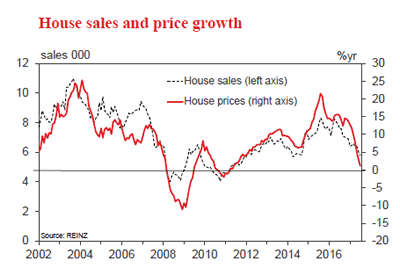
The RBNZ has acknowledged the slowdown in the housing market over the last year, but it remains concerned about the risk of a resurgence in house prices. This is a significant point of difference for us. We believe that the rise in mortgage rates since 2016 has played a major role in cooling the housing market, and will continue to do so.
The July house sales figures, released after the MPS, support our view. House sales have been falling steadily over the last year, and are now at a three-year low. House prices in Auckland continued their gradual decline (now down 4% from their peak), and prices were flat in the rest of the country for the second straight month. There are still some pockets of strength, but prices are off their peak in a growing number of regions.
We expect the rise in mortgage rates to persist, as it is the product of two factors that are beyond the control of domestic monetary policy: rising global interest rates, and increased competition among banks for deposits. That points to the housing market remaining very soft over the next year or two; the Reserve Bank's forecast of even a relatively modest 4% rise in prices this year looks too high. That implies a softer path for spending, investment and housing construction, and less home-grown inflation pressure than the RBNZ is looking for.
The RBNZ's interest rate projections this time were identical to the May Monetary Policy Statement, with a flat track for the next two years followed by a gentle upturn. We've been broadly in agreement with that view for some time, and if anything we see downside risks to the RBNZ's view on growth and inflation pressures. We will be releasing our latest quarterly Economic Overview next Tuesday, which will detail how our views on the economy have evolved.
One forecast change that we have already made is to push out the expected timing of OCR hikes even further. Previously, we expected the first hike to be delayed until the March quarter of 2019; we now expect it to be in the December quarter of that year. As we've noted before, it's hard to be specific about dates over this sort of time horizon. The bottom line is that we think the market's insistence on pricing in an OCR hike by August 2018 is well off the mark.
Data previews
Aus Jul Westpac-MI Leading Index
Aug 16, Last: -0.76%
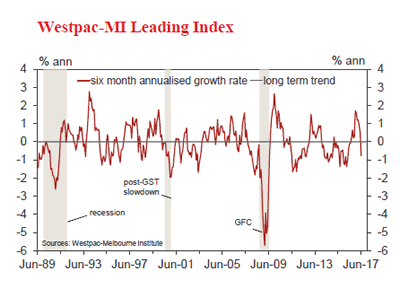
- The six month annualised growth rate in the Leading Index, a guide to the pace of economic activity three to nine months into the future, fell sharply from 0.51% in May to -0.76% in June, the first below trend reading since July 2016. The abrupt slowdown in momentum mainly reflects international factors including a sharp turnaround in Australia's commodity prices in Australian dollar terms.
- The Jul read will include updates on: the ASX200, down -1.3% vs -0.1% last month; the Westpac-MI Consumer Expectations Index, up 1.6% vs -1.4% last month; US industrial production, up 0.2% vs 0.4% last month; commodity prices, down -16% (in AUD terms) vs -8% last month; dwelling approvals, up 10.9% vs -5.4% last month; the yield spread, widened 25.8bps vs a 12.5bps narrowing last month; the Westpac-MI Unemployment Expectations Index, down -2.6% vs -3% last month; and total hours worked, up 0.3% vs 0.5% last month.
Aug 16, Last: 0.5%% WBC f/c: 0.5%
Mkt f/c: 0.5%, Range: 0.5% to 0.7%
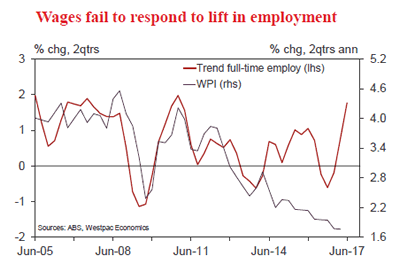
- Total hourly wages ex bonuses gained 0.5% in Q1 which was a lift from 0.4% in Q4 (which was revised down from 0.5% and is now the record low quarter print). Nevertheless it is holding surprisingly soft momentum with the annual rate at a historical low of 1.9%yr.
- The relative softness in the labour market seen in broader measures, such as underemployment where a worker is willing and able to work more hours than they do, has coincided with the record low in wage growth.
- Those looking for a minimum wage increase in the Q2 WPI are one quarter too early as the increase was not applied until July 1, 2017. So while it is true that the minimum wage rise is likely to boost wage inflation back though 2%yr in Q3, for Q2 we are looking for modest 0.5%qtr/1.9%yr print.
Aus June Labour Force employment '000
Aug 17, Last: 14.0k, WBC f/c: 35k
Mkt f/c: 20k, Range: 10k to 35k
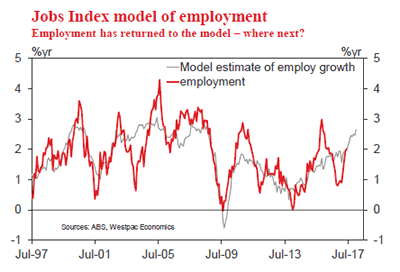
- May and June were robust updates from the Labour Force survey. The recovery in employment was something that our Jobs Index had been pointing to for some time and our employment forecasts going forward incorporated on-going strength at least to year end.
- Total employment rose 14k in June compared to the market's forecast of 15k. Full-time employment surged 62.0k following on from a 53.4k gain in May. In the year full-time employment gained 175.4k/2.1%. Part-time employment fell 48k following a -15.4k in May. In the year part-time employment lifted 64.8k/1.7%, slower than full-time employment for the first time since Mar 2015.
- Employment is now running on par with our Jobs Index which is pointing to it accelerating as we near year end. Our forecast for 35k will hold the annual pace at 2.0%yr.
Aus June Labour Force - unemployment %
Aug 17, Last: 5.6% WBC f/c: 5.6%
Mkt f/c: 5.6%, Range: 5.4% to 5.7%
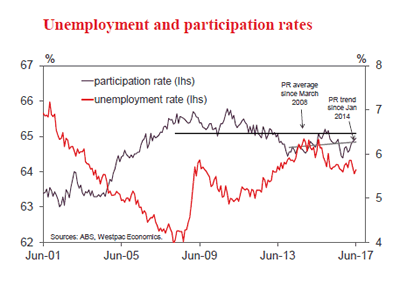
- The solid June gain in employment was matched by a 0.1ppt lift in participation. This led to a 27.1k gain in the labour force thus holding the unemployment rate flat at 5.6%. However, at two decimal places the unemployment rate was 5.65% up almost 0.1ppt from 5.56% in May so it was a very small smidgen off being rounded up to 5.7%.
- We believe we have seen the low in unemployment and expect it to hold around 5.6% until it starts to drift higher as we move into 2018. Robust employment growth is drawing workers back into the labour force (and/or holding more in the labour force), lifting participation and preventing any near term dip in unemployment.
- For July, strong employment should again be associated with higher participation. At 65.1% participation should lift the labour force enough to hold unemployment at 5.6%.
NZ Q2 real retail sales
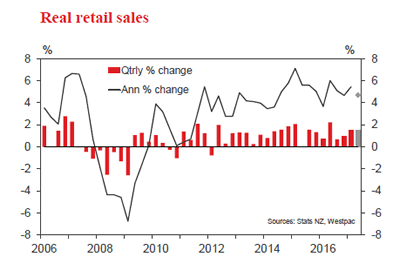
Aug 14, Last: +1.5%, Westpac f/c: +1.5%, Mkt f/c: +0.8%
- Retail spending rebounded in March, rising by 1.5%. Much of this was the result of a very large increase in motor vehicle sales. However, there were gains in most categories including a strong lift in categories linked to the tourism sector.
- We expect another solid gain in the June quarter, underpinned by solid growth in core categories. Once again, much of the strength in spending is expected to be in areas related to tourism. During the June quarter, we saw strong tourist inflows on the back of high profile sporting events, like the Lions tour. This provided a large boost to spending in areas like food services and accommodation. We also expect to see gains in other categories, supported by softness in import prices and continued strong population growth.
US Jul retail sales
Aug 15, Last: -0.2%, WBC 0.5%
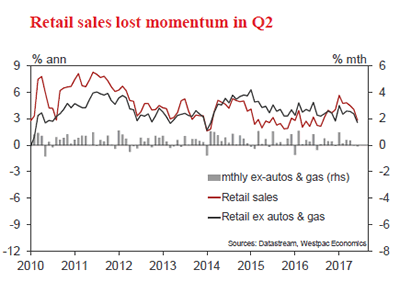
- During the June quarter, there was a distinct loss of momentum in retail sales - a 0.3% gain in April followed by a 0.1% decline in May and a 0.2% fall in June. Core retail sales (ex autos and gas) were a little stronger but still quite weak, with a gain of 0.4% followed by a flat outcome and a -0.1%.
- Through the quarter, weak inflation was a key cause of the soft nominal sales trend, both for gas and more broadly. Importantly, from the GDP consumption detail, it is evident that volumes were actually better in the June quarter than in the March quarter, when durables sales volumes were flat.
- The momentum in sale volumes in the June quarter points to a rebound in nominal retail sales from July as the negative influence of prices abates. We look for a 0.5% gain in headline retail sales and a similar result for the core series. This growth should continue in coming months.
Inflation Stayed Stubbornly Steady in July
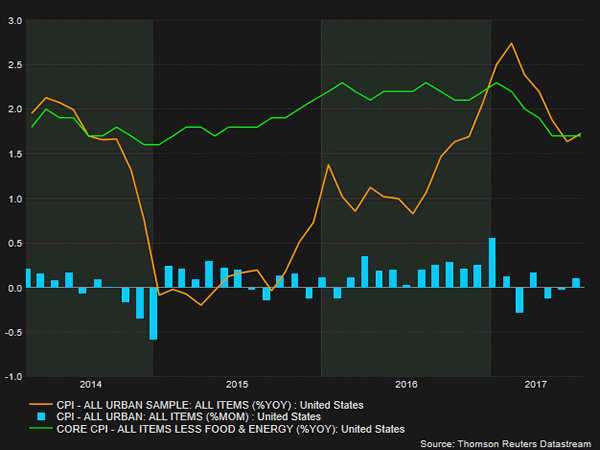
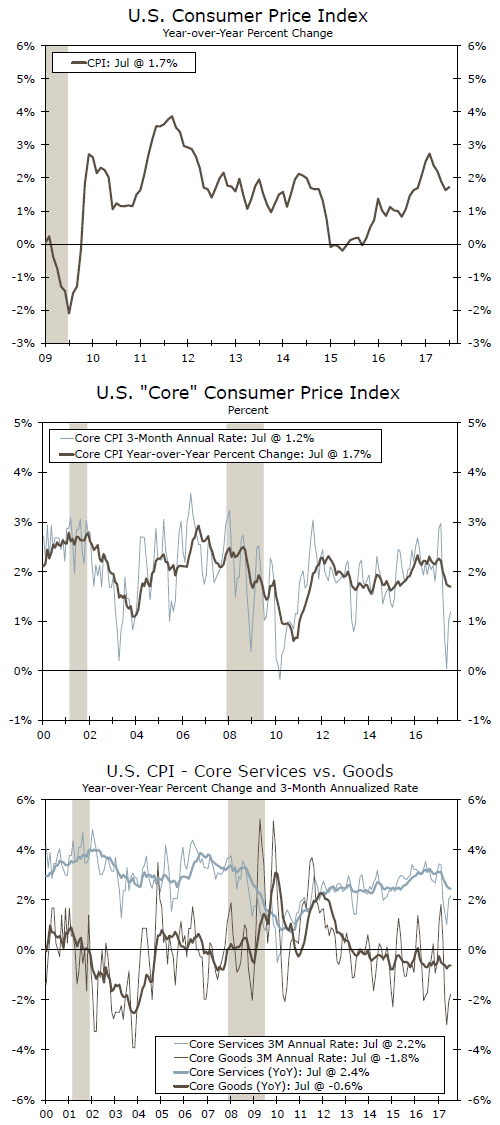
The headline consumer price index (CPI) ticked up 0.1% in July, slightly below market expectations. Inflation on a year-on-year basis remained steady at 1.7% in July.
Core inflation matched headline in July, with a slight 0.1% increase for the fourth month in a row now, slightly disappointing market expectations for a 0.2% gain. That left core inflation at 1.7% year-on-year, a pace that has been steady for three months now.
Delving into the details, a slight drop in energy prices on the month (-0.1%) offset a 0.2% m/m increase in food prices, leaving headline inflation matching core. Prices also rose for shelter (+0.1% m/m) , medical care (+0.3% m/m), recreation (+0.3% m/m), apparel(+0.3% m/m), motor vehicle insurance(+0.3% m/m) and airline fares (+0.7% m/m) all rose in July.
These increase were somewhat offset by declines in prices for new vehicles (-0.5% m/m), communication (-0.2% m/m), used cars & trucks (-0.5% m/m) and household furnishings and operations (-0.2% m/m).
Overall the tug of war in core inflation between falling goods prices (-0.1%) and rising services prices (+0.2%) continued in July. That dynamic has been in place since 2014, exacerbated by a strong U.S. dollar. Now, the services side of the rope is losing some strength. Core services inflation was 2.5% y/y in July, a notable cooling from the 3.2% pace in Q3 2016. Meanwhile core goods prices are in deflationary territory, down 0.6% from a year ago, a pace that has been reasonably steady over the past year.
Key Implications
The story remained the same for the American economy in July. A healthy job market, but no new momentum in inflation pressures. While one-off price drops in specific categories are part of the story, it doesn't explain the entire weakening seen in measures of inflation that strip out such volatility (trimmed mean or median CPI). Inflation has weakened across many advanced economies, suggesting that a broader phenomenon – such as persistent economic slack globally – may be playing a role.
We still expect inflation pressures to build through the remainder of the year, but the process is proving slower than expected This adds considerable risk to the pace of Fed hikes over the rest of this year and in 2018.
That said, it is unlikely today's inflation data will keep the Fed from starting the process to normalize its balance sheet in September. Recent Fed speakers, even some notable doves like Kashkari, have emphasized that normalization of the balance sheet is coming soon.
US Consumer Prices Miss Forecasts; Dollar Down to One-Week Low
US core consumer prices, grew steadily for the fourth month in July, disappointing analysts who anticipated inflation to improve moderately. Following the data, the dollar retreated immediately against a basket of currencies to a one-week low, as the recent evidence on inflation, mirrored by consumer prices as well as by producer prices, indicated the weakness of prices to move toward the 2% Fed's target.
On Thursday, the US Bureau of Labor Statistics published the figures on consumer prices for the month of July. Headline inflation rose to 0.1% month-on-month (seasonally adjusted) after it showed no growth in June, undershooting the forecast of 0.2%. This drove monthly real earnings growth down to 0.2% compared to 0.5% seen in the previous month. Year-on-year, the CPI index increased by 0.1 percentage points to 1.7%, while expectations were for a rise to 1.8%.
The core CPI, which is a closely watched indicator by the Fed, as it excludes price volatility stemming from food and energy sectors and therefore is a better proxy of longer-term inflationary pressures, remained flat at 0.1% month-on-month. This was below 0.2% forecasted. On a yearly basis, the index was in line with expectations at 1.7%.
Looking at the details underpinning the records, gasoline prices continued weighing significantly on the index in July, falling the most among sectors by 2.8% month-on-month, while airline fares which dropped by 2.7% in June, improved by 0.7% in July. The fall in transportation costs softened from the negative 0.7% to a negative 0.1%.
Taking into account disappointing readings on US PPI which experienced the largest drop in 11 months in July, as well as today's softer US CPI, the odds for a third rate hike this year have diminished as inflation doesn't show any sign of approaching the Fed's target of 2%. However, further economic data releases in the next months will give a clearer picture on inflation before Fed policymakers gather to decide on the future rate path.
Turning to the reaction in the forex markets, the dollar index fell to a one-week low of 92.99 from round 93.40. Euro/ dollar gained the most, surging by 0.65% to 1.1834 from 1.1753.The pair was last trading at 1.1785. Dollar/yen dropped below the 109 key level to 108.71 but managed to recover soon after, picking up to 109.16.
Consumer Inflation Remains Soft in July
Coming in shy of expectations, headline and core CPI inflation ticked higher in July. Debate amongst Fed officials should remain robust as they assess whether the inflation backdrop warrants a near-term rate hike.
Inflation Pressures Remain Tame
Following soft monthly performances in May and June, the headline Consumer Price Index (CPI) edged higher in July, rising at 0.1 percent. The modest gain, however, missed expectations and, therefore, continues to paint a backdrop of tame inflationary pressures.
Marking its third consecutive decline, the energy index slipped 0.1 percent in July as natural gas prices registered their largest monthly decline since April 2015. Retail gasoline prices were unchanged on the month. Consumer food prices increased 0.2 percent in July, supported by matching increases in food both at, and away from, home.
Inflation pressures were no greater when excluding food and energy. Core CPI also edged up a weaker-than-expected 0.1 percent on the month, keeping the year-over-year pace steady at 1.7 percent. The shelter index recorded its smallest increase since March (0.1 percent). This modest gain, however, was primarily due to the record 4.2 percent plunge in lodging. Weakness was also seen in new vehicles, down 0.5 percent, its largest monthly decline since August 2009, and wireless services (-0.3 percent). Encouragingly, both apparel and airfares ended multi-month slides, rising 0.3 percent each, and medical care continues to post solid monthly gains.
Plenty of Runway to December, But Trajectory Needs to Turn
As we have cautioned, the runway to a potential December Fed interest rate increase is still somewhat long, giving opportunity for a change of trajectory to take place (note, four more CPI updates before the December 13 FOMC meeting). While this month's performance missed the chance to show a start to that quickening in the pace of inflation needed to cement the third Fed rate hike this year, it is encouraging that the recent slide stabilized somewhat.
In the July FOMC policy statement, officials continued to characterize consumer inflation as running below target, though they reaffirmed confidence that the target will be met over the medium-term horizon. Today's CPI performance does not inspire a lot of confidence that officials are on course for another rate hike this year, though any concerns over a September balance sheet normalization announcement not unfolding have fully dissipated. As previously cited, the Fed will remain on attentive watch for all incoming inflation indicators to better gauge attainability of their symmetric inflation goal. Our outlook projects a gradual firming in the pace of consumer inflation over the coming quarters. That quickening in the pace of consumer inflation is needed for officials to seriously consider further rate tightening at year's end. If the pace of inflation fails to turn higher over the coming months, projections for another rate hike this year should dissipate even further and push the next Fed rate hike into 2018.
Slower Inflation Growth in the US Results in EUR/USD Rise
The price of EUR/USD demonstrates positive dynamics after the release of important macro statistics on the consumer price index in the US, the growth of which was only 0.1% in July, doubly worse than the average forecast. Lower than expected inflation growth will restrain the FOMC from another round of rate increases until the end of the year, which in turn puts pressure on the US dollar that is also hit by political tensions within the US. The news on consumer inflation growth by 0.4% in Germany and 0.3% decline in France had little impact on the sentiment of traders.
The demand for defensive assets including the Japanese Yen, Swiss franc and gold remains high. The reason for such an interest was the Korean crisis which flared after news of potential attacks on American territory and the promise of Donald Trump to show "fire and fury" in response to the threat of nuclear attacks. Today in Japan there is a public holiday, but on Monday it will take centre stage due to the preliminary report on the GDP growth in Japan.
The oil price keeps mowing downward after a recent correction, despite the depreciation of the US dollar. Bears got some support from the recent statistics according to which the oil output within the OPEC increased in July by 173.000 barrels per day to 32.87 million barrels per day. At the same time production growth in Libya has been the fastest since the beginning of the year.
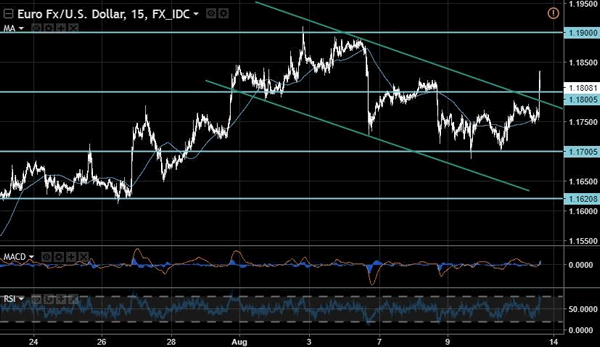
EUR/USD
The EUR/USD has shown a sharp upward movement and as a result has broken the upper limit of the descending channel and the resistance at 1.1800. This fact points to the high possibility of further growth until 1.1900 and 1.2000. In case of the fall resumption, the potential target will be at 1.1700.
USD/JPY
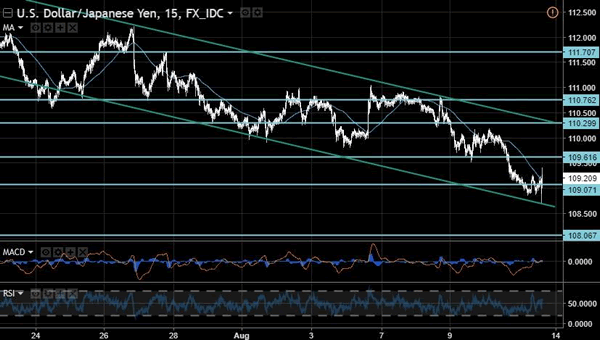
The USD/JPY quotes are moving along the lower limit of the descending channel. Now bears are trying to pull the price under the support at 109.00. In case of success, the immediate goals will be at 108.00 and 107.00. We do not exclude the price rebound from the lower limit of the channel with potential targets at 110.30 and 110.75. In such case the stop may be set under the 108.60.
WTI
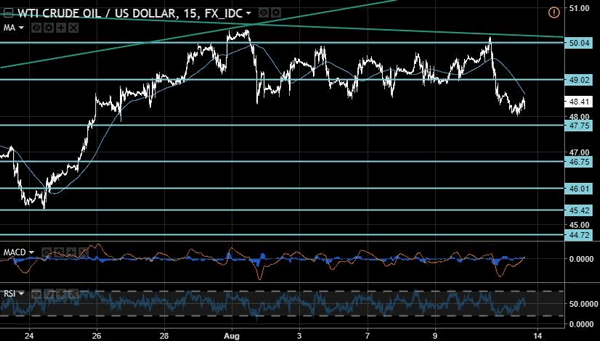
The American oil benchmark WTI was unable to gain a foothold above the psychologically important level of 50.00 and started to correct downwards. After the strong decline, quotations may restore some positions and reach SMA100 on the 15-minute chart or even 49.00. The next targets within the saving current impulse will be at 47.75, 46.75 and 45.40.
US-North Korea Dispute Remains on the Forefront; Dollar Weakens on Inflation
Rising tensions between North Korea and the United States were once again the theme of the day with only the release of much-awaited inflation figures out of the US managing to divert attention away from developments on that front. Inflation numbers surprised to the downside, leading the dollar to post considerable losses relative to other major currencies within the first minutes of data release.
The all-important July inflation numbers out of the US failed to satisfy dollar bulls' hopes of strongly putting a Fed rate hike later in the year back on the table. In particular, July headline inflation came in at 0.1% month-month in July, falling short of expectations for CPI growth to stand at 0.2% – still this was better than June's 0.0%. On an annual basis, inflation grew by 1.7%, below the 1.8% that was expected but above the 1.6% from the previous month. Core inflation that excludes volatile food and energy items grew at a pace of 0.1% m/m, the same as in June but below the forecasted 0.2%. Year-on-year, the measure remained unchanged relative to June – it stood at 1.7% as expected. Odds of a Fed rate rise during the December meeting currently stand at around 40% according to the CME Group's 30-day Fed Fund futures prices.
In terms of forex market movements, the US currency lost significant ground relative to majors including the yen, sterling and the euro – most notably the latter one – as the news on inflation went public. Interestingly though, it soon after managed to more than make up for its losses relative to the Japanese and British currencies, while it recovered a significant portion of its losses versus the euro as well.
The dollar index, which gauges the greenback against the currencies of six major US trading partners, was last 0.2% down on the day during afternoon European trading hours – it stood at 93.20. It fell to a one-week low of 92.99 a few minutes after the release of inflation figures. Meanwhile, euro/dollar was 0.2% up, just shy of the 1.18 handle, pound/dollar was flat, having earlier hit a three-week low of 1.2939 and dollar/yen was 0.1% down above the 109 level – the pair fell to 108.72 after the data on US CPI, its lowest since April 20.
The US-North Korea spat that allowed safe havens to rally this week continued during today's European session. US President Donald Trump added to the heat by tweeting that "Military solutions are now fully in place,locked and loaded,should North Korea act unwisely. Hopefully Kim Jong Un will find another path!" [sic]. North Korea accused him of driving the Korean Peninsula to the brink of nuclear war. Safe-haven perceived gold rose to a more than two-month high of $1291.99 an ounce during today's trading. It later retreated to last trade slightly below the day's open at $1286.49. The precious metal posted hefty gains in the three preceding days. The Swiss franc, another safe-haven, failed to maintain momentum from earlier days, losing ground relative to the euro and was last broadly flat versus the dollar after dollar/franc fell to a fresh two-week low 0.9582 earlier in the day.
Turning to the oil-linked loonie, it managed to post some gains relative to the greenback despite weakening oil prices. Dollar/loonie was last down 0.3% and below the 1.27 mark after rising to a one-month high of 1.2752 earlier in the day. The pair advanced in the preceding nine out of ten trading days.
Concluding with oil, WTI was last 1.0% down on the day, just above $48 a barrel, while Brent crude was 0.9% down, around $51.40 a barrel.