Sample Category Title
USD/CHF Strengthening, USD/CAD Consolidating Higher, AUD/USD Wide-Open For Further Increase.
USD/CHF Strengthening.
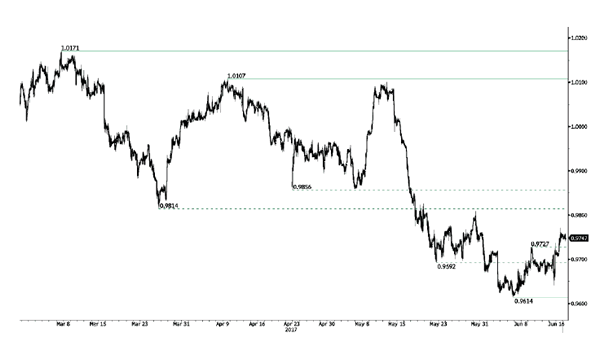
USD/CHF is pushing higher. Hourly resistance given at 0.9727 (09/06/2017 high) has been broken. Strong resistance is given at 1.0107 (10/04/2017 high). Expected to show continued short-term bullish pressures.
In the long-term, the pair is still trading in range since 2011 despite some turmoil when the SNB unpegged the CHF. Key support can be found 0.8986 (30/01/2015 low). The technical structure favours nonetheless a long term bullish bias since the unpeg in January 2015.
USD/CAD Consolidating higher.
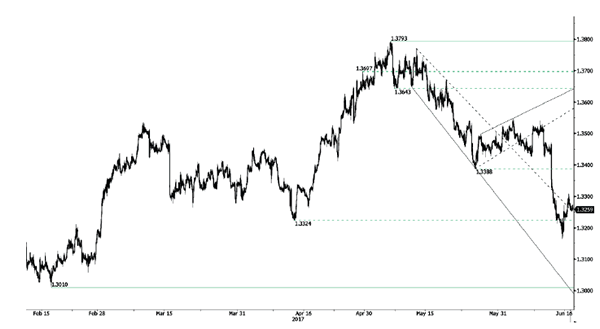
USD/CAD has strongly declined and is now consolidating higher. Hourly support found at 1.3324 (13/04/2017 high) has been broken. Expected to show continued weakness towards support given at 1.3010 (16/02/2017 low)
In the longer term, the pair lies in a bullish channel since a year. Strong resistance is given at 1.4690 (22/01/2016 high). Long-term support can be found at 1.2461 (16/03/2015 low).
AUD/USD Wide-open for further increase.
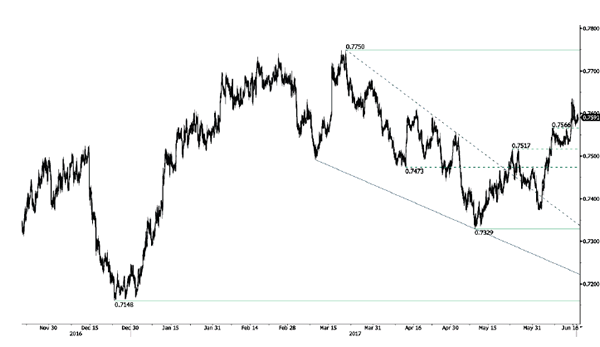
AUD/USD is pushing higher since the pair has failed to reach hourly support given at 0.7329 (09/05/2017 low). As long as prices remain below resistance at 0.7608 (17/04/2017 high), there are nonetheless strong downside risks.
In the long-term, we are waiting for further signs that the current downtrend is ending. Key supports stand at 0.6009 (31/10/2008 low) . A break of the key resistance at 0.8295 (15/01/2015 high) is needed to invalidate our long-term bearish view.
EUR/USD Consolidating Above 1.1100, GBP/USD Strengthening, USD/JPY Surprising Rebound.
EUR/USD Consolidating above 1.1100.
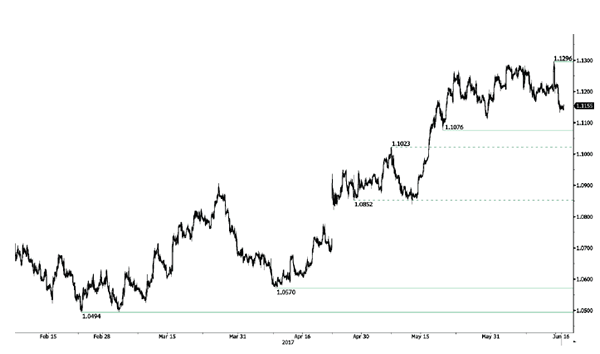
EUR/USD is trading lower. The pair is still trading below strong resistance given at 1.1300 (09/11/2017 high). Hourly support is given at 1.1110 (22/05/2017 low) has been broken. Stronger support lies at 1.0842 (11/05/2017 low) and key support is given at 1.0494 (22/02/2017 low). Expected to show renewed bullish pressures.
In the longer term, the momentum is clearly negative. We favour a continued bearish bias towards parity. Key resistance holds at 1.1714 (24/08/2015 high) while strong support lies at 1.0341 (03/01/2017 low).
GBP/USD Strengthening.
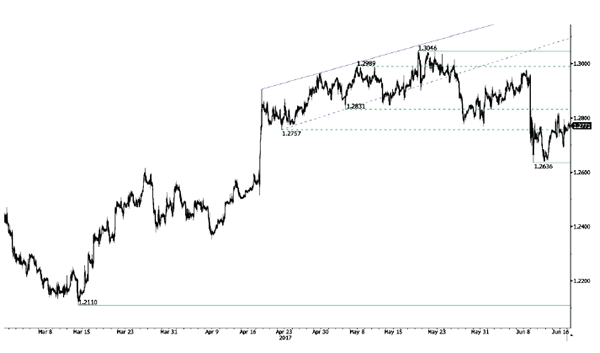
GBP/USD is now pushing up and down around former hourly support given at 1.2757 (21/04/2017 low). Hourly resistance lies at 1.3046 (18/05/2017 high). Expected to show continued short-term increase.
The long-term technical pattern is even more negative since the Brexit vote has paved the way for further decline. Long-term support given at 1.0520 (01/03/85) represents a decent target. Long-term resistance is given at 1.5018 (24/06/2015) and would indicate a long-term reversal in the negative trend. Yet, it is very unlikely at the moment.
USD/JPY Surprising rebound.
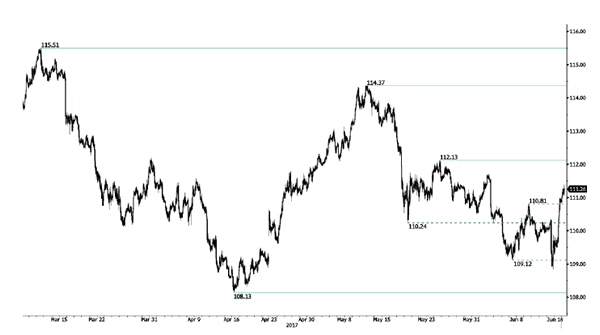
USD/JPY's short-term bearish pressures have faded. The pair has surged. Hourly support can be found at 108.89 (14/06/2017 high). Strong support is located at 108.13 (17/04/2017 low). Hourly resistance given at 110.81 (09/06/2017 high) has been broken. Other key supports lie at a distance 106.04 (11/11/2016 low). Expected to show continued increase towards resistance given at 112.13 (24/05/2017 high)
We favor a long-term bearish bias. Support is now given at 96.57 (10/08/2013 low). A gradual rise towards the major resistance at 135.15 (01/02/2002 high) seems absolutely unlikely. Expected to decline further support at 93.79 (13/06/2013 low).
BOJ Monetary Policy Remains Steady
The Bank of Japan maintained their monetary policy on Friday whilst upgrading their assessment of private consumption and overseas growth; signaling its confidence that an export focused economic recovery was broadening and gaining momentum. Short term interest rates will remain at -0.1% and 10-year Government Bond yields close to zero.
Unlike the US Federal Reserve, who have reduced their massive stimulus program, the BOJ is unlikely to adopt the same approach whilst Japanese inflation is nowhere near BOJ’s 2% target.
Following the Policy Decision, a statement from the BOJ stated; “Private consumption has shown increased resilience against a background of steady improvement in the employment and income situation”
In early trading USDJPY touched a high around 111.37 and is currently trading around 111.15. Japan’s Nikkei 225 advanced 0.7%, narrowing its loss for the week to 0.3%.
GBP moved higher on news that Prime Minister Theresa May has reached a “broad agreement on a governing agenda prioritizing Brexit and UK unity with Northern Ireland’s Democratic Unionist Party”. The markets take this as a positive with “stability” returning to the UK Government. GBP has also been bolstered with signs that there is a likely shift in the Bank of England’s policy on keeping UK interest rates at record lows. GBPUSD is currently holding above 1.2750 & EURGBP remains close to the early Friday high of 0.8741.
The Dollar Index rose to 97.539 extending the 0.5% gain it had on Thursday.
With USD strengthening gold has seen muted trading currently trading at $1254.50. If gold fails to recover from current levels it will mark a weekly loss of 1% and a second weekly decline.
WTI also remains “depressed” trading close to a 6 week low due to continued concerns over rising US inventories adding to an already heavy supply of Oil in the global market.
Friday is relatively “light” on economic data releases with the University of Michigan Consumer Sentiment Index at 15:00 BST and Dallas FOMC Member Kaplan speaking at 17:45 BST.
GBPUSD May See Further Weakness Below 50-Day Moving Average
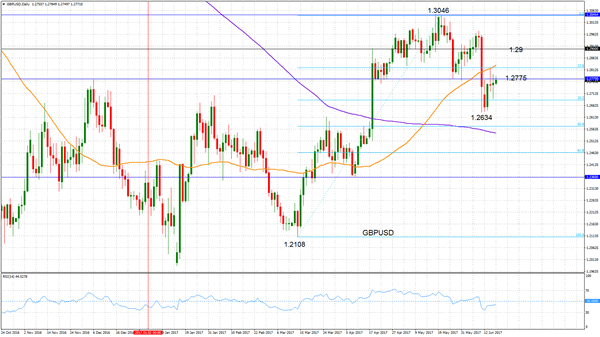
GBPUSD turned bearish in the short term after the pair’s fall from the May 18 high of 1.3046 to the June 9 low of 1.2634. There was a bounce from this level but resistance was found at the 50-day moving average and at the 23.6% Fibonacci retracement level at 1.2821. This is the retracement of the upleg from 1.2108 to 1.3046. Following a pullback from this resistance area, the market is consolidating just below 1.2775, which is now immediate resistance but was support in the past.
It remains to be see whether this bounce from 1.2634 is a temporary correction before a resumption of the downtrend that started from 1.3046. Downside momentum has faded after the RSI’s dip below 50 has resulted in a flattening of the oscillator. But it still remains in bearish territory.
A break below 1.2634 and below important support at the 50% Fibonacci at 1.2574 would increase downside momentum. A deeper decline from here would bring about a resumption of the downtrend from 1.3046 and change the bullish picture that was forming from the rise from 1.2108 to 1.3046.
Central Banks Back In Focus
SNB sidelined
As was widely expected, the Swiss National Bank held its policy unchanged. Incoming macroeconomic data has been mixed and political risk from Europe has failed to materialise, providing no impetus for the SNB to shift policy strategy.
On the economic front, despite recent improvement in inflation data, the SNB downgraded its 2018-2019 inflation forecast. The distant downgrade gave the meeting a slightly dovish tint from its prior, more cautiously optimistic, outlook.
The bank also reiterated its commitment to negative interest rates and FX intervention. With the domestic economy growing below trend and only surveys providing evidence of potential pick up, the SNB is correct in keeping policy untouched. With outlook for domestic data subdued, CHF will remain at the mercy of European events while less sensitive to shifts in global yields.
The pace of the ECB normalisations and European political uncertainty will continue to drive CHF through EURCHF direction. With European peripheral yields tightening, indicating less political concerns (French elections, Italy general election and Greek debt funding issues), CHF should weaken against the Euro. EURCHF base at 1.0860 should support a recovery bounce back to 1.1000 resistance.
BoJ maintains status quo and still focuses on 10-year yield
BoJ had no choice than to hold its monetary policy unchanged for now. The base rate has been kept on hold at -0.1% and the central bank will continue to focus on maintaining the 10-year yield to 0 by purchasing massive amounts of Government bonds (80 trillion yen annually).
The BoJ seems definitely stuck in its very loose monetary policy as deflationary pressures are still important.
Some recent fundamental data showed improvement in Japan’s economy. Japan’s demand has accelerated according to a report released last Wednesday and central bankers, once more, expect this demand to keep growing, in particular the foreign demand. Nonetheless the inflation is standing well below the target, and this has not changed for the past decade. CPI is currently standing at an annualised data of -0.4%.
Upside pressures on the currency remain but the BoJ cannot tighten its monetary policy or it would largely hurt its economy. The safe haven status is also one key issue, as whatever the state of Japan’s economy, investors would drive their money as soon as a risk-off sentiment arises.
We believe that Japan, in the medium-term, will try to expand the monetary policy divergence with the US in order to help reduce pressures on its currency. Yet, we consider that the US economy is overestimated and may trigger again inflow towards the Japanese yen. We reload bullish yen positions around 112 against the greenback.
Sterling Spikes Higher On ‘Hawkish’ BoE Vote
The Bank of England kept its policy unchanged yesterday, as was widely anticipated. However, policymakers delivered a 'hawkish' twist, as the vote to remain on hold was 5-3, much tighter than the forecast of 7-1. MPC members McCafferty and Saunders joined Forbes in calling for a rate hike, sending the message that a potential tightening move may be closer than markets previously expected. The result was a stronger pound.
EUR/GBP slid following the surprise in the BoE's votes. The pair fell below the support (now turned into resistance) zone of 0.8775 (R1) to stop slightly above the 0.8700 (S1) line. A dip below that hurdle may extend the tumble towards the 0.8640 (S2) territory. Nevertheless, given that the price structure still suggests an uptrend, we would treat such a setback as a corrective phase before the bulls decide to take the reins again.
The minutes showed that these dissents are probably owed to the higher inflation prints recently. Policymakers noted that inflation could exceed 3% by the autumn, suggesting the inflation overshoot could be more pronounced than previously thought, which reduces their tolerance of above-target inflation.
Despite the tighter vote, we do not expect the BoE to actually hike rates anytime soon. This was Forbes's last meeting as an MPC member, implying the hawkish camp in the BoE is likely to get smaller, unless her replacement is someone with very similar views. What's more, above-target inflation is temporary as the BoE reminds us of in every Inflation Report recently, and the 'overshoot entirely reflects the effects of the falls in sterling'. It would be strange to raise rates in order to combat 'temporary' effects, especially since a hike could weigh on employment and growth, in a period of elevated political uncertainty.
Moving forward, we think that GBP traders will quickly turn their attention back to developments in the political spectrum. Specifically, we think that next week, market focus will be on the Queen's speech on Wednesday and subsequently, on when the Brexit negotiations will commence.
Bank of Japan keeps its stimulus program unchanged
The BoJ kept its QQE with yield-curve control framework unchanged today, via a 7-2 vote. The meeting statement contained no surprises, with the most noteworthy point being that policymakers are now more optimistic on private consumption. Importantly, the Bank provided absolutely no signals regarding a QE-exit plan, as has been suggested by some media reports recently.
In fact, as long as inflation remains stuck near 0%, we don't expect any such announcement from the BoJ. Even though policymakers could provide a plan on how QQE with yield-curve control may eventually be removed, we think any such plan will be accompanied by strong signals that this is not going to happen anytime soon. As for the yen, given that longer-term JGB yields remain capped near 0% by the BoJ, we continue to expect the movement in yen crosses to be decided primarily by its counterparts and not so much by JPY. The exception to that would be periods when risk sentiment dominates market moves, as JPY is considered a safe haven asset.
USD/JPY surged yesterday, breaking above the crossroad of the 110.30 (S2) barrier and the downtrend line taken from the peak of the 10th of May. Then the pair emerged above the 110.80 (S1) zone to stop near 111.25 (R1). In our view, yesterday's rally has turned the short-term outlook to positive and as such, we expect a move above 111.25 (R1) to open the way for our next resistance of 111.70 (R2). Nevertheless, we would stay mindful of a corrective setback for now, given that the latest rally appears overextended.
Today's highlights:
During the European day, we have a relatively quiet calendar day. From Eurozone, we get the final CPI for May, but as the final figure is expected to confirm the preliminary estimate, the reaction in EUR is likely to be limited.
From the US, we get building permits and housing starts, both for May. These figures are expected to have risen somewhat. We also get the nation's preliminary U of M consumer sentiment index for June, which is expected to have remained unchanged.
We have only one speaker one the agenda: Dallas Fed President Robert Kaplan.
EUR/GBP
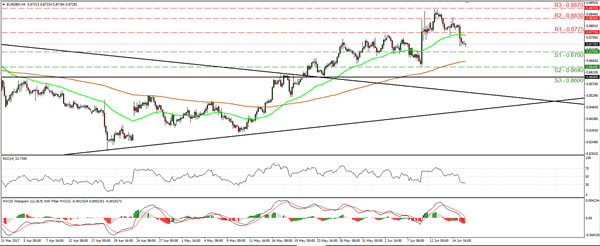
Support: 0.8700 (S1), 0.8640 (S2), 0.8600 (S3)
Resistance: 0.8775 (R1), 0.8830 (R2), 0.8870 (R3)
USD/JPY
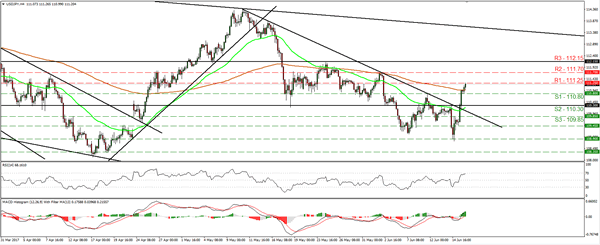
Support: 110.80 (S1), 110.30 (S2), 109.85 (S3)
Resistance: 111.25 (R1), 111.70 (R2), 112.15 (R3)
Gold Analysis: Reaches Targeted Support
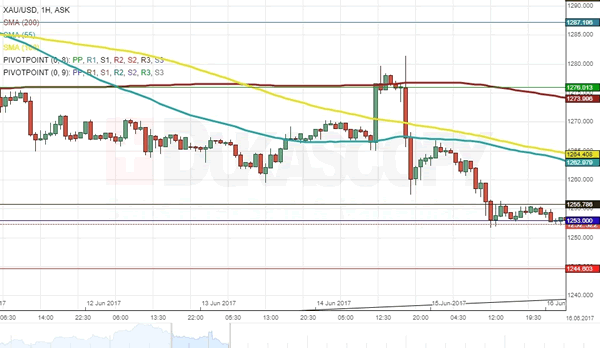
The yellow metal's price moved in the last 24 hours, as it was forecasted on Thursday morning. The commodity price has reached the combined support of the weekly S1 and the monthly PP. The weekly first support, which is located at the 1,255.79 level, has clearly been passed. However, the monthly PP at the 1,253.00 mark is holding its ground. As it can be observed on the chart, the monthly level of significance has held off a fall of the bullion for nearly 20 hours. Although, if the monthly pivot point gets passed, the commodity price is most likely going to fall to the next level of significance, as the second weekly support is located at the 1,244.60 mark. Meanwhile, while trying to identify a pattern, only slight hints of a descending short term channel can be noticed.
USD/JPY Analysis: Attempts To Stretch Gains
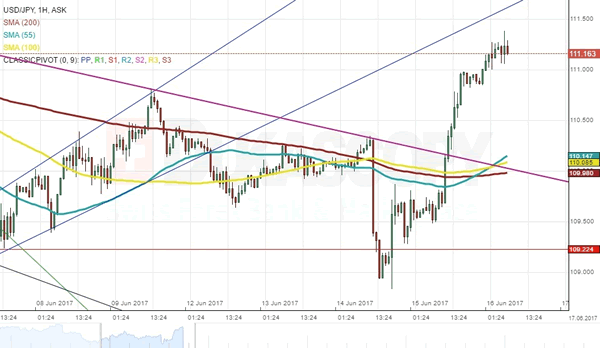
On Thursday, the US Dollar surprised to the upside, having successfully outperformed the Japanese Yen. As a result, the given pair was able to reach the 111.00 handle, but even then refused to stop appreciating. The current target is the monthly pivot point, located at 111.79; this area could provide strong resistance and limit the further gains. This pivot point is also the only solid obstacle on the USD/JPY pair's path, which is preventing the Buck from reaching its main target— the seven-month down-trend. On the other hand, the Greenback could struggle to post further gains, as some indicators suggest the rally ran out of steam, such as the RSI, which reached its 70 reading today.
GBP/USD Analysis: Continues To Consolidate
The British currency managed to erase all intraday losses yesterday and, thus, remain relatively unchanged against the Greenback. The rebound occurred from what appears to be the support line of a newly-forming ascending channel pattern, but additional confirmations are required to confirm if the channel is reliable. So far the exchange rate keeps gravitating towards the monthly S1, with risks skewed to the downside. Consequently, if the Cable experiences another decline today, the potential support would be the earlier-mentioned channel's support line around 1.2720. On the other hand, gains should be capped circa 1.2850, but a surge that far up today is doubtful, as there are no solid market movers expected to drive the given pair today.
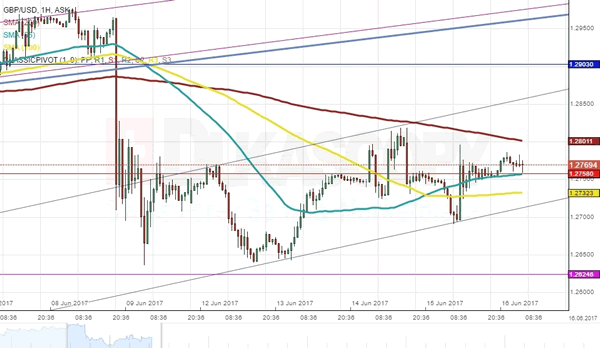
EUR/USD Analysis: Leaves 1.12 Mark
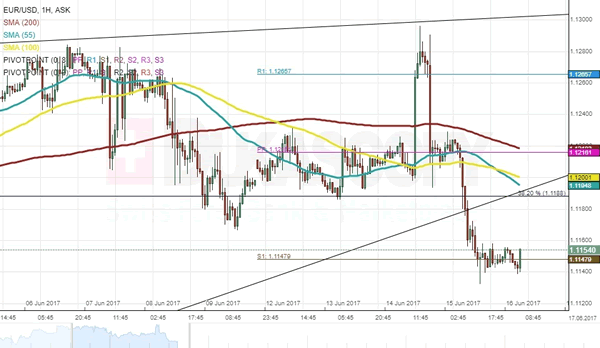
It seems that the third bounce off from the long term resistance did the trick. The common European currency has declined against the US Dollar to the weekly S1, which is located at the 1.1148 level. This fall was long expected on larger timeframe charts. It is most likely now that the currency exchange rate will continue on its path lower. In the process a new medium term pattern is expected to form, which should provide guidelines about the probable direction of the Euro against the Buck in the upcoming few months. However, for now the target zone is unclear. Meanwhile, from a technical perspective it can be observed that a depreciation of the Euro against the US Dollar is to be expected.