

Sample Category Title
Elliott Wave View: GBPJPY Extension Lower
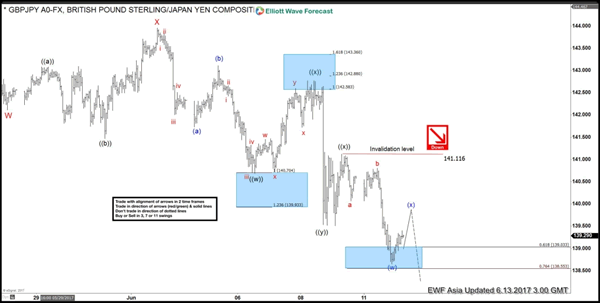
Short term GBPJPY Elliott Wave view suggests the decline from 5/10 high shows a 5 swing sequence, thus favoring more downside. Decline from 5/10 high is unfolding as a double three Elliott Wave structure. Down from 5/10 peak (148.11), Minor wave W ended at 141.47 and Minor wave X ended at 143.96. Minor wave Y is currently in progress and has scope to retest 4/16 low (135.58). Support can be seen at 135.7 – 137.3 area for at least 3 waves bounce.
Subdivision of Minor wave Y is proposed to be unfolding as a triple three Elliott Wave structure. Down from 6/1 peak (143.96), Minute wave ((w)) ended at 140.68, Minute wave ((x)) ended at 142.77, Minute wave ((y)) ended at 139.52 and Minute second wave ((x)) ended at 141.11. Near term, while Minutte wave (x) bounce stays below 141.11, and more importantly below 143.95, expect pair to extend lower. We don’t like buying the proposed bounce.
GBPJPY 1 Hour Elliott Wave Chart
Market Morning Briefing: All Eyes Remain Glued On The Three Central Bank Meetings This Week
STOCKS
Overall stocks are stable and could either remain ranged or move up in the near term
Dow (21235.67, -0.17%) is slowly inching up towards 21600 and could possibly test 21400 on the upside this week. Support remains at 21000 and while the index is trading above 21000, the trend remains bullish.
Dax (12690.44, -0.98%) fell sharply yesterday instead of breaking above 12850. We could possibly see some trade within the 12650-12850 region in the near term before testing 13000.
Shanghai (3138.67, -0.04%) has enough scope on the upside towards 3160-3170 for the next couple of sessions.
Nikkei (19885.72, -0.11%) is holding above 19825 and could move up towards 20000 in the coming sessions. Near term looks bullish.
Nifty (9616.40, -0.54%) has been fluctuating within the 9700-96500 region and could possibly continue to do so for some more sessions. Immediate support is seen near 9600 which could extend to 9550 on the downside. Overall the index could be ranged sideways before rallying to higher levels.
COMMODITIES
Muted price action had been seen in Gold (1264) as it remains in a slow corrective move which may take it to the support of 1242 but if the support holds, a quick bounce towards 1307can’t be ruled out. Silver (16.88) also moved lower in line with our expectation. A close below 16.80 could open up 16.50 as well. We might see less volatility in the market ahead of FOMC meeting (on 14th June 2017), which may add some directional clarity.
Copper (2.62) is trading within the narrow range of 2.56-2.68. Only above 2.68, higher resistances of 2.84 can come into consideration. We will remain bullish on copper while it is trading above 2.55 regions.
Nothing new to add as market is waiting for tomorrow’s U.S FOMC as well as weekly crude inventory data. Brent (48.47) and WTI (46.30) is trading above their respective supports of 47.40 and 44.20 to keep the upside possibility of 50.22 (Brent) and 47.50 (WTI) open. If Brent and WTI manage to close above 50.30 and 47.50 in the next couple of sessions, another attempt for 52 and 49.55 can be seen. Bearish possibilities will come in consideration in case 47.40 for Brent and 44.20 for WTI break down.
Gold/WTI ratio (27.59) found resistance at 28 levels and might come down towards 26.50-27 levels.At the same time Brent-WTI 3day spread (2.22) had bounced from its support near 2.00 levels and could move up towards 3.00-3.25 regions within a few days of time.
FOREX
All eyes remain glued on the three central bank meetings this week - FOMC on 14th, BOE on 15th and BOJ on 16th, among which BOE and BOJ are expected to keep the rates unchanged but the Fed is expected to hike.
Dollar Index (97.22) is taking a comfortable pause after the sharp rally from 96.50 to 97.30 last week and may resume the rally for 97.70-80 after the FOMC conclusion tomorrow. A sustained break above 97.80 may open the door for further upside towards 100.00.
Euro (1.1191) remains weak and may test the immediate support area in 1.1140-00 in the next couple of sessions. If 1.1100 fails to hold in the near term, the downside risk for Euro may increase considerably.
A bit of risk aversion is driving money into Yen and pushing Dollar-Yen (109.98) lower. If the FOMC policy decision looks favorable to the market tomorrow, then Dollar may strengthen and pull Dollar Yen up but it needs a break above 110.60 as the initial signal for an upside reversal.
Contrary to expectations, Pound (1.2646) is in a free fall towards 1.2600 and may test the long term support of 1.2560-40 by the end of the week if the current bearish momentum persists. Some amount of short covering can be expected near 1.2560-40 if Pound declines that far. The trend remains firmly down below 1.2800.
Aussie (0.7558) is stalling near the previous week’s high of 0.7567 and may rise to 0.7590-0.7610 yet but it may be the time for caution as a short term correction can be expected from anywhere in the area of 0.7570-0.7610.
Dollar-Rupee (64.44) closed above 64.40 yesterday moving in line with our expectation. The rise may extend towards 64.50/60 in the coming sessions from where a pulll back to current levels is possible.
INTEREST RATES
The US yields continue to rise and look bullish in the near term. The 10Yr (2.21%) could head towards 2.28% while the 30YR (2.87%) could move up to 2.90% but there could be a small dip before moving up.
The Japan-US 10YR (2.15%) has bounced from immediate support and could test 2.2% in the near term taking up Dollar Yen a bit. Overall the yield spread looks bullish for the near term.
The German-US 10Yr (-1.96%) has broken below the immediate support near -1.95% mentioned yesterday and while the yield spread continues to move lower, Euro could come off sharply. The German-US 2Yr (-2.11%) had given an initial indication of a fall in the yield spreads and the Euro. The 2YR yield spread could possibly pause before moving to lower levels in the next couple of sessions.
The UK-US 10YR (-1.24%) has come off sharply in the last few sessions and is testing support near current levels. If the yield spread bounces back from support, it could move back towards -1.18%. In that case the Pound could remain stable for at least 1-2 sessions.
FOMC Preview: Expectations Are High But Data Do Not Justify A Hike Yet
- We stick to our view that the Fed will skip hiking at the upcoming meeting and instead announce the triggers for quantitative tightening (QT), as a datadependent Fed should wait at least one meeting to confirm that recent weakness is only temporary.
- However, given the high expectations of a June hike, the Fed may have painted itself into a corner, as high expectations have weighed on the Fed's decision before.
- If the Fed hikes in June, we do not expect an announcement on QT. Instead, we expect it to be postponed until the September meeting. We still think the third hike is most likely in December.
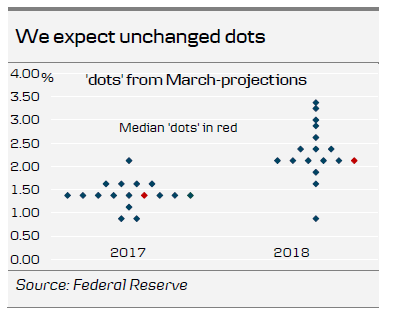
- We expect unchanged 'dots' signalling three hikes per year and see limited chance of a hawkish surprise.
- We target EUR/USD at 1.09 in 3M and expect only modest impact on Treasury yields from QT.
Unchanged dots
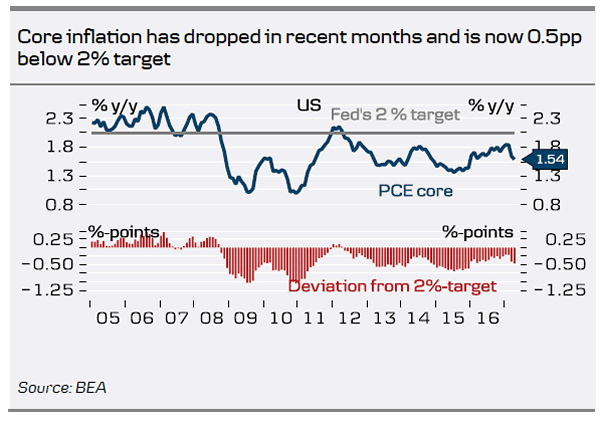
Next week's meeting is one of the so-called big meetings, which means that we get updated projections and there will be a press conference after the meeting. We will pay particular attention to the 'dots'. We believe the 'dots' will be unchanged signalling a hiking pace of three hikes per year, which is also part of the reason why we do not think the Fed will want to hike at this meeting since it would signal four hikes this year – more on this below. Furthermore, we believe the estimate of the long-run interest rate will be 3%. NAIRU and inflation estimates are also interesting. The NAIRU estimate is interesting, as the Fed's latest estimate of NAIRU was 4.7% and the unemployment rate has recently hit 4.3%. The projection for inflation is interesting given the recent sharp fall in inflation
Data-dependent Fed should wait at least one meeting
For a long time we have held the view the Fed would skip hiking in June and instead announce the triggers for quantitative tightening. One reason has been the Fed's desire to start quantitative tightening this year while avoiding a new round of 'taper tantrum', meaning the FOMC members want to announce the details well in advance. Another was that the hiking cycle would be smoother by waiting until July, assuming the Fed wants to hike three times this year as signalled both in December and in March (by hiking in both March and June, the Fed has hiked every other meeting since December, implying a hike pace of four per year). However, given the high expectations of the Fed delivering, it may have painted itself into a corner, as high expectations have weighed on the Fed's decision before although we do not expect a possible June hike to be unanimous.
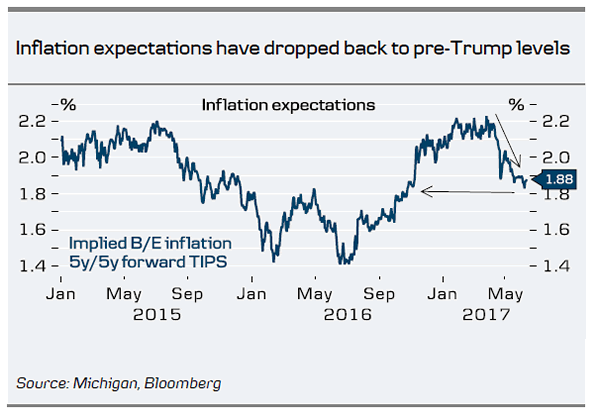
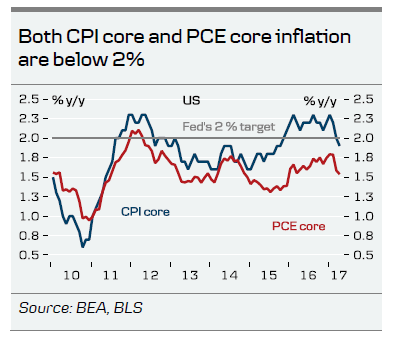
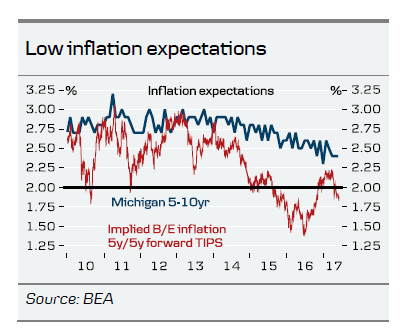
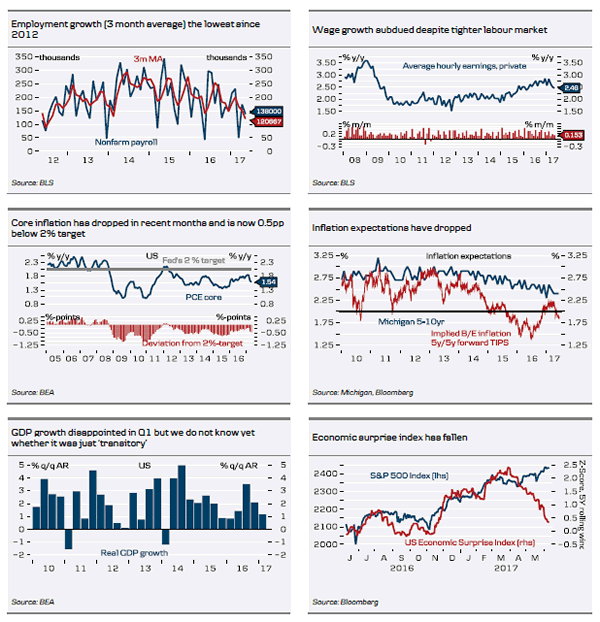
We are a bit worried about the Fed hiking already again here in June (especially after the hike in March, which came out of the blue), as we do not think the data support it. While the unemployment rate fell to a new cycle low of 4.3% in May, it was for the wrong reason, as the labour force fell – employment growth has declined to the lowest level since 2012. Inflation has disappointed in recent months, inflation expectations have declined since the March meeting and wage growth is still missing despite the tighter labour market. The US surprise index has fallen back to neutral. GDP growth disappointed in Q1, possibly partly due to negative residual seasonality, but we do not know whether growth has accelerated here in Q2. Also, it seems less likely that Trump will deliver on his promises on tax reform and infrastructure investments, meaning that growth will not be boosted by Trumponomics. Although most FOMC members have not incorporated more expansionary fiscal policy in their projections (some have partly), sentiment has begun to decline again both among consumers and businesses.
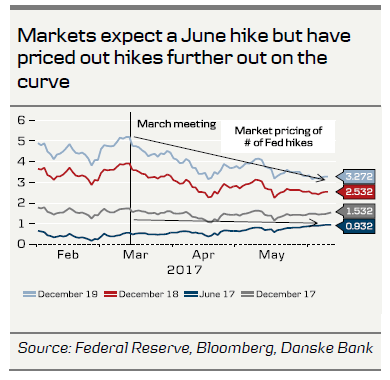
A Fed hike in June would mean that it is not as data dependent as we thought or the Fed puts more weight on the unemployment rate than we estimated. By waiting until July the FOMC members will get a few more data points to support their views that the recent weakness is temporary and additionally they show markets that every meeting is in fact live, although even July may turn out to be soon. While markets seem convinced the Fed is going to hike in June, it is interesting investors have priced out the number of hikes further out even since the surprising hike in March. By hiking this fast, there is a risk that the Fed may need to pause its hiking cycle and we think risks are skewed towards fewer hikes than the three hikes per year regime, which is our current base case.
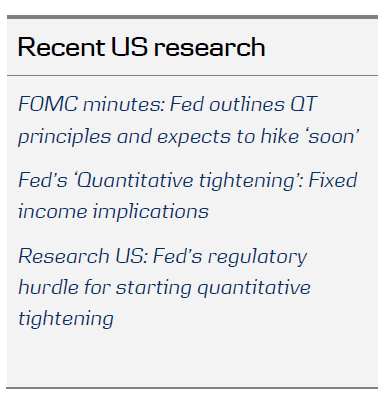
In the statement from the May meeting, the Fed communicated that 'ahead of future adjustments to the target range for the federal funds rate, the Committee will assess realized and expected economic conditions relative to its objectives of maximum employment and 2 percent inflation'. If the Fed is serious about this, the recent, and rather significant, decline in PCE inflation speaks in favour of postponing a hike and seeing whether this downtick is temporary or permanent before continuing to hike. EUR/USD: Fed to fuel a negative summer cocktail
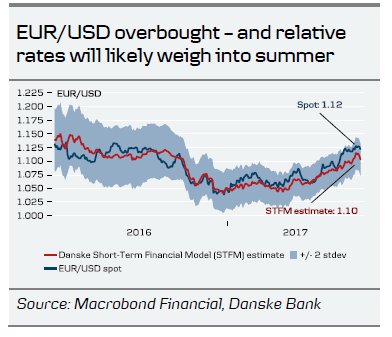
With a Fed that is poised to confirm its determinedness to move on with both hikes and balance-sheet reduction - irrespective of whether a June hike is delivered or not - we expect dollar strength to return temporarily into the summer as the market is currently priced very soft beyond 2017. Although the Fed may eventually have to slow down on its proposed tightening package, we deem that complacency in US rates recently makes for a period of upside to USD crosses from a relative-rate angle.
Ample USD liquidity following the US Treasury Q1 cash deluge has also led to narrowing of the EUR/USD XCCY basis – a factor we reckon has been supportive for EUR/USD during H1 this year. However, with the Fed likely to make an announcement, or at least provide further details, on its planned reduction of its balance sheet focus in the market will return to USD liquidity which is prone to become scarcer during H2. In Research US - Fed's regulatory hurdle for starting quantitative tightening we highlighted an optimistic scenario for reducing the balance sheet to be one which targets a total reduction of around USD1,700bn over five years that would amount to an average monthly reduction of USD30bn. We stick to that view, which means that if the Fed presents something along those lines we see a risk of the start of an unwarranted tightening of USD liquidity over the coming 3-12M depending on the timing of the start of the reduction. That should widen the EUR/USD XCCY basis and be a negative contributing factor for EUR/USD. In particular, if reductions to a greater extent target Fed's holdings of mortgage-backed securities.
For EUR/USD, a hawkish stance from the Fed would come at a time where the ECB has admittedly moved a tad closer to 'neutral' on rates but at the same time laid out an inflation outlook that deters Draghi and co from looking for an easing exit any time soon. In our view, this makes for a period where EUR/USD could move to the lower end of its newfound 1.08-1.13 range. Should the Fed refrain from hiking in June, the knee-jerk reaction will most likely be to send EUR/USD higher, but we do not expect a move much above the 1.13 level. However, in our base case that a summer hike will come – if not June, then July – we think that as markets digest the boldness with which we think the FOMC will move near term, USD strength will materialise for a while. Add the risk of a slowing eurozone growth momentum in coming months and you have a EUR/USD negative summer cocktail. We remain tactically short the pair in the Danske FX Trading Portfolio and target EUR/USD at 1.09 in 3M. That said, we still see levels below 1.10 as attractive for positioning for a renewed uptick towards the end of the year.
We expect modest spill-over to Treasury yields from QT
The latest minutes stated that quantitative tightening will be conducted 'in a gradual and predictable manner'. The staff proposes that the FOMC announces a set of gradually increasing caps/limits on the dollar amounts of bonds that will be allowed to run off each month and only reinvest the amounts that exceeded the caps each month. The caps will be set at low levels and then raised every three months (corresponding to every other meeting, although the Fed will likely not vote on this every month, as many FOMC members have argued it should run in the background). When the final values of the caps are reached, the caps will be maintained and the balance sheet will continue to shrink until the target is reached. In the minutes, it was also noted that the approach would 'likely be fairly straightforward to communicate'. Besides, the ongoing caps/limits 'could help mitigate the risk of adverse effects on market functioning or outsized effects on interest rates'.
In our view, the spill-over to Treasury yields from a reduction in the Federal Reserve's balance sheet by phasing out or ceasing reinvestments of the MBS prepayments and/or scheduled repayment of principals should be modest. That said, the potential steepening pressure induced by phased out or ceased reinvestments of maturing Treasuries relies heavily on the Treasury's issuance pattern going forward, but should be moderate compared to the 'taper tantrum' in 2013. Besides, a too excessive quantitative tightening could lead to temporary tightening of financial conditions, offsetting a potential steepening pressure (for more see Fed's 'Quantitative Tightening' Fixed Income Implications, 6 April 2017).
Bank Of Canada’s Wilkins Hints At Hikes And Drops USD/CAD As A Result
But it wasn't even the Queen's birthday, I hear you say?
'The day has been celebrated since 1788, when Governor Arthur Phillip declared a holiday to mark the birthday of King George III. Until 1936 it was held on the actual birthday of the Monarch, but after the death of King George V it was decided to keep the date at mid-year.'
Ah yes, of course…
Even the most hardened Australian republican enjoys being part of the British Commonwealth when they're so generously gifted a long weekend.
God Save the Queen!
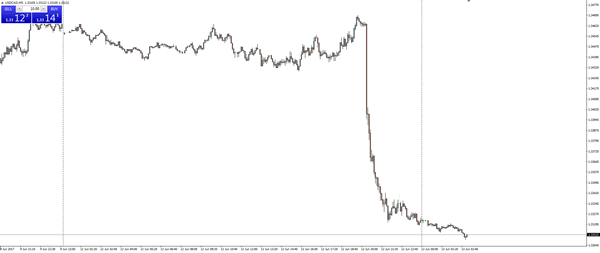
Now moving onto markets and speaking of British Commonwealth countries, it was the Canadian Dollar making headlines with a rip in Asia today. It was the Bank of Canada's Carolyn Wilkins that hit the newswires with a speech that wasn't even marked on a lot of forex calendars and she had USD/CAD in the firing line.
'…BoC would need to take appropriate action.'
That's all that forex markets needed to hear and is a clear hawkish shift by the BoC moving forward.
Goodbye USD/CAD.
USD/CAD 5 Minute:
Now with today's comments not being scheduled on most economic calendars, there will be plenty of you (including myself), who missed the early boat on any potential shorts.
This is where looking for areas of interest on pullbacks comes into play.
USD/CAD 4 Hour:
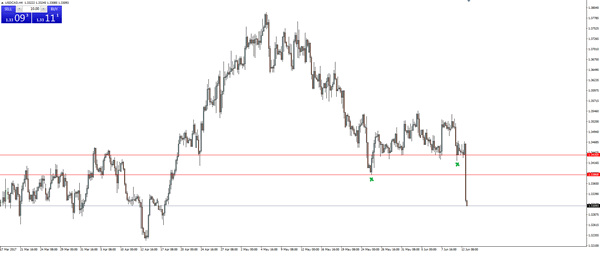
On the above 4 hour chart, I've marked a couple of these areas to watch out for, if price does in fact pull back.
The Loon Ruffles Some Feathers
The Loon ruffles some feathers
UK politics continues to be the main narrative with the usual conversations around President Trump providing the background fodder. However, the Bank of Canada did more than ruffle a few feathers with some unexpected hawkish rhetoric
Canadian Dollar
Carolyn Wilkins, Senior Deputy Governor of the Bank of Canada signalled that Canadian interest rates have bottomed and the next policy shift will likely be higher came like a bolt from the blue. Her guidance caught more than a few traders off guard as the Loonie rallied hard and fast from 1.3470 to 1.3310 during the NY session.
British Pound
Sterling traded in bedraggled fashion overnight as there remain no protective legislative measures in place engulfing the markets in a cloud of uncertainty.While GBP near term direction will continue to be driven by the post-election fallout, but the prospects for the Pound look increasingly gloomy as the possibility of another Tory leadership vacuum enters the picture at precisely the wrong time for the UK.
Japanese Yen
USDJPY fell below the psychological 110 level on the back of falling US yields as the markets bore witness to an acute bout of risk aversion with the NASDAQ correction moving into day two. However, with the FOMC this week it is unlikely yields will press much lower and we should expect the USDJPY make a minor comeback
Euro
EURUSD remains exceptionally stable although the political fallout in the UK. The market appears content to look past whatever dovish interpretation gleaned from last week’s ECB, given few catalysts I suspect the EURUSD to remain mired within the current ranges ahead of the FOMC.
Australian Dollar
The Aussie dollar remains very resilient although the Australia May NAB business confidence slid to 7 versus 13 prior and business conditions fell 12 versus 13 previous.
The commodity block is trading on a positive note riding the Canadian dollar coattails after the BOC signalled a probable shift in monetary guidance.What’s at play here is the notion that central bankers, in general, may not want to fall behind hind the curve more so if inflation pressures see a resurgence. Perhaps some of this argument may be rubbing off locally and supporting the AUD
BOC Flips The Switch
A quick look at the USD/CAD chart shows how seriously the market took a hint from Bank of Canada senior deputy Wilkins today. The loonie was the top performer while the pound lagged. Australian business confidence is due later. The Premium video below dissects the technical and fundamental forces underpinning the British pound, inlcuding our GBP trades.
Any time a central banker's comment leads to a 150 pip fall in a currency it's serious but when it leads to a six-week low, a break of the 100-day moving average and a break of the 200-dma, it's especially notable.
That's what happened after Wilkins said the BOC is rethinking whether the 50 basis points in rate cuts since 2015 is still needed. She painted an upbeat picture of the economy that was already evident after GDP rose at a 3.7% annualized pace in Q1 and the economy added 54.5K jobs in May. Wilkins was almost unequivocal in her praise for an economy where she said signs of growth are broadening.
The implied probability of a hike by year-end rose to 58% from 29% on her comments. That kind of swing is rare and underscores the downside for USD/CAD. In addition, note that longs in the pair a sliver away from record extremes and are surely feeling uncomfortable.
Another place where central bankers have been feeling upbeat is Australia. The RBA last week brushed aside a soft Q1 and one of the reasons is upbeat consumer and business sentiment. We will get the next look at 0130 GMT when NAB releases its business confidence data for May. The prior reading was +13.
Yen Shrugs Off Soft Manufacturing Report
USD/JPY has edged higher at the start of the week. In Monday's North American session, the pair is trading at the 110 line. On the release front, Japanese Core Machinery Orders declined for the first time in three months, with a reading of -3.1%. This was much weaker than the forecast of +0.6%. Japanese PPI gained 2.1%, shy of the forecast of 2.2%. Later in the day, Japan releases BSI Manufacturing Index, with an estimate of 1.1 points. On Tuesday, Japan releases PPI, with the markets braced for a flat reading of 0.0%.
The Japanese economy has shown some improvement in the first quarter, but Final GDP was a major disappointment. First quarter GDP was revised downwards to 0.3%, compared to 0.5% in the preliminary GDP report. At the same time, the economy has posted growth for five consecutive quarters – the first time that has occurred in over 10 years. Japan has benefited from a stronger global economy, notably the manufacturing and export sectors. However, domestic consumption remains sluggish, and household spending contracted 1.4% on year in April. The Bank of Japan will hold a policy meeting on Thursday, and is expected to maintain its ultra-loose monetary stance in order to prop up inflation and domestic demand. Given that the economy has strengthened, policymakers may be looking to exit current policy, and analysts will be looking for nuances in BoJ language (in the rate statement or BoJ Governor Haruhiko Kuroda's press conference) which could point to a more hawkish monetary stance. If the central bank does hint at a tighter policy, the yen could gain ground.
The Federal Reserve will meet on Wednesday, and the markets have priced in a rate hike, which would be the second increase in 2017. The likelihood continues to hover around the 90% level, so it would be a shock if the Fed did not make a move. However, an additional rate hike seems much less likely in the third quarter, with the CME forecasting the odds of a September move at just 26%. The markets are skeptical about another rate hike in the second half, unless the political situation in Washington shows signs of stabilizing. The Trump administration remains in damage control mode, as it's difficult to assess the damage from the dramatic evidence of ex-FBI director James Comey. With dark clouds hovering above the White House, the Fed and the markets have serious concerns with regard to Trump's ability to move forward with his economic agenda.
Elliott Wave Trade Ideas Performance Update
3 positions were entered last week with total profit of 210 points and the positions are listed below.
2 Jun : GBP/JPY - Short at 143.65, exited at 141.65 (+ 200 points)
2 Jun : EUR/GBP - Short at 0.8735, exited at 0.8725 (+ 10 points)
9 Jun : USD/CAD - Short at 1.3500,
| AUD EUR/JPY EUR/GBP CAD GBP GBPJPY
Jan - 15 -275 - 35 -120
Feb + 140 -17 - 40 +11
Mar - 20 +115 +132 - 19
Apr + 30 - 40 +120 + 45
May - 55 +100 - 60 -65 -60
Jun + 1 + 10 +200
Jul
Aug
Sep
Oct
Nov
Dec
Y-T-D + 136 - 232 +127 + 98 -65 +185
Candlesticks and Ichimoku Trade Ideas Performance Update
6 positions were entered among all 4 currency pairs with total profit of 65 points and the positions are listed below:
1 Jun : EUR/USD - Long at 1.1205, exited at 1.1235 (+ 30 points)
8 Jun : EUR/USD - Long at 1.1240, exited at 1.1210 (- 30 points)
8 Jun : USD/JPY - Short at 110.20, exited at 110.55 (- 35 points)
9 Jun : GBP/USD - Short at 1.2760, exited at 1.2660 (+ 100 points)
9 Jun : USD/CHF - Short at 0.9720,
12 Jun : EUR/USD - Short at 1.1230,
| JPY EUR CHF GBP
Jan + 167 - 85 - 10 + 50
Feb + 200 +150 +93 - 59
Mar -23 -70 -23 - 35
Apr + 65 + 93 + 50 - 40
May - 65 - 35 + 100 -175
Jun - 35 0 + 100
Jul
Aug
Sep
Oct
Nov
Dec
Y-T-D + 308 + 48 +210 -149
Trade Idea Wrap-up: USD/CHF – Hold short entered at 0.9720
USD/CHF - 0.9691
Most recent candlesticks pattern : N/A
Trend : Near term down
Tenkan-Sen level : 0.9683
Kijun-Sen level : 0.9692
Ichimoku cloud top : 0.9697
Ichimoku cloud bottom : 0.9677
Original strategy :
Sold at 0.9720, Target: 0.9620, Stop: 0.9720
Position : - Short at 0.9720
Target : - 0.9620
Stop : - 0.9720
New strategy :
Hold short entered at 0.9720, Target: 0.9620, Stop: 0.9720
Position : - Short at 0.9720
Target : - 0.9620
Stop : - 0.9720
Although dollar staged a strong rebound from last week’s low of 0.9613 to 0.9728 (last week’s high), the subsequent retreat has retained our bearishness and consolidation with mild downside bias remains for weakness to 0.9657 support, however, break of 0.9640 is needed to signal the rebound from 0.9613 has ended, bring retest of this level first. A break below this level would extend recent decline to 0.9600-05 (50% projection of 1.0100-0.9692 measuring from 0.9808) later.
In view of this, we are holding on to our short position entered at 0.9720. Above said resistance at 0.9728 would abort and signal a temporary low has been formed at 0.9613 last week instead, bring a stronger rebound to 0.9761 resistance but price should falter below resistance at 0.9808.
