

Sample Category Title
Go With The Herd And Short Gold?
After featuring XAU/AUD (the ugly cousin?), over the last couple of weeks, a double top in XAU/USD has eventually brought us back home!
First up we focus on the gold daily chart, featuring a nice double top at previous support turned possible resistance:
XAU/USD Daily:
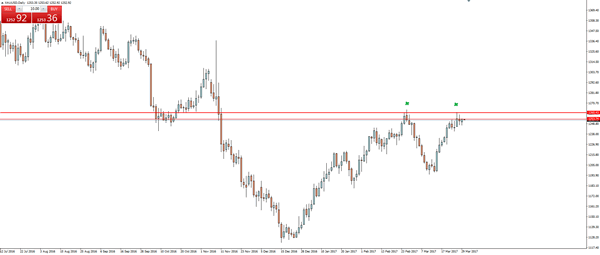
A double top that just happens to coincide with that previous swing low you can see on your MT4 charts from back in September 2016.
I guess you could call that a confluence of resistance now that we have the second touch of a potential double top? Well, whichever way you want to look at it, you have price that has retested previous support as resistance on the daily and when you zoom in that little further you can see potential for a clear double top.
So now that price is being capped by resistance, we zoom into an intraday chart to look for possible short term pullbacks to short into:
XAU/USD Hourly:
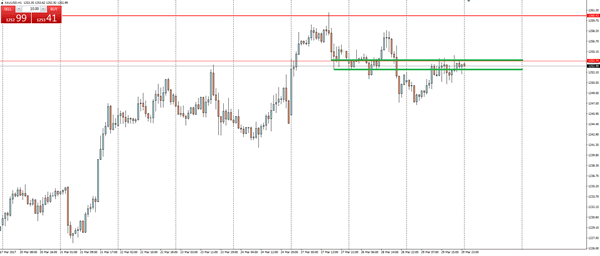
Price hasn’t cleanly rejected off the daily level like we’d ideally like, but if you’re after textbook idealism then live forex trading probably isn’t for you.
In saying that, price is forming lower highs and lower lows and this level is a short term retest that we can use to enter off and manage risk around if you’re aggressive, while still being close to enough to the double top if you’re more conservative.
It was a tongue in cheek comment about how being a contrarian to trading calls made in the mainstream media is never a bad strategy.
My chart is obviously a little different to the Gold chart in that CNBC article, but the possible herd mentality of this trade is definitely something to be aware of.
Trade Idea Wrap-up: USD/CHF – Stand aside
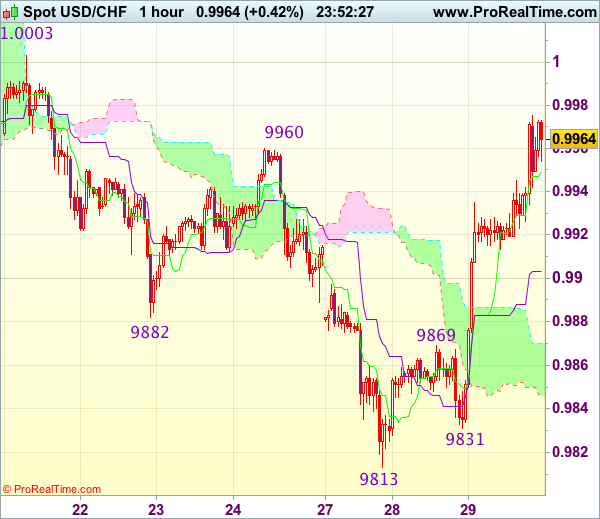
USD/CHF - 0.9968
Most recent candlesticks pattern : N/A
Trend : Near term down
Tenkan-Sen level : 0.9949
Kijun-Sen level : 0.9905
Ichimoku cloud top : 0.9870
Ichimoku cloud bottom : 0.9946
New strategy :
Stand aside
Position : -
Target : -
Stop : -
The greenback rallied after finding renewed buying interest at 0.9831 yesterday, dampening our bearishness and suggesting recent decline has ended at 0.9813, hence upside risk remains for this rise from 0.9813 to bring retracement of recent decline and further gain to resistance at 0.9960 would be seen but break there is needed to provide confirmation and retain bullishness for further rise towards another previous chart resistance at 1.0003 later.
In view of this, would be prudent to stand aside in the meantime. below the Kijun-Sen (now at 0.9905) would suggest an intra-day top is formed instead, bring weakness to the lower Kumo (now at 0.9846) but break of said support at 0.9831 is needed to revive bearishness for retest of 0.9813 first.
Trade Idea Wrap-up: GBP/USD – Sell at 1.2500
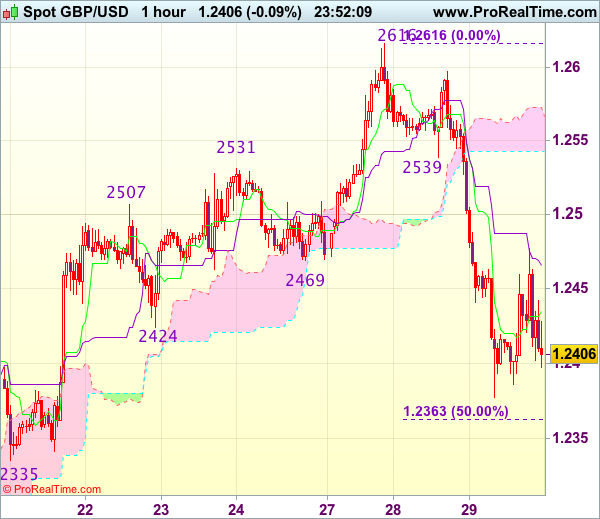
GBP/USD - 1.2412
Most recent candlesticks pattern : N/A
Trend : Near term up
Tenkan-Sen level : 1.2437
Kijun-Sen level : 1.2458
Ichimoku cloud top : 1.2567
Ichimoku cloud bottom : 1.2543
Original strategy :
Sell at 1.2500, Target: 1.2365, Stop: 1.2535
Position : -
Target : -
Stop : -
New strategy :
Sell at 1.2500, Target: 1.2365, Stop: 1.2535
Position : -
Target : -
Stop : -
As cable has dropped sharply since yesterday, suggesting top has been formed at 1.2616 and the selloff from there is likely to bring retracement of recent upmove, hence further weakness to 1.2360-65 (50% Fibonacci retracement of 1.2109-1.2616) would be seen, however, loss of near term downward momentum should prevent sharp fall below 1.2335 support and reckon 1.2300-05 (61.8% Fibonacci retracement) would hold from here, bring rebound later.
In view of this, we are looking to turn short on recovery as the Kijun-Sen (now at 1.2486) should limit upside and bring decline. Above 1.2500-10 would defer but only break of previous support at 1.2539 would abort and signal the fall from 1.2616 has ended instead, bring rebound to 1.2560-65 first.
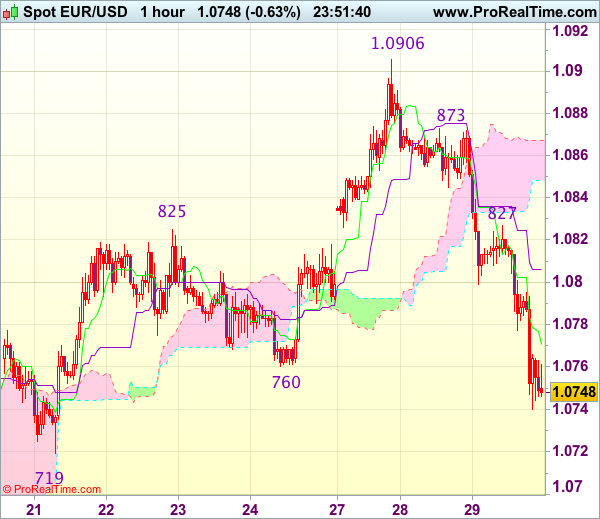
Trade Idea Wrap-up: EUR/USD – Stand aside
EUR/USD - 1.0753
Most recent candlesticks pattern : N/A
Trend : Near term up
Tenkan-Sen level : 1.0771
Kijun-Sen level : 1.0806
Ichimoku cloud top : 1.0867
Ichimoku cloud bottom : 1.0848
New strategy :
Stand aside
Position : -
Target : -
Stop : -
As the single currency has fallen again after brief recovery, suggesting the fall from 1.0906 is still in progress and downside risk remains for this fall to extend weakness towards support at 1.0719, however, near term oversold condition should prevent sharp all below 1.0695-00 and reckon 1.0670 would hold from here, risk from there is seen for a rebound to take place later.
In view of this, would not chase this fall here and would be prudent to stand aside in the meantime. Above 1.0780 would bring recovery to 1.0800 but only break of resistance at 1.0827 would signal low is formed, bring a stronger rebound to 1.0850 later.
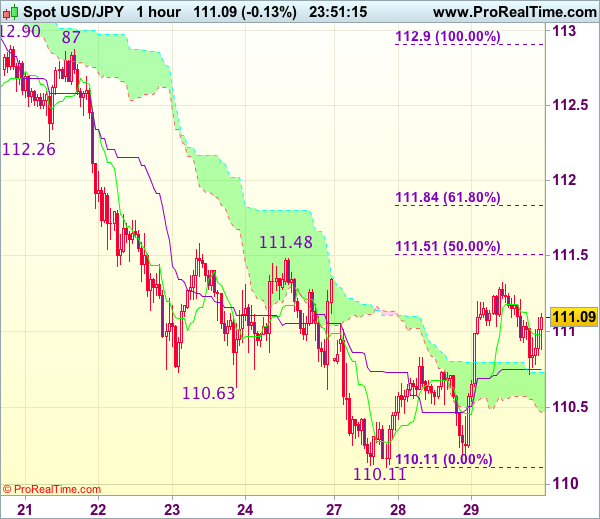
Trade Idea Wrap-up: USD/JPY – Hold short entered at 111.20
USD/JPY - 111.00
Most recent candlesticks pattern : N/A
Trend : Down
Tenkan-Sen level : 110.97
Kijun-Sen level : 110.75
Ichimoku cloud top : 110.73
Ichimoku cloud bottom : 110.47
Original strategy :
Sold at 111.20, Target: 110.20, Stop: 111.35
Position : - Short at 111.20
Target : - 110.20
Stop : - 111.35
New strategy :
Exit short entered at 111.20,
Position : - Short at 111.20
Target : -
Stop : -
As dollar found support at 110.72 and has rebounded, suggesting near term upside risk remains and above 111.32 resistance would bring test of 111.48-51 (previous resistance and 50% Fibonacci retracement of 112.90-110.11), however, break there is needed to signal low is formed at 110.11, bring retracement of recent decline to 111.80-85 (61.8% Fibonacci retracement) but price should falter below previous support at 112.26, bring retreat later.
In view of this, we are exiting our short position entered at 111.20 and stand aside for now. Below 110.72 would bring weakness to 110.50 but break of said support at 110.11 is needed to confirm recent decline has resumed and extend weakness to 109.95-00 but loss of downward momentum should prevent sharp fall below 109.70-75 and reckon 109.50 would hold.
Pound Halts Slide as UK Triggers Brexit
GBP/USD is almost unchanged in the Wednesday session. In North American trade GBP/USD is trading at the 1.24 line. On the release front, British Net Lending edged up to GBP 4.9 billion, matching the forecast. In the US, Pending Home Sales jumped to 5.5%, well above the forecast of 2.3%. Crude Oil Inventories posted a gain of 0.9 million, shy of the forecast of 1.2 million. On Thursday, the US releases Final GDP and unemployment claims.
It's "B" day in Brussels, as the UK formally gave notice to the European Union of its intent to leave the bloc. The pound posted considerable losses in the Tuesday session, but is steady on Wednesday. However, actual negotiations between the parties may not commence until June, according to recent statements from EU policymakers. The negotiations are supposed to be conducted over a two-year period, and promise to be tough and perhaps acrimonious. The EU has no intentions to "go easy" on the UK and give it a sweet deal, since this would provide ammunition to euro-skeptics on the continent who also want to quit the EU. For its part, the British government needs to reach what it considers a fair deal, and has threatened to leave the EU without a deal if the EU is intransigent in the negotiations. This scenario. labeled "hard Brexit", would likely take a toll on the British economy and could send the pound on its heels.
President Donald Trump found himself on the short end of the stick in the rough-and tumble politics in Washington, as his bill to replace the Affordable Care Act was pulled before prior to a vote. This was a humiliating setback for Trump, given that the Republicans enjoying a majority in Congress. The bruising defeat has sent the US dollar sharply lower and market jitters higher. Trump's administration has stumbled out of the starting gate, and after more than two months in office, he has yet to provide any details over even an outline of economic policy. The inquiry into the Trump administration's links with Russia is gathering steam, and is another cause for concern for nervous investors. Trump has said he will now focus on tax reform, but he has his work cut out, trying to convince a skeptical Congress and general public that he can deliver the goods and push his tax legislation through Congress.
Pending Home Sales and Purchase Applications Perk Up
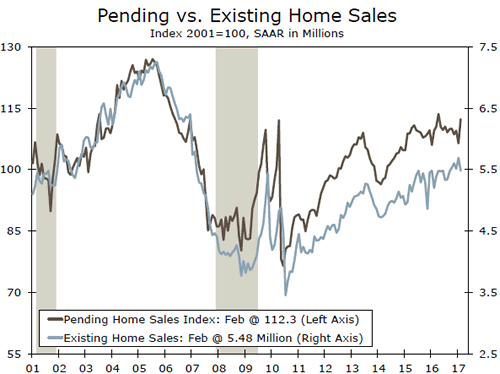
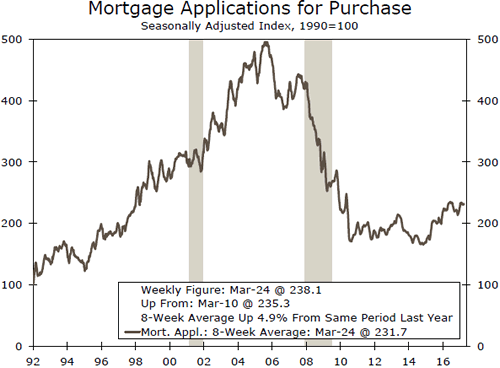
Pending home sales bounced back a robust 5.5 percent in February, as contract signings rose in all regions. Mortgage purchase applications are also rising. The positive reports bode well for home sales this spring.
Broad-Based Strength in Pending Home Sales
Pending home sales, which are contract signings that lead closings by one to two months, jumped 5.5 percent in February, recouping all of January's 2.8 percent loss.
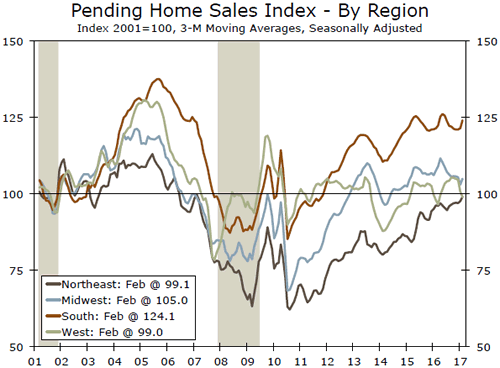
Strength in contract signings was broad-based, as all regions posted a gain on the month. Notably, pending home sales in the Midwest surged 11.4 percent, ending a three month string of declines. The South also saw a solid increase of 4.3 percent.
Mortgage Purchase Applications Trend Higher
The resurgence in pending sales was likely influenced by unusually mild winter weather, which boosted contract signings in the Midwest. Weather provided less help in the West, where sales are being held back by exceptionally tight inventories.
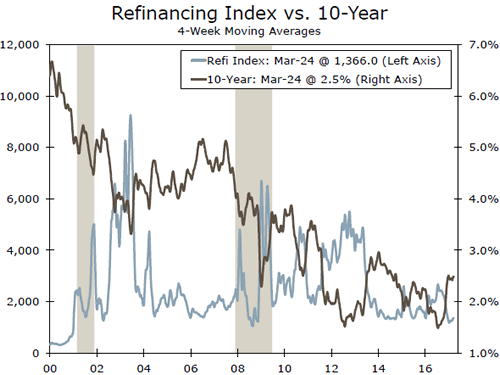
Mortgage applications fell 0.8 percent in the week ending March 24, as refinance applications fell further. Purchase applications rose 1.2 percent, marking the fourth gain in the past five weeks.
UK invokes Article 50 of the Lisbon Treaty
Brexit proceeds on schedule: UK invokes Article 50 of the Lisbon Treaty, officially beginning the two-year negotiation of the terms of separation
- Today, the President of the EU council, Donald Tusk, received a letter from UK Prime Minister Theresa May that officially declares the UK's intent to part ways with the EU.
- Negotiations on the terms of the breakup between the UK and EU can now officially proceed over the next two years, with the hope that an agreement will be reached by the deadline of April 2019.
- Market reaction has been relatively muted this morning, with early weakness in the GBPUSD unwinding following news of the delivery of the UK's letter to the EU.
A long road ahead for the UK and EU
- Negotiations on the terms of the breakup between the two parties are likely to begin slowly, as both sides take the time to form an internal agreement on their initial bargaining positions.
- There are a number of important issues that will have to be ironed out between the two parties. One early hurdle is the question of who is responsible for payment of the legacy costs of the UK's exit from the EU. These costs are estimated to be as much as €60 billion by the EU, while the UK thinks they should be responsible for much less (about £3 billion). An amicable agreement on this front will help set the tone of negotiations on other matters.
- Another early issue will be the status of UK and EU citizens. Optimistically, an early agreement that recognizes the rights of each party's citizens would further help set an optimistic tone for negotiations on other matters such as market access and financial services passporting.
- One of the most contentious points will be how much access to the EU's single market the UK will be allowed. Perhaps most importantly, the UK would like to maintain passporting rights to the EU for its financial services sector, but the EU has made it clear that it would like much of the euro-oriented financial trade to occur within the EU. Reduced access to the EU will hurt the UK's financial services industry.
- There is no doubt that the EU has the upper hand in negotiations, being the larger economy. However, it is still in their interest to reach some sort of amicable agreement, setting the stage for trade negotiations with the UK after April 2019, (although it is possible that the EU will relax its stance on this point and agree to some sort of trade framework before then). It should be noted that negotiating a new trade agreement between the UK and EU within the next two years is a lofty goal, as trade agreements between the EU and other nations have historically taken many years before being ratified by EU parliaments.
Economic costs of Brexit to be borne primarily by the UK
- The UK economy has performed well following the referendum, with household consumption remaining resilient despite increasing uncertainty about the future of the UK. Nevertheless, rising inflation is expected to take a bite out of the purchasing power of UK households this year and next, which should result in a gradual deterioration in consumer spending. Similarly, the Eurozone has proven resilient as well, with growth firming in the second half of last year despite fears of a break-up of the EU.
- Although the total economic costs of this breakup are still unknown and will ultimately depend on the new relationship between the UK and the EU, we anticipate that the long-run growth of the UK economy is likely to slow by about 0.3 percentage points as a result of Brexit beginning in 2019. This is due mainly to a slower migration of workers to the UK, and a slower pace of business investment that could dampen productivity growth.
Still a lot of unanswered questions
- The future of the UK remains unclear. Yesterday the Scottish Parliament voted to hold a second referendum on remaining a part of the UK, with the intent of calling the referendum within the next 18 months. Ultimately the UK parliament has the final say on whether another referendum will be held and when, and the current government has no inclination to discuss the future of the UK while negotiating the breakup terms with the EU. Both Scotland and Northern Ireland voted to remain as part of the EU in the UK referendum last June, and both may seek to ensure that the UK does its best to avoid a hard breakup with the EU.
- While unlikely, the UK may decide to walk back on Brexit and remain within EU. There is some uncertainty about the legality of the UK referendum with Britain, and it's unclear if an invocation of Article 50 by an EU member state is irrevocable.
- Perhaps the most important unknown is what the new trade arrangement between the UK and the EU will ultimately look like. Both parties are at the start of a long and bumpy journey that could result between either of two extremes of a new trading relationship that is very similar to the current one, or a devolving situation where tariffs are reimposed according to WTO rules.
Elliott Wave Analysis: USD Index Could Be In For A Reversal Higher
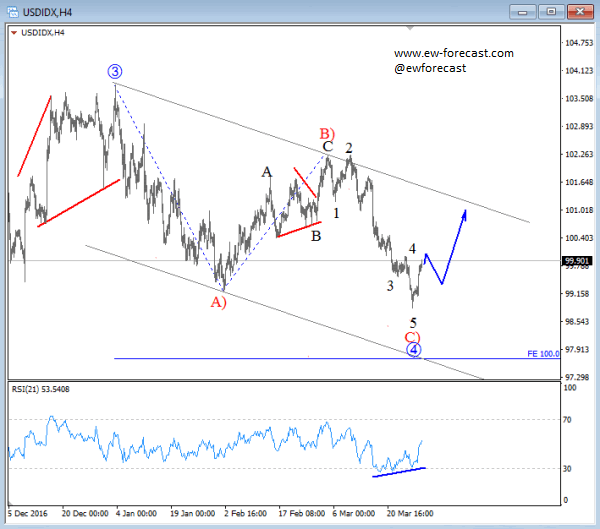
On the 4h chart of USD Index we see price trading within a higher degree three wave decline so bearish breakdown in March may be wave C as part of a big contra-trend move. That said, current bullish price activity may be the first signs of a new reversal to the upside being made and a suggestion that the previous three wave decline is completed. As such, more gains may be in for the USD index. A minor five wave move to the upside will be a confirmation, that bulls are in play.
USD Index, 4H
Anxious ECB Lifts Bund
Headlines
European stock markets opened stronger after yesterday's WS gain, but had difficulties to safeguard them. US stock markets opened flat to 0.25% lower.
Theresa May has started the two-year countdown to Brexit as she formally notified the EU of Britain's intention to quit. The PM called it a "great turning point in our national story", but her letter and statement to MPs marked a new tone of conciliation and compromise, promising to approach talks in a spirit of "respectful, sincere co-operation".
Manuel Valls, the former French prime minister, will vote for Emmanuel Macron in the upcoming presidential election, the biggest Socialist party name to abandon the ruling party's official candidate in favour of the centrist frontrunner.
Greece has agreed with its lenders on key labour reforms, spending cuts and energy issues, moving closer to clinching a deal before a meeting of euro zone finance ministers on April 7, sources close to the talks said.
ECB policymakers are wary of making any new change to their policy message in April after small tweaks this month upset investors and raised the spectre of a surge in borrowing costs for the bloc's indebted periphery. One ECB source said the bank has been overinterpreted by markets at its March 9 meeting.
Rates
Anxious ECB Lifts Bund
Global core bonds traded with an upward bias today with Bunds outperforming US Treasuries after Reuters quoted sources indicating that the ECB is wary of changing its message again after the "overinterpretation" of the March policy message. At the time of writing of writing, German yields decline by 5.5 bps (5-yr) to 2 bps (30-yr). Changes on the US yield curve range between - 1.8 bps (30-yr) and -2.4 bps (2-yr). On intra-EMU bond markets, 10-yr yield spread changes versus Germany are nearly unchanged with Greece outperforming (-19 bps) on supportive talk pointing in the direction of a bailout review agreement at the April 7 Eurogroup meeting.
Intraday, the Bund traded with an upward bias from the start of European trading despite the strong equity market opening and rising oil prices. Given the empty eco calendar, we think that technical end-of-quarter buying was at play. Eventually, oil prices and stocks also could built on their positive momentum. Just ahead of US dealings, the Bund really started outperforming as Reuters quoted ECB sources who indicated that the central bank was surprised by the market reaction after the March ECB meeting given the marginal changes. They are wary of making new changes in April as markets would interpret them as an approaching normalisation of monetary policy. The article states that the ECB wants to reassure investors that their easy monetary policy is far from ending. Additionally, a further rise in yields would hurt countries like Spain, Italy and Portugal where debt payments are a major cost item and rising yields would curb spending and thwart growth. Chicago Fed Evans repeated earlier comments in the US session, saying that he backs 1 or 2 more rate hikes this year.
The Finnish debt agency successfully tapped the on the run 7-yr RFGB (€1B 0% Sep2023). The auction bid cover was decent at 1.57. Later today, the US Treasury ends its refinancing operation with a $13B 2-yr FRN auction and a $28B 7-yr Note auction. Currently, the WI of the latter trades around 2.22%.

Currencies
EUR loses interest rate support
The dollar rebounded yesterday as the reflation trade resumed after strong US data. Today, the picture for the dollar was again more diffuse. EUR/USD declined further below the 1.08 handle, but the move was inspired by a decline in EMU yields rather than by outright USD strength. USD/JPY traded with a slight negative bias as there was little follow-through price action on yesterday's US risk-on trade. The pair struggles not to give away the 111 level.
Overnight, Asian equities showed only modest gains despite yesterday's rebound in the US. Oil traded off the recent lows and so did the dollar. USD/JPY tried to extend gains north of 111. EUR/USD hovered in a tight range in the low 1.08 area.
European equities had some catching up to do on WS gains yesterday. However, there were no real follow-through gains. Without important eco data on the agenda, technical considerations prevailed for EUR/USD trading. Yesterday's late session USD rebound probably wrong-footed EUR/USD longs who took their position on recent speculation that the ECB might scale down policy stimulation sooner than expected. So, USD strength triggered (stop-loss) euro weakness.
There were also no important eco data in the US. However, early in US trading interest rate markets also faced a repositioning. After the recent narrowing of US/EM (German) interest rate differentials, spreads widened again. The trend already started this morning, but accelerated on rumours that ECB sources said that markets had over-interpreted changes to the March ECB statement. The subsequent decline in European yields (and US-EMU interest rate differentials) also further changed the balance between the euro and the dollar. EUR/USD filled bids in the 1.0740 area and trades currently in the 1.0750/50 area. We see it as a correction on 'excessive' euro strength of late, rather than outright USD strength. The price action of USD/JPY apparently confirms this view. The pair dropped back below the 111 handle as yesterday's risk-on rebound slows today. In this respect the jury remains out whether the dollar will be able to profit from a continuation of the reflation trade.

Sterling shows no clear pattern as 'real' Brexit starts
The UK finally triggered article 50 of the Lisbon treaty, starting the official procedure to leave the EU in two years' time. Investors had plenty of time to adopt positions for this event. Still, some last-minute reposition had to be done. Sterling was quite aggressively sold in (thin) Asian markets this morning, but rebounded going in to the official announcement of Brexit. The statement of Theresa May and the first answer of EU's Tusk were quite conciliatory. EUR/GBP filled bids in the 0.8625 area after the Brexit statements, but regained some ground afterward. The pair trades currently in the 0.8662 area. We are reluctant to make any direct link between the Brexit communication and the performance of sterling today. Euro weakness also played a role. The swings in cable were more modest. Contrary to a decent performance against a weak euro, sterling is trading rather soft against the dollar (1.2420 area).
