Sample Category Title
Euro Drops in Article 50 Aftermath, Yen Gains
Trumpmania is taking a break from dominating the global media headlines as UK Prime Minister Theresa May is the talk of the town after she finally invoked Article 50, effectively providing a letter to the European Union telling Europe that the United Kingdom wants a divorce.
The financial markets from the perspective of global stocks have performed somewhat mixed on this historic day, alternating between both buying and bearish momentum but there are some signs of investors searching for safety assets with the Japanese Yen noticeably higher against its major trading partners and Gold showing more marginal gains. We have seen time and time again in recent times that the Japanese Yen becomes a trader's best friend in times of uncertainty and depending on how stubborn the prolonged negotiations take between Theresa May and her EU counterpart, perhaps Brexit uncertainty will be viewed as another reason for investors to hedge on Gold this year after the precious metal has already gained just over $100 since the opening day of trading in 2017.
EURUSD suffers as trading progresses
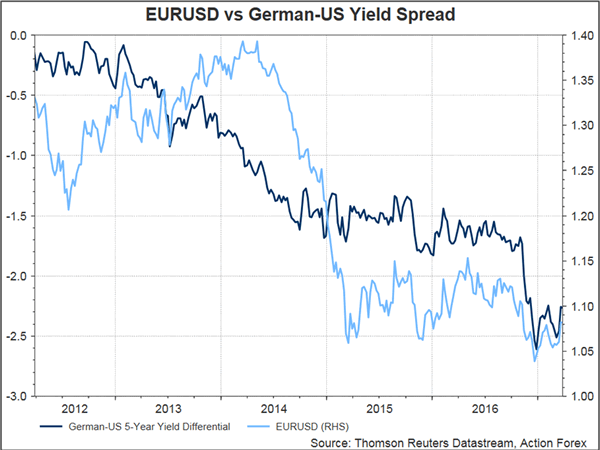
While all eyes are understandably on the British Pound, it is the Euro that looks set to be a surprise contender for the loser of the currency markets today following the Eurodollar succumbed to selling pressure above 1.08 to looking at risk to slipping below 1.07. You could on one hand say that investors are pricing in the likelihood that Europe itself is going to enter its own period of uncertainty by losing a member of the European Union, while others could say that the losses in the Eurodollar represents a withdrawal of gains after spiking heavily as trading for the week commenced after President Trump was defeated in his quest at replacing Obamacare.
I personally stand by my view that the Euro is grossly oversold, or you could say underbought on an economic basis but the political risks around Europe this year does also support the bias that the Euro remains at risk especially if Marine Le Pen's campaign to win the election in France achieves a bid.
GBPUSD encounters a tug of war
The British Pound is as you would expect where all the major action is happening, but there are signs of a somewhat tug of war taking place with the GBPUSD alternating between both buying and selling momentum after suffering late in trading yesterday and overnight.
It is no hidden secret at all that the market is short on the Sterling with short options on the Pound recently at historic levels, but traders still need to be careful and inherit appropriate risk management strategies whether that is hedging towards the Japanese Yen or whatever because it is not unknown for the market to suddenly bounce the other direction if the currency encounters a sudden squeeze.
No ECB Rate Hike or Tapering Until 2018
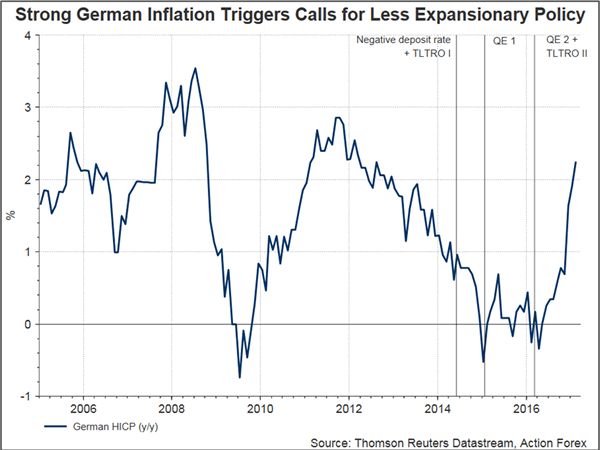
Talks of ECB's tapering have been looming of late, thanks to Eurozone's improving economic developments, especially in Germany, adverse effects of negative deposit rates on financial institutions, bigger-than-expected targeted longer-term refinancing operations (TLTROSs) take-up last week, as well as the asset buying program's ongoing deviation from its capital key. Bundesbank president Jens Weidmann has been vocal about less expansionary policy and a review to the forward guidance, while other members of the Governor Council reiterated the need to maintain accommodative measures to boost inflation.
No change to ECB policy throughout the year
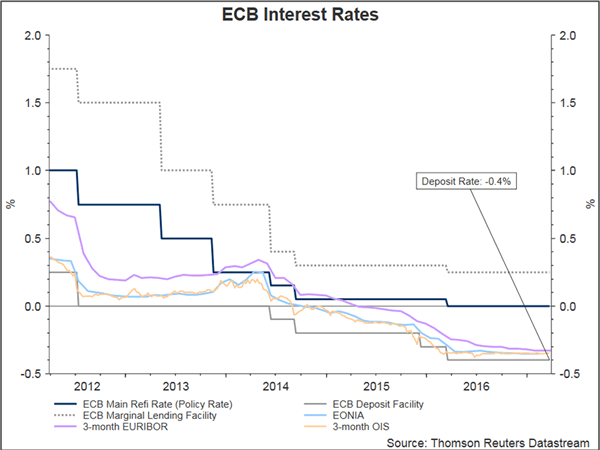
We expect ECB's monetary policy and QE measures to stay the same throughout the year. That is, ECB should keep the main refi rate, marginal lending rate and the depo rate 0%, 0.25% and -0.40%, respectively. Meanwhile, the central bank would continue the asset purchase program at the pace of 80B euro per month until the end of this month and then continue the program at a pace of 60B euro per month from April 2017 until the end of December 2017, or beyond, if necessary. QE tapering would likely begin in early 2018 and end by the first half of the year. ECB might begin raising the depo rate in 2Q18.
Some hawkish comments recently
Austrian central bank president Ewald Nowotny sent quite hawkish comments earlier this month, suggesting that ECB would decide only whether to raise rates or end QE first. He added that "the structure of the interest rates does not always need to remain constant… The ECB could also raise the deposit rate earlier than the prime rate", whilst affirming that the forward guidance that bond purchases would continue until the end of the year would be maintained.
Separately, Bundesbank president Jens Weidmann noted on Monday that he would like to see a "less expansive stance". Weidmann a week ago raised the question "whether the ECB council should slowly start considering an exit from the very easy policy and make its communication somewhat more symmetric". By contrast, Belgian central bank governor Jan Smets saw no urgency "to revisit what we have decided". As he noted in a Reuters interview, the "forward guidance is clear and we have to stick to that" and "if other views have been expressed on this issue, they are reflecting a minority position. Our decision is clear and I would like to stick to that steady hand approach".
However, ECB's chief economist Peter Praet reiterated that "a very substantial degree of monetary accommodation is still needed for underlying inflation pressures to build up and support headline inflation in the medium term remains valid".
Eurozone underlying inflation stays weak
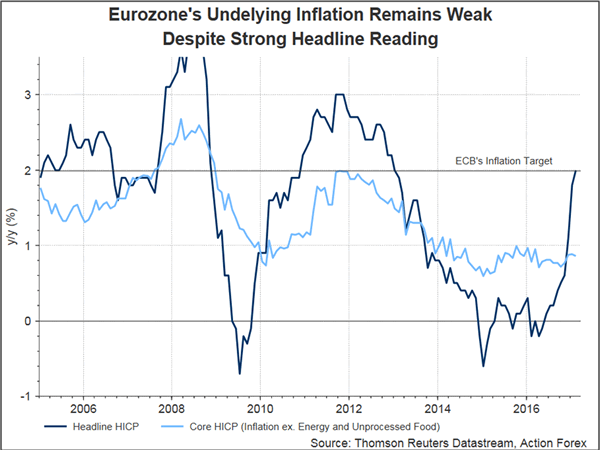
Markit's PMI data signaled that Eurozone's GDP growth might accelerate in 1Q17, from +0.4% in both 3Q16 and 4Q16. Moreover, expansion should be broadly based, spanning across manufacturing and services activities. Region-wide inflation accelerated to +2% y/y in February, exceeding ECB's target of "close to, but below, +2%" for the first time since 2013. However, core inflation, excluding energy and seasonal food products, at +0.9% for the month, has stayed below +1% since 2014.
Germany showed solid improvements
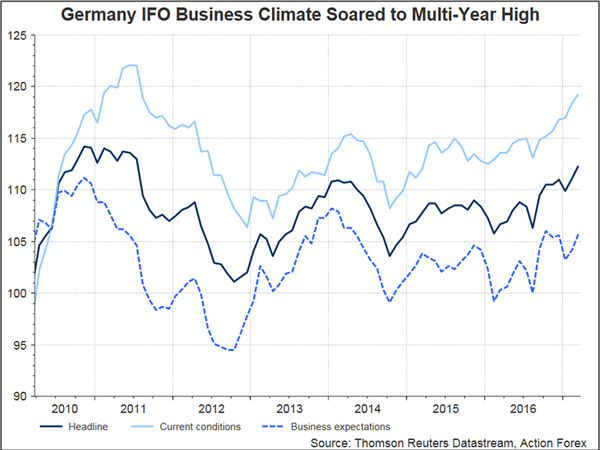
Inflation in Germany outperformed. Headline HICP soared to +2.2% y/y, highest in more than 4 years, in February, from +1.9% a month ago. The report triggered Weidmann to call for ECB's upgrade of inflation forecasts (current HICP forecasts: +1.3% for 2017, +1.5% for 2018 and +1.7% for 2019). Separately, IFO's confidence indices for the country rose across all aspects in March. The business climate index added +1.3 points to 112.3 while the expectations index gained +1.7 points to 105.7. Moreover, the current assessment index added +0.9 point to 119.3. All indices came in better than market expectation. Germany's GDP expanded +1.9% last year, compared with US' growth of +1.6%.
But peripherals still suffering
However, the improvement mainly concentrated in core economies, in particular Germany, while most peripheral economies continued to suffer. For instance, annual inflation rate in Ireland came in at +0.3%, Malta at +1.2% and Slovakia at +1.3%. France, being the second largest economy in the Eurozone, registered an annual HICP at +1.4% for the month. Continuous pleasant surprises in both soft and hard data might give ECB more confidence in considering QE tapering and/or rate hike. Meanwhile, German officials would from time to time pressure the central bank to move in such direction.
Bigger-than-expected TLTROSs take-up
Last week, over 400 banks took up 233.5B euro of 4-year loans in the fourth and the final allotment of TLTROS, a program that allows Eurozone commercial banks to borrow money from the ECB at very favorable rates, almost doubled consensus of 125B euro. This resulted in rising ECB's balance sheet by a significant amount, mimicking the effects of QE.
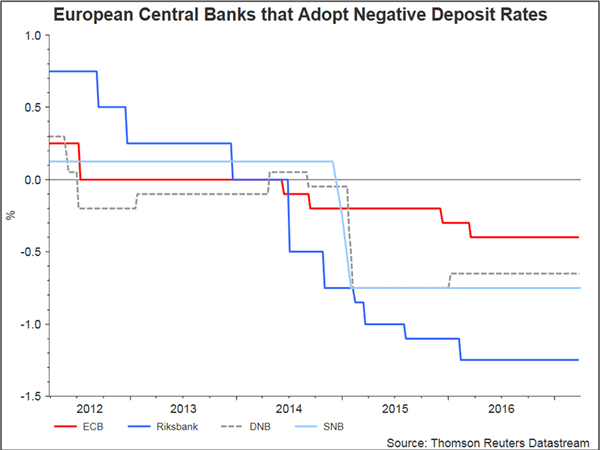
Separately, some technical constraints have made it challenging for QE to extend beyond this year. The central bank would find it difficult to continue the program without significantly exceeding the capital key limits (% of the total ECB capital determines its monthly purchase). Besides, tapering, some Eurozone stakeholders have been talking about raising the deposit rate, which currently stays at -0.4%. Some have suggested hiking interest rates before tapering. It is true that negative deposit rate is squeezing banks' profit margins because they can't generally pass the cost to their customers.
No tapering until 2018
Although upbeat growth outlook and technical constraints signal that the ECB might need to consider QE tapering, we expect the actual implementation would not begin until 2018. As we mentioned above, underlying inflation pressure has remained subdue, suggesting that the region has not yet achieved a self-sustained inflation rate. Meanwhile, the unemployment rate remains elevated despite decline from record highs. Wage growth pressure remains weak with ECB's indicator of pay settlements easing to 1.4% in 4Q16 from 1.5% in the prior quarter while nominal unit labor costs rising merely 1% last quarter. However, the improved economic outlook and technical constraints facing ECB in adopting QE are inevitably triggering ECB to consider tapering. We expect tapering to begin in early 2018 and end by 1H18. Meanwhile, ECB might begin raising the depo rate in 2Q18. That means we do not rule out the possibility of a rate hike before QE ends.
Trade Idea: EUR/GBP – Target met and stand aside
EUR/GBP - 0.8655
Recent wave: Major double three (A)-(B)-(C)-(X)-(A)-(B)-(C) is unfolding and 2nd (A) has possibly ended at 0.6936.
Trend: Near term down
Original strategy :
Bought at 0.8620, met target at 0.8750
Position : - Long at 0.8620
Target : - 0.8720
Stop : -
New strategy :
Stand aside
Position : -
Target : -
Stop : -
The single currency found renewed buying interest at 0.8618 and staged the anticipated rebound, our long position entered at 0.8620 met upside target at 0.8720 with 100 points profit, having said that, as euro ran into selling interest at 0.8735 and has retreated, suggesting further consolidation would take place and pullback to 0.8660 cannot be rule out, however, reckon 0.8635-40 would limit downside and bring another rise later. Above 0.8635 would suggest the fall from 0.8788 has ended, bring test of indicated resistance at 0.8760, break there would confirm and bring retest of 0.8788, a breach there would extend the rise from 0.8403 low to 0.8800 and later 0.8825-30.
As we have taken profit on our long position entered at 0.8620, would not chase this rise here and would be prudent to stand asIde for now. Below 0.8620 would risk test of 0.8605 (previous support as well as 50% Fibonacci retracement of 0.8422-0.8788), break there would suggest top has been formed at 0.8788, risk test of 0.8560-65 (61.8% Fibonacci retracement) but support at 0.8547 should remain intact.
Our preferred count is that, after forming a major top at 0.9805 (wave V), (A)-(B)-(C) correction is unfolding with (A) leg ended at 0.8400 (A: 0.8637, B: 0.9491 and 5-waver C ended at 0.8400. Wave (B) has ended at 0.9413 and impulsive wave (C) has either ended at 0.8067 or may extend one more fall to 0.8000 before prospect of another rally. Current breach of indicated resistance at 0.9043 confirms our view that the (C) leg has ended and bring stronger rebound towards 0.9150/54, then towards 0.9240/50.

Trade Idea: USD/CAD – Stand aside
USD/CAD - 1.3369
Recent wave: Only wave v of c has ended at 0.9407 and wave C of major A-B-C correction is underway for headway to 1.4700
Trend: Near term up
Original strategy :
Exit short entered at 1.3400,
Position: - Short at 1.3400
Target: -
Stop: -
New strategy :
Stand aside
Position: -
Target: -
Stop:-
Although the greenback retreated after meeting resistance at 1.3415 yesterday and weakness to 1.3326 support cannot be ruled out, break there is needed to revive bearishness, bring retest of said last week’s low at 1.3264, below there would add credence to our view that top has been made at 1.3535 earlier this month, bring further fall to 1.3235-40 (61.8% Fibonacci retracement of 1.3056-1.3535) but previous resistance at 1.3210 would hold due to loss of downward momentum.
On the upside, whilst recovery to 1.3400 cannot be ruled out, a firm break above 1.3415 is needed to signal low has been formed at 1.3264 last week, bring a stronger rebound to 1.3450 and possibly test of resistance at 1.3479 but only break of 1.3495 resistance would indicate the pullback from 1.3535 has ended and bring retest of this level later. As near term outlook is still mixed, would be prudent to stand aside in the meantime.
To recap, wave B from 1.3066 is unfolding as an a-b-c and is sub-divided as a: 1.2192, b: 1.2716 and wave c is a 5-waver with i: 1.1983, ii: 1.2506, extended wave iii with minor iii at 1.0206, wave iv ended at 1.0781 and wave v as well as wave iii has ended at 0.9931, hence the subsequent choppy trading is the wave iv which is unfolding as (a)-(b)-(c) with (a) leg of iv ended at 1.0854, followed by (b) leg at 1.0108 and (c) leg as well as the wave iv ended at 1.0674. The wave v is sub-divided by minor wave (i): 0.9980, (ii): 1.0374, (iii): 0.9446, (iv): 0.9913 and (v) as well as v has possibly ended at 0.9407, therefore, consolidation with upside bias is seen for major correction, indicated target at 1.3700 and 1.4000 had been met and further gain to 1.4700 would be seen later.

Trade Idea Update: USD/CHF – Stand aside
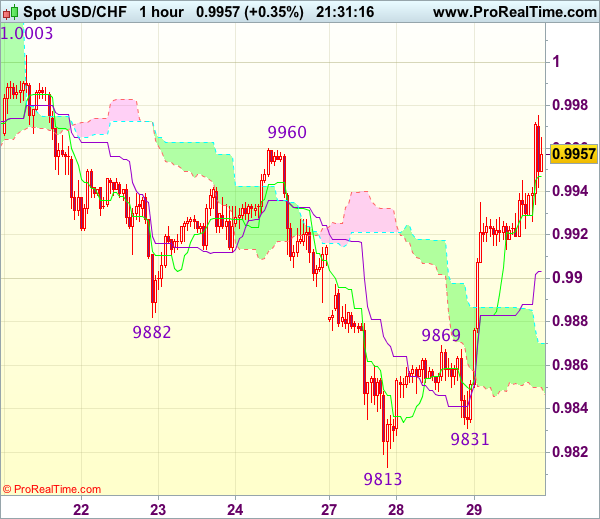
USD/CHF - 0.9955
New strategy :
Stand aside
Position : -
Target : -
Stop : -
The greenback rallied after finding renewed buying interest at 0.9831 yesterday, dampening our bearishness and suggesting recent decline has ended at 0.9813, hence upside risk remains for this rise from 0.9813 to bring retracement of recent decline and further gain to resistance at 0.9960 would be seen but break there is needed to provide confirmation and retain bullishness for further rise towards another previous chart resistance at 1.0003 later.
In view of this, would be prudent to stand aside in the meantime. below the Kijun-Sen (now at 0.9888) would suggest an intra-day top is formed instead, bring weakness to the lower Kumo (now at 0.9851) but break of said support at 0.9831 is needed to revive bearishness for retest of 0.9813 first.
Trade Idea Update: GBP/USD – Sell at 1.2500
GBP/USD - 1.2420
Original strategy :
Sell at 1.2500, Target: 1.2365, Stop: 1.2535
Position : -
Target : -
Stop : -
New strategy :
Sell at 1.2500, Target: 1.2365, Stop: 1.2535
Position : -
Target : -
Stop : -
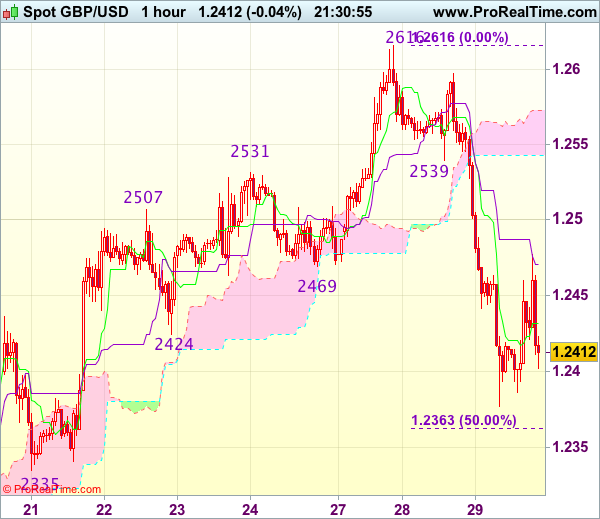
As cable has dropped sharply since yesterday, suggesting top has been formed at 1.2616 and the selloff from there is likely to bring retracement of recent upmove, hence further weakness to 1.2360-65 (50% Fibonacci retracement of 1.2109-1.2616) would be seen, however, loss of near term downward momentum should prevent sharp fall below 1.2335 support and reckon 1.2300-05 (61.8% Fibonacci retracement) would hold from here, bring rebound later.
In view of this, we are looking to turn short on recovery as the Kijun-Sen (now at 1.2486) should limit upside and bring decline. Above 1.2500-10 would defer but only break of previous support at 1.2539 would abort and signal the fall from 1.2616 has ended instead, bring rebound to 1.2560-65 first.
EUR/JPY Mid-Day Outlook
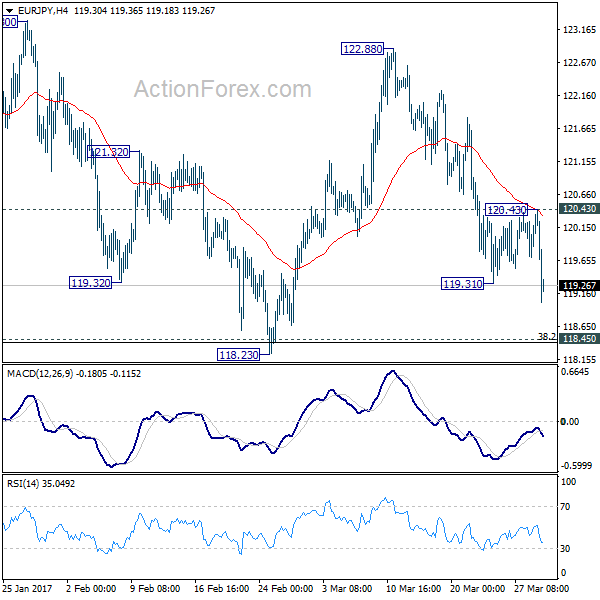
Daily Pivots: (S1) 119.79; (P) 120.08; (R1) 120.48; More...
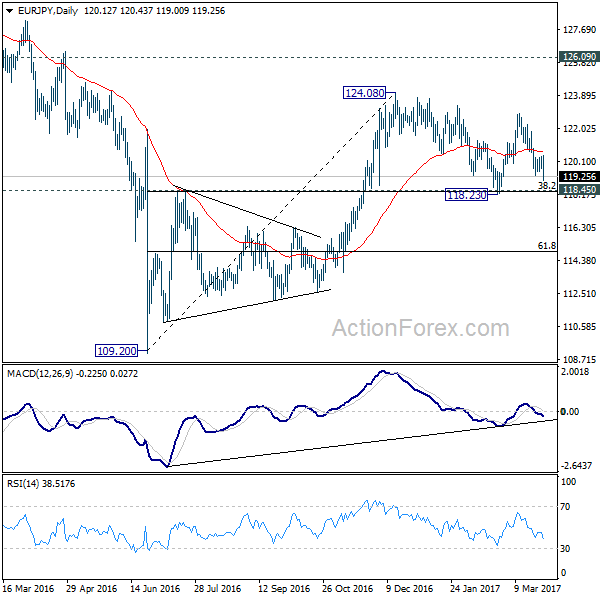
EUR/JPY's fall from 122.88 resumed by taking out 119.31 and reaches as low as 119.00 so far. Intraday bias is back on the downside for 118.23 support. Overall, price actions from 124.08 are seen as a consolidation pattern. Hence we'd expect strong support around 118.45 key cluster support level (38.2% retracement of 109.20 to 124.08 at 118.39) to contain downside and bring rebound. On the upside, above 120.43 minor resistance will turn bias back to the upside for 122.88 resistance.
In the bigger picture, we're holding on to the view that medium term rise from 109.20 is still in progress. Focus is on 126.09 key resistance level. Sustained break will confirm completion of the whole decline from 149.76. And rise from 109.20 is of the same degree as the fall from 149.76. In such case, further rally would be seen to 104.04 resistance and possibly above before topping. Meanwhile, rejection from 126.09, or firm break of 118.45 cluster support, will likely extend the fall from 149.76 through 109.20 low.
Trade Idea Update: EUR/USD – Stand aside
EUR/USD - 1.0754
New strategy :
Stand aside
Position : -
Target : -
Stop : -
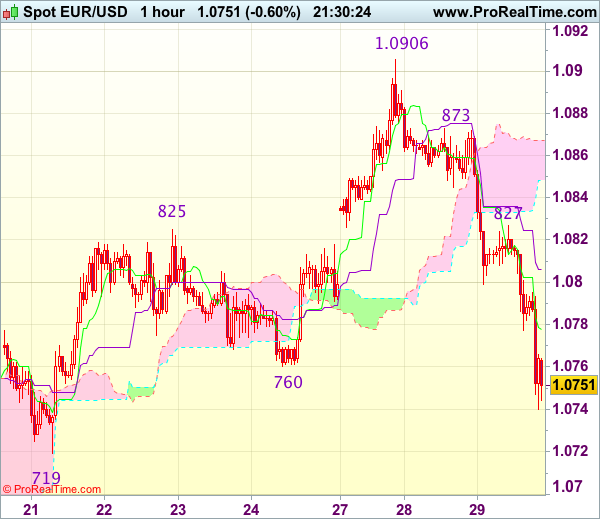
As the single currency has fallen again after brief recovery, suggesting the fall from 1.0906 is still in progress and downside risk remains for this fall to extend weakness towards support at 1.0719, however, near term oversold condition should prevent sharp all below 1.0695-00 and reckon 1.0670 would hold from here, risk from there is seen for a rebound to take place later.
In view of this, would not chase this fall here and would be prudent to stand aside in the meantime. Above 1.0780 would bring recovery to 1.0800 but only break of resistance at 1.0827 would signal low is formed, bring a stronger rebound to 1.0850 later.
EUR/GBP Mid-Day Outlook
Daily Pivots: (S1) 0.8639; (P) 0.8663; (R1) 0.8709; More...
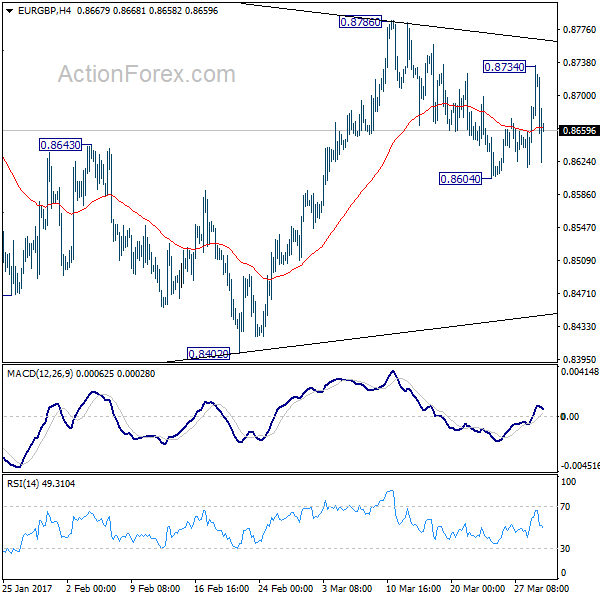
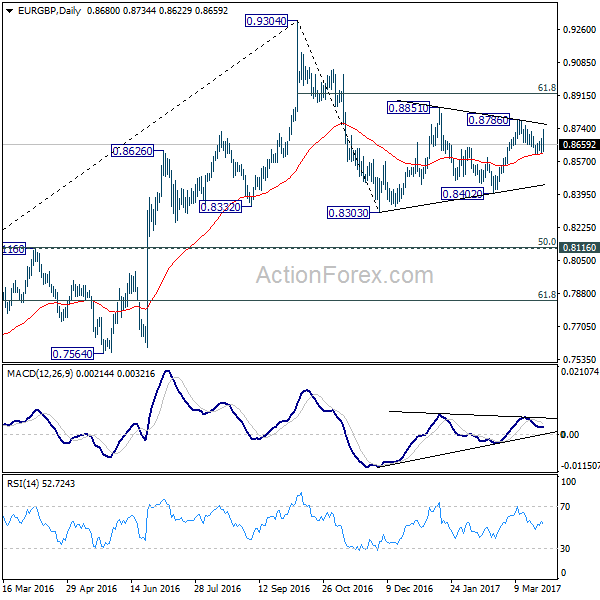
EUR/GBP rebounded to as high as 0.8734 earlier today but quickly reversed. The development mixed up the near term outlook a bit and turns intraday bias neutral first. Still, price actions from 0.8303 are forming a corrective pattern, as the second leg of the correction from 0.9304. Below 0.8604 will turn bias to the downside for 0.8402. Break will target 0.8116 cluster support, where the correction from 0.9304 should end. On the upside, above 0.8786 will target 61.8% retracement of 0.9304 to 0.8303 at 0.8922 instead.
In the bigger picture, price actions from 0.9304 are viewed as a medium term corrective pattern. Deeper fall cannot be ruled out yet. But we'd expect strong support from 0.8116 cluster support (50% retracement of 0.6935 to 0.9304 at 0.8120) to contain downside. Overall, the corrective pattern would take some time to complete before long term up trend resumes at a later stage. Break of 0.9304 will pave the way to 0.9799 (2008 high).
Trade Idea Update: USD/JPY – Hold short entered at 111.20
USD/JPY - 110.90
Original strategy :
Sold at 111.20, Target: 110.20, Stop: 111.35
Position : - Short at 111.20
Target : - 110.20
Stop : - 111.35
New strategy :
Hold short entered at 111.20, Target: 110.20, Stop: 111.35
Position : - Short at 111.20
Target : - 110.20
Stop : - 111.35
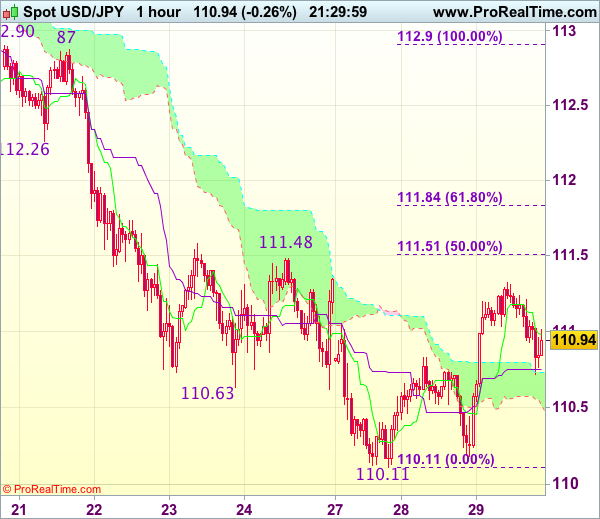
Although dollar staged a strong rebound after holding above support at 110.11, as this move is still viewed as retracement of recent decline, reckon upside would be limited to 111.30-35 and bring retreat later, below the Kijun-Sen (now at 110.75) would bring weakness to 110.50 but only break of said support at 110.11 would confirm recent decline has resumed and extend weakness to 109.95-00 but loss of downward momentum should prevent sharp fall below 109.70-75 and reckon 109.50 would hold.
In view of this, we are holding on to our short position entered at 111.20, Only above 111.48-51 (previous resistance and 50% Fibonacci retracement of 112.90-110.11) would abort and signal low is formed, bring a stronger rebound to 111.80-85 first (61.8% Fibonacci retracement).