

Sample Category Title
RBA Lowe: Further tightening required, but closer to a pause
RBA Governor Philip Lowe said in a speech that further rate hike is still necessary. But the central bank is now closer to the point of a pause.
The board's judgment remained that "further tightening of monetary policy is likely to be required to bring inflation back to target within a reasonable timeframe", Lowe said.
"Inflation is still too high and while it looks to be on a declining path it is likely to remain higher than target for a few years," he added. "If we don't get inflation down fairly soon, the end result will be even higher interest rates and more unemployment.
Meanwhile, " with monetary policy now in restrictive territory, we are closer to the point where it will be appropriate to pause interest rate increases to allow more time to assess the state of the economy," he noted.
"At what point it will be appropriate to pause will be determined by the data and our assessment of the outlook".
SNB Jordan: Monetary policy is still too loose
SNB Chairman Thomas Jordan, stated that the current monetary policy is too loose to bring inflation back to price stability in the medium term, and further tightening cannot be ruled out. The comment came after recent data showed that consumer inflation reaccelerated to 3.4% in February, staying well above SNB's 0-2% target.
"The SNB's monetary policy is still too loose to return inflation back to price stability in the medium term," Jordan yesterday at Zurich University. "We cannot exclude that we have to tighten further."
"The SNB has to act to reach price stability in the medium term again," he said. "The barren Swiss labor market can lead to second- and third-round effects happening more easily."
Meanwhile Jordan also pointed out that the central bank has more than one option, as "we can raise rates, but also sell foreign currency — and we have sold foreign currency in the past."
SNB will meet on March 23 to decide on monetary policy.
Bank of Canada to Set Tightening Campaign on Hold
The Bank of Canada will likely keep its promise to declare a pause in monetary tightening during Wednesday’s policy meeting, although other major central banks are still debating higher rates. The policy announcement could cause more shorting of the battered Canadian dollar, unless policymakers signal a conditional halt, leaving the door open for additional rate increases later in the year.
BoC to take break from rate hikes
After a record pace of rate hikes, which pushed interest rates from nearly zero to 4.50% in just eight meetings during the past year, the Bank of Canada decided to diverge from its peers and set its tightening campaign on pause as of March while assessing the impact of cumulative rate increases. The message was clear in January and doing otherwise would damage its credibility, with investors widely expecting stable rates at the moment.
Reasons to pause
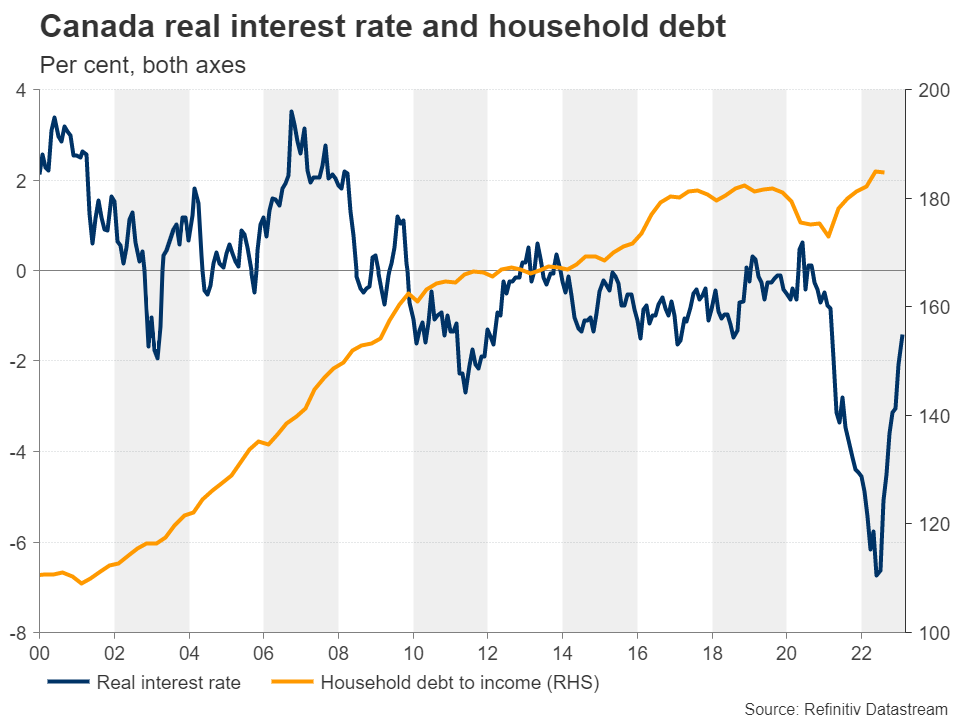
The negative surprise in Q4 GDP growth figures, which revealed a flat economy after five consecutive quarterly increases versus estimates for a 1.5% expansion, as well as the sharp decline in housing starts in February, could excuse a break in monetary tightening for now. Canadian households are among the most indebted in the world, with debt-to-disposable income standing at 180% at the end of 2022. Hence, the central bank is reasonably taking a more careful approach than the Fed.
Will there be more tightening?
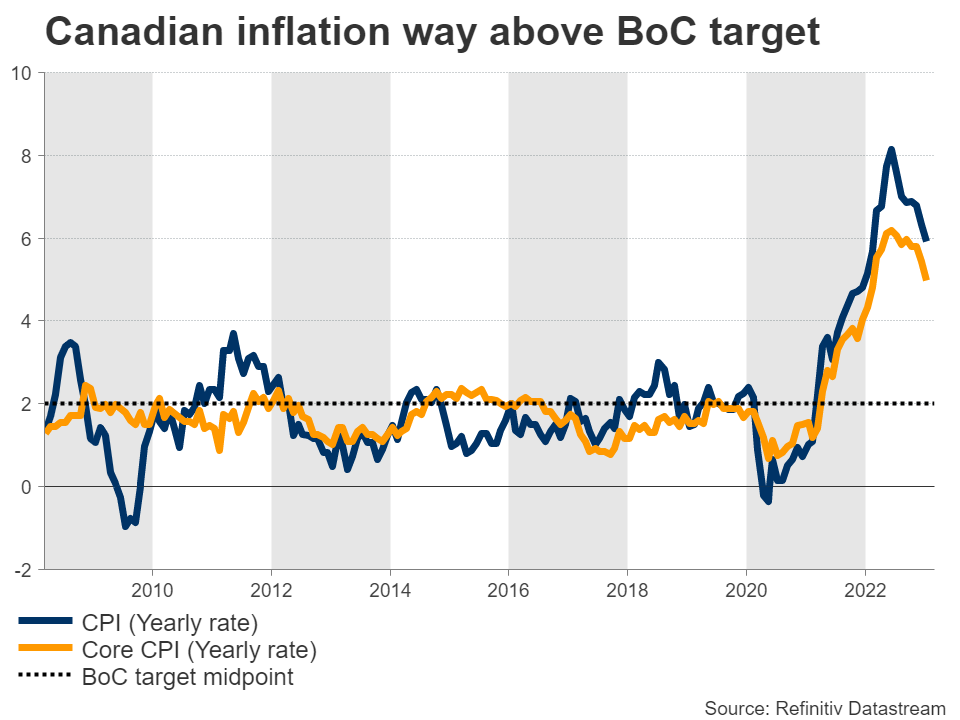
Nevertheless, it might be premature to exclude additional tightening in the year ahead, as inflation is still triple the central bank’s 2.0% target. The core measure, which excludes volatile food and energy prices, is also a problem at 5.0% y/y, and could remain sticky at an elevated level if the resilient labor market keeps driving demand.
Recall the outsized job addition of 150k in January, which beat analysts’ pessimistic expectations for a 15k employment growth and was the largest in almost a year. The next update will be on Friday, with forecasts pointing to a negligible 10k employment increase and a slight pickup in the unemployment rate to 5.1%. Still, February used to deliver upbeat employment reports over the past two years. Hence, another positive surprise cannot be ruled out.
USD/CAD
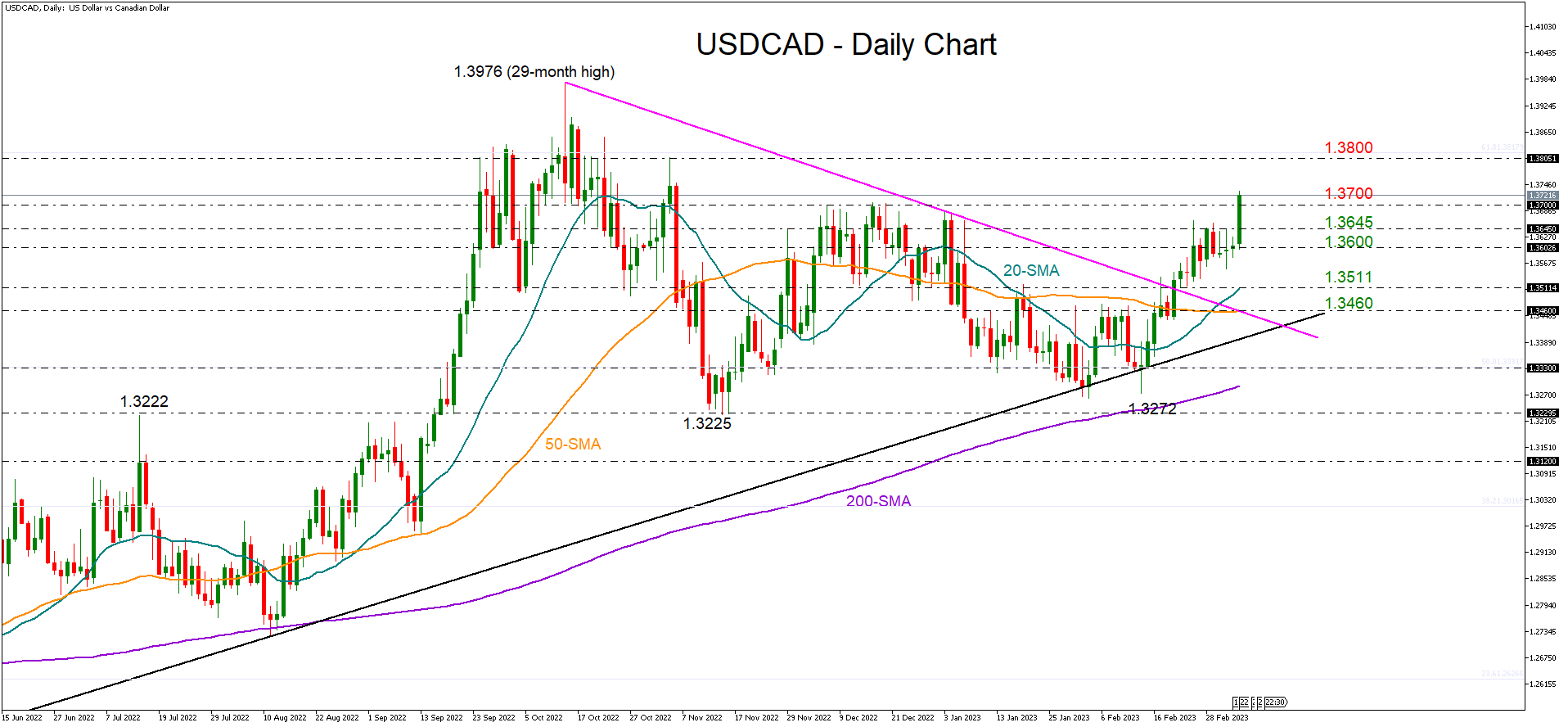
Futures markets are currently pricing out rate increases above 5.0% by the end of the year, while foreseeing a cut in January 2024. If policymakers keep rates unchanged but see a strong chance to drive interest rates above that peak, while playing down the rate cut scenario, the loonie could recoup some lost ground. In this case, dollar/loonie could retest the 1.3645 -1.3600 constraining zone before tumbling towards the 20-day simple moving average (SMA) at 1.3511. A more aggressive decline could even reach the 50-day SMA at 1.3460.
Alternatively, if the central bank judges that a potential break from pause may not be more than 50bps, remaining confident that the existing tightening will push inflation towards 2.0% by 2024, dollar/loonie could spike towards 1.3800. Should the US nonfarm payrolls further confirm a widening Fed-BoC rate divergence later in the year, the loonie could get another hit.
It’s also worthy to note that Canada’s distorted political relations with China over election meddling probes and investment laws in the mining sector could make it harder for Canadian producers to benefit from the reopening of the Chinese economy.
CAD/JPY
In other pairs, loonie/yen will be another interesting pair to watch as expectations for a hawkish shift within the Bank of Japan gain traction. A decisive close above the 100.80 ceiling could stage an exciting rally towards the 200-day simple moving average at 103.50.
Can Nonfarm Payrolls Refuel Dollar’s Rally?
Another high-stakes US employment report will be released on Friday. Most indicators point to another strong month for the labor market, although there's a risk of some 'payback' following the sensational numbers last month. As for the dollar, the outlook seems positive in an environment of rising Fed bets, especially when considering the vulnerabilities in equity markets.
Economic resilience
The central theme in the markets this year has been the strength of the US economy. Incoming data continues to paint a picture of an economy that is firing on most cylinders, despite the Fed's rapid-fire rate increases to tame inflation.
Consumer demand, inflationary pressures, and most importantly the labor market have not shown any real signs of damage yet. This economic resilience has caused a sharp repricing in the market, fueling bets that the Fed will push rates even higher and keep them elevated for a longer period to win the inflation battle.
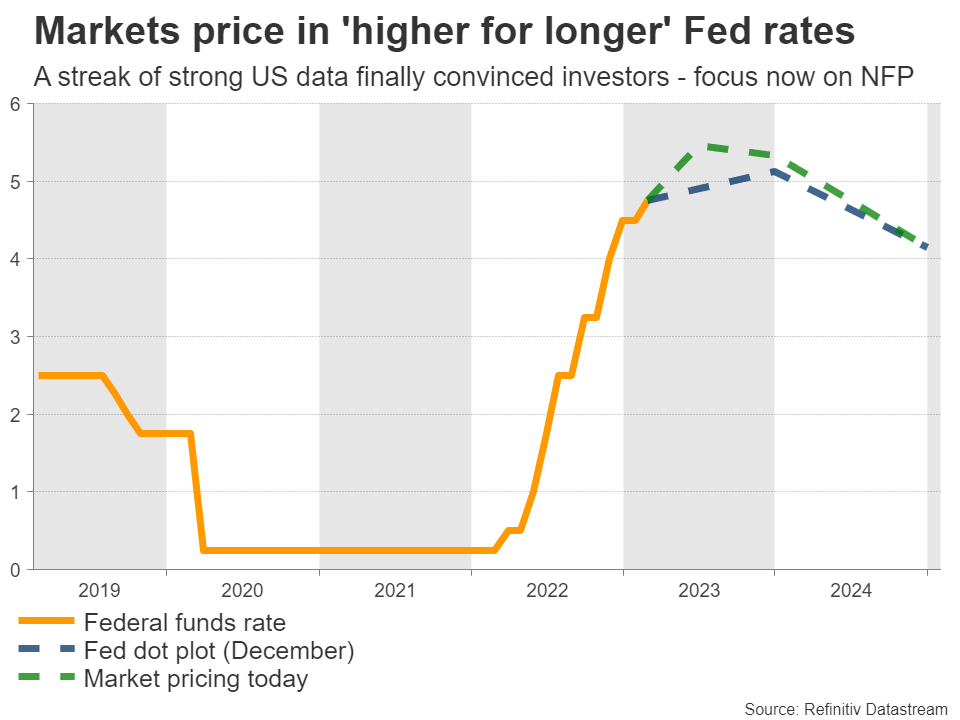
Market pricing currently suggests the Fed will raise rates to around 5.4% by the summer and keep them there for the rest of the year. Hence, the upcoming data will be crucial in shaping these expectations, and by extension, driving the dollar.
Strong report or payback?
In February, nonfarm payrolls are forecast to have risen by 200k after an astonishing 517k print last month. The unemployment rate is expected to have remained unchanged at 3.4%, while wages are projected to have risen at a faster pace.
Early indicators suggest it was indeed a strong month for jobs. Business surveys from ISM and S&P Global pointed to stronger employment growth, while applications for unemployment benefits remained very low.
Nonetheless, there is a risk of disappointment. When a nonfarm payrolls print is as strong as it was last month, it is often followed by a softer number. Essentially, there is a correction back to the prevailing trend. Considering also that warmer weather and seasonal adjustments played a big role in boosting the last number, some 'payback' would be normal this time.
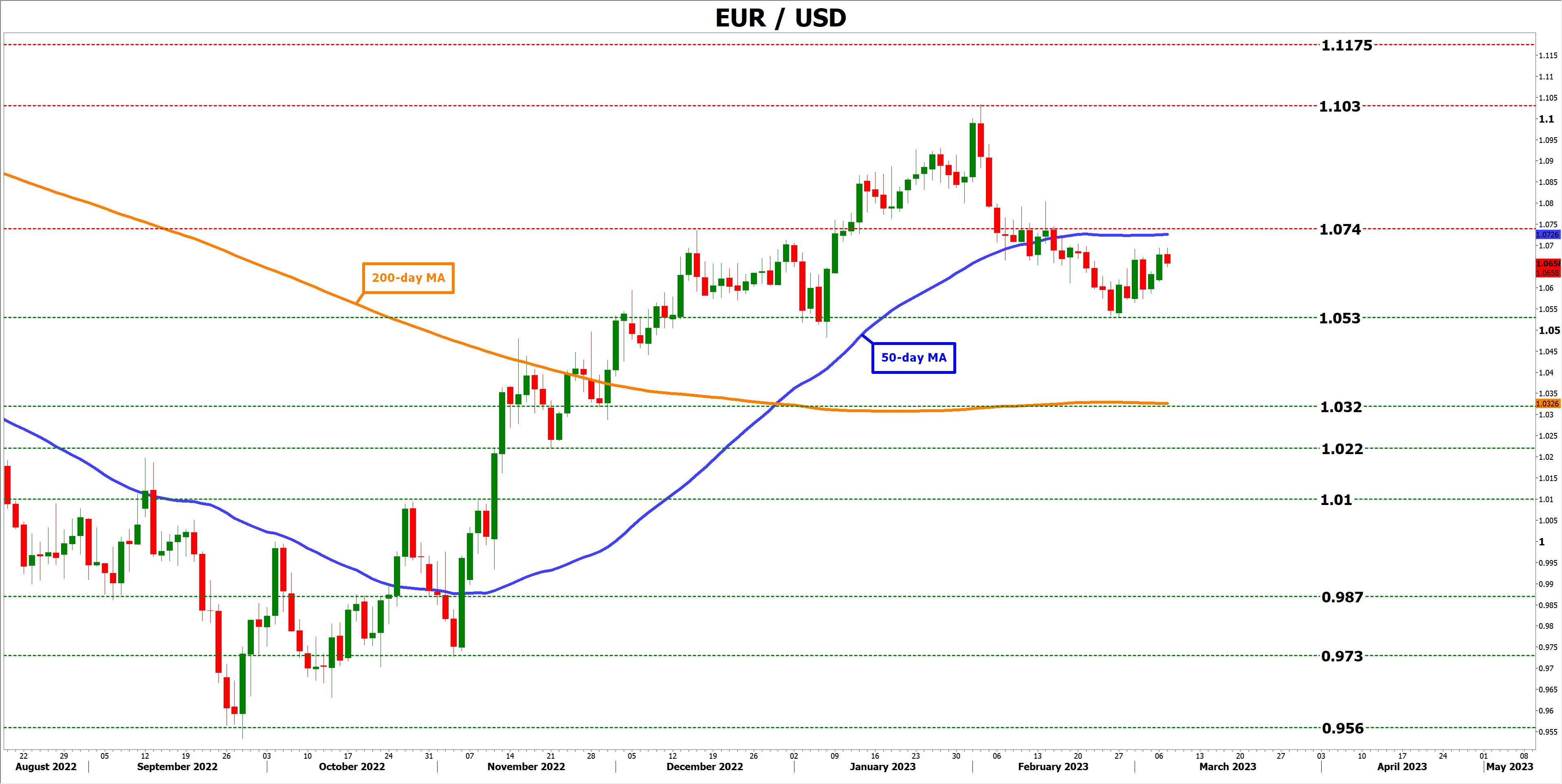
A minor disappointment could inflict some damage on the dollar, although the overall reaction will also depend on the wage numbers. Taking a technical look at euro/dollar, a potential move higher could encounter initial resistance near the 1.0740 zone, which also encapsulates the 50-day moving average.
On the flipside, a surprisingly strong report or a hot wage print could hammer the pair lower, with the first obstacle likely to be the 1.0530 region.
Dollar - Better times ahead?
In the bigger picture, the outlook for the dollar seems bright, even if there is a negative reaction on Friday. In short, America is in better shape than other major economies, which allows the Fed to raise rates higher and for longer than other central banks.
This outperformance is linked to the structure of the loan market. Since most US mortgages are on 30-year fixed rates, existing homeowners have not been directly affected by rising rates. Higher rates affect only the next homebuyer, so it takes some time before they significantly impact economic activity.
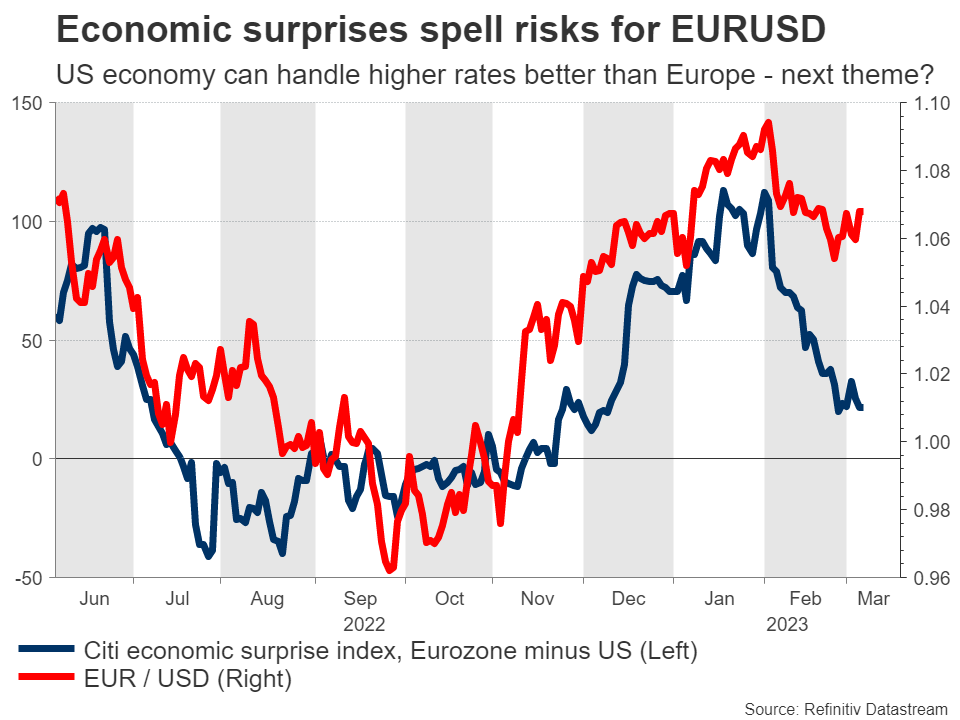
But in Europe, there is a much higher proportion of mortgages at variable rates. Those rates usually adjust on a yearly basis, which means European consumers will feel the heat of rising rates much earlier.
Therefore, any real economic weakness will likely show up in Europe first, presenting downside risks for pairs like euro/dollar or pound/dollar.
Similarly, these pairs have a strong correlation with the global investment mood, often rising and falling with stock markets. This is another vulnerability as equities seem overvalued at this stage, with corporate earnings contracting and interest rates rising.
USD/CAD Rallies Ahead of BoC Rate Decision, Dips Supported
Key Highlights
- USD/CAD started a major increase above the 1.3650 resistance zone.
- It broke a major contracting triangle with resistance near 1.3625 on the 4-hours chart.
- GBP/USD resumed its decline and traded below 1.1920.
- The BoC interest rate decision is scheduled today (forecast 4.5%, versus 4.5% previous).
USD/CAD Technical Analysis
The US Dollar started a major increase from the 1.3550 support against the Canadian Dollar. USD/CAD broke the 1.3600 zone to enter a bullish zone.
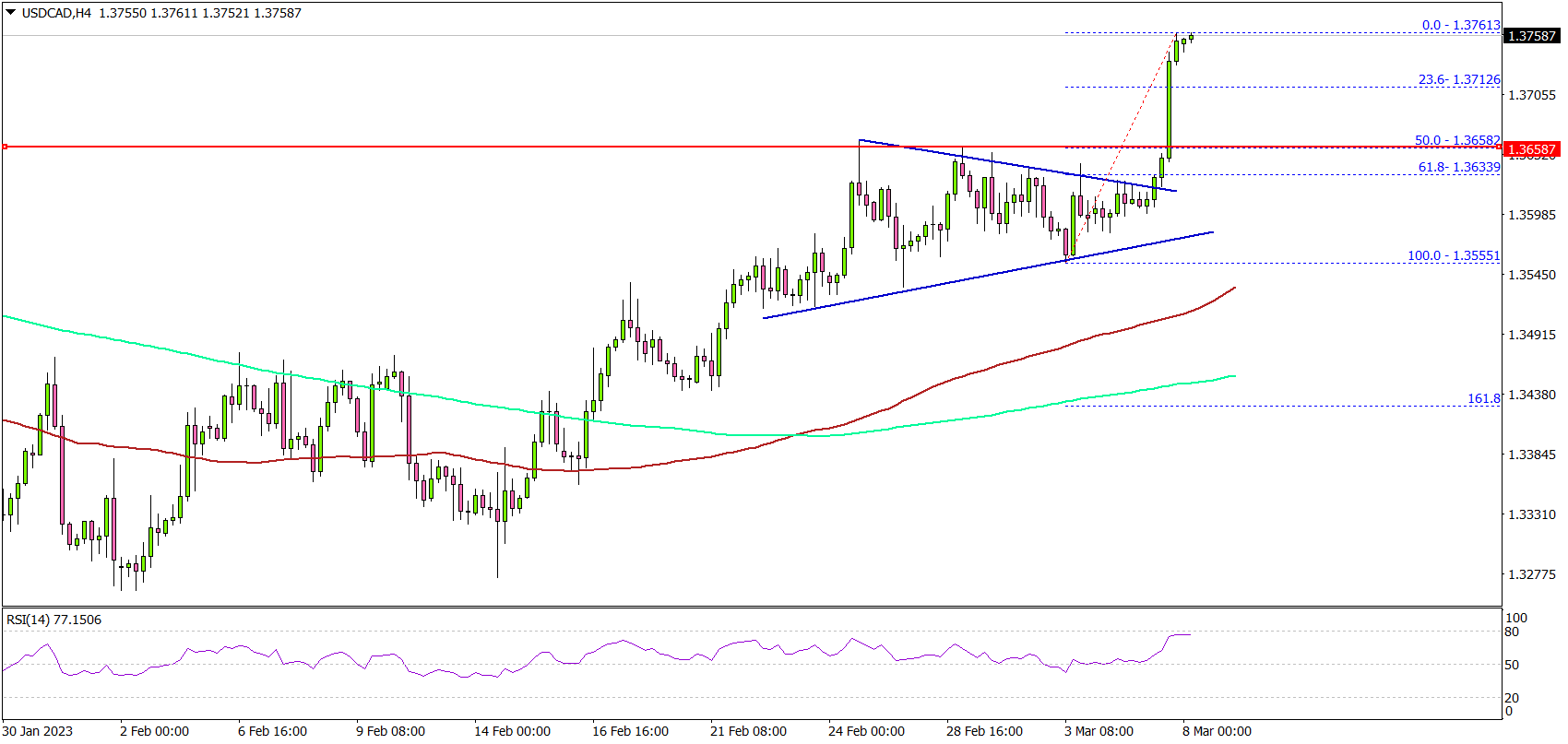
Looking at the 4-hours chart, the pair broke a major contracting triangle with resistance near 1.3625. There was a close above the 1.3650 level, the 100 simple moving average (red, 4-hours), and the 200 simple moving average (green, 4-hours).
The pair even climbed above the 1.3750 level and is showing a lot of positive signs. An immediate resistance is near the 1.3780 level.
The next major resistance is near the 1.3800 level. A clear move above the 1.3800 resistance might start a steady increase towards the 1.3880 zone. Any more gains might send the pair towards 1.4000.
On the downside, an immediate support is near the 1.3720 level. The next major support is near the 1.3650 level, below which there is a risk of a move towards the 1.3600 level. Any more losses could open the doors for a drop towards 1.3550.
Looking at GBP/USD, there was a sharp decline below the 1.1920 support and the pair is now showing a lot of bearish signs.
Economic Releases
- Euro Zone Gross Domestic Product for Q4 2022 (YoY) - Forecast 0%, versus 0.1% previous.
- US ADP Employment Change for Feb 2023 - Forecast 200K, versus 106K previous.
- BoC Interest Rate Decision – Forecast 4.5%, versus 4.5% previous.
How Will BOJ Statement Affect the Yen?
The Bank of Japan is expected to release a statement regarding its monetary policy for the second time this year. This statement, due on the 10th of March, usually has a very high impact on the outlook of the Japanese Yen as it ties in closely with the short-term interest rates and overall strength of the currency.
USDJPY
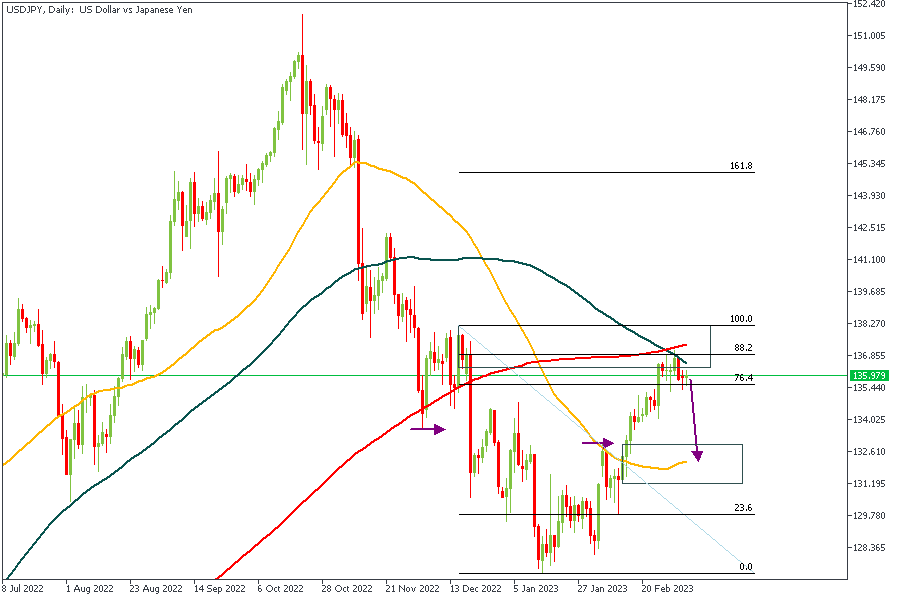
The Daily timeframe chart of the USDJPY already looks like the onset of a downward move. We can see the 100- and 200-period moving averages have successfully rejected prices from going higher. Also, looking at the fact that the rejection occurred from the supply zone overlapping with the 88% Fibonacci retracement level, it is quite safe to sustain a bearish sentiment.
Analysts’ Expectations:
- Direction: Bearish
- Target: 131.7
- Invalidation: 138.3
GBPJPY
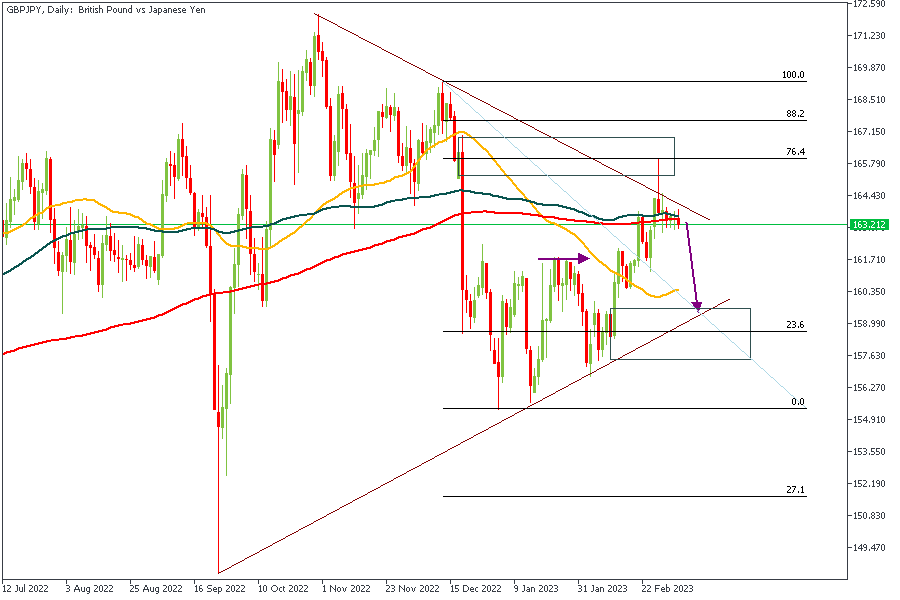
Here we have a large wedge constricting price movement on the daily timeframe of GBPJPY. Price has also recently bounced off the supply zone above the trendline resistance of the wedge. Based on this, the position of the moving averages, and the 76% of the Fibonacci retracement zone, it is safe to expect a further price decline.
Analysts’ Expectations:
- Direction: Bearish
- Target: 158.9
- Invalidation: 168.9
CADJPY
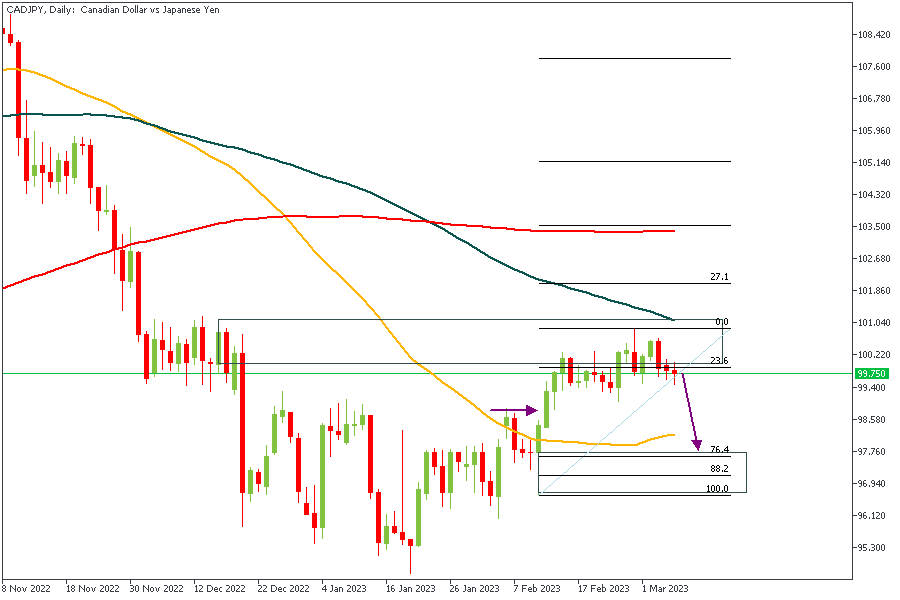
CADJPY is reacting within the highlighted supply zone, and we also have a bearish alignment from the moving averages. As a result of these confluences, I have a bearish sentiment. However, it is less confident than I would like.
Analysts’ Expectations:
- Direction: Bearish
- Target: 97.9
- Invalidation: 101.8
CHFJPY
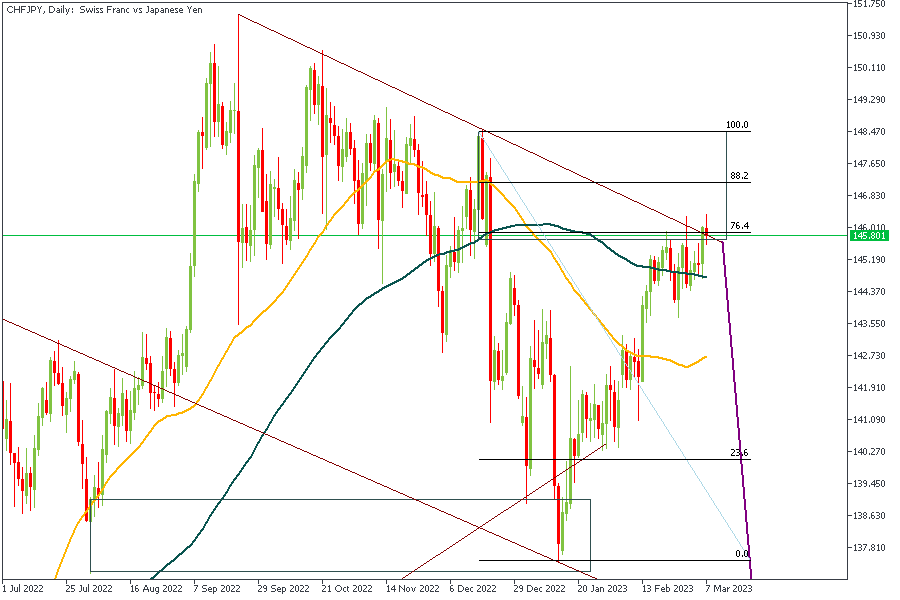
We've been pursuing this particular setup for a few days. It is noticeable that the price here is still trading under the supply zone, with slight rejections already taking place. The resistance trendline and the 76% Fibonacci retracement level add additional confluences. The 50-period moving average trading below the 100-period moving average also confirms a bearish sentiment.
Analysts’ Expectations:
- Direction: Bearish
- Target: 142.7; and 141
- Invalidation: 148.5
CONCLUSION
The trading of CFDs comes at a risk. Thus, to succeed, you have to manage risks properly. To avoid costly mistakes while you look to trade these opportunities, be sure to do your due diligence and manage your risk appropriately.
AUDUSD Wave Analysis
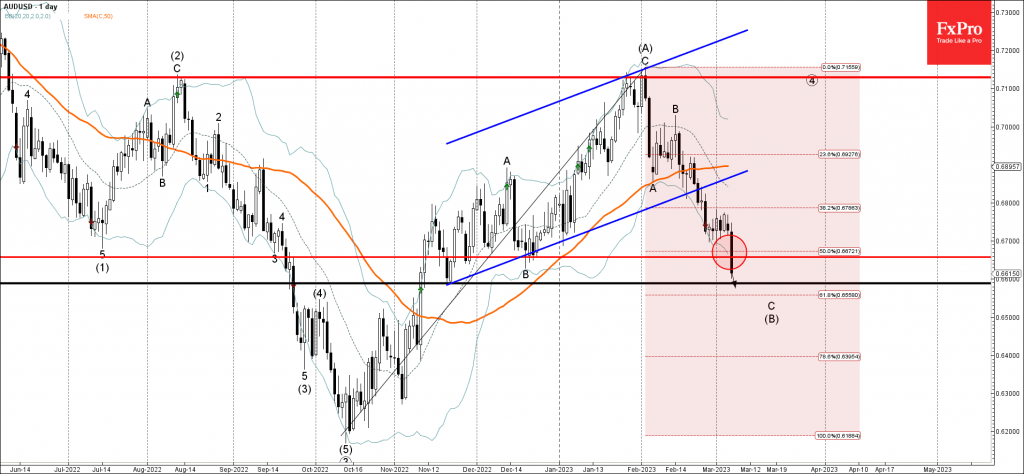
- AUDUSD broke support level 0.6660
- Likely to fall to support level 0.6600
AUDUSD recently broke the key support level 0.6660 (which stopped the earlier B-wave in December) intersecting with the 50% Fibonacci correction of the upward impulse from October.
The breakout of the support level 0.6660 accelerated the active C-wave of the intermediate ABC correction (B) from the start of February.
AUDUSD can be expected to fall further to the next support level 0.6600 (which reversed the pair in the middle of November).
CADCHF Wave Analysis
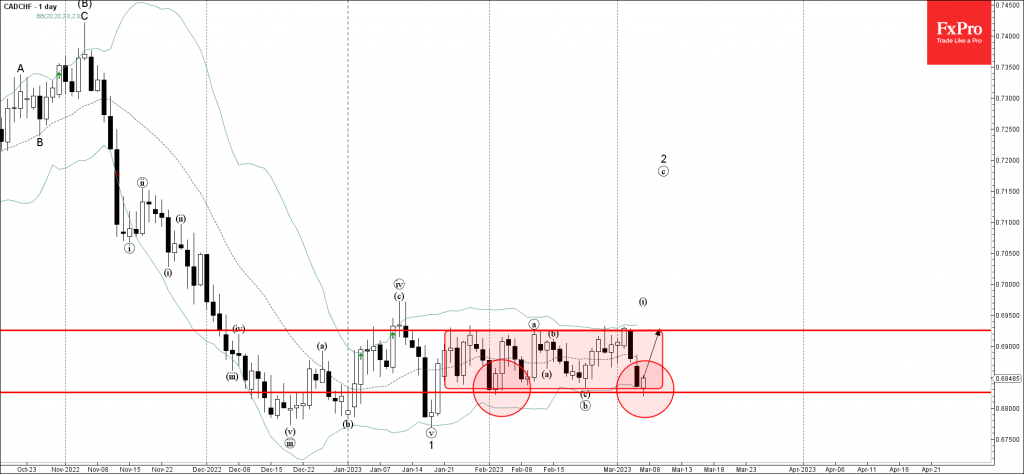
- CADCHF reversed from strong support level 0.6825
- Likely to rise to resistance level 0.6925
CADCHF currency pair recently reversed up from the strong support level 0.6825 (which is the lower boundary of the narrow sideways price range inside which the pair has been trading from January).
The support level 0.6825 was further strengthened by the lower daily Bollinger Band.
CADCHF can be expected to rise further to the next resistance level 0.6925 (upper border of the active sideways price range).
Fed Chair Powell Said Ultimate Peak Interest Rate Level Would be Higher
Markets
Fed Chair Powell in front of the US Senate as expected said that the ultimate peak interest rate level would be higher than expected in December (5-5.25% median projection in the dot plot). Less expected was the other bomb he dropped: showing readiness to speed up rate hikes again if warranted by the data. Stronger January data and the bumpy inflation data ahead could be the key. We warned for quite some time that the Fed in March would have to revert to a 50 bps rate hike, a scenario US money markets are now attaching a 1/3 possibility to. The US yield curve turns more inverse with yields rising by 2.7 bps (30-yr) to 7.4 bps (2-yr). The dollar profits with EUR/USD losing 1.06 again. US stock markets lose around 1% in a first move.
Ahead of Fed Chair Powell’s testimony before US Senate, another central banker grabbed headlines with some interesting comments on Bloomberg. The lady in question was not ECB President Lagarde, but Bank of England policy maker Catherine Mann, amongst the more hawkish members on the BoE-board. She argued that the UK central bank needs to push hard on rates as the traditional transmission mechanism is hampered by the volume of long-term, fixed loans by companies and households during (and ahead) of the Covid-period. As a result, interest rate increases we are seeing today are not really hitting the economy, she says. Another argument is concern about the extent to which there is strong pricing power among firms and acceptance of those price rises by a lot of consumers. Worries about diminishing labour supply in the wake of Covid and brexit (end UK-EU freedom of movement) add to her personal inflation outlook. The return to a small and open economy following brexit implies as well that it will be tough to grow without creating inflation. Mann still thinks that there’s more to go for the UK central bank with the terminal rate still “beyond the forecast horizon”. It’s unclear whether the latter means a preference to hold rates until 2025. Her reference to sterling suggests that she’ll lose out against the more dovish majority under BoE-governor Bailey’s wings. Mann fears that sterling could fall further given the hawkish tone coming from the Fed and the ECB, especially if it turns out that this hawkishness isn’t completely discounted yet. Sterling is a tad softer today, but testing the psychologic EUR/GBP 0.89-mark again. UK Gilt yields follow the global move today, sliding 2.4 bps (2-yr) to 8 bps (30-yr). UK money markets currently discount three additional 25 bps rate hikes at the March, May and June or August policy meetings with the terminal rate then being 4.75%.
News Headlines
South-African GDP contracted by 1.3% Q/Q in the fourth quarter of last year, resulting in activity only being 0.9% higher compared to the same period in 2021. The decline follows 1.8% Q/Q and 4.2% Y/Y growth in Q3. The decline was much more pronounced than analysts expected. Economic growth for the whole of 2022 slowed to 2% compared to 4.9% in 2021. Electricity blackouts probably were an important factor behind the poor economic performance. According to Statistics South Africa, seven of the ten industries contracted in Q4. The finance, real estate & business services industry shrank by 2,3%. As this sector is the largest in the economy, the decrease was the biggest factor behind the decline in GDP, subtracting 0,6 ppt from GDP growth. Trade, catering and accommodation subtracted 0.3 ppt. Transport and communication, construction and personal services where the only sectors to make a (marginal) positive contribution. The 2-y swap rated declined 6 bps after the release. The rand loses about 0.75% with USD/ZAR trading at 18.41, near recent YTD peak levels in the 18.51/58 area.
Perceived inflation over the previous 12 months eased in the ECB’s monthly consumer expectations survey to 9.5% in January from 9.9%. Median expectations for inflation in the year ahead slowed slightly from 5.0% to 4.9% but expectations for three years ahead declined sharply from 3.0% to 2.5%. Consumers expect nominal income to grow by 1.3% over the next year, but expectations on spending moderated from 4.2% to 3.8%. Expectations on economic growth turned less negative (-1.2% from -1.5%) and this also caused expectations for the unemployment rate to ease from 11.9 to 11.6%. Current unemployment rate is perceived at 11.3%. Consumers expect growth in the price of their home to slow to 2.5% down from 3.0%.