Sample Category Title
Strong US PPI Pushing Fed to Do More
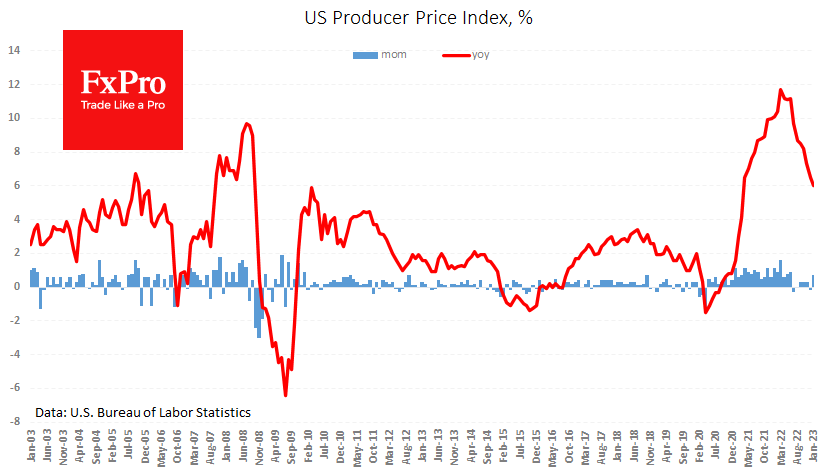
After consumer prices, US producer prices delivered another hawkish surprise. PPI rose by 0.7% in January, impressively stronger than the expected +0.4%. The annual price growth rate slowed from 6.5% to 6.0%, against expectations of 5.4%.
It is worth disregarding the slowdown in the annual inflation rate, as it is due to the high base effect of the previous year, while the monthly increase remains above the historical average.
Producer prices are a couple of months ahead of consumer prices, so today’s release is a crucial hawkish signal for the Fed to continue raising rates without letting inflation expectations hang in the balance.
Aside from high inflation, the labour market also needs more reasons to take a breather. Initial jobless claims remained below 200k for the fifth week in a row, complementing the 3% rise in retail sales in January.
Overall, this mix of data suggests that the economy is in good shape. Still, it now risks triggering a reassessment of the monetary policy outlook, which is harmful to the markets.
BoC Macklem: Additional monetary tightening if inflation gets stuck above 2% target
BoC Tiff Macklem told a parliament committee, "we expect CPI inflation to fall to around 3% in the middle of this year and reach the 2% target in 2024."
"For inflation to get back to 2%, the effects of higher interest rates need to work through the economy and restrain spending enough for supply to catch up."
"The tightness in the labour market needs to ease, wage growth needs to moderate, and service price inflation needs to cool."
"Inflation expectations also need to come down and businesses return to more normal pricing behaviour."
"If those things don't happen, inflation will get stuck above our 2% target, and additional monetary tightening will be required."
USD/JPY: Weaker than Expected US Data Add to Positive Outlook
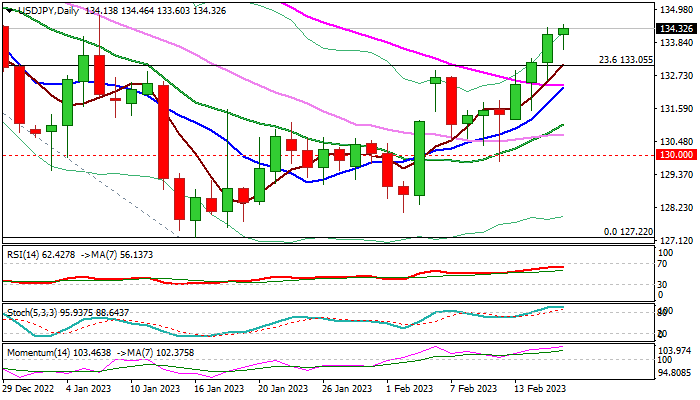
The USDJPY is consolidating within a narrow range under new multi-week high on Thursday, as bulls pause after a strong rally in past three days, when the pair gained 2.2%.
The dollar keeps bullish near-term stance on expectations that the Fed would remain on policy tightening path after inflation in January rose above expectations.
The US data released today added to dollar’s bullish outlook as core producer prices (a leading indicator of consumer inflation) rose above expectations in January (0.5% vs 0.3% f/c / previous month), while
Philadelphia Fed manufacturing index collapsed to the lowest since May 2020 (-24.3 vs -7.4 f/c), partially offsetting optimism about skipping recession.
Bullish setup of daily indicators underpins the action, with bullish signal developing on weekly chart as the pair is on track for weekly close in green and formation of bullish engulfing pattern.
Bulls pressure immediate barrier at 134.77 (2023 high of Jan 6), but could extend towards strong resistances at 136.66/89 (Fibo 38.2% of 151.94/127.22 / 200DMA) on stronger bullish acceleration.
Meanwhile, bulls may take a breather for consolidation as daily studies are overbought, with dips to ideally find ground above broken Fibo 23.6% (133.05) and deeper downticks to be contained above 132.38/32 (converging 10/55DMA’s in attempt to form a bull-cross) to keep bulls intact.
Res: 134.77; 135.23; 136.66; 136.89.
Sup: 133.60; 133.05; 132.32; 131.06.
ECB Lane: Tightening estimated to lower inflation by 1.2% in 2023, 1.8% in 2024
ECB Chief Economist Philip Lane said in a speech that the central bank's tightening is estimated to have "already lowered inflation by around 0.2 percentage points in 2022".
"The considerable lags between monetary policy actions and their impact on inflation, however, imply that most of the effects are only expected to materialise from 2023 onward." Inflation is estimated to be 1.2% lower in 2023 and 1.8% lower in 2024 as a result of the tightening.
On the other hand, the impacts on GDP growth "occur much sooner across most models, with the peak effect expected this year." The negative impact on real GDP growth is estimated to be around 1.5 percentage points on average over the three years.
Sunset Market Commentary
Markets
The empty European eco agenda obviously failed to lift market spirits. ECB executive board Panetta, one of the final “doves” standing, suggested a downshift in rate hikes after the flagged +50 bps move in March. “With rates now moving into restrictive territory, it is the extent and duration of monetary policy restriction that matters. By smoothing our policy rate hikes – that is moving in small steps – we can ensure that we calibrate both elements more precisely in the light of the incoming information and our reaction function.” He stressed that to move in small steps is not to move less. Markets shrugged off the news as they did with the ECB’s new economic bulletin. From that moment, it turned in to a waiting game for the early US numbers. A new all-time high for the French CAC 40 index provided some welcome distraction (spoiler alert: inverted hammer warning). US data turned out a mixed bag. Markets spotted sub 200k jobless claims and a faster-than-expected acceleration in producer price inflation. Monthly headline (0.7% M/M) and core PPI (0.5% M/M) rose at the fastest pace since June and March 2022 respectively. Y/Y-readings decelerated less than feared to 6% (headline) and to 5.4% (core). We add the PPI-numbers in line with stellar payrolls, stubborn January CPI and very good retail sales. All support the case for Fed policy rates to peak above December projections and to stay at those levels for longer than anticipated. US Treasuries spiked lower and the dollar gained in a first reaction, but moves were temporarily hampered by those other data releases, painting a more uncertain picture. Housing starts fell by 4.5% M/M (vs -1.9% expected) with building permits stagnating by 0.1% M/M (vs 1% expected). The Philly Fed Business Outlook dropped to a new cycle low (-24.3) in February with details bleak over the whole spectrum (new orders, shipments, employment, average work week, expectations). Shortly after the numbers, Cleveland Fed Mester amplified market moves, by saying that she saw a compelling case for a 50 bps rate hike at the February meeting. If Mester (and others?) were prepared to stick to the 50 bps pace before this month’s batch of eco data, they (and more?) will surely be willing to put the option back on the table on March 22. Especially if February payrolls (March 10) stay strong and February inflation (March 14) stays high. Next week’s FOMC Minutes (Feb 22 release) can give additional color on how big the hawkish minority was last month. US yields rise by up to 4.5 bps (30-yr) today. The US 5-yr yield is trying to take out 4.04% resistance, which is the final stop ahead of the 4.5% cycle peak. The US 10-yr yield is approaching similar resistance at 3.9%. German yields follow the move higher with yields increases by up to 2.8 bps 10-yr. The German 10-yr yield moves above 2.5% and has the 2.57% cycle peak within reach. 10-yr yield spreads vs Germany widen by up to 2 bps for Italy. Italy today launched a new 30-yr syndicated benchmark (€5bn) with order books in excess of €26bn. The sell-off on core bonds for the first time in some sessions weighs on risk sentiment. Main European indices switched gains for losses with key US benchmarks opening more than 1% lower. The dollar gains ground (EUR/USD 1.0675) but can’t force the break below the 1.0650 area for now. We stick with our view that this is a matter of time. EUR/GBP returns above 0.89.
News Headlines
The Advocate General of the European Court of Justice, in an opinion published today, gave a non-binding advice on the renumeration Polish banks can ask customers after the annulment of FX mortgage loans due to unfair terms. According to the advice, a bank is not entitled to assert against a consumer claim that go beyond reimbursement of the loan capital transferred and payment of default interest at the statutory rate from the date of the request for reimbursement. Consumers on the other hand could claim additional sums beyond the cost of capital already repaid, which hasn’t been a common practice in these disputes till now. In the end national courts will have to rule on the individual cases according to national law, but in line with principles of the EU directive. A ruling of the EU Court now is expected within six months and can lead to substantial additional costs for Polish banks. Via lending conditions, it might also have broader impact on (the financing of the) economy. Polish Banks today underperform the broader local index. The zloty declined from the EUR/PLN 4.76 area to currently trade near 4.7775.
Bitcoin Risks Getting Stuck Near $25K
Market picture
Bitcoin has rallied over 9% in the past 24 hours, returning to August highs and peaking near $25,000. The move looked like a short squeeze following softer-than-feared comments from the SEC. At the same time, we note that the optimism was concentrated in Bitcoin and Ethereum.
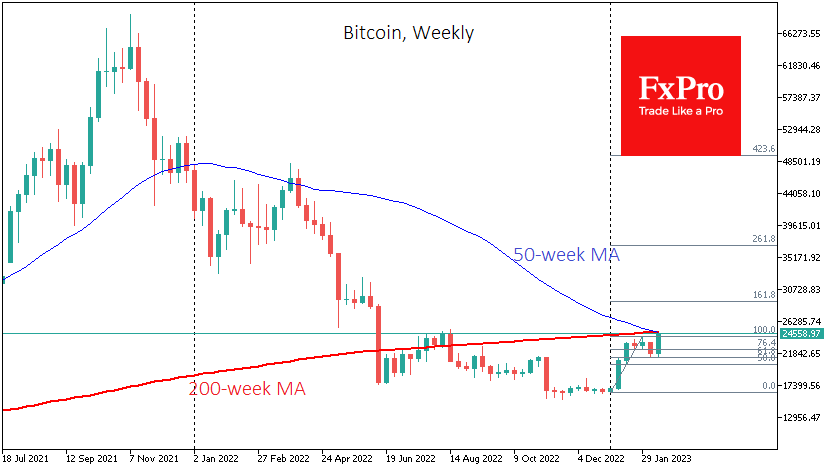
The short-term technical picture has become even more bullish. Bitcoin has turned higher after correcting 61.8% of the rally since the beginning of the year and has rewritten previous highs with strong momentum. The next Fibonacci target is at 29,000, which coincides with the consolidation area from last May.
However, the picture on the weekly chart suggests that a serious tug-of-war may be taking place at current levels. A “death cross” pattern forms at 24.9, where the 50-week crosses the 200-week. And the price is now below that cross. History suggests that bitcoin gets stuck near this long curve for many weeks.
News background
Dan Morehead, CEO of cryptocurrency hedge fund Pantera Capital, said that the bear cycle in the cryptocurrency market ended in November and that bitcoin will rise. He said confidence in the cryptocurrency industry is rebounding, no matter what happens in the risky asset market.
Stablecoin issuer USDC Circle refuted Fox Business’ information about possible reprisals from the SEC. Earlier, one of the network’s reporters tweeted that Circle had been ordered to stop selling “unregistered securities”.
Changpeng Zhao, chief executive of the Binance exchange, believes the industry could move to stablecoins pegged to other fiat currencies because of recent nagging from US regulators over the BUSD.
The ECB has urged EU banks to apply the Basel Committee on Banking Supervision’s restrictions on crypto assets before they come into force. Implementing the Basel standard for regulating crypto-asset risk for banks is expected to be completed by 1 January 2025.
USD/JPY Mid-Day Outlook
Daily Pivots: (S1) 133.03; (P) 133.69; (R1) 134.84; More...
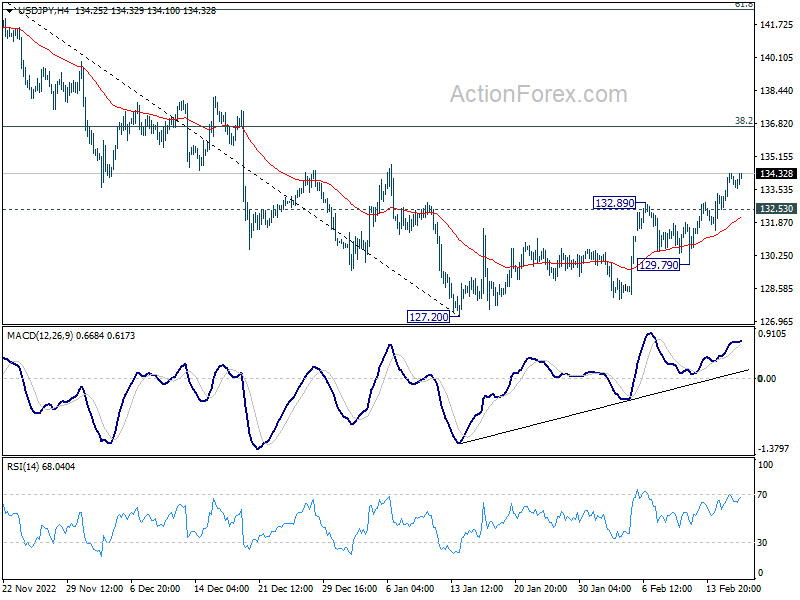
USD/JPY's rise from 127.20 is still in progress and intraday bias remains on the upside Next target is 38.2% retracement of 151.93 to 127.20 at 136.64. Strong resistance could be seen there to complete the corrective rise. On the downside, break of 131.49 minor support will turn intraday bias neutral again first.
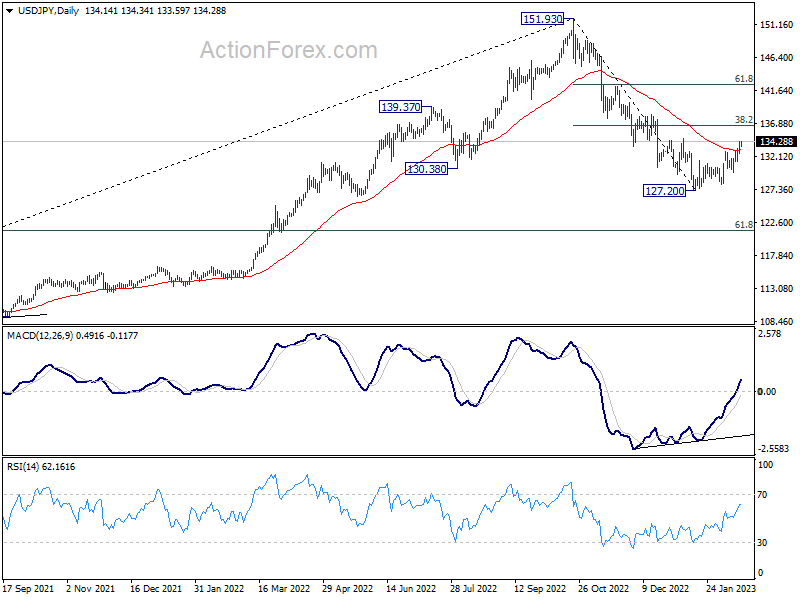
In the bigger picture, prior of 55 week EMA (now at 131.47) raises the chance of medium term bearish reversal, but that's not confirmed yet. Strong rebound from current level, followed by sustained break of 38.2% retracement of 151.93 to 127.20 at 136.64 will argue that price actions from 151.93 is merely a corrective pattern. However, rejection by 136.64 will solidify medium term bearishness for 61.8% retracement of 102.58 to 151.93 at 121.43 and 38.2% retracement of 75.56 to 151.93 at 122.75.
USD/CHF Mid-Day Outlook
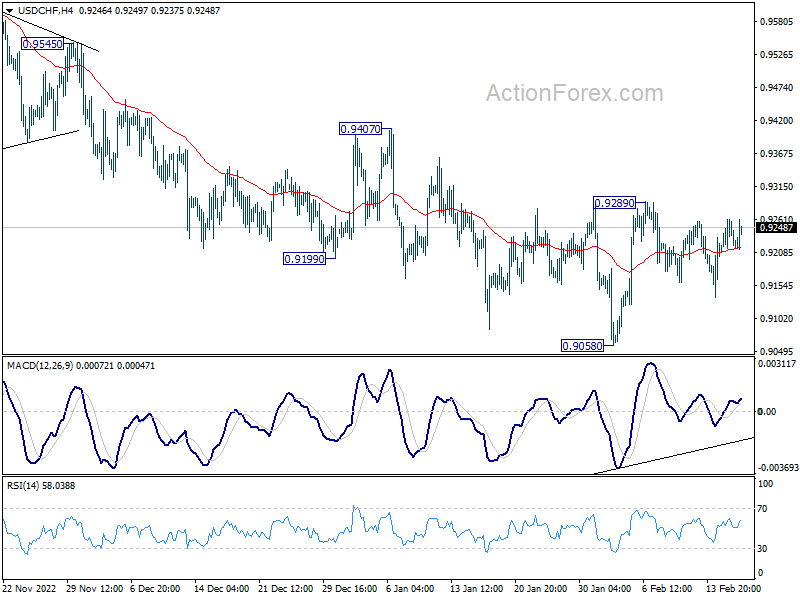
Daily Pivots: (S1) 0.9209; (P) 0.9236; (R1) 0.9264; More...
Intraday bias in USD/CHF stays neutral at this point. On the upside, firm break of 0.9289 resistance will confirm short term bottoming at 0.9058, and bring stronger rise to 0.9407 resistance. On the downside, however, sustained break of 0.9058 will resume larger decline from 1.0146 instead.
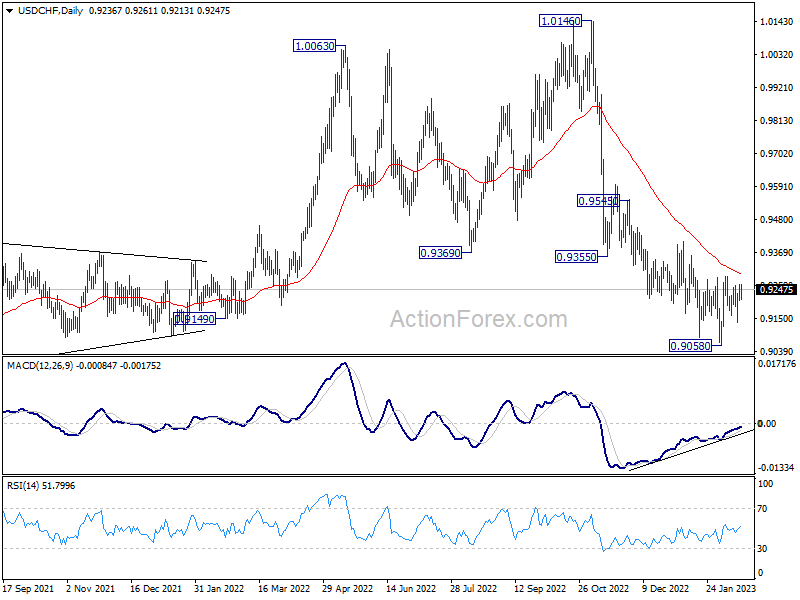
In the bigger picture, rise from 0.8756 (2021 low) has completed at 1.0146, well ahead of 1.0342 long term resistance (2016 high). Based on current downside momentum, fall from 1.0146 should be a medium term down trend itself. Next target is a test on 0.8756 low. Strong support should be seen there to bring rebound. Still, further decline will be expected as long as 0.9407 resistance holds, in any case.
GBP/USD Mid-Day Outlook
Daily Pivots: (S1) 1.1955; (P) 1.2069; (R1) 1.2147; More...
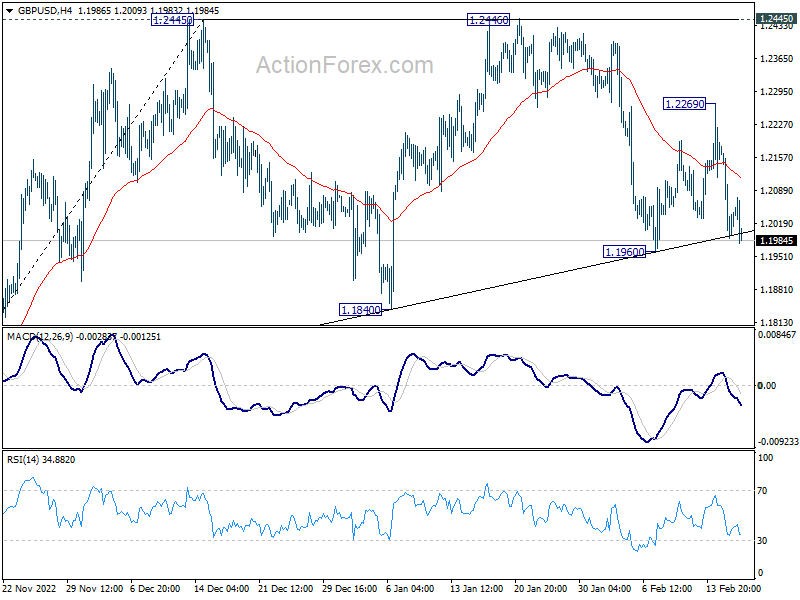
Intraday bias in GBP/USD stays mildly on the downside for the moment. Break of 1.1960 support will resume the fall from 1.2446, as the third leg of the corrective pattern from 1.2445, to 1.1840 support and possibly below. Risk will now stay mildly on the downside as long as 1.2269 resistance holds, in case of recovery.
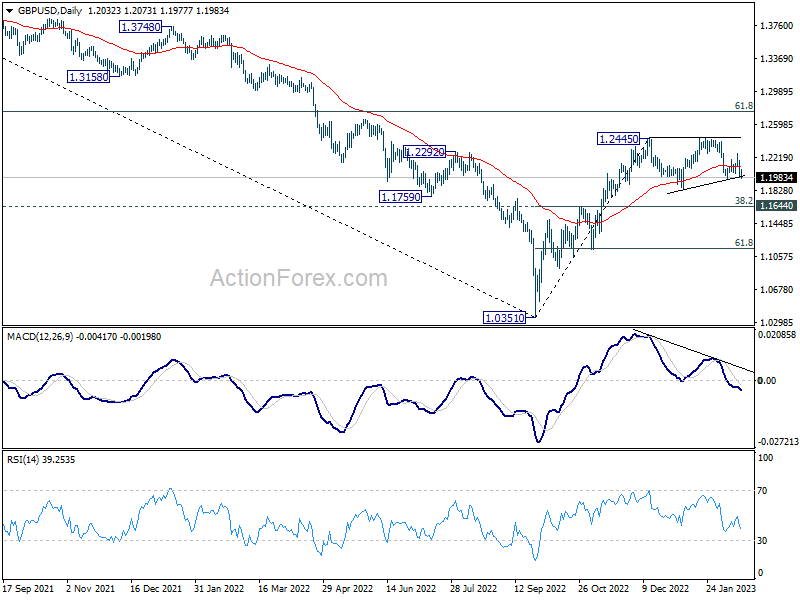
In the bigger picture, rise from 1.0351 medium term bottom is at least correcting whole down trend from 1.4248 (2021 high). Further rise is expected as long as 1.1644 resistance turned support holds. Next target is 61.8% retracement of 1.4248 to 1.0351 at 1.2759. Sustained break there will pave the way back to 1.4248.
EUR/USD Mid-Day Outlook
Daily Pivots: (S1) 1.0650; (P) 1.0698; (R1) 1.0734; More...
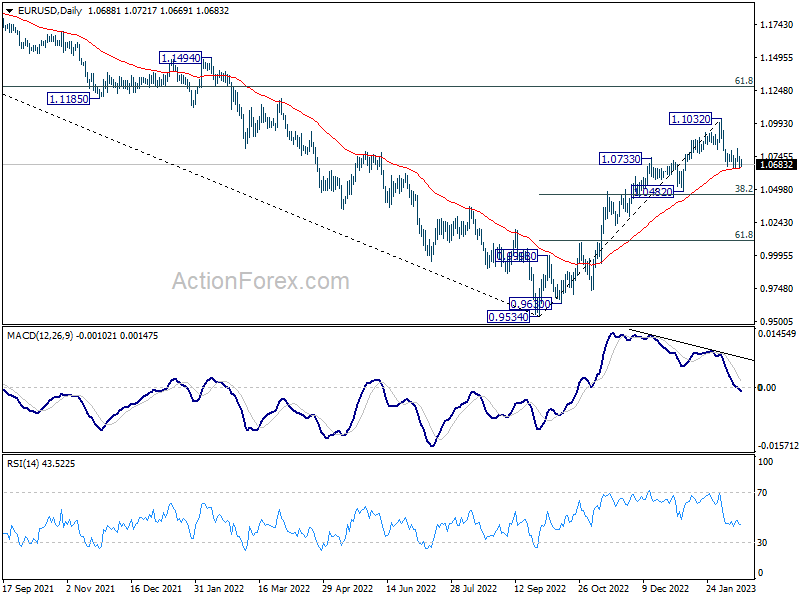
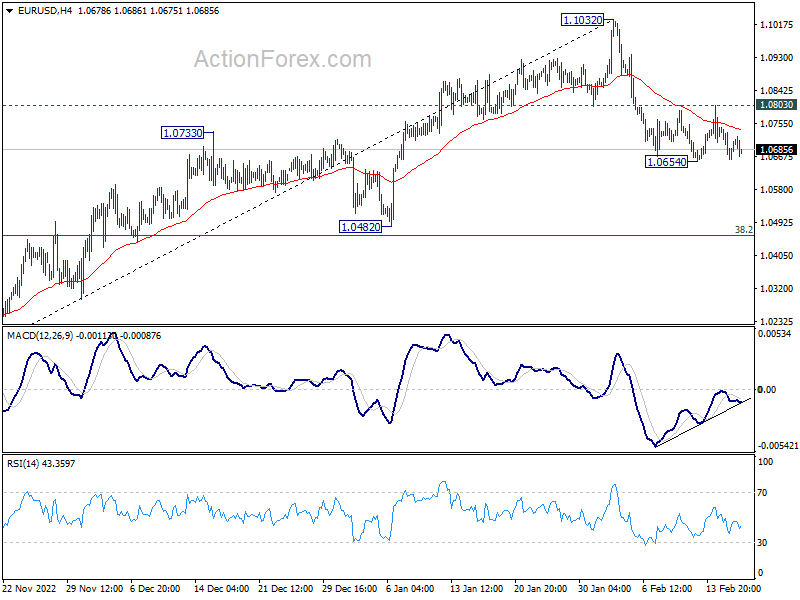
Intraday bias in EUR/USD remains neutral and outlook is unchanged. On the downside, break of 1.0654 will resume the corrective fall from 1.1032 to 38.2% retracement of 0.9534 to 1.1032 at 1.0463. Strong support should be seen around there to bring rebound, at least on first attempt. On the upside, firm break of 1.0803 minor resistance will turn bias back to the upside for retesting 1.1032 high instead.
In the bigger picture, the rally from 0.9534 low (2022 low) is a medium term up trend rather than a correction. Further rise is in favor to 61.8% retracement of 1.2348 (2021 high) to 0.9534 at 1.1273 next. This will remain the favored case as long as 1.0482 support holds.