

Sample Category Title
Will USDJPY Slide Lower in 2023?
Last year was tough for the Japanese yen. USDJPY gained more than 30% over 2022, striking above 150 in October. While anticipation of slower Fed rate hikes pulled the pair below the 130 level at the start of 2023, the speculations over the destiny of BOJ’s yield control policy grabbed the attention of the Japanese assets in the middle of January. What lies ahead for traders of the Japanese yen?
How does BOJ affect the market?
The Bank of Japan is famous for its slow and steady monetary policy, which aims to boost economic activity and fire inflation. There are two main tools that the BOJ uses: the negative interest rate at -0.1% and the yield-curve control, which allows the 10-year government bond to fluctuate within a pre-determined range to reach the 0% yield target.
The Bank of Japan’s yield-control policy, introduced in 2016, aimed to keep yield meager to encourage consumer spending. This, in turn, should stimulate inflation. In 2018, the Bank of Japan announced that the 10-year yield could increase by 0.1% above or below zero. In March 2021, the regulator made the band wider to 0.25% in either direction to reactivate the market’s activity. In 2022, the BOJ raised the ceiling to 0.5% above/below zero and increased bond-buying amid the escalated pressure on the Bank to raise the interest rate. It also added speculation that the Bank would abandon the long-term rate target.
However, on January 18, the Bank announced no changes to the monetary policy, which pulled the 10-year bond yield lower to 0.38%.
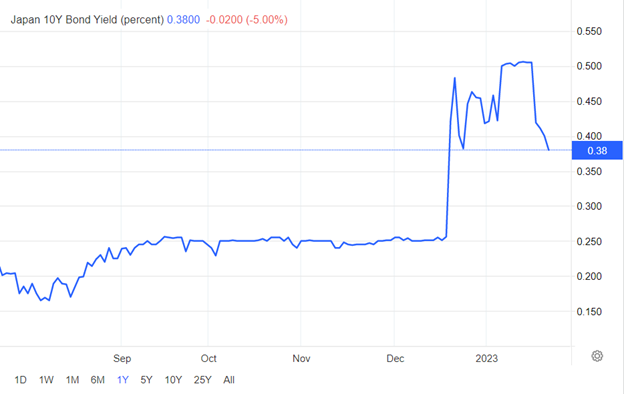
The market mood changes resulted in the Japanese yen going up and down in January. USDJPY fell almost 14% at the beginning of the month but started rising after the Bank declared the continuation of the easing monetary policy. Despite that, analysts don’t believe in the long-term weakness of the Japanese currency.
Factors that may strengthen the JPY
Many factors may affect the long-term weakness of the Japanese yen.
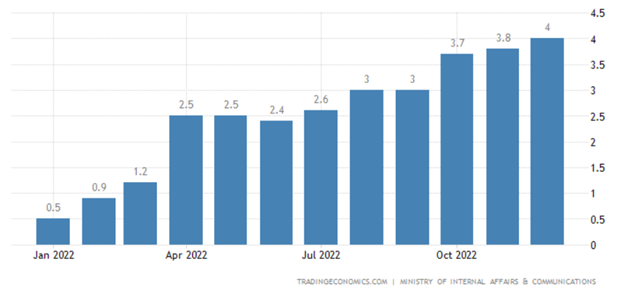
First, the inflation rate, which hit 4% in December 2022, may push the central Bank into action. According to the Bank of America, the inflation rate may skyrocket far above the market consensus (3% vs. 1.9%).
Another point for the hawkish policy shift is related to the upcoming end of the BOJ Governor Haruhiko Kuroda's term. Analysts warn that the BOJ may repeat the Fed's transitionary rhetoric and start making hawkish steps too late.
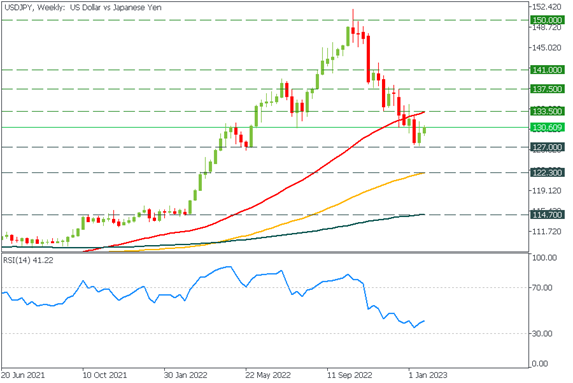
If this is true and the JPY gains its strength, we may see USDJPY sliding below the 127 level. In that case, the following targets for sellers will lie at 122.30 and 114.70. The selling pressure may increase after the retest of the 50-day SMA at 133.50.
If you want to take advantage of the Japanese yen, join FBS. With FBS, you can trade USDJPY, EURJPY, and GBPJPY on favorable conditions, including fast execution and leverage up to 3000.
Conclusion
The recent monetary policy decisions weakened the performance of the Japanese yen. However, high inflation and a leadership change in the Bank of Japan may result in USDJPY sliding below 120.
Euro Continues to Drift
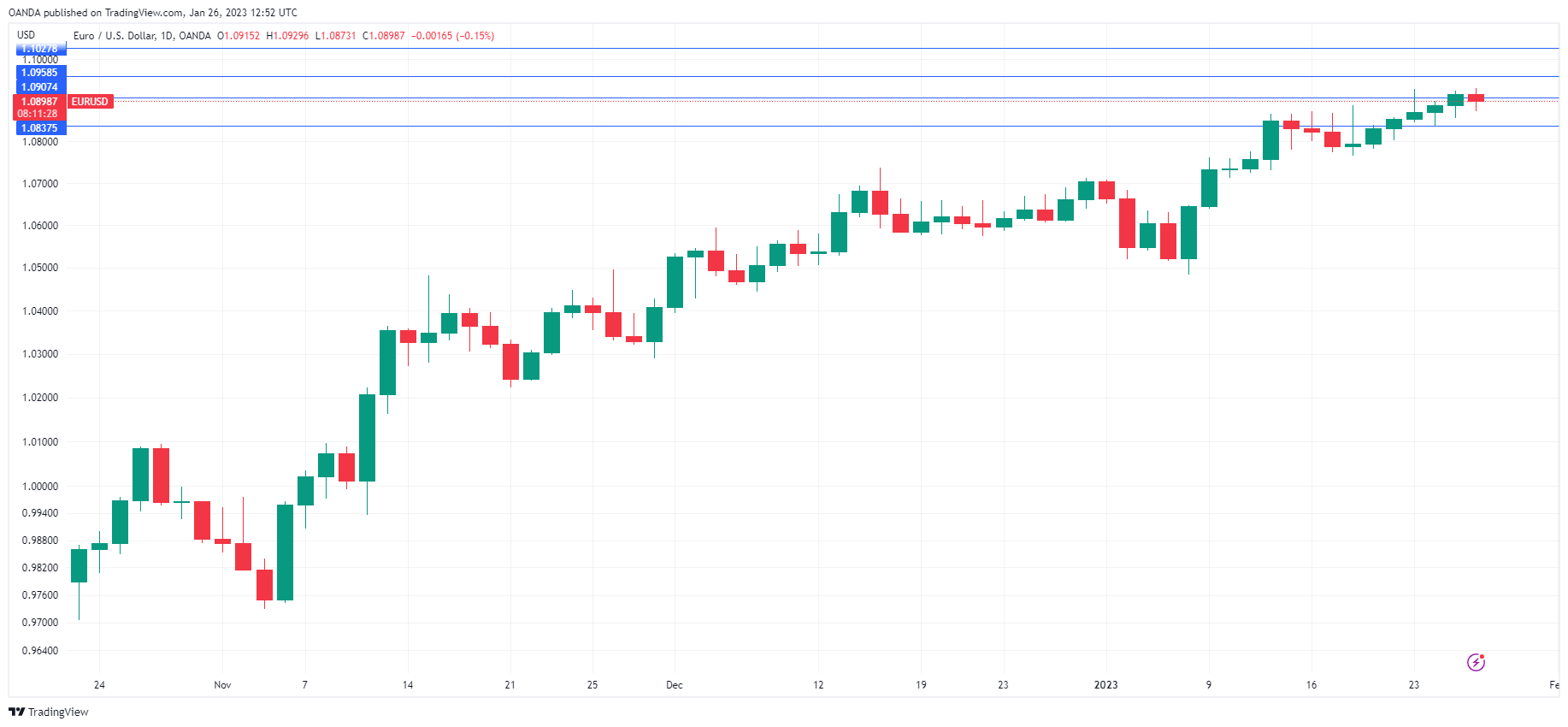
The ECB has been in calm waters all week and the trend has continued on Thursday, as EUR/USD continues to hug the 1.09 line.
What is the ECB’s game plan?
With inflation designated as public enemy number one, the ECB is no doubt pleased that inflation has fallen for two straight months, dropping to 9.2% in December. Still, this is well above the ECB’s inflation target of 2%, and the newly-hawkish Christine Lagarde has declared that the ECB will “stay the course” to ensure that inflation comes back down.
Lagarde’s tough language is all well and good, but the markets are far from certain that ECB policy makers plan to continue with oversize rate hikes after March. The markets have priced in 50-basis point hikes at the February and March meetings, but what happens after that? ECB member Panetta reportedly said earlier this week the ECB should not commit to any specific rate moves after March.
The ECB will have to decide between increases of 25 or 50 points in May and June, and the decision will likely be determined by economic data, particularly the inflation outlook. The cash rate stands at 2.50%, and the markets are forecasting a terminal rate in the range of 3.25%-3.75%. Eurozone data has surprised to the upside, giving the ECB room to continue hiking rates without worrying about the economic fallout. The fact that an energy crisis failed to materialize is one less headache for the central bank, although the war in Ukraine isn’t going anywhere and is likely to heat up once winter is over.
The US released sharp numbers today, led by GDP for Q4, which came in at 2.9%. This beat the forecast of 2.6% and follows a 3.2% gain in Q3. Unemployment claims fell to 186,000, down from 192,000 and below the consensus of 205,000. Finally, Durable Goods Orders shot up 5.6% in December, rebounding from -2.1% in November and ahead of the 2.5% forecast. EUR/USD lost ground immediately after these releases but has recovered.
EUR/USD Technical
- EUR/USD is testing support at 1.0907. Below, there is support at 1.0837
- 1.0958 and 1.1028 are the next resistance lines
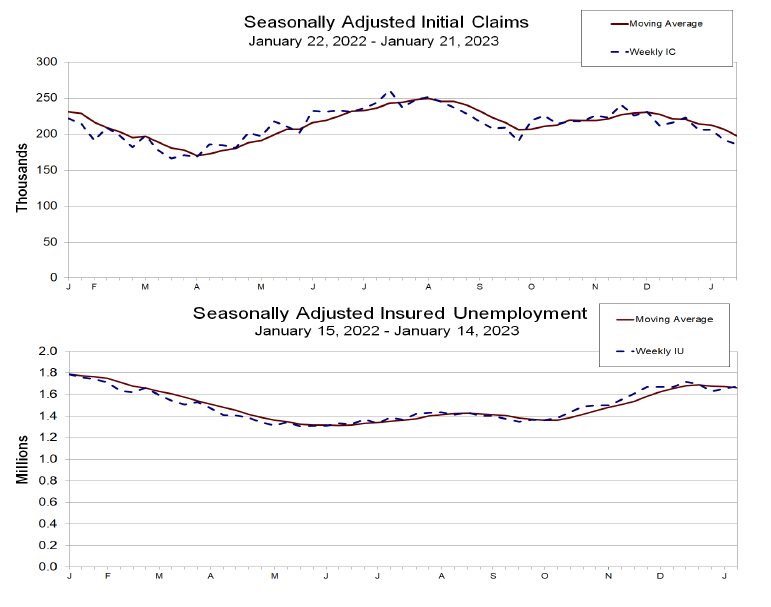
US initial jobless claims dropped to 186k
US initial jobless claims dropped -6k to 186k in the week ending January 21, below expectation of 211k. Four-week moving average of initial claims dropped -9k to 197.5k.
Continuing claims rose 20k to 1675k in the week ending January 14. Four-week moving average of continuing claims dropped -11k to 1664k.
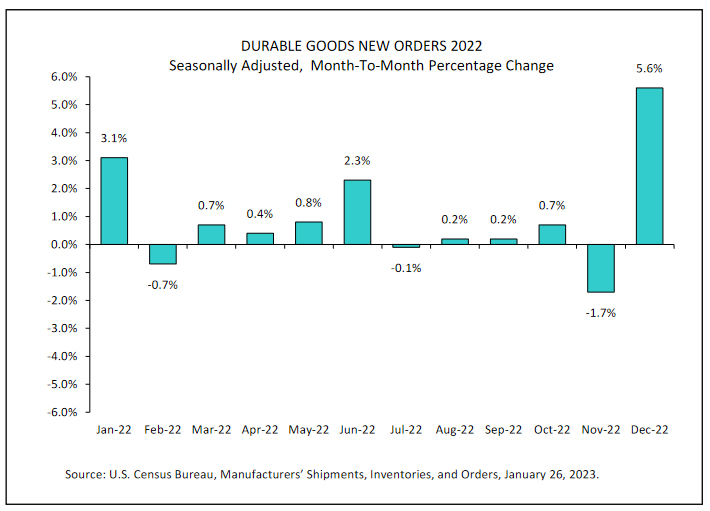
US durable goods orders rose 5.6% mom, ex-transport orders down -0.1% mom
US durable goods orders rose 5.6% mom to USD 286.9B in December, above expectation of 2.5% mom. Ex-transport orders dropped -0.1% mom to USD 178.8B, below expectation of 0.0% mom. Ex-defense orders rose 6.3% mom to USD 269.6B. Transportation equipment rose 16.7% mom to USD 108.1B.
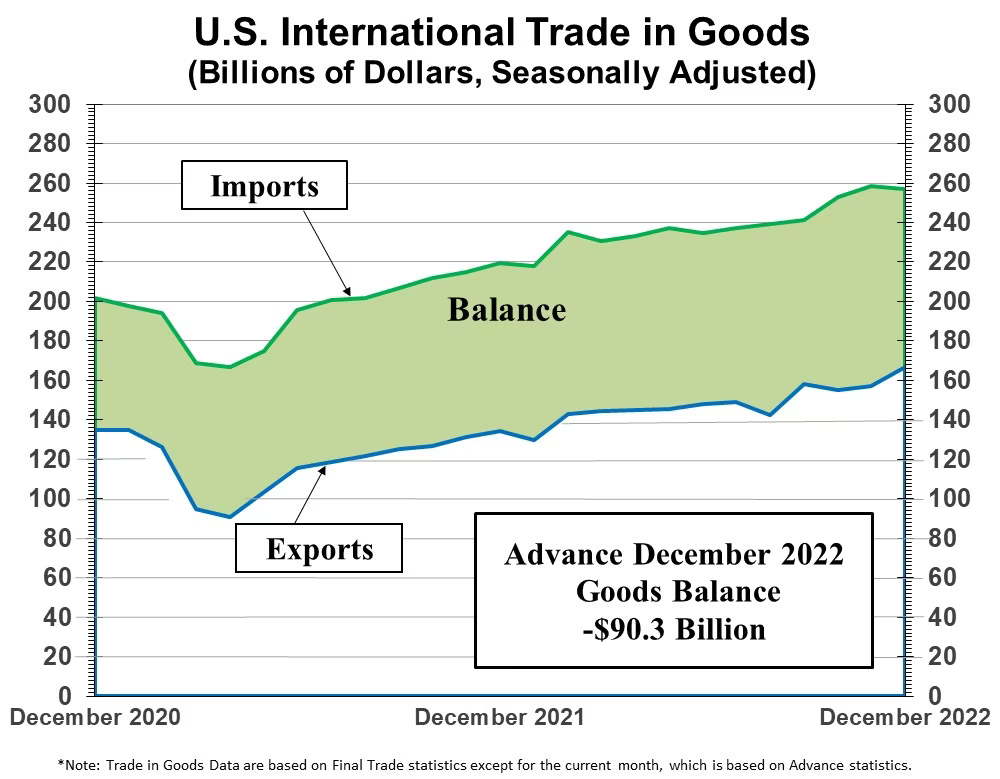
US goods trade deficit widened to USD -90.3B in Dec
US exports of goods dropped -1.6% mom to USD 166.8B in December. Imports of goods rose 1.9% mom to USD 257.1B. Goods trade deficit rose 8.8% mom to USD -90.3B, versus expectation of USD -88.8B.
Wholesale inventories rose 0.1% mom to USD 934.1B. Retail inventories rose 0.5% mom to USD 742.2B.
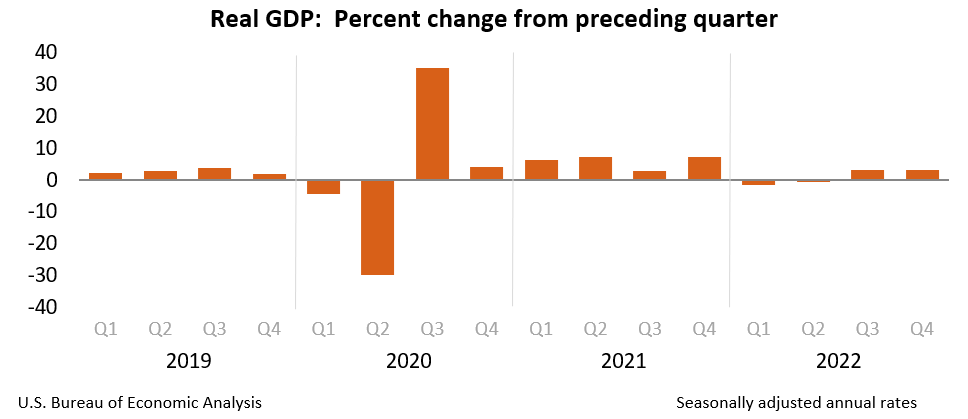
US GDP grew 2.9% annualized in Q4
US GDP grew 2.9% annualized in Q4, slightly above expectation of 2.8%. The increase in real GDP reflected increases in private inventory investment, consumer spending, federal government spending, state and local government spending, and nonresidential fixed investment that were partly offset by decreases in residential fixed investment and exports. Imports, which are a subtraction in the calculation of GDP, decreased.
For 2022, GDP grew 2.1%, compared with an increase of 5.9% in 2021. The increase in real GDP in 2022 primarily reflected increases in consumer spending, exports, private inventory investment, and nonresidential fixed investment that were partly offset by decreases in residential fixed investment and federal government spending. Imports increased.
Pound Hits Ceiling
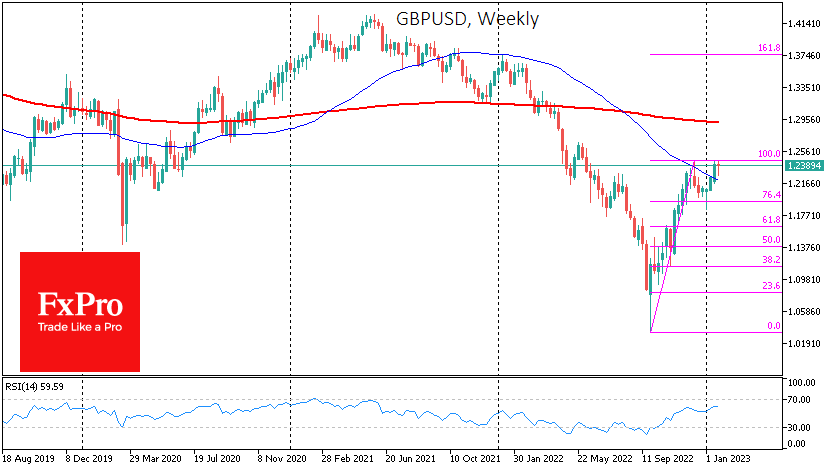
The British Pound is testing the $1.2400 level this week, above which it failed to consolidate in the middle of last month. The GBPUSD has yet to trade consistently higher since last June.
Looking at the entire rally from September’s historic lows at 1.0327, the retreat from December’s highs to 1.19 is a fairly common Fibonacci retracement to the 76.4% area of the original move, though not the classic 61.8%.
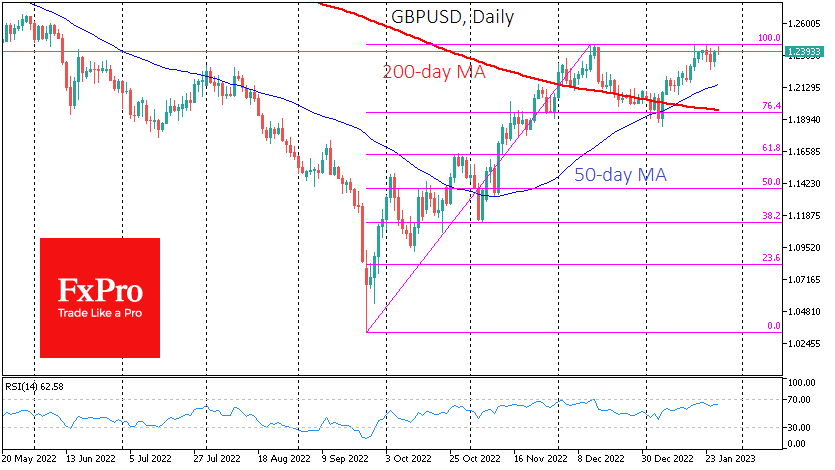
Technically, two important moving averages, the 50- and 200-day moving averages, acted as support in early January, preventing the pair from falling any further while allowing it to take some profits from the initial rally.
The pattern now suggests that GBPUSD has the potential to rise to 1.37-1.38, where the highs of last January and the 161.8% level of the first wave of the rally are concentrated. A move in this direction has every chance of becoming the main trend this year, although we expect a very significant battle for 1.3000 over the next few quarters.
However, the tactical stance is more cautious. The pound has been hitting a glass ceiling just above 1.2430 for over a week now. The inability to rewrite the previous highs is not a formal signal for further growth.
At the same time, a divergence with the Relative Strength Index is forming on the daily timeframe, as the price’s repeated highs are coming from the index’s lower local peaks, which is a bearish signal.
Without a strong rally above 1.2430, we should be prepared for a deeper local correction. The area of the January lows, also crossed by the 200 SMA, looks like a good target for another pullback.
A deeper correction towards 1.1630, where 61.8% of the recent rally and last October’s local peak are located, cannot be ruled out. Such a full-blown correction would fully recharge the pound bulls and pave the way for further growth.
XAU/USD: Bulls Take a Breather Ahead of Key US GDP Data
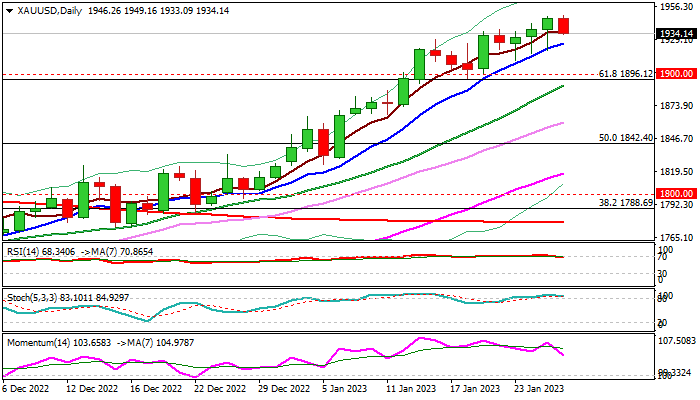
Gold price eases from new multi-month high ($1949) in European trading on Thursday, as larger bulls take a breather ahead of release of key US GDP data.
The US economy is expected to show growth of 2.6% in the last three months of 2022, down from 3.2% expansion in Q3, which adds to signals of slowing US economy.
In such scenario, the Fed would opt for further easing in its policy tightening cycle and go for 25 basis points hike on Feb 1 policy meeting, compared to 0.5% raise in the last meeting.
Lower rates would deflate dollar and help bullion to extend its three-month strong rally, with targets at $1962/$2000 (Fibo 76.4% of $2070/$1614 / psychological).
Rising 10DMA ($1925) offers initial support, with extended dips to find ground above $1900 to keep bulls in play and mark pullback as a healthy correction.
Res: 1949; 1962; 1971; 2000.
Sup: 1925; 1900; 1896; 1890.
Japanese Yen Steady ahead of Tokyo CPI
Tokyo CPI expected to rise
Inflation has been on the rise in Japan and the trend is expected to continue with the release of Tokyo CPI later today. The headline figure is expected to rise to 4.4% in December, up from 4.0% in November, while the core rate is forecast to climb to 4.2%, up from 4.0%. Earlier this week, BoJ Core CPI, the central bank’s preferred inflation gauge, rose to 3.1%, up from 2.9% prior and above the forecast of 2.9%. BoJ Core CPI has now accelerated for 11 straight months, challenging the BoJ’s stance that inflation is transitory.
The BoJ is projecting that inflation will peak at 3% in March, but this forecast seems questionable, given that rising energy and food prices have been driving inflation higher and higher. With wage growth lagging behind inflation, the cost of living is squeezing consumers, who are likely to cut back on consumption which will hurt Japan’s fragile economy.
Kanda sends warning to speculators
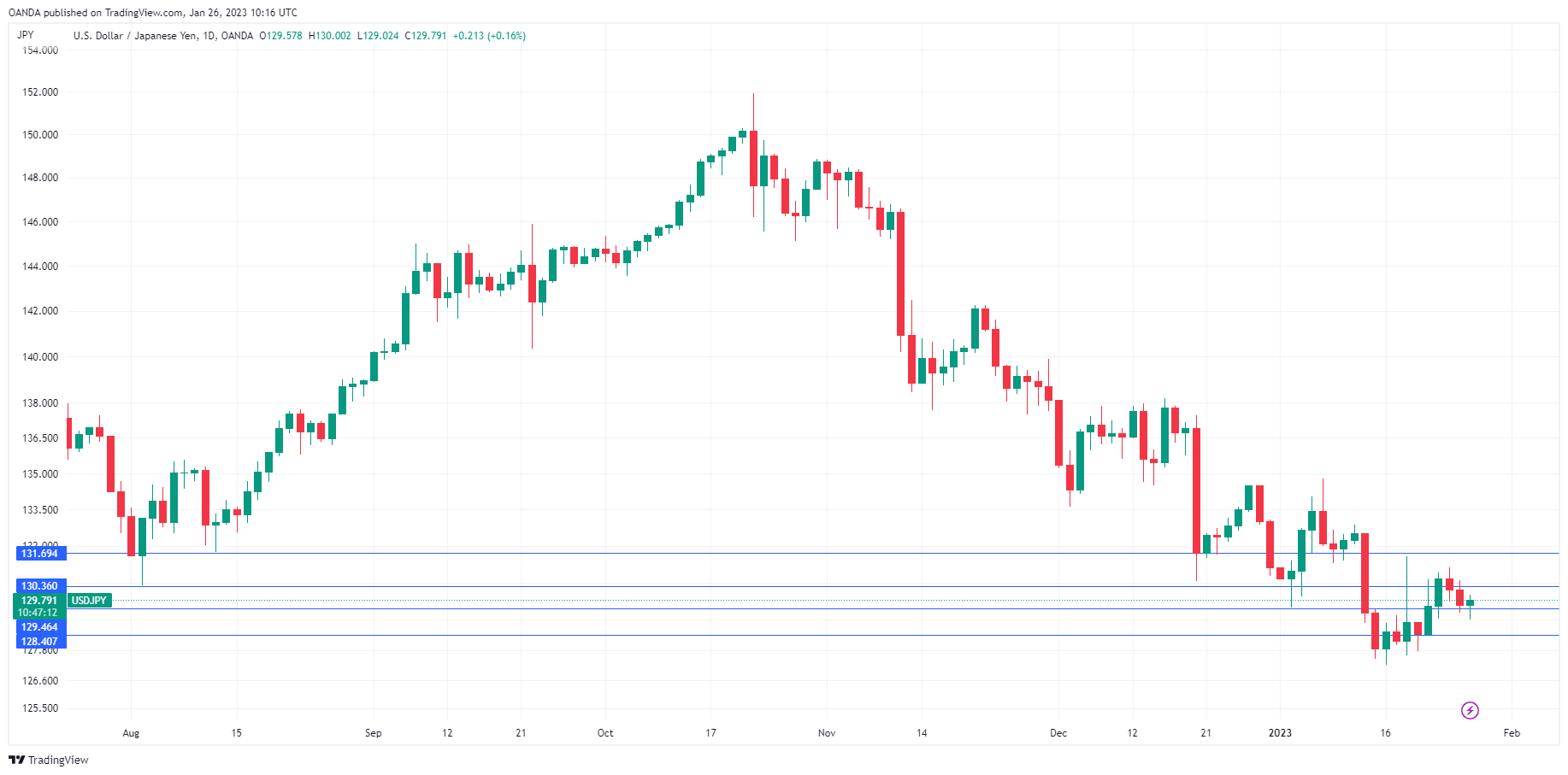
The yen has been relatively quiet over the past two weeks, but Japan’s top “currency diplomat” sent out a warning today. Vice Finance Minister for International Affairs Kanda said that sharp, one-sided moves in the currency markets would not be tolerated. Kanada oversaw the currency intervention in October after the yen had fallen close to 152 to the dollar. The yen has since rebounded and is currently trading close to 130 to the dollar. Kanda’s message is aimed at speculators, but with inflation rising and the BoJ’s ultra-loose policy looking increasingly anachronistic, speculators are likely to continue betting that the BoJ will have to tighten policy and the yen will rise as a result. The IMF had a message of its own for the BoJ, suggesting that the central bank allow more flexibility in 10-year bond yields, which would mean a shift in BoJ policy.
It’s a busy day on the economic calendar, with the US releasing GDP and durable goods. GDP is expected to slow to 2.6% in Q4, which would still point to solid growth. Durable Goods is forecast to rebound and gain 2.5% in December, following a soft reading of -2.1% in November. Traders can expect some volatility from the US dollar in the North American session, as the markets have jumped on any soft readings as a signal that the Fed will have to ease up on its aggressive rate policy, and this has sent the US dollar lower.
USD/JPY Technical
- There is resistance at 130.36 and 131.69
- 129.46 and 128.40 are providing support
IMF proposes options for BoJ to allow further flexibility and increases in long-term yields
IMF said in a statement that "accommodative monetary policy stance remains appropriate" for BoJ. But it warned of the "exceptionally high uncertainty around baseline inflation projections with risks tilted to the upside".
Upside risks include "delayed effects of exchange rate depreciation, border reopening, second round effects of imported inflation, fiscal support, and higher-than-expected wage growth." Downside risks are mainly from slowdown in the global economy.
"Given the two-sided risks to inflation, more flexibility in long-term yields would help to avoid abrupt changes later... providing clear guidance on the pre-conditions for a gradual policy rate change in the future would help anchor market expectations and strengthen the credibility of the BoJ's commitment".
"BoJ could consider the following options to allow further flexibility and increases in long-term yields: widening the 10-year target band and/or raising the 10-year target, shortening the yield curve target, or shifting from a JGB yield target to a quantity target of JGB purchases".