

Sample Category Title
Natural Gas Wave Analysis
- Natural gas broke support zone
- Likely to fall to support level 2.5000
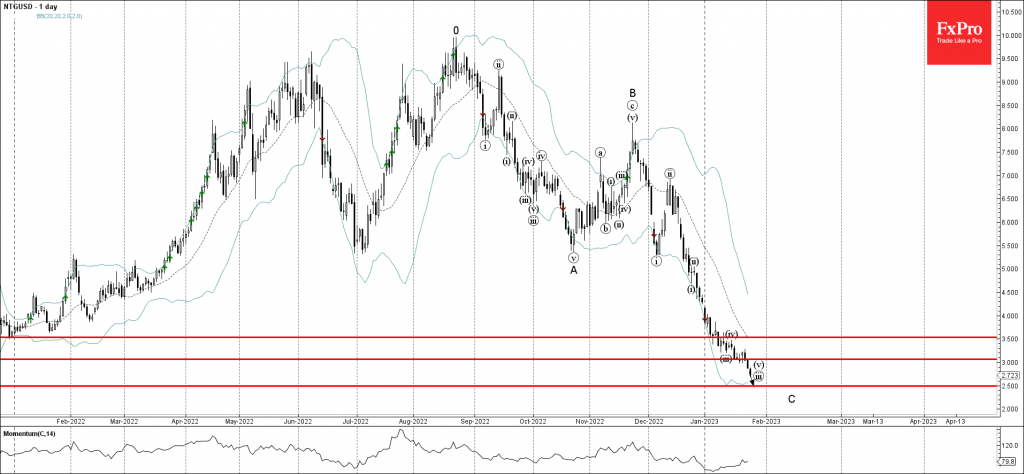
Natural gas recently broke the support zone lying between the round support level 3.000 and the support level 3.500, which started the sharp uptrend at the end of 2021.
The breakout of these support levels accelerated the active impulse waves (iii) and C.
Natural gas can be expected to fall further toward the next support level 2.5000 (target price for the completion of the active impulse wave C).
US: Real GDP Ended 2022 on a Firm Footing, Though Details Show Demand Adjustment Already Underway
Real GDP expanded by 2.9% quarter-on-quarter (q/q, annualized) in the fourth quarter of 2022. The reading came in above the consensus forecast of 2.6%. For the year, the U.S. economy expanded by 2.1% – a pace of growth slightly above trend (~1.8%) – though a marked deceleration from 2021's 5.9%.
Consumer spending grew by 2.1% – a modest deceleration from the 2.3% recorded in Q3. Spending on both services (+2.6%) and goods (+1.1%) were higher on the quarter. Gains in goods were concentrated in non-durables (+1.5%), though durables (+0.5%) eked a small gain.
Non-residential business investment expanded by just 0.7%, with gains almost entirely coming from intellectual property products (+5.3%). Structures (+0.4%) were flat on the quarter – after having declined in each of the prior six quarters – while equipment spending (-3.7%) turned lower.
Residential investment (-26.7%) showed another steep contraction in Q4, as both residential construction and sales activity continued to slow under the weight of higher interest rates.
Government spending rose 3.7% – matching the gain in Q3 – with contributions at both the federal (+6.2%) and state & local (+2.3%) level.
After two quarters of strong gains, exports (-1.3%) retreated, with the pullback entirely concentrated in the exports of goods (-7.0%), while services exports (+12.4%) recorded its strongest gain of the year. Imports (-4.6%) fell for a third straight quarter, which was entirely due to a pullback in goods imports (-5.6%). The overall impact to GDP was positive, with net trade adding 0.6 percentage points (pp) to headline growth.
Inventory investment was also strong, adding 1.5 pp to GDP – a marked improvement from the 1.2 pp drag in the third quarter.
Key Implications
Economic growth appeared to end 2022 on a relatively firm footing, though the headline number was somewhat flattered by a sizeable (and unsustainable) contribution from inventory investment. Moreover, sales to private domestic purchasers – the best gauge of underlying domestic activity – rose by only 0.2% q/q (annualized). This was a sharp deceleration from Q3's gain of 1.1% and was weighed down by both softening business investment and another outsized decline in residential investment. Even the above trend reading on consumer spending showed some underlying weakness, with services coming in considerably weaker than expected.
The broader demand adjustment appears to have already started towards the end of last year and will only intensify over the coming months as the cumulative impact of higher interest rates continues to bear down on the economy. Our Q1 tracking has GDP growth decelerating to sub-1%, and not returning to trend until late-2024.
Sunset Market Commentary
Markets
Trading in core bonds and the major FX cross rates was mainly order driven this morning. With both the ECB and the Fed having entered the blackout period ahead of next week’s policy meetings and few data in Europe, markets had to rely on their own internal dynamics. After mixed (Europe) to slightly lower (US) yields yesterday, the pendulum in interest rate markets today went in the other direction with yields gaining a few basis points ahead of the publication of the advance reading of US Q4 GDP growth. Sentiment on risk remained constructive. The US economy in Q4 grew slightly faster than expected at 2.9% Q/Qa from 3.2% in Q3 and 2.6% expected. Details were mixed. Consumption contributed an ‘moderate’ 1.42 ppts to overall growth with a decline in (fixed) investment (-1.2 ppts) counterbalanced by a big contribution from inventories (1.46 ppts). Net exports also contributed in a positive way (0.56 ppt) but this occurred as a decline in imports contributed more than a smaller easing in exports subtracted from growth. The core PCE deflator at 3.9% came out exactly as expected (3.9%). At the same time, US (headline) December durable goods orders grew more than expected (mainly due to aircraft orders) while US jobless claims declined further below the 200k reference (186k). In the end, the US data were no game-changer, but good enough for core yields to stay in green. US yields are rising about 3 bps across the curve. German yields show similar changes. Still, the move clearly lacks any momentum to regain any technically relevant levels. 10-y EMU yield spreads vs German continue recent tentative bottoming/widening with Greece still the exception to the rule (-5 bps). A story of mild growth continues to please equity investors (EuroStoxx50 +0.8%; S&P500 +0.75%, Nasdaq + 1.5%). The downside for oil also looks rather well protected (brent $ 87.75 p/b).
In FX the US dollar fails to move away from recent lows even if there were no additional losses today with DXY at101.7 and EUR/USD holding near the 1.09 big figure. The yen slightly underperforms (USD/JPY 130.05, EUR/JPY 141.75) on the modest rise in core yields. Sterling is strengthening below EUR/GBP 0.88 even as CBI sales data show a uninspiring start of activity at the start of the year and little prospect for a sustained improvement in the near future. News & views
The IMF advised the Bank of Japan to take a flexible approach to controlling government bond yields. The central bank should consider the option of raising the 10y yield target and/or widening the tolerance band around it, shorten the yield curve target or shift to a quantity target of JGB purchases. Deputy managing director Gita Gopinath said upside risks to inflation in the short term are significant. If these were to materialize, the BoJ and its YCC programme could come under intense market pressure again (if not sooner; editor’s note). The BoJ tried to alleviate pressures by unexpectedly doubling the tolerance range (0% +/- 50 bps) in December. It sent shockwaves through markets, which were anticipating an exit from the ultra-easy monetary policy. The BoJ pushed back at the January meeting, by keeping policy settings unchanged and even announce an expanded programme of loans to banks to stabilize the yield curve. The Japanese 10y yield in the days after dropped to 0.4%. But more recently, and owing to an almost 5 bps increase today as well, it clawed back to the upper bound of the tolerance range.
South Africa’s central bank raised policy rates by the smallest increment of 25 bps to 7.25% following three jumbo hikes of 75 bps. Analysts expected a 50 bps increase but that move was favoured by only two out of five members. The decision was a trade-off between trying to damp inflation (7.2% headline and 4.9% core in December) but not completely flooring an economy already reeling from worsening electricity blackouts. Growth was revised lower for this year from 1.1% to a mere 0.3% and from 1.4% to 0.7% in 2024. The South African rand lost in a kneejerk reaction to the US dollar before paring gains again. USD/ZAR is currently trading around 17.12, close to opening levels.
EUR/USD Mid-Day Outlook
Daily Pivots: (S1) 1.0873; (P) 1.0899; (R1) 1.0940; More...
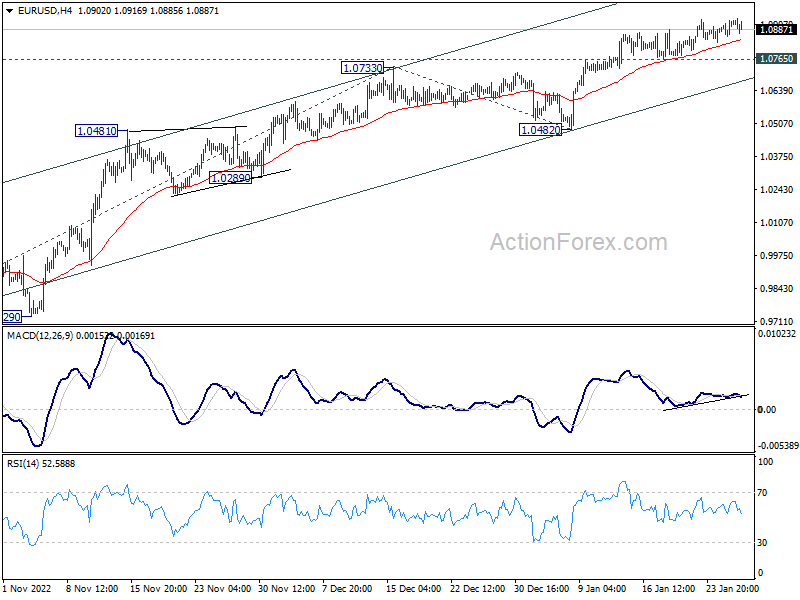
Intraday bias in EUR/USD stays on the upside for the moment. Current rise from 0.9534 should target 61.8% projection of 0.9630 to 1.0733 from 1.0482 at 1.1164 next. On the downside, though, break of 1.0765 support should now indicate short term topping, and turn bias back to the downside for 55 day EMA (now at 1.0582).
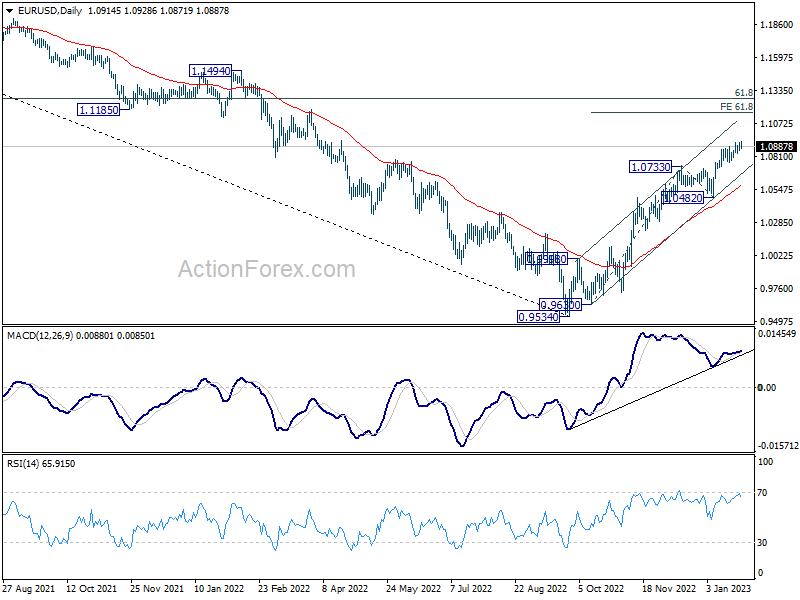
In the bigger picture, current development suggests that the rally from 0.9534 low (2022 low) is a medium term up trend rather than a correction. Further rise is in favor to 61.8% retracement of 1.2348 (2021 high) to 0.9534 at 1.1273 next. This will remain the favored case as long as 1.0482 support holds.
GBP/USD Mid-Day Outlook
Daily Pivots: (S1) 1.2321; (P) 1.2363; (R1) 1.2442; More...
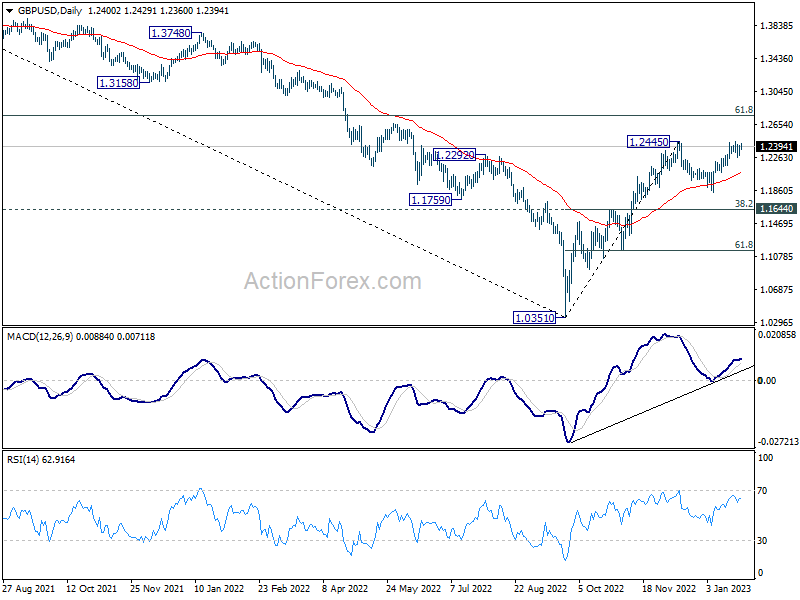
Intraday bias in GBP/USD stays neutral for the moment. On the downside, firm break of 1.2252 minor support will turn bias to the downside, and extend the corrective pattern from 1.2445 with another falling leg. On the upside, decisive break of 1.2445 will confirm resumption of whole rise from 1.0351. Next target will be 1.2759 fibonacci level.
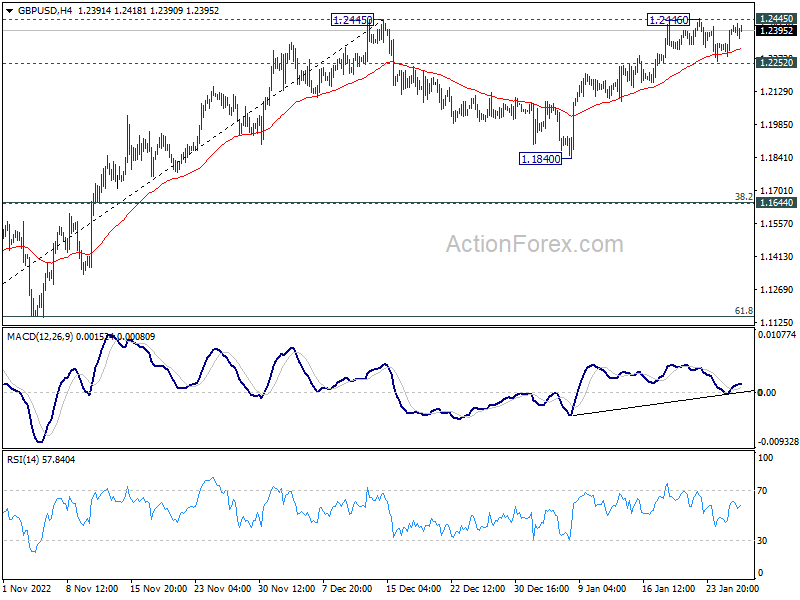
In the bigger picture, rise from 1.0351 medium term bottom is at least correcting whole down trend from 1.4248 (2021 high). Further rise is expected as long as 1.1644 resistance turned support holds. Next target is 61.8% retracement of 1.4248 to 1.0351 at 1.2759. Sustained break there will pave the way back to 1.4248.
USD/CHF Mid-Day Outlook
Daily Pivots: (S1) 0.9154; (P) 0.9199; (R1) 0.9226; More...
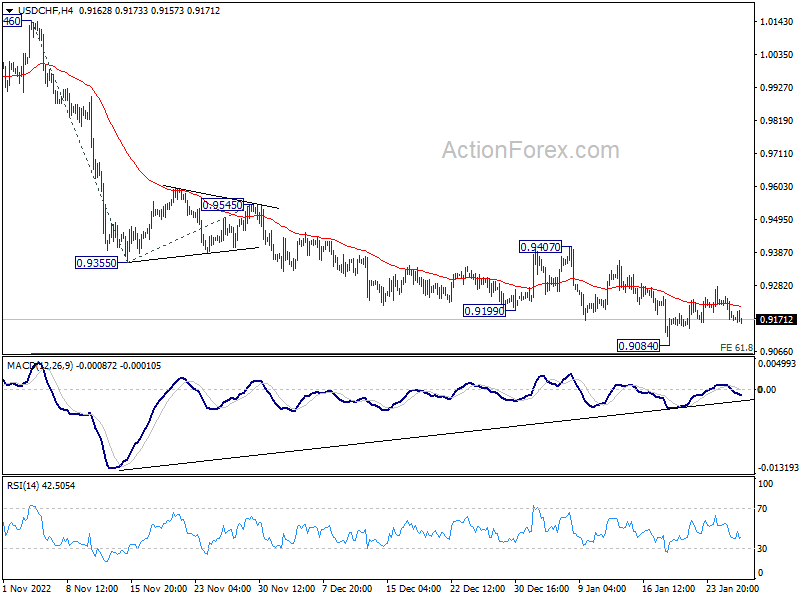
Intraday bias in USD/CHF remains neutral for the moment. On the downside, sustained break of 61.8% projection of 1.0146 to 0.9355 from 0.9545 at 0.9056 will pave the way to 100% projection at 0.8754, which is close to 0.8756 long term support. Nevertheless, on the upside, break of 0.9407 should confirm short term bottoming and turn bias back to the upside.
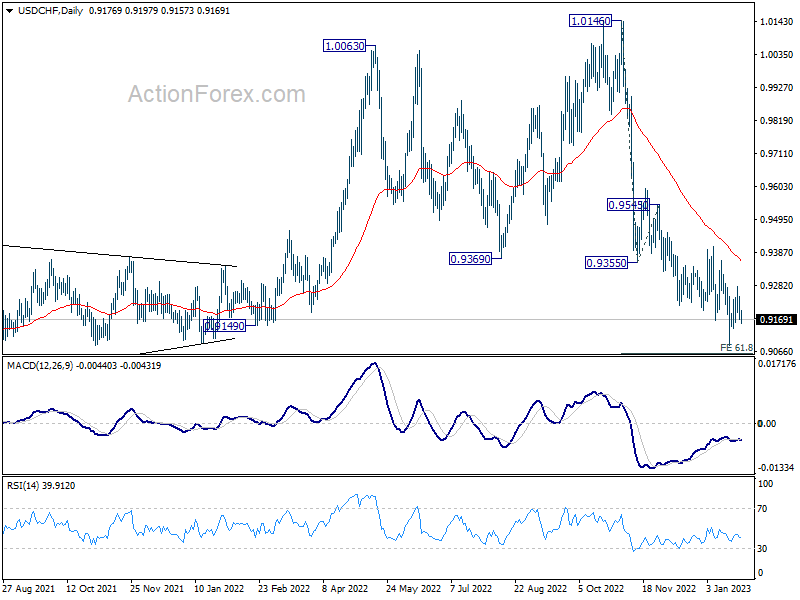
In the bigger picture, rise from 0.8756 (2021 low) has completed at 1.0146, well ahead of 1.0342 long term resistance (2016 high). Based on current downside momentum, fall from 1.0146 should be a medium term down trend itself. Next target is a test on 0.8756 low. Strong support should be seen there to bring rebound. Still, further decline will now be expected as long as 0.9407 resistance holds, in any case.
USD/JPY Mid-Day Outlook
Daily Pivots: (S1) 129.04; (P) 129.82; (R1) 130.36; More...
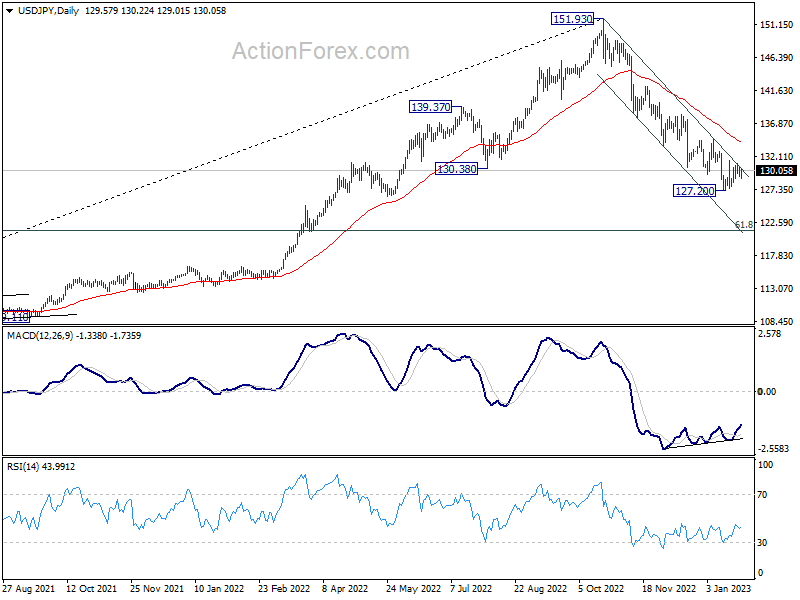
Range trading continues in USD/JPY and intraday bias stays neutral at this point. On the downside, break of 127.20 will resume the whole decline from 151.93 and target 121.43 fibonacci level. Nevertheless, on the upside, break of 131.56 should confirm short term bottoming, and turn bias back to the upside for stronger rebound to 55 day EMA (now at 134.13).
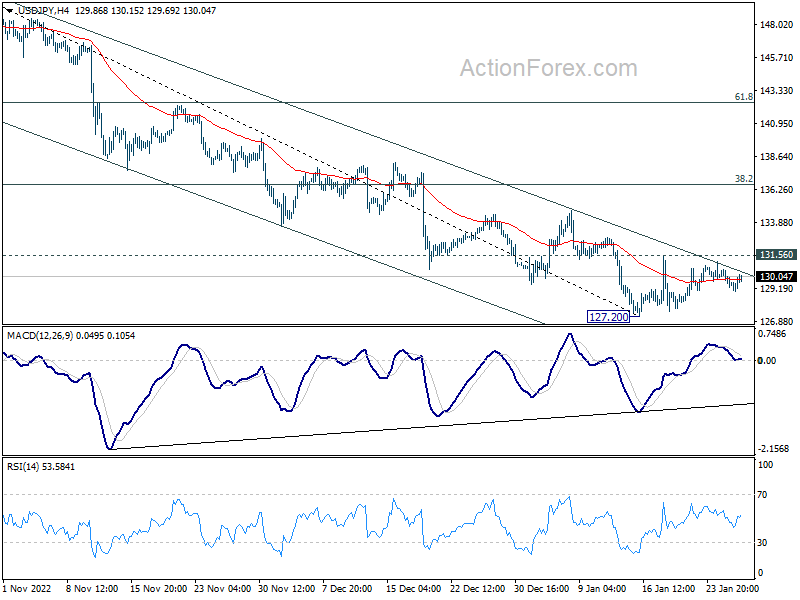
In the bigger picture, the break of 55 week EMA (now at 131.47) raises the chance of medium term bearish reversal, but that's not confirmed yet. Strong support could be seen around 61.8% retracement of 102.58 to 151.93 at 121.43 and 38.2% retracement of 75.56 to 151.93 at 122.75 to bring rebound. But break of 131.56 resistance is needed to indicate bottoming first. Otherwise further fall will remain in favor.
USD/CAD Mid-Day Outlook
Daily Pivots: (S1) 1.3345; (P) 1.3387; (R1) 1.3433; More....
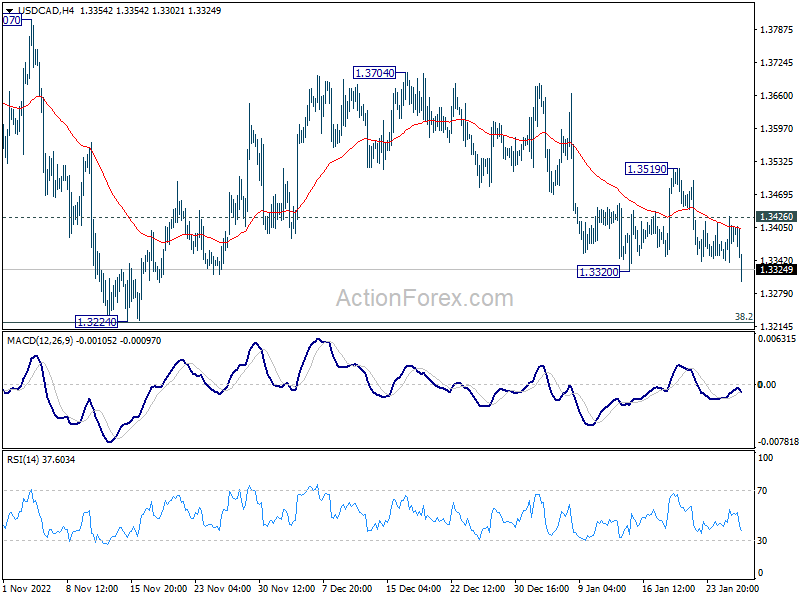
USD/CAD's decline resumed by breaking through 1.3320 and intraday bias is back on the downside. Fall from 1.3704 would target 1.3224 key support level. Strong support is still expected from there to bring rebound. But decisive break would carry larger bearish implication. On the upside, above 1.3426 minor resistance will turn intraday bias neutral first.
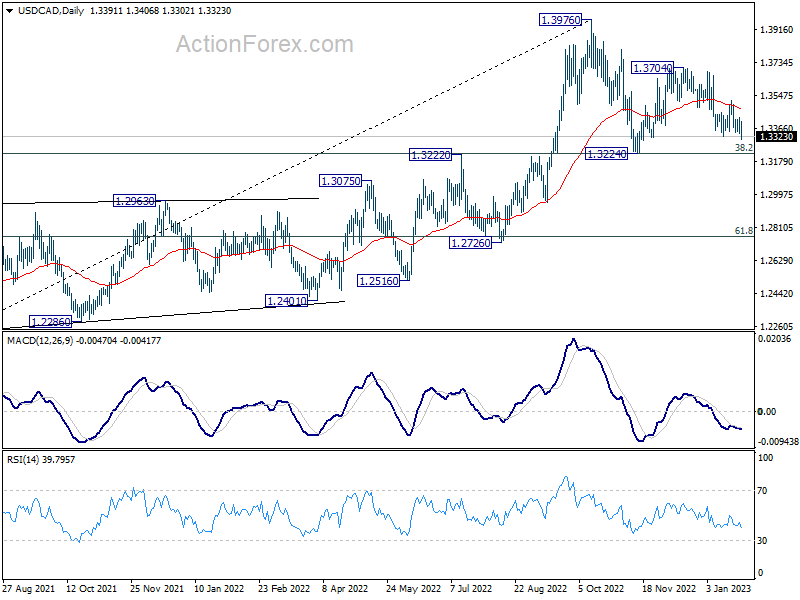
In the bigger picture, as long as 1.3222 cluster support (38.2% retracement of 1.2005 to 1.3976 at 1.3223) holds, larger up trend from 1.2005 (2021 low) is still expected to resume through 1.3976 high at a later stage. However, firm break of 1.3222/3 will indicate that the trend might have reversed. Deeper fall would be seen to next cluster support at 1.2726 (61.8% retracement at 1.2758).
Solid Data Support Risk Sentiment, Dollar Struggles
US futures trade higher after a batch of solid economic data. Positive risk sentiment are lifting commodity currencies in general, in particular Aussie. Dollar and Yen are turning softer while European majors are mixed, with Euro lagging behind. In the weekly picture, while Aussie is still the strongest, Dollar and Yen are the weakest. Euro is indeed the second best, but it apparently lacks follow through buying.
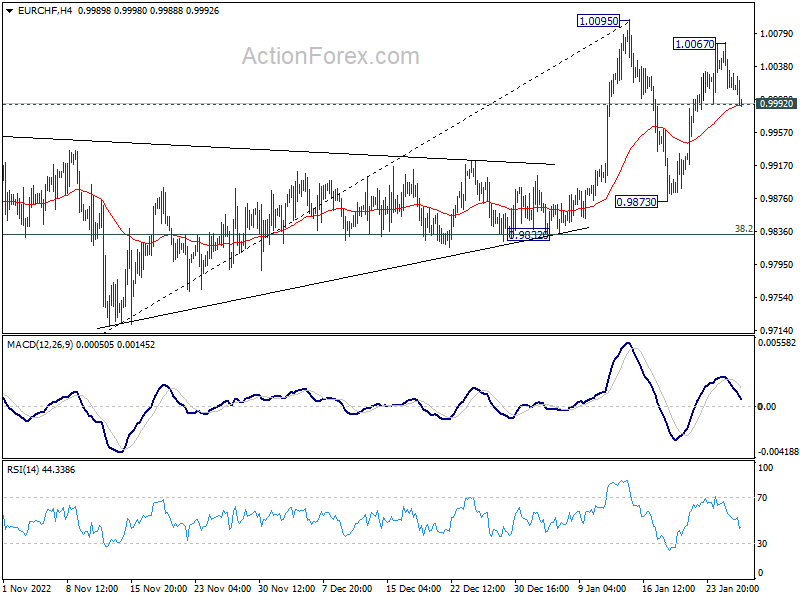
Technically, some attention will remain on EUR/CHF for the rest of the week. Firm break of 0.9992 and 4 hour 55 EMA will indicate that corrective pattern from 1.0095 is already in the third leg, towards 0.9873. Such development could be accompanied by more downside in Euro elsewhere, including against Dollar.
In Europe, at the time of writing, FTSE is up 0.48%. DAX is up 0.20%. CAC is up 0.94%. Germany 10-year yield is up 0.0164 at 2.173. Earlier in Asia, Nikkei dropped -0.12%. Hong Kong HSI rose 2.37%. Singapore Strait Times rose 0.73%. Japan 10-year JGB yield rose 0.0212 to 0.465.
US GDP grew 2.9% annualized in Q4
US GDP grew 2.9% annualized in Q4, slightly above expectation of 2.8%. The increase in real GDP reflected increases in private inventory investment, consumer spending, federal government spending, state and local government spending, and nonresidential fixed investment that were partly offset by decreases in residential fixed investment and exports. Imports, which are a subtraction in the calculation of GDP, decreased.
For 2022, GDP grew 2.1%, compared with an increase of 5.9% in 2021. The increase in real GDP in 2022 primarily reflected increases in consumer spending, exports, private inventory investment, and nonresidential fixed investment that were partly offset by decreases in residential fixed investment and federal government spending. Imports increased.
US durable goods orders rose 5.6% mom, ex-transport orders down -0.1% mom
US durable goods orders rose 5.6% mom to USD 286.9B in December, above expectation of 2.5% mom. Ex-transport orders dropped -0.1% mom to USD 178.8B, below expectation of 0.0% mom. Ex-defense orders rose 6.3% mom to USD 269.6B. Transportation equipment rose 16.7% mom to USD 108.1B.
US goods trade deficit widened to USD -90.3B in Dec
US exports of goods dropped -1.6% mom to USD 166.8B in December. Imports of goods rose 1.9% mom to USD 257.1B. Goods trade deficit rose 8.8% mom to USD -90.3B, versus expectation of USD -88.8B.
Wholesale inventories rose 0.1% mom to USD 934.1B. Retail inventories rose 0.5% mom to USD 742.2B.
US initial jobless claims dropped to 186k
US initial jobless claims dropped -6k to 186k in the week ending January 21, below expectation of 211k. Four-week moving average of initial claims dropped -9k to 197.5k.
Continuing claims rose 20k to 1675k in the week ending January 14. Four-week moving average of continuing claims dropped -11k to 1664k.
German EM Habeck: We have broken the inflation trend
German Economy Minister Robert Habeck told Bundestag that inflation will remain high at the beginning of this year. But, "we have broken the inflation trend."
According to the government's annual economic report published yesterday, inflation is projected to be at 6% in 2023, revised down by prior forecast of 7%. The economy is projected to growth 0.2% this year, much better than autumn forecast of -0.4% contraction.
Habeck also noted that in 2024, inflation will be lower than in 2023 and growth will be higher.
IMF proposes options for BoJ to allow further flexibility and increases in long-term yields
IMF said in a statement that "accommodative monetary policy stance remains appropriate" for BoJ. But it warned of the "exceptionally high uncertainty around baseline inflation projections with risks tilted to the upside".
Upside risks include "delayed effects of exchange rate depreciation, border reopening, second round effects of imported inflation, fiscal support, and higher-than-expected wage growth." Downside risks are mainly from slowdown in the global economy.
"Given the two-sided risks to inflation, more flexibility in long-term yields would help to avoid abrupt changes later... providing clear guidance on the pre-conditions for a gradual policy rate change in the future would help anchor market expectations and strengthen the credibility of the BoJ's commitment".
"BoJ could consider the following options to allow further flexibility and increases in long-term yields: widening the 10-year target band and/or raising the 10-year target, shortening the yield curve target, or shifting from a JGB yield target to a quantity target of JGB purchases".
BoJ Opinions: Necessary to take some time to examine effect of YCC change
In the Summary of Opinions at BoJ's January 17-18 monetary policy meeting, it's repeated noted that it's important to continue with current monetary easing as well as yield curve control.
The modification of YCC at the December meeting was "aimed solely at making monetary easing more sustainable". It is "necessary" to "take some time" to examine the effects of the change in YCC.
One member noted the "upward pressure" on long-term interest rates and the distortions on the yield curve. And, BoJ "should curb interest rate rises across the entire yield curve through measures".
Regarding prices, CPI is expected to fall below 2% from fiscal 2023, and there is "still a long way to go to achieve the price stability target".
But opinions were more upbeat as one noted that "momentum for wage hikes has grown, and it is possible that a certain degree of base pay increases will be realized". But it still takes time for wages to see a "sustained increase".
Firms' stance has "shifted toward actively raising their selling prices" as seen in the outlook for output prices. Pace of rises in prices of both goods and services is "accelerating". It's possible that the significant price shocks since last week will "change the norm for prices".
USD/CAD Mid-Day Outlook
Daily Pivots: (S1) 1.3345; (P) 1.3387; (R1) 1.3433; More....
USD/CAD's decline resumed by breaking through 1.3320 and intraday bias is back on the downside. Fall from 1.3704 would target 1.3224 key support level. Strong support is still expected from there to bring rebound. But decisive break would carry larger bearish implication. On the upside, above 1.3426 minor resistance will turn intraday bias neutral first.
In the bigger picture, as long as 1.3222 cluster support (38.2% retracement of 1.2005 to 1.3976 at 1.3223) holds, larger up trend from 1.2005 (2021 low) is still expected to resume through 1.3976 high at a later stage. However, firm break of 1.3222/3 will indicate that the trend might have reversed. Deeper fall would be seen to next cluster support at 1.2726 (61.8% retracement at 1.2758).
Economic Indicators Update
| GMT | Ccy | Events | Actual | Forecast | Previous | Revised |
|---|---|---|---|---|---|---|
| 23:50 | JPY | BoJ Summary of Opinions | ||||
| 23:50 | JPY | Corporate Service Price Index Y/Y Dec | 1.50% | 1.60% | 1.70% | |
| 13:30 | USD | Initial Jobless Claims (Jan 20) | 186K | 211K | 190K | 192K |
| 13:30 | USD | GDP Annualized Q4 P | 2.90% | 2.80% | 3.20% | |
| 13:30 | USD | GDP Price Index Q4 P | 3.50% | 6.20% | 4.40% | |
| 13:30 | USD | Goods Trade Balance (USD) Dec P | -90.3B | -88.8B | -83.3B | |
| 13:30 | USD | Wholesale Inventories Dec P | 0.10% | 0.50% | 1.00% | |
| 13:30 | USD | Durable Goods Orders Dec | 5.60% | 2.50% | -2.10% | |
| 13:30 | USD | Durable Goods Orders ex Trans Dec | -0.10% | 0.00% | 0.20% | 0.10% |
| 15:00 | USD | New Home Sales Dec | 615K | 640K | ||
| 15:30 | USD | Natural Gas Storage | -79B | -82B |