Sample Category Title
First Impressions: RBNZ Monetary Policy Review, October 2022
The RBNZ delivered another 50 basis point OCR hike to 3.5%, and hinted that the urgency to deal with inflation pressures has increased.
RBNZ Monetary Policy Review, October 2022
- The Reserve Bank increased the Official Cash Rate by another 50 basis points to 3.5% and signalled more increases to come.
- The accompanying statement repeated much of the language from the August review. The RBNZ continues to tighten monetary policy “at pace”, and remains “resolute” in achieving its inflation target over the medium term.
- The RBNZ continues to emphasise the extent of inflation pressures in the New Zealand, with overheated demand and a very tight labour market.
- The main statement did not discuss the likely extent of future interest rate rises.
- However, the record of the meeting was unusually explicit in noting that the Committee debated between a 50 or a 75 basis point hike.
- The latter was argued on a ‘stitch in time’ basis: a larger increase now could reduce the risk of a higher peak in the overall OCR cycle. This suggests that the RBNZ is now eyeing a considerably higher peak than the 4.1% from its August projections.
- Today’s 50bp increase was widely expected, and the implicit signal of a higher OCR peak was broadly in line with what we expected. We recently revised up our OCR forecast to a peak of 4.5% by next February.
AUD/USD Aims Steady Recovery, Gold Surges
Key Highlights
- AUD/USD started an upside correction above the 0.6450 level.
- It broke a key bearish trend line at 0.6480 on the 4-hours chart.
- Gold price gained bullish momentum and climbed above the $1,710 resistance.
- The US ADP Employment could change 200K in Sep 2022, up from 132K.
AUD/USD Technical Analysis
The Aussie Dollar traded as low as 0.6363 before it found support against the US Dollar. AUD/USD is slowly forming a base above the 0.6400 level.
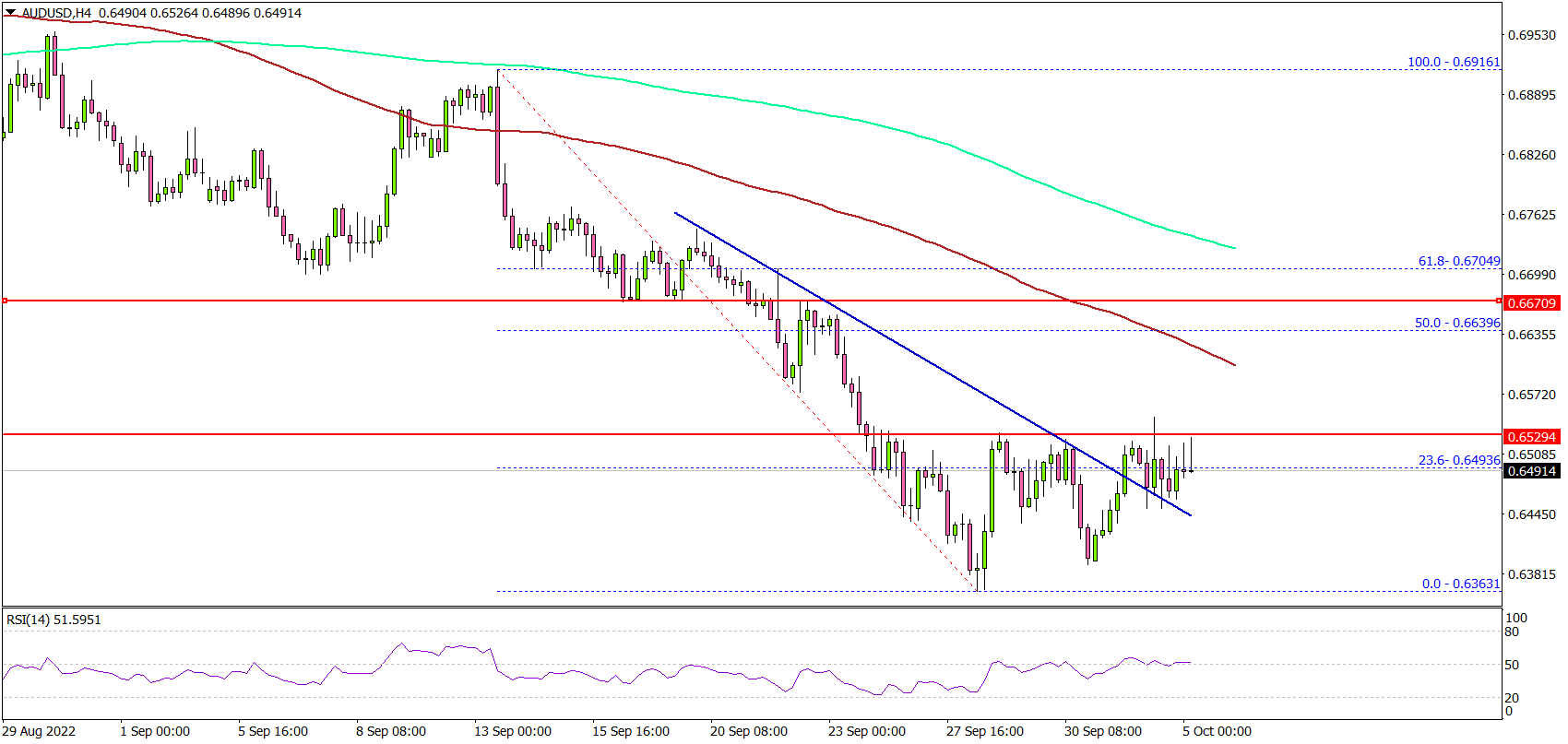
Looking at the 4-hours chart, the pair was able to recover above the 0.6420 and 0.6440 resistance levels. There was a move above a key bearish trend line with resistance at 0.6480.
The pair is now consolidating near the 23.6% Fib retracement level of the downward move from the 0.6916 swing high to 0.6363 low. An immediate resistance is near the 0.6520 level, above which the pair could test the 100 simple moving average (red, 4-hours).
The next major resistance is near the 0.6640 level. It is near the 50% Fib retracement level of the downward move from the 0.6916 swing high to 0.6363 low.
A clear move above the 0.6640 level might send the pair towards the 0.6700 level or at least the 200 simple moving average (green, 4-hours). On the downside, an initial support is near the 0.6440 level. The main support sits at the 0.6400 level.
A downside break below the 0.6440 zone might send the pair towards the 0.6320 level. The next major support is near the 0.6300 level, below which the pair could even test the 0.6250 support zone.
Looking at gold price, there was a decent increase above the $1,700 level and it seems like the bulls are aiming more upsides.
Economic Releases
- Germany’s Services PMI for Sep 2022 - Forecast 45.4, versus 45.4 previous.
- Euro Zone Services PMI for Sep 2022 – Forecast 50.2, versus 48.9 previous.
- UK Services PMI for Sep e 2022 – Forecast 49.2, versus 49.2 previous.
- US Services PMI for Sep 2022 – Forecast 49.2, versus 49.2 previous.
- US ISM Services PMI for Sep 2022 – Forecast 56.0, versus 56.9 previous.
- US ADP Employment Change for Sep 2022 - Forecast 200K, versus 132K previous.
Fed Daly: Needs to hold restrictive policies until truly done on inflation
San Francisco Fed President Mary Daly said Fed needs to raise interest further and hold restrictive policies in place until it's "truly done" on bring back inflation to 2% target.
"Those interest rate increases slow the economy and they do have spillover effects on currencies in other countries," Daly said, of the Fed's interest-rate rises. "But central banks, no matter where you are, are meant to create policy for the nation that they serve, and then we have to be aware of how this affects the global economy because that's part of the puzzle."
Nonfarm Payrolls: More Bad News for the Fed?
The latest US employment report will rock financial markets at 12:30 GMT Friday. With the Fed actively trying to weaken the labor market, the stakes are very high. However, it seems like Powell won’t get his wish yet, as most indicators point to another solid jobs report. That could inflict more damage on stocks and supercharge the roaring dollar.
Still running hot
Federal Reserve officials have embarked on a crusade to vanquish inflation, raising interest rates at an astonishing pace in order to cool the labor market and demand in the economy. Chairman Powell has been adamant that this process requires a period of economic pain, which is a necessary evil since letting inflation run rampant would be even more painful in the long run.
Investors have finally absorbed this message. Market pricing currently suggests interest rates will be raised to 4.4% by early next year, and will be held there for some time. Speculation for rate cuts has almost vanished, as policymakers insist they will hold their nerve until inflation has truly been slain.
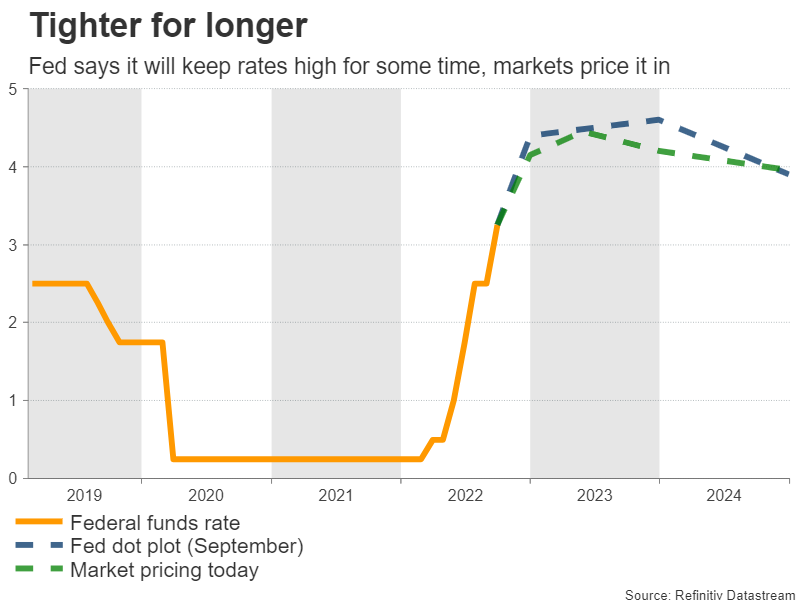
The ‘problem’ is that the labor market is still booming. Employment opportunities remain plentiful, previously discouraged workers are returning to the labor force, and there’s no sign of any widespread job losses yet. As long as this is the case, the Fed will be forced to keep its foot heavy on the rate increase pedal.
Another solid report?
Turning to the upcoming data, economists expect nonfarm payrolls to have risen by 250k in September, less than the 315k previously but still a healthy number overall. The unemployment rate is seen unchanged at 3.7%, while earnings growth is anticipated to have lost some steam in yearly terms.
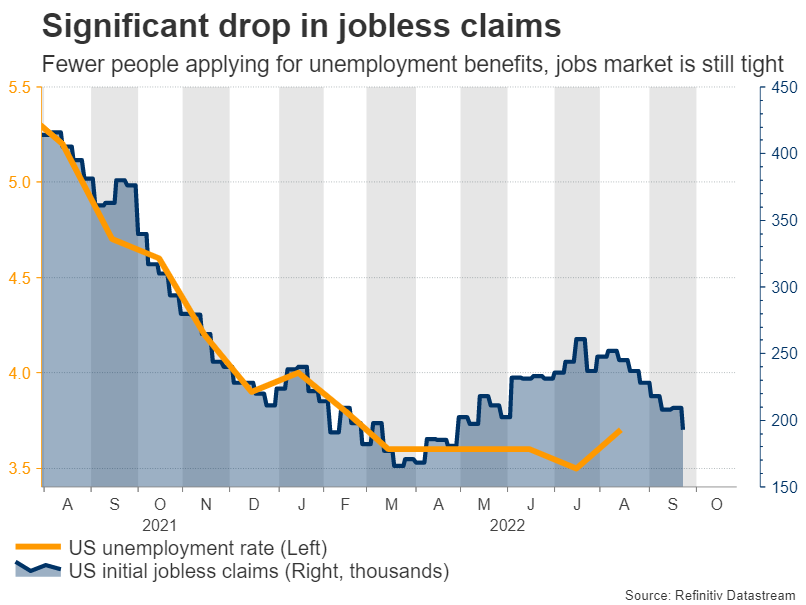
As for any surprises, the indicators that have been released so far point to another strong report. The number of people applying for unemployment benefits kept falling during the entire month, signaling that fewer workers got laid off. Meanwhile, business surveys pointed to a further increase in employment levels, albeit at a softer pace than the previous month.
This will be the final round of employment data before the next Fed meeting in early November, so it will be crucial in shaping expectations. Market pricing is currently leaning towards a fourth 75 basis points rate increase in a row, assigning a 63% probability for such action. A solid jobs report could push that percentage even higher, adding fuel to the US dollar’s rally.
From a technical perspective, further declines in euro/dollar could encounter an initial cluster of support around the 0.9560 region, marked by the recent lows.
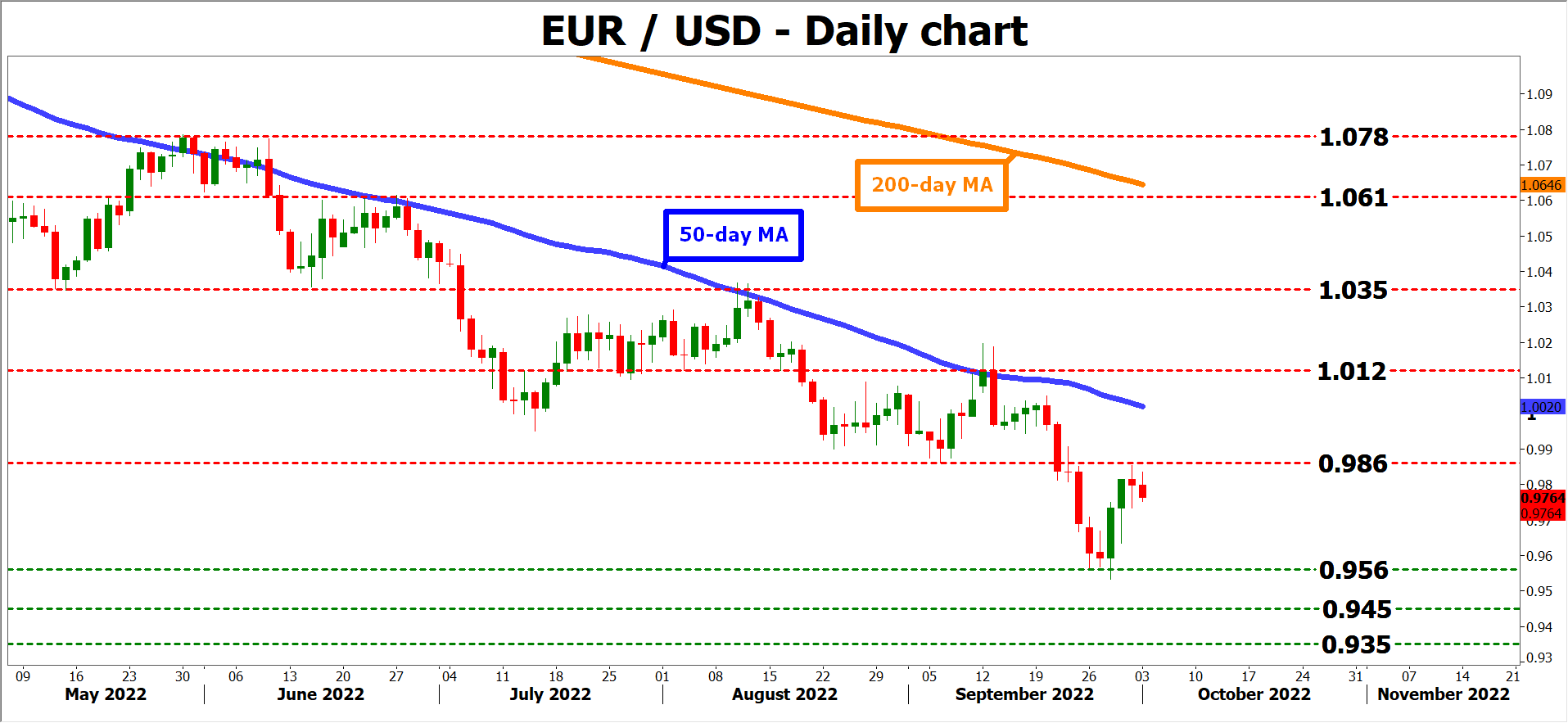
On the flipside, a surprisingly soft report might send euro/dollar higher, with a break above 0.9860 turning the focus towards the 1.0120 zone.
Investors will receive more clues about the employment data on Wednesday, when the ADP jobs report and the ISM services PMI are released.
Dollar remains king
In the big picture, it’s still too early to call for any trend reversal in the dollar. The reserve currency has gone on a rampage this entire year, capitalizing on a perfect storm of widening interest rate differentials, safe-haven flows, and an absence of any attractive alternatives. These dynamics haven’t changed.
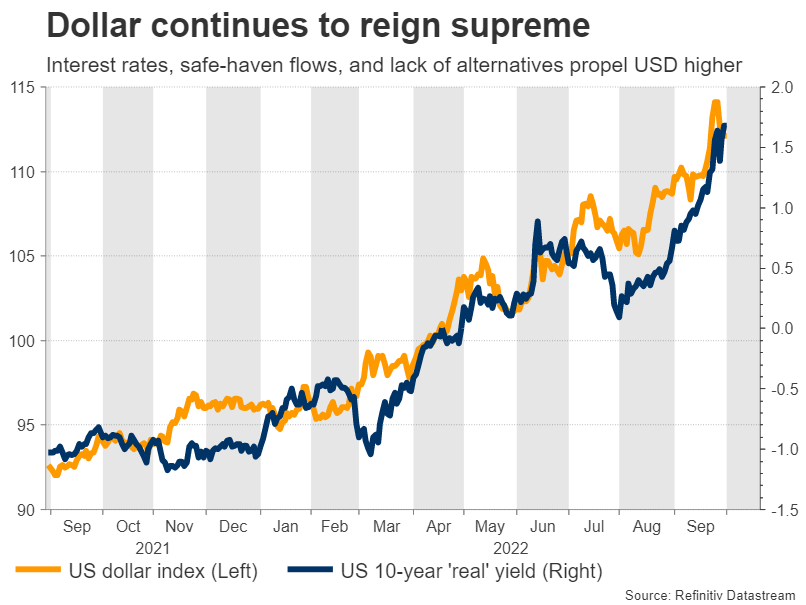
The Fed continues to outgun other central banks on interest rates, as foreign economies are grappling with even greater threats. European business surveys imply a recession is imminent as the energy crisis ripples across the economy, the British pound has been decimated by the government’s irresponsible budget plans, the Bank of Japan has left the yen for dead, and China’s property sector is imploding.
Until something begins to change on the global scene, it’s difficult to imagine the dollar losing its crown.
RBA Fine-Tuning Hikes, Changing Mood of AUD
The Reserve Bank of Australia raised its rate by 25 points to 2.6%, against an expected increase to 2.85%. Previously, the rate had been hiked by 50 points four times since June. The same decision was also predicted by the market this time.
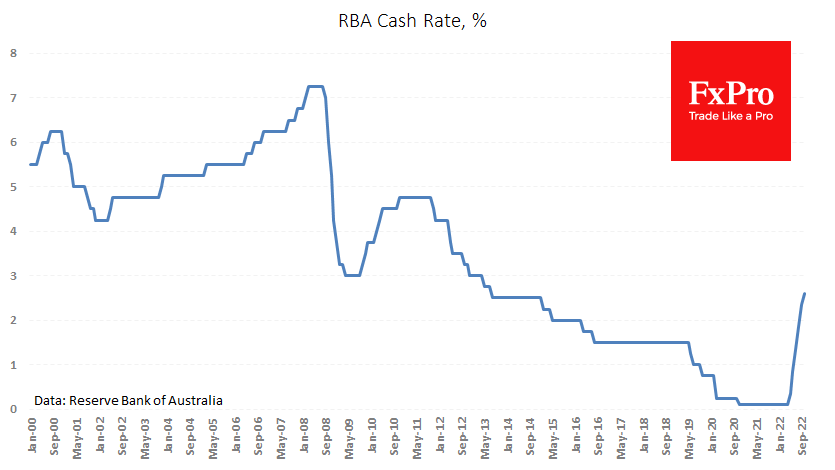
In the commentary on the decision, central bank governor Philip Lowe argued that more hikes were necessary. However, the fact that the RBA has moved ahead of many central banks from developed countries to fine-tune monetary policy has triggered sudden selloffs.
The AUDUSD pair lost 0.8% to 0.6450 on the surprise from the RBA, but on the back of general optimism in the markets, the pair rocketed higher, reaching 0.6550 at one point. At the time of writing, AUDUSD is trading near the day’s lows again as traders overestimate the outlook for monetary policy.
The macroeconomic picture in Australia hardly justifies a move to such fine-tuning, with unemployment near half-century lows and inflation projected at 7¾ with a target of 2-3% in 2022.
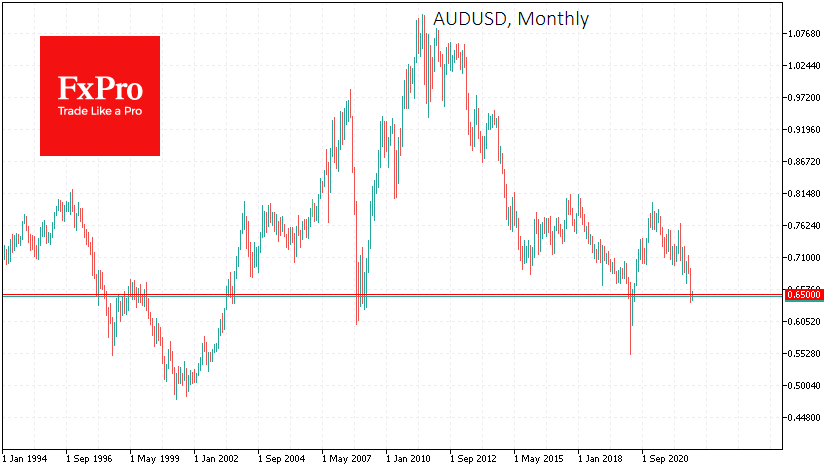
Between 2001 and mid-2008, the Aussie was one of the favourite chips in the carry trade game, thanks to the RBA’s high rates, trade surplus and impressive economic growth. The RBA’s move of monetary policy from a run to one of the first among peers and at lower rates than in the US risks turning the Aussie into a lame duck.
This sudden rate cut also calls into question the AUDUSD’s ability to recover quickly from the 0.6500 area as it has for the past 20 years. It now seems that only a similar slowdown in policy tightening from the Fed could keep traders’ interest on the Aussie side, and we should watch closely to see if the RBA knows something the rest of the world doesn’t see.
EUR/USD: Recovery Accelerates Through Key Barriers on Improved Risk Sentiment
The Euro accelerated higher on Tuesday (up 1% since Asian opening) boosted by improved risk sentiment that kept dollar under pressure for the second straight day.
Hawkish comments from ECB policymaker further fuel expectations for ECB’s 0.75% rate hike in October, adding to bullish near-term stance.
A number of key releases from the US this week to provide fresh direction signals on more evidence about the current conditions in the services and labor sector, after the data from US manufacturing sector fell below expectations.
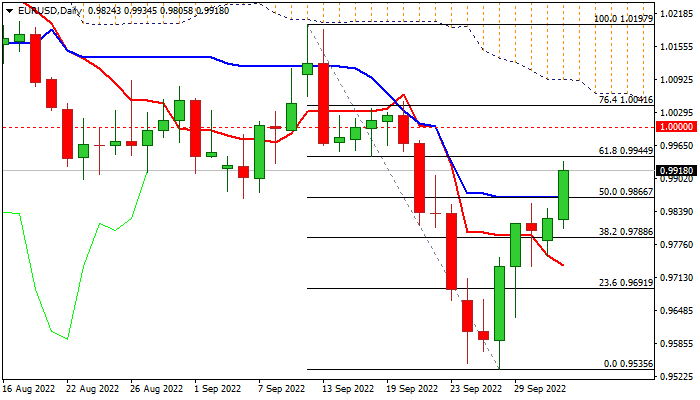
Improving daily technical studies (north-heading 14-d momentum / 5/10DMA bull cross) support the action, with additional positive signals from Monday’s close above pivot at 0.9788 (Fibo 38.2% of 1.0197/0.9535), formation of bullish engulfing pattern and today’s rise through 0.9866 (daily Kijun-sen / 50% retracement.
Bulls pressure Fibo 61.8% of 1.0197/0.9535 (0.9944), violation of which would open way for attack at parity level.
Overbought stochastic on daily chart warn of price adjustment, with dips to ideally stay above broken Kijun-sen to keep fresh bullish structure intact.
Res: 0.9944; 0.9975; 1.0000; 1.0041
Sup: 0.9866; 0.9844; 0.9788; 0.9735
Sunset Market Commentary
Markets
Should we call it euphoria or are we simply attending a long overdue short-squeeze after a protracted risk sell-off? Whatever, it has been quite a long time since European equities gained 2.5% to 3.5% intraday across indices. A weaker-than-expected US manufacturing ISM yesterday and the Reserve Bank of Australia hiking rates by a smaller-than-expected 25 bps were enough a reason for markets to reassess how fast and how long central banks including the Fed and the ECB, will have to raise rates further to restore the demand/supply balance to drive inflation sustainably back lower. The 2-y US yield and 2-y EMU swap yield at some point declined another 10/15 bps respectively. However, the repositioning eased as the session proceeded. US yields currently are declining less than 2 bps across the curve. EMU swap yields are losing between 6 bps (5-y) and 3 bps (30-y) in volatile trading. Money markets brought the expected Fed and ECB cycle peak rates back to 4.25%/4.50% and about 2.75% respectively. The market also again ponders the scenario of a Fed rate cut late next year, something most Fed members dismissed recently. In interview ECB’s Villeroy said that the ECB without hesitation could bring the policy rate ‘close to’ 2% which he sees as a neutral level. In a second phase, the ECB then could shift to a more flexible and possible slower approach. Today’s market reaction to some extend was reminiscent of the summer when markets assumed that weaker than expected data/fear of a recession could block CB’s rate hike intentions rather soon. However, the likes of the Fed and the ECB recently reiterated that their priority is to arrest inflation. Slower growth might help but (the outlook of sustainably lower) inflation remains key and EMU and US inflation recently remained uncomfortably high. The EuroStoxx 50 currently maintains a gain of 3.25%. US indices open with additional gain between 1.65% (Dow) and 2.5% (Nasdaq). Brent oil jumped from $89 p/b to $91 p/b as market anticipate a substantial OPEC(+) oil production cut this week. For now, this potential new ‘supply shock’ apparently this doesn’t hamper the equity rebound.
On FX, the USD correction even accelerates further. DXY is sliding below the 111 handle. Contrary to yesterday, the euro this time fully profits from the USD-correction. EUR/USD jumped from the low 0.98 area to currently trade at 0.9915. Gains of the yen, however, remain close to non-existent with USD/JPY holding in a tight range just below the 145 big figure. After a ‘post-crisis’ comeback late last week and yesterday, sterling today underperformed the euro despite the broader risk-on context. Investors apparently are scaling back expectations for very aggressive BoE action with UK yields declining about 15 bps across the curve (except for the 30-y). EUR/GBP tries to regain the 0.8721 previous resistance area.
News Headlines
EU Commissioner for the Internal Market Thierry Breton and for Economy Paolo Gentiloni in op-eds for several European newspapers argued for more solidarity among member states in addressing the energy crisis. The piece followed Germany’s plans for a massive €200bn borrowing program to cap power prices announced last week. It draws criticism because it may drive a wedge with member states that have less fiscal room, a concern that grew during the pandemic crisis too before the €1.8tn EUNextGen package was erected. Breton and Paolo said the EU must think about similar “mutualized tools at the European level”. German Finance Minister in a reaction told this crisis is different from the pandemic in the sense that it is a supply shock and not demand that needs stimulating.
Eurozone producer prices rose to a new record-high in August. Pipeline inflation rose a whopping 5% m/m following an already sharp 4% rise the month before. On a yearly basis, factory output prices rose 43.3%, up from 38% in July. The increase was, once again, driven by energy prices (11.8% m/m). Excluding energy and construction, prices rose only 0.3% month over month. The data do not bode well for future consumer inflation readings, which already hit double digits last month, data last week showed.
EUR/AUD Mid-Day Outlook
Daily Pivots: (S1) 1.4982; (P) 1.5145; (R1) 1.5239; More...
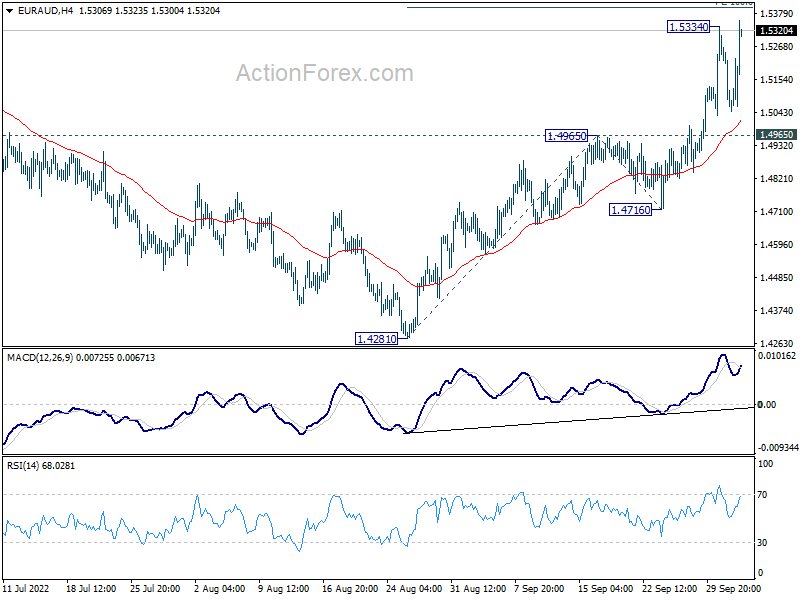
EUR/AUD's rally resumed after brief retreat and intraday bias is back on the upside. Decisive break of 1.5396 key resistance carry larger bullish implication. Next target is 161.8% projection of 1.4281 to 1.4965 from 1.4716 at 1.5823. For now, further rally will remain in favor as long as 1.4965 resistance turned support holds.
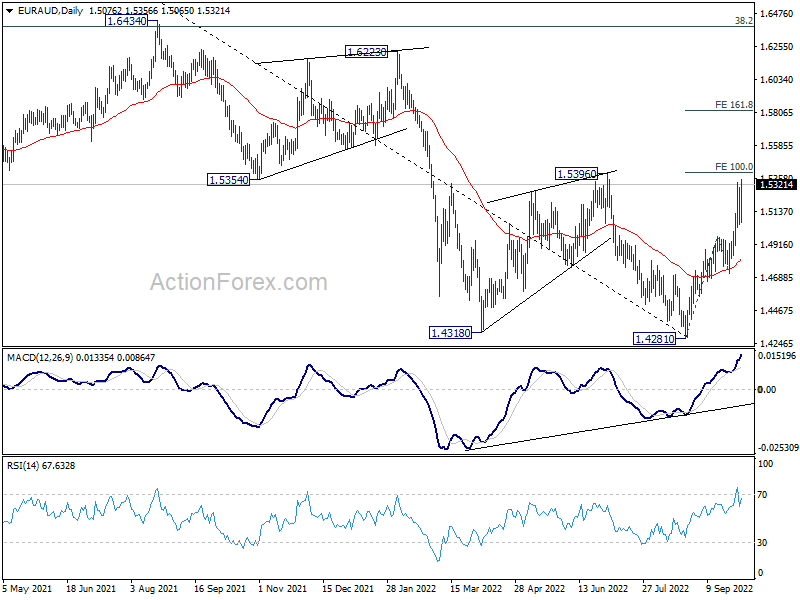
In the bigger picture, current development raises the chance of medium term bottoming at at 1.4281, on bullish convergence condition in daily MACD. Firm break of 1.5396 will bring stronger rally back to 1.6434 key resistance next. Nevertheless, rejection by 1.5396 will maintain medium term bearishness for another fall through 1.4281 at a later stage.
USD/JPY Mid-Day Outlook
Daily Pivots: (S1) 144.06; (P) 144.67; (R1) 145.17; More...
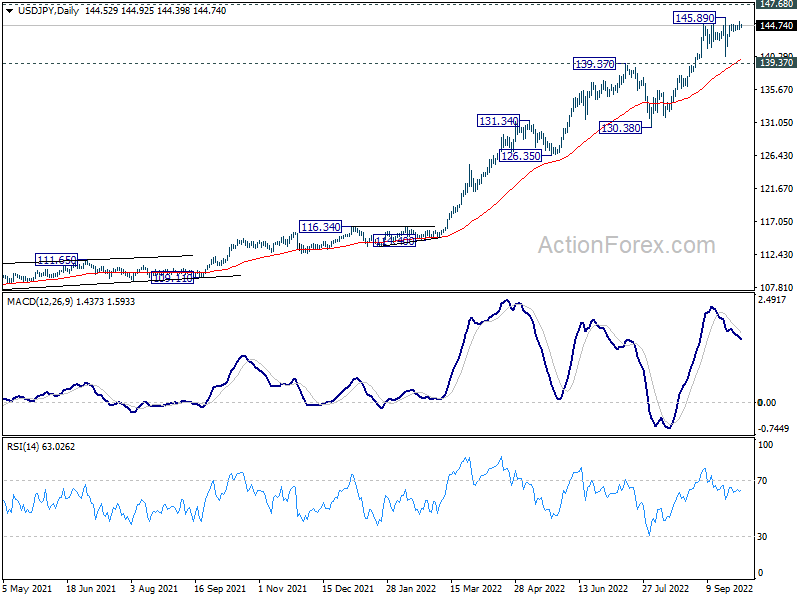
No change in USD/JPY's outlook as range trading continues. Intraday bias stays neutral for the moment. Further rally is expected as long as 139.37 resistance turned support holds. Break of 145.89 will target 147.68 long term resistance. On the downside, however, decisive break of 139.37 will confirm short term topping. Deeper decline would be seen back towards 130.38 support.
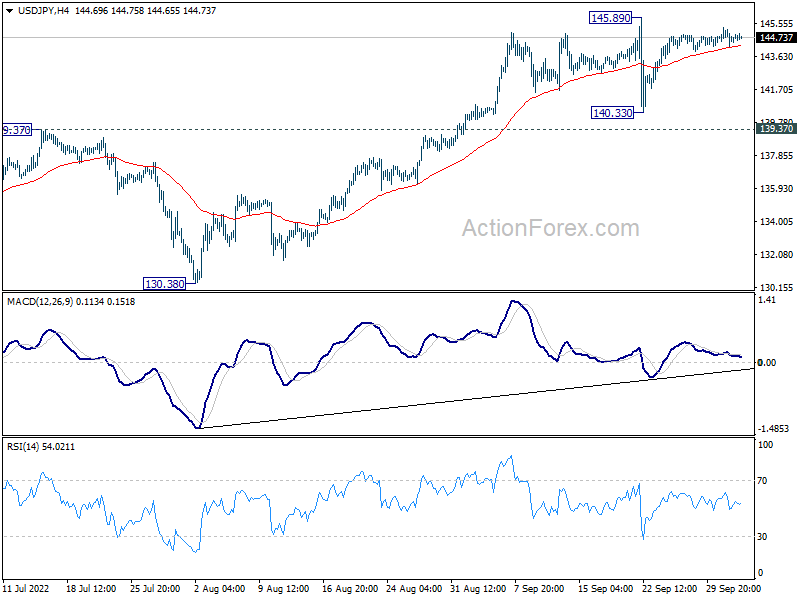
In the bigger picture, up trend from 101.18 is still in progress, as part of the whole up trend from 75.56 (2011 low). Further rise should be seen to 147.68 (1998 high). For now, break of 130.38 support is needed to be the first indication of medium term topping. Otherwise, outlook will stay bullish even in case of deep pull back.