Sample Category Title
Weekly Focus – The Inflation Fight Continues
The main event this week was the ECB's decision to hike policy rates by 75bp highlighting that central banks are very much in inflation fighting mode despite the outlook for recession. ECB governor Christine Lagarde stressed though, that 75bp hikes is not the new norm but that the ECB needed to move further to a neutral rate. She emphasised the data dependency, but also a meeting-by-meeting approach to calibrate policy rates. She guided that at most five meetings with rate hikes were expected, including the ones we have just had. Our forecast remains another 50bp hike in October and 25bp hike in December but recognize the possibility of hikes continuing into next year.
Otherwise gas and electricity prices have taken centre stage this week following Russia's continued closure of the NordStream 1 pipeline. Governments have scrambled to come up with measures to cap electricity bills, guarantee credit for utility companies in need of liquidity due to the price spike and power saving measures in the public sectors. EU energy ministers meet today to coordinate policies. In many cases the policies to mitigate the energy costs are not fully funded, which means fiscal policies are again being eased. This will all else equal require more monetary tightening to compensate for the fiscal easing in order to get inflation down. More hikes from European central banks are thus being priced sending bond yields higher again. Prices on gas and electricity have actually come down somewhat this week following focus on power saving measures and risk of a deeper economic downturn. Electricity prices are now down 35% from the peak in August.
Outside the gas and electricity space global price pressures are actually easing when it comes to goods inflation. Oil prices declined below USD90 per barrel this week (the lowest level since January) despite a cut in oil production by OPEC+ members of 100,000 barrels. Oil prices are now down 30% from the peak in March. Freight rates from Shanghai to Los Angeles dropped another 15% this week compared to last week and have taken back more than half of the sharp rise seen in 2020 and 2021. The decline in commodity and freight prices reflect weaker goods demand in US and Europe and with less pricing power amid weaker sales and high inventories, this should contribute to lower inflation in goods prices. However, in order to get service inflation down as well, more slack is needed in labour markets to bring down wage growth. Hence, central banks will need to keep tightening until they see clear signs that labour markets are turning.
China has seen some recurrence of covid outbreaks in some of its big cities with Chengdu entering lockdown and Shenzhen also implementing restrictions. So far it has had limited impact on supply chains but if it spreads to more cities on China's east coast it may come. Equity markets have moved mostly sideways this week bringing a halt to the past weeks declines. EUR/USD hit a new cycle low below 0.99 on Tuesday but recovered following the ECB meeting. We still look for EUR/USD to trend lower over the next year.
Next week all eyes will be on US inflation, which is one of the last important data points before the Fed will decide on a 75bp or 50bp hike on their meeting in two weeks. US retail sales and the German ZEW index will give further clues to the outlook for recession.
UK Data Ahead of the BoE Next Week
Earlier this week, cable dropped to lows not seen in decades. Since then, it has bounced back a bit, but it spun up speculation about what to expect from the BOE next week. Some analysts are pointing to the widening interest rate cap between the pound and dollar. The BOE started raising rates first, but has been slower to tighten policy and inflation has outpaced the US. With more double-digit inflation expected, pressure is mounting on the BOE to take more drastic action.
But there isn't any certainty about what the bank will do next week. Although a small majority are expecting another 50bps hike, there is a growing contingent calling for a 75bps hike. Both of the major peers, the ECB and Fed, have not only already done "triple" rake hikes, but are widely expected to do so at their next meetings. But, there's a problem trying to figure out what the BOE will do, which is that there is a series of key data expected to be released early next week ahead of the meeting. Those data points might shape policy expectations right up to the meeting, so we could have increased cable volatility through the coming days.
What could move the markets
On Monday we have the release of monthly GDP, expected to show another month of negative growth, though not as much as before. UK July GDP is expected to come in at -0.1% compared to -0.6% in June.
On Tuesday it's the turn of employment figures. The BOE has not been particularly worried about the job market as it's focusing primarily on inflation. But the earnings data could be relevant for demand-side pressures on prices. And that, in turn, could be impacted by how tight the labor market is. So lower wages and increasing claimant count, as expected, might be an argument in favor of a 50bps hike instead of a 75bps one.
UK August Claimant count is expected to deteriorate a bit to -4K from -10.5K in July. Remember that the more negative this number is, the better it is for the economy, since it's the number of people seeking job benefits. July's unemployment rate is expected to remain steady at 3.8%. But July Average Earnings are expected to slow growth to 4.6% compared to 5.1% prior. Note that this is in the context of inflation of 10.1%, implying further erosion of employee purchasing power.
On Wednesday is the most important data, since the BOE is trying to get inflation down. But there aren't any forecasts for inflation this far out. Particularly after the ONS delayed publication of statistics for Friday until next week, due to the passing of the Queen.
Although it's expected that inflation will increase, a higher CPI would increase pressure on the BOE to take more drastic action. This could be the point at which markets definitively price in expectations for the BOE, which meets the very next day.
Also on Wednesday is the release of PPI figures, which are seen as a precursor to the trend in inflation. It's not expected for inflation to meaningfully adjust if producers have to keep raising prices. However, there could be a little less relevance this time around as the potential energy cost reduction plan from the new Government could help reduce costs. However, the exact mechanism and inflation impact has still not been sketched out. Chancellor Kwarteng is expected to give more details later in the month.
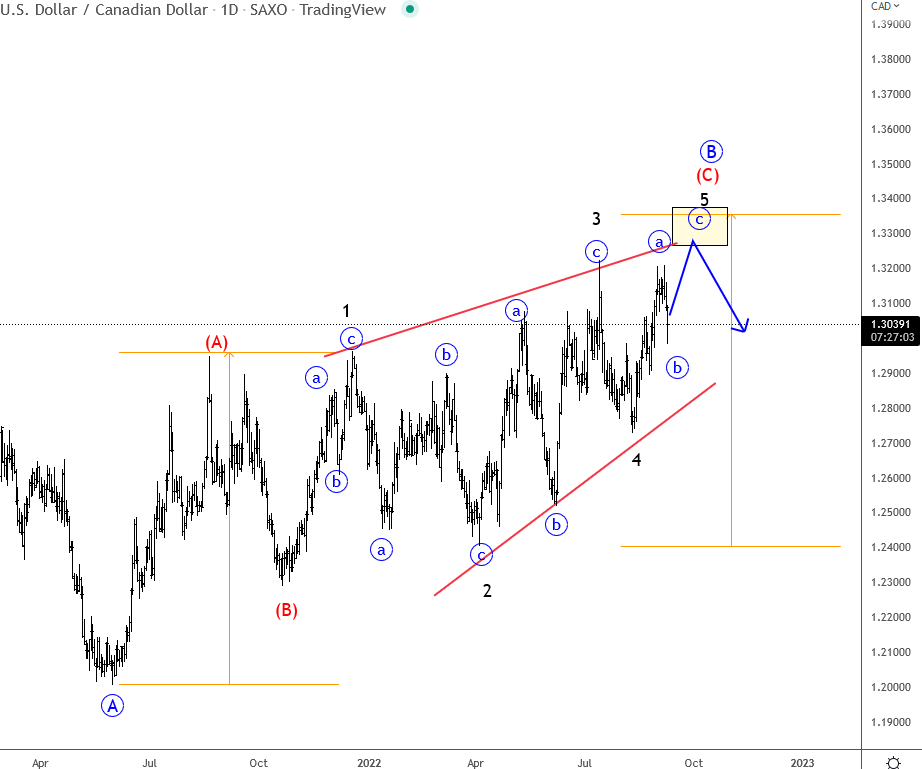
USD/CAD Seen in Late Stages of an Ending Diagonal
USDCAD is coming lower, after 75bp increased by BoC, but Rogers noted that the rates will need to be rised further. At the same time, we see USD making a strong reversal across the board while crude oil is trying to stabilize near 80-82USD. This makes a perfect case for some bearish price action. However this reversal can be temporary as we are now tracking wave b pullback that can belong to a higher degree fifth wave of an ending diagonal. Ideall resistance is at 1.3300/1.3400 area.
I think that later this year or in 2023 current USD bull cycle can come to an end, but of course this will depend on further FEDs interest rate policy decision. As soon as FED will signal that they are approaching end of the cylce the USD will be expected to turn south across the board.
Sunset Market Commentary
Markets
A75 bps rate hike is not the new norm (according to ECB’s Lagarde yesterday at the ECB press conference). Also the Fed pledged to set interest rates in line with incoming economic data. That said, after the assessments made by ECB Chair Lagarde and Fed Chair Powell yesterday, markets currently see anything different from a 75 bps rate hike by both the ECB and the Fed at their next meetings as highly unlikely. A further reappraisal is very much possible, especially if inflation were the stay at elevated levels for longer. However, after recent sharp repositioning and 75 bps hikes ‘discounted,’ markets understandably were ripe for a pause. Technical considerations and a calendar deprived of any key economic data facilitated a wait-and-see attitude. The US 2-y yield for new is ‘blocked’ at strong resistance near 3.50%. That said, it still holds near levels not seen since 2007. The US 10-y (3.28%) yield also nears key resistance in the 3.36/3.50% area. Similar narrative on the EMU interest rate markets. The EMU 10y swap and German 10-y yield almost touched the closing peak levels as set mid-June. The EMU 2-y yield intra-day backtracked after touching a new cycle top. In this (admittedly labile) consolation US yields currently are trading almost unchanged across the curve. German yields initially eased 5bps+ across curve (except for the 30-y), but already reversed intraday losses. The pause in the bond sell-off also provides relief for other markets. US and European, equities are rebounding (EuroStoxx 50 +2.0%, Nasdaq +1.1%). European gas prices continue a gradual but protracted correction of the historic record levels reached two weeks ago as EMU energy ministers are contemplating new mechanisms to cap unwarranted high pricing, or at least try to reduce the negative impact of these prices on the broader economy. The reference Dutch future contract eases to € 212 p/MWH (peak was (€349). On the other hand, oil rebound after recent sharp, with Brent rebounding north of $ 91 p/b.
On FX markets, recent aggressive USD bid also eased on the broader risk-relief. The DXY index currently trades near 109 compared to 109.50 this morning, but well of the intraday lows. USD/JPY also further leaves from recent multi year highs 142.30). In recent USD ascent, the euro often outperformed most other G10 currencies (NZD, AUD, CHF, SEK, NOK….). This pattern was completely revered today. The euro is losing against most other ‘smaller’ G10 currencies, the Canadian dollar being the exception to the rule (cf infra). EUR/USD, this morning briefly filled offers north of 1.01, but a sustained upside failed despite the broader USD correction, a better risk sentiment, the ECB catching up the broader tightening move….EUR/USD currently only maintains a ‘meagre’ daily gain (1.0040 vs 0.9997 at yesterday’s close). Sterling also gained a few ticks against the single currency. However, EUR/GBP still holding with reach of the 0.87/0.8721 resistance area, only suggests fragile underlying sentiment against the UK currency. The Bank of England delayed its September meeting by one week to Sept 22 due to the national mourning for Queen Elisabeth 2.News Headlines
The Canadian Labour Force Survey showed a 39 700 job loss in August. It’s the third month running of declining employment. Details pointed to a decrease of 77 200 full time jobs and an increase of 37 500 part time jobs. Diving in the numbers, educational services (- 50 000), construction (-28 000) and public sector (-28 000) were the most hard hit sectors. The unemployment rate rose for the first time in seven months, from 4.9% to 5.4%. An increase of the participation rate (64.8% from 64.7%) softens the blow. Hourly wage growth accelerated from 5.4% Y/Y to 5.6% Y/Y. The loonie had a strong run against the dollar going into Canadian payrolls thanks to the friendly risk environment. USD/CAD drifted temporary below 1.30 for the first time since end August before the labour market report halted the Canadian currency’s rally.
Canada’s Labour Market Sheds More Jobs in August
- The Canadian labour market shed 40k positions in August, with full-time employment down 77k and part-time employment up 37.5k.
- The unemployment rate rose by 0.5 percentage points, to 5.4%, as August's jobs decline was met by a 66k expansion in the labour force. The participation rate also rose to 64.8% (up 0.1 percentage points).
- By industry, employment losses were felt in educational services (-50k) and construction (-28k), though somewhat offset by gains in professional, scientific, and technical services (+14k), as well as 'other services' (+15k).
- The bulk of the jobs decline was concentrated in the public sector (-28k), although employment also fell in the private sector (-4k). Meanwhile, self-employment was down 8k.
- On a geographic basis, the report noted employment losses in British Columbia (-28k), Manitoba (-10k), and Nova Scotia (-5.2k). Gains were noted in Quebec (+27k), while Ontario was flat on the month.
- Lastly, total hours worked were unchanged in August following July's 0.5% monthly decline. Wages were up 5.4% year-on-year, marking an acceleration from July's 5.2% pace.
Key Implications
- That's three negative job prints in a row, with the accumulated job losses now reaching 114k. With the bounce back in the number of people engaged in the labour market, the unemployment rate has decisively moved back towards a more sustainable level of 5.4%.
- Though this report is likely to get some people worried, we'd argue that a slowing labour market is what is needed to ensure that this high inflation environment does not become entrenched. The labour market is coming from levels of extreme tightness and has been due for some giveback. This is exactly what is currently playing out.
- This report shouldn't cause the Bank of Canada to change course. Wage growth has increased again and domestic demand driven inflation is only continuing to rise. This has us expecting a 50 point hike in October, with the policy rate getting to 4% by year-end.
AUD Soars as China’s Inflation Drops
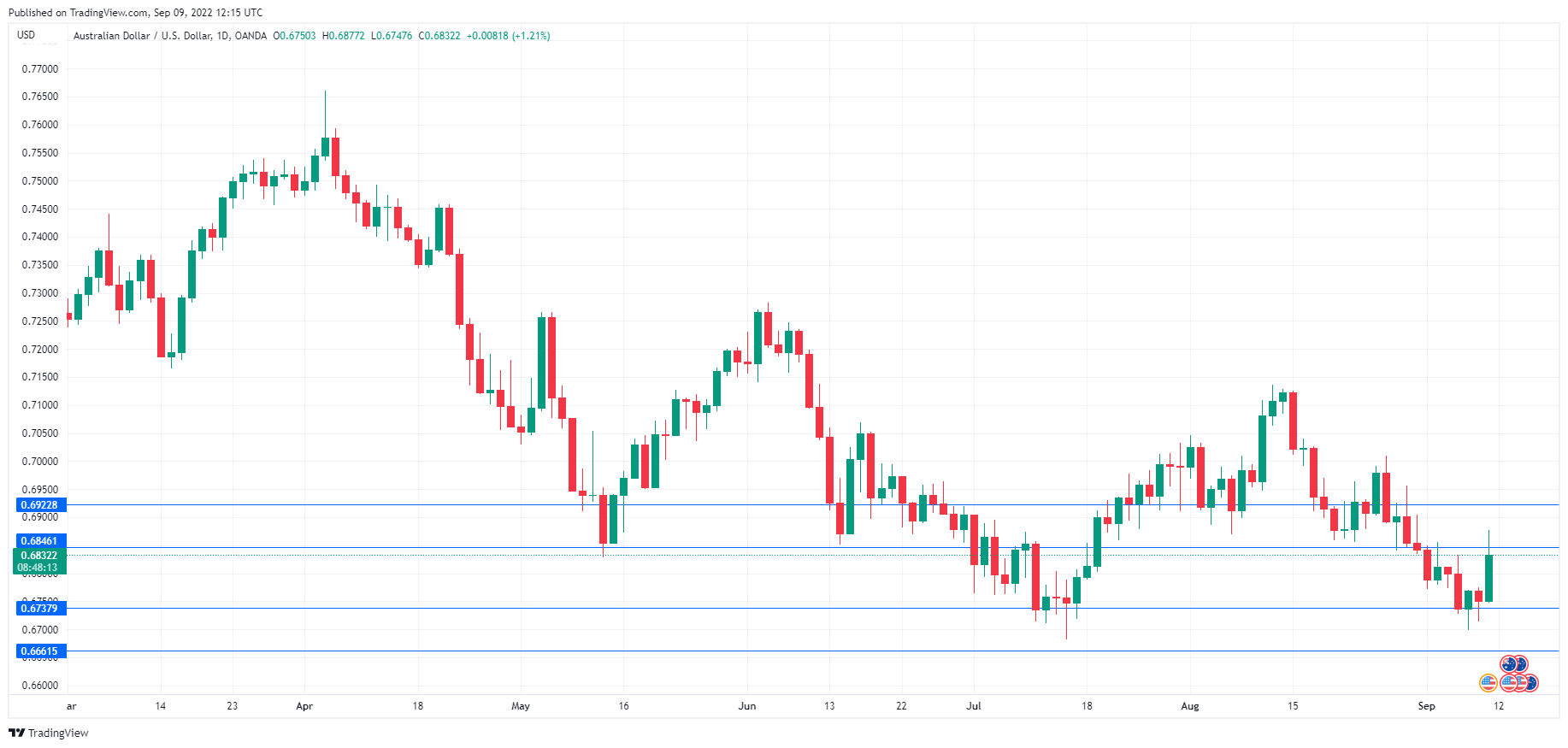
The Australian dollar has posted sharp gains today. In the European session, AUD/USD is trading at 0.6837, up 1.27%.
China inflation falls unexpectedly
China’s economy has been stalling, as global demand has weakened and China rigorously enforces a zero-Covid policy. The slowdown in the Chinese economy has hurt global growth, but the silver lining is that August inflation also dropped, which has taken the edge off global inflation. China is a key driver of external inflation pressures, and the decline will be welcome news in the major economies, where inflation remains enemy number one and has led to a sharp tightening in policy.
China released the August inflation earlier today. On an annualized basis, August CPI was up 2.5%, lower than the 2.7% gain in July and below the consensus of 2.8%. The Producer Price Index for August slowed to 2.3%, down from 4.2% and below the estimate of 3.1%. The drop in CPI in the world’s number two economy has raised risk sentiment and sent risk-related currencies like the Aussie sharply higher today.
The RBA raised rates by 0.50% earlier this week, bringing the cash rate to 2.35%. RBA Governor Lowe said on Thursday that the RBA would need to raise interest rates at least twice more to contain the “scourge” of inflation. Lowe reiterated that the pace and extent of future rate hikes would be data-dependent, especially inflation and wage growth. After four straight hikes of 0.50%, the RBA may decide to ease up in October with a small hike of 0.25%. Next week’s employment report will be an important factor in the RBA’s rate decision.
AUD/USD Technical
- AUD/USD is testing support at 0.6737. Below, there is support at 0.6661
- There is resistance at 0.6737 and 0.6846
EUR/USD Mid-Day Outlook
Daily Pivots: (S1) 0.9944; (P) 0.9986; (R1) 1.0042; More...
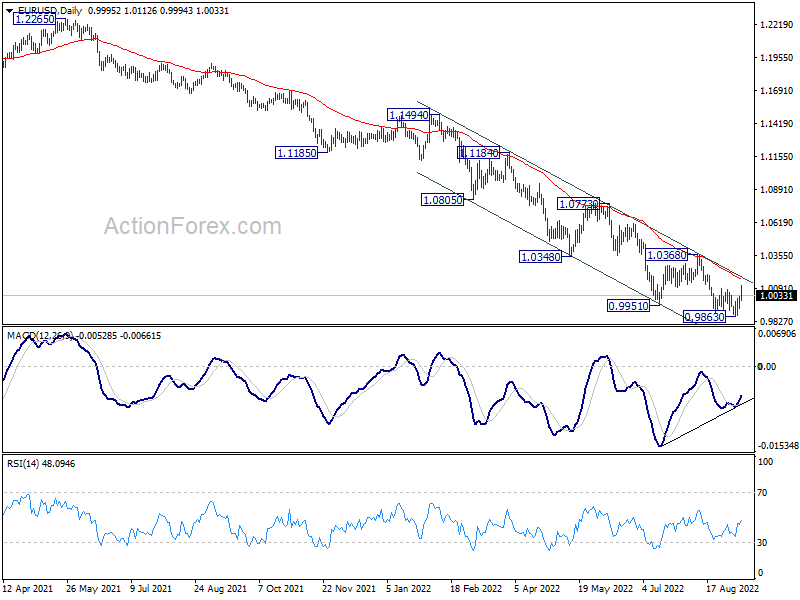
Intraday bias in EUR/USD remains mildly on the upside at this point. Rebound from 0.9863 short term bottom would target 55 day EMA (now at 1.0170). Sustained break there will raise the chance of larger reversal, and target 1.0368 resistance. On the downside, firm break of 0.9863 will resume larger down trend.
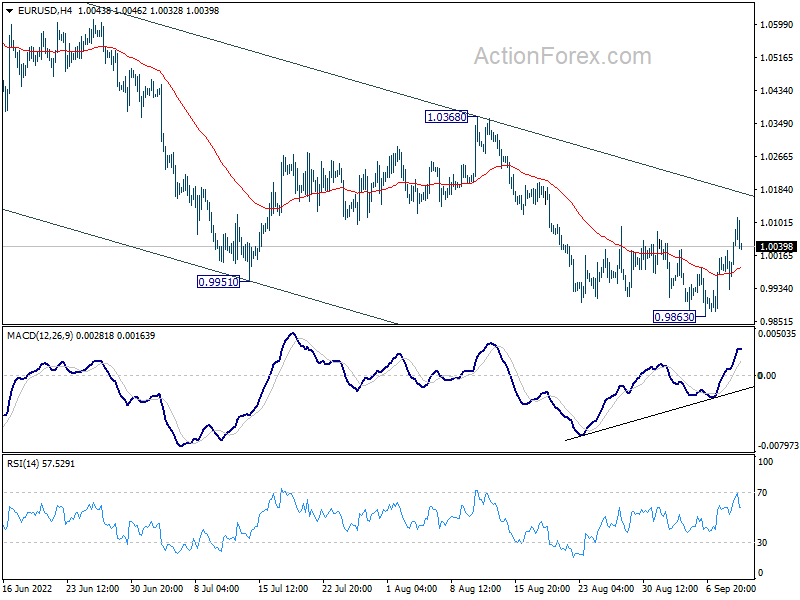
In the bigger picture, down trend from 1.6039 (2008 high) is still in progress. Next target is 100% projection of 1.3993 to 1.0339 from 1.2348 at 0.8694. In any case, outlook will stay bearish as long as 1.0368 resistance holds, even in case of strong rebound.
GBP/USD Mid-Day Outlook
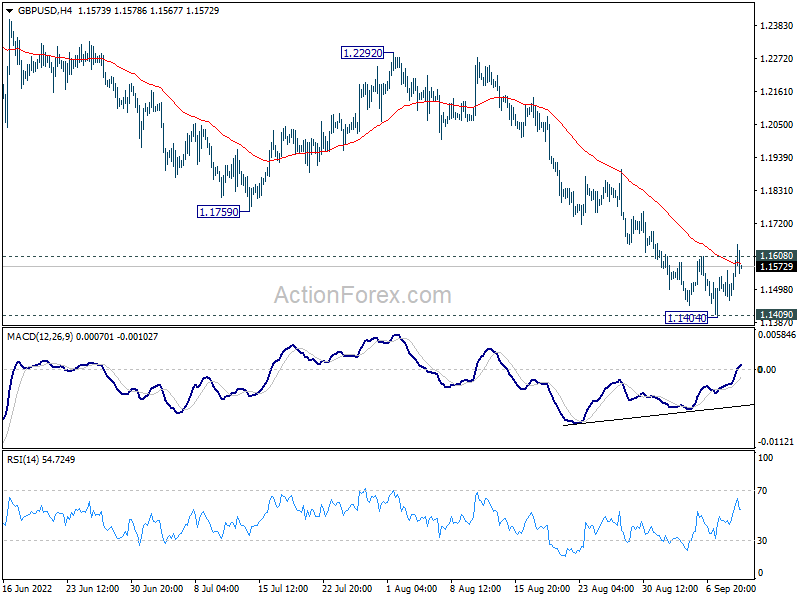
Daily Pivots: (S1) 1.1456; (P) 1.1508; (R1) 1.1556; More...
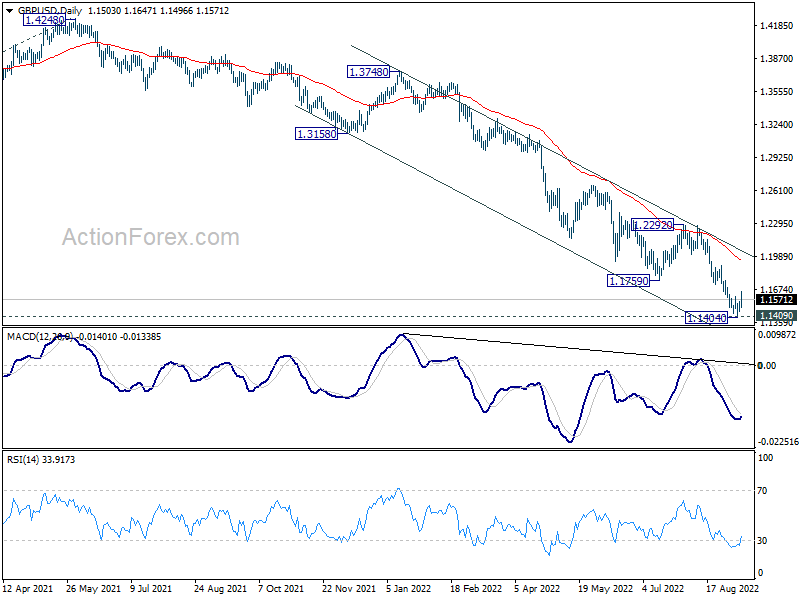
GBP/USD's break of 1.1608 minor resistance suggests short term bottoming at 1.1404, on bullish convergence condition in 4 hour MACD, after defending 1.1409 low. Intraday bias is back on the upside for 55 day EMA (now at 1.1942). On the downside, decisive break of 1.1409 will resume larger down trend.
In the bigger picture, based on current momentum, fall from 1.4248 (2018 high) is probably resuming long term down trend from 2.1161 (2007 high). Sustained break of 1.1409 will target 61.8% projection of 1.7190 (2014 high) to 1.1409 (2020 low) from 1.4248 (2021 high) at 1.0675. This will remain the favored case for now as long as 1.2292 resistance holds.
USD/JPY Mid-Day Outlook
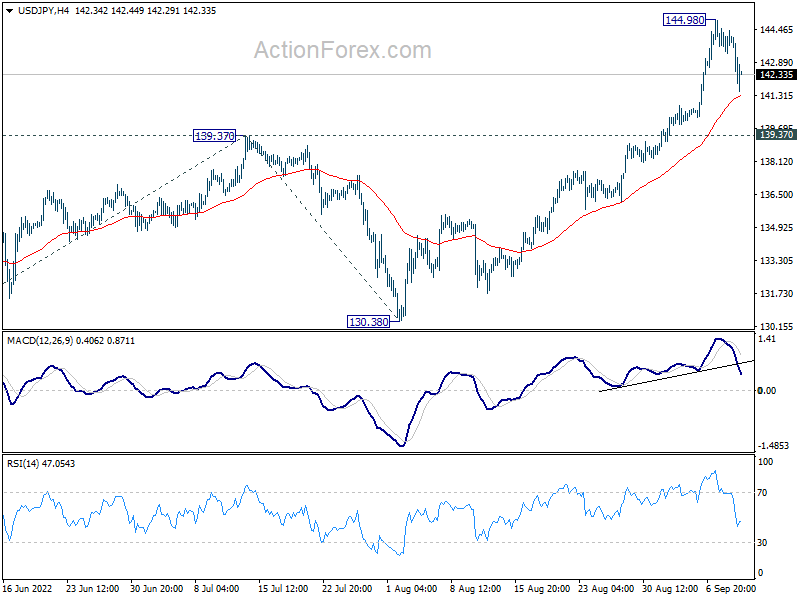
Daily Pivots: (S1) 143.43; (P) 144.00; (R1) 144.67; More...
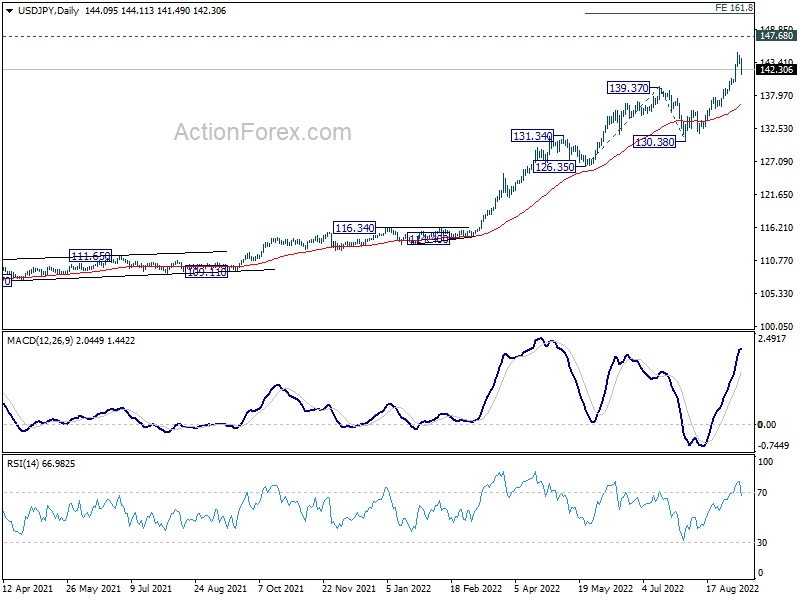
USD/JPY's retreat from 144.98 is extending but stays above 1.3937 resistance turned support. Intraday bias remains neutral first. Downside should be contained by 139.37 resistance turned support to bring another rally. On the upside, break of 144.98 will resume larger up trend to 147.68 long term resistance. Break there will target 161.8% projection of 126.35 to 139.37 from 130.38 at 151.44 next.
In the bigger picture, up trend from 101.18 is still in progress, as part of the whole up trend from 75.56 (2011 low). Further rise should be seen to 147.68 (1998 high). For now, break of 130.38 support is needed to be the first indication of medium term topping. Otherwise, outlook will stay bullish even in case of deep pull back.
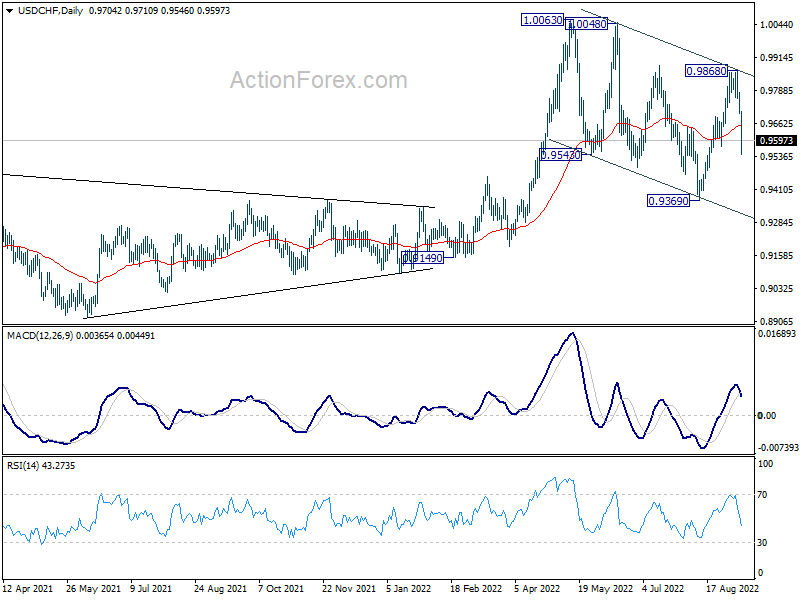
USD/CHF Mid-Day Outlook
Daily Pivots: (S1) 0.9677; (P) 0.9730; (R1) 0.9758; More...
USD/CHF's decline from 0.9868 accelerates to as low as 0.9546 so far. Current fall is seen as the corrective pattern from 1.0063. Intraday bias stays on the downside for 0.9369 support. On the upside above 0.9707 minor resistance will turn intraday bias neutral first.
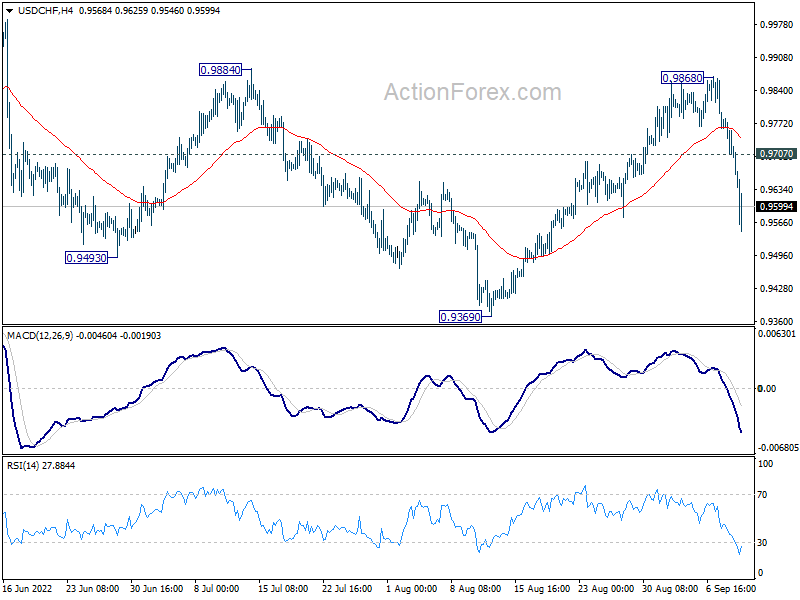
In the bigger picture, current development suggests that up trend from 0.8756 (2021 low) is still in progress. Sustained break of 1.0063 will target 100% projection of 0.9149 to 1.0063 from 0.9369 at 1.0283, and then 1.0342 (2016 high). For now, this will remain the favored case as long as 0.9369 support holds, even in case of deep pull back.