

Sample Category Title
Fed Waller supports larger than 75bps hike if retail sales and housing data materially stronger than expected
Fed Governor Christopher Waller said in a speech that as the base case, he supports another 75bps rate hike at the July 26-27 FOMC meeting. This level is "close to neutral", neither stimulates nor restricts demand.
But Waller added, if upcoming retail sales and housing data "come in materially stronger than expected it would make me lean towards a larger hike at the July meeting to the extent it shows demand is not slowing down fast enough to get inflation down."
After July, Waller expects "monetary policy to be restrictive until there has been a sustained reduction in core personal consumption expenditure (PCE) inflation, which excludes food and energy." And, "until I see a significant moderation in core prices, I support further rate hikes," he added.
Oil Outlook Bears Leading the Way
As global economic conditions continue to stroll casually towards deterioration, the market scrambles to reappraise the possibility for a recession. Contributing to the worsening of the economic outlook, is the soaring inflation, with year-on-year US consumer price index, reaching levels once seen before in 1981, marking a four-decade high, which puts increased pressure on the Fed to adopt an even more hawkish stance. Not only that, but the inversion of the yield curve also points out that the market anticipates economic fallout, sooner rather than later, as we observed increased volatility in the bond market around the CPI release. As a consequence, WTI slipped lower yesterday 13th of July, closing the day around the $94 per barrel. In this report we aim to provide a comprehensive analysis on the current economic developments, draw a picture on what could lie ahead and finish off with a technical analysis of WTI.
US Secretary Treasury Yellen, embarked on a new crusade mission towards the far east, attempting to encourage G20 members, to opt-in the price-capping plan on Russian oil. The price cap aims to prevent another global price spike in the energy sector, by allowing the flow of Russian oil towards the west and in parallel restrict the revenues, Russia uses to finance its war operations in Ukraine. Problems arising with the price proposal include, how to enforce the plan, what would the proposed sales price be and whether the other counterparts will subscribe to the idea. Furthermore, another factor outside of western control is whether Russia will agree to sell oil at the “mandated” price to western nations. This highlights the fragmented microcosmic perspective of westerners on the matter, naively assuming that Russia cannot and will not divert their oil exports towards, other non-western nations such as India and China. Without much surprise, the proposed plan triggered President Putin’s reaction, lashing out and threatening the western nations for “catastrophic consequences” for world energy markets, if they impose further sanctions on Moscow. Characteristically, on another note, currently Nord Stream 1 pipeline which supplies natural gas to Europe, is closed for maintenance, but analysts fear the reopening could be delayed as a retaliation tactic, by Russian government.
President Biden is to visit the Saudi Arabian oil mogul royalties, pitching for a production boost this weekend. Even though, it appears Saudi Arabia, the top crude oil producer, currently runs at maximum output capacity according to OPEC, the expected output increases to be discussed at the meeting will take place in the near future. Noteworthy, are the major OPEC players, such as Nigeria and Libya who are facing production and export limitations, failing to deliver promises, due to sociopolitical unrest and operational hurdles respectively. Should the meeting with Biden and Saudis fail to produce any increase in production levels in the near future, that could cause practically the price of oil to rise as it would imply the possible shortage of the supply of the commodity.
Turning our attention towards yesterday’s key economic releases we noticed that the market reaction was rather contradictory, diverging from fundamental market expectations. As an example, the surprise actual YoY CPI rate of 9.1% contrasted with the 8.8% forecast, should have in our assessment, pushed the greenback to higher grounds, a scenario wherein the strong US dollar would weigh down WTI’s price. On the contrary, we saw the dollar closing the day in the reds whilst oil closed in the greens. Moreover, US Crude Oil Inventories release reported surpluses by both the American Petroleum Institute as well as the Energy Information Administration failed to weigh on oil’s price, despite implying a slack in the US oil market. Thus, we maintain a bearish bias outlook for the continuation of WTI’s price action in the short-term horizon.
As to what follows, the Baker Hugh’s oil rig count will be out tomorrow 15th of July, which will shed some light on the demand-side of oil. In the grand scheme of things, we expect oil prices to be affected by supply and demand fundamentals. Should market worries for a possible supply shortage intensify, we may see oil prices getting a boost, while on the flip side should market worries for a possible recession and lockdown measures in China come into play, we may see the demand expectations of oil dropping, thus weigh on oil’s prices.
Technical Analysis
WTI H4
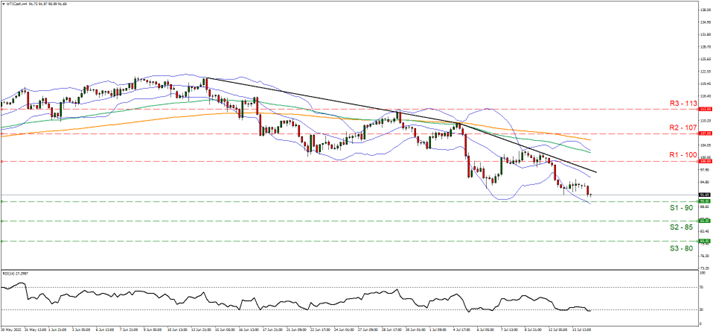
WTI continues to move in a downward trend, as we can observe the lower peaks and lower troughs forming a descending trendline. WTI currently trades around the $91 range aiming for the $90 (S1) having the $100 psychological level as closest resistance (R1). We tend to have a propensity for a continuation towards a downwards motion, as we believe that a breaking through the $90 support (S1) line and $85 support (S2) barrier its within WTI’s reach, in the short-term horizon. Supporting our case, the RSI indicator below our 4-hour chart is nearing the reading of 30. Also, given the fundamentals described above, there could be a substantial possibility for the price to experience volatility and head further down. Should WTI find extensive buy orders along its way, we may see its price action breaking through the descending trendline first, signaling a possible trend reversal, then followed by a break above the $100 psychological resistance (R1) line and moving decisively towards the $107 resistance (R2) hurdle. Should selling interests continue to be seen, we may see its price breaking the $90 (S1) support line, a level not seen since February 2022, and move decisively lower, aiming for the $85 support (S2) level.
Yen Tumbles to 139
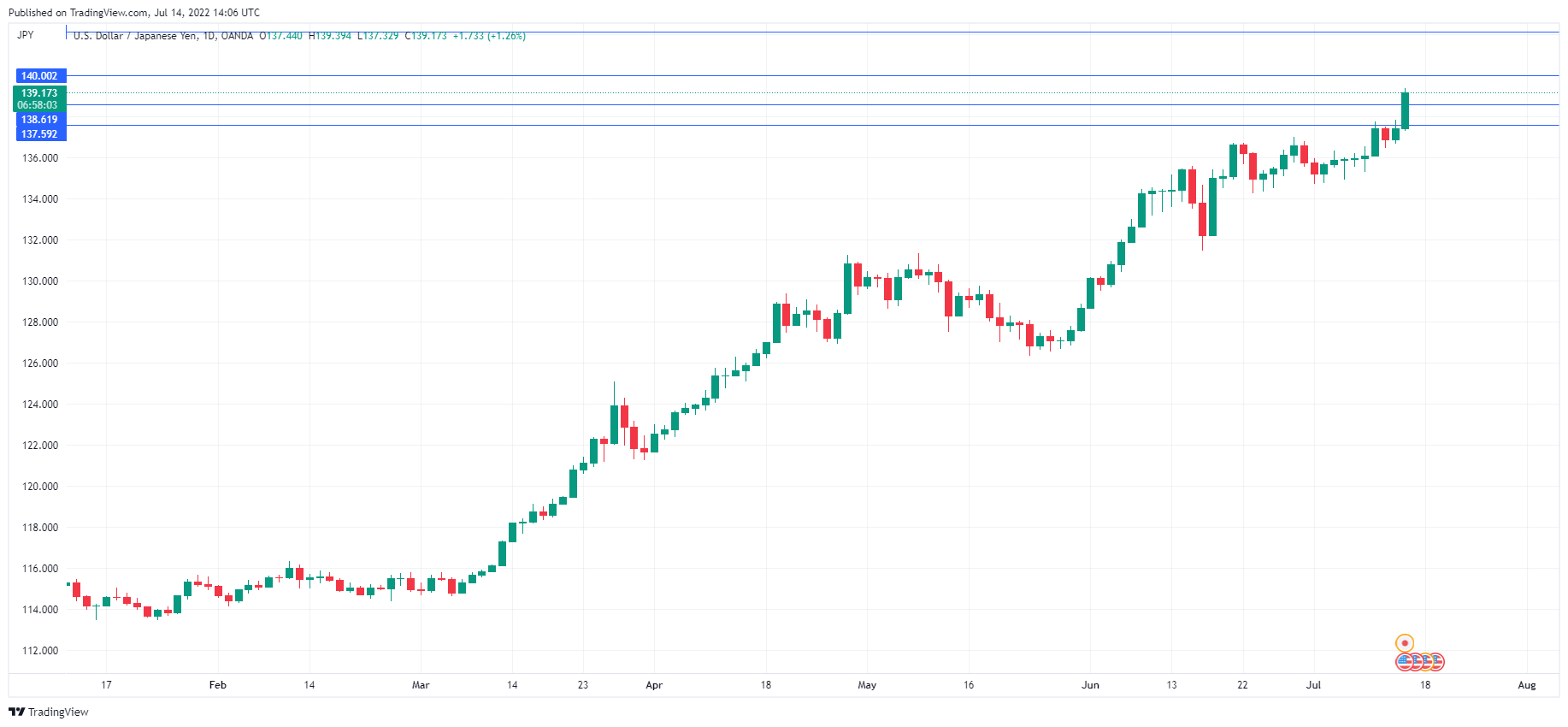
The Japanese yen has been pummeled today by the US dollar. USD/JPY is currently trading at 139.22, up 1.29% on the day.
Is 140 next for the yen?
The US dollar is showing broad strength today, and for the yen that has meant a new 20-year low, as USD/JPY touched 139.39 earlier in the day. The symbolic 140.00 line is within striking distance, and it would certainly be memorable if the yen breaks 140 right after the euro broke below the parity line for the first time since 2000.
There have been a parade of central banks announcing higher rates in the past day, notably the Bank of Canada, which surprised the markets with a massive 100bp increase, and the Bank of Korea, which raised rates by 50bp. This has put the Bank of Japan’s loose policy further out of sync with the global trend of tightening, and this appears to be weighing on the yen.
On Monday, the yen slid around 1%, triggering a response from Japan’s Finance Minister Suzuki, who expressed his concern about the exchange rate at a meeting with US Treasury Secretary Yellen. We have seen this jawboning from Suzuki before, but the likelihood of the Ministry of Finance (MOF) intervening in the currency markets to prop up the ailing yen are remote. We have seen the yen cross the 120 and 130 lines without incident, and there is nothing magical about the 140 level either.
I would note that there are mixed signals emanating from the MOF and the Bank of Japan, which lead me to believe that no intervention is being planned. Governor Kuroda reiterated on Monday that the central bank would take additional monetary easing steps as necessary in order to boost the fragile economy. Kuroda has said on occasion that a weak yen has its advantages, and it seems unlikely that a 140 yen will trigger any change in policy from the BoJ. There are no guarantees, of course, but I would submit that the MoF and BoJ have bigger worries than a weak Japanese yen.
USD/JPY Technical
- USD/JPY has support at 135.82 an 135.06
- There is resistance at the round number of 140.00, followed by 142.14
Sunset Market Commentary
Markets
Frontloading policy tightening is the talk of the town on interest rate markets these days. The Bank of Canada was leading by example as it yesterday raised its policy rate by 100 bps The move was justified as serving a soft landing as it hopefully removes the need to raise rates higher and longer further down the road. A 9.0%+ US inflation print fully opened the debate whether the Fed should consider a similar move on July 27. Markets think it’s likely. This morning, the Monetary Authority of Singapore and the central bank of the Philippines provided evidence that the frontloading recipe is broadly applicable. Strong labour data caused the debate to spill over to Australia. EMU markets of late were focused on recession risks rather than on the need for aggressive ECB anti-inflationary action. Yields recently even were at risk of falling below key supports (2-y swap 1.05/10% area, 10-y swap 2.0% area, 10-y Bund 1.15/18% area). Investors finally realized that the ECB in one why or another will also face the question how far it can stay behind the curve as inflation mounts. Short-term EMU yields intra-day jumped almost 20 bps, but ‘enthusiasm’ faded later. German yields currently rise between 12 bps (2-y) and 2.5 bps (30-y). Aside from inflation fear and recession risk, EMU bonds (and the euro) are facing a new headwind from a political crisis in Italy. A no confidence vote might cause PM Draghi to resign. Next steps in the process are unclear for now. The combination of higher yields, the Italian crisis and global risk-off widens the Italian 10-y spread over Germany by 16 bps. Spain/Portugal add 6 bps. The US flattening trend continues with yields rising between 10 bps (5-y) and 3 bps (30-y). US data were mixed with the headline PPI printing higher than expected at 11.3%, but jobless claims rising 244k. Persistent political uncertainty annex recission fears keep European equities in the defensive (Eurostoxx -1.5%). First US Q2 earnings from major banks also didn’t help sentiment (S&P -1.5%). Brent oil extends its journey below $100 p/b ($ 97.25).
Anticipation on potential Fed frontloading keeps de dollar in the driver’s seat. The DXY index (108.8) is touching the highest levels since September 2002. This move is mainly driven by USD/JPY as the pair surpassed the 139 big figure. EUR/USD initially copied the price pattern from the previous days, hovering between 1.005 and 1.0000, but finally forced the break (0.996). Interestingly, the Aussie dollar and even more the loonie don’t profit from the CB’s proactive monetary policy. The Canadian dollar even underperforms against the euro (EUR/CAD gains 2 big figures, 1.316). The sterling rally from last week/early this week also stalls. EUR/GBP rebounds to the 0.846 area. News Headlines
Hungary’s EU funds minister Navracsics told the Mandiner weekly that they don’t rule out the possibility of accepting the jurisdiction of the EU’s chief prosecutor. Orban earlier called such measure a red line which infringes on national sovereignty. However, the PM is getting in dire straits when it comes to funding his lavish fiscal policy. Over the past weeks, his cabinet has been courting the EU in order to overcome their stand-offs and secure the release of EU funds under the multi-annual budget framework and pandemic-related. The EU delayed disbursements of up to €37bn, about €10bn of which can’t be recovered after the end of this year without deal. The forint strengthened slightly on the news, from EUR/HUF 412 to 407. Earlier on the day, the local currency tended to weaken following the Hungarian national bank’s decision to keep its 1-week deposit rate unchanged at 9.75%.
Swedish inflation (CPIF; CPI with fixed interest rate) unexpectedly accelerated by 1.2% M/M to 8.5% Y/Y (from 7.2% Y/Y), the highest level in over three decades. The monthly change was mainly driven by price increases in transport (mainly higher fuel prices). All other categories rose as well with lower prices on clothing (seasonal summer sale) being the exception. The Swedish swap yield curve bear flattens significantly today with yields rising by 18.3 bps (2-yr) to 6.7 bps (30-yr). Money markets discount a 100 bps (!) rate hike by the Riksbank in September. As we’ve seen before over the past weeks/months, the local currency doesn’t really profit from this frontloading for rate hikes. EUR/SEK trades stable around 10.60.
EUR/USD Mid-Day Outlook
Daily Pivots: (S1) 1.0000; (P) 1.0037; (R1) 1.0074; More...
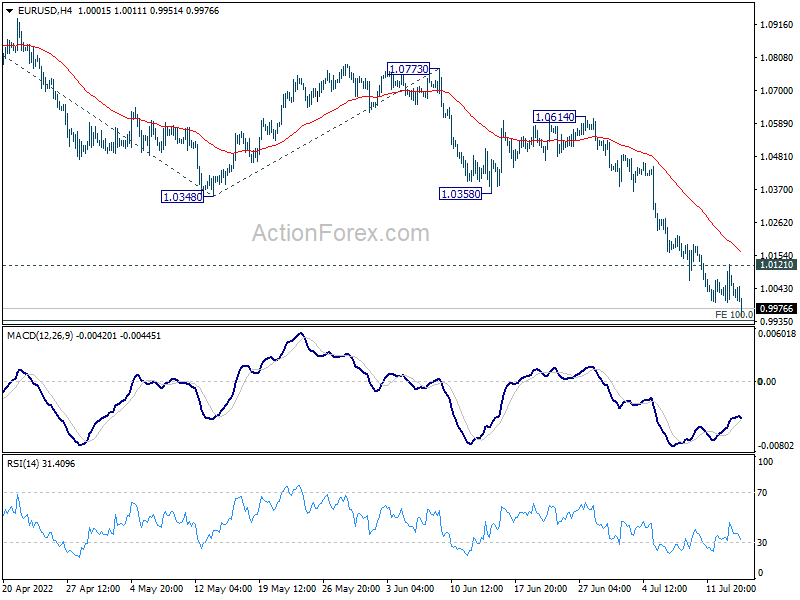
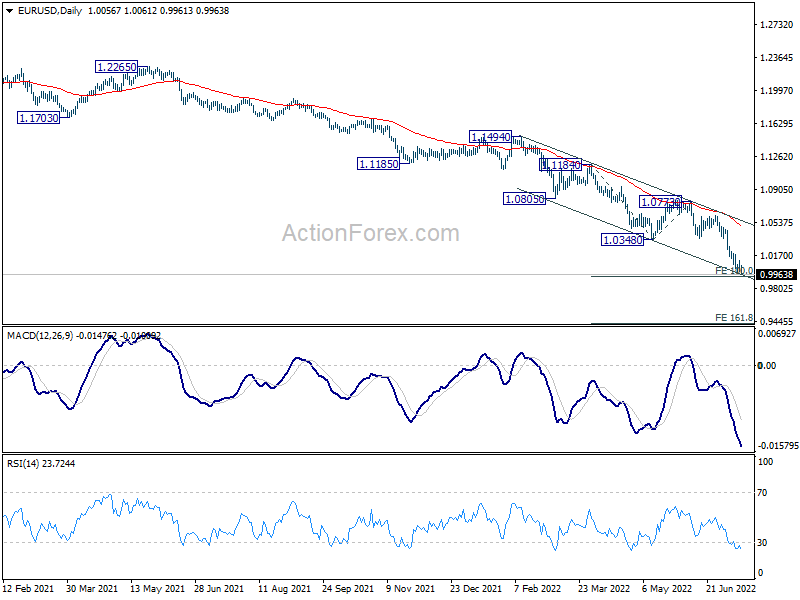
EUR/USD's fall continues today and intraday bias stays on the downside. Firm break of 100% projection of 1.1184 to 1.0348 from 1.0773 at 0.9937 could prompt downside acceleration to 161.8% projection at 0.9420. On the upside, break of 1.0121 minor resistance will turn intraday bias neutral again. But outlook will stay bearish as long as 1.0348 support turned resistance holds.
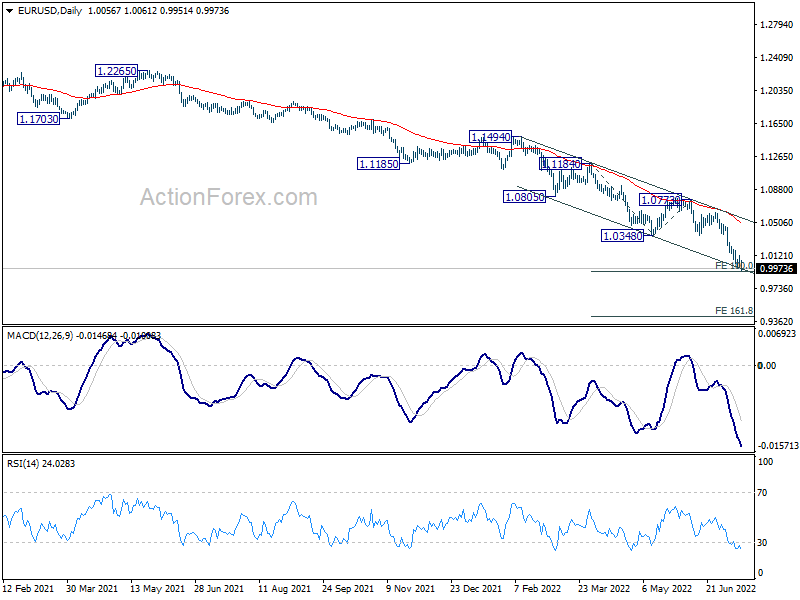
In the bigger picture, down trend from 1.6039 (2008 high) is still in progress. Next target is 100% projection of 1.3993 to 1.0339 from 1.2348 at 0.8694. In any case, outlook will stay bearish as long as 1.0773 resistance holds, in case of rebound.
GBP/USD Mid-Day Outlook
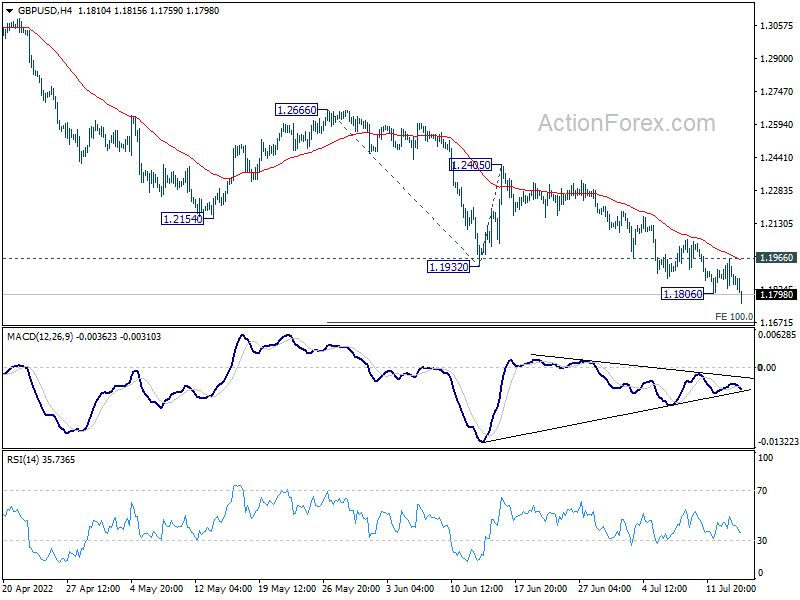
Daily Pivots: (S1) 1.1823; (P) 1.1895; (R1) 1.1962; More...
GBP/USD's down trend resumed after brief recovery and intraday bias is back on the downside. Current fall should target 100% projection of 1.2666 to 1.1932 from 1.2405 at 1.1671. Decisive break there will target a test on 1.1409 long term support. On the upside, above 1.1966 minor resistance will turn intraday bias neutral against and bring more consolidations.
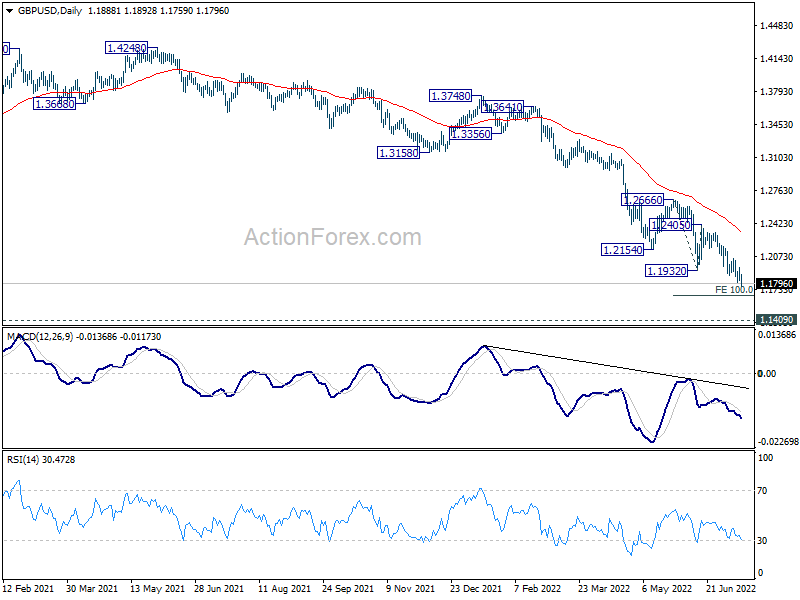
In the bigger picture, fall from 1.4248 (2018 high) could be a leg inside the pattern from 1.1409 (2020 low), or resuming the longer term down trend. Deeper decline is expected as long as 1.2666 resistance holds. Next target is 1.1409 low. However, firm break of 1.2666 will bring stronger rise back to 55 week EMA (now at 1.3065).
USD/CHF Mid-Day Outlook
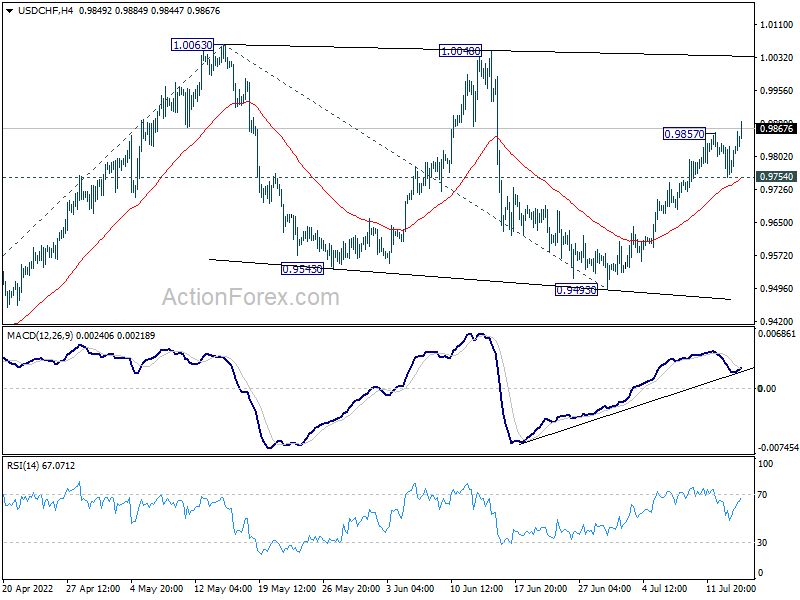
Daily Pivots: (S1) 0.9752; (P) 0.9794; (R1) 0.9830; More...
USD/CHF's rise resumed after brief retreat and intraday bias remains on the upside for retesting 1.0063 high. Decisive break there will resume larger up trend. On the downside, break of 0.9754 will dampen the bullish view and turn bias neutral again first.
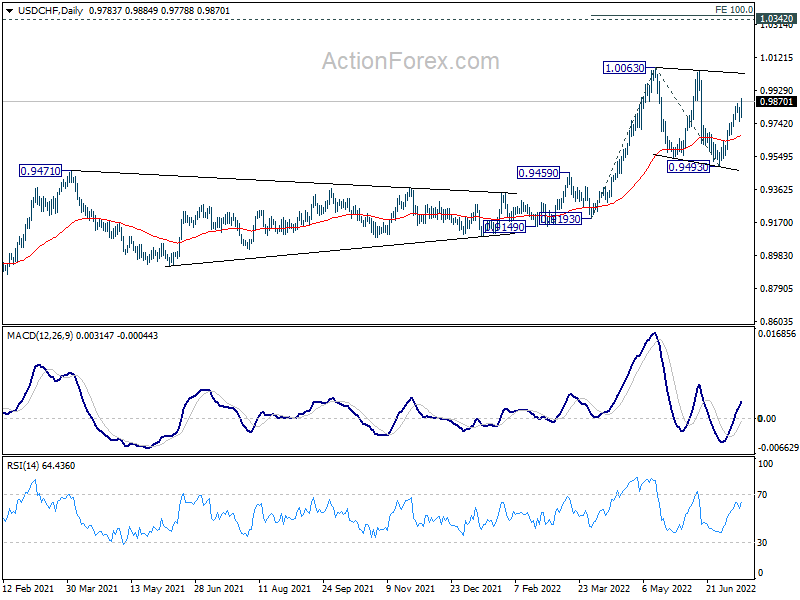
In the bigger picture, medium term up trend from 0.8756 (2021 low) is still in progress. Next target is 1.0342 (2016 high). Sustained break there will resume long term up trend from 0.7065 (2011 low). This will remain the favored case as long as 0.9471 resistance turned support holds.
USD/JPY Mid-Day Outlook
Daily Pivots: (S1) 136.39; (P) 136.96; (R1) 137.44; More...
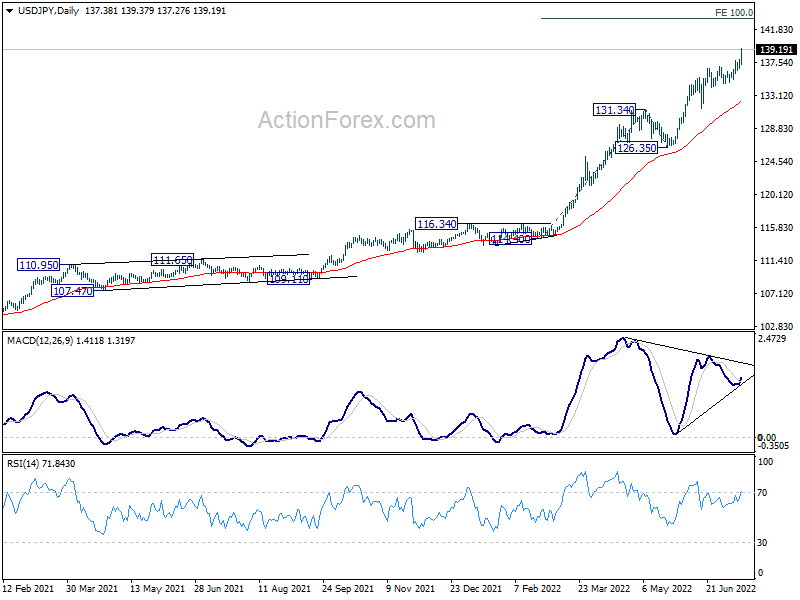
Intraday bias in USD/JPY remains on the upside for the moment. Current up trend should target 100% projection of 114.40 to 131.34 from 126.35 at 143.29. On the downside, below 137.74 minor support will turn intraday bias neutral and bring consolidations first, before staging another rally.
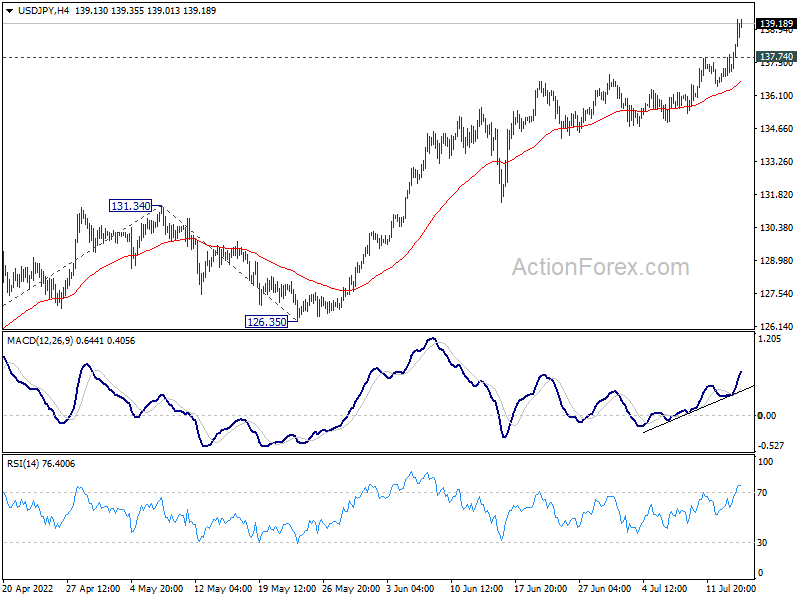
In the bigger picture, current rally is seen as part of the long term up trend from 75.56 (2011 low). Next target is 100% projection of 75.56 (2011 low) to 125.85 (2015 high) from 98.97 at 149.26, which is close to 147.68 (1998 high). This will remain the favored case as long as 126.35 support holds.
USD/CAD Daily Outlook
Daily Pivots: (S1) 1.2988; (P) 1.3019; (R1) 1.3055; More...
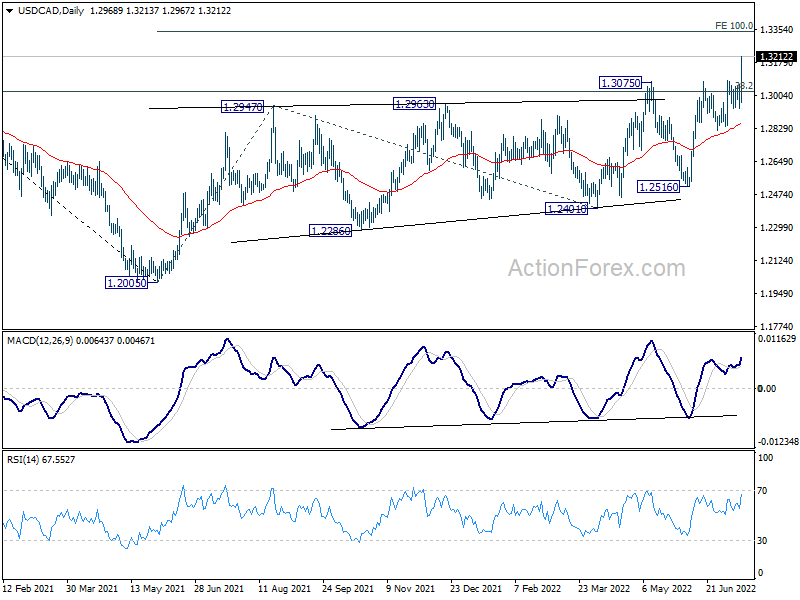
USD/CAD's strong break of 1.3082 confirms up trend resumption . Intraday bias is back on the upside. Next target is 100% projection of 1.2005 to 1.2947 from 1.2401 at 1.3343. For now, outlook will stay bullish as long as 1.2935 support intact, in case of retreat.
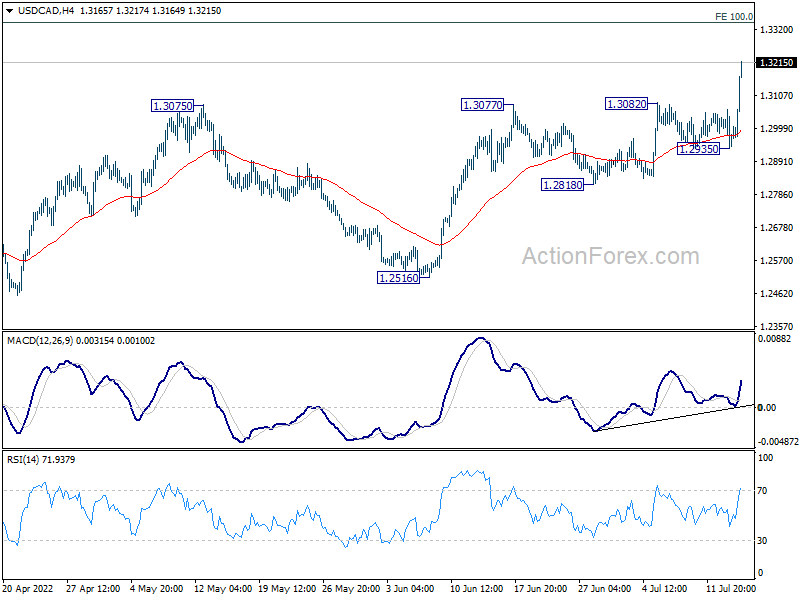
In the bigger picture, the firm break of 38.2% retracement of 1.4667 (2020 high) to 1.2005 (2021 low) at 1.3022 should confirm that down trend from 1.4667 has completed after defending 1.2061 long term cluster support. Further rise should be seen to 61.8% retracement at 1.3650 next. This will now remain the favored case as long as 1.2516 support holds.
Dollar Buying Continues after Record PPI, EUR/USD Breaks Parity Again
Dollar stays strong in early US session after release of another record print of PPI inflation. Buying of Dollar is currently concentrated again Yen and Canadian. But the moves in Aussie and European majors are also picking up. Loonie is the worst performing one today, despite the mega 1% rate hike by BoC yesterday. It's some what weighed down by oil prices, with WTI breaching April's low. Yen is currently the second worst.
Technically, EUR/USD breaks parity with another fall today. A main focus is indeed on 100% projection of 1.1184 to 1.0348 from 1.0773 at 0.9937. As long as this projection level holds, there is still prospect of a near term rebound. However, sustained break there could prompt further downside acceleration to 161.8% projection at 0.9420. This should be decided in the next few days.
In Europe, at the time of writing, FTSE is down -1.36%. DAX is down -1.64%. CAC is down -1.56%. Germany 10-year yield is up 0.0607 at 1.203. Earlier in Asia, Nikkei rose 0.62%. Hong Kong HSI dropped -0.22%. China Shanghai SSE dropped -0.08%. Singapore Strait Times dropped -1.22%. Japan 10-year JGB yield dropped -0.0029 at 0.235.
US PPI rose 1.1% mom in July, 12-mnth rate at record 11.6% yoy
US PPI for final demand rose 1.1% mom in July, above expectation of 0.8% mom. For the 12-month period, PPI accelerated to a record 11.6% yoy, above expectation of 10.% yoy. PPI less foods, energy, and trade services rose 0.3% mom, 6.4% yoy.
US initial jobless claims rose to 244k, slightly above expectations
US initial jobless claims rose 9k to 244k in the week ending July 9, above expectation of 240k. Four-week moving average rose 3k to 236k.
Continuing claims dropped -41k to 1331k in the week ending July2. Four-week moving average of continuing claims rose 5k to 1340k.
EU downgrades 2022 Eurozone GDP forecasts to 2.6%, 2023 to 1.4%
In the Summer 2022 Economic Forecast, European Commission downgraded both 2022 and 2023 Eurozone GDP growth projections. Meanwhile, HICP inflation projections were upgraded for Eurozone in both years. .
Eurozone GDP growth forecasts:
- 2022 at 2.6% (downgraded from 2.7%).
- 2023 at 1.4% (downgraded from 2.3%).
Eurozone HICP inflation forecasts:
- 2022 at 7.6% (upgraded from 6.1%).
- 2023 at 4.0% (upgraded from 2.7%).
Valdis Dombrovskis, Executive Vice-President said: "Russia's war against Ukraine continues to cast a long shadow over Europe and our economy. We are facing challenges on multiple fronts from rising energy and food prices to a highly uncertain global outlook."
Paolo Gentiloni, Commissioner for Economy said: "Russia's unprovoked invasion of Ukraine continues to send shockwaves through the global economy. Moscow's actions are disrupting energy and grain supplies, pushing up prices and weakening confidence...
"In Europe, momentum from the reopening of our economies is set to prop up annual growth in 2022, but for 2023 we have markedly revised down our forecast. Record-high inflation is now expected to peak later this year and gradually decline in 2023...
"With the course of the war and the reliability of gas supplies unknown, this forecast is subject to high uncertainty and downside risks. To navigate these troubled waters, Europe must show leadership, with three words defining our policies: solidarity, sustainability and security."
Australia unemployment rate dropped to 3.5%, lowest since 1974
Australia employment grew 88.4k in June, above expectation of 30.0k. Full time jobs grew 52.9k while part-time jobs rose 35.5k. Unemployment rate dropped sharply from 3.9% to 3.5%, below expectation of 3.8%. That's the lowest level since August 1974. Participation rate rose from 66.7% to 66.8%. Monthly hours worked was essentially unchanged at 1856m.
Bjorn Jarvis, head of labour statistics at the ABS, said: "The 3.4 per cent unemployment rate for women was the lowest since February 1974 and the 3.6 per cent rate for men was the lowest since May 1976."
"The large fall in the unemployment rate this month reflects more people than usual entering employment and also lower than usual numbers of employed people becoming unemployed. Together these flows reflect an increasingly tight labour market, with high demand for engaging and retaining workers, as well as ongoing labour shortages."
USD/CAD Daily Outlook
Daily Pivots: (S1) 1.2988; (P) 1.3019; (R1) 1.3055; More...
USD/CAD's strong break of 1.3082 confirms up trend resumption . Intraday bias is back on the upside. Next target is 100% projection of 1.2005 to 1.2947 from 1.2401 at 1.3343. For now, outlook will stay bullish as long as 1.2935 support intact, in case of retreat.
In the bigger picture, the firm break of 38.2% retracement of 1.4667 (2020 high) to 1.2005 (2021 low) at 1.3022 should confirm that down trend from 1.4667 has completed after defending 1.2061 long term cluster support. Further rise should be seen to 61.8% retracement at 1.3650 next. This will now remain the favored case as long as 1.2516 support holds.
Economic Indicators Update
| GMT | Ccy | Events | Actual | Forecast | Previous | Revised |
|---|---|---|---|---|---|---|
| 23:01 | GBP | RICS Housing Price Balance Jun | 65% | 70% | 73% | |
| 01:00 | AUD | Consumer Inflation Expectations Jul | 6.30% | 6.70% | ||
| 01:30 | AUD | Employment Change Jun | 88.4K | 30.0K | 60.6K | |
| 01:30 | AUD | Unemployment Rate Jun | 3.50% | 3.80% | 3.90% | |
| 04:30 | JPY | Industrial Production M/M May F | -7.50% | -7.20% | -7.20% | |
| 06:30 | CHF | Producer and Import Prices M/M Jun | 0.30% | 0.70% | 0.90% | |
| 06:30 | CHF | Producer and Import Prices Y/Y Jun | 6.90% | 7.30% | 6.90% | |
| 12:30 | CAD | Manufacturing Sales M/M May | -2.00% | 1.40% | 1.70% | 2.60% |
| 12:30 | USD | Initial Jobless Claims (Jul 8) | 244K | 240K | 235K | |
| 12:30 | USD | PPI M/M Jun | 1.10% | 0.80% | 0.80% | 0.90% |
| 12:30 | USD | PPI Y/Y Jun | 11.30% | 10.80% | 10.80% | 10.90% |
| 12:30 | USD | PPI Core M/M Jun | 0.40% | 0.50% | 0.50% | 0.60% |
| 12:30 | USD | PPI Core Y/Y Jun | 8.20% | 8.60% | 8.30% | |
| 14:30 | USD | Natural Gas Storage | 56B | 60B |