

Sample Category Title
EURCHF Wave Analysis
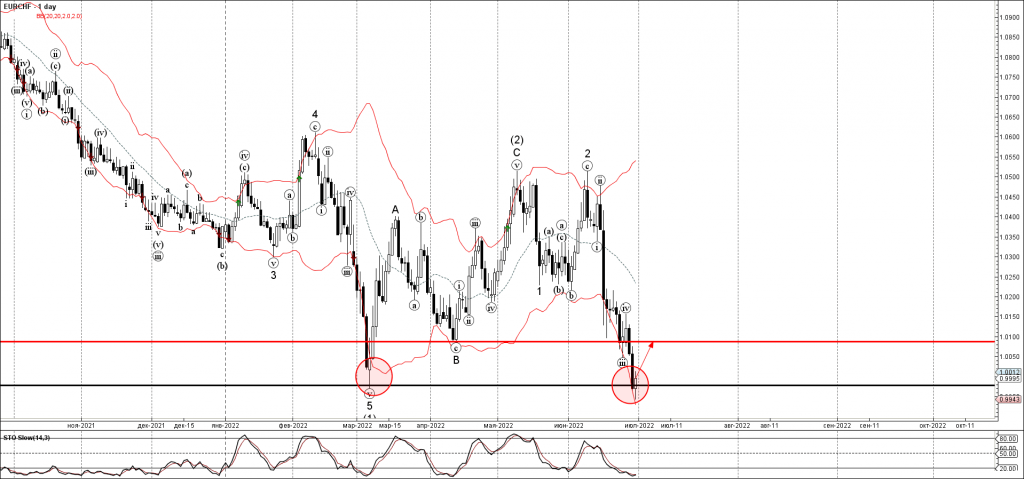
- EURCHF reversed from support level 0.9980
- Likely to rise to resistance level 1.0100
EURCHF currency pair recently reversed up from the multi-month support level 0.9980 (previous monthly low from March), intersecting with the lower daily Bollinger Band.
The upward reversal from the support level 0.9980 stopped the earlier impulse waves (v) and (3).
Given the strength of the support level 0.9980 and the oversold daily Stochastic, EURCHF can be expected to rise further toward the next resistance level 1.0100.
USDJPY Wave Analysis
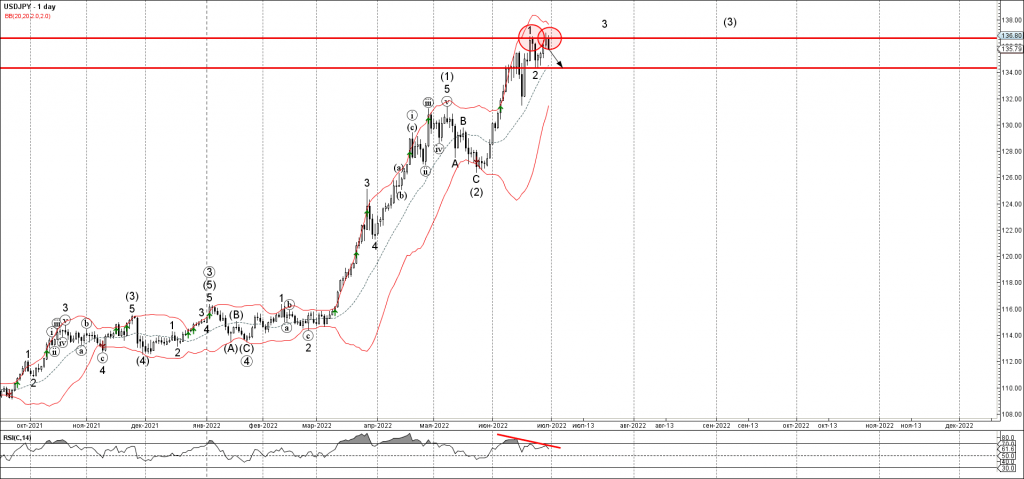
- USDJPY reversed from resistance level 136.60
- Likely to fall to support level 134.00
USDJPY continues to fall after the earlier downward reversal from the resistance level 136.60 (top of the previous impulse wave 1 from the middle of this month).
The downward reversal from the resistance level 136.60 stopped the earlier impulse waves 3 and (3).
Given the strength of the resistance level 136.60 and the bearish divergence on the daily RSI, USDJPY can be expected to fall further toward the next support level 134.00 (low of the previous correction 2).
New Zealand Dollar Near 2-year Low
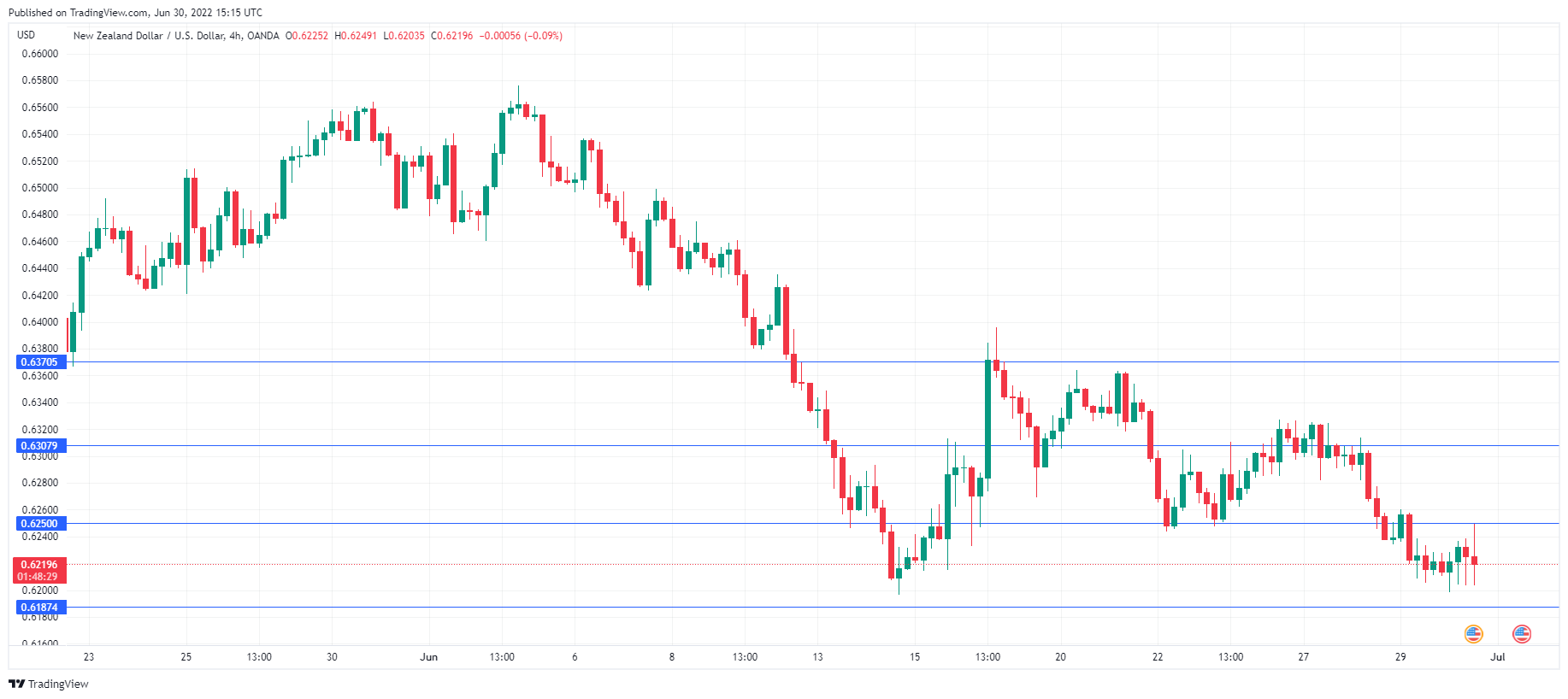
The New Zealand dollar is steady on Thursday. Earlier in the day, NZD/USD fell below the 0.62 line before recovering, coming within a whisker of 0.6996, its lowest level since May 2020.
NZ Business Confidence sags
It was another rough outing for New Zealand ANZ Business Confidence, which fell in June to -62.6, down from -55.6 in May. This not only marked a 12th straight decline but also was a near-record low. There’s no sugar-coating the increasing pessimism that businesses are experiencing about the economic outlook. Domestic demand is holding up well, but businesses continue to report being severely hampered by supply-side disruptions and cost pressures. This is consistent with inflation pressures which remain broad-based and intense.
We’ll get a look at ANZ Consumer Confidence on Friday. Last week, Westpac Consumer Confidence fell sharply to 78.7 in Q1, down from 92.1 in Q4 2021 and I don’t expect the ANZ release to be the bearer of good news. Consumers have been hammered by the cost of living crisis, as food and petrol prices have soared. The pressure on households has been exacerbated by the Reserve Bank of New Zealand continuing to raise interest rates, with more hikes on the way. The rise in mortgage rates has left households with less disposable income, with many seeing a drop in their assets as home prices have fallen.
If the ANZ consumer confidence release confirms that consumer confidence is heading south, this could translate into lower consumer spending, which would be bad news for the New Zealand economy. It could have a significant effect on the Reserve Bank’s policy. If consumer demand sinks, the central bank may have room to ease its rate policy. The RBNZ has been tightening aggressively and the cash rate, which is currently at 2%, is expected to rise to 3% by the end of August and possibly to 4% in 12 months’ time.
NZD/USD Technical
- NZD/USD faces resistance at 0.6307 and 0.6370
- There is support at 0.6250 and 0.6187
WTI Oil Futures Falter But Still Supported
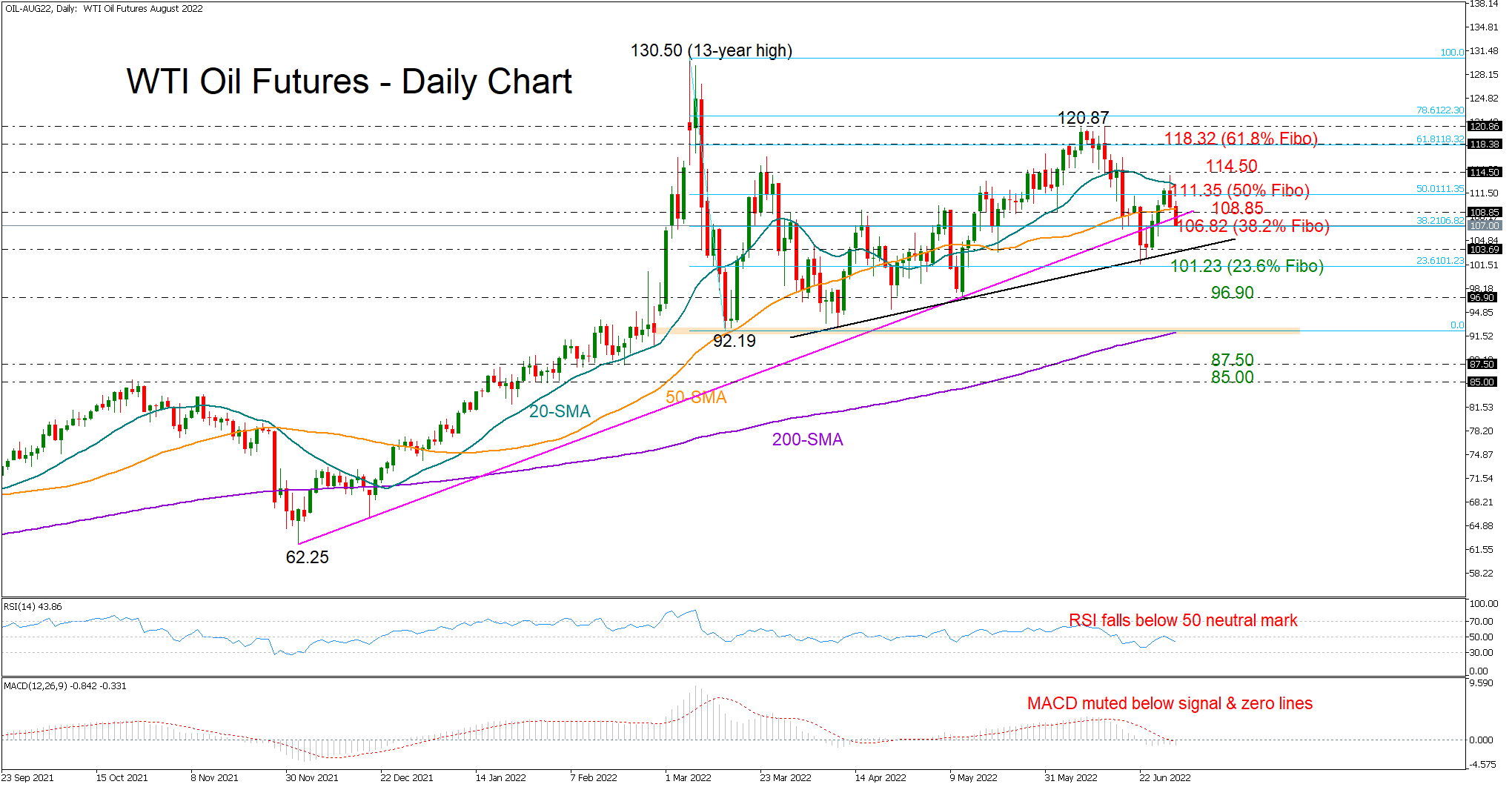
WTI oil futures (August delivery) turned red after failing to close above the 20-day simple moving average (SMA) and the 50% Fibonacci retracement of the $130.50 – $92.19 downfall at $111.35/barrel on Wednesday.
The latest pullback could gain new legs as the RSI has slid back below its 50 neutral mark and the MACD remains muted below its signal and zero lines. If that turns out to be the case and the price retreats below the nearby 38.2% Fibonacci of $106.82 too, the door will open for the shorter-term support trendline at $103.70. A step beneath the latter may immediately halt around the 23.6% Fibonacci of $101.23. Otherwise, the sell-off may stretch towards the $96.90 floor.
Should the price sail northwards instead and above the longer-term ascending trendline, the bulls will again push for a close above the 50% Fibonacci of $111.35 and the 20-day SMA. If they prove successful this time, and the bar at $114.50, which was a crucial constraint to market actions this year, gives way, the rally may speed up to the 61.8% Fibonacci of $118.32 and then meet the June top of $120.87.
All in all, WTI oil futures are technically exposed to additional losses. A decisive close below $106.82 is expected to motivate fresh selling.
USD/JPY: Dollar Takes a Breather after Hitting New 24-Year High vs Yen
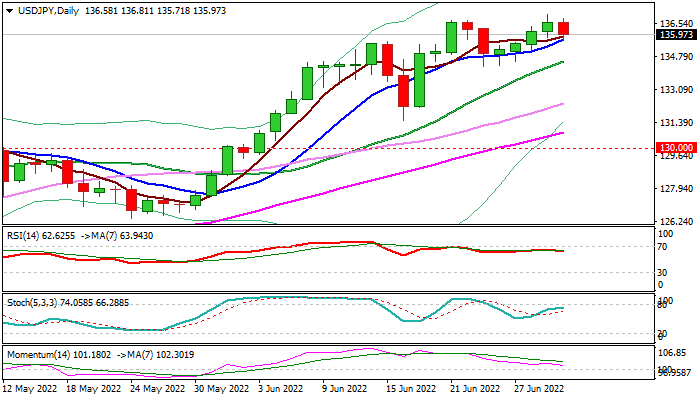
The USDJPY eases from new highest (137.00) since 1998, posted on Wednesday, as dollar loses traction on concerns that economic growth slowdown and possible recession may shorten Fed’s tightening cycle, that signaled traders to take profits.
Larger uptrend remains intact and the pair is on track for 5.6% monthly gain, though risk of deeper correction was signaled by daily RSI and stochastic diverging from the price action for some time and fading bullish momentum, but Q3 results will be eyed for further signals.
Fresh weakness initial support at 135.70 (10DMA), which guards more significant levels at 134.56/26 (20DMA / June 23 trough, where dips should find firm ground, while break would lead to stronger correction and put bulls on hold.
Res: 137.00; 137.28; 137.63; 137.92
Sup: 135.70; 135.11; 134.26; 132.93
Ending a Bad Month in the Red
Stock markets have fallen heavily in June so it seems only fitting that they're ending the month with big losses as reality continues to bite.
There's no getting away from recession chat and while the heads of the Fed, ECB and BoE didn't exactly fuel that during their panel discussion on Wednesday, they didn't do anything to dispel it either. They all know that there's a strong likelihood of recession this year or next and investors are increasingly accepting that fate as well.
There's been a plethora of economic data from across Europe this morning, mostly tier two and three, and it was a bit of a mixed bag. The labour market figures, for example, remain strong with the anomaly being Germany but this was heavily distorted by the integration of Ukrainian refugees into the labour market. Underlying numbers remain in good shape even if across the bloc, employment growth is expected to slow.
It's impossible to ignore the fact that households are being squeezed and we're seeing that appear in the data, particularly in the UK which will probably fall into recession later this year. But it is unlikely to be alone in that which is why bear-market rallies are proving to be so short-lived.
US inflation boost but spending slips
US inflation data was unusually encouraging ahead of the open. Perhaps that's getting a little carried away but it didn't deliver another crushing below so maybe this feeling is actually relief rather than joy. The core reading was a little better than expected at 0.3%, in line with April, while the headline also fell a little short of expectations at 0.6%.
The income and spending data were arguably less encouraging. Earnings rose 0.5% as expected, a slight acceleration from April, while spending rose only 0.2%, a big drop from 0.9% a month earlier and half the forecast. Another sign of the squeeze taking a toll on households? The US economy is among the best positioned to fend off a recession but it's not completely immune to the cost-of-living crisis. It may be catching up.
Oil lower as OPEC+ sticks to August target
Oil prices are modestly lower on Thursday, further paring recent gains following yesterday's reversal. As expected, OPEC+ stuck to its planned 648,000 barrel increase in August and refrained from any decision beyond then which could add an element of uncertainty to future targets, particularly given recent reports that even Saudi Arabia and UAE are running near capacity.
The global economic uncertainty doesn't make planning ahead any easier, either. The prospect of a recession has created more two-way price action in recent weeks, preventing any unsustainable surges in the price of crude as China reopened and the OPEC+ deficit increased.
Gold slightly buoyed by inflation data
Gold has been trending lower over the last couple of weeks but remains in its early summer range between $1,800 and $1,870. It's really struggled for direction over the last couple of months despite the volatility in the broader financial markets. It has been like a deer in the headlights, unable to process and respond to the wicked combination of higher inflation, faster monetary tightening and recession fears.
It received a boost from the slightly softer PCE reading from the US, a rare bit of good news when it comes to inflation data. It's not exactly a massive win, especially when paired with weak spending but it could be worse. Yields fell a little after the data, enabling gold to get back into positive territory for a while.
Bitcoin crumbling
Bitcoin has been hanging on in there around $20,000 but its resilience may finally be crumbling under pressure, with the cryptocurrency sliding more than 5% today to trade around $19,000. This could be really bad news for the crypto space and may even trigger much more severe declines in the coming weeks.
The forced liquidation of Three Arrows Capital may have contributed to the latest decline as traders are left to wonder what other leveraged firms will follow in its footsteps. The fear alone could deliver another hammer blow to crypto valuations before the dust settles.
US: Personal Income Up, But Spending Loses Momentum
Personal income rose 0.5% month-on-month (m/m) in May, meeting the consensus estimate. April's growth was revised up to 0.5% (from the 0.4% m/m reported the month prior). Compensation of employees (+0.5% m/m) and proprietors' income (+1.5% m/m) were the biggest contributors to income growth.
Removing the effect of price changes and taxes, real personal disposable income was down 0.1% m/m in May, while April's figure was revised up to 0.3% m/m (from a flat reading released earlier).
Nominal personal spending rose by 0.2% m/m in May, below the consensus estimate (+0.4% m/m). April's print was revised down to +0.6% m/m vs. +0.9% m/m reported in the preliminary estimate.
- Goods spending was down by 0.7% m/m from downwardly revised growth of 0.2% in April (originally +0.8% m/m). Higher prices of gasoline supported growth in non-durables (+0.7% m/m), while spending on durable goods were down by 3.2% m/m.
- Services spending rose by 0.7% m/m, while the April reading was adjusted down to 0.7% m/m (originally +0.9% m/m). The gains were led by housing, "other" services (including international travel), and health care.
Adjusted for price changes, real spending was down -0.4% m/m – a tenth of a percentage point below expectations. April's reading was revised down to 0.3% m/m (vs. 0.7% m/m reported earlier).
On the prices side, the PCE deflator increased by 0.6% m/m, surprising markets by +0.1 percentage points (0.7% m/m expected). This translates to a 6.3% gain relative to last year (vs. the 6.4% expected). Stripping out food and energy prices, the core PCE deflator was up 0.3% m/m in May, matching April's print. In year-over-year terms, core inflation stood at 4.7% last month (vs. 4.8% expected).
The personal saving rate remained below its pre-pandemic average of 7.5% with a reading of 5.4%, indicating that consumers continue to tap into their pool of excess savings. Current estimates suggest that excess savings remain elevated at roughly $2.4 trillion.
Key Implications
Consumer spending lost momentum last month, but it's not entirely surprising given the strength in May and relentless increases in prices. As was anticipated, services spending continued to make good strides in regaining ground lost during the pandemic, but just not enough to offset the pull-back in goods spending. Accounting for today's print and last months' revisions, we now expect real personal expenditures to grow at roughly 1.5% (annualized) in the second quarter, meaningfully slower than we expected in our Quarterly Economic Forecast.
A healthy level of demand destruction is exactly what the Fed is looking for, so today's release won't stop it from acting decisively. With its preferred inflation measure – the core PCE deflator – more than two percentage points above its target, the Fed is expected to raise the policy rate by another 75 basis points (bps) at its next meeting in July.
Canada’s Economy Decelerates in April, Points to a Negative Print for May
The Canadian economy expanded by +0.3% month-over-month (m/m) in April, beating Statistics Canada's flash estimate of +0.2%. Surprisingly, the flash estimate for May showed a decrease of 0.2% m/m.
April's increase in activity was fairly broad, with output expanding in 13 of the 20 industries. The goods-producing sector rose 0.9%, while the service-producing sector rose 0.1%.
Substantial growth was seen in the mining, quarrying and oil and gas sectors, which grew at 3.3% on the month. This was a product of high production growth in oil, natural gas, and potash.
The increasing demand for in person services continued to push the accommodation and food services sector higher (+4.6%). This was led by a 3.5% rise in the food services and drinking places sector.
Key Implications
Though the data for April was upgraded, the drop in the flash estimate for May is certainly a worry. Despite May's flash print being only a preliminary estimate and there is a lot of volatility in the data, there is risk that Canada's recent outperformance relative to its global peers may be coming to an end. As we highlighted in our recent Quarterly Economic Forecast, the impact of rising interest rates and high inflation will cause a deceleration in Canadian economic growth.
Though this report is sure to raise eyebrows, we don't expect it to stop the Bank of Canada (BoC) from raising its policy rate by 75 basis points at its meeting on July 13th. With the economy remaining in excess demand and current inflation pressures showing no signs of abating, more aggressive action by the BoC is warranted.
Sunset Market Commentary
Markets
Moves on core bond markets are once again impressive today. Recession fears are holding a tight grip. Investors are pricing out central bank rate tightening, especially for the euro zone. This is happening even as (or is it because?) French and Portuguese inflation, just as was the case in Belgium and Spain yesterday, accelerated further. Prices in the former country rose by 6.5% y/y in June, up from 5.8% in May. Portuguese inflation came in at 9% vs 8.1% the month before. The numbers confirm the cooldown in Germany is a (statistical) fluke. The outdated US PCE deflator stabilized at 6.3% in May with the core reading slowing to 4.7% from 4.9%. Both were slightly below expectations but left no material market trace. Still, German bond yields tank 10 to 18 bps in a bull steepener. Markets currently price the peak in the ECB policy rate back below 2%. US Treasuries underperform with yields 6.7-8.1 down at the front end (2y-5y) and 4.6-6 bps further out (30y-10y). UK Gilts yields forfeit up to 11 bps (2y). Other markets fit the recession narrative as well with European stocks tumbling another 2.5%+. The EuroStoxx50 is testing the June lows around 3430 and just a whisker away of the March 2022 post-invasion trough of 3387. Wall Street opens with losses of about 1.5%. Commodity prices are also under pressure. Copper loses 2.5%, iron ore is down for the day. Brent oil loses marginally ($115.85/barrel) after OPEC+ ratified the planned August oil supply hike of 648k barrels/day at its meeting today. With the move, it restored the final step of the 9.7mln barrels a day production cut after the pandemic broke out two years ago. The oil cartel didn’t elaborate on what its next move will be. Gas prices are the exception to the commodity rule. The Dutch future jumps to the highest level since early March amid intensifying worries over shortages.
Euro bulls are sounding the alarm on FX markets. The common currency is under continuous selling pressure this week, sliding from EUR/USD 1.06 at the start to heavily test the 1.04 big figure today. Crucial support kicks in at 1.0354 (May multiyear low) and/or 1.0341 (2017 low). It serves as the last line of defense before parity. The Japanese yen gains slightly vs the dollar (USD/JPY down to 136.13) but more vs the euro (EUR/JPY down to 141.65). The Swiss franc edges higher. EUR/CHF nudges below the March intraday low of 0.997. Heavy Bund outperformance relative to UK Gilts (yields up to 10 bps lower) is even allowing sterling to take the upper hand over the euro. EUR/GBP (0.857) is at risk losing the upward sloping trend channel even as the economic future eyes at least as dark in the UK. News Headlines
The Swedish Riksbank (RB) joined the broader trend of CB’s frontloading policy normalization, raising the policy rate by 50bps to 0.75%. CPIF, the RB’s preferred inflation measure, rose 1.0% M/M and to 7.2% Y/Y in May. Core inflation (ex energy) printed at 5.4% Y/Y. The Riksbank upwardly revised its 2022 average CPIF inflation forecast to 6.9% (from 5.5%). Prices rises are still seen at 4.2% next year but expected to return to 2.0% in 2024. It expects the policy rate to be close to 2% at the start of next year. This implies two rate hikes of at least 50 bps at the regular meetings in September and November. Governor Ingves didn’t exclude a 75 bps hike if necessary but dismissed the idea of additional rate moves in between regular meetings. The Riksbank will also shrink its asset holdings faster an expected, reducing reinvestments in H2 of this year to SEK 18.5 bln instead of SEK 37 bln as planned in April. The Swedish krone doesn’t profit, on the contrary. The RB believes that a policy rate peak near 2% will be enough to bring inflation back to 2% but markets apparently don’t. The krone weakened further to EUR/SEK 10.735.
According to Bloomberg reporting, German energy companies are asking the government to be allowed to pass on higher gas prices to their customers. Due to lower gas deliveries from Russia, the companies are coming under financial stress as they have to replace missing reserves at an extra cost. In this respect, Germany’s biggest buyer of Russian gas is reported to be in talks with the German government on a bail-out or other forms of government support.