Sample Category Title
Continuation of USD Correction Accompanied by Further Euro Comeback
Markets
Of late markets were mainly driven by global sentiment and by investors pondering the impact of central banks tightening to cap inflation. In this complex, markets are giving ever more weight to activity data. Yesterday’s EMU PMI’s didn’t cause a big reaction. The EMU composite PMI slowed more than expected from 55.8 to 54.9. Still both the manufacturing (54.4) and services index (56.3) stayed at comforting levels, even as the outlook deteriorates. Except for some further euro gains, the direct market impact was modest.
It was US data that further deteriorated an already fragile investor sentiment. The US composite PMI dropped from 56.0 to 53.8 mainly due to a decline in the services measure (53.5). Minutes later, the Richmond manufacturing index nosedived (-9 from 14). Markets rarely react much to housing data. However, the decline in April US new homes sales was too big to ignore (-16.6% M/M), extending a 10.5% setback in March.
US equities touched intraday lows after the data, but recouped part of the losses later closing between +0.15% (Dow) and -2.35% (Nasdaq). Uncertainty on growth also caused a sharp bull flattening move with US yields declined between 14.2 bps (2-y) and 8.7 bps (30-y).
The decline in EMU yields was more modest. ECB’s Lagarde and Villeroy confirmed a lift-off with gradual rate hikes starting in July/ September. However, hawks (Holzmann, Kazaks) kept the debate on a 50 bps hike open. German yields due to the risk-off lost between 5.2 bps (5-y) and 3.2 bps (30-y).
On FX, a continuation of the USD correction was accompanied by a further euro comeback. DXY slid from 102+ to close at 101.85. USD/JPY fell below 127 (close 126.83). EUR/USD confirmed its break beyond 1.0642 to close at 1.0736. Sterling had to fight an uphill battle. A stronger euro, a sharp drop in the services PMI and ‘balanced’ comments from governor Bailey pushed EUR/GBP to the high 0.85 area (close 0.8565).This morning, sentiment in Asia improves after yesterday’s WS selling. Regional equities mostly gain between 0.5% and 1.0%, the Nikkei underperforming (-0.1%). US yields and the dollar regain modest ground after yesterday’s setback (USD/JPY 127.0, DXY 101.95, EUR/USD 1.071).
Later today, the US durable goods orders (exp 0.6%) and Minutes of the May 4 Fed meeting will be published. We don’t expect them to provide much new insights as the market focus is gradually turning to growth rather than inflation. Maybe also keep an eye at the US mortgage applications. There are again plenty of ECB speakers including Lagarde, Lane, Knot and Holzmann. Will the hawks continue to ‘challenge gradualism’?
On interest rate markets, we look out whether the US 2-y yield can hold above 2.5%. For the 10-y, 2.72% is an important reference. If not, the dollar slide might also continue. For EUR/USD next reference is 1.0806, but that maybe is a bit too far short-term. For now the downside in EMU yields looks better protected compared to their US counterparts.
News Headlines
The Reserve Bank of New Zealand continued to frontload monetary tightening with a 50 bps hike bringing the OCR at the lower end of the estimated 2-3% neutral rate. The RBNZ aims to constrain demand which is supported by a strong labour market, continued fiscal support and strong terms of trade, until there is a better match with still-disrupted supply. While the RBNZ notes strong headwinds coming from heightened uncertainty and high inflation dampening global and domestic consumer confidence, it expects to tighten monetary conditions in a much more aggressive way than projected back in February. The RBNZ foresees an additional 200 bps hikes by the first half of 2023. Previously, the peak policy rate was seen in the second half of 2024 near 3.5%. Higher projected inflation of 6.9% this year (+0.3 ppts) and 4.4% in 2023 (+1.2 ppts) explain the twist. The kiwi dollar extends its recent rebound from the low 0.62 mid-May to 0.65 this morning. New Zealand ST swap rates soar more than 20 bps.
Solid Rally in Fixed Income on the Back of Negative Sentiment in Equities
Market movers today
In Germany and France, we get consumer confidence surveys for June and May, respectively. However, while these surveys have painted a bleak picture of the state of the consumer, actual spending has held up quite well so far.
In the US, the FOMC minutes may contain some details on the discussions but nothing which should move markets significantly, in our view, as we have a pretty good idea of what the Fed wants to do over the next few meetings, although we will be looking for mentioning of a possible 75bp hike and some QT details. We also get core capex expenditures in April.
As Danske Morning Mail will not be released the next two days due to holidays in Denmark, a key focus in the US on Friday is the personal consumption expenditure data for April, which includes the Federal Reserve's preferred inflation measure, PCE core. Another key element is to see how goods and service consumption are faring amid the full opening of the US economy after the COVID-19 pandemic.
The 60 second overview
Another volatile trading session in the global financial markets yesterday with equity markets declining, while bond prices were rising and 10Y US Treasuries ended the day at 2.76%. This morning 10Y Treasuries have remained at 2.76% in Asian trading hours. There have been modest gains in Asian equity markets this morning after the sell-off yesterday.
The Reserve Bank of New Zealand hiked the official cash rate (OCR) by 50bp to 2.00% overnight, in line with expectations and market pricing. However, RBNZ also signalled more aggressive front-loading of coming rate hikes and higher terminal rate, as the updated rate path indicates that the OCR will reach 3.75% in Q1 2023. The broad-based rise in inflationary pressures, further uptick in inflation expectations and tight labour market conditions warrant more aggressive tightening even despite the rising recession risks. RBNZ projects that inflation will peak during Q2, but it also sees unemployment rate starting to rise from Q3 onwards as rising costs and tighter financial conditions weigh on aggregate demand. NZD FX gained support from the hawkish decision, but the current environment of slowing growth and tightening financial conditions does not appear favourable for NZD especially vis-à-vis USD despite the projected rapid hiking cycle.
Today, we have a string of speeches from ECB officials including Lagarde, and the market will be looking for comments on monetary policy after Lagarde pre-committed to a rate hike of 25bp in July.
The risk of a Russian default is moving closer as the US government has said it will let a sanctions waiver expire today at noon. The sanctions waiver had allowed Russia to pay bond holders through American banks. Hence, Russia may default during the summer as this waiver has expired.
FI: Yesterday, there was a solid rally in the fixed income markets on the back of the negative sentiment in the equity market. 10Y German government bond yields declined some 6bp and ended again below 1%. 10Y Treasuries declined 10bp. The 2-10Y curves flattened in Europe from the long end and the Bund ASW-spread widened almost 2bp, but has been range-trading around the 75bp-level.
FX: GBP, SEK and CHF gained the most among G10 currencies yesterday, where GBP, CAD and NZD were biggest losers. Of noticeable moves, the move in EUR/USD above 1.07, EUR/GBP up towards 0.86 and USD/JPY below 127.
Credit: Credit spreads as measured by EUR CDS indices were slightly wider yesterday, with iTraxx Main widening 2bp to 98bp and Crossover wider by 7bp to 479bp. Nonetheless, the primary market was busy and saw issuance of bank and insurance Tier 2, marking the return of EUR capital trades for the first time since early April.
Up and Down, Turn Around
Social media companies were hit hard yesterday, as Snap dropped more than 43% in yesterday’s session alone, and is down by 85% since its last September peak. Other companies that make money with digital advertising fell along with Snap. Facebook lost 7%, Alphabet lost almost 5%, Twitter more than 5.50% and Pinterest more than 23%!
One of the rare companies that rebounded was Zoom, its shares jumped more than 5% after reporting a better-than-expected sales forecast beat.
But zooming out, the social media plunge pulled Nasdaq lower yesterday, as the technology-heavy index slid more than 2%, as the S&P500 lost 0.81%, while the Dow eked out a tiny 0.15%.
Fresh earnings from retailers were mixed. Abercrombie took a hit after downgrading its sales outlook, leading to a nearly 30% plunge at yesterday’s session, Best Buy cut its guidance, though the new guidance was still better than the Wall Street estimates – which certainly helped saving the day for Best Buy, while Nordstrom rose its full-year forecast, as the company predicted shoppers will continue to shop despite higher prices.
Overall, the US equity futures are in the positive again, hinting that we may see another positive attempt, in the middle of a storm.
US yields ease
Good news is that we see a further easing in the US 10-year yield, hinting that a significant rise above the 3% level is not on the cards for now. That’s relatively good news, and could help the downside pressure in risk assets ease, but not stop.
As long as the positive pressure on food and energy prices remain, the inflation worries will stick around, and the energy stocks will continue providing a solid hedge to portfolios.
On Tuesday, the US energy stocks outperformed their peers; Exxon Mobil and Chevron rose, Occidental Petroleum eased (but only around 0.50%), while in the UK, BP and Shell were softer but the British oil giants remain on a very strong positive trend, suggesting that the price pullbacks offer interesting dip-buying opportunities rather than a cause for concern.
Gold gains on softer yields
Gold extended gains to $1870 per ounce, and the softer US yields hint that we may see further gains in the precious metal, especially when the predictability in the equity markets remains poor and drives cash into safe haven assets.
The Dollar Index eased below the 102 mark
The EURUSD extended gains to 1.0750. After Christine Lagarde’s blog post on Monday, which called the end of the negative rate era in Europe as soon as in the third quarter, we could start seeing the price pullbacks in euro as interesting opportunities to build fresh long positions aiming a further recovery toward the 1.10 mark against the greenback.
Released yesterday, the flash PMI data came in weaker than expected in the Eurozone, hinting that high energy prices and the war took a bigger toll on the European economic activity than what the analysts predicted. But the price stability is the primary goal of the European Central Bank (ECB), and the ECB must address the rising inflation problem, before it addresses the slower economic growth.
RBNZ raises OCR to 2%, points at 3.95% for Q3, 2023
The Reserve Bank of New Zealand (RBNZ) raised its official cash rate to 2% as expected at today’s monetary policy meeting, and released a more hawkish than expected accompanying statement, saying that the OCR will continue lifting the rates ‘at pace to a level that will confidently bring back consumer price inflation to within the target range’, and the stable inflation expectations will be taken as a key indicator that the policy is working. The RBNZ projected that the cash rate will peak to 3.95% in the third quarter of next year. That’s almost the double of today’s 2% level. The kiwi extended gains to around 65 cents against the US dollar, and is one of the most promising major currencies in the coming months.
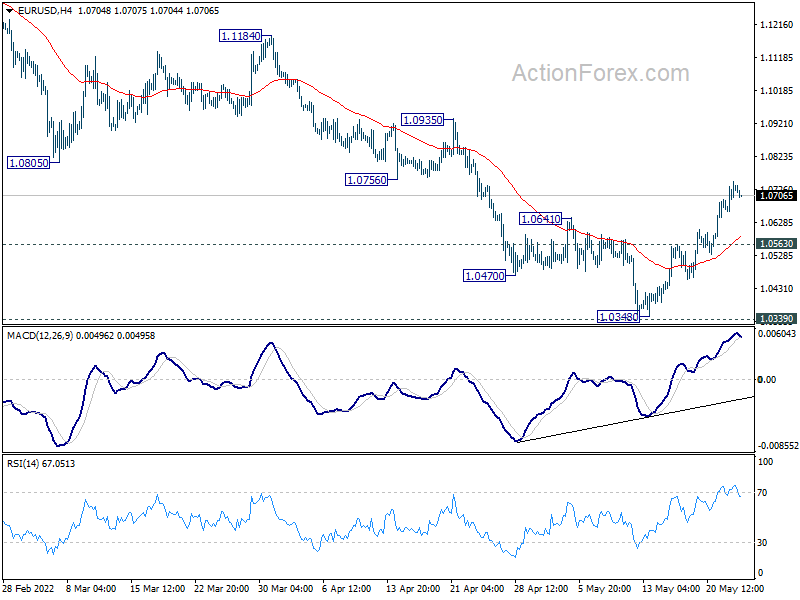
EUR/USD Daily Outlook
Daily Pivots: (S1) 1.0682; (P) 1.0715 (R1) 1.0770; More...
Intraday bias in EUR/USD stays mildly on the upside as rebound from 1.0348 extends. Firm break of 55 day EMA (now at 1.0760) will target 1.0935 resistance next. On the downside, however, below 1.0563 minor support will turn intraday bias back to the downside for retesting 1.0348 low instead.
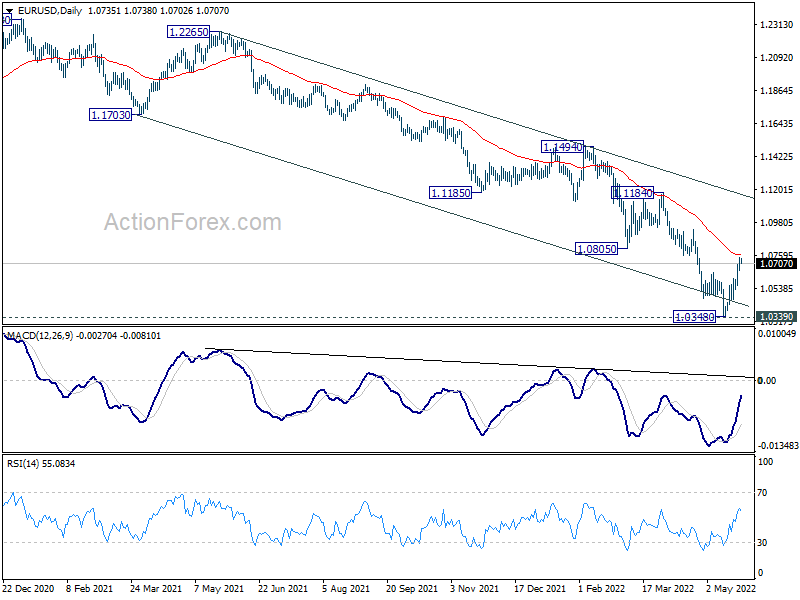
In the bigger picture, focus stays on 1.0339 long term support (2017 low). Decisive break there will resume whole down trend from 1.6039 (2008 high). Next target is 61.8% projection of 1.3993 to 1.0339 from 1.2348 at 1.0090. However, firm break of 1.0805 support turned resistance will delay this bearish case and bring medium term corrective rebound first.
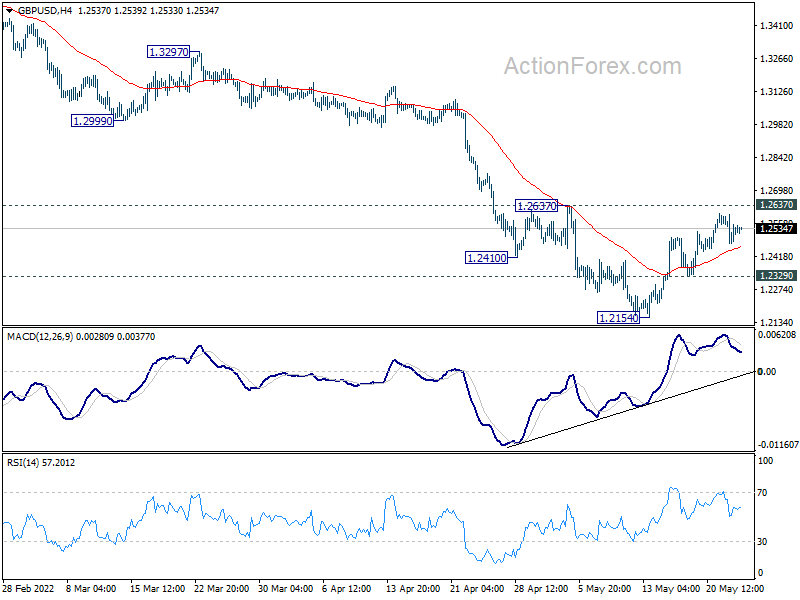
GBP/USD Daily Outlook
Daily Pivots: (S1) 1.2472; (P) 1.2535; (R1) 1.2599; More..
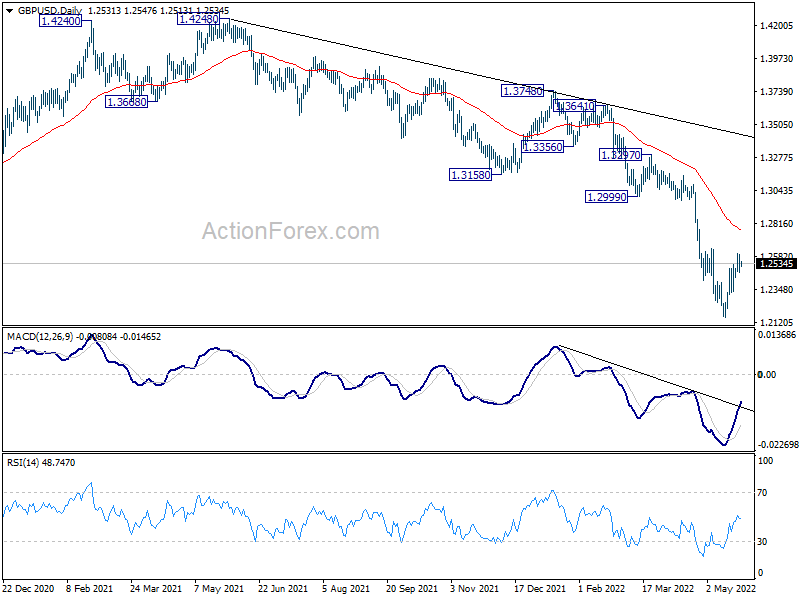
Intraday bias in GBP/USD remains neutral for the moment. On the upside, firm break of 1.2637 resistance will bring stronger rebound to 55 day EMA (now at 1.2765). On the downside, below 1.2329 minor support will retain near term bearishness and bring retest of 1.2154 first. Break there will resume larger down trend from 1.4248.
In the bigger picture, based on current momentum, fall from 1.4248 (2018 high) at least at the same degree as the rise from 1.1409 (2020 low). That is, fall from 1.4248 could be a leg inside the pattern from 1.1409, or resuming the longer term down trend. In either case, deeper decline is expected as long as 1.2999 support turned resistance holds. Next target is 1.1409 low.
USD/JPY Daily Outlook
Daily Pivots: (S1) 126.13; (P) 127.10; (R1) 127.85; More...
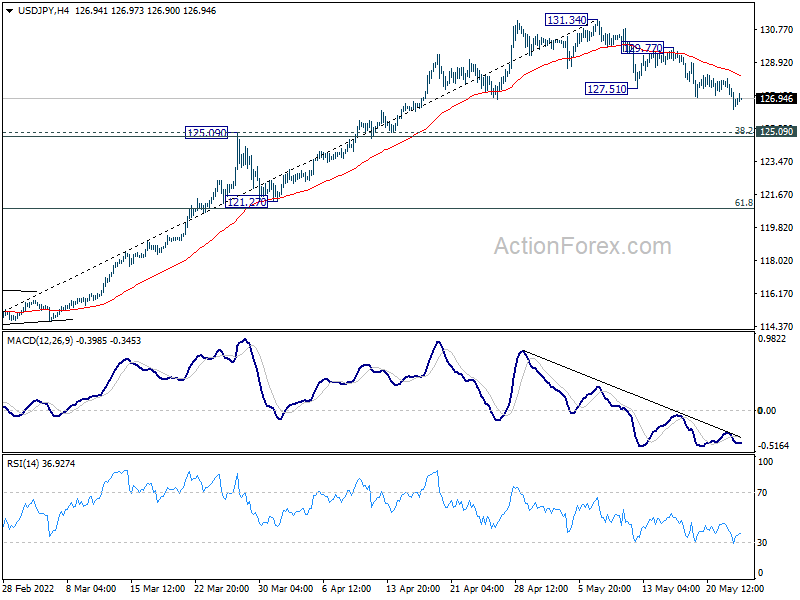
USD/JPY's correction from 131.34 is still in progress and deeper fall could be seen. But downside should be contained by 125.09 cluster support (38.2% retracement of 114.40 to 131.34 at 124.86) to bring rebound. On the upside, break of 129.77 minor resistance will suggest that the correction is finished and bring retest of 131.34.
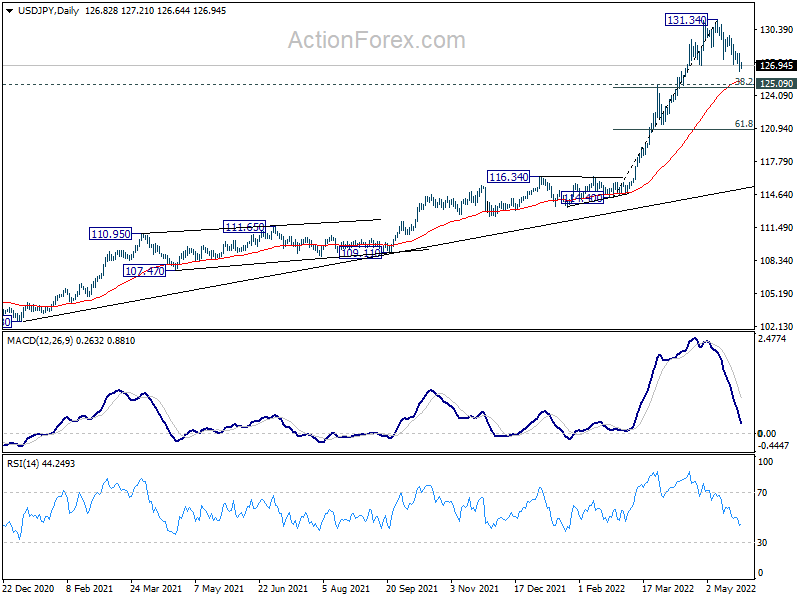
In the bigger picture, current rally is seen as part of the long term up trend form 75.56 (2011 low). Sustained trading above 61.8% projection of 75.56 (2011 low) to 125.85 (2015 high) from 98.97 at 130.04 will pave the way to 100% projection at 149.26, which is close to 147.68 (1998 high). For now, this will remain the favored case as long as 121.27 support holds.
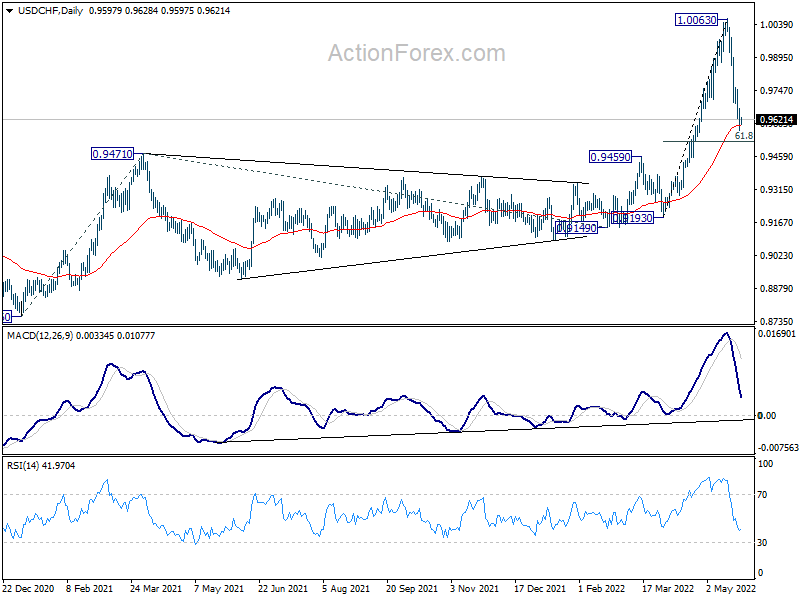
USD/CHF Daily Outlook
Daily Pivots: (S1) 0.9563; (P) 0.9617; (R1) 0.9659; More...
USD/CHF's fall from 1.0063 could still extend lower. But downside should be contained by 61.8% retracement of 0.9193 to 1.0063 at 0.9525 to bring rebound. On the upside, above 0.9763 minor resistance will turn bias back to the upside for recovery. However, sustained break of 0.9525 will bring deeper decline to 0.9459 support.
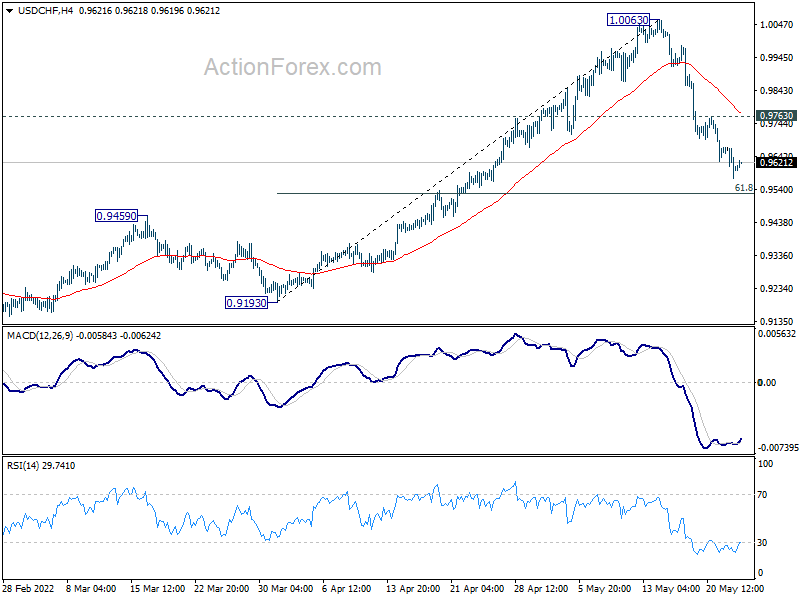
In the bigger picture, down trend from 1.0342 (2016 high) should have completed with three waves down to 0.8756 (2021 low) already. Rise from 0.8756 is likely a medium term up trend of its own. Next target is 161.8% projection of 0.8756 to 0.9471 from 0.9149 at 1.0306, which is close to 1.0342 (2016 high). This will remain the favored case as long as 0.9459 resistance turned support holds.
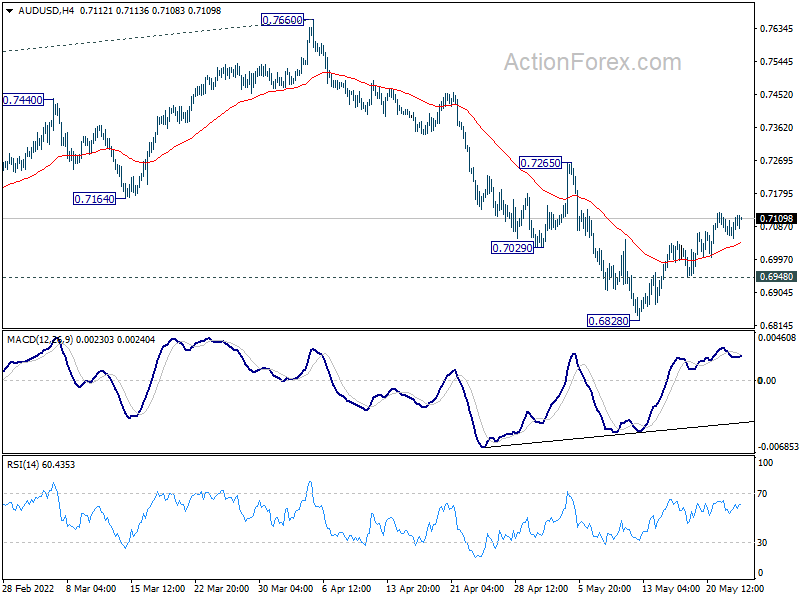
AUD/USD Daily Report
Daily Pivots: (S1) 0.7072; (P) 0.7093; (R1) 0.7128; More...
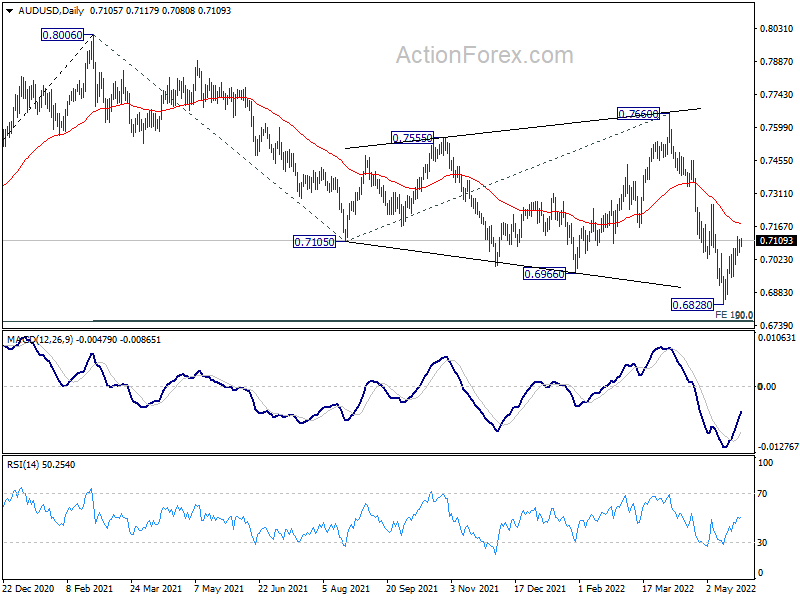
Further rise is expected in AUD/USD with 0.6948 minor support intact. Rebound from 0.6828 short term bottom would target 55 day EMA (now at 0.7179). Break there will target 0.7265 resistance next. On the downside, though, break of 0.6948 will resume larger fall from 0.8006 through 0.6828 low, and target 0.6756/60 medium term fibonacci level next.
In the bigger picture, price actions from 0.8006 are seen as a corrective pattern to rise from 0.5506 (2020 low). Deeper fall could be seen to 50% retracement of 0.5506 to 0.8006 at 0.6756. This coincides with 100% projection of 0.8006 to 0.7105 from 0.7660 at 0.6760. Strong support is expected from 0.6756/60 cluster to contain downside to complete the correction. However, sustained break of 0.6756/60 would argue that AUD/USD is indeed already in a medium term down trend.
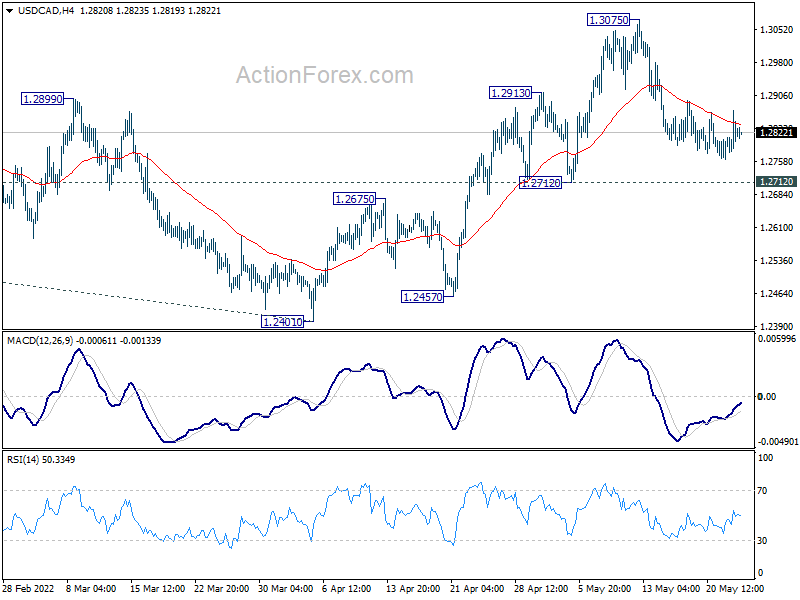
USD/CAD Daily Outlook
Daily Pivots: (S1) 1.2764; (P) 1.2819; (R1) 1.2875; More...
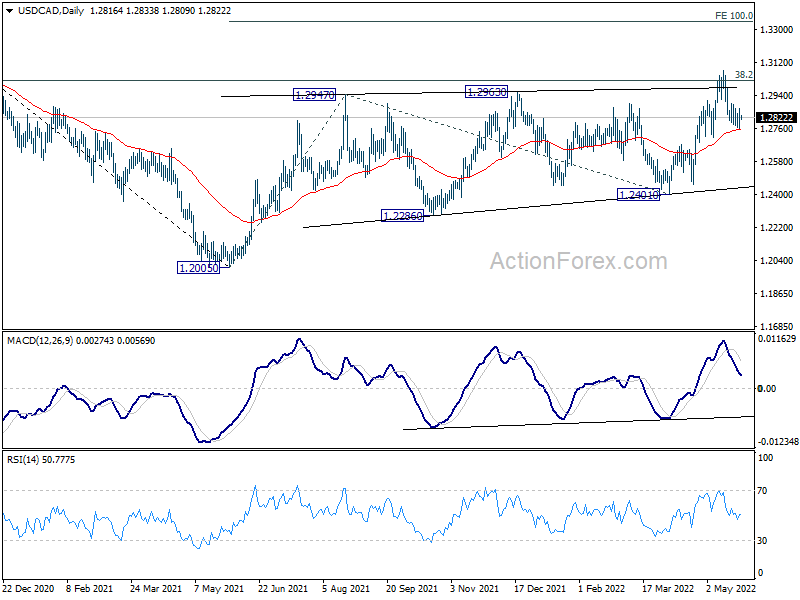
Intraday bias in USD/CAD remains neutral and further rise is mildly in favor with 1.2712 support intact. On the upside, break of 1.3075 will resume the rise from 1.2401. Sustained trading above 1.3022 fibonacci level will carry larger bullish implications. Next target will be 100% projection of 1.2005 to 1.2947 from 1.2401 at 1.3343. On the downside, however, break of 1.2712 support will indicate rejection by 1.3022 key fibonacci resistance, and bring deeper decline back to 1.2401 support.
In the bigger picture, focus stays on 38.2% retracement of 1.4667 (2020 high) to 1.2005 (2021 low) at 1.3022. Sustained break there should confirm that the down trend from 1.4667 has completed after defending 1.2061 long term cluster support. Further rise would then be seen towards 61.8% retracement at 1.3650. However, rejection by 1.3022 will maintain medium term bearishness. Break of 1.2005 will resume the down trend from 1.4667 and that carries larger bearish implications too.
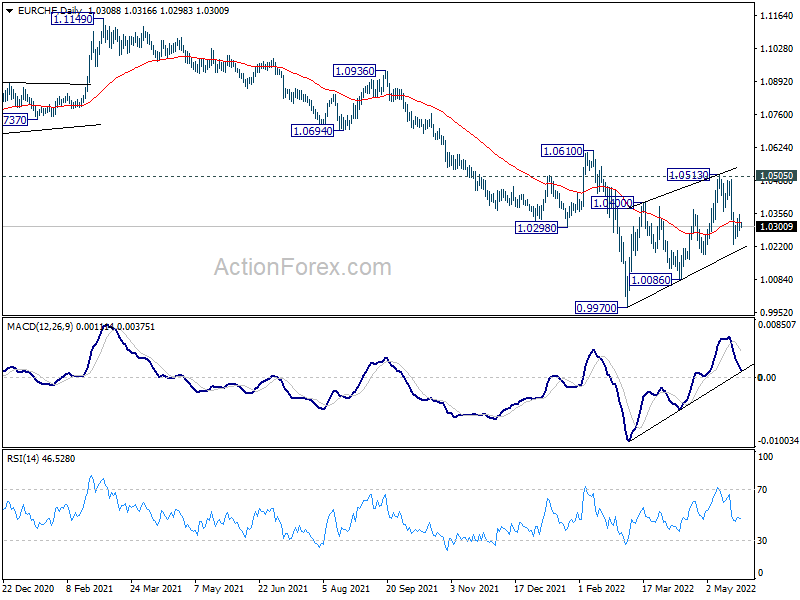
EUR/CHF Daily Outlook
Daily Pivots: (S1) 1.0284; (P) 1.0317; (R1) 1.0348; More....
Intraday bias in EUR/CHF remains neutral and outlook is unchanged. Corrective rebound from 0.9970 should have completed with three waves up to 1.0513, after rejection by 1.0505 key resistance. Below 1.0228 will target 1.0086 support. Firm break there will bring retest of 0.9970 low. However, break of 1.0359 will dampen this bearish view and bring stronger recovery back towards 1.0513 resistance.
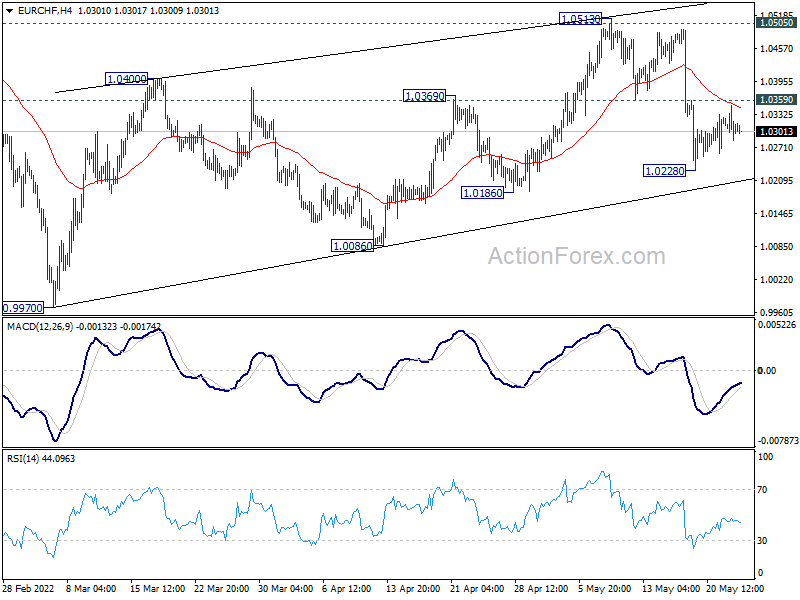
In the bigger picture, as long as 1.0505 support turned resistance (2020 low) holds, long term down trend from 1.2004 (2018 high) is expected to continue. Next target is 100% projection of 1.2004 to 1.0505 to 1.1149 at 0.9650. However, firm break of 1.0505 will suggest medium term bottoming, and bring stronger rebound towards 1.1149 structural resistance.