Sample Category Title
A Volatile Week ahead for Financial Markets?
Stocks in Asia traded cautiously on Tuesday, following a negative close on Wall Street overnight as growth concerns, inflation worries and geopolitical tensions hit risk sentiment. European markets opened lower this morning due to the deepening crisis in Ukraine, with the caution likely to find its way back to US markets this afternoon. In the currency space, the mighty dollar rose to a fresh two-year high during early trade, supported by rising treasury yields and Fed hike bets. Gold slipped after almost kissing $2000 in the previous session, while oil benchmarks steadied after jumping on Monday.
Despite the public holiday in most of Europe yesterday, this is shaping up to be another volatile and eventful week for global markets. The latest comments from the World Bank have added to the cocktail of caution that will most likely influence sentiment over the next few sessions. The bank cut its global growth forecast for 2022 by nearly a full percentage point to 3.2% from its previous estimate of 4.1%, thanks to the war in Ukraine, soaring inflation, and the lingering effects of Covid-19. Later today, the International Monetary Fund (IMF) will release its updated global economic outlook with markets expecting a downgrade for growth this year. Such a development may hit investor confidence, sweetening appetite for safe-haven assets.
On the earnings front, Johnson & Johnson and insurance company, Travelers will report their latest results before the opening bell. Streaming giant Netflix will release its earnings after the market close. Traders will also focus on speeches from financial heavyweights Fed Chair Jerome Powell and ECB President Christine Lagarde later this week.
Dollar flexes muscles across the FX space
The dollar tightened its grip on its throne this morning by rising to a fresh two-year high as investors braced for more aggressive U.S rate hikes. Markets have fully priced in a 50bp rate hike at the Fed’s May meeting, with the odds of another half-point rate hike in June very high. Given how the dollar has appreciated against every single G10 currency this month, bulls are certainly in a position of power to drive prices higher.
When considering how the week ahead will be filled with more speeches from Fed officials, this could fuel upside gains if they all sing a hawkish tune. Indeed, we heard from arch-hawk Bullard overnight who signaled an openness to a 75bp hike. The dollar index (DXY) has the potential to challenge 103.00 if a solid daily close above 101.00 is secured.
Commodity spotlight: Gold
After rallying within a hair’s length of $2000 in the previous session, gold is trading back around $1974 as of writing. With numerous competing themes likely to influence market sentiment this week, gold may find itself pulled and tugged by conflicting forces. Heightened geopolitical risks and global growth concerns could trigger risk aversion, sending investors rushing towards gold’s safe embrace. However, an appreciating dollar, rising Treasury yields, and Fed hike expectations may create multiple obstacles down the road.
Looking at the technical picture, gold has the potential to trend higher, but prices seem to be forming another range. Support can be found at around $1960 and resistance at $2000. A move back below $1960 could trigger a selloff towards $1920. Alternatively, a solid breakout above $2000 may open the doors towards $2009, $2015, and $2050, respectively.
EURJPY Bulls Get Back on Track; Next Goal 138.90
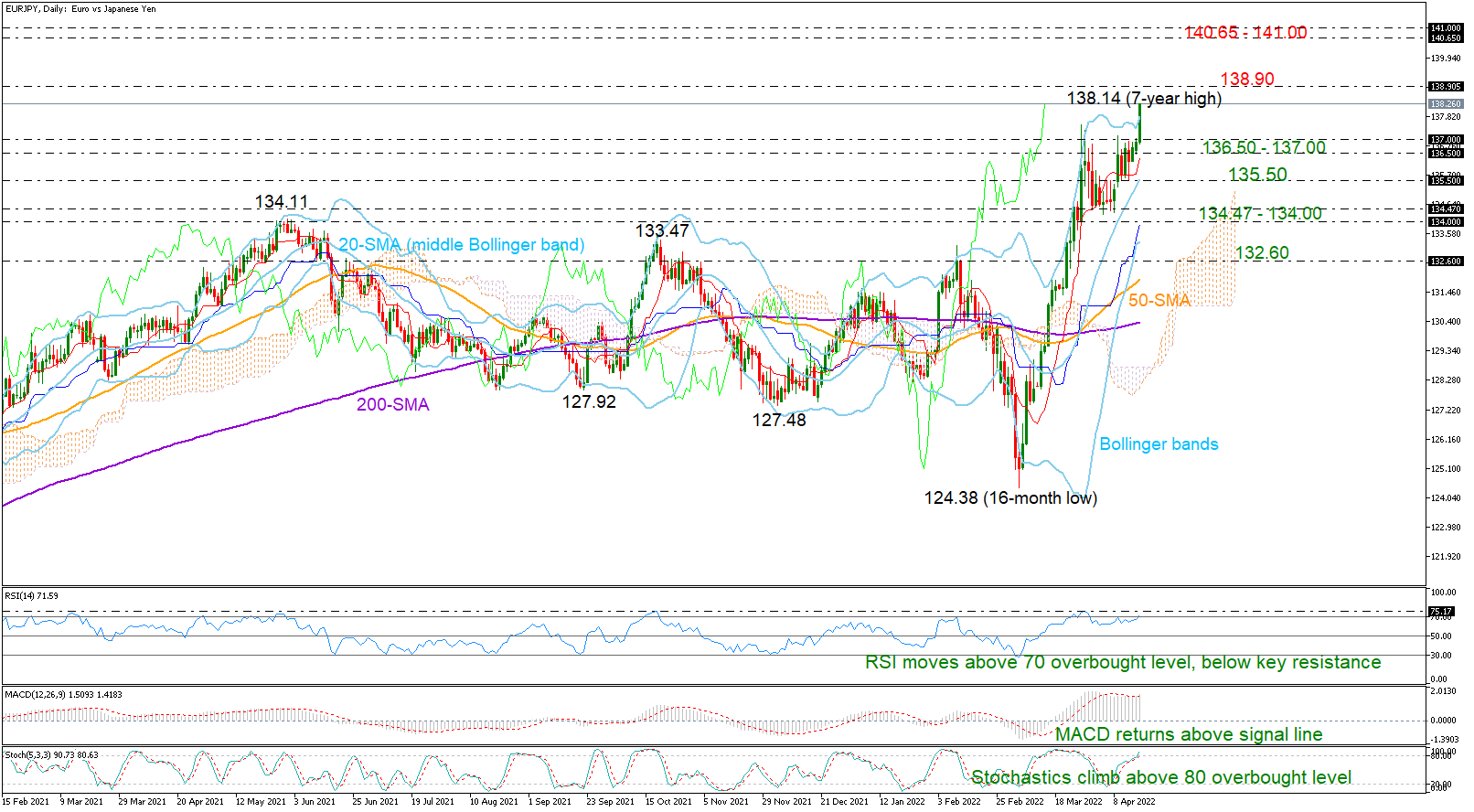
EURJPY violently cracked the 136.50 – 137.00 boundary after more than two weeks of consolidation to advance to a new seven-year high of 138.14 on Tuesday.
The door has now opened for the 138.90 resistance from August 2015, with the momentum indicators favoring additional bullish actions, though with some conservatism. Specifically, the MACD is trying to resume its positive direction above its red signal line, but the rising RSI and the fast Stochastics are entering the overbought region, warning that any further improvement could be constrained. Note that the price is currently looking for a close above the upper Bollinger band, making a slowdown likely in the coming sessions as well.
In the event the rally successfully overcomes the limits around 138.90, the next obstacle could pop up within the 140.65 – 141.00 zone from June 2015. Higher, the pair may push for a close above the 142.00 round-level with scope to reach the 143.30 barrier.
Otherwise, if the price erases its latest pickup, sinking back below 136.50, it may initially seek shelter near the 20-day simple moving average (middle Bollinger band) at 135.50 before heading for the 134.47 – 134.00 support area. A decisive step below the latter would downgrade the positive outlook to neutral, bringing the 132.60 on the radar.
In brief, EURJPY is expected to haunt fresh gains in the coming sessions, though whether the bulls will successfully knock down the wall at 138.90 remains to be seen.
Daily Technical Analysis
EUR/USD
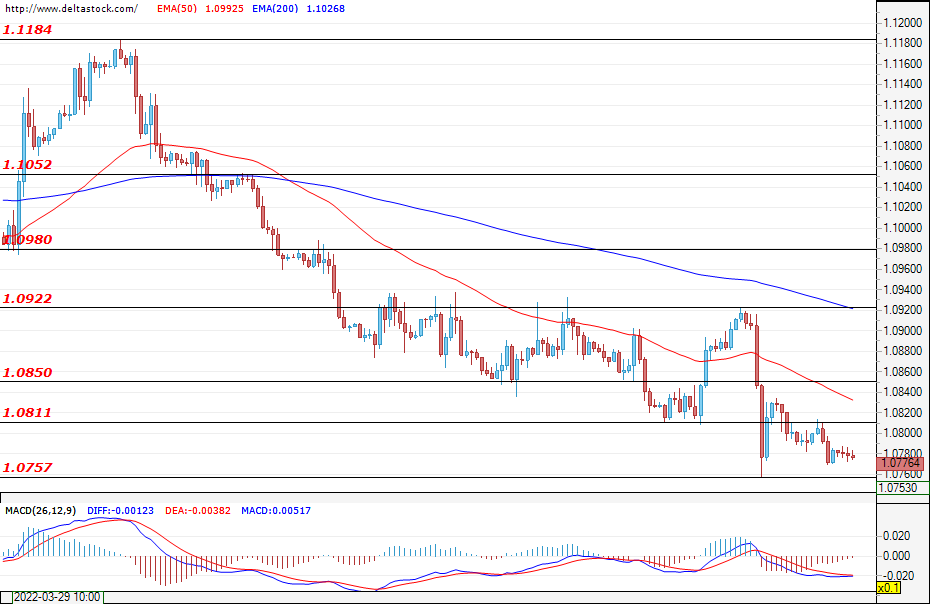
The euro started the week with a loss at low trading volumes. The breach of the 1.0810 zone is currently limiting the buyers, and it is possible that with the opening of the European markets after the holidays, the zone could be tested again. Expectations remain negative, with the daily support for the pair being 1.0757. A potential breach of this level would create the likelihood of the price declining towards 1.0640. A full recovery from the losses at the moment seems unlikely and forecasts are for an acceleration of the downtrend. Given the upcoming holidays, the bulls could attempt to fill in the imbalances after the drop from 1.0922, but all their attempts are expected to be limited to the zone of 1.0840 – 1.0850.
USD/JPY
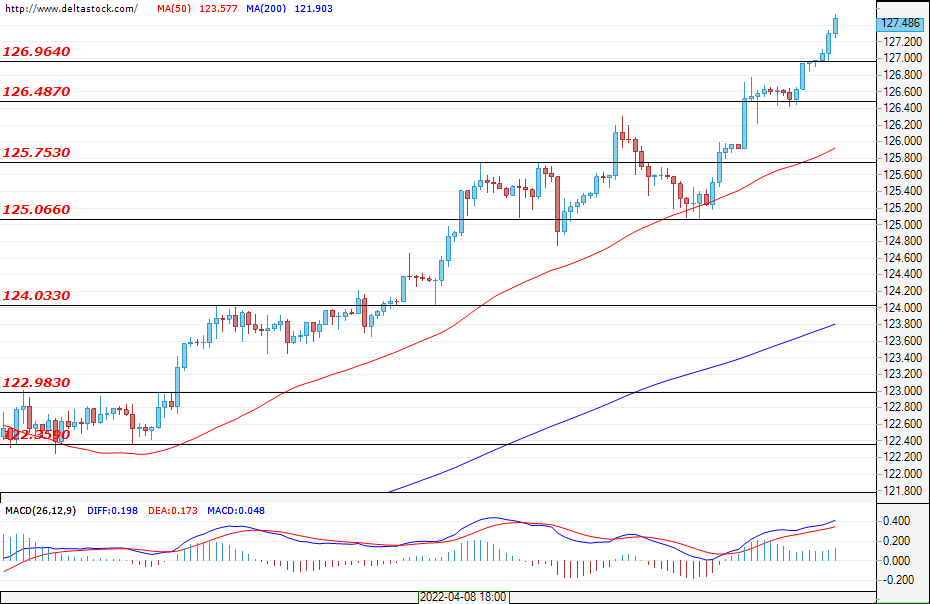
The uptrend continues in full force and it is about to become parabolic. The opinion that the move is caused by the highest time frames and by significant changes in the macro environment has been confirmed and 149.80 can be determined as a potential target of the impulse. The last significant resistance at 125.75 failed to hold the bulls for long, and this week prices quickly moved away from the zone. The first support zone for the bulls is 126.96, followed by 126.48. In the early hours of today, the rally continues and minor pullbacks can be expected, however the growth is expected to continue in the next sessions as well.
GBP/USD
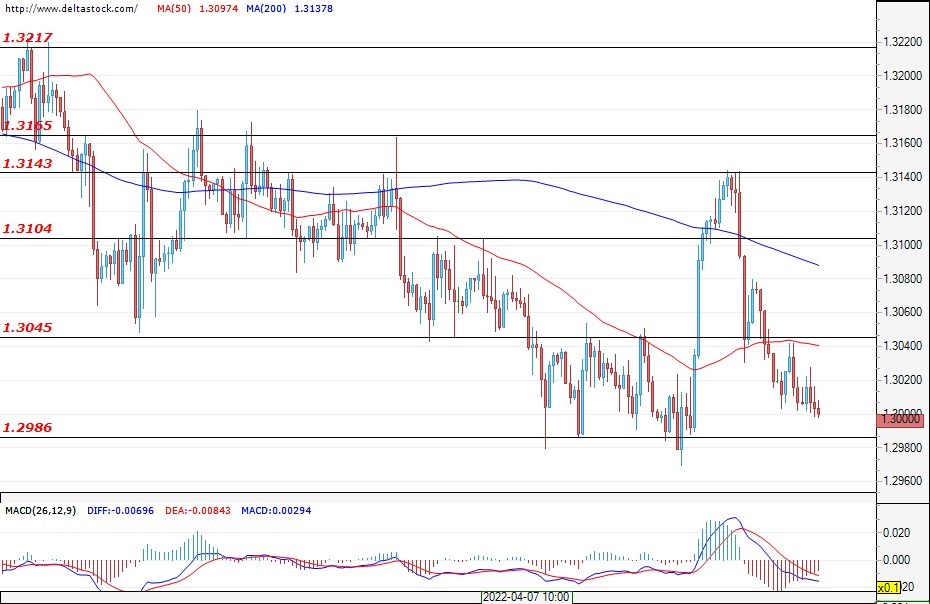
The Cable is also experiencing serious difficulties against the U.S. dollar, and in the early hours of today, prices turned lower to test the support at 1.2986. A breach of the zone would provoke a decline towards 1.2850 and 1.2660. It is expected that the downward movement will gain momentum and that any possible bullish corrections would remain limited by the resistance at 1.3045.
EUGERMANY40
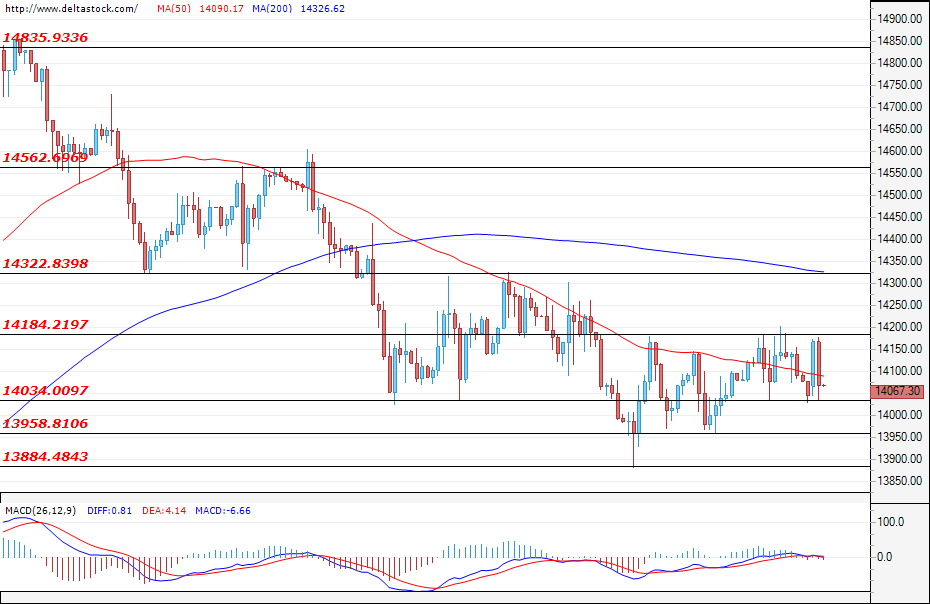
The German index continues to trade without a clear direction and so far prices have remained above the support at 13960. The first significant resistance can be noted at around 14180, followed by 14320. The war in Ukraine continues to weigh on the European stock markets and investors seem to be waiting for the quarterly earnings releases before making any more serious moves. The sentiment is mixed and a confirmed breach of the consolidation would be a telling sign of the future market developments.
US30
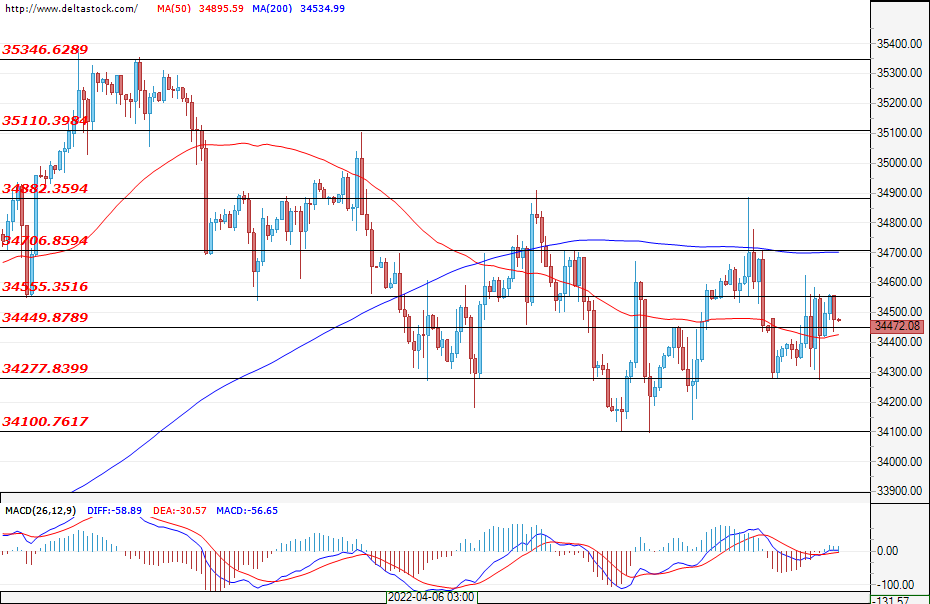
The US30 narrowed the losses and the lack of new lows showed the first signs of a reversal. The first support for the bulls is the area at 34280, while at around 34450 we can see the accumulation of positions. With the kick-off of the corporate earnings season, an increase in activity is expected, while a more tightened monetary policy by the Fed does not necessarily mean that we should expect a negative market performance. A breach of 34555 would open the possibility for a test of the larger structure at 34882, and if it is overtaken, then a new test of 35346 could also be expected.
Yield Dynamics Put EUR/USD Weakness into Perspective
Markets
The ECB on Thursday last week disappointed euro bulls as they went into a four-day weekend. They hoped for something more than an almost unchanged assessment, especially after inflation in March again surprised to the upside. Between the lines we still read that a July rate lift-off is certainly possible, but the euro required a clearer signal. EUR/USD fell from an intraday high of 1.0923 to below 1.08 but managed to close above still (1.0828). That was just postponing the inevitable though. The pair in the days thereafter, admittedly in low-volume trading, eased further.
As of this morning, EUR/USD is trading in the 1.077 area; a support zone marked by the February-May 2020 correction lows. In case of a break we’re eying a return to the pandemic low of 1.0636. This looks increasingly likely, especially with Fed governors now starting to talk about 75 bps rate hikes. The governor in case, Bullard, said it was not his base case today but remember how 50 bps moves was no-one’s either, until recently.
Moves in EUR/GBP were similar yet less dramatic from a technical point of view. The duo forfeited 0.83 but steered clear from the 2022 low. It even staged a minor rebound after hitting support at the lower bound from the downward sloping trend channel into the high 0.82 zone currently.
Interest rate markets behaved interestingly. The European front-end eased a few bps in the wake of the ECB leaving markets still a bit in the dark with respect to the timing of a first hike. The German 2y yield neared 0% but a return into negative territory was never really an option (0.05%). Europe’s 2y swap finished at 0.70%, down 3 bps. The long end, however, underperformed heavily. The steepening (8 bps rise in the German 10y yield or 9-10 bps in swaps) came as inflation expectations remain on the rise. Markets judge the ECB as being too slow to react. Depending in the gauge, indicators melt up to cycle/multi-year highs or even series highs.
Reports (from the NYT) that the EU is moving towards adopting a phased-in ban on Russian oil obviously add to such moves. In just five days, Brent jumped from $100 to $113/b currently.
Yield dynamics also put EUR/USD weakness into perspective since inflation expectations in the US have plateaued. Real yields are the driving force there. The 2-y yield stabilized near but below 2.50%. The 10y yield however just yesterday hit a new cycle high of 2.85% and the 30y is within 6 bps of the 3% landmark.
It is also what is crushing the Japanese yen: USD/JPY soars past 128 this morning to a 20-year high. We see few reasons for the current yield trends to dramatically reverse course for the time being. As such, there’s no stopping king dollar either.
News Headlines
In the Minutes of the April policy meeting, the Reserve Bank of Australia indicated that time is coming closer for conditions to be fulfilled to raise its policy rate. The RBA sees core inflation rising above the 2%-3% inflation target band in the Q1 and further upward pressure is likely. The RBA also sees wage growth picking up, however this develops still at a pace that is likely below rates that are consistent with inflation being sustainably at target. The Bank will closely monitor important additional evidence on both inflation and the evolution of labour costs. Markets are discounting a rate hike first rate hike for the June 7 policy meeting. The Australian 2-y yield rose 7.8 bps to 2.11% this morning. The Aussie dollar rebounded slightly after recent correction to trade near 0.7370. Economic data for the first quarter published in China yesterday painted a mixed picture. GDP growth unexpectedly rose from 4.0% Y/Y to 4.8% Y/Y YTD. Industrial production eased to 6.5% YTD Y/Y, retail sales growth slowed from 6.7% YTD Y/Y tot 3.3%. The March figure even declined to -3.5% Y/Y. The surveyed jobless rate also unexpectedly jumped from 5.5% to 5.8%. The property sector faces ongoing headwinds (residential property sales YTD declining to -25.6%). In a statement, the PBOC announced a series of 23 selective measures to support the economy. Amongst others, the package includes relending programs making funds available for banks to continue to finance sectors that are hit by lockdowns/the consequences of the pandemic. The Bank also advocates banks to continue to support financing to local governments’ projects and other major investment projects. For now, the bank didn’t signal any RRR cut or broader rate reduction.
AUD/JPY resumes up trend, NZD/JPY to follow?
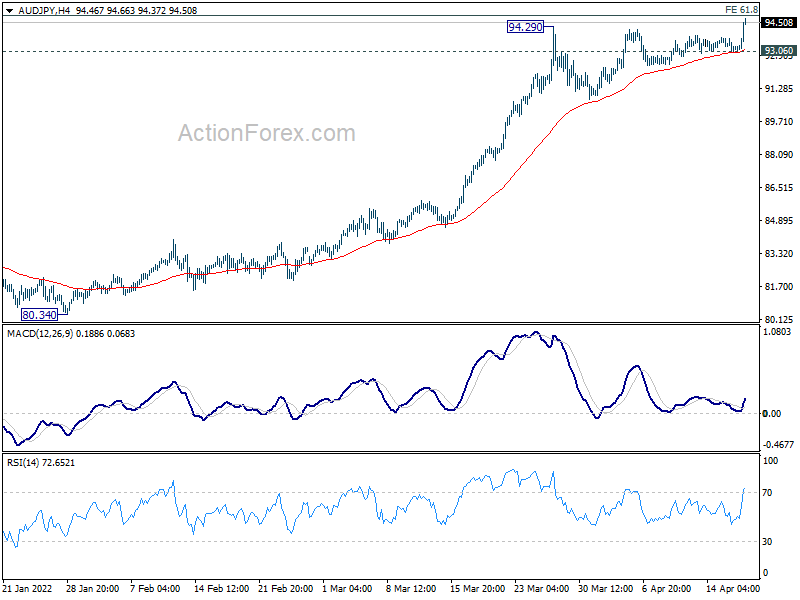
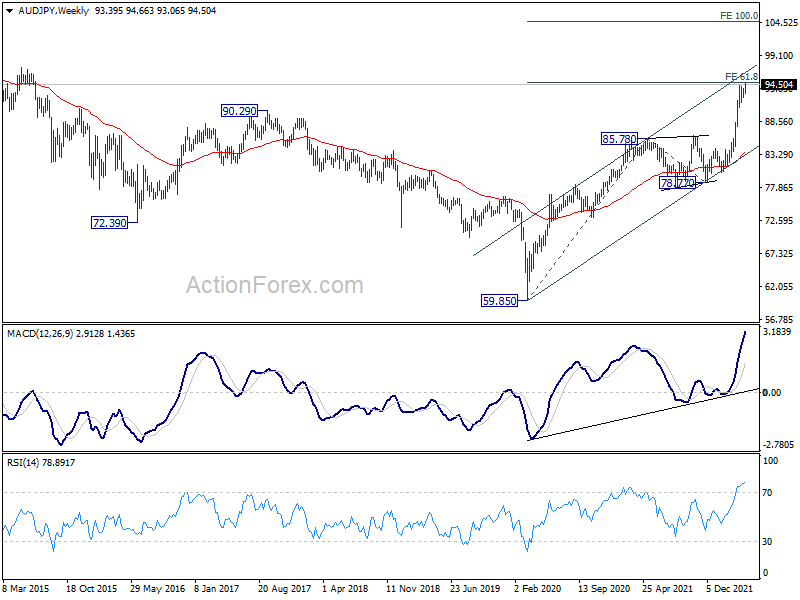
AUD/JPY's up trend finally resumes today by breaking 94.29 near term resistance. Immediate focus is now on 61.8% projection of 59.85 (2020 low) to 85.78 from 78.77 at 94.79. Sustained break there could prompt upside acceleration, for next medium term target at 100% projection at 104.70, which is close to 105.42 (2013 high). However, break of 93.06 support will suggest rejection by 94.79 and bring deeper correction, back towards 55 day EMA (now at 88.55).
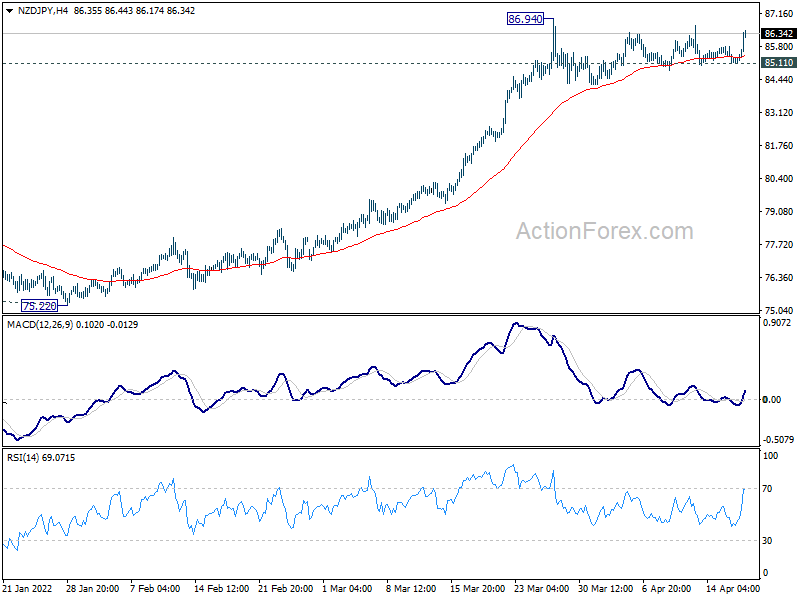
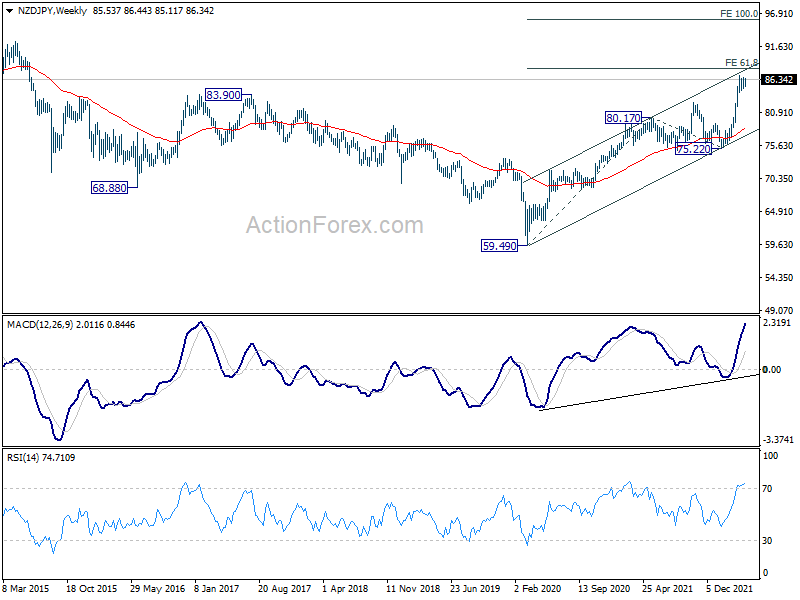
NZD/JPY is lagging behind and it's still staying below 86.94 resistance. The next move will probably need from help from AUD/JPY. Break of 86.94 in NZD/JPY (following break of 94.79 in AUD/JPY) will resume larger up trend through 61.8% projection of 59.49 to 80.17 from 75.22 at 88.00. However, break of 85.11 (following AUD/JPY's break of 93.06) will bring deeper pull back towards 55 day EMA (now at 82.09).
Buyers Claw at Bitcoin
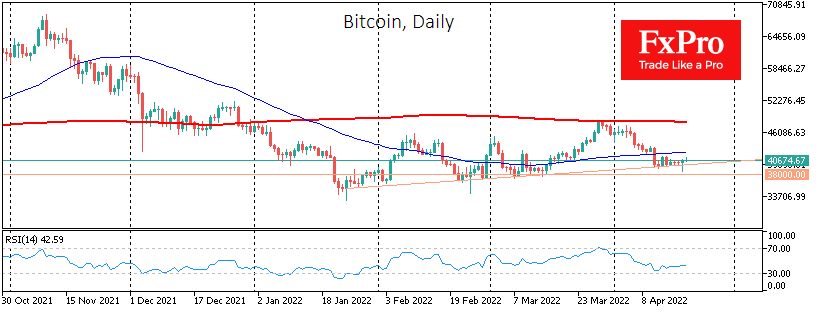
Bitcoin returned to growth territory with a powerful surge at Monday’s close, above the all-important $40K key level. A desperate attempt to hold on to the uptrend line from January resulted in a temporary success.
Over the past 24 hours, we have seen a 5% jump to $40.8K. Ethereum adds 4.5% in 24 hours, trading above $3040. Other leading altcoins from the top ten are adding between 3.5% (Dogecoin) and 18% (Terra). Total crypto market capitalisation, according to CoinMarketCap, rose 4.6% overnight to $1.89 trillion. Bitcoin’s dominance index added 0.3 p.p. to 41.0%.
The cryptocurrency Fear and Greed Index declined Tuesday, adding 3 points to 27 and moving into “fear” territory.
Yesterday, the formal trigger for bitcoin buying was reverting US stock indices in the New York trading session to the upside. However, what is striking is that cryptocurrencies were many times more optimistic about this change in trend, suggesting demand has been waiting to surge into the market.
Also noteworthy is the increased amplitude of growth in the hottest cryptocurrencies (Solana, Terra, Avalanche), gaining more than bitcoin. The buying wave has not yet spread to the entire market, evidenced by bitcoin’s rising share.
As the market as a whole, Cryptocurrencies are a system of communicating vessels on several levels. Bitcoin fills the demand first, followed by the first round of popular coins, followed by a wave of buying of smaller projects. The further away from the centre, the lower the liquidity, but the higher the sensitivity to sentiment. NTFs in this scheme are illiquid, where demand has not yet reached.
The NFT market is about to burst because of rising interest rates, believes Nassim Taleb, American economist and author of Black Swan. Previously, he has been critical of bitcoin, calling it “entertainment for losers”.
According to Blockchain.com, fees on the bitcoin network have fallen to their lowest since June 2020. The average transaction processing fee now costs a user just over $1. The number of Lightning Network users has grown 800 times in a year, to 80 million, Arcane Research estimated. Lightning is designed to solve the problem of reducing high transaction fees.
PBoC Steps in as Chinese Economy Slows
Market movers today
Today, the IMF releases its latest take on the global economy also known as the World Economic Outlook. We are looking forward to reading the IMF's assessment of the impact of the Russian invasion, Western sanctions and rising commodity prices on the global economy and inflation.
Besides that the calendar is relatively thin this week. On Friday, preliminary PMIs for April are due out. We are also still monitoring the Russian invasion of Ukraine. Also keep an eye on Fed speeches ahead of the next meeting in early May.
The 60 second overview
China: We had several key figures out of China on Monday. Q1 GDP growth surprised on the upside with 4.8% yoy but both retail sales and unemployment figures indicate slowing in March as COVID curbs hit activity. Retail sales declined 3.5% yoy and the unemployment rate rose to 5.8%, both significantly worse than expected. On top of that the housing market keeps slowing as annual house price increases declined to 1.5% from 2% in February. The Peoples Bank of China is stepping in to cushion the slowdown and announced a cut in the reserve requirement ratio on Friday among other things. Asian stock markets reacted to the Chinese numbers with a decline this morning.
Yen: In Japan, FM Suzuki repeated Bank of Japan (BoJ) governor Kuroda's worry about sharp yen moves this morning as a perfect storm of increasing global yields and high energy prices is weighing heavily on the yen. USD/JPY hit a 20-year low this morning. Stepping in to support the yen is at odds with the BoJ's easy monetary policy and we expect it will take a further yen slide for Tokyo to step in.
Russia: The Bank of Russia looks set to continue to cut its key interest rate following the cut to 17% on 8 April, despite accelerating inflation. Central Bank Governor Elvira Nabiullina hinted at this on Monday as she aims "to increase the availability of credit for the economy".
ECB: On Thursday, the ECB was in no rush to tighten.
Equities: US equities were directionless on Monday and the sector performance quite even, but with a slight preference for growth cyclicals. Reflation winners, as materials and energy, continued to outperform. S&P500 unchanged (-0.5% for the week), Dow -0.1%, Nasdaq -0.1% and Russell 2000 -0.7%. Similar setting last week, with value cyclicals and energy outperforming while expensive defensives stocks (for instance, health care) have underperformed.
FI: Thursday's ECB meeting ended with a significant bullish steepening of the EUR curve amid mild spread widening despite Lagarde signalling that no new bond buying is around the corner.
FX: EUR/USD moved sharply lower after the ECB meeting and is now trading below 1.08. EUR/GBP declined below 0.83. Oil has risen from USD104/barrel to now USD113/barrel.
Credit: The cautious sentiment in credit markets continued with Itraxx main closing the recent session unchanged at 78.8bp, while Xover tightened 3.3bp, closing the session at 374.8bp.
Are US Earnings Resilient to Inflation, War and COVID-19?
Week started quietly on Monday, as many European markets were closed for the Easter holiday. Trading volumes were slim, and the US indices swung between slim gains and losses following a bearish session on Friday which sent the S&P500 1.20% down and Nasdaq more than 2% lower, to a fresh one-month low.
Inflation worries, the hawkish Federal Reserve (Fed) expectations, the intensifying war in Eastern Ukraine and rising energy prices weigh on appetite, while better-than-expected earnings from big US banks, including the Bank of America, Morgan Stanley and Citigroup, hint that the US earnings season could be a positive surprise and confirm that the US economy is resilient to higher inflation, higher energy prices, war disruptions and the Chinese lockdown.
Earnings from big US technology companies should help determining the short-term direction in US equities. Johnson & Johnson, IBM and Netflix will go to the earnings confessional today. Procter & Gamble, Tesla and United Airlines are due to report earnings on Wednesday, Snap, Dow, American Airlines and Philip Morris International on Thursday and American Express on Friday.
Gold up, Bitcoin down
Risk appetite remains slim, and the rising geopolitical tensions increase appetite in safe haven assets. Gold rallied to the $2000 per ounce on Monday, despite the positive pressure on US yields – which increase the opportunity cost of holding the non-interest-bearing gold. The worsening tensions in Ukraine could enhance capital inflows toward the yellow metal in the short run and help the bulls clear the $2000 offers.
Bitcoin, on the other hand, remains under a decent selling pressure and trades near the $40K mark as the cryptocurrency moves parallel to risk assets, and more precisely to technology stocks right now. Appetite in cryptocurrencies is limited due to the rising inflation that boosts the expectations of a tighter Fed policy and a possible recession.
Oil rises on Ukraine tensions, Libyan unrest
Crude oil flirted with the $100pb mark on Monday on rising tensions in Eastern Ukraine, and unrest in Libya.
Libya closed its biggest oil field – which can pump up to 300’000 per day, due to protests and warned of further disruption. A nearby facility which could pump 65’000 barrels per day was closed for the same reason. Overall, the Libyan oil production fell by more than half a million barrels per day, and the National Oil Corporation declared force majeur and suspended exports.
The Libyan unrest intensifies the energy crisis, as the European lawmakers warn that paying the Russian oil and gas in rubles would violate the sanctions and could force the European countries to stop buying energy from Russia.
As such, risks in crude oil remain tilted to the upside although growth in drilling permits for new wells in the US Permian basin, which is the most prolific US oilfield, could signal a future production surge by allowing a horizontal drilling. But that production may not hit the market before 2023.
GER 40 Seeks Support
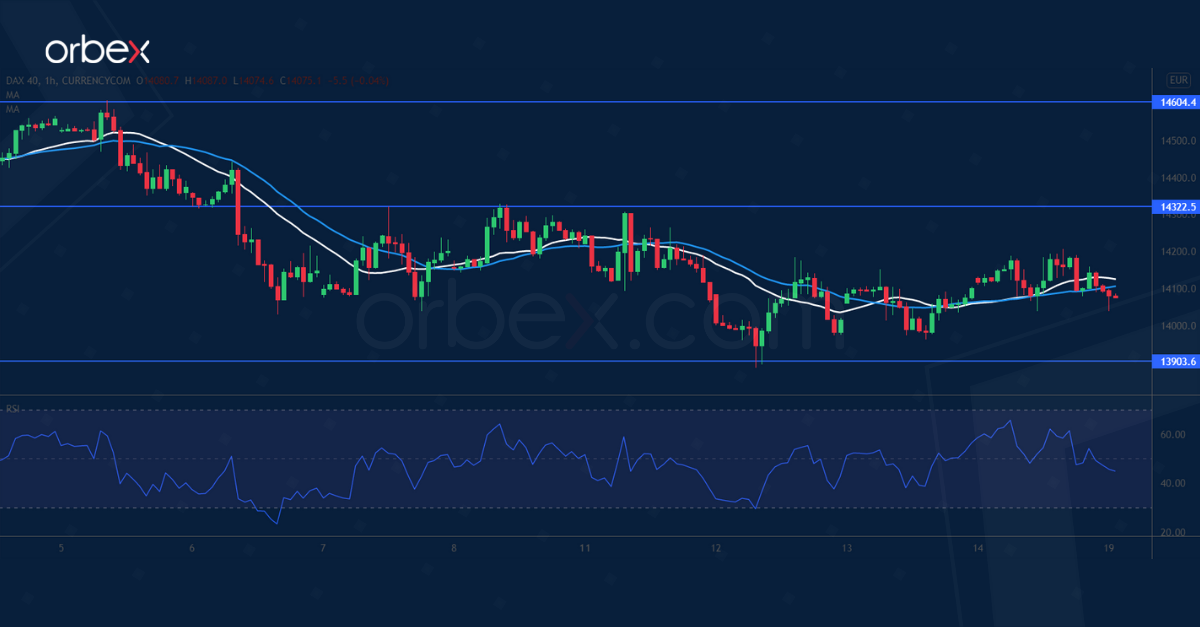
The Dax 40 retreats as risk appetite remains subdued across equity markets. The index is still under pressure after it struggled to hold above the psychological level of 14000.
The current pennant may turn out to be another distribution phase. Additionally, a break below 13900 would make the index vulnerable to a new round of sell-off.
13600 would be the next support. The bulls need to push above 14320 in order to turn the cautious mood around. Then 14600 will be the final hurdle before an extended recovery could materialize.
AUD/USD Breaks Support
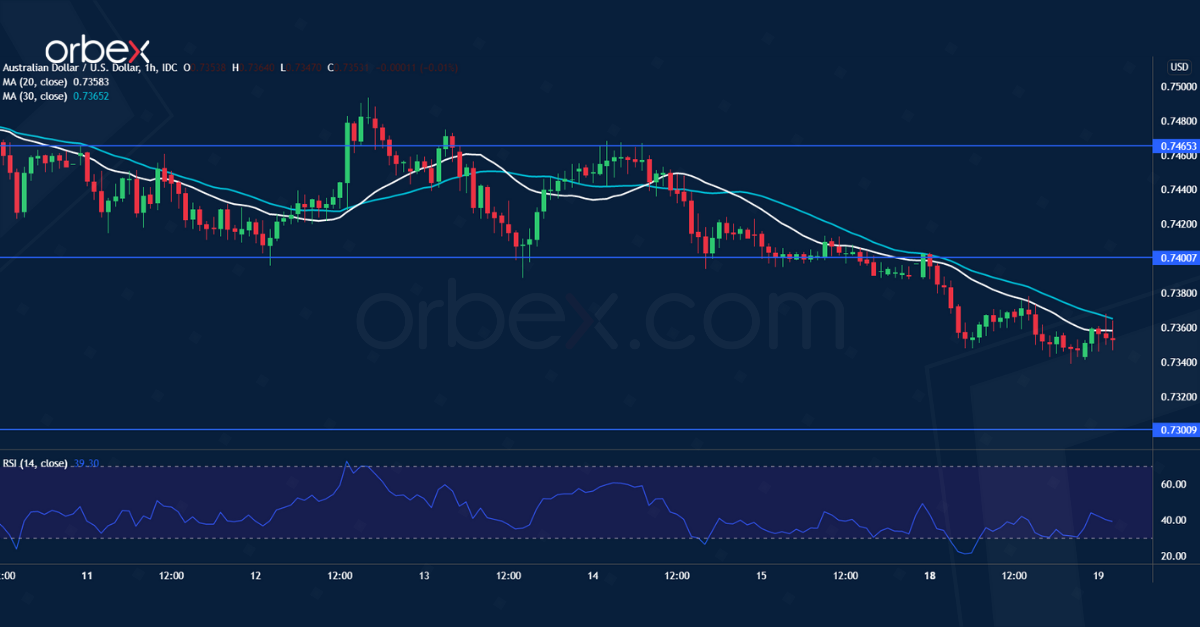
The Australian dollar remains under pressure after dovish RBA minutes. A fall below the demand zone between 0.7380 and 0.7400, which sits on the 30-day moving average, has put the bulls further on the defensive.
As the short-term prospect turns bearish, depressed offers compound the lack of bids, driving the Aussie even lower. 0.7300 would be the next target.
As the RSI recovers into the neutral area, the pair may face stiff selling pressure around the support-turned-resistance at 0.7400.