Sample Category Title
XAU/USD Outlook: Bulls Taking a Breather But Gold Remains Supported By Risk Aversion
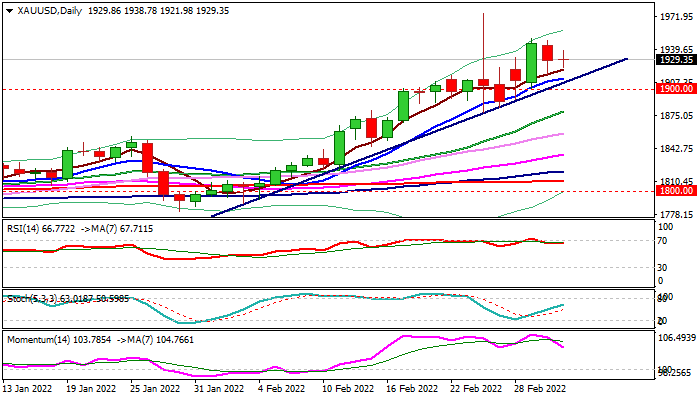
Spot gold is trading within a narrow range on Thursday, with the action being so far shaped in a Doji candle, signaling near-term indecision.
The metal remains supported by the uncertainty over the war in Ukraine, while less hawkish than expected Fed’s stance implies the central bank would be less aggressive in its policy meeting later this month that adds to positive signals for gold.
Also, surging inflation so far shows no signs of easing that would provide additional boost the price of the yellow metal, usually used as a hedge against inflation.
Bulls face obstacles at $1950 (Mar 1 high) and $1974 (Feb 24 spike high) ahead of $2000 level.
Rising 10DMA tracks the action since Feb 7 and marks solid support at $1911, expected to keep the downside protected and guard psychological $1900 level (also Fibo 38.2% of $1780/$1974 upleg), loss of which would ease the upside pressure and expose lower pivot at $1877 (Feb 24 trough / 20DMA / 50% retracement).
Res: 1950; 1957; 1974; 2000.
Sup: 1920; 1911; 1900; 1882.
Sunset Market Commentary
Markets
Central banks/authorities in Central-Europe walk the talk. The Polish central bank yesterday and two days ago intervened in FX markets to support the ailing zloty. There were no amounts specified. Additionally, the Polish government showed readiness to convert euro proceeds (coming from EU funds) into zloty’s directly via the market instead of via the NBP. This would increase selling pressure in EUR/PLN. Deputy Governor Virag a few days ago said Hungary’s central bank (MNB) was ready to intervene to ensure stability. He referred to rate hikes as being the most important tool to defend the forint. The MNB today made a move by jacking up the weekly deposit rate from 4.60% to 5.35%, close to the current ceiling of the interest rate corridor (5.4%). Unfortunately though, the impact of both the NBP and the MNB on their respective currencies was modest. The forint stabilizes vs the euro at record lows of EUR/HUF 378. EUR/PLN inches higher to surpass 4.76, a new 13-year low for the zloty. The Czech koruna extends a recent losing streak to EUR/CZK 25.66. The central bank (CNB) there also hinted at potential FX interventions. But while it has massive legacy FX reserves, the CNB kept power dry for now.
Other markets are muddling through. European stocks trade with minor losses, WS opens in light green. Brent oil briefly hit $120/b (> +4%) before paring all (and more) gains on rumours/reports that a nuclear deal with Iran would soon be signed. This could pave the way for now-boycotted Iranian oil to flow to the market again. The black gold currently loses 0.3% to $112. Soft commodities including wheat (+6.4%) continue to soar. Core bonds are under pressure with Europe/German Bunds underperforming. The German curve flattens with yield changes ranging from +1.8 bps (30y) to 6.2 bps (2y). The 10y (+3.9 bps) extends its return above 0%. European swap yields advance 3bps + across the curve. The 2y swap yield bounced off -0.10% yesterday – the level seen just before ECB president’s Lagarde verbal pivot. It is extending gains to 0.05% today. The 10y swap yield (0.74%) nears first resistance (0.77%). US bond yields hover sideways. FX markets trade quietly. EUR/USD remains below 1.11 with the euro unable to profit from ECB meeting minutes. There were a lot of inflation concerns which has become more widespread. The main risk was no longer of tightening policy too early but too late. Some already wanted to adjust guidance on phasing out APP in February. With war in the meantime having erupted, the minutes of course lost relevance. Sterling ekes out another minor gain after yesterday’s rally that caused a technical break in EUR/GBP below the previous YtD lows. The pair is currently changing hands at 0.828, extensively testing December 2019 support at 0.8277.
News Headlines
Inflation in Turkey continued to move higher in February from already extreme levels. Headline inflation printed at 4.81% M/M to be 54.44% higher compared to the same month last year (was 48.69% in January). Core inflation also accelerated from 39.45% to 44.05%. In a Y/Y perspective costs of transportation rose 75.75%, followed by furnishes and household equipment (64.83%) and food and beverages (64.47%). The ‘slowest’ annual increase was recorded for communication services (11.89%). February PPI inflation jumped 7.22% M/M to be up an astonishing 105.01% Y/Y suggesting further upward inflationary risks, even as the government took measures to alleviate price rises on some basic goods. The Turkish lira lost modest ground today even as the real policy rate is becoming ever more negative (EUR/TRY 15.75 area).
We’re speaking of a different degree of inflation compared to most other countries, but even Swiss inflation in February also surprised on the upside. Headline inflation rose 0.7% M/M and 2.2% Y/Y, well above expectations and the highest reading since 2008. Price increase for fuel, housing rental and heating were mentioned as driving the rise. Core inflation excluding fresh and seasonal products, energy and fuel also rose a faster than expected 1.3% Y/Y (from 0.8% in January). The Swiss franc today strengthened further below the 1.02 handle (1.0190).
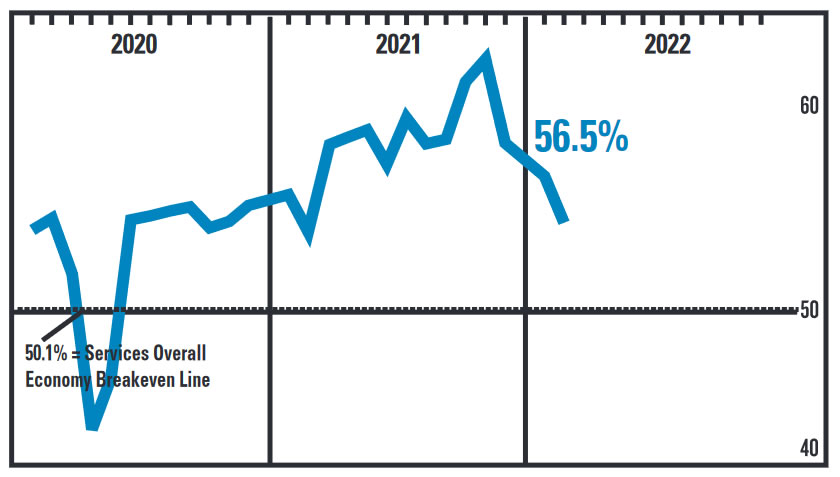
US ISM services dropped to 56.5 in Feb, employment dropped to 48.5
US ISM Services PMI dropped from 59.9 to 56.5 in February, well below expectation of 60.5. Looking at some details, business activity/production dropped -4.8 to 55.1. New orders dropped -5.6 to 48.5. Employment dropped -3.8 to 48.5. Prices rose 0.8 to 83.1.
ISM said: The past relationship between the Services PMI and the overall economy indicates that the Services PMI for February (56.5 percent) corresponds to a 2.3-percent increase in real gross domestic product (GDP) on an annualized basis."
JP 225 index finds support at 26,100 after diving to 15-month low
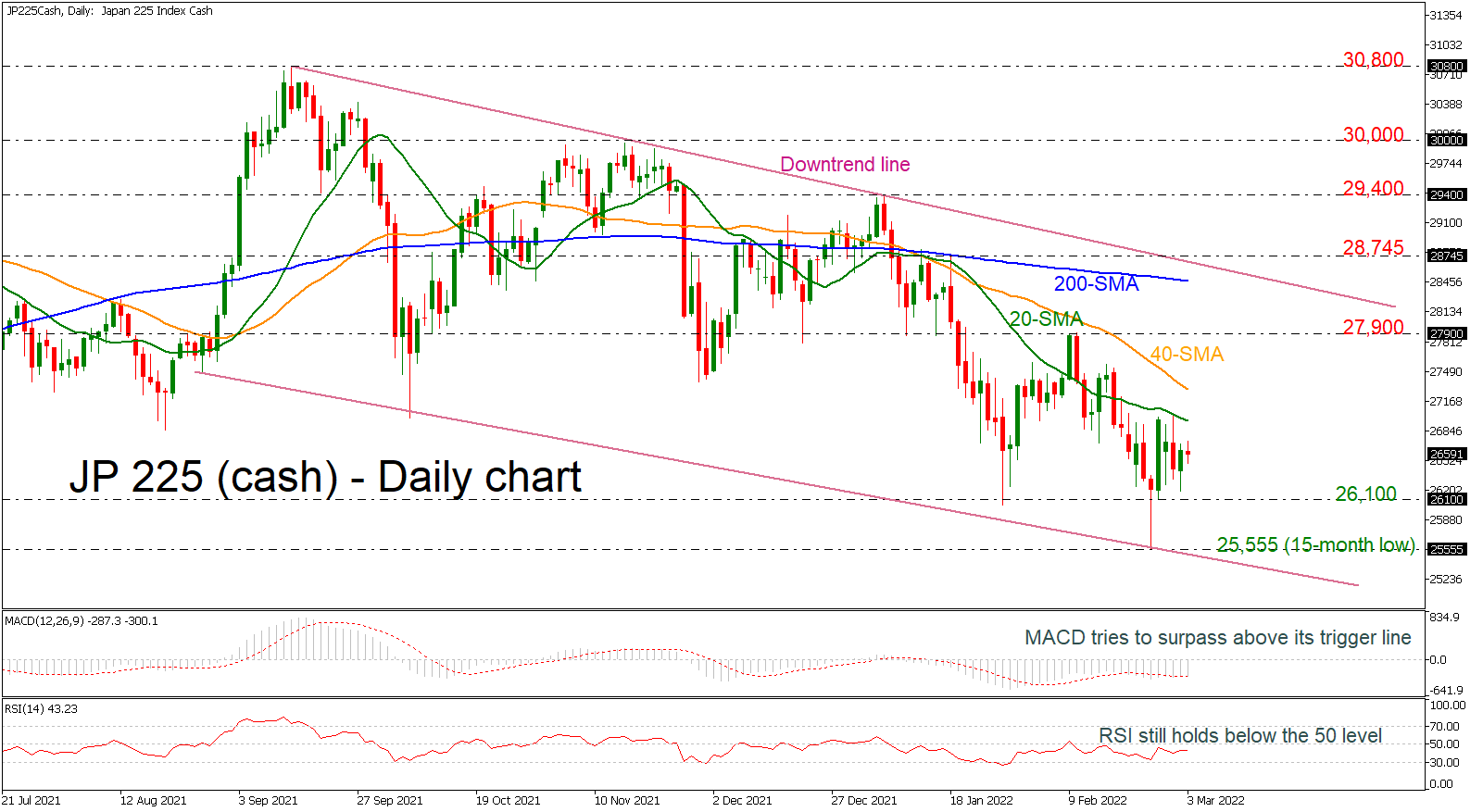
JP 225 index looks to be creating a floor around the 26,100 support as the RSI and the MACD seem to have reached a bottom in bearish territory and are now changing direction to the upside.
Traders, however, would be more eager to engage in buying activities if the price manages to surpass the nearby 20-day simple moving average (SMA) around 26,950. If this is successfully breached, then the rally may next rest near the 40-day SMA at 27,281 and the 27,900 resistance. Moreover, a closure above the 200-day SMA at 28,474 may be needed to push the price towards the valid resistance trendline dewan from the September 2021 peak of 30,800.
On the flip side, the selling pressure could accelerate again if the market deteriorates below the former strong support area of 26,100. Such a move could next bring the 15-month low of 25,555 under the spotlight, which if violated could trigger sharper losses probably towards the 2019 peaks of 24,171.
In the medium-term timeframe, the pair is in a bearish trend since September 2021 and only a rally above the descending trend line would put the market in a sideways path.
Oil Remains in Sharp Focus as Russia and Ukraine Hold Talks…
The focus remains firmly fixated on the situation in Ukraine and nothing else matters, it seems, for the markets. Tensions between Russia and the West continue to wreak havoc across financial markets and the energy sector in particular. From their lows last week to their highs this week, prices of both oil contracts have rallied a huge 30% each. This morning saw Brent crude oil nearly hit the $120 per barrel mark, before retreating a huge $5. Talking of volatility! WTI similarly eased sharply after momentarily trading above the 2011 high of $115.00. Investors are just waiting to see if the ongoing talks between Russia and Ukraine will lead to any ceasefire. Putin and Macron are also apparently talking. The uncertainty is weighing on risk appetite, with European stocks unable to catch any momentum to the upside. US index futures held their own slightly better, trading around the flat line at the time of writing.
But all the attention will be on those talks between delegations from Russia and Ukraine, and oil prices. Unless something changes in the Ukraine conflict, it is difficult to see where the pressure will come from, because the OPEC decided against hiking their output more aggressively. The inelasticity of the demand curve for oil means, prices can rise even further before we see any noticeable drop in demand.
The crude oil market was already tight, even before the invasion of Ukraine by Russia. But now there are concerns that because of the ongoing situation, foreign refiners are going to be very reluctant to buy crude oil from Russia, with some banks also refusing to finance shipments of Russian commodities. In effect, this is the same as an actual drop in Russian exports of crude oil. Moscow must find ways to continue selling its oil, otherwise there is the risk of an even bigger oil-price shock.
The unthinkable would be if fresh measures are introduced that would directly target oil and gas exports from Russia, or if the latter retaliates by turning off supplies of these commodities to its western neighbours in Europe. An energy-dependant Europe will want to avoid this situation, nearly at all costs. But traders are not taking any chances as fighting in Ukraine continues, while international payments to and from Russia become increasingly very difficult with the West’s decision to exclude several Russian banks from the SWIFT global financial messaging system.
So, don’t be surprised if oil prices rebound again after easing some $5 off their earlier highs.
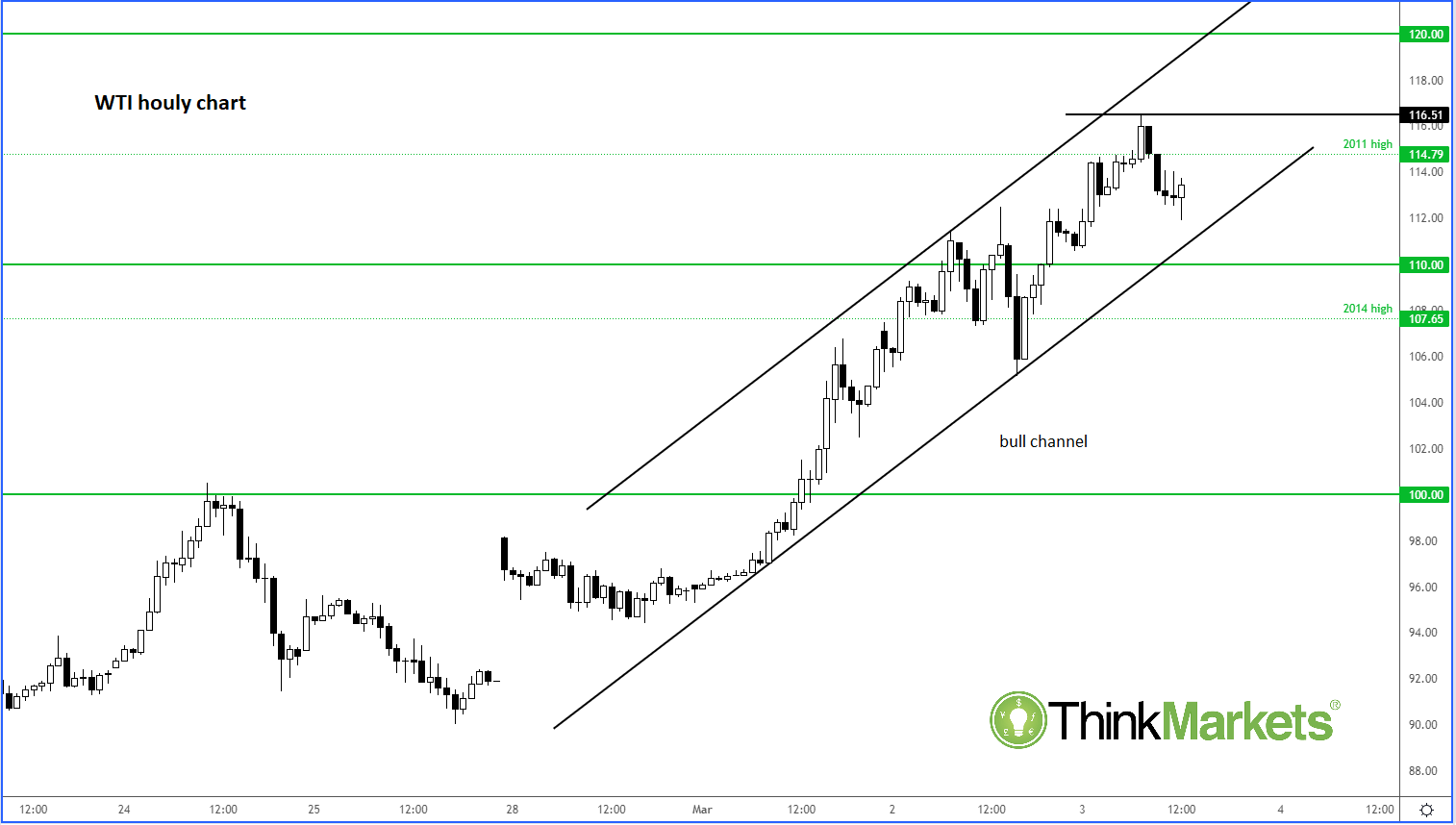
Source: ThinkMarkets and TadingView.com
On the hourly chart of the WTI contract, one can see that despite the big drop, prices remain highly volatile inside the rising channel. As such, it is far too early to suggest we may have seen the top. Prices can easily rebound if the Ukraine talks are unsuccessful in de-escalating the situation.
Dollar and US Futures Head North as Russian Invasion Lingers
Dollar shines but euro slips on geopolitics
The ongoing Russian invasion in Ukraine, alongside the tough Western sanctions and their imminent effects on the global economy continue to be the key drivers for the markets today. Although a new round of negotiations between the two countries is taking place at the moment of writing, there are not any concrete signs of de-escalation so far, thus volatility is expected to remain high. These recent developments in the Ukrainian crisis seem to be increasing risk aversion in markets but positive news from the ongoing meeting could alter investors’ sentiment.
The US dollar is trading higher on the day, capitalizing on the mild risk-off mood in markets despite the weakness observed in US Treasury yields. In addition, the dollar got an extra boost as the weekly jobless claims decreased to 215k against the 225k projection, providing optimistic signals about the upcoming NFP report on Friday and the overall health of the US labor market. On the other hand, the euro is losing ground for a fourth consecutive day as soaring risk aversion and the softer-than-expected February PMI reading for the Eurozone are acting as a headwind for the single currency.
Elsewhere, the Australian dollar is the absolute winner in the forex spectrum, supported by the booming commodity prices and the increasing bets for faster hikes by the RBA.
US futures edge higher despite initial retreat
Wall Street is set to open higher today and extend yesterday’s gains as the major indexes’ futures are trading higher in pre-market trade. Fed Chair Jerome Powell noted yesterday that the central bank is going to ‘proceed carefully’ with its rate hike timeline in order to avoid a market overreaction. This statement improved market sentiment and enabled indices to storm higher, but the persistently high inflation, the elevated energy prices, and the absence of signs that Russia is going to stop its invasion soon continue to pose downside risks for the US stock markets.
Oil rally eases; gold ticks down
Despite rallying early in today’s session, WTI futures have surrendered a huge part of their gains as an imminent Iran nuclear deal, which is expected to improve oil’s supply outlook, is drawing closer. On the other hand, gold is on the retreat following US jobless claims data release, heavily pressured by the stronger dollar, while the softer US Treasury yields and the moderate risk-off sentiment in markets seem to be capping its downside.
Main events coming up
The ISM services PMI report for February is due at 15:00 GMT today and is expected to inch higher to 61 from 59.9 in January. However, it is unlikely to affect the pace and timing of the Fed’s rate hike timeline as the central bank is more focused on inflation than growth outlook.
USD/JPY Mid-Day Outlook
Daily Pivots: (S1) 114.98; (P) 115.34; (R1) 115.87; More...
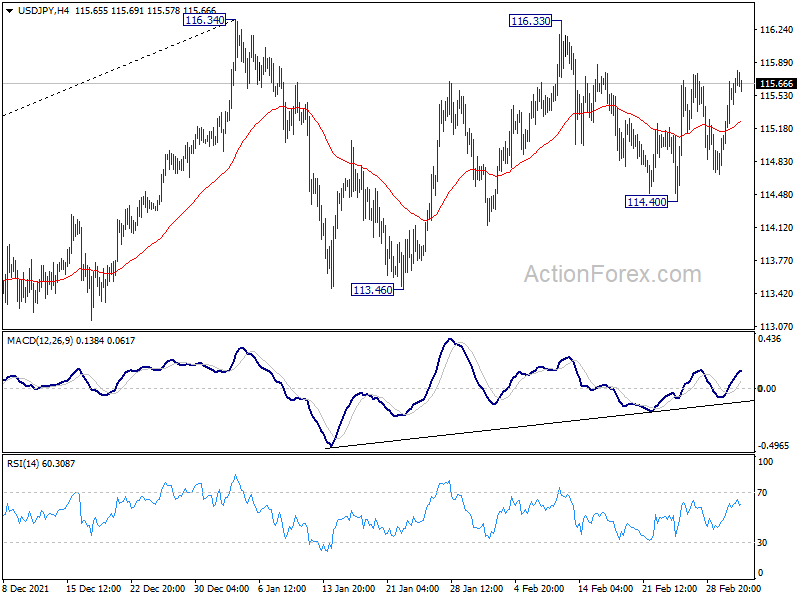
No change in USD/JPY's outlook as range trading is still in progress. Intraday bias remains neutral for the moment. On the upside, firm break of 116.34 will resume larger up trend from 102.58 to 118.65 long term resistance next. On the downside, though, break of 114.40 will continue the corrective pattern from 116.34 with another fall to 113.46 support.
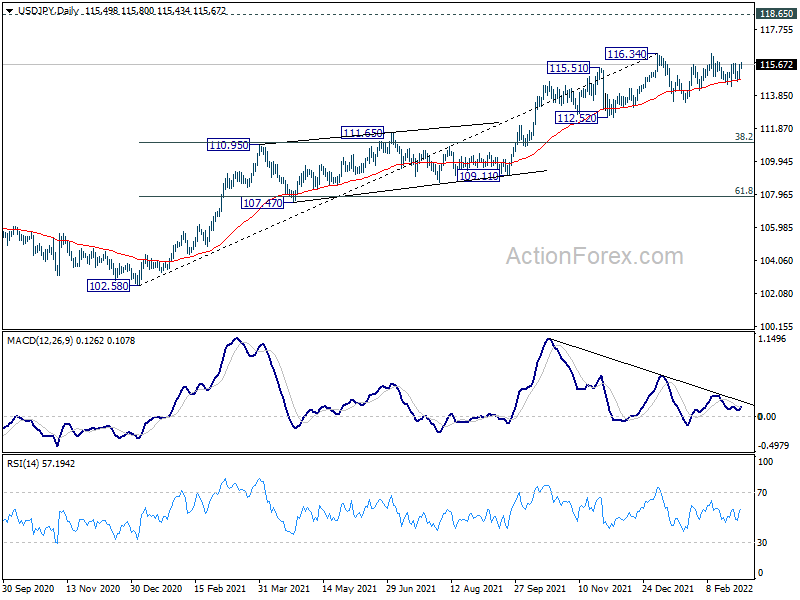
In the bigger picture, no change in the view that rise from 102.58 is the third leg of the up trend from 101.18 (2020 low). Such rally should target a test on 118.65 (2016 high). Sustained break there will pave the way to 120.85 (2015 high) and raise the chance of long term up trend resumption. This will remain the favored case as long as 55 week EMA (now at 111.64) holds.
USD/CHF Mid-Day Outlook
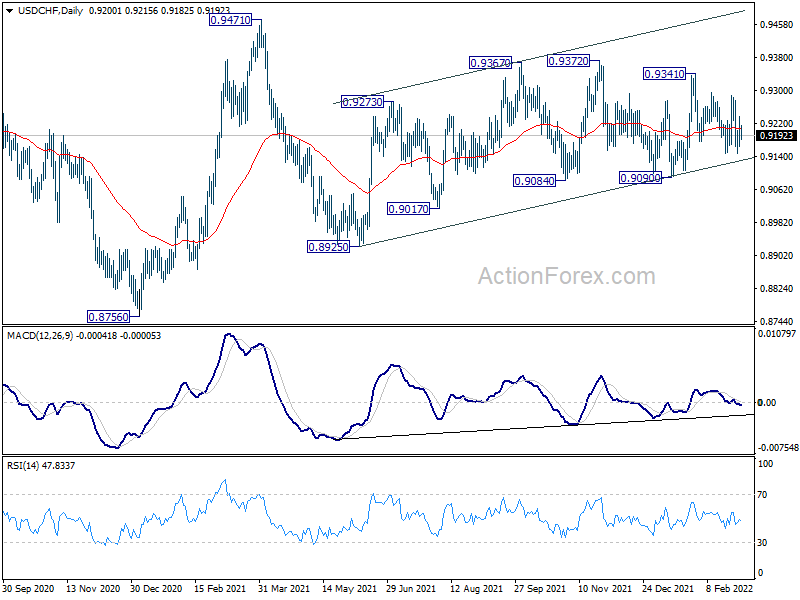
Daily Pivots: (S1) 0.9167; (P) 0.9204; (R1) 0.9240; More....
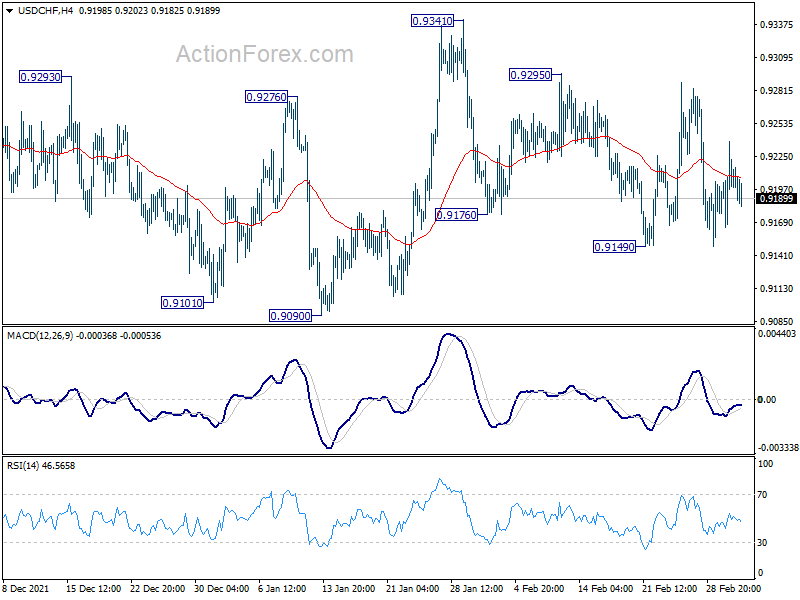
Intraday bias in USD/CHF remains neutral as range trading continues. Choppy rise from 0.8925 would still be in favor to extend higher as long as 0.9090 support holds. Break of 0.9341 will target 0.9372 resistance and then 0.9471. On the downside, however, break of 0.9090 will bring deeper fall back to 0.8925 support.
In the bigger picture, medium term outlook will be neutral at best as long as 0.9471 resistance holds. Larger down trend could still extend through 0.8756 (2021 low). However, firm break of 0.9471 will argue that the trend has already reversed and rebound the rally from 0.8756 with another impulsive move.
GBP/USD Mid-Day Outlook
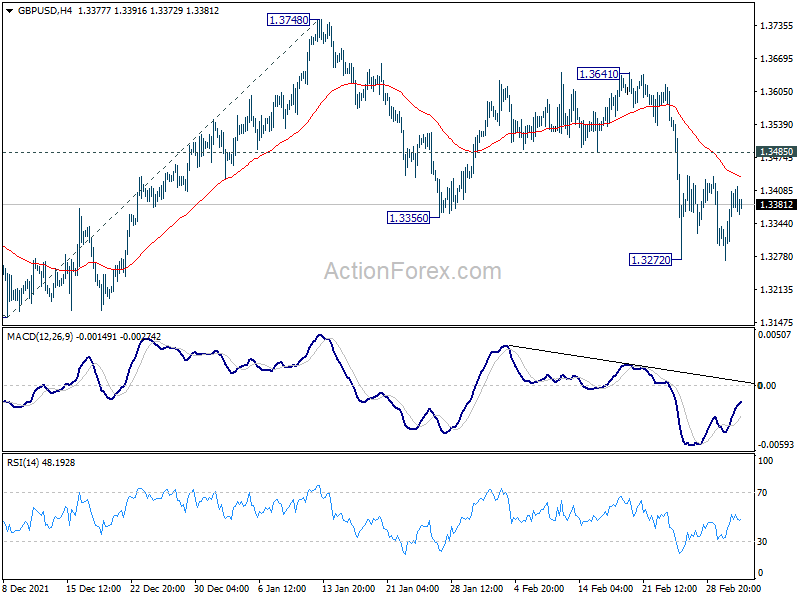
Daily Pivots: (S1) 1.3316; (P) 1.3362; (R1) 1.3451; More...
GBP/USD is staying in sideway trading and intraday bias remains neutral at this point. Further decline is expected with 1.3485 support turned resistance intact. On the downside, break of 1.3272 will target 1.3158 low. Further break there will resume larger down trend from 1.4248. However, firm break of 1.3485 will dampen this bearish view and turn bias back to the upside for 1.3641 resistance.
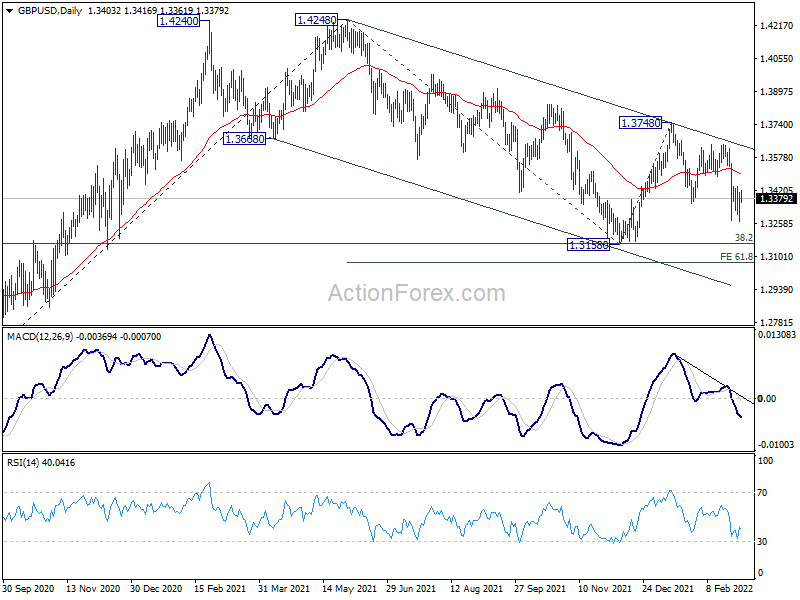
In the bigger picture, as long as 38.2% retracement of 1.1409 to 1.4248 at 1.3164 holds, up trend from 1.1409 (2020 low) is still in progress. On resumption, next target will be 38.2% retracement of 2.1161 to 1.1409 at 1.5134. Nevertheless sustained break of 1.3164 will argue that whole rise from 1.1409 has completed and bring deeper fall to 61.8% retracement at 1.2493.
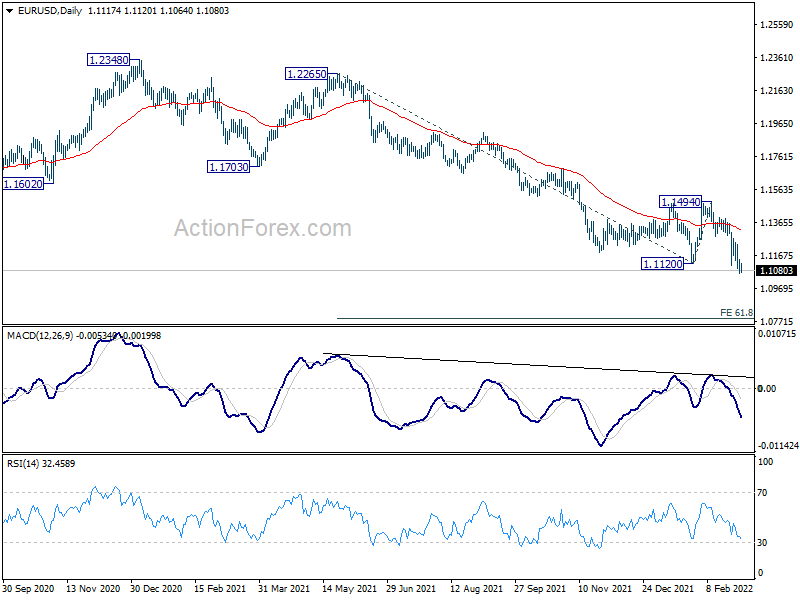
EUR/USD Mid-Day Outlook
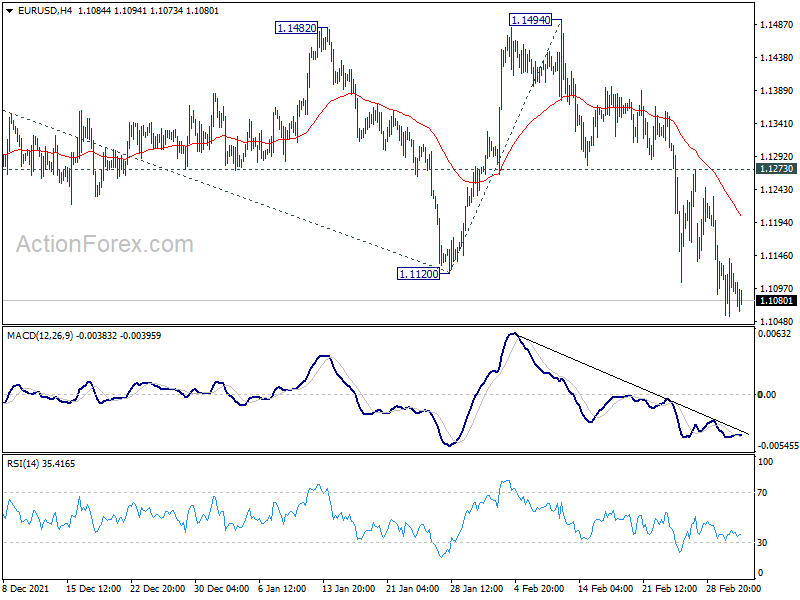
Daily Pivots: (S1) 1.1074; (P) 1.1109; (R1) 1.1159; More...
Intraday bias in EUR/USD remains on the downside for the moment. Current fall is part of the down trend from 1.2348. Next target is 61.8% projection of 1.2265 to 1.1120 from 1.1494 at 1.0786. On the upside, break of 1.1273 resistance is needed to be the first sign of bottoming. Otherwise, outlook stays bearish in case of recovery.
In the bigger picture, the decline from 1.2348 (2021 high) is expected to continue as long as 1.1494 resistance holds. Firm break of 1.0635 (2020 low) will raise the chance of long term down trend resumption and target a retest on 1.0339 (2017 low) next. Nevertheless, break of 1.1494 will maintain medium term neutral outlook, and extend range trading first.