Sample Category Title
Daily Technical Analysis
EUR/USD
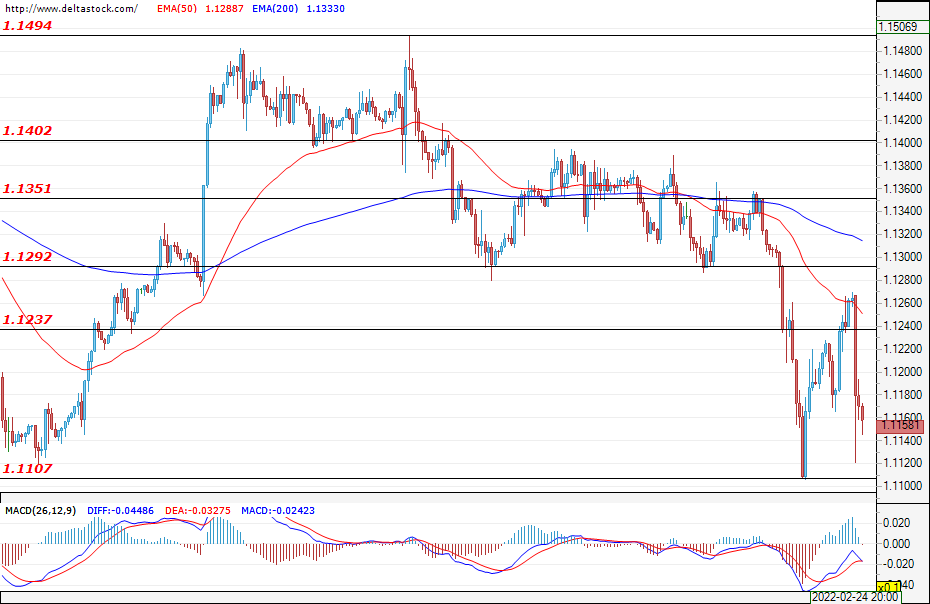
The single European currency has lost nearly a figure and a half of its value against the U.S. dollar since the beginning of the trading session. For the time being, the sell-off remains limited above the support zone at 1.1107. It is possible to witness additional sell-offs, but for this to happen, the bears would first need to prevail and successfully breach the aforementioned support at 1.1107. By the looks of it, another volatile week is ahead of us mostly due to the deteriorating conflict between Russia and Ukraine. Investors will also look at the ADP non-farm employment change data for the U.S. (Wednesday; 13:15 GMT), as well as the unemployment change data for the U.S. (Friday; 13:30 GMT), with the spotlight falling on the non-farm payrolls change data for the U.S. (again on Friday at 13:30 GMT).
USD/JPY
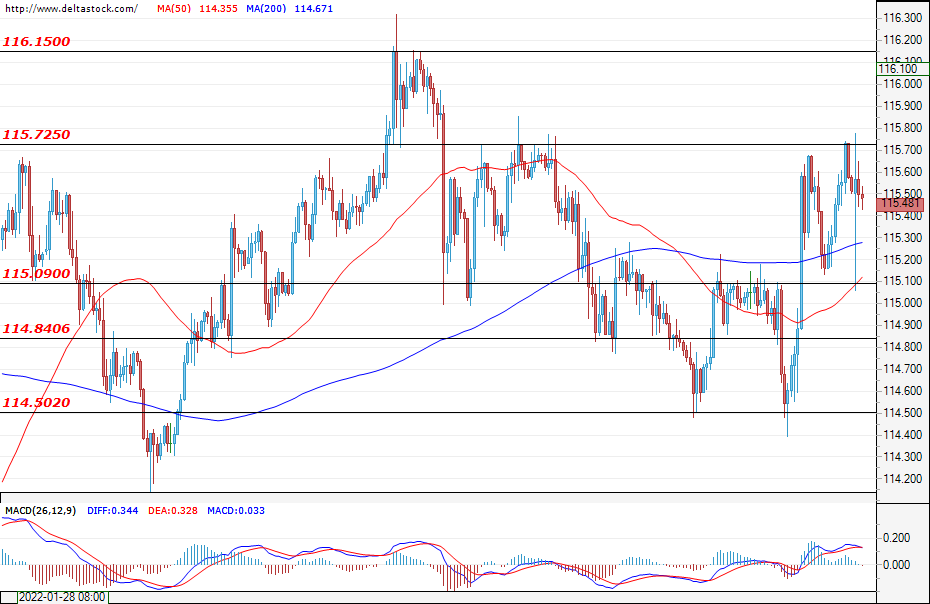
Last week, we witnessed two consecutive unsuccessful attempts at breaching the resistance at 115.72. The U.S. dollar continues to gain positions against the Japanese yen, which is likely to lead to a third test of the mentioned resistance zone. A successful breach here could lead to a rise and a possible test of the next significant level at 116.15. On the other hand, if the bulls fail to gain enough momentum, then it is very likely for the bears to enter the market and lead the trading action towards the first significant support area at 115.10.
GBP/USD
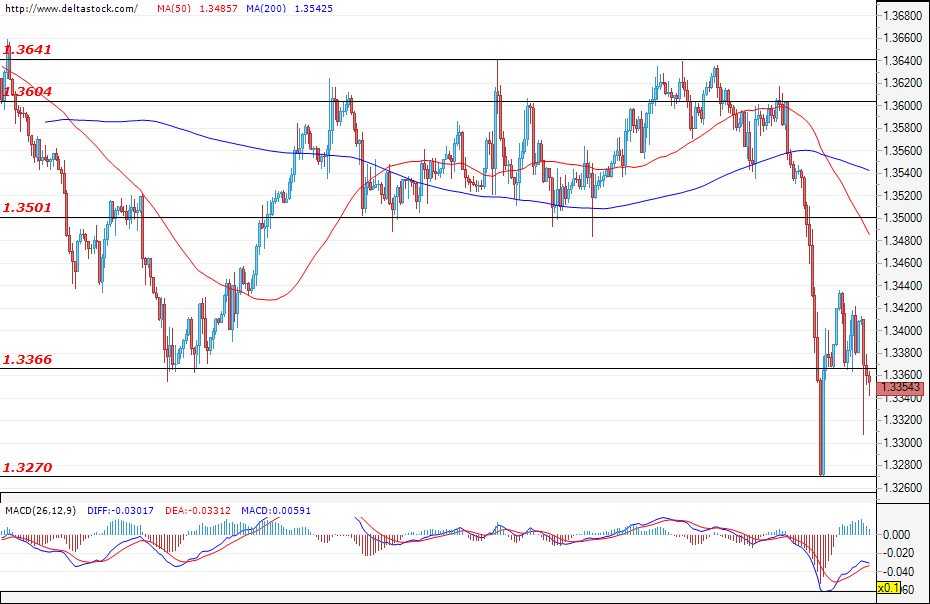
The U.S. dollar strengthened its position against the British pound, and at the time of writing, the trade is located immediately after the breach of the support area at 1.3366 – a level that would play the role of resistance if the breach is confirmed. In this case, the most likely scenario would be for an additional reduction towards the next significant support at 1.3270.
EUGERMANY40
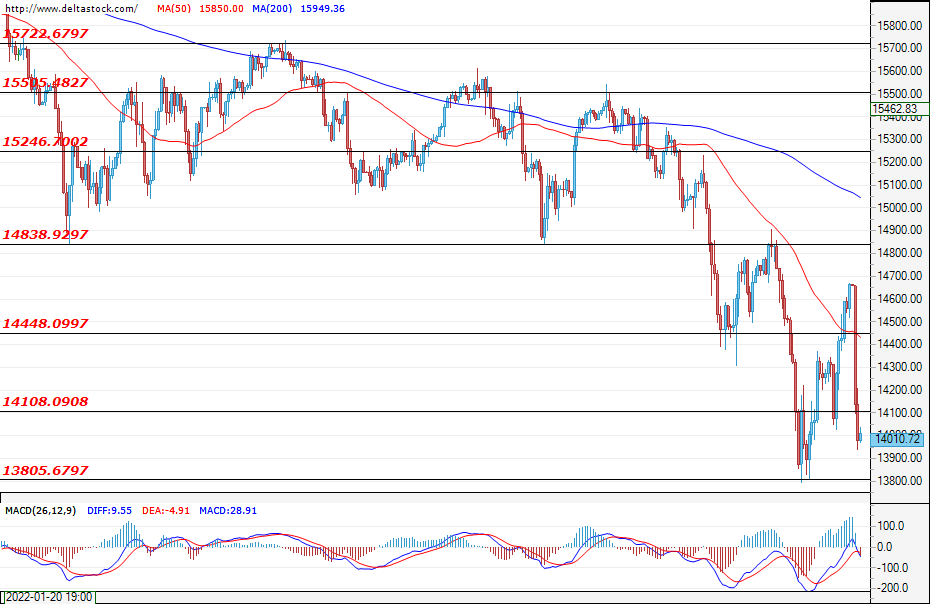
The German index opened with a negative gap in the first trading session of this week, losing more than 4% of its value due to the escalating conflict between Russia and Ukraine, which has led to uncertainty and fear among investors around the world and resulted in a flurry of economic sanctions against Russia. Another week of high volatility awaits the index, which may face a test of the key support at 13800. A possible breach of the mentioned support would seriously worsen the current sentiment and could lead to a deepening of the sell-off towards the next significant zone at around 13000. Investors will closely monitor the development of the forthcoming negotiations between Russia and Ukraine, the outcome of which is expected to play a major role in shaping the future of the index.
US30
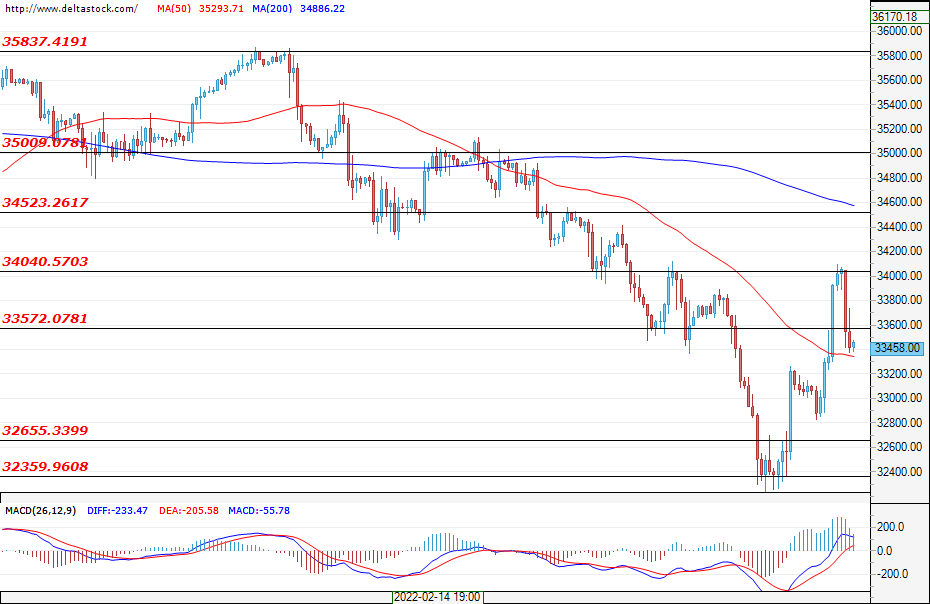
After recovering from Friday's session, the U.S. blue-chip stock index opened with a negative gap today, losing more than 1.7% of its value at the time of writing. The losses were largely driven by the growing concerns about the economic consequences spurred from the Russia - Ukraine conflict. A confirmed breach of the 33572 area would open an opportunity for the bears to instigate an additional sell-off and to attack the next support zone at around 32350. Negotiations between the warring parties remain at the forefront, the outcome of which would be the main factor determining the future of the index. Any planned economic news this week that could affect the volatility of the U.S. index has already been mentioned in the EUR/USD analysis.
European and American Futures Retreat as Russian Sanctions Mount
European futures retreated on Monday morning as the crisis in Europe continued. Russian troops continued moving into Ukraine, where they are finding stronger resistance than they had expected. During the weekend, pressure on Russia continued as a group of western countries announced new sanctions that are set to hit Russia harder. For example, the countries will disconnect Russia from the SWIFT system that is used by over 11,000 banks globally. They also announced plans to limit activities by the Bank of Russia.
The Australian dollar retreated even after the country published strong economic data. According to the country’s statistics agency, retail sales bounced back in January after they crashed by 4.4% in December. At the same time, private sector credit and housing credit also did well in January. These numbers came as the Reserve Bank of Australia (RBA) started its second meeting of the year. Analysts expect that the bank will leave interest rates unchanged and point to a rate hike in May or June this year. At the same time, analysts expect that many Australian natural gas players will benefit from the ongoing challenges in Moscow.
The market will continue to focus on the ongoing crisis in Europe today. In addition, there will be some key economic numbers. Sweden will publish the latest GDP and retail sales numbers. Switzerland will also announce the latest GDP data while Spain will publish the flash inflation numbers for February. Several important companies will publish their quarterly results this week. Some of those that will publish their results are Ambarella, Workday, TaskUs, and Nielsen Holdings.
EURUSD
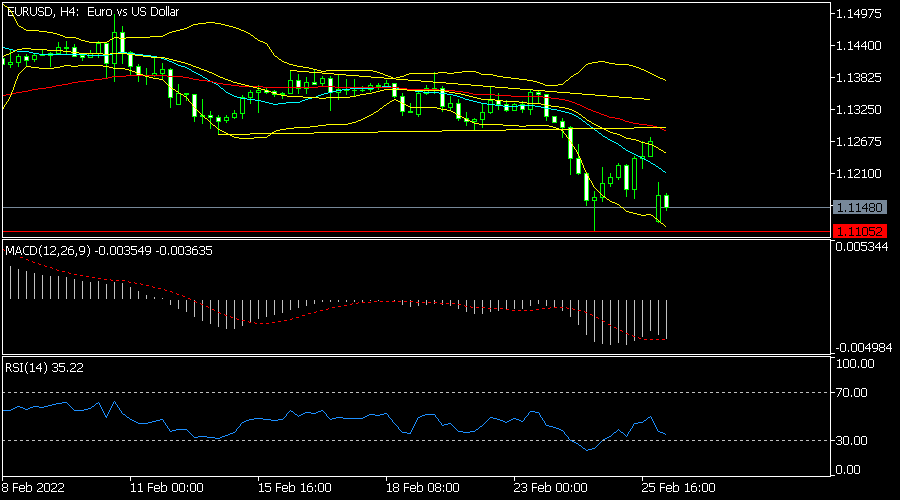
The EURUSD pair is trading at 1.1146, which is a bit higher than last week’s low of 1.1100. On the four-hour chart, the pair is slightly above the middle line of the Bollinger Bands and slightly above the 25-day moving average. The MACD has made a bullish crossover while the Relative Strength Index is pointing downwards. Therefore, the pair will likely resume the downward trend as investors assess the impact of sanctions.
EURCAD
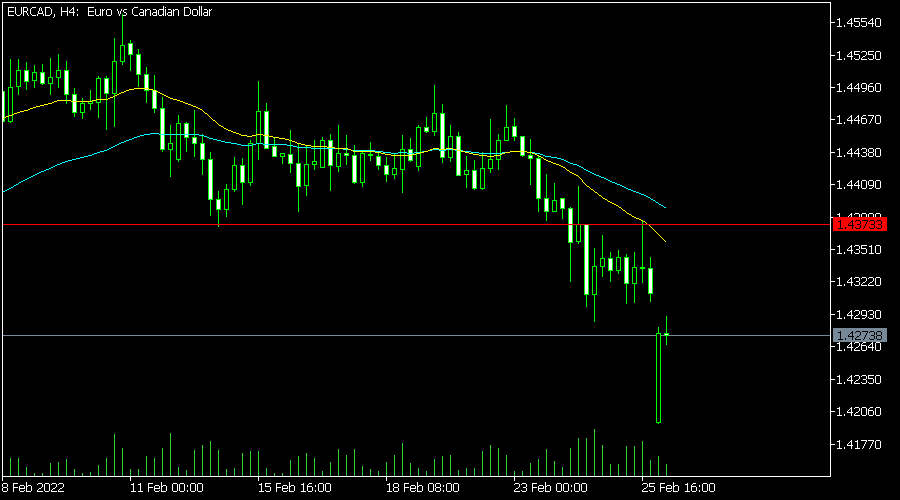
The EURCAD continued its downward trend on Monday morning. It is trading at 1.4273, which is substantially lower than this month’s high of 1.4633. On the four-hour chart, the pair has moved between the 23.6% and 38.2% Fibonacci retracement level. It is also below the 25-day and 50-day moving averages. Therefore, the pair will likely keep falling in the next few days.
USDZAR
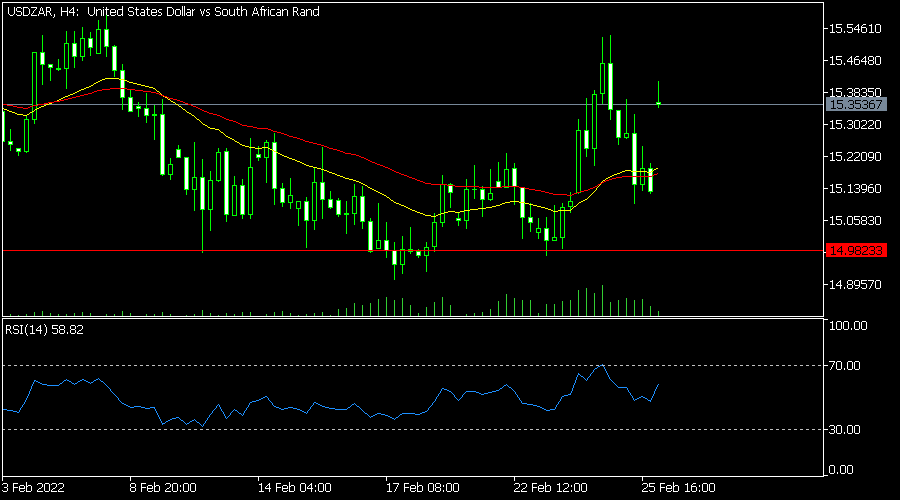
The USDZAR pair rose on Monday morning as investors moved to the safety of the US dollar. It is trading at 15.35, which is slightly lower than last week’s high of 15.28. On the four-hour chart, the pair is slightly above the 25-day moving average while the Relative Strength Index (RSI) has moved from the overbought level. Therefore, the pair will likely continue moving higher in the near term.
EURUSD Stands on Moving Sand Around 1.1100 Area
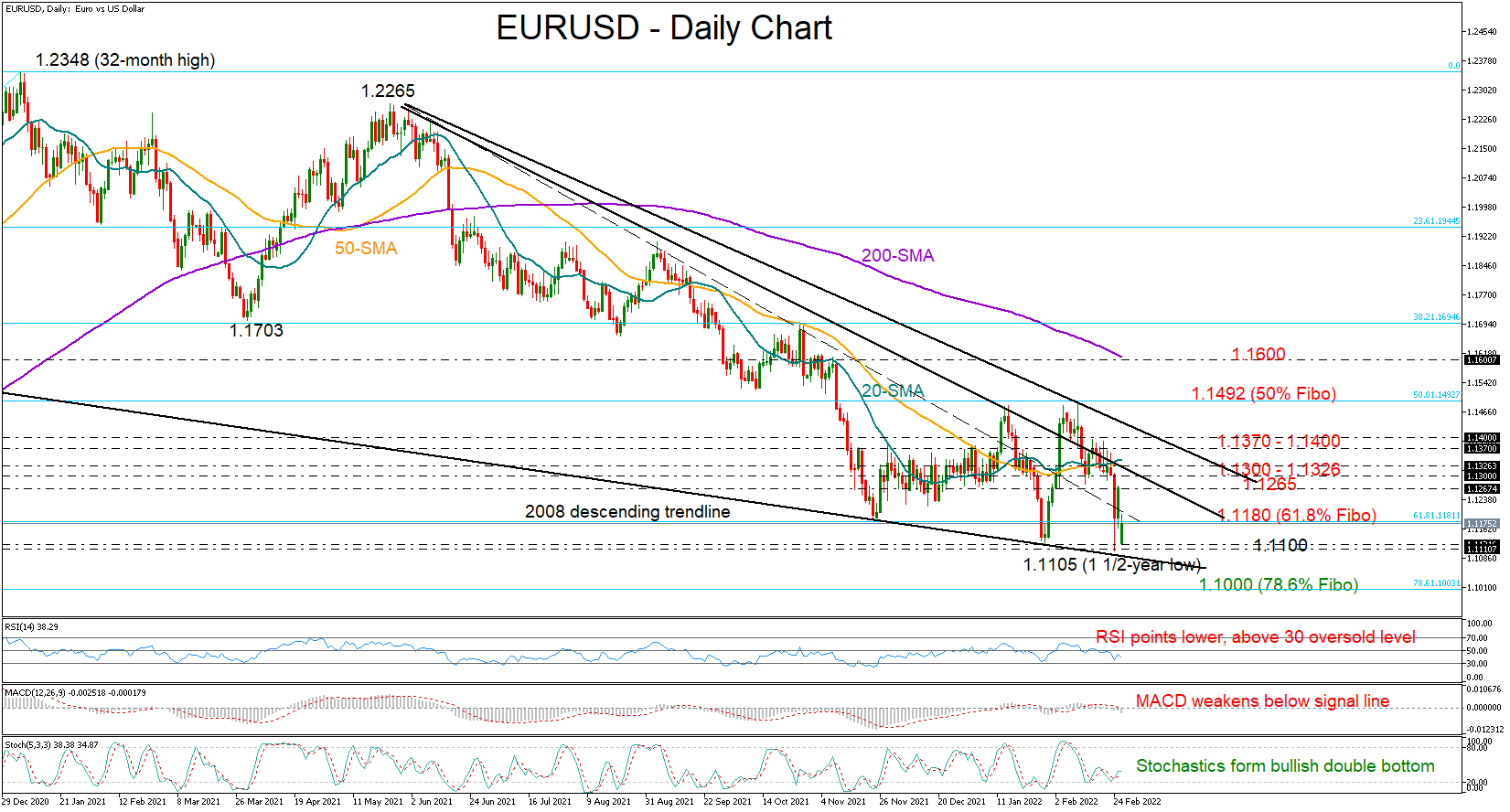
EURUSD opened with a negative gap near January’s low of 1.1120 on Monday as the world is eagerly awaiting the crucial Russian – Ukrainian meeting.
Despite last week’s volatile session, the 1.1100 territory continues to feed buying appetite, with the price currently pushing to recoup today’s lost ground. The fast Stochastics seem to have created a sort of a double bottom formation around their 20 oversold level, endorsing the recovery mood in the market, though the indicator has yet to print fresh higher highs, whereas the RSI and the MACD are still moving southwards. Hence, overall, the short-term outlook is still looking cloudy.
In terms of market trend, the 20- and 50-day simple moving averages (SMAs) managed to remain flat despite last week’s sell-off, reducing the risk for a significant outlook deterioration. Besides, as long as the 2008 descending trendline, currently at 1.1093, keeps supporting the market, the pair could still stage a brief corrective rally. If the price returns above 1.1180, which coincides with the 61.8% Fibonacci retracement of the 1.0636 – 1.2348 upleg, today’s upturn could extend towards the 1.1265 restrictive region, while higher, the bulls may attempt to breach the 1.1300 – 1.1326 zone and head to claim the key 1.1370 – 1.1400 territory.
Alternatively, if sellers press sustainably the price below 1.1100, the door will open for the 78.6% Fibonacci and the 1.1000 mark. Another collapse here may squeeze the price directly to 1.0870.
Summarizing, EURUSD seems to be standing on moving sand. For the sellers to take full control, the price will need to dip decisively below 1.1100. On the upside, an outlook upgrade above 1.1492 could be a tougher task to achieve in the short term.
It’s All About Ukraine
As we enter the end of February and the beginning of March, I could be discussing the very busy week of data ahead and its implications on monetary policy. But who are we kidding? It’s all about the Russia-Ukraine situation and evolutions in that situation will drive market sentiment and direction. I will circle back to that.
First of all, though, let’s take a look at the week ahead elsewhere. In the US and Europe, we have an avalanche of manufacturing and non-manufacturing PMIs, a probable Bank of Canada rate hike, two days of testimony on the Hill by Federal Reserve Chairman Jerome Powell, capped off by Friday’s latest US Non-Farm Payrolls release. In Asia, we see regional PMIs released, indicating the direction of travel of omicron impacted (or not) economies, an RBA rate decision on Tuesday, and most importantly, official and non-official China PMIs.
Looking at that line-up, I would say the most important snippet will be from the Powell testimony and whether the Ukraine situation threatens to derail the pace of tightening from the Fed, which should start at this month’s FOMC meeting.
Now that that is out of the way, it’s time to circle back to the only thing that really matters to financial markets and the world right now, Russia’s war in Ukraine. First of all, I must doff my hat to the Europeans, whose recalcitrance I have criticised recently. Over the weekend, sanctions were seriously escalated with Europe fully on board. Russian banks were cut off from SWIFT, although I can’t find a list of which Russian banks. Notably, the EU, Britain and the US are freezing the Russian central bank’s assets, meaning they can’t be deployed to intervene in currency markets. The list of airspace bans and asset freezes and travel bans on Russian individuals and companies is too long to list. Most notably, Germany, which had been dragging its feet, got on board and also authorised weapon sales to Ukraine and also massively hiked its defence budget. No more German soldiers turning up to NATO exercises with broomsticks.
President Putin will now have to accept that the “Western” powers are prepared to accept quite a bit of economic pain now to punish Russia. Naturally, he put Russian nuclear forces on high alert and Belarus, “voted” to allow Russian nuclear weapons to be stationed on its soil. Meanwhile, it appears that the Russian invasion is not quite going to plan thanks to the tenacity and bravery of the Ukrainian people.
Russian ruble plummets
A bank run has already started in Russia over the weekend, and the ruble, if it actually trades today, will be well above 100 to the US dollar. Inflation will immediately spike massively, and the Russian banking system is likely to be in trouble. None of that will bother Mr Putin, but his soldiers have effectively had a near 50% pay cut since the war has begun in dollar terms. If Mr Putin authorises the use of thermobaric weapons, even China is likely to drop him like a hot rock, and the endgame will have begun.
Asia has seen a sell-off in risk today and a rush to havens, not just because of the Putin nuclear headlines, or the imminent implosion of the Russian economy, but also because of the rippling effects across the global economy, starting with inflation. US stock futures have tanked, oil and gold have rallied, and the US dollar if pushing higher versus DM and Asian EM currencies. All straight out of the risk aversion playbook.
Asia stock markets, however, are proving very resilient, and in the case of China, Japan, and Australia, are actually rallying, which US futures have unwound some of their losses. Firstly, my initial impression of the SWIFT exclusion is that it is designed to still allow payments for energy and commodities. Also, Russian and Ukrainian officials will stage a meeting today on the Belarus border. Clearly, the perpetual buy-the-dip mega-bulls of the equity market are pricing in that some progress will occur on ending the war. I won’t disagree with the premise, only the timing.
The first sign of progress officially emerging from that meeting, should it occur, should spark an immediate rally by global hot money into risk. The longer-term consequences of cremating the Russian economy will be a global headwind, but in the shorter term, an even remotely positive meeting should swing market sentiment.
Short-term Trading Dominated by a New Risk-off Wave
Markets
In the past, the impact of (geo)political tensions on global markets often tended the be relatively short-lived. End last week, it looked that global markets again were inclined to embrace a similar scenario. Investors apparently assumed that the Russian military action could soon be concluded and might lead to a ‘new political equilibrium’ in Ukraine (possible negotiations? Neutrality?). European (EuroStoxx +3.69%) and US equities (S&P +2.24%) rebounded. European/German bond investors also gave up most of their safe haven positioning and cautiously also returned their focus rising inflationary risks. The German curve rose 3.2 bps/3.9 bps in the 2 & 30-y sector and 5.9 bps/7.1bps elsewhere. Even intra-EMU spreads showed signs of an easing of tensions. US yields which already reversed most of their safe haven decline on Wednesday and Thursday closed with changes of less than 1 bp. Oil dropped (temporarily) below $100 p/b. The dollar (DXY) eased to close near 96.6. EUR/USD rebounded to close at 1.1268.However, this weekend’s political and military developments clearly overthrew Friday’s positive investor mood. Russia and Ukraine are said to prepare negotiations near the Belarusian-Ukraine border, but it is unclear whether this will yield any result in the short-term. President Putin raising the alert on its nuclear deterrent only illustrated a further escalation in the conflict. At the same time, markets are pondering the potential consequences for the economy and financial system after western allies decided to decouple some Russian banks from the Swift payment system and took restrictive measures limiting the Russian central bank to use of its international reserves. At the open of Asian trading, the ruble was in free-fall. The Russian central bank raised the key rate from 9.5% to 20%. In volatile trade, the Russian currency trades near USD/RUB 105 after open substantially weaker. Brent oil ($103 p/b) again jumps as do several other commodities. The fall-out on Asian equity markets remains modest with Hong Kong losing about 1.0% but the likes of Japan (+0.2%) and Australia (0.73%) trading in positive territory. US Treasuries rally with yields at shorter maturities declining up to 9 bps. The TW dollar regains the 97.00 barrier. However, the yuan also enjoys some kind of safe have bid with USD/CNY declining to the 6.3125 area. EUR/USD dropped to the mid 1.11 area.At the end of last week, it look that the key eco data to be published in the US (payrolls) and in Europe (inflation) this week could regain some market attention ahead of the upcoming March Fed and ECB meetings. However, short-term trading in US and even more on European markets will be dominated by a new risk-off wave. Even after last week’s rebound, the technical picture of the likes of the EuroStoxx50 remains fragile and futures suggest a new selling wave. German Bunds and Treasuries will remain well bid. More interestingly: will European swap rates continue a similar stickiness as they did recently? On FX, EUR/USD might go for a retest of the 1.1121/06 support. A break lower only would complicate the ECB’s reaction function as it would raise inflationary risks. Also keep a close eye at CE currencies with EUR/PLN (3.67) and EUR/HUF (370) nearing levels that are key in the CB’s anti-inflation strategy.
News Headlines
Australian retail sales recovered 1.8% m/m in January after slumping 4.4% in December, even amidst a renewed Covid outbreak with the omicron variant. Expectations were for a more modest 0.3% increase. Food retailing had the largest rise in sales last month, being up 2.2% in the largest monthly rise since July 2021. Sales in cafes, restaurants and takeaway food eased 0.8%. The strong data strengthens the RBA’s case that omicron wouldn’t derail the recovery. The central bank meets tomorrow. It is expected to keep the policy rate stable at 0.10%. The Australian dollar inches lower this morning in a risk-off move. AUD/USD trades around the 0.72 big figure.President Joe Biden’s approval rating fell to a record low, a new Washington Post-ABC News poll showed. 37% said they approve of the job Biden is doing while 55% said they disapprove. Asked specifically about how Biden is handling the economy, 37% said they approve vs 58% disapproving. Half of the people in the survey disapproved the president’s handling of the pandemic. The results come one day ahead of Biden’s first State of the Union.
The West Escalates Sanction Measures on Russia amid Continued Fighting
Market movers today
All eyes are on the Russian invasion of Ukraine and on the implementation and announcements of sanctions from both the West and Russia. Markets will be characterised by heightened volatility, large sensitivity to headlines and low intraday transparency on news and rumours out of Ukraine.
Economic data releases will matter little in the coming sessions even if Wednesday's Eurozone inflation print and Friday's nonfarm payrolls report have the potential to shake up markets. Also, we are likely to hear OPEC comments on oil prices going into Wednesday's OPEC+ meeting.
The 60 second overview
Continued Russian aggression in Ukraine: fighting continues on multiple fronts in Ukraine. According to local authorities Ukraine has regained control in Kharkiv and continues to defend the capital of Kyiv. Western intelligence indicate that Russia so far has only committed roughly half of its available firepower to the invasion. The West has stepped up their military support to Ukraine and as a response Russia has put their nuclear defences on alert. Ukraine and Russia leaders have agreed to meet at the Belarus border on Monday but the exact time of the meeting has not been confirmed. Many Western countries advise their citizens to leave Russia.
The West escalates sanctions: The US, EU, UK and Canada announced a fresh round of sanctions against Russia over the weekend. Following earlier announcements of sanctions targeting Russian individuals and key Russian financial institutions, the West has now communicated a coordinated set of significantly tougher sanctions including an exclusion of certain Russian financial institutions from SWIFT, the freezing of Russian central banks (CBR) assets in their jurisdictions, an expansion of the list of Russian individuals whose assets abroad will also be frozen and sharp limits on the sale of "golden passports" to Russian citizens. Also the EU has banned all state-owned media companies and has closed the European airspace to all Russian aircraft.
The EU has also said it plans to impose sanctions on Belarus that has acted as an aid to Russia during its aggressions. Few hours after the announcement a referendum in Belarus allowed for nuclear weapons being deployed in the country thereby ditching its non nuclear-status.
Markets: Friday's session was characterised by a relief rally amid the toughest sanctions not getting implemented. This morning this reverses as markets react negatively to the renewed escalation with the big equity futures in red (-2-5%), yields moving lower, USD gaining, RUB coming under severe pressure and commodity prices rising. Brent crude has risen USD 5/bbl while we have yet to see the impact on European natural gas prices. Also there are signs of funding stress in the USD market - amid fear of missed payments and overdrafts - with FRA/OIS spreads widening the most since March 2020.
Hit to RUB: RUB has come under immense pressure with much uncertainty as to where the market is be quoted. In offshore trading RUB has fallen as much as 30% vs the USD while the drop in onshore trading has been more modest (~6%). The freezing of CBR's assets is an unprecedented move at this scale given the size of the CBR's balance sheet. Freezing central banks assets will largely cut off the CBR from access to its EUR and USD reserves, which in total comprise app. 50% of its total foreign reserves (16% in USD and 32% in EUR). While some of the CBR's EUR and USD denominated assets are held outside the respective jurisdictions, the decision is likely to paralyze the CBR's capacity to use its foreign reserves for outright FX interventions. Also several large entities such as the Norwegian Government Pension Fund Global (the oil fund) and BP have reported significant divestment plans out of Russia during the weekend.
Media reports of long lines of people in Russia for ATMs. This morning Russia reacted by "temporarily prohibiting" foreigners from selling Russian securities.
Germany: Germany is making a massive turnaround on the political scene after Chancellor Scholz gave a historical speech yesterday reversing the past many years of SPD policies, as well as Germany defence politics. In the speech Germany will now almost double the defence budget by EUR100bn this year via the creating of special fund, and further will allow weapon export via Netherlands to Ukraine. That means Germany will now spend more than 2% of GDP on defence living up to its NATO commitment. Furthermore Scholz declared an end to the energy dependence where amongst other two new terminals for LNG and green energy is set to be created. The renewed focus on the defence and its increased spending, may open for a larger political discussion later this year on this should be treated at the upcoming budget and deficit rules review this year. We do not rule out a different treatment to military spending given the geopolitical situation as well as green and digitalisation.
What to follow from here: Naturally the ongoing fighting should be followed closely although one should be aware of low intraday transparency, rumours and propaganda from both sides. Details on the implementation of sanction and counter sanctions should also be followed closely as well as whether China will condemn Russia's aggression. Given Switzerland's large share of Russian payment flows there will also be focus on Swiss politicians and how/if they will implement EU/UK/US/Canada sanctions. We will also follow developments in Russia closely including the risk of bank run and demonstrations.
FI: Friday's price action was relatively benign with Bunds ending 5bp higher on the day, and tighter spreads to Bunds across the board, with Finland -2bp and Italy -3bp, as the sanctions announced at that stage were relatively mild. However, we are in for a volatile session today with Bund yields lower and wider spreads. In Lagarde's speech on Friday she said they are ready to take the necessary action to ensure price and financial stability without sending particular new policy signals. Ahead of next week's ECB meeting, we could see liquidity operations and/ or swap lines in case of need. The HICP inflation print on Wednesday is a particular important release ahead of next week's ECB meeting for the overall calibration of instruments.
FX: RUB collapsed overnight with USD/RUB moving more than 30% higher to 107.5 at the time of writing. Broad USD strengthened with EUR/USD falling 1% to now below 1.115. Safe haven currencies like CHF and JPY rose overnight, while SEK and NOK sold off. EUR/SEK is approaching 10.70, while EUR/NOK moved above 10.00. The Russia-Ukraine war and sanctions will dominate FX space today.
Ukraine War: Energy Up, Equities Down
The week kicks off with soaring energy prices and a decent selling pressure on European and American index futures as the Russian invasion in Ukraine and the bigger sanctions imposed on Russia take a severe toll on market sentiment.
The barrel of US crude jumped more than 5% to $100 this morning, whereas the European natural gas futures closed last Friday 50% higher.
Could OPEC help? Yes, but it will probably choose not to. About two years ago, OPEC countries had refused to restrict production as a response to the pandemic, sending the price of a barrel all the way down to minus $40. There is no guarantee that they don’t do the opposite move this week and announce they won’t raise production in the face of the Ukrainian crisis and send the energy prices soaring. Therefore, the risks to the energy markets remain tilted to the upside.
Business versus ethics
The British BP has given the most drastic response among the Western companies to the Russian invasion by selling near 20% stake in the Russian oil giant Rosneft. It’s a huge deal as the two companies work closely together since thirty years and Rosneft stands for about half of BP's oil and gas reserves and a third of its production. Divesting near 20% stake will result in charges of up to $25 billion, according to the company, which hasn’t yet given details on how it plans to detach itself from such a close tie.
The latest news will probably be a decent blow to the BP’s share price and jeopardize the latest gains due to the soaring energy prices.
The BP news also raise questions on how the other oil giants will react to the Ukrainian calamity. Will other oil companies like Total Energies or Shell dare make similar moves?
The Ukraine war comes as a big and unexpected threat to the energy exposure, which was one of the best inflation hedges until last Thursday, but it’s no longer a safe place.
SWIFT headache
SWIFT is the messaging system of international transactions and being left outside SWIFT complicates the oversees transactions terribly. It doesn’t block them, but it makes them chaotic and unreliable. It’s like going to a restaurant and not being able to order the food you want.
The sanctions increase the risk of insolvency of big Russian banks and the risk of a bank run in Russia.
More importantly, the Russian central bank is also concerned with Western sanctions which will greatly weaken its ability to manage the war, the crisis, and the financial stability.
Russian markets will again be under a huge selling pressure, and dollarization will be the next chapter in Russia. The Ruble has already been smashed by near 30% this morning to a record low, and there are hints that this could extend to 175-200 range. This means that this needless and compulsive Ukrainian war will become hard for Russia to finance.
According to the latest news, Russians are surprised and frustrated by how strong the Ukrainians resist to protect their home. The two countries will talk today at the Belarus border, but the expectations are pessimistic.
Markets
The US dollar is set for another strong session, and if we don’t see the tensions de-escalate, the dollar index could well advance toward the 100 mark.
The US index futures kicked off the week in the negative. Any hopeful news could change the negative sentiment within minutes and send the international stock markets rallying. But the chance of seeing a diplomatic progress is rather slim.
The softening Fed expectations due to the Ukrainian war could revive the tech bulls, as the Fed could abandon its back-to-back rate hike plans, as the war will take a severe toll on the global economic recovery and the Fed may need to accept a higher inflation to give the support the economy needs. Powell will testify before the American policymakers this week, and investors will try to catch any hint on how the Ukrainian war may re-shape the FOMC’s plans regarding the US monetary policy.
EUR/USD Daily Outlook
Daily Pivots: (S1) 1.1201; (P) 1.1238; (R1) 1.1309; More...
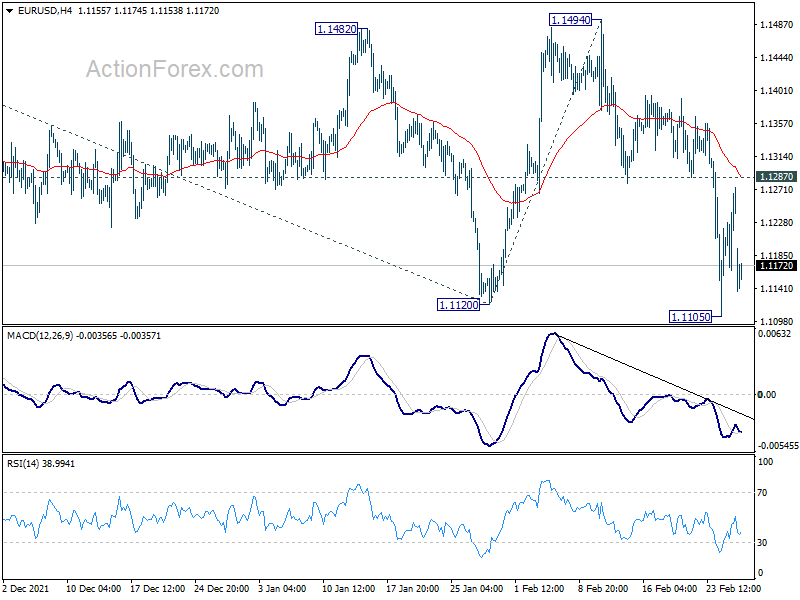
Intraday bias in EUR/USD remains neutral and further decline is expected with 1.1287 resistance intact. On the downside, sustained break of 1.1120 will confirm resumption of larger down trend from 1.2348. Next target is 61.8% projection of 1.2265 to 1.1120 from 1.1494 at 1.0786. However, firm break of 1.1287 will dampen this bearish view and turn bias back to the upside for 1.1494 resistance.
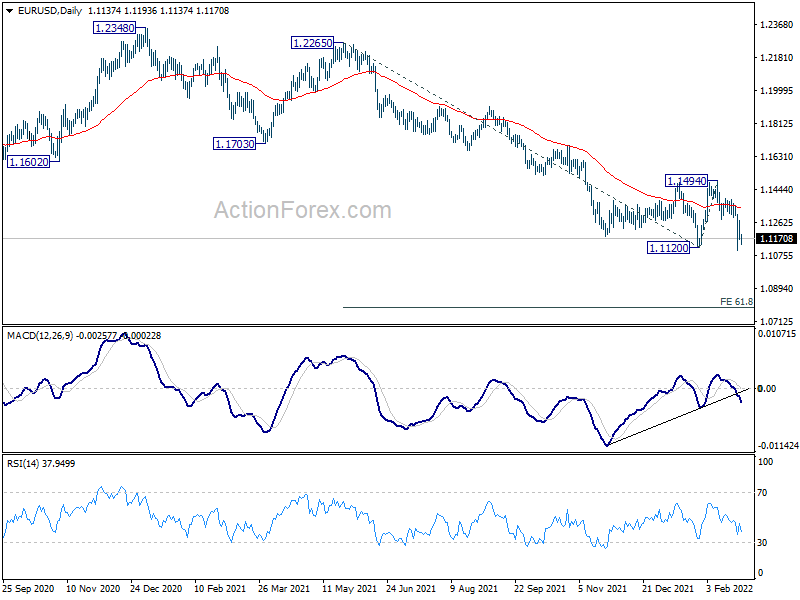
In the bigger picture, the decline from 1.2348 (2021 high) is seen as a leg inside the range pattern from 1.2555 (2018 high). Sustained trading above 55 week EMA (now at 1.1582) will argue that it has completed and stronger rise would be seen back towards top of the range between 1.2348 and 1.2555. However, firm break of 1.0635 (2020 low) will raise the chance of long term down trend resumption and target a retest on 1.0339 (2017 low) next.
GBP/USD Daily Outlook
Daily Pivots: (S1) 1.3372; (P) 1.3406; (R1) 1.3444; More...
Intraday bias in GBP/USD remains neutral and further fall is expected as long as 1.3485 support turned resistance holds. On the downside, break of 1.3272 will target 1.3158 low. However, firm break of 1.3485 will dampen this bearish view and turn bias back to the upside for 1.3641 resistance.
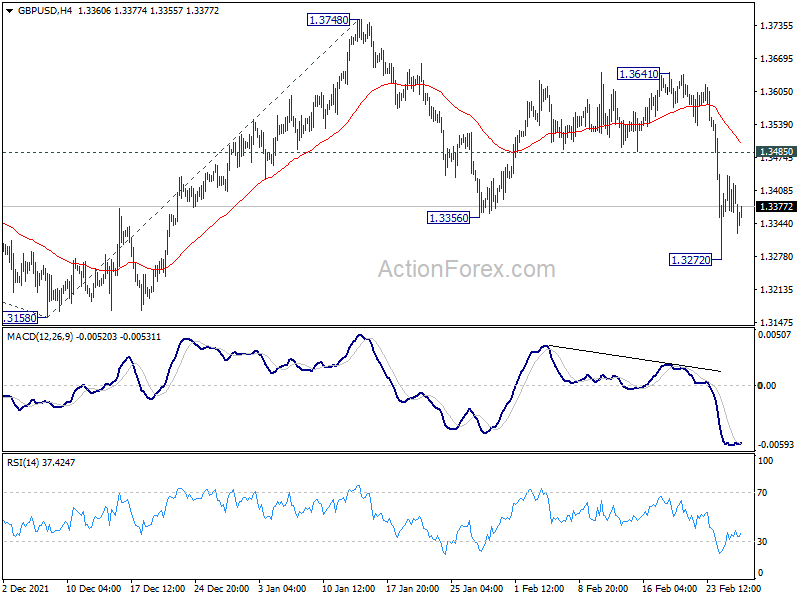
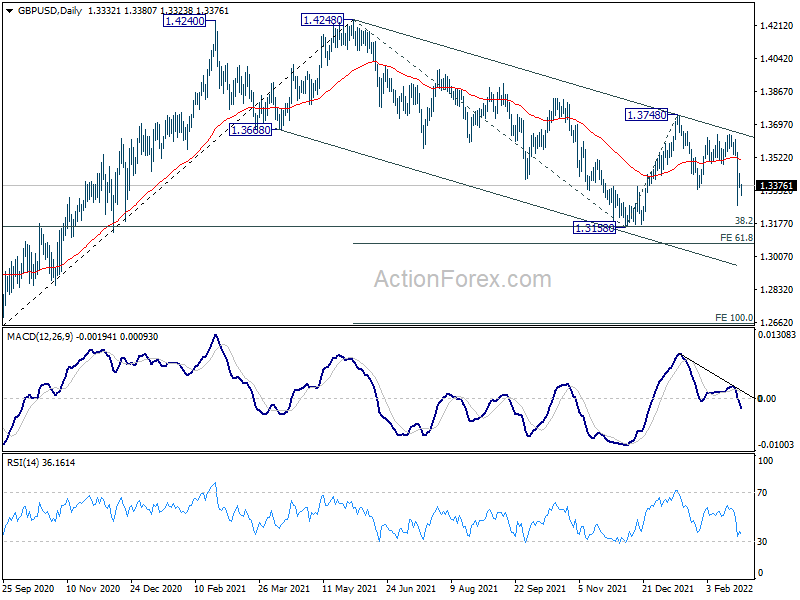
In the bigger picture, as long as 38.2% retracement of 1.1409 to 1.4248 at 1.3164 holds, up trend from 1.1409 (2020 low) is still in progress. On resumption, next target will be 38.2% retracement of 2.1161 to 1.1409 at 1.5134. Nevertheless sustained break of 1.3164 will argue that whole rise from 1.1409 has completed and bring deeper fall to 61.8% retracement at 1.2493.
USD/CHF Daily Outlook
Daily Pivots: (S1) 0.9227; (P) 0.9256; (R1) 0.9282; More....
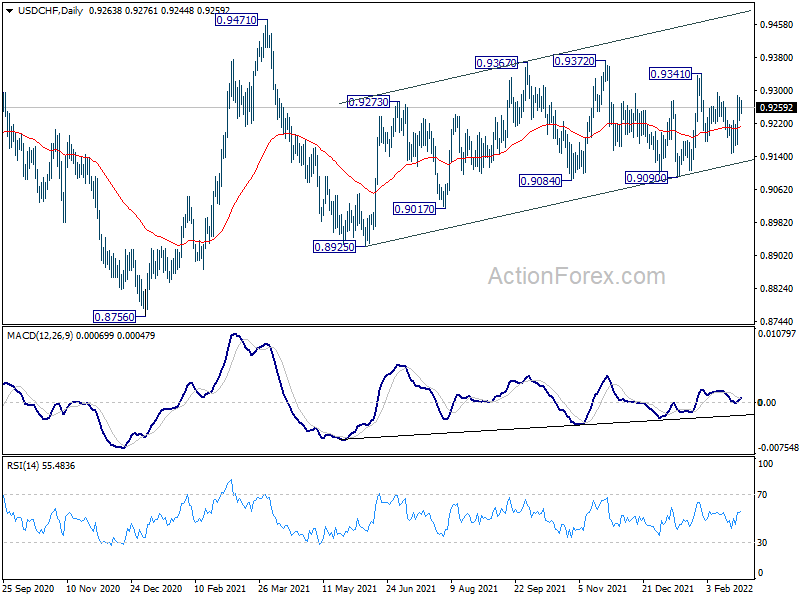
Intraday bias in USD/CHF remains neutral for the moment. Choppy rise from 0.8925 would still be in favor to extend higher as long as 0.9090 support holds. Break of 0.9341 will target 0.9372 resistance and then 0.9471. On the downside, however, break of 0.9090 will bring deeper fall back to 0.8925 support.
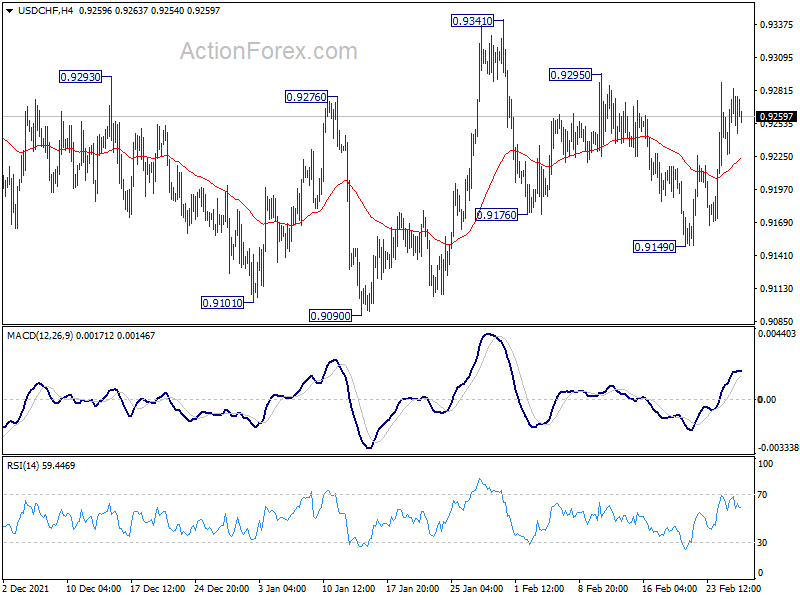
In the bigger picture, medium term outlook will be neutral at best as long as 0.9471 resistance holds. Larger down trend could still extend through 0.8756 (2021 low). However, firm break of 0.9471 will argue that the trend has already reversed and rebound the rally from 0.8756 with another impulsive move.