Sample Category Title
Western Sanctions Decimate the Russian Economy
- America and Europe hit Russia with suffocating economic sanctions
- Russian central bank raises interest rates but cannot defend currency
- Stocks retreat, US dollar and oil advance as traders reduce risk
Capital flees Russia
The invasion of Ukraine has sent markets into a tailspin. Europe and America finally took off the gloves and announced a new round of crippling economic sanctions against Russia. These include the expulsion of several Russian banks from the SWIFT international payments system and freezing most of the FX reserves held by the central bank.
This is essentially a one-two punch from the West. It will deal a heavy blow to Russia’s financial institutions and perhaps spark a recession, while also leaving the central bank powerless to defend its currency by preventing access to its own war chest. The Russian central bank raised interest rates to 20% today in a last-ditch attempt to fight currency depreciation, but the rouble still collapsed to a new record low.
Capital is fleeing the country and Russian assets are on fire sale. Many large players have announced they will divest their Russian holdings, people are queuing up for cash machines, and soft capital controls have already been introduced by ‘prohibiting’ foreigners from selling securities on the Moscow Exchange.
Markets react
Pricing geopolitical risk into financial markets is notoriously difficult. There is no exact formula for how to protect a portfolio against potentially catastrophic events, so oftentimes investors tend to overreact by dramatically slashing their risk exposure and deleveraging.
Crude oil has been the best barometer of market concerns around this conflict. The prospect of sanctions constraining Russian supply has turbocharged energy prices, although Western powers have been careful not to target the sector explicitly, fearful of the collateral damage on the European economy from soaring fuel prices.
This is also why the euro is under pressure. The sanctions could come back to bite Europe by squeezing consumers and restraining the banking sector in countries with high exposure to Russian money, so currency traders are taking cover in the safety of the US dollar.
What now?
Stock markets were hit by a powerful wave of selling as well. European markets are down almost 2% while futures point to a similar loss when Wall Street opens today. ‘Cut risk first, ask questions later’ seems to be the strategy among money managers.
The one piece that doesn’t fit the puzzle is gold. Bullion opened higher for the week but has already surrendered those gains, which is strange considering that Treasury yields are also sinking. It could be that the Russian central bank is dumping gold on the open market to shore up its devastated currency, since most of its FX reserves have been frozen.
Looking ahead, markets will remain hostage to incoming headlines. Russian forces have encircled Ukraine’s capital, Vladimir Putin has put his nuclear arsenal on high alert, and the European Union has pledged to deliver arms to Ukraine, including fighter jets. Hence, the situation is very unpredictable.
One ray of hope comes from the peace talks that will be held between Ukrainian and Russian officials today. While the negotiations might not stop the war, they might be enough to lift risk sentiment. A lot of the negativity has already been priced in and everyone is hedged at this point, so any piece of good news could have a tremendous impact in terms of calming the markets.
Crude Oil Finds Temporary Top: Elliott Wave Analysis
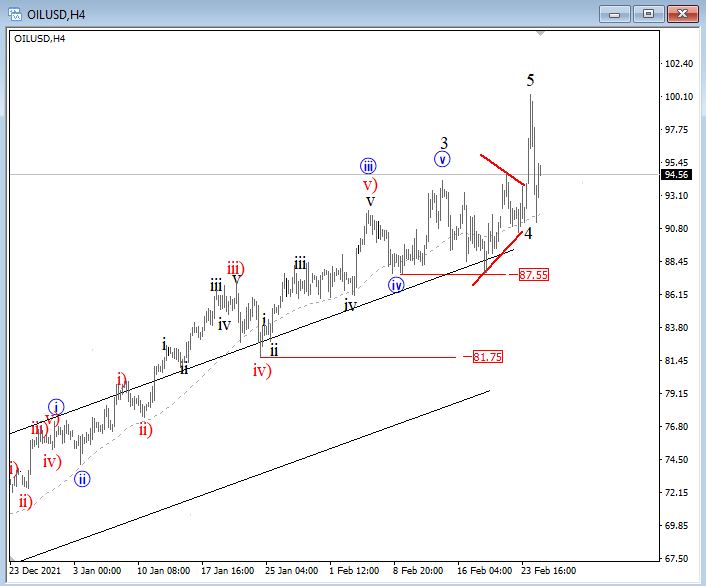
Crude is sharply down in the 4-hour chart after reaching 100 level for the 5th wave, so smells like a temporary top and we will now have to be aware now of a bigger, higher degree slow down, especially if the price drops back below 87.55 level.
Crude oil 4h Elliott Wave analysis
EUR/USD Outlook: Euro Rebounds after Opening with Gap, but Overall Bias Remains Bearish
The Euro opened with gap-lower on Monday as geopolitical tensions escalated after Russia put its fast response forces, including nuclear, on highest alert over the weekend.
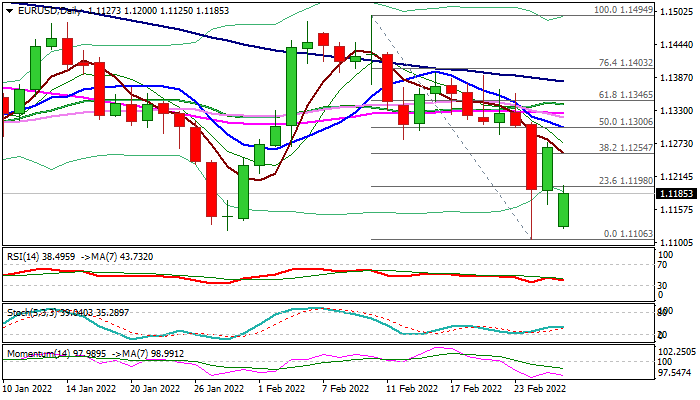
Although the pair bounced after dipping to 1.1125 after Monday’s opening (close to Thursday’s low, hit after Russia launched an attack on Ukraine, but talks between Russia and Ukraine, which started today, may ease tensions and ease near-term downside pressure and allow for further recovery.
However, upticks are expected to be limited and possibly to fill today’s gap before bears regain control, as overall picture remains negative on persisting threats of further escalation that keeps traders in defense and focusing safe-havens.
Bearish daily studies support the notion as 14-d momentum continues to head south and move deeper into negative territory, while moving averages are in full bearish setup.
Initial resistance at 1.1200 zone (round-figure / Fibo 23.6% of 1.1494/1.1106 descend) is under pressure, with extended upticks to stall under pivotal barriers at 1.1250 zone (Fibo 38.2% / daily Tenkan-sen) to keep bears in play and offer better levels to re-enter downtrend for acceleration towards targets at 1.1040/1.1000 (Fibo 76.4% of 1.0635/1.2349 /psychological).
Only return and close above 1.1300 (50% retracement of 1.1494/1.1106 / daily Kijun-sen) would ease bearish pressure.
Res: 1.1200; 1.1254; 1.1280; 1.1300.
Sup: 1.1166; 1.1125; 1.1106; 1.1040.
Euro Volatile as Ukraine Crisis in Focus
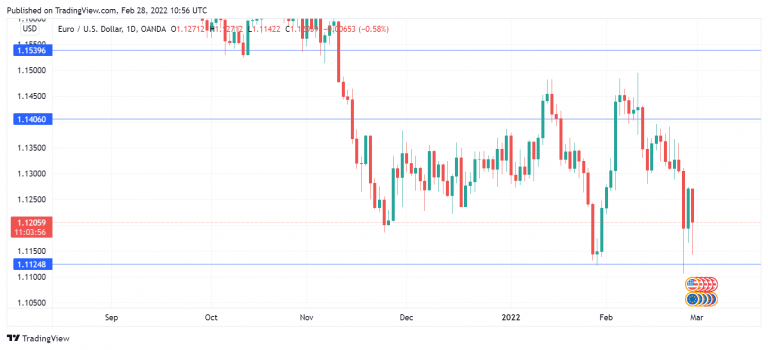
The euro remains under pressure and was down close to 1% earlier in the day. EUR/USD has recovered and is currently trading at 1.1215, down 0.50%. There are no tier-1 events on today’s economic calendar.
Russian-Ukrainian talks to discuss cease-fire
The financial markets remain focused on Ukraine, where fierce battles continue to rage. Russian and Ukrainian officials are meeting on the Belarus-Ukraine border to discuss a cease-fire, and if there are any positive developments from the meeting, we could see risk appetite return and push the US dollar lower. In the meantime, the dollar remains elevated against the major currencies, as panicky investors have snapped up the safe-haven dollar. US Treasury yields have been on an upswing and the dollar index has risen 0.42% to 97.02.
US data showed some strength at the end of the week. The key release was Core PCE, which is the Fed’s preferred inflation indicator. The January reading accelerated to 5.2% YoY, up from 4.9% in December and above the consensus of 5.0%. This was the highest reading since July 1982, and puts additional pressure on the Fed to raise rates by 50 basis points at the March meeting. However, these are not normal times, as the uncertainty around the Ukraine crisis has decreased the likelihood of a 50 bps hike. According to CME’s Fedwatch, the likelihood of a 25-bps hike is 76% and a 50-bps is 24%.
There was more good news, as Personal income and spending beat expectations, as did UoM Consumer Sentiment. Durable Good Orders jumped 1.6% MoM in January, up from 1.2% in December and above the 0.8% forecast. Despite the strong finish to the week, the markets were clearly more focused on geopolitical developments, and the direction of the US dollar this week will largely depend on developments in the Ukraine crisis.
EUR/USD Technical
- There is resistance at 1.1406 and 1.1538
- There is support at 1.1124, followed by 1.0974
GER 40 Attempts to Rebound
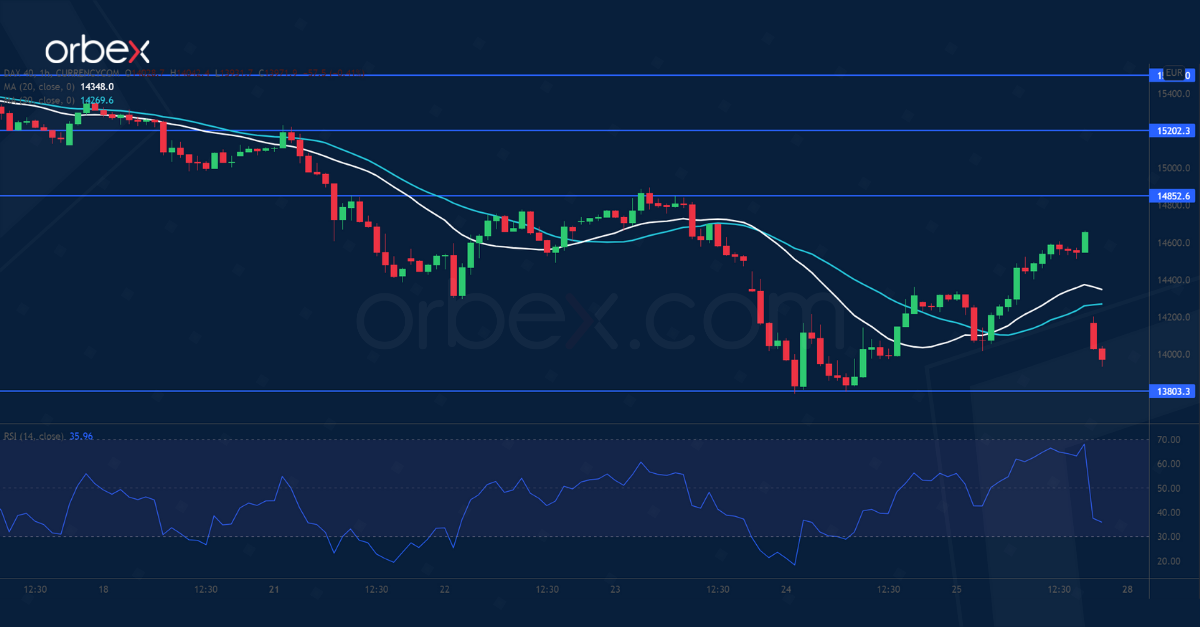
The Dax 40 rebounds as traders bet that sanctions against Russia may not reach their full extent.
The index saw solid bids near its 12-month lows (13800). The RSI’s repeated oversold indication has led short-term sellers to take profit in this key demand zone. 14850 from the tip of a previous bounce is the immediate resistance where the bears could be awaiting to sell into strength.
A bullish breakout could soothe a battered mood. Otherwise, another round of sell-off may push the index below 13500.
GBP/USD Looks to Steady
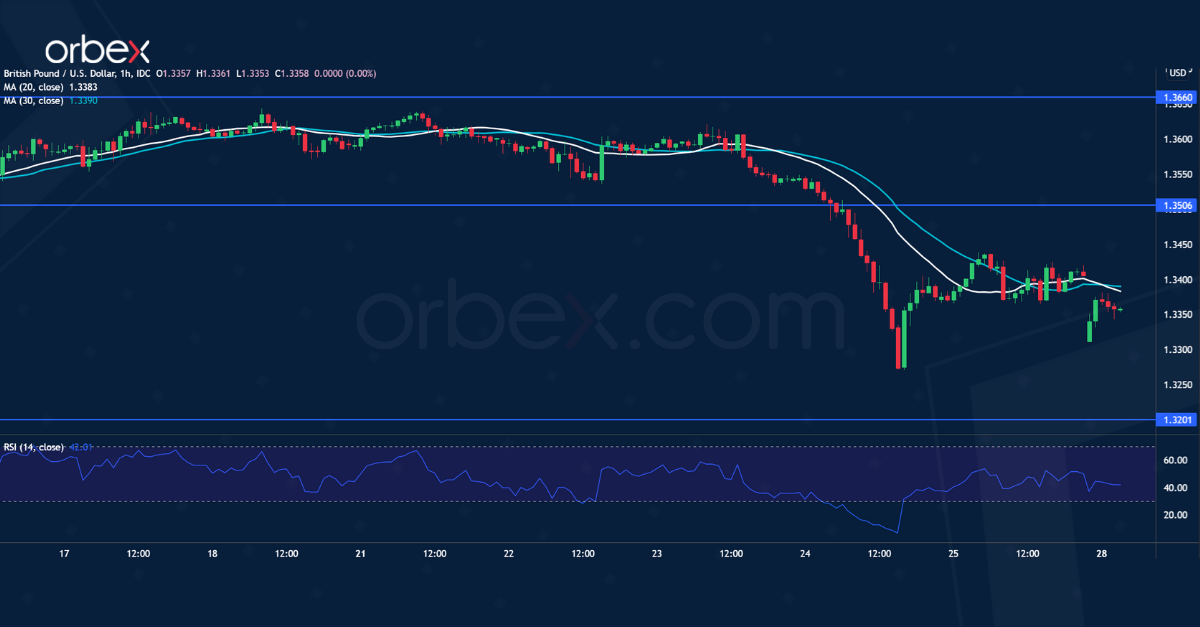
The sterling recoups some losses as sentiment stabilizes after the initial fear-driven sell-off.
A clean cut through the daily support at 1.3360 has triggered a wave of liquidation. Sentiment remains downbeat despite the recent rebound. A deeply oversold RSI attracted some bargain hunters.
However, the pound is vulnerable to another sell-off as buyers could be wary of catching a falling knife. 1.3500 from the previous consolidation range is the closest resistance. Further down, 1.3200 (near last December’s lows) might be the next target.
Gold Currently Consolidating Losses from 1,878 Low
Gold price started a major increase above the $1,900 resistance against the US Dollar. The price broke the $1,950 resistance level, but it struggled to clear the $1,975 zone.
The price started a fresh decline and traded below the $1,950 level. The bears pushed the price below the $1,900 level and the 50 hourly simple moving average. The price traded as low as $1,878 and is currently consolidating losses.
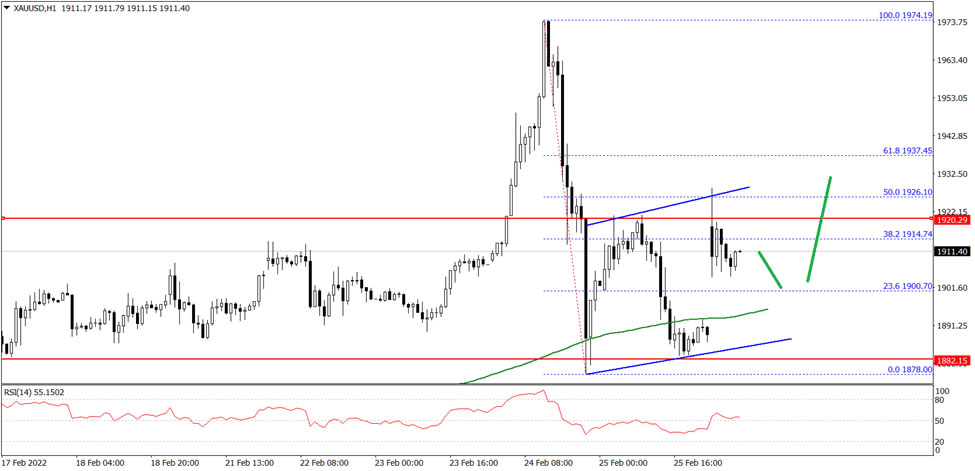
On the upside, the price is facing resistance near the $1,920 level. The next main resistance could be near the $1,932 level, above which the price could rise towards the $1,950 level. Any more gains might open the doors for a move to $1,975 on FXOpen.
If not, it could drop below $1,900. The next major support is near $1,885, below which the bears might gain strength. In the stated case, the price could start a steady decline towards $1,865.
Risk Assets Slip Again on Harsher Russian Sanctions
US and European equity futures fell dramatically in early Asian trading hours along with bond yields, while the dollar and commodity prices surged as investors looked for havens to hedge their portfolios, following the latest developments in the Ukraine crisis.
The Russian ruble plunged by almost 30% to trade at a new record low of 106 ruble per dollar after Western countries blocked a list of Russian banks from the SWIFT global payment system. Fears that oil supplies could be disrupted sent Brent crude 5% higher and European gas futures rose by more than 60%. The decision to cut Russia from the global payment system could possibly halt gas supplies to Europe and lead to dangerous economic consequences on the continent and the rest of the world.
Investors are still trying to figure out what happens next and act accordingly. Dip buyers emerged on Thursday and Friday, just one day after the large-scale military attack, but now they are seeking shelter again after they realized that this war is not a one-day event and outcomes are hard to predict.
The world has not seen a military confrontation on such a scale since World War II, and no one seems to know how this will end. It’s not just the direct effects that worry investors such as the short-term impact on commodity prices, but the longer-term consequences are of even greater importance.
Monetary and fiscal policy makers across the Western world have already exhausted their tools in response to the coronavirus pandemic. Now they are facing a new crisis with bloated fiscal deficits and near zero interest rates. So, any response from governments will be limited in supporting the economy or financial markets in case of turmoil and investors will be left on their own.
The Fed, ECB, and other major central banks are already behind the curve with inflation levels at multi-decade highs. The current geopolitical crisis will only add further upward pressure on prices, and central banks are left with no option but to tighten policy. So those counting on monetary policy makers to intervene in case of a meltdown will be disappointed.
The global economy may not be headed towards a recession, but the chances of one have increased over the past few days. The trajectory of the ongoing conflict will be an important factor to investors as it will either encourage dip buyers to emerge or lead to further steep selloffs.
Allocation to cash needs to be high in current circumstances. Even companies with very solid financials will be highly correlated to the overall market. A defensive approach is needed as volatility continues to spike, but with such volatility comes long term investment opportunities, and hence cash is vital.
Swiss KOF dropped to 105 in Feb, primarily on manufacturing
Swiss KOF Economic Barometer dropped from 107.2 to 105 in February, below expectation of 108.5. KOF said, "the indicators from the manufacturing sector are primarily responsible for the decline, followed by those from the financial sector. The signals for the Swiss exporters are somewhat more favourable than before. "

Gold Decreases Sharply after the Spike to New 19-month Peak
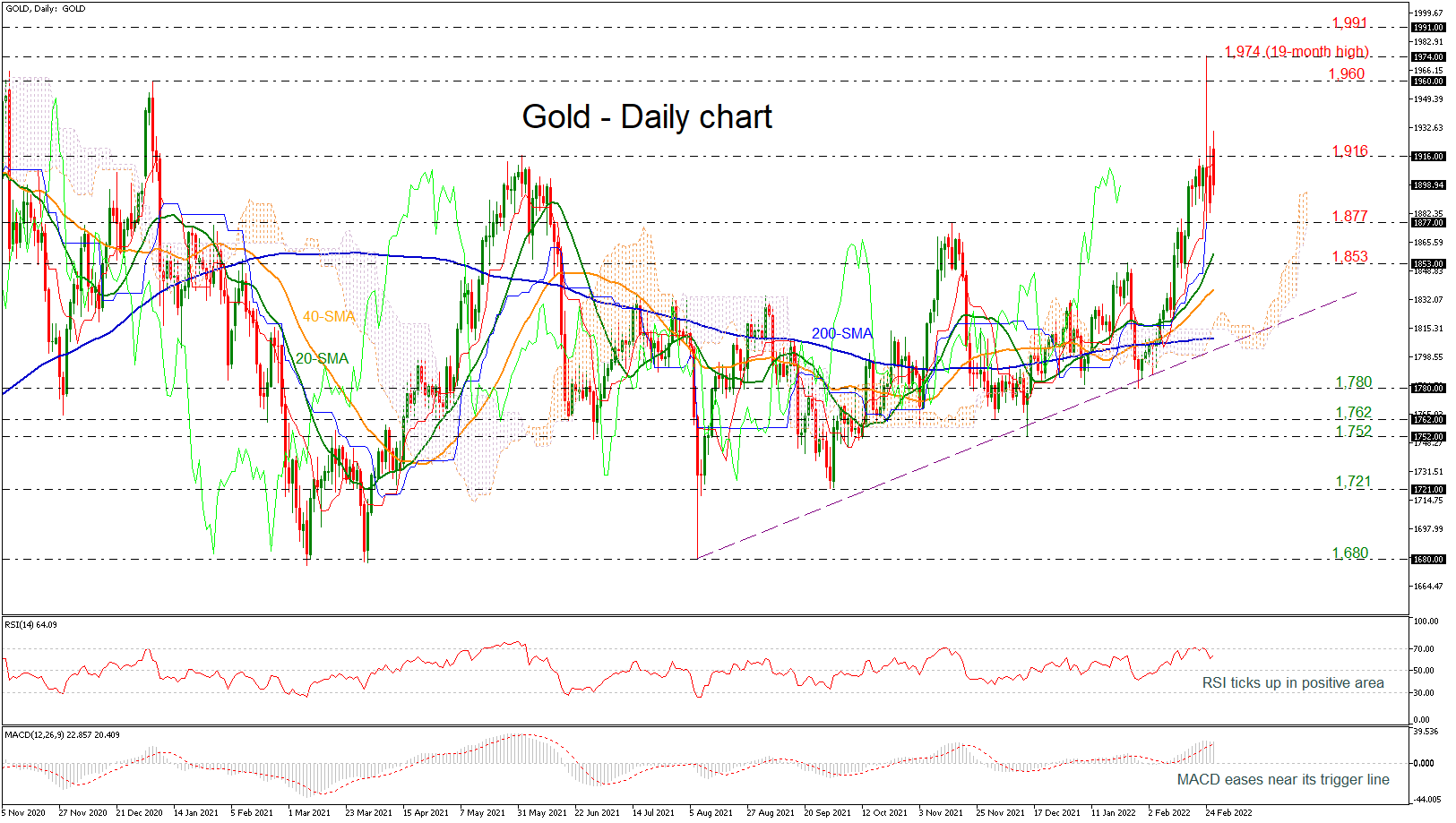
Gold prices started the day with a positive gap, but they quickly declined lower, unable to re-challenge the 19-month high of 1,974. The RSI indicator is showing some positive signs as it is pointing upwards in the bullish region; however, the MACD is approaching its trigger line for a bearish cross above its zero level.
In case there are steeper declines the next immediate support could come from the 1,877 barrier and then from the 20-day simple moving average (SMA) at 1,859 ahead of the 1,853 support level. More downside pressures could visit the 40-day SMA at 1,837 and the 200-day SMA at 1,808, which encapsulates the long-term ascending trend line and the Ichimoku cloud. Any moves below these obstacles could open the window for a bearish market in the short-term view.
On the other hand, a climb above the strong resistance at 1,916 could take the bulls until the 1,960 barrier, taken from the peak on January 2021 before meeting again the 19-month top of 1,974. Above these hurdles, the next stop could come from the 1,991 mark, registered in August 2020.
All in all, the yellow metal is creating a negative move after the aggressive spike towards the multi-month high in the previous week. However, the broader picture is still bullish and only a fall below the 200-day SMA and the uptrend line may change this view.