

Sample Category Title
Australian NAB quarterly business confidence improved, but likely short-lived
Australia NAB quarterly Business Confidence index rose from 0 to 6 in Q2. Current Business Conditions index dropped from 4 to 1. Next 12 months Business Conditions index rose from 22 to 23. Next 12 months Capex Plans rose from 22 to 24.
Alan Oster, NAB Group Chief Economist said the down tend in conditions continued. And, the quarterly survey has now show a below average reading, for the first time since 2014. The decline in conditions suggests "business sector has lost significant momentum over the past year", and "we are unlikely to see a substantial pickup in growth in the Q2 national accounts".
On the other hand, "the strong lift in confidence appears to be related to the outcome of the Federal election, with the bulk of the survey conducted post election day and also around the time of firming expectations of rate cuts". But such lift should be short-lived as already shown in the June monthly business survey.
Market Morning Briefing: Dollar-Yen Has Also Not Been Able To Break Above 108.50
STOCKS
Equities are continuing to trade subdued as the renewed threats on the US-China trade war front are weighing on the market. The Asians are trading in red following the negative close in the US and European markets overnight. The near-term view has turned weak and the global indices can dip further, may be for the rest of the week.
Dow (27219.85, -115.78, -0.42%) has turned around as expected towards 27200. However, the pull-back has happened little earlier from just below the expected resistance level of 27500. We remain bearish in the near-term for the Dow to test 27000. We also remain cautious as a break below 27000 will see the fall accelerating towards 26500 or even lower thereafter.
DAX (12341.03, -89.94, -0.72%) has come-off failing to rise past 12450. A test of 12300-12250 is possible now. A close below 12250 will turn the near-term outlook negative to test 12000 on the downside which will then delay our expected rise beyond 12450.
Nikkei (21142.31, -326.87, -1.52%) has tumbled much beyond our expected level of 21300. The near-term view is negative to test 20900 and 20750. Resistance is at 21350.
Shanghai (2908.71, -22.99, -0.78%) has dipped towards the lower end of our preferred 2900-2950 range. We expect this range to remain intact and a bounce to 2950 is possible. But in case of a decisive break below 2900 we will have to allow for a fresh fall to 2850.
Sensex (39215.64, +84.60, +0.22%) has inched slightly higher but seems to lack strength. It has to sustain above 39000 to test 39500 and negate the bearish view. But a dip below 39000 can drag it lower to 38750 and 38500 which will bring back our bearish view into the picture.
Similarly, Nifty (11687.50, +24.90, +0.21%) has to sustain above 11650 to keep the near-term view bullish and test 11700 initially and then 11800 or even higher levels eventually.
COMMODITIES
Metals are trading strong with Silver outperforming just now. Copper looks bearish. Crude prices dipped after a modest inventory draw of 3.1mln barrels was reported for the week ended 12th July’19.
Gold (1424) could fall towards 1400-1380 in the near term while 1440 holds. Overall range of 1380-1440 is holding well for now. A break on the upside could be seen after the ranged move ends possibly by next week.
Silver (16.15) has risen sharply outperforming Gold in the near term. It would be important to see if 16.25/50 can produce a rejection just now and lead to a short corrective dip in Silver price towards 15.50.
Copper (2.7060) could hold below 2.75 and target lower levels of 2.60 in the near term.
Brent (63.81) and WTI (56.91) are trading low today. A test of 62-60 and 56-54 looks likely on the downside in the medium term.
FOREX
Dollar Index (97.36) tested an intra-day high of 97.44 yesterday before coming off from there. The fall has been in line with our expected view of resistance at 97.50 holding in the near term. While the fall sustains, a test of 96.75 is possible in the next 1-2 sessions.
Euro (1.12) has bounced from support near 1.12 and while that holds Euro could move up towards 1.13 again in the next 2-3 sessions. Immediate view is bullish above 1.12.
Dollar-Yen (107.74) has also not been able to break above 108.50. Immediate trade within 108.5-107.5 is likely to continue for some more time unless a sharp break on either side is seen. On the downside, a break below 107.50 could extend the fall towards 107.
Euro-Yen (121.07) has dipped slightly and is trading near crucial support levels just now. We would closely watch price action near 121. A break below 121 could be indicative of further bearishness in the medium term.
Aussie (0.7028) has immediate resistance above current levels. The currency looks bearish for the medium term, initially targeting 0.6950 in the coming sessions.
Pound (1.2438) has fallen well from resistance at 1.26 and while that holds, Pound could target 1.22 in the near term.
USDCNY (6.8760) is trading in a very narrow range and could see a sharp movement on either side of current levels to target 6.90 or 6.86/84 in the near term. Equal chances of moving on either side looks possible.
USDINR (68.82) closed about 10paise higher than the close seen on Tuesday. There is scope for rise towards 69.0-69.25 in the near term before the pair comes off room there. Near term looks bullish for Dollar-Rupee.
INTEREST RATES
The US Treasury yields have dipped sharply across tenors yesterday as the weak housing data and the renewed trade war concerns weighed on the bond market. The US 2Yr (1.81%), 5Yr (1.81%), 10Yr (2.04%) and 30Yr (2.56%) were down between 4 bps to 6 bps. The sharp fall has reduced the chances of further rise that we have been expecting. The 30Yr can dip to 2.50% while the 10Yr is in a danger of declining below 2% again.
The German yields have also declined sharply and the resistances mentioned yesterday seem to be holding well. The 5Yr (-0.64%), and 10Yr (-0.29%) yields were down 4 bps each while 30Yr (0.28%) was down 5 bps. The 2Yr (-0.76%) remained stable. The yields can dip further in the near term. The 10Yr can test -0.40% while the 30 Yr can dip to 0.20%.
The 10Yr GoI (6.3446% dipped to 6.25% as expected and has bounced from there. We expect it to sustain above 6.25% and bounce to 6.5% in the coming days.
Australian employment grew 0.5k, unemployment rate unchanged at 5.2%
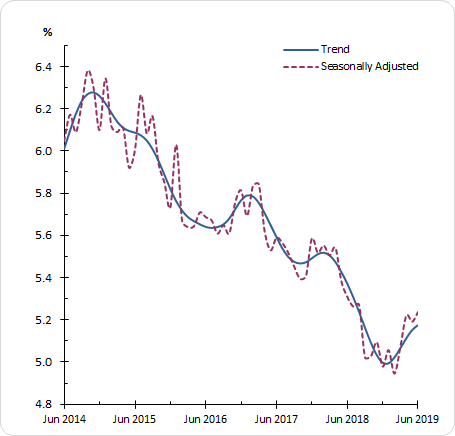
Australia employment grew just 0.5k in June, below expectation of 9.1k. Full-time jobs increased 21.1k while part-time jobs decreased -20.6k. Unemployment rate was unchanged at 5.2% with participation rate steady at 66.0%.
ABS Chief Economist Bruce Hockman said, "Australia's participation rate was at 66 per cent in June 2019, which means nearly two of every three people are currently participating in the labour market. The participation rate for 15 to 64 year olds was even higher and closer to four out of every five people."
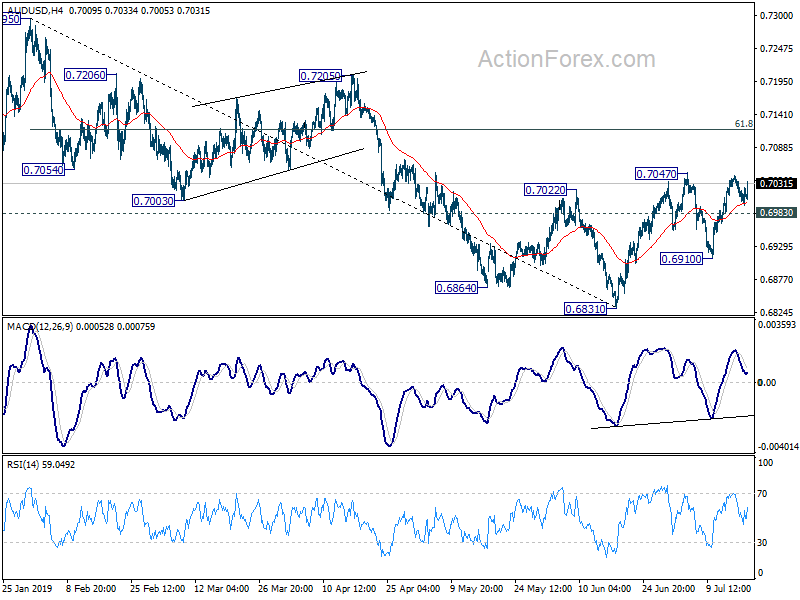
AUD/USD recovers strongly today despite the job data miss. With 0.6983 minor support intact, further rise is mildly in favor. Break of 0.7047 resistance will resume the rebound from 0.6831 to 61.8% retracement of 0.7295 to 0.6831 at 0.7118.
Japan’s export dropped for the seventh straight month
In non seasonally adjusted terms, Japan exports dropped -6.7% yoy to JPY 6.585T in June. That's the seventh straight month of decline. Imports dropped -5.2% yoy to JPY 5.995T. Trade surplus came in at JPY 0.589T.
Looking at some details, exports to China dropped -10.1 yoy and imports dropped -5.3% yoy. That's the fourth straight month of decline in exports to China. Exports to US rose 4.8% yoy while imports dropped -2.5% yoy. That's the ninth straight month of increase in exports to US.
In seasonally adjusted terms, exports rose 4.8% mom to JPY 6.554T in June. Imports dropped -4.4% mom to JPY 6.568T. Trade deficit came in at JPY -0.014T.
Fed’s Beige Book: Outlook generally positive for the coming months
Fed's Beige Book noted that outlook generally was "positive for the coming months" with expectations of "continued modest growth". Though, there were "widespread concerns about the possible negative impact of trade-related uncertainty".
Employment grew at a "modest pace" but "slightly slower" than previous reporting period. Compensation grew at a "modest-to-moderate pace" but some contacts "emphasized significant increases in entry-level wages".
Rate of price inflation was "stable to down slightly" from prior period. Districts generally saw "some increase in input costs, stemming from higher tariffs and rising labor costs". However, the ability to pass on to final prices was "restrained by brisk competition".
Crude Oil Price Correcting Gains But Remains Supported
Key Highlights
- Crude oil price struggled two times to clear the $60.85 resistance against the US dollar.
- There was a break below a major bullish trend line at $58.70 on the 4-hours chart of XTI/USD.
- Canada’s CPI declined 0.2% in June 2019 (MoM), similar to the forecast.
- The US Initial Jobless Claims for the week ending July 13, 2019 might increase from 209K to 216K.
Crude Oil Price Technical Analysis
After forming a support base near $56.00, crude oil price climbed higher steadily above $58.00 against the US Dollar. The price even broke the $60.00 resistance area, but it struggled to climb above $60.85-60.90.
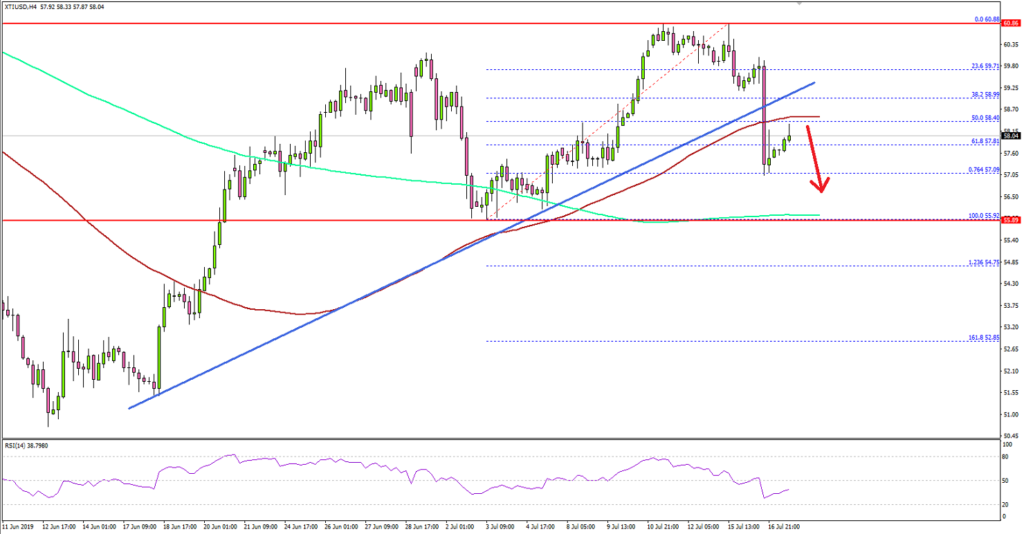
Looking at the 4-hours chart of XTI/USD, the price made two attempts to climb further above $60.85. However, the bulls struggled to gain momentum, resulting in a bearish reaction below $60.00.
The price formed a swing high $60.88 and recently declined below a major bullish trend line at $58.70 on the same chart. Later, there was a break below the $58.50 support plus the 100 (red) simple moving average (4-hours).
Moreover, the price declined below the 61.8% Fib retracement level of the upward move from the $55.92 low to $60.88 high. It seems like the price has started a downside correction and it may continue to correct lower.
The main support on the downside is near the $56.00 level and the 200 (green) simple moving average (4-hours). As long as the price is above $56.00, it could bounce back and resume its upward move. If not, there is a risk of more downsides below $55.00 and $54.00.
Fundamentally, the Canadian Consumer Price Index (CPI) for June 2019 was released by the Statistics Canada. The market was looking for a 0.2% decline in the CPI, compared with the last increase of 0.4%.
The actual result was similar to the forecast, with a decline of 0.2% in the CPI. The yearly change posted a 2.0% increase, down from the last 2.4%. Looking at the BoC’s CPI report, there was no change in the Core CPI in June 2019 (MoM), whereas the market was looking for a 0.1% increase.
The report by the Statistics Canada added:
Energy prices fell 4.1% year over year in June, following a 0.1% decrease in May. Consumers paid less for gasoline (-9.2%) and fuel oil and other fuels (-4.1%). This was due in part to falling oil prices amid rising fuel inventories in the United States and the elimination of carbon pricing in Alberta at the end of May.
Looking at major pairs, EUR/USD and GBP/USD are trading in bearish zone and they might find it difficult to correct higher in the short term.
Economic Releases to Watch Today
- UK Retail Sales for June 2019 (YoY) – Forecast +2.6%, versus +2.3% previous.
- UK Retail Sales for June 2019 (MoM) – Forecast -0.3%, versus -0.5% previous.
- US Initial Jobless Claims – Forecast 216K, versus 209K previous.
Fed’s Beige Book Points to Modest Growth Amid Lingering Uncertainty
- Today's Beige Book showed that economic activity increased at a modest pace across all Federal Reserve Districts from mid-May to early-July, little changed from the previous reporting period.
- Broadly, manufacturing activity was flat or slightly weaker, but a few Districts noted signs of a modest pickup (Atlanta, Dallas and Richmond).
- The labor market continued to be characterized as tight, with the shortage of workers especially acute in construction, information technology, and health care. However, employment growth has moderated somewhat relative to the previous reporting period, and some manufacturing and IT firms in the Northeast were reportedly scaling down their payrolls. There were also some concerns among businesses about securing and renewing work visas, which was flagged as a risk. Compensation growth was unchanged, with wages increasing at a modest-to-moderate pace but entry-level wage growth has strengthened.
- In terms of consumer spending, retail sales were said to have increased slightly, even though vehicle sales were flat. Tourism activity was solid.
- Assessment of activity in residential construction and real estate was mixed. Sales of homes have picked up somewhat, but homebuilding remained flat. Things were somewhat hotter outside of the residential sector, with nonresidential construction increasing or remaining strong in most Districts.
- Inflation was reported as stable to down slightly from the prior reporting period. Prices for steel and lumber softened due to lower demand. Elsewhere, businesses reported some upward pressure in input costs stemming from tariffs and the rising cost of labor, but reported limited ability to pass those increases to consumers due to stiff competition.
- Trade uncertainty remained top of the mind for survey respondents: "tariffs" were mentioned 33 (vs. 37 times previously) in the report, and "uncertainty" was mentioned 21 times (vs. 19 times previously). However, despite substantial concern among respondents about the trade-related risks, the outlook for the coming months was positive "with expectations of continued modest growth".
Key Implications
- This as another steady-as-she-goes Beige Book report. While trade uncertainty continue to rear its head in business surveys, particularly on the manufacturing side, overall domestic economy continue to hold up reasonably well with activity running at the not-so-hot – not-so-cold pace.
- Overall, we expect economic growth to moderate in Q2, and today's edition of the Beige Book appears to be consistent with this view. As the temporary factors that boosted headline growth in Q1 reverse course this quarter, growth is likely to come in around 2%.
- From the Fed's standpoint this report doesn't provide much new information, largely reflecting developments which have already been communicated by other data releases. While the domestic economy continues to hold up quite well and consumer spending is expected to rebound in Q2, crosscurrents and risks remain elevated. This is likely to prompt the Fed to take out an insurance cut at the end of July.
CRUDE OIL Corrective Pullback Mode Remains
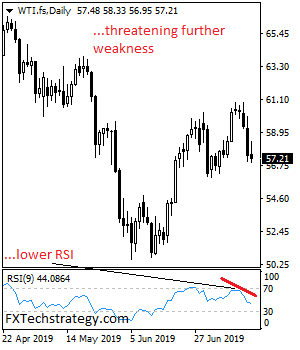
CRUDE OIL corrective pullback mode remains as more decline is likely in the days ahead. Support lies at the 56.50 level where a break will expose the 56.00 level. A cut through here will set the stage for a run at the 55.50 level. Further down, support comes in at the 55.00 level. Its daily RSI is a bearish and pointing lower suggesting further weakness. On the upside, resistance resides at the 57.50 levels. Further out, resistance comes in at the 58.00 level. A break above here will aim at the 58.50 level and then the 59.00 level followed by the 59.50.00 level. All in all, CRUDE OIL remains biased to the downside nearer term on pullback.
US Crude Oil Inventory Fell, While Fuel Stockpile Gained
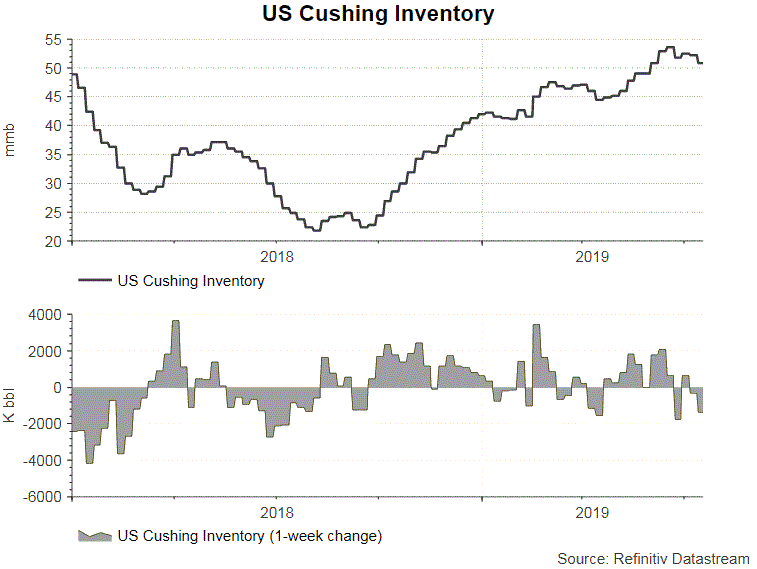
The report from the US Energy Information Administration (EIA) shows that total crude oil and petroleum products (ex. SPR) stocks jumped +11.66 mmb to 1315.23 mmb in the week ended July 12. Crude oil inventory declined -3.12 mmb to 455.88 mmb (consensus: -2.69 mmb). Inventories fell in 4 out of 5 PADDs. Stockpile in PADD2 (Midwest) alone dipped -1.5 mmb during the week. Cushing stock slipped -1.35 mmb to 50.83 mmb. Utilization rate dropped -0.3 percentage point to 94.4% while crude production slipped -0.3M bpd to 12M bpd for the week. Crude oil imports dropped -0.47M bpd to 6.83M bpd in the week.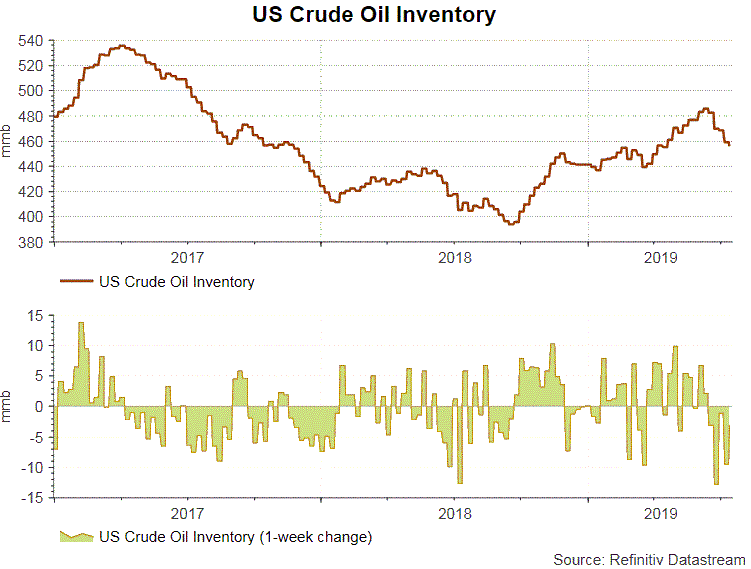
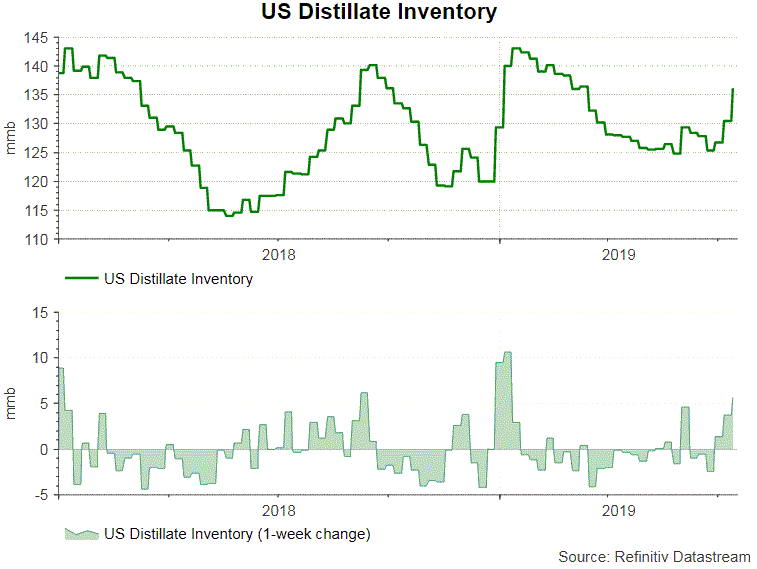
Concerning refined oil product inventories, gasoline inventory rose +3.57 mmb to 232.75 mmb as demand plunged -5.54% to 9.21M bpd. The market had anticipated a -0.93 mmb decrease in stockpile. Production fell -5.4% to 9.86 bpd while imports slipped -2.18% to 0.85M bpd during the week. Distillate inventory gained +5.69 mmb to 136.2 mmb. Demand added +0.39% to 3.57M bpd. The market had anticipated a +0.61 mmb increase in inventory. Production was largely unchanged at 5.36M bpd while imports slumped -27.1% to 0.13M bpd during the week.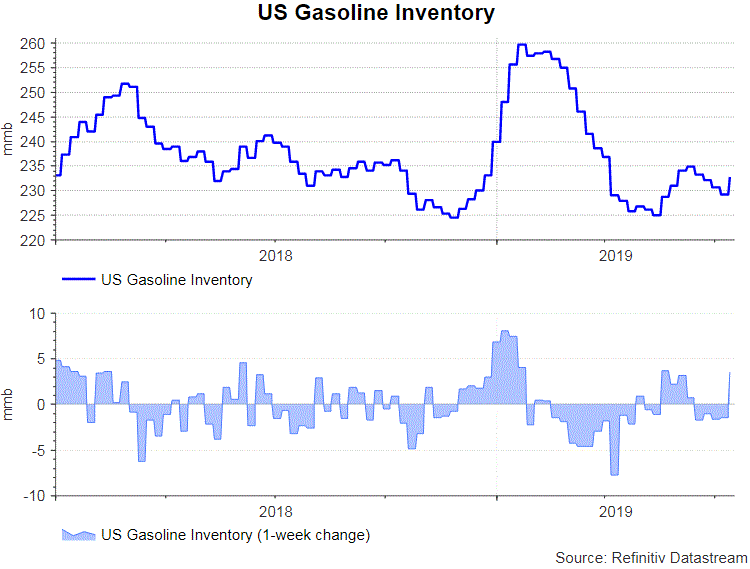
 Released after market close on Thursday, the industry- sponsored API estimated that crude oil inventory dropped -1.4 mmb during the week. For refined oil products, gasoline stockpile slipped -0.48 mmb while distillate gained +6.2 mmb.
Eco Data 7/18/19
[php_everywhere instance="1"]