Sample Category Title
EURNZD Persists with the Sell-off Towards Weekly Uptrend Line; Sellers Dominate in Short-Term
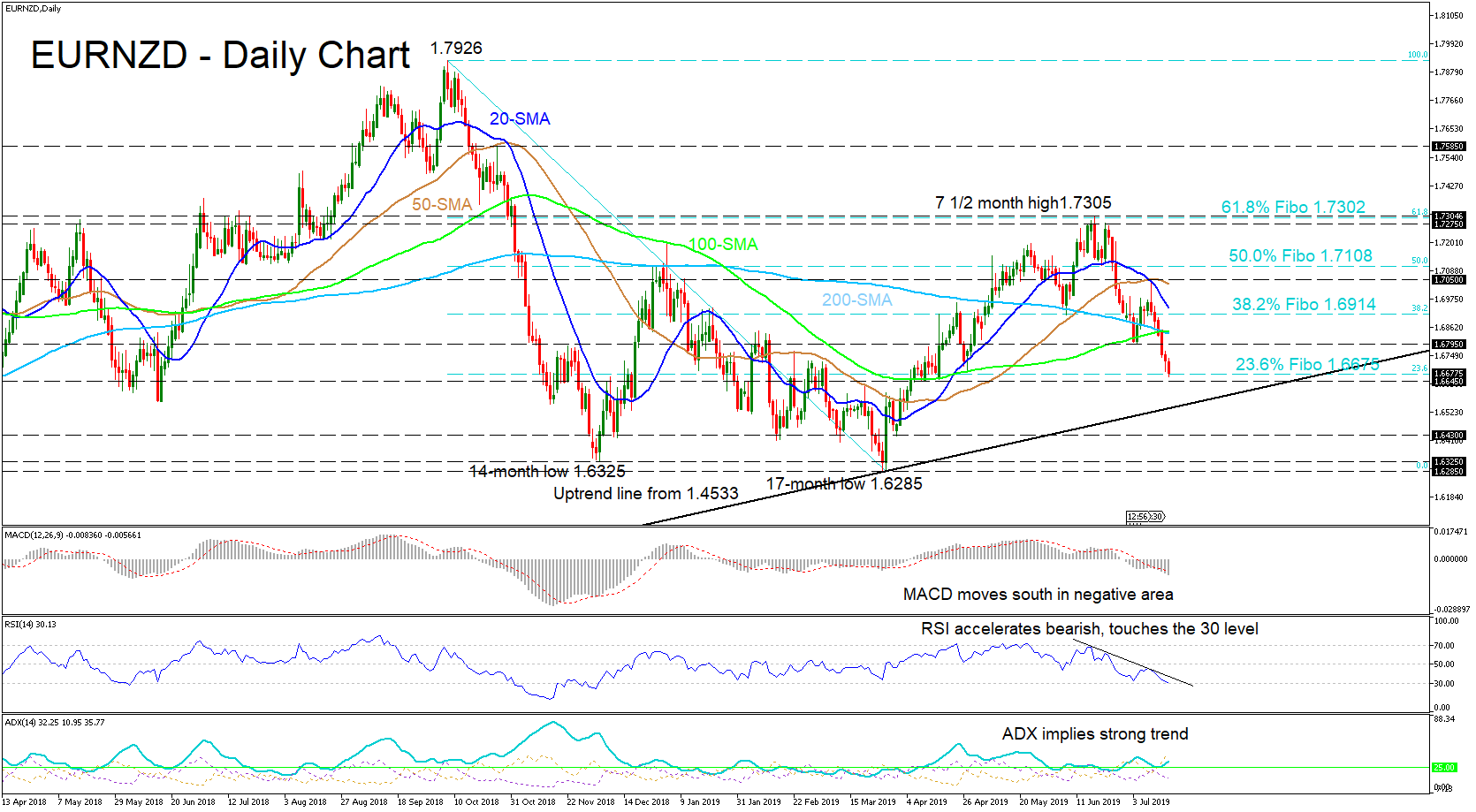
EURNZD kept up the downwards move after surpassing the previous swing low of 1.6795 to flirt next with the 23.6% Fibonacci of the down move from 1.7926 to 1.6285, of 1.6675. Although the price fell below the coupled 100- and 200-day simple moving averages (SMAs), the 100-SMA has slightly crossed above the 200-SMA, suggesting maybe a pullback could be coming.
The bearish momentum is confirmed by the MACD moving south in the negative area and the RSI accelerating down to touch the oversold level. Furthermore, the ADX hints that the downtrend is strong.
Bearish continuation in the short-term would require the breech of the 23.6% Fibo of 1.6675 and the nearby support of 1.6645, before the move can even test the uptrend line from February 2017, which started from the low of 1.4533. For a medium-term bearish outlook, the fracture of the 14- and 17-month lows is necessary.
To the upside, the 100-SMA and 200-SMA suggest that the price may stall around 1.6675 – 1.6645, or at the uptrend line, before moving north. To become bullish, the price would need to ultimately move above the seven and a half-month high of 1.7305, after facing the resistances and Fibonacci levels in between.
For now, the short-term bearish bias remains.
Oil Mixed After EIA Report Shows Large Drawdown
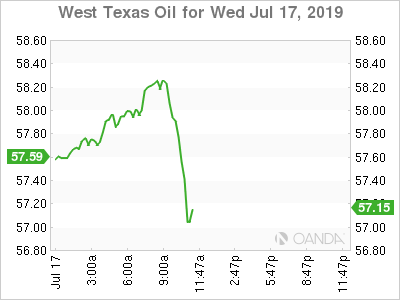
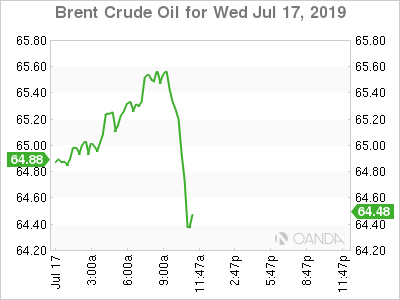
Oil rose on Wednesday after the release of the Energy Information Administration (EIA) weekly crude inventories report showed a larger drawdown than anticipated at 3.1 million barrels of crude, a surprise buildup of 3.6 million barrels of gasoline and a larger than expected buildup of distillates at 5.7 million barrels.
Crude was under pressure from easing Middle East tensions but the bigger than expected drawdown is giving oil prices a boost with WTI up 0.52 percent and Brent 0.9 percent.
Weather related supply disruptions in the Gulf of Mexico affected around 70 percent of production in the area, but it will slowly get back online, but could lead to lower stock data in the next weekly report.
Easing of tensions between the US and Iran, mixed Chinese growth data and storm hit operations getting back online are all pressuring oil prices downward.
Oil prices were lower on Tuesday as Middle East tensions eased after comments from US Secretary of Sate Mike Pompeo about Iran’s willingness to negotiate.
Previously Iran had a more aggressive stance, but after President Hassan Rouhani said on Sunday that Iran is ready to hold talks if sanctions were lifted, a diplomatic avenue thought to be exhausted came back into play although it did so at the same time of the threat of higher uranium enrichment. Tensions could still flare up as Iran denies it is ready to negotiate on its missile program.
EURGBP Holds Above 0.90 Level But Risk of Pullback on Profit-Taking Exists
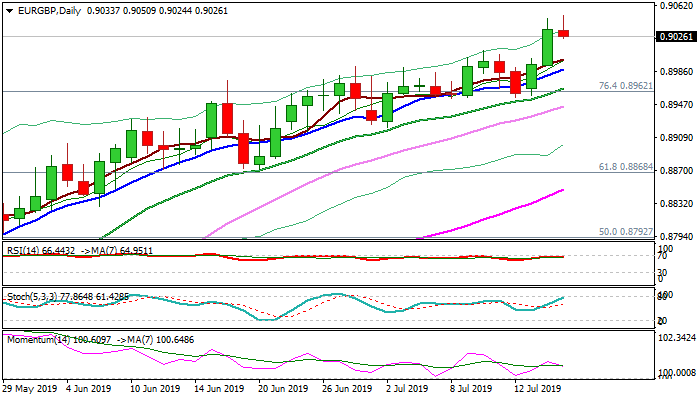
The cross is attempting to establish above broken psychological 0.90 level after hitting new high at 0.9050 (the highest since 11 Jan) on Wednesday.
Steep 2 ½ month uptrend accelerated on Tuesday and closed above 0.90 barrier for the first time since 9 Jan after pound was hit by overall negative UK labor data, while today’s UK CPI in line with expectations, showed no significant impact on pound.
Strong negative sentiment on fears of no-deal Brexit was fueled by pessimistic comments from UK officials who see no possibility of approving current Brexit deal without changes.
On the other side, profit-taking after bulls reached certain targets, can push the price lower into adjustment.
Weaker momentum on daily chart supports the notion, with limited dips expected to find ground at 0.8987/66 zone (rising 10/20DMA’s) to keep immediate bulls intact and prevent deeper pullback towards troughs at 0.8920 and 0.8872.
Res: 0.9050; 0.9061; 0.9087; 0.9113
Sup: 0.9000; 0.8987; 0.8966; 0.8920
IMF: Trade tensions could become entrenched over medium term
IMF said in its latest External Sector Report that overall current account surpluses and deficits reached 3 percent of world GDP in 2018. Around 35-40% of them are deemed excessive.
Higher-than-warranted balances remained centered in the euro area as a whole (driven by Germany and the Netherlands) and in other advanced economies (Korea, Singapore).
Lower-than-warranted balances remained concentrated in the United Kingdom, the United States, and some emerging market economies.
China's external position, however, was assessed to be in line with fundamentals and desirable policies.
IMF also warned that "an intensification of trade tensions or a disorderly Brexit outcome—with further repercussions for global growth and risk aversion—could, however, affect other economies that are highly dependent on foreign demand and external financing."
"Over the medium term, in absence of corrective policies, trade tensions could become entrenched, and further divergence of external stock positions could trigger costly disruptive adjustments in key debtor economies that could spill over to the rest of the world.
Oil inventories dropped -3.1m barrels, WTI steady
US commercial crude oil inventories dropped -3.1m barrels in the week ending July 12, less than expectation of -3.1m barrels. At 455.9m barrels, crude oil inventories are about 4% above the five year average for this time of year.
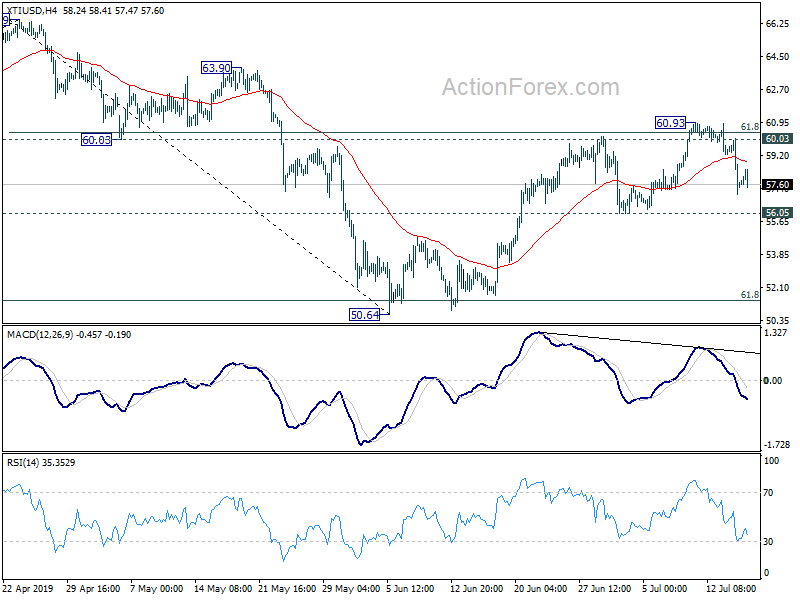
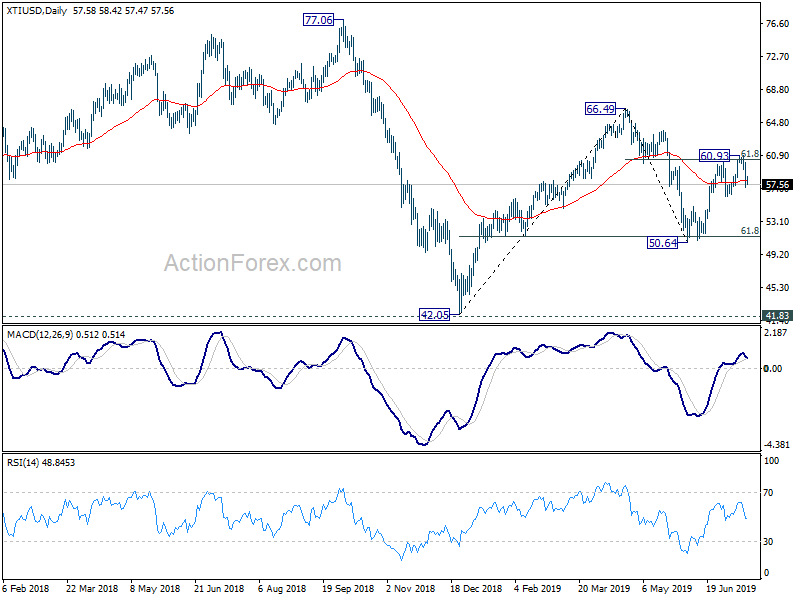
WTI crude oil has little reaction to the release. It was shot higher to 60.93 last week, mainly due to selloff in Dollar. WTI failed to sustain above 61.8% retracement of 66.49 to 50.64 at 60.34 as expected and dropped sharply lower from there. Focus is now on 56.05 support. We don't expect a break there yet and more range trading is likely between 56.05 and 60.93. Nevertheless, firm break of 56.05 will indicate completion of rise from 50.64 and should pave the way to retest this low.
US: Housing Starts Edge Lower, But Single-Family Starts Up in June
- U.S. housing starts declined by 0.9% to 1.253 million units (annualized) in June from a downwardly revised 1.265 million units in April. The market expected a slightly smaller decline of 0.7%.
- The decline was concentrated in the volatile multi-family segment, which fell by 9.2% to 406k, breaking a four-month streak of increases. The larger single-family segment posted a gain of 3.5% to 847k.
- Permits retreated 6.1% in June to 1.22 million. Multi-family permits plunged by 16.8%, following a more modest 3.0% decline in the previous month, while single-family permits were up marginally by 0.4%.
- On a regional basis, the results were evenly split with starts down in the South (-9.2%) and West (-4.9%), but up in the Northeast (+31.3%) and the Midwest (+27.1%).
Key Implications
- U.S. housing starts continue to move sideways. While down over the past two months, they are up ever so slightly for the second quarter as a whole. Still, the pullback in building permits in June suggests further weakness could be in the pipeline.
- Rising costs, lack of land and labor shortages continue to pose challenges to builders, impeding their ability to fully take advantage lower borrowing rates to construct more in demand entry-level units. Consequently, the housing market continues to face tight inventories and soft sales.
- On the demand side, affordability should remain favorable relative to the past few years, as interest rates stay low and wage growth accelerates.
Canadian Inflation Slows on Falling Gas Prices in June
- Consumer price inflation slowed to 2.0% year-on-year in June (from 2.4% in May). Month-on-month, seasonally adjusted prices edged down 0.1%.
- Falling energy prices were the main factor pulling the headline number lower. Energy prices were down 4.1% from a year-ago (down from -0.1% in May), with gasoline prices down 9.2%. Excluding energy, inflation was up 2.6% (edging down slightly from 2.7% in May).
- Food price inflation was unchanged in June at a still-strong 3.5%.
- Core inflation edged lower in the month. CPI-median was unchanged at 2.2% (upwardly revised from 2.1%), CPI-trim slowed to 2.1% (from 2.3%). The CPI-common measure was unchanged for the fifth straight month at 1.8%. On average, the three core measures are at 2.0% (down from 2.1% in May).
Key Implications
- That was a short stint above 2.0%. With energy prices pulling back, inflation is right back on the 2.0% target.
- Inflation for the quarter as a whole averaged 2.1%, consistent with the Bank of Canada's updated projection. Base effects suggest that headline inflation will cool further in the months ahead, but core measures should remain relatively close to the 2.0% mark.
- Data continue to point to a healthy rebound in Canadian economic activity in Q2 of this year. Alongside encouraging data on wage growth and rebounding housing activity, there is little obvious to point to in terms of domestic concerns. Still, risk management remains the name of the game. With trade tensions elevated and global central banks easing policy in response, the Bank of Canada is likely to remain on the sidelines and especially attentive to signs that global weakness is seeping into Canada.
Sunset Markets Commentary
Markets
Core bonds trade mixed today with German Bunds outperforming steady US Treasuries. There’s no real trigger for Bund strength. European stock markets trade directionless as oil prices pared a small part of yesterday’s significant losses. Weak demand at Germany’s 30-yr Bund auction and a marginal upward revision to June EMU CPI normally plead against Bund strength, but obviously not so today. ECB board member Coeuré repeated that underlying inflation remains muted and that the governing council is determined to act if needed. US housing starts (marginally) and building permits disappointed. The release of the Fed’s Beige Book, preparatory document for the July meeting, can still grab some market attention tonight. Changes on the US yield curve vary between -1.2 bps (10-yr) and +0.4 bps (2-yr). The German yield curve bull flattens with yields down 1.3 bps (2-yr) to 5.1 bps (30-yr). 10-yr yield spreads changes vs Germany are close to unchanged with Greece (+4 bps) underperforming.
This morning, EUR/USD continued suffering from the downside bias that already dominated trading yesterday. Solid US data yesterday, a faltering risk sentiment and yield spreads widening in favour of the dollar still gave the US dollar the benefit of the doubt in summer holiday market conditions. At the same time, poor EMU car sales data confirmed a lackluster economic momentum in the region and weighed on the euro. EUR/USD dropped to the 1.12 figure but the 1.1181 MT support stayed out of reach. EMU June headline inflation printed marginally stronger than expected at 1.3%. The impact on the euro was negligible, but it helped to put a floor for the single currency. The news flow from the US didn’t bring much inspiration to revive FX trading. US housing data were soft but, as usual, were no big issues of USD trading. EUR/USD hovers in the 1.1215 area. USD/JPY (108.25/30 area) stayed well north of 108 as US equites markets are looking for direction as the most recent US equity upleg stalled.
Sterling continued struggling to prevent a new downleg both against the euro and the dollar. Selling sterling remains the path of the least resistance for sterling traders as UK politicians reiterated that the chance of a no-deal Brexit is currently underpriced (Brexit Secretary Steve Barclay). UK June inflation printed close to expectations but a further decline in house prices was seen as an illustration of Brexit uncertainty eroding sentiment for UK assets. EUR/GBP tested the 0.9050 area. From there, sterling selling pressure eased, at least temporarily. EUR/GBP is trading in the 0.9035 area. Cable is changing hands in the low 1.24 area. At least for now, there is no technical signal of a potential trend reversal anytime soon.
News Headlines
UK Brexit minister Barclay thinks chances of a no deal scenario are underpriced when asked about the likelihood of it by UK lawmakers. He pointed at the fact that the amount of legislation required to pass for a deal is significant compared to the relatively short period of time in September and October parliament is due to sit.
The EU has opened an antitrust investigation against Amazon today over its use of customer information. The move is likely to trigger frustration at the US administration. It had its State Department sent letters to embassies in a.o. Spain today, ordering them to warn local governments for retaliatory measures if ‘Google tax’ like or other “discriminating” legislation against US-based companies is passed.
June US housing data disappointed. Housing starts retreated from 1269k to 1253k (-0.9% MoM) while building permits fell to the lowest in two years (1220k, -6.1% MoM). The decline is driven by a significant drop in multi-family residential.
EUR/USD Mid-Day Outlook
Daily Pivots: (S1) 1.1187; (P) 1.1225; (R1) 1.1249; More...
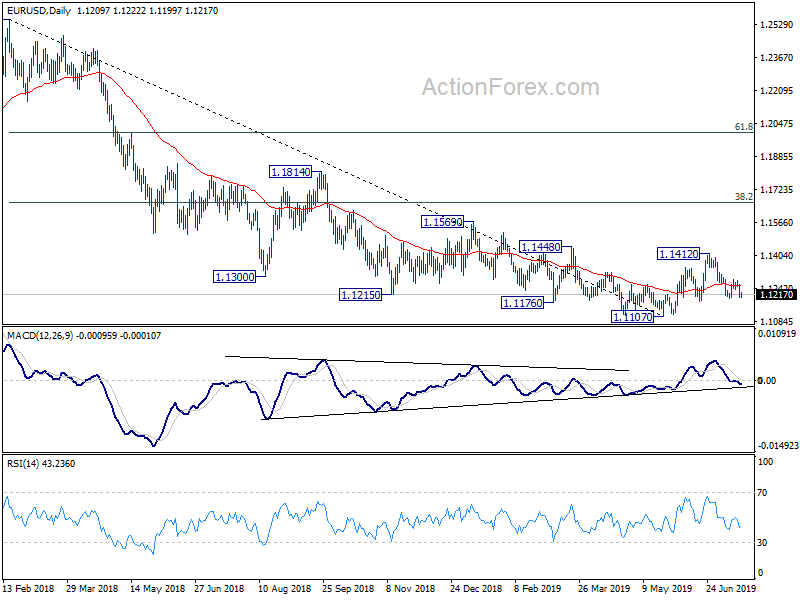
EUR/USD is staying in range of 1.1193/1285 and intraday bias remains neutral first. Break of 1.1193 will resume the fall from 1.1412 to retest 1.1107 low. On the upside, above 1.1285 resistance will turn bias back to the upside for 1.1412 resistance.
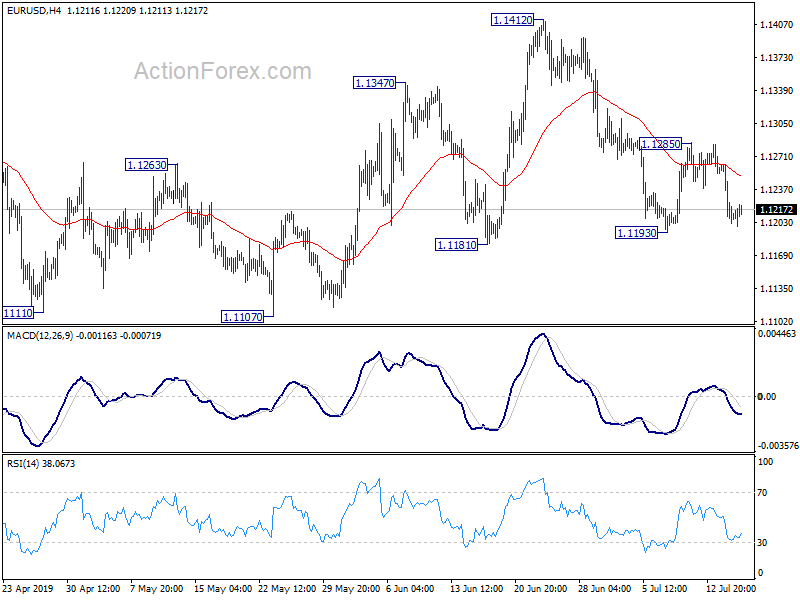
In the bigger picture, bullish convergence condition in daily and weekly MACD suggests that 1.1107 is a medium term bottom. However, rejection by 55 EMA retains medium term bearish. Outlook will be neutral for now. On the downside, break of 1.1107 will resume the down trend from 1.2555 (2018 high) to 78.6% retracement of 1.0339 to 1.2555 at 1.0813. Meanwhile, break of 1.1412 will resume the rebound to 38.2% retracement of 1.2555 to 1.1107 at 1.1660.
GBP/USD Mid-Day Outlook
Daily Pivots: (S1) 1.2361; (P) 1.2441; (R1) 1.2486; More....
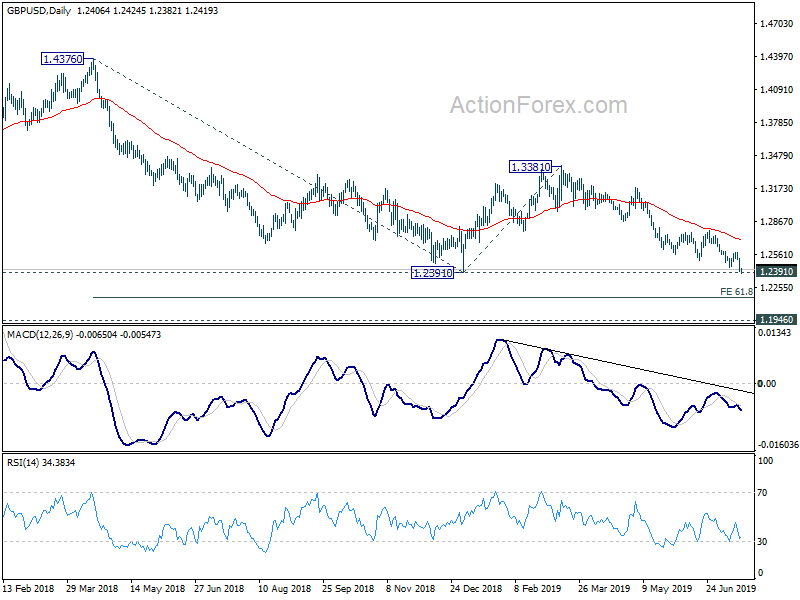
No change in GBP/USD's outlook. Intraday bias stays on the downside with focus on 1.2391 low. Sustained break will resume larger down trend for 61.8% projection of 1.4376 to 1.2391 from 1.3381 at 1.2154 next. On the upside, break of 1.2579 resistance is needed to indicate short term bottoming. Otherwise, outlook remains bearish in case of recovery.
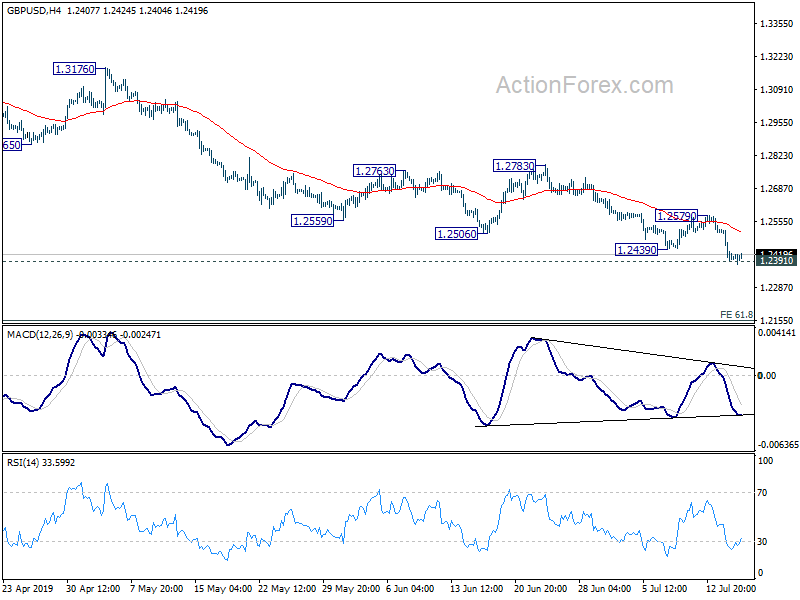
In the bigger picture, down trend from 1.4376 (2018 high) is still in progress. Break of 1.2391 would target a test on 1.1946 long term bottom (2016 low). For now, we don't expect a firm break there yet. Hence, focus will be on bottoming signal as it approaches 1.1946. In any case, medium term outlook will stay bearish as long as 1.3381 resistance holds, in case of strong rebound.