Sample Category Title
Officials Warn Of Possible Slowdown In German Growth
Germany's services sector could see a slowdown in the coming months, alongside sluggish growth in the industrial sector. Germany's economic minister cautioned that the services sector was what was driving Germany's growth so far. Officials are expecting to see growth in Europe's largest economy slowing. This potentially drags the eurozone's growth lower as well.
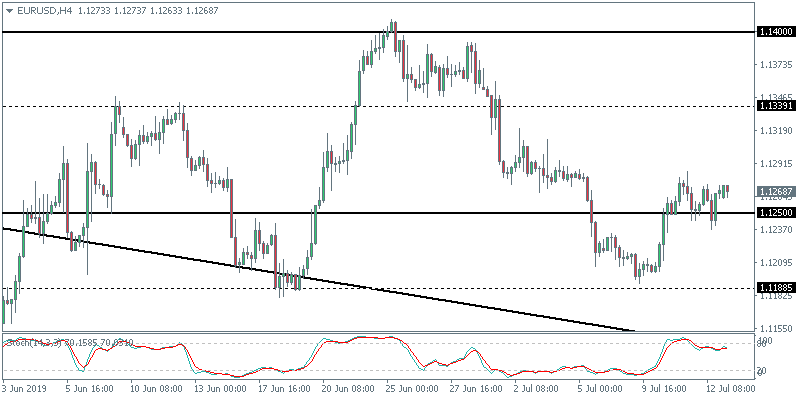
EURUSD Steady Above 1.1250
The common currency held on to the support at 1.1250 level on Monday. Price action was subdued due to lack of any clear fundamentals. However, investors are expecting the ECB to act, either by cutting rates even lower or restarting the QE program. As long as the 1.1250 level holds, the currency pair could be aiming for 1.1400.
EUR/AUD And EUR/NZD – Can Bears Slow Down This Week?
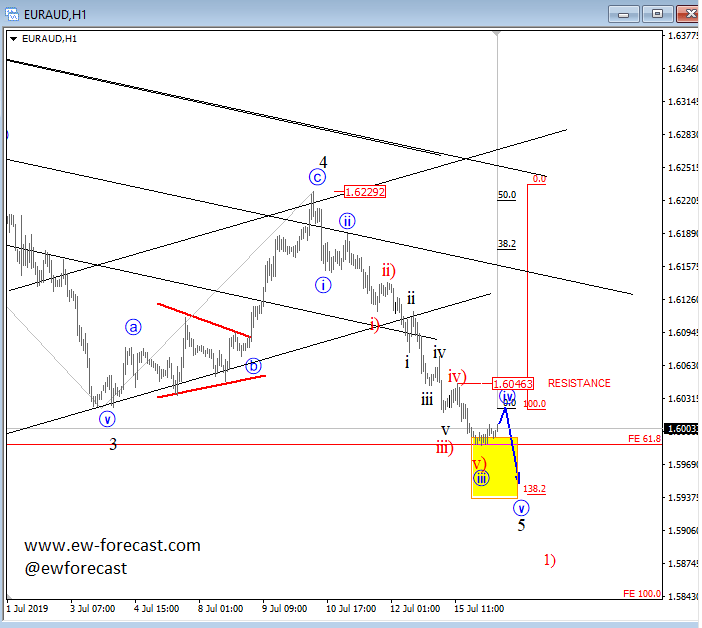
EUR crosses are moving very nicely to the downside, with both EURNZD and EURAUD progressing lower into a fifth wave of a decline. However, we see supports close to current levels, so we should not be surprised if market turns up till Friday.
EURAUD, 1h
 EURNZD, 1h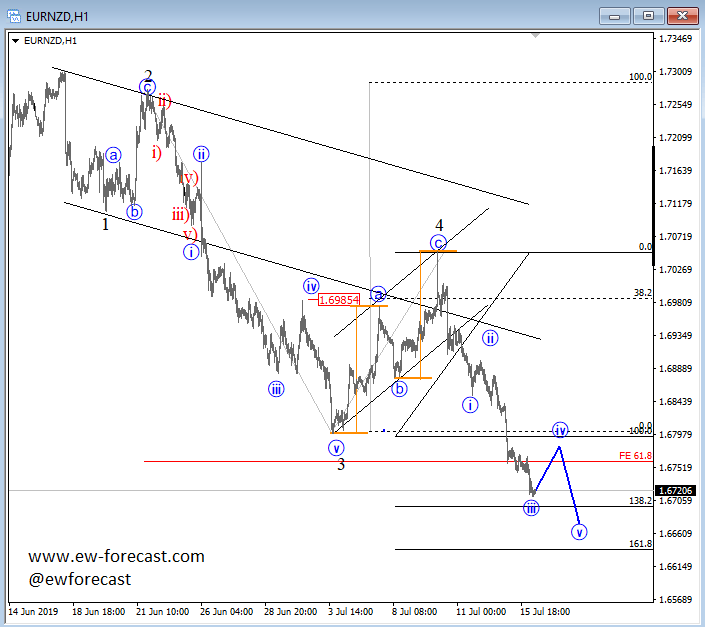
USD/CAD Potential Bounce On A Super-Dot
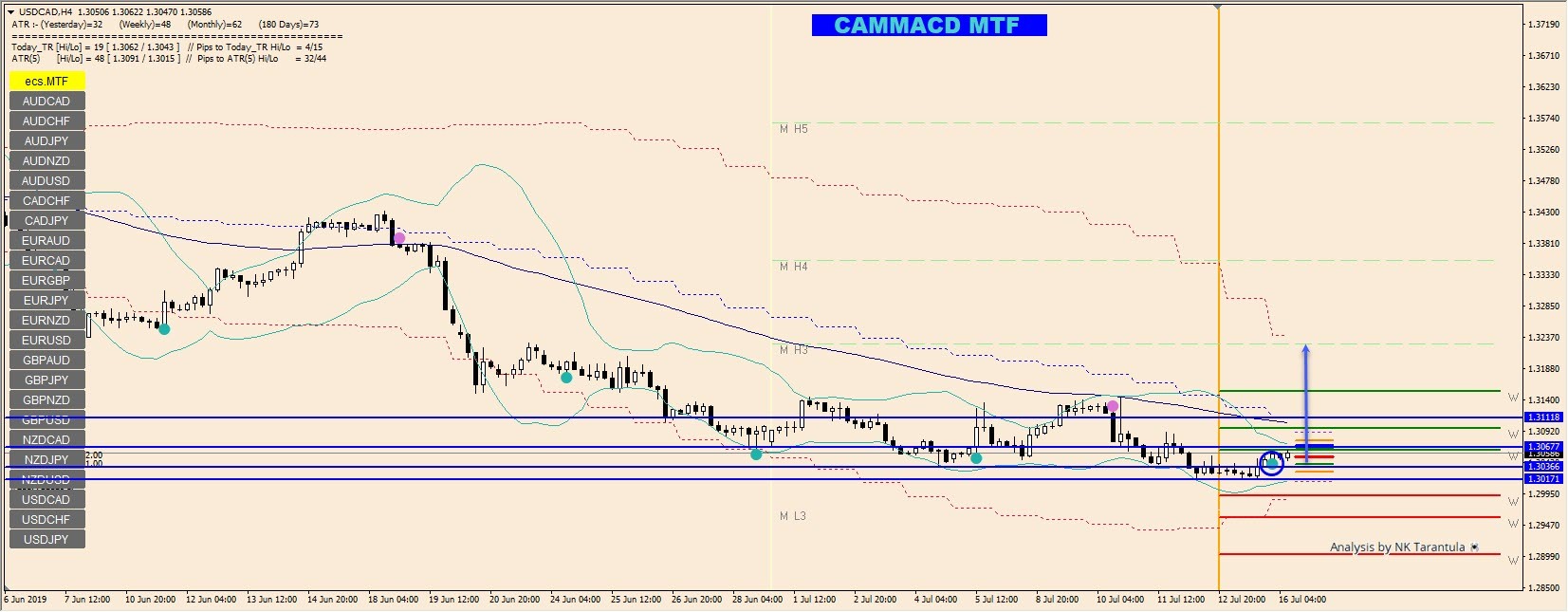
The USD/CAD has formed a super-dot within 1.3050 zone. The super-dot ™ is an extreme for the price and usually its followed by a reversal as a countertrend or a continuation in a trend.
This time the super-dot signals for a potential reversal from 1.3050. It seems that bearish trend came to a stall and oversold reading on the pair will induce profit taking. Targets are 1.3092, 1.3318 and 1.3150. However, 1.3000 needs to stay strong for this to happen. A close above 1.3150 might induce a bullish continuation move towards 1.3225. Only below 1.3000 the pair will be bearish.
US Retail Sales & Powell’s Remarks To Set The Tone
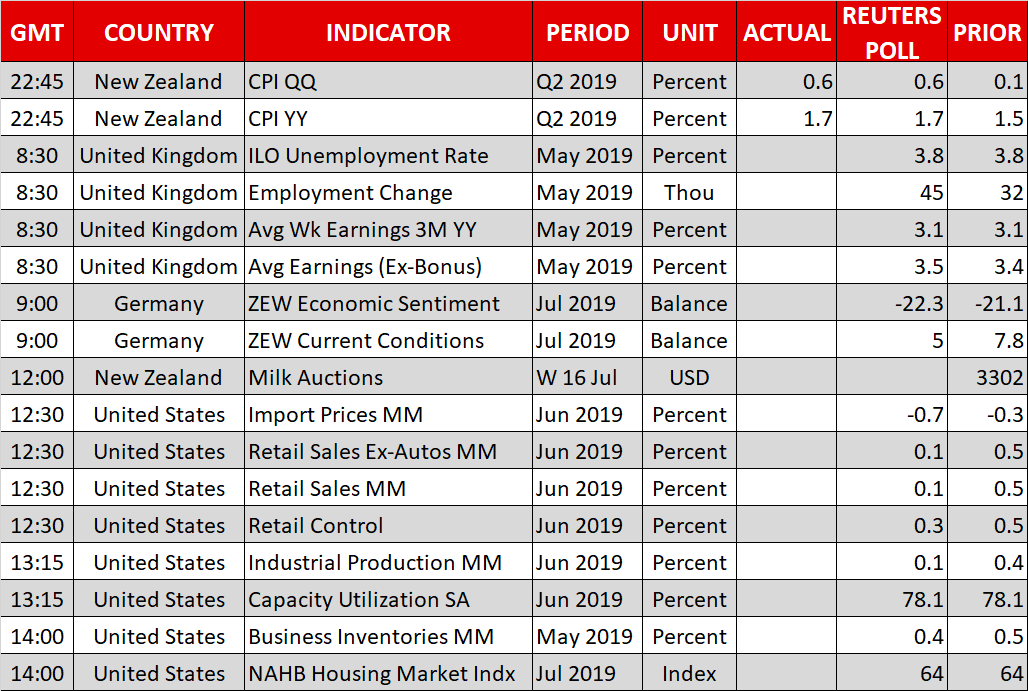
- US retail sales and remarks by Powell top the agenda today
- UK jobs data may be watched as Brexit news flow remains limited
- Kiwi ticks up, despite lingering RBNZ rate-cut speculation
- EU Commission chief awaits Parliamentary confirmation
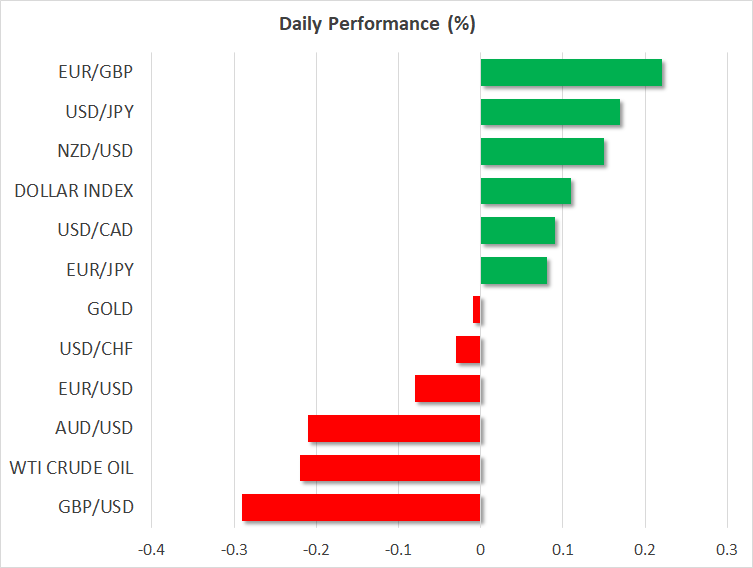
Dollar looks to US retail sales and Powell's remarks
The greenback recovered some ground to start the week, in the absence of any noteworthy US news to drive the price action. That may change today though, with the release of the nation's retail sales stats for June and a speech by Fed chief Jay Powell (17:00 GMT) likely to provide ample of excitement.
Most of the focus could fall on the retail ‘control group' – the measure that excludes autos, gasoline, and construction materials, and which is used in GDP calculations. Since this will be the final major data set before official GDP prints for Q2 are released next week, it may be crucial in shaping the narrative around how deep the Fed will cut on July 31.
Markets continue to price in a ~25% probability for a ‘double' rate cut of 50 basis points, which frankly seems “overdone”, as even the most dovish Fed official – James Bullard – noted lately. Hence, the dollar may have some more scope to rebound in the coming days, if incoming data remain decent enough to allay expectations for such an aggressive course of action.
Besides Powell, the Fed's Bowman (12:15 GMT) and Evans (18:35 GMT) will also deliver remarks.
UK employment data in focus as Brexit takes a brief break
Brexit news flow has been scarce recently, and will likely remain so until next week, when Boris Johnson is expected to become Prime Minister. Meanwhile, the pound continues to be battered by a double whammy of fears for a no-deal Brexit, as Johnson has been adamant that the UK will leave in October “come what may”, coupled with expectations for a dovish turn by the Bank of England soon.
Employment data for May are due today, and with markets pricing in a ~40% chance for a rate cut by year end, they may be important. Overall, the outlook for the pound remains bleak, as a no-deal Brexit is looking more realistic by the day. That said, a potential ‘saving grace' for the British currency may be US dollar weakness in the long term – as the Fed cuts rates more than other central banks – which limits any severe losses in sterling.
Kiwi extends gains
In New Zealand, the local dollar is trading at three-month highs versus the greenback today. The nation's inflation data – released overnight – were in line with expectations, so the kiwi's reaction was limited. Investors still expect an August rate cut by the RBNZ, as trade tensions and a weak data pulse domestically amplify the case for more stimulus.
EU Commission chief awaits confirmation; earnings season continues
In the EU, Parliament will vote today on whether Ursula von der Leyen will become the new President of the Commission – arguably the Union's most important branch. Markets typically overlook such events, but this time may be different as her appointment has faced pushback, mainly by the Greens. A rejection could heighten political uncertainty, and perhaps impact the euro a little.
Elsewhere, the US earnings season continues with JP Morgan Chase, Wells Fargo, Goldman Sachs, and Johnson & Johnson being the most notable names releasing their results today.
RBA’s July Minutes – Cutting Rate to Weaken Aussie and Lower Unemployment Rate
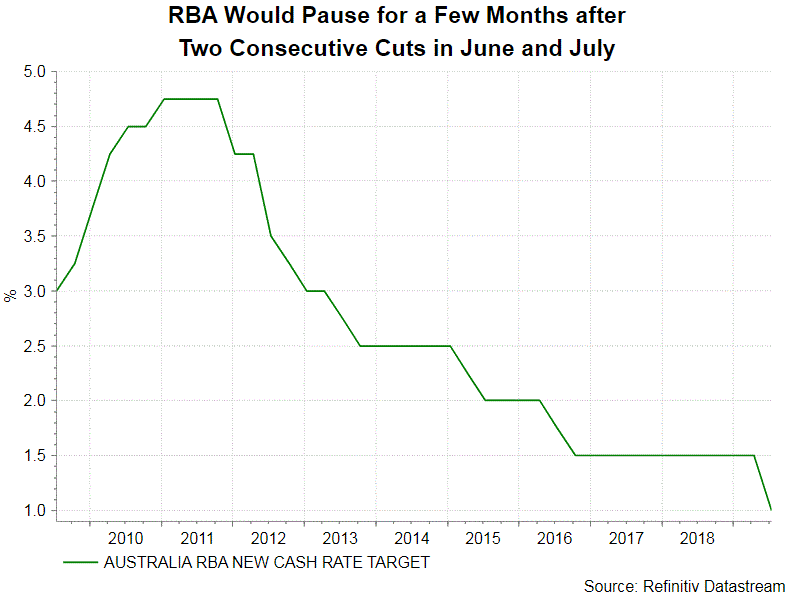
RBA’s minutes for the July meeting revealed that the objective for lowering interest rate in July again was bringing down the unemployment rate and lowering the exchange rate. Unlike the June minutes, the central bank had not hinted more rate cuts would come in the near-term. Yet, we do not judge that this is less dovish sign. We believe the members would like to see how well the previous two rate cuts transmit to the real economy before more actions. RBA noted that further actions would be data-dependent and focused on the labor market. We expect more policy easing would be needed later this year to bring down the unemployment rate to RBA’s target.
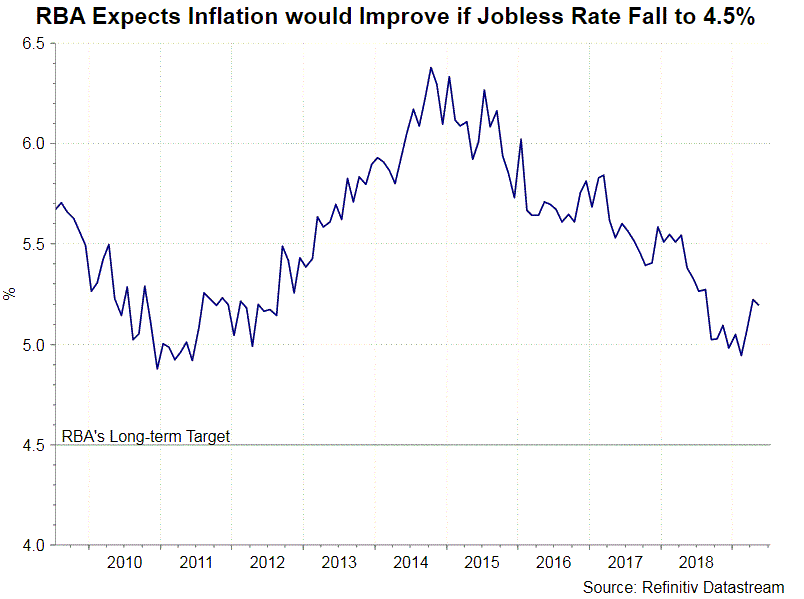
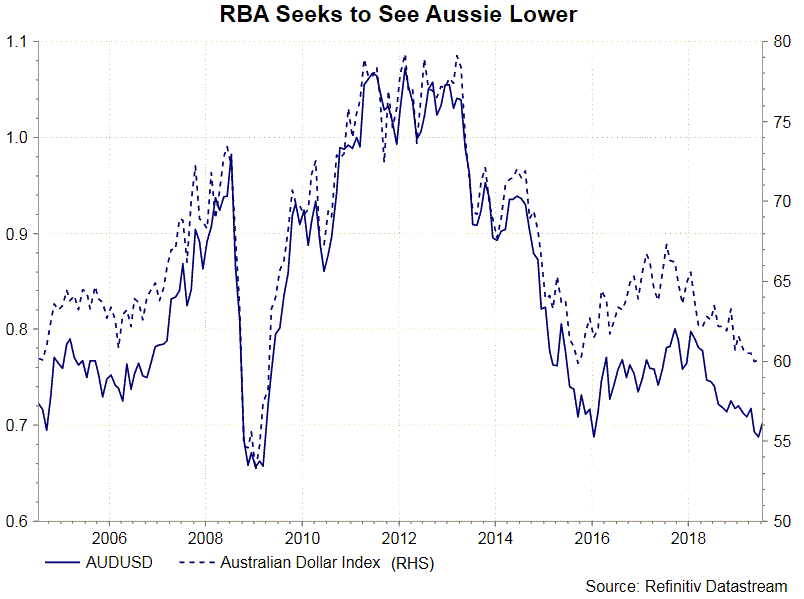 Reiterating the stance in the previous meeting, the members noted that “employment growth had remained strong“, although “some of the additional labour demand had been met by an increase in the participation rate, which had reached its highest level on record”. Yet, “forward-looking indicators, such as job advertisements and employment intentions, suggested that growth in employment would moderate over coming months”. The members judged that the current level of unemployment rate – 5.2%- as “elevated”. As such, further rate cut was needed to absorb the spare capacity. Meanwhile the minutest this month added that “the main channels through which lower interest rates would support the economy were a lower value of the exchange rate”. This suggests that exchange rate depreciation would be another goal in the near- to medium- term.
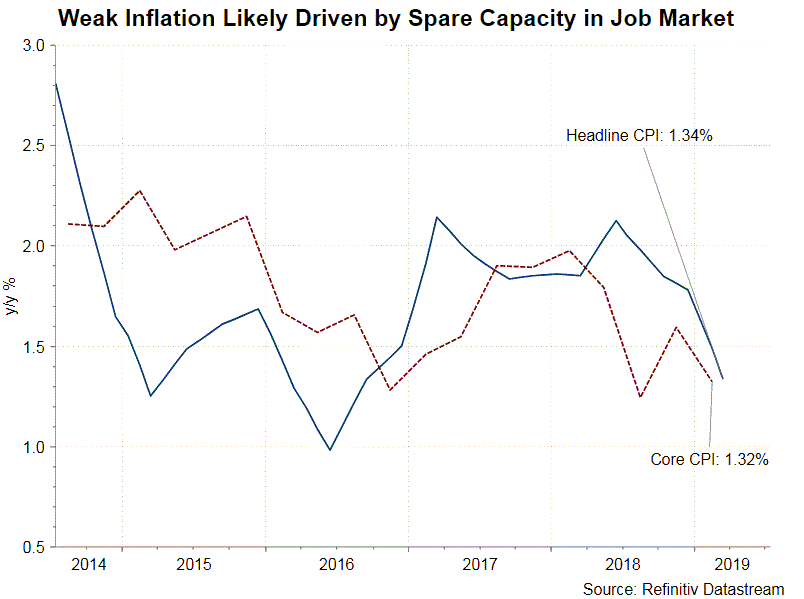
 Globally, RBA noted that economic growth had “remained moderate over preceding months“. They reiterated the elevated risks in trade tensions “although no new measures had been introduced since the previous meeting“. On inflation, the members acknowledged improvement in the wage level but the growth “had not yet been translated into stronger inflationary pressures and inflation remained below target in most advanced economies”.
In the concluding statement, RBA pledged to “monitor developments in the labour market closely and adjust monetary policy if needed”. This is compared with the reference in June minutes that “it was more likely than not that a further easing in monetary policy would be appropriate in the period ahead”. This obviously does not imply RBA has been done in rate cuts. Rather, the members would gauge how well the cuts in June and July do to “provide more Australians with jobs and assist with achieving more assured progress towards the inflation target”. RBA’s target is to bring down the unemployment rate to as low as 4.5%, from the current 5.2%. Against the backdrop of rising downside risk to global economy and lingering uncertainty in the US-China trade war, we believe further rate cuts later this year would be needed
The Analytical Overview Of The Main Currency Pairs
The EUR/USD currency pair
Technical indicators of the currency pair:
Prev Open: 1.12662
Open: 1.12574
% chg. over the last day: -0.10
Day's range: 1.12554– 1.12635
52 wk range: 1.1111 - 1.2009
The EUR/USD currency pair continues to consolidate. There is no defined trend. Local levels of support and resistance continue to be 1.12500 and 1.12800. Investors expect additional drivers. Today, investors will evaluate a number of important economic releases from Germany and the United States. We recommend to open positions from key levels.
The Economic News Feed for 16.07.2019:
ZEW Economic Mood Index (GER) – 12:00 (GMT+3:00);
Retail Sales Report (US) – 15:30 (GMT+3:00);
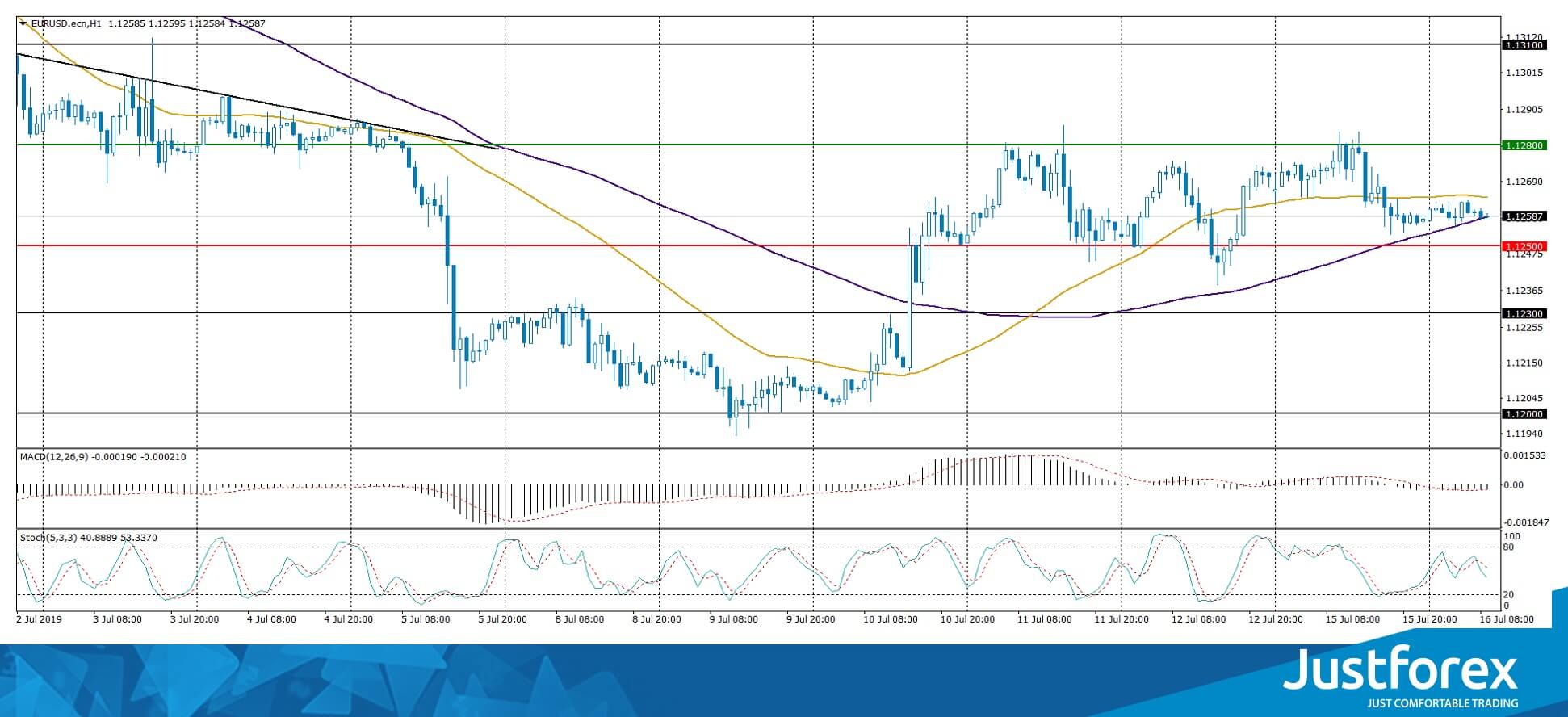
Indicators do not give accurate signals: the price crossed 50 MA and 100 MA.
The MACD histogram is in the negative zone, but above the signal line, which gives a weak signal to sell EUR/USD.
The Stochastic Oscillator is in the neutral zone, the %K line is below the %D line, which indicates bearish moods.
Trading recommendations
Support levels: 1.12500, 1.12300, 1.12000
Resistance levels: 1.12800, 1.13100, 1.13500
If the price consolidates above 1.12800, expect further growth toward 1.13100-1.13400.
Alternatively, the quotes can drop toward 1.12200-1.12000.
The GBP/USD currency pair
Technical indicators of the currency pair:
Prev Open: 1.25495
Open: 1.25125
% chg. over the last day: -0.43
Day's range: 1.25070 - 1.25203
52 wk range: 1.2438 - 1.3631
GBP/USD once again moved to a decline. GBP updated local lows. At the moment, GBP/USD quotes are consolidating. The key range is 1.25100-1.25400. The pound remains under pressure due to the uncertainty around Brexit. Trading instrument has the potential to further decline. Today we expect important statistics from the UK. Positions must be opened from key levels.
At 11:30 (GMT + 3:00) a report on the labor market in the UK will be published.
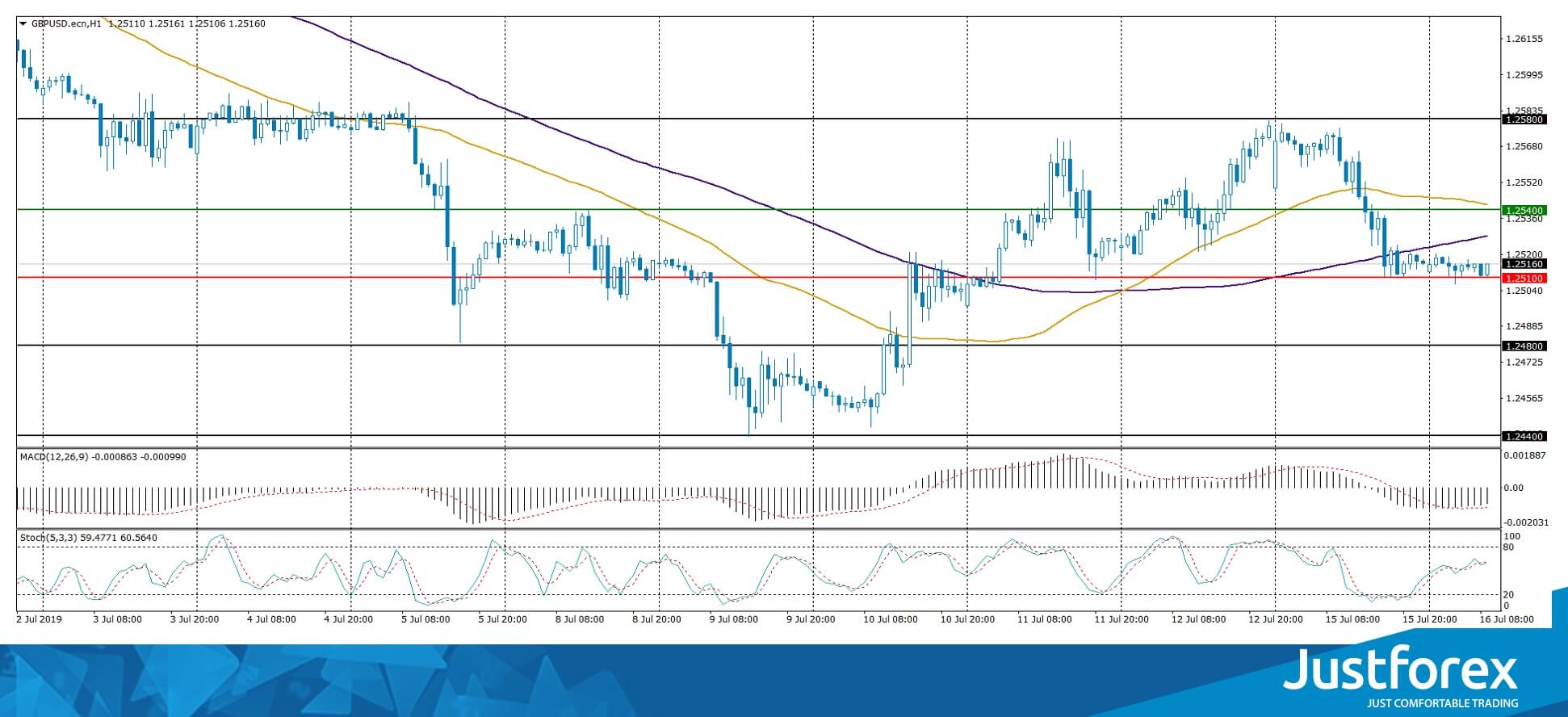
Indicators do not give accurate signals: the price has crossed 100 MA.
The MACD histogram is in the negative zone, but above the signal line, which gives a weak signal to sell GBP/USD.
The Stochastic Oscillator is in the neutral zone, the %K line crossed the %D line. There are no signals at the moment.
Trading recommendations
Support levels: 1.25100, 1.24800, 1.24400
Resistance levels: 1.25400, 1.25800, 1.26300
If the price consolidates below 1.25100, a further drop in GBP/USD quotes is expected. The movement will tend toward 1.24800-1.24600.
Alternatively, the quotes can grow toward 1.25700-1.25900.
The USD/CAD currency pair
Technical indicators of the currency pair:
Prev Open: 1.30312
Open: 1.30472
% chg. over the last day: +0.11
Day's range: 1.30442 - 1.30588
52 wk range: 1.2727 - 1.3664
The USD/CAD currency pair has stabilized. CAD is in lateral movement. Currently, the local support and resistance levels are: 1.30350 and 1.30600, respectively. In the near future, technical correction of the trading instrument after a long fall is not excluded. We recommend to pay attention to the dynamics of oil prices. Positions must be opened from key levels.
The Economic News Feed for 16.07.2019 is calm.
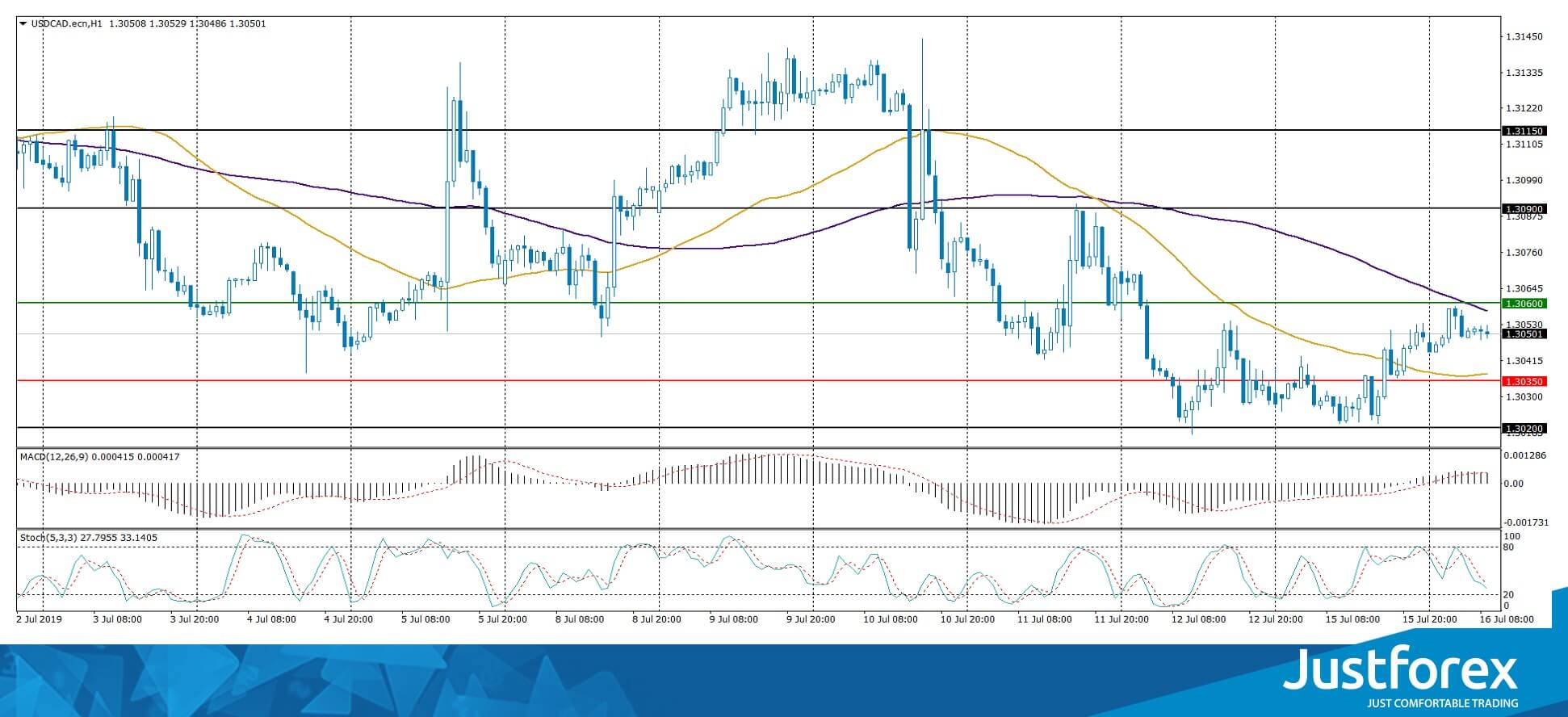
Indicators do not give accurate signals: prices are fixed between 50 MA and 100 MA.
The MACD histogram is in the positive zone and continues to rise, indicating a correction of the USD/CAD quotes.
The Stochastic Oscillator is in the neutral zone, the %K line is below the %D line, indicating a bearish mood.
Trading recommendations
Support levels: 1.30350, 1.30200, 1.30000
Resistance levels: 1.30600, 1.30900, 1.31150
If the price consolidates above 1.30600, the price will rise toward 1.30900-1.31100.
Alternatively, the quotes can descend toward 1.30000.
The USD/JPY currency pair
Technical indicators of the currency pair:
Prev Open: 107.854
Open: 107.909
% chg. over the last day: +0.06
Day's range: 107.820 - 108.094
52 wk range: 104.97 - 114.56
The USD/JPY currency pair continues to consolidate. There is no defined trend. The safe harbor currency tests local support and resistance levels: 107.800 and 108.100, respectively. Financial market participants expect additional drivers. Today we recommend to pay attention to economic releases from the USA. Positions must be opened from key levels.
The Economic News Feed for 16.07.2019 is calm.
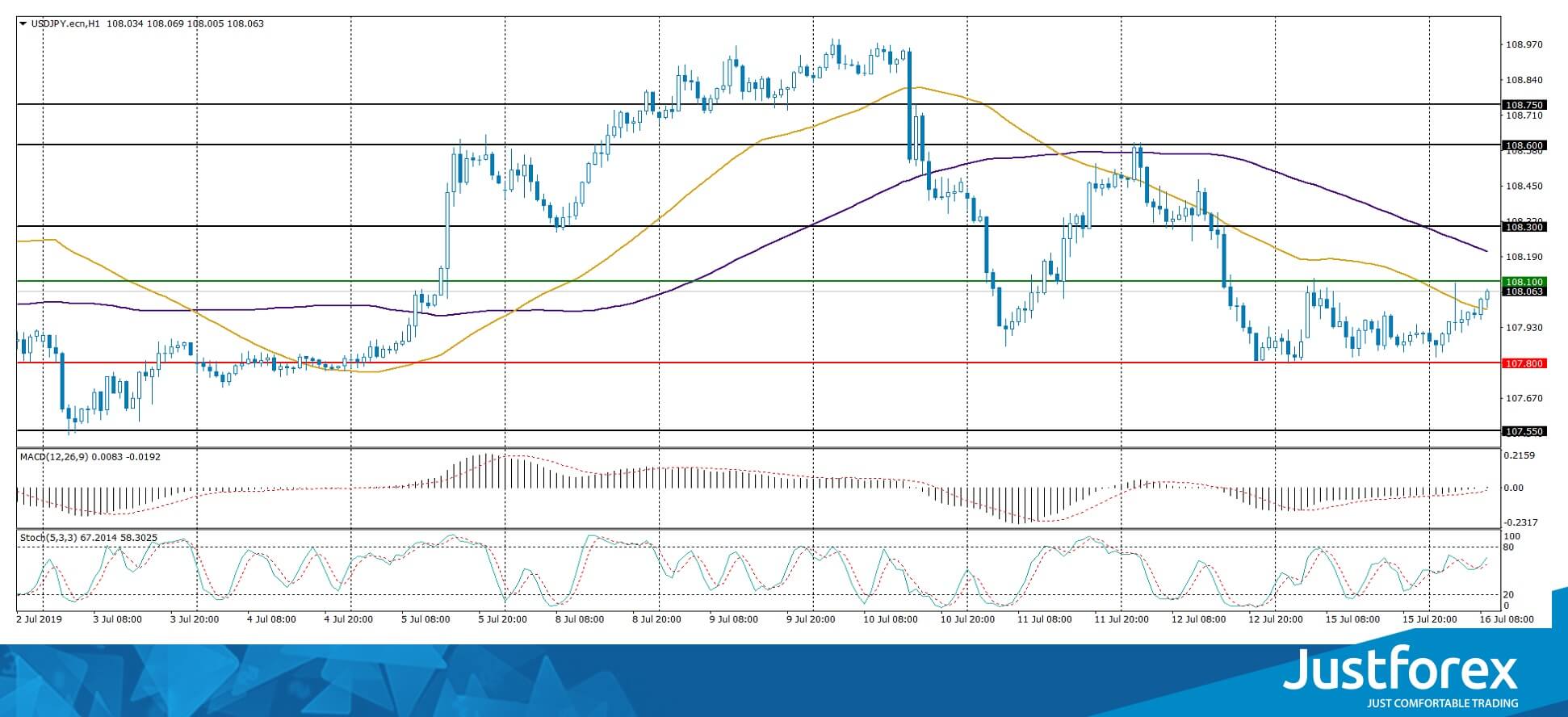
Indicators do not give accurate signals: the price crossed 50 MA.
The MACD histogram is near the 0 mark.
The Stochastic Oscillator is in the neutral zone, the% K line is above the% D line, which indicates bullish moods.
Trading recommendations
Support levels: 107.800, 107.550
Resistance levels: 108.100, 108.300, 108.600
If the price consolidates below the 107.800, the quotes will fall toward 107.550-107.400.
Alternatively, USD/JPY can grow to 108.400-108.600.
ECB Villeroy: Should not rely too exclusively on market based inflation expectation measures
ECB Governing Council member Francois Villeroy de Galhau reiterated his stance that ECB rate decision should be "data dependent". In the upcoming meeting, policymakers will "assess actual economic data and we will act accordingly if and when needed."
He acknowledged that policymakers would "take account of market indications" but emphasized "must not be market dependent". That is ECB should not rely "too exclusively for inflation expectations on market-based measures".
Additionally, Villeroy also noted monetary policy is limited as it cannot repair the damage from protectionism, or replace structural reforms or more selective fiscal policies. And, "monetary policies cannot do everything and cannot perform miracles."
Markets Yawn And Hit Snooze Button Ahead Of US Earnings Reports
Asian shares are tired and struggling for direction this morning due to a lack of fresh market- moving news, with investors on the sidelines ahead of earnings reports from major American companies.
Although Wall Street closed again at record highs overnight, this positive momentum is unlikely to rollover into Tuesday's session given how market players are adopting a wait-and-see approach. The mood across financial markets will certainly be influenced by US corporate earnings, especially the performance of major US banks like JP Morgan, Goldman Sachs and Wells Fargo. Should earnings disappoint investor expectations, risk aversion is set to make a rude return and sadly global equity markets will be in the direct firing line.
Dollar creeps higher before US Retail Sales
The Greenback is having a hard time nursing deep wounds inflicted by Fed rate cut bets and this continues to be reflected in the Dollar Index (DXY) which is trading around 97.00 as of writing.
More pain could be in store for the bruised Dollar this afternoon if US retail sales prints below market expectations. Economists are forecasting a tepid 0.1% expansion in sales for the US economy last month. Given how consumption contributes to almost 70% of US GDP, a disappointing figure will not only fuel concerns over the US economy but strengthen the case for a US interest rate cut this month – ultimately punishing the Dollar. With the fundamental ingredients initially sweetening appetite for the Dollar expired, weakness could be a major theme during the second half of 2019.
Currency spotlight – GBPUSD
For as long as Brexit uncertainty, political risk in Westminster and BoE rate cut bets remain major themes, the Sterling is poised to remain depressed and unloved in the G10 space.
The British pound slipped towards six-month lows against the Dollar this morning and is likely to extend losses as the bitter cocktail of negative themes swirling around Brexit and UK growth sour appetite for the currency.
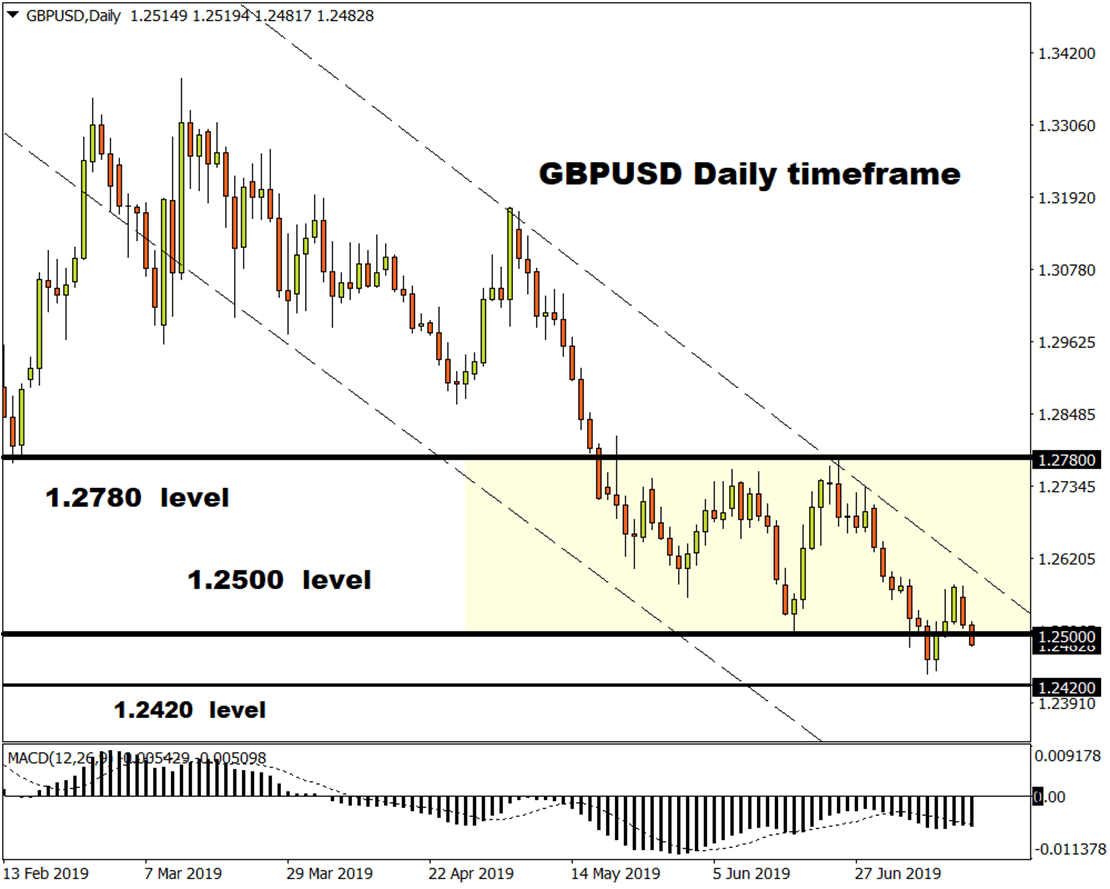
Focusing on the technical picture, the GBPUSD is under pressure on the daily charts. A breakdown below 1.2500 should encourage a move lower towards 1.2420.
Commodity spotlight – Gold
Gold has the potential to shine with intensity this week if US corporate earnings disappoint and the tired Dollar depreciates.
Appetite for the yellow metal remains supported by expectations of a US rate cut this month, a timid Dollar and ongoing concerns over slowing global growth. For as long as these core themes weigh on global sentiment, bulls remain in a position of power. Focusing on the technical, an intraday breakout above $1419 should signal a move higher towards $1430 in the short to medium term.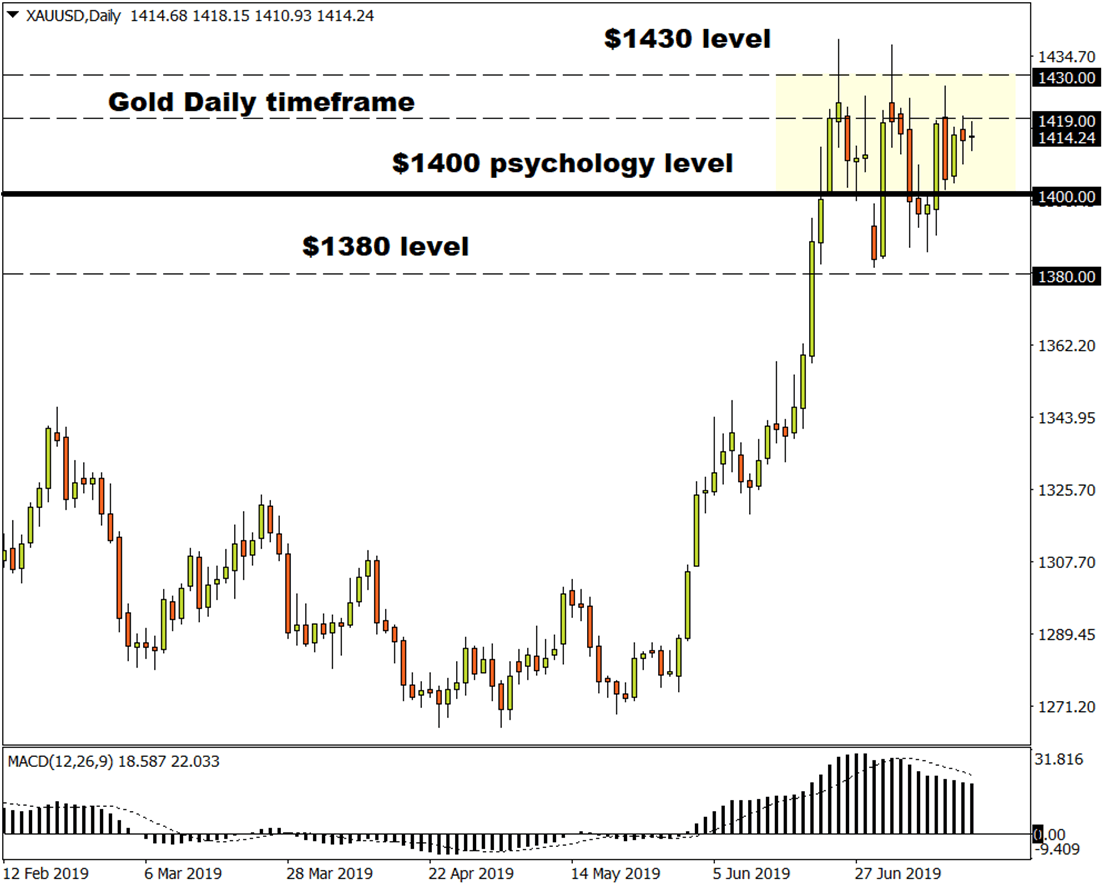
Earning Season Warning | Markets In Holding Pattern
A slow summer trading session may remain the main theme after day. There is a little reason for European traders to push markets higher today. This is despite the fact that Wall Street eked out another fresh record high yesterday but still ended the day mostly flat. Most of the momentum was built on the fact that the Chinese economic data hasn't fallen off the cliff.
The truth is everything is in holding pattern and investors are looking for direction. this could come from a strong earnings season or the Fed running a loose monetary policy. Complacency remains a massive concern because there is just too much optimism among investors and this can easily lead them to disappointment. The expectations are that the trade war issue will be resolved, the Fed will cut interest rates by at least 50 basis points this year and the People Bank of China will also adopt a more aggressive accommodative stance towards their monetary policy. By looking at this one can really understand why the US market are still making fresh record highs. Smart money understand that this is a tall order hence there is a strong need to buy protection which is selling at a decent discount.
Today, investors are focused on two major things. Firstly, it is the US retail sales number which needs to deliver the same message as the Chinese data did- the trade war isn't really a massive concern. But the reality is if the trade war isn't leaving any dents on the two biggest economies of the world, especially the US, then one should not really bet on the hopes of loose monetary policy by the Fed. Secondly, today's trading action is primarily going to keep its focus on earnings; the Wall Street giants JPMorgan Chase and Goldman Sachs group will be reporting their earnings today. After Citibank’s drop in trading revenue, the US banks dropped yesterday and the big question is if the weakness in the banking sector going to pull the major US bench marks lower?
Moreover, the ratio of the CBOE VVIX index/CBOE Volatility index has soared and this represents nerves kicking in. From the chart below you can see that when the index touched the level of 7 back in April, the equity market experienced a massive correction.
GBPUSD Lacks Bullish Signals Near Six-Month Lows
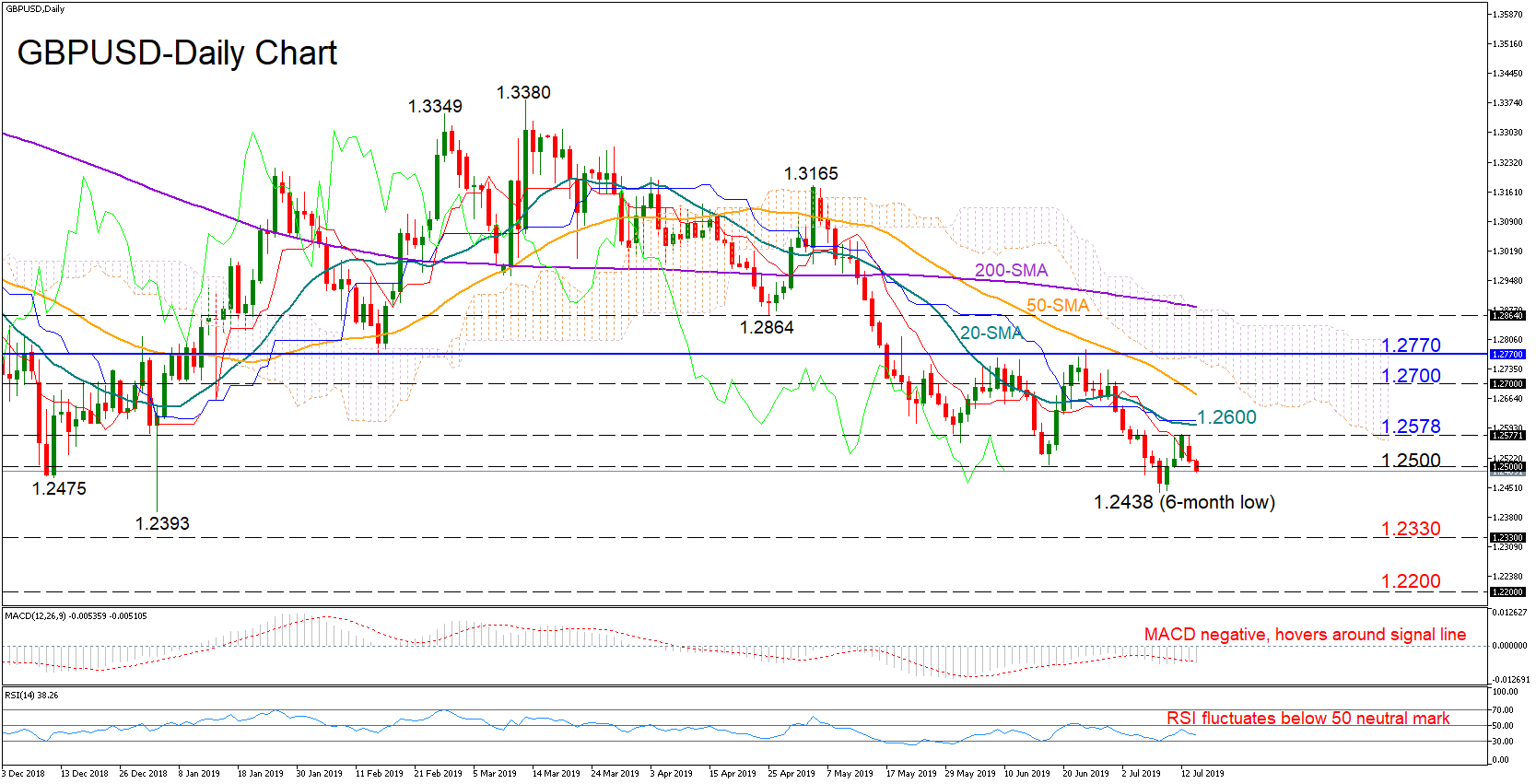
GBPUSD returned to the red zone and near a key support area around 1.25 after attempting to recover during the past three sessions. Chances for a meaningful rally in the short-term are currently viewed as minimal as the market action continues to take place comfortably below the simple moving averages (SMA) and the Ichimoku cloud, while the RSI and the MACD are lacking a clear direction while in the bearish area.
Should the bears clear the 1.25 barrier, the focus will shift immediately towards the six-month low of 1.2438. Breaking decisively below the latter, the sell-off could extend until the 1.2330 number, where any violation would open the way towards the 1.22 psychological level.
Alternatively a strong rebound above the recent peak of 1.2578 and more importantly higher than the 20-day SMA (1.2600) could return some buying confidence, with the price probably crawling next up to 1.2700. Higher, the bulls would need to beat a taller wall between 1.2770-1.2780 for the rally to pick up steam.
In the medium-term picture, the sentiment turned even more bearish following this month’s price discount. A steeper rally is now required for the price to reach the April trough of 1.2864, where any close higher would shift the outlook to neutral.
In brief, GBPUSD is facing a bearish bias both in the short and the medium-term.