

Sample Category Title
Central Bank To Adjust Interest Rates, If Necessary: RBA Minutes
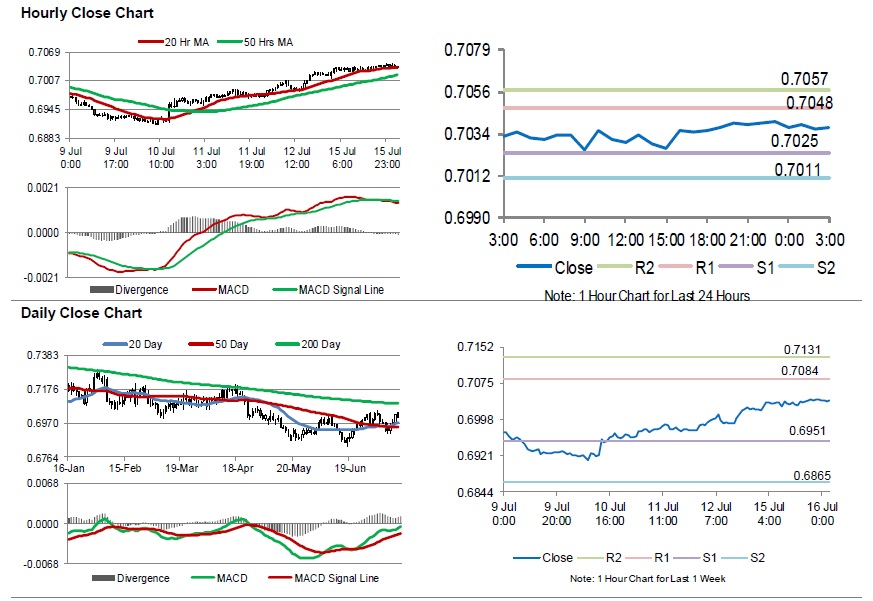
For the 24 hours to 23:00 GMT, the AUD rose 0.26% against the USD and closed at 0.7041.
LME Copper prices rose 0.8% or $47.5/MT to $5997.5/MT. Aluminium prices rose 0.6% or $10.5/MT to $1810.0/MT.
In the Asian session, at GMT0300, the pair is trading at 0.7038, with the AUD trading slightly lower against the USD from yesterday’s close.
The Reserve Bank of Australia (RBA), in its July monetary policy meeting minutes, reiterated that it is prepared to alter interest rates “if needed” and would continue to monitor labour market for further developments in order to support economic growth and achieve the inflation target.
The pair is expected to find support at 0.7025, and a fall through could take it to the next support level of 0.7011. The pair is expected to find its first resistance at 0.7048, and a rise through could take it to the next resistance level of 0.7057.
Going ahead, investors would closely monitor Australia’s Westpac leading index for June, scheduled to release overnight.
The currency pair is showing convergence with its 20 Hr moving average and trading above its 50 Hr moving average.
Gold: Yellow Metal Reverses Its Gains In The Asian Session
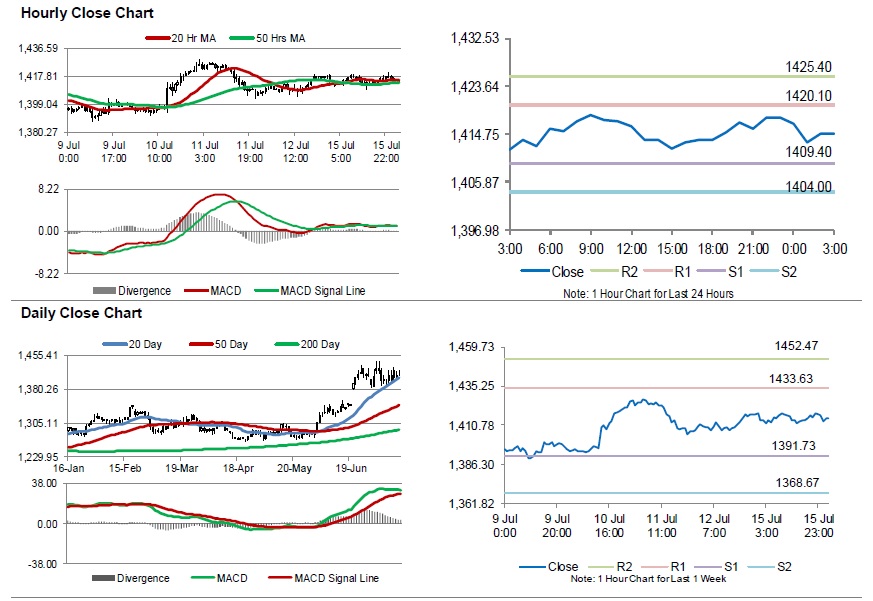
For the 24 hours to 23:00 GMT, Gold rose 0.27% against the USD and closed at USD1417.90 per ounce.
In the Asian session, at GMT0300, the pair is trading at 1414.80, with gold trading 0.22% lower against the USD from yesterday’s close.
The pair is expected to find support at 1409.40, and a fall through could take it to the next support level of 1404. The pair is expected to find its first resistance at 1420.10, and a rise through could take it to the next resistance level of 1425.40.
The yellow metal is showing convergence with its 20 Hr and 50 Hr moving averages.
Silver: White Metal Trading On A Weaker Footing This Morning
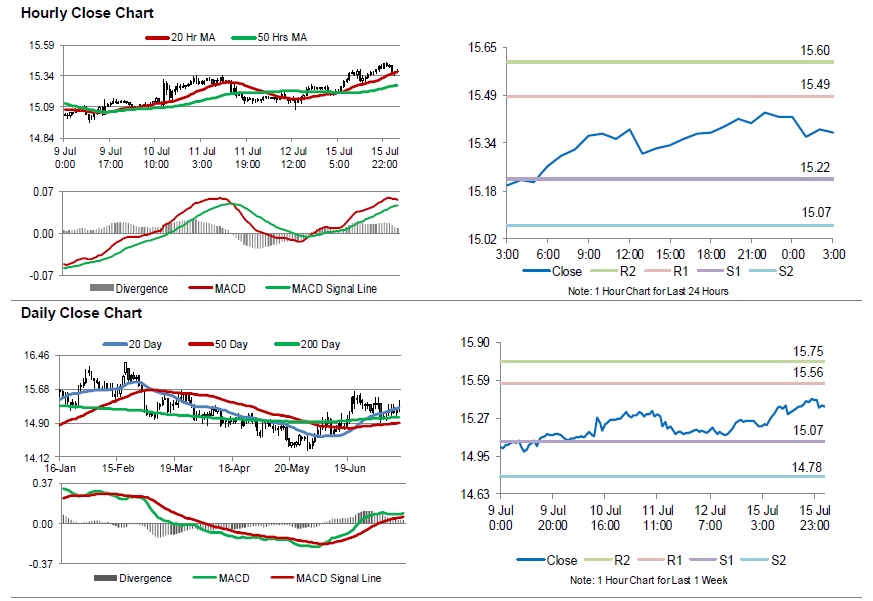
For the 24 hours to 23:00 GMT, Silver rose 1.45% against the USD and closed at USD15.42 per ounce, tracking gains in gold prices.
In the Asian session, at GMT0300, the pair is trading at 15.37, with silver trading 0.32% lower against the USD from yesterday’s close.
The pair is expected to find support at 15.22, and a fall through could take it to the next support level of 15.07. The pair is expected to find its first resistance at 15.49, and a rise through could take it to the next resistance level of 15.60.
The white metal is showing convergence with its 20 Hr moving average and trading above its 50 Hr moving average.
Crude Oil: Oil Trading Higher, Ahead Of API’s Weekly Crude Oil Inventories Data
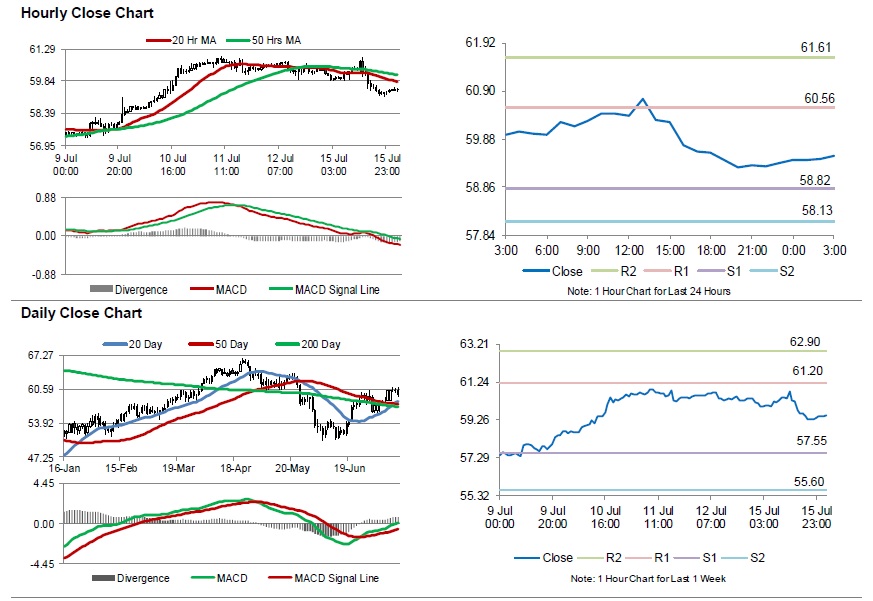
For the 24 hours to 23:00 GMT, Crude Oil declined 0.97% against the USD and closed at USD59.37 per barrel, after oil production in the Gulf of Mexico restarted, after Hurricane Barry swept through over the weekend.
In the Asian session, at GMT0300, the pair is trading at 59.51, with oil trading 0.24% higher against the USD from yesterday's close.
The pair is expected to find support at 58.82, and a fall through could take it to the next support level of 58.13. The pair is expected to find its first resistance at 60.56, and a rise through could take it to the next resistance level of 61.61.
Crude oil is trading below its 20 Hr and 50 Hr moving averages.
New Zealand CPI rose 0.6% qoq, NZD/USD extending rebound
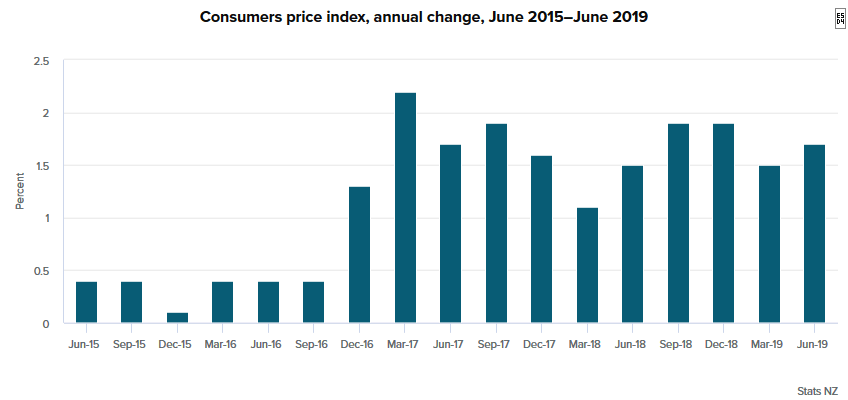
New Zealand CPI rose 0.6% qoq 1.7% yoy in Q2, matched expectations. The annual rate accelerated from 1.5% yoy in Q1. However, the rise in headline inflation was largely due to the 5.8% quarter increase in petrol price, which contributed 0.25% to the 0.6% qoq figure. That suggests the pick-up could be temporary only, not to mention that annual CPI remains firmly below 2% mid-point of RBNZ's 1-3% target range.
Stronger monetary stimulus and economic growth is required to lift inflation sustainably back to the 2% target. Yet, domestic and global headwinds remain. Thus, more OCR cuts are still expected for RBNZ. August could be the month to deliver even though it's not totally certain yet.
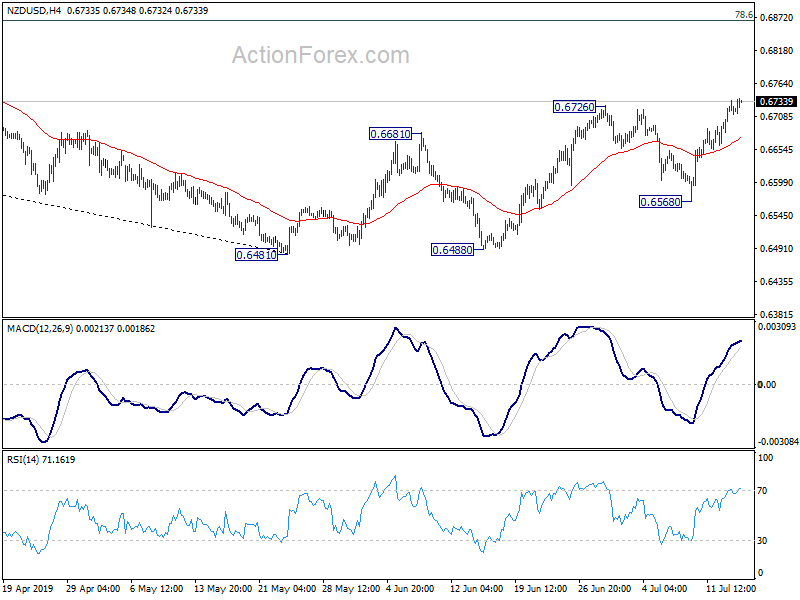
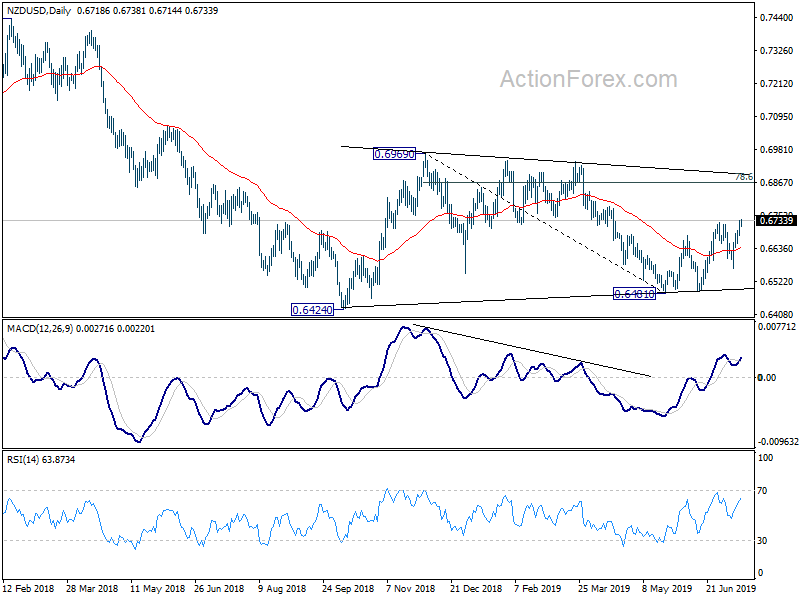
NZD/USD's choppy rebound from 0.6481 resumed this week by taking out 0.6726 resistance. Such rise is seen as part of the sideway pattern from 0.6424. It should now be heading to 78.6% retracement of 0.6969 to 0.6481 at 0.6865. But upside should be limited below 0.6969 resistance to bring near term reversal.
RBA minutes indicate easing bias, but wait-and-see first
In the minutes of July 2 RBA rate meetings, it's noted that "the Board would continue to monitor developments in the labour market closely and adjust monetary policy if needed to support sustainable growth in the economy and the achievement of the inflation target over time."
The conclusion indicates that RBA is still adopting an easing bias after cutting interest rate in both June and July meeting. However, the next move will come "if needed", as the central will first "monitor developments" to see how the economy reacts to the prior rate cuts.
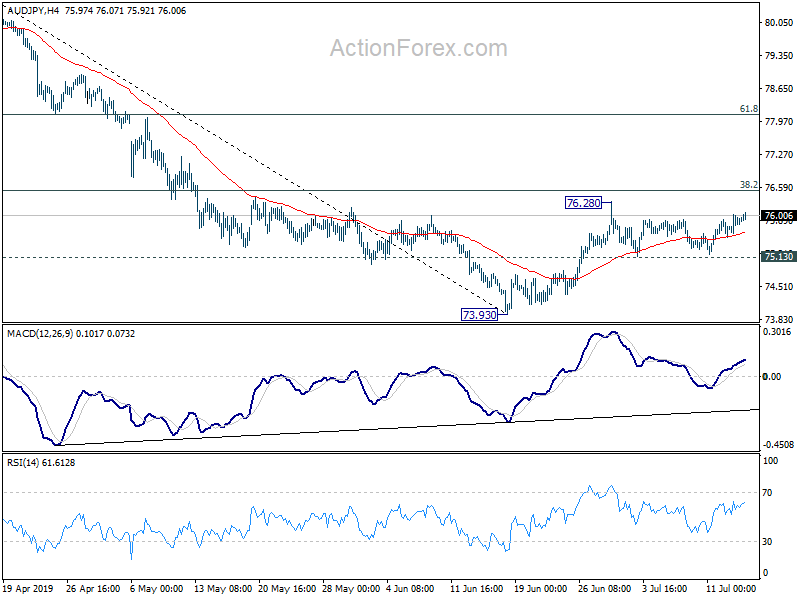
Australian Dollar firms up mildly after the release. Yet, AUD/JPY is staying below 76.28 resistance. Thus, there could be more consolidations before rebound from 73.93 resumes. Break of 76.28 is expected eventually as long as 75.13 support holds.
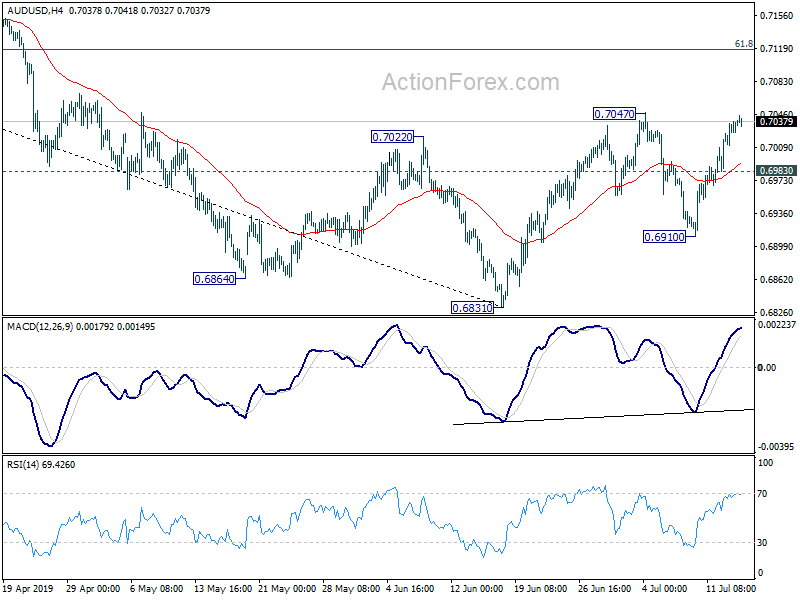
AUD/USD is still eyeing 0.7047 resistance for now. Break will resume the rebound from 0.6831. Though, rejection by 0.7047, followed by 0.6983 minor support, will turn bias to the downside for 0.6910 support.
US Mnuchin: Debt ceiling deal soon, another call with China this week
US Treasury Secretary Steven Mnuchin said yesterday that a deal is close on raising debt ceiling. and he didn't see another government shutdown looming over the issue. Trump's administration and Congress have been discussing a possible two-year budget that sets that overall federal spending for fiscal 2020 and 2021. He added "we're getting closer".
He emphasized that all parties wanted to reach an agreement on the budget issues. And, if a deal on all issues couldn't be reached before summer recess, lawmakers would either stay put or approve an increase in the debt ceiling. He noted, "I think we're very close to a deal, but as you know, these deals are complicated."
Separately, he also noted that there will another telephone call with Chinese officials this week regarding resuming trade negotiations. And, "to the extent that we make significant progress, I think there's a good chance we'll go there later."
(RBA) Minutes of the Monetary Policy Meeting of the Reserve Bank Board
Darwin – 2 July 2019
Members Present
Philip Lowe (Governor and Chair), Guy Debelle (Deputy Governor), Mark Barnaba AM, Wendy Craik AM, Philip Gaetjens, Ian Harper, Allan Moss AO, Carol Schwartz AO, Catherine Tanna
Others Present
Luci Ellis (Assistant Governor, Economic), Christopher Kent (Assistant Governor, Financial Markets), Alexandra Heath (Head, Economic Analysis Department)
Anthony Dickman (Secretary)
International Economic Conditions
Members commenced their discussion by noting that growth in the global economy had remained moderate over preceding months. Global trade and manufacturing activity had slowed over the preceding year. Trade tensions had remained elevated, although no new measures had been introduced since the previous meeting.
In China, recent indicators of economic activity suggested that growth had slowed since the March quarter. Growth in industrial production had fallen following a strong reading in March and the level of fixed asset investment had declined. Conditions in the Chinese property market had also softened and underlying demand conditions were expected to moderate over time, given the ageing of the population and a slowing in the rate of urbanisation. Over the preceding month, the Chinese authorities had introduced additional measures to support growth, including more favourable financing conditions for local governments investing in infrastructure projects.
In east Asia, the combination of weaker Chinese growth, the downturn in global semiconductor demand and the trade and technology disputes had weighed on trade, although new export orders suggested that conditions might be stabilising. The effect of the US–China trade dispute had not been even across the region. Some economies, such as Thailand and Vietnam, had seen strong growth in their exports to the United States, which reflected some diversion of trade that had previously been between the United States and China.
Growth in output in the United States had continued to be supported by strong growth in consumption, while growth in investment appeared to have slowed further. Members noted that capital goods orders had slowed and that the stimulus to investment from tax cuts had largely run its course. Growth in domestic demand in the euro area had been relatively resilient in the March quarter, but more recent data had been mixed. Growth in Japanese domestic demand had slowed in early 2019, partly as a result of spillovers from weak external demand conditions, but growth was likely to be supported in the near term by a pick-up in consumption growth in the lead-up to an increase in the consumption tax in October 2019.
Labour markets remained tight in the major advanced economies. Members noted that participation rates for people aged between 15 and 64 years had increased significantly in recent years and unemployment rates were at historically low levels. This suggested that there was relatively little spare capacity in these labour markets. Members noted that participation rates of people aged 65 years and over had also been increasing. Wages growth had picked up, but this had not yet been translated into stronger inflationary pressures and inflation remained below target in most advanced economies. Although inflation had been around target in the United States, some measures suggested US inflation had shifted lower more recently. The decline in oil prices, by around 15 per cent since their peak in mid May, would weigh on headline inflation globally in the near term.
Iron ore prices had increased by more than 25 per cent since the previous meeting and had more than doubled over the previous year. Chinese steel production had continued to grow strongly in recent months, despite slowing industrial activity in China. At the same time, there was limited spare capacity in the seaborne market to increase supply and inventories of iron ore at Chinese ports had been declining. Rising iron ore prices had underpinned a 3 per cent increase in the Australian terms of trade in the March quarter.
Domestic Economic Conditions
Members noted that the main domestic economic news over the previous month had been the release of the national accounts for the March quarter and updates on the labour and housing markets.
The national accounts reported that the domestic economy had grown by 0.4 per cent in the March quarter. Public demand had continued to support growth in the quarter, with public consumption boosted by the rollout of the National Disability Insurance Scheme and increased spending on the Pharmaceutical Benefits Scheme. Growth in public sector investment had been positive despite a decline in defence spending. Members noted that there was a strong pipeline of public infrastructure projects that could support activity for some time.
Private demand had contracted for the third consecutive quarter because there had been further falls in mining investment and housing construction. Consumption growth had remained subdued.
Growth in business investment had been weaker than expected in the March quarter. This was partly because it had taken longer than expected for liquefied natural gas (LNG) projects to reach final completion. However, investment in automation and other productive efficiencies had supported machinery & equipment investment in the mining sector. Non-mining business investment had continued to expand in the March quarter, supported by a further increase in non-residential construction, while non-mining machinery & equipment investment had fallen. Members observed that there had been some differences in the findings of surveys of business conditions. In the main, surveyed measures of business conditions had declined to around or a little above average levels. However, both the retail and transportation sectors had experienced well below-average conditions.
Exports had increased in the March quarter, primarily driven by growth in rural and service exports. The boost to meat exports in the quarter as a result of ongoing drought conditions leading to destocking had been larger than the subtraction from lower crop exports. Resource exports (excluding non-monetary gold) had fallen in the March quarter because of temporary supply disruptions. More recent data on trade and shipments suggested that iron ore and LNG exports had increased since the March quarter, while coal exports appeared to have fallen. Higher iron ore prices had supported overall export values and the trade surplus had increased to almost 3 per cent of GDP in the March quarter. The trade surplus was at its highest level, and the current account deficit at its lowest level, measured as a share of GDP, since the 1970s.
Consumption had grown by 1.8 per cent over the year to the March quarter, which was well below average. Members noted that, in per capita terms, consumption had been broadly flat. Growth in household spending on essential items had been relatively steady, while the level of spending on discretionary items had fallen in the March quarter. This weakness had been broadly based across the states and recent retail trade data suggested that discretionary spending had remained soft in the June quarter.
Members had a detailed discussion of the effects on price inflation in the retail trade sector of increased competition from foreign entrants and online retailers over the preceding decade or so. Members noted that the increase in the supply of retail items and lower retail prices in response to increased competition were positive developments for consumers, other things equal. Many retailers and wholesalers had also become more efficient in response to more intense competition, often using new technology (including in logistics), which had resulted in relatively rapid multifactor productivity growth in these sectors. Members noted that the adjustment in the retail sector had been protracted and had put downward pressure on inflation for some years. In the more recent period, the effects on prices of greater competition had been difficult to separate from the effects of the prevailing weak demand conditions.
Growth in household disposable income had increased in recent quarters, supported by growth in labour income, but had remained low in year-ended terms. Members noted that growth in labour income had been driven by strong employment growth and that growth in hourly earnings had remained subdued. New private sector enterprise bargaining agreements had incorporated slightly faster wages growth than agreements reached a year earlier. However, wages growth for workers on existing enterprise bargaining agreements had remained subdued, and there was little prospect of a near-term pick-up in public sector outcomes given the ongoing wage caps.
A small decline in growth in tax payments had also contributed to growth in household disposable income in the March quarter. By contrast, the income of unincorporated enterprises had remained weak, partly because of drought-related falls in farm incomes and the downturn in housing construction. Members noted that this weakness was likely to continue in the near term.
Dwelling investment had declined in the March quarter. Further falls were expected given the sharp decline in building approvals over the preceding year and a half. While the pipeline of construction work yet to be done in New South Wales and Victoria remained high, liaison contacts expected housing construction could drop off more sharply because pre-sales activity had been so weak.
Conditions in the established housing markets of Sydney and Melbourne had improved a little since the previous meeting. Housing prices had stabilised in June in these cities and auction clearance rates had picked up further, albeit still on low volumes. More generally, turnover in the housing market had remained low. Housing prices had continued to fall in Perth and Darwin.
Employment growth had remained strong, at 2.9 per cent over the year to May. Despite this, there was still spare capacity in the labour market. Some of the additional labour demand had been met by an increase in the participation rate, which had reached its highest level on record. Even so, forward-looking indicators, such as job advertisements and employment intentions, suggested that growth in employment would moderate over coming months. The unemployment rate had remained at 5.2 per cent in May and the underemployment rate had remained elevated.
In view of the fact the meeting was held in Darwin, members had a thorough discussion of economic conditions and future economic opportunities in the Northern Territory. They noted that the Northern Territory economy had experienced a significant cycle related to the construction and then completion of the INPEX LNG plant. The downturn in the mining cycle had had significant spillovers to other parts of the Northern Territory economy because, aside from the public sector, mining and construction are the largest industries in terms of gross value added. Employment had fallen in the Northern Territory over 2019 and this had been accompanied by large flows of people moving to other parts of the country. As a result, the unemployment rate for the Northern Territory had increased, but it remained lower than the national average. More generally, the Northern Territory had a relatively young population and high labour market participation rates. The decline in the Northern Territory population had also led to a significant decline in dwelling investment in the Northern Territory over recent years.
Members observed that the broad statistics on the labour market for the Northern Territory masked the relative disadvantage of the Indigenous population. The unemployment rate for Indigenous Australians on average was relatively high, and Indigenous Australians were less likely to complete school and more likely to experience poor health. These measures of Indigenous disadvantage were particularly acute in remote locations, where it is more difficult to deliver services.
Members noted that there were a number of opportunities for economic growth in the Northern Territory in the future, including tourism, agricultural exports (including live beef exports), the defence industry and mining. Higher mining investment in the Northern Territory in the future could come from some small-scale mining projects that had not yet reached final investment decision and the possibility of some onshore unconventional gas projects.
Financial Markets
Members commenced their discussion of financial markets by noting the significant change in the expected path of monetary policy around the world, particularly in the United States. This change had reflected a combination of weaker-than-expected economic activity and inflation over recent months, as well as the downside risks from the trade and technology disputes between the United States and China.
Monetary policy in the United States had been unchanged in June, but the Federal Reserve had indicated that it was prepared to act to sustain the economic expansion. Members of the Federal Open Market Committee (FOMC) saw a stronger case to reduce the federal funds rate during 2019, in contrast with the earlier 'patient' stance as the FOMC had awaited further data. Market pricing had moved to imply an expectation that the federal funds rate would decline by 100 basis points over the following year, compared with 50 basis points a month earlier.
In other major economies, the European Central Bank had indicated that it was prepared to add more monetary stimulus if the outlook for growth and inflation did not improve, including by expanding its bond-buying program. The Bank of Japan had intimated that it would allow bond yields to move below the lower end of its 'yield curve control' target and reiterated that there was scope to ease monetary policy further if needed. And in China, market participants expected the People's Bank of China to ease monetary policy further in the period ahead.
As expectations for monetary policy easing had firmed over the course of this year, government bond yields had declined further in major markets, to a record low in Germany and further into negative territory in Japan. In the United States, lower bond yields reflected lower expected real policy rates for an extended period, as well as persistently low inflation and term premia. Yields on 10-year Australian government bonds had reached a historical low of 1.3 per cent, with yields remaining around 70 basis points below US treasury bond yields of similar maturity. Compensation for risk on corporate bonds globally remained compressed, as market participants judged that policy easing would support growth in economic activity and profits. Members noted that, as a result, the cost of funds for corporations remained low, including in Australia.
Equity prices had increased in major markets over the preceding month, to a record high level in the United States, despite prominent downside risks. Higher equity prices owed primarily to a lowering of discount rates, reflecting the expected easing of monetary policies, whereas the outlook for corporate earnings had been little changed. Recent movements in equity prices in Australia had broadly followed international trends, with increases in equity prices in all main sectors over the preceding month. Members noted that analysts' forecasts of earnings of Australian non-resource companies had declined over the course of the past year, consistent with broader surveys of business conditions.
Members noted that bank liquidity conditions in China had remained accommodative overall. However, the solvency and liquidity of small banks (which account for one-quarter of banking assets) had been attracting more scrutiny from both investors and the authorities after a period of rapid asset growth, amid wider financial stability concerns.
In foreign exchange markets, the US dollar had remained around multi-year highs on a trade-weighted basis, although it had depreciated somewhat in the weeks leading up to the meeting as US bond yields had declined relative to those in other major economies. The euro had remained within the relatively narrow range of the preceding few years on a trade-weighted basis, while the yen had broadly appreciated over recent months. The Australian dollar had been largely unchanged following the decision to lower the cash rate in June. Nevertheless, having depreciated by about 3 per cent in TWI terms since late 2018, the Australian dollar was around its lows of recent years, with the effect of the decline in Australian bond yields relative to other major markets over that period partly offset by the unexpected strength in commodity prices.
In Australia, monthly housing credit growth had remained broadly stable in recent months, particularly for lending for owner-occupation. Aggregate housing credit had been growing at an annualised rate of around 3 per cent, with much of the decline in the rate of growth over the preceding year driven by weaker demand for finance associated with the correction in the housing market. Loan approvals by both owner-occupiers and investors had continued to decline in May. However, an easing in the loan serviceability interest-rate floor was likely to see a boost in borrowing capacity for many new borrowers, which would be in addition to the positive effect on the cash flow of the household sector overall following the reduction in the cash rate at the previous meeting.
The three-month bank bill swap rate (BBSW) had declined further over the preceding month. Accordingly, the increase in the spreads of BBSW and other short-term money market rates to the overnight indexed swap rate in 2018 had been fully unwound. Wholesale funding costs (which affect two-thirds of banks' debt funding) had also declined in line with the cash rate. As a result, the major banks' debt funding costs had reached a historic low.
Members noted that the favourable financing conditions for non-financial corporations had supported corporate bond issuance. Although business credit growth had declined over recent months, growth in total business debt had remained little changed. Meanwhile, yields on residential mortgage-backed securities had also been at low levels and issuance by non-banks in this market had increased significantly in the June quarter, to levels not seen since prior to the global financial crisis.
Members noted that most lenders had passed on the 25 basis points reduction in the cash rate in June to mortgage rates. Business borrowing rates had declined in line with the decline in BBSW. Members also noted that the reduction in the cash rate had been passed through to many retail deposit rates, although some of these rates were already very low.
Market pricing implied that further monetary policy easing was expected following recent data and the Bank's communication since the previous meeting. A 25 basis points reduction in the cash rate had been fully priced in by August 2019, with a further easing expected by the end of the year.
Considerations for Monetary Policy
Members observed that the outlook for the global economy remained reasonable, although the risks from the international trade and technology disputes remained high. Growth in trade had remained weak and there had been further signs that heightened uncertainty was affecting investment decisions. Despite tight labour markets and rising wages growth, inflation had generally remained low in the advanced economies. Both the trade-related downside risks to global growth and ongoing subdued inflation had spurred an increased expectation that major central banks would ease monetary policy. This had reinforced already very accommodative conditions in global financial markets.
In considering the policy decision, members discussed the recent data on output and the labour market. On the former, GDP growth had been well below trend over the year to the March quarter. Despite strong growth in employment, growth in household disposable income had remained low and this had contributed to low growth in consumption. Members noted the near-term prospects for a lift in income growth and the contribution of the low and middle income tax offset. Higher growth in disposable income was expected to support consumption, although the outlook for consumption remained uncertain. Accommodative monetary policy, strong public demand, a renewed expansion in the resources sector and growth in exports were also expected to support a return of GDP growth to trend over coming years.
Members observed that employment growth continued to outpace growth in the working-age population. However, most of the strength in labour demand over preceding months had been met by an increase in participation, which had risen to a record high level, rather than a decline in the unemployment rate. Although there had been a modest pick-up in wages growth in the private sector, wages growth had remained low overall. In combination, these factors suggested that spare capacity was likely to remain in the labour market for some time.
Declining housing prices had also contributed to low growth in consumption, although there were signs that conditions in some housing markets, notably in Sydney and Melbourne, had stabilised. Members noted that mortgage rates were at record lows and that there was strong competition for borrowers of high credit quality. However, demand for credit by investors continued to be subdued and credit conditions for small and medium-sized businesses remained tight.
In assessing the outlook for inflation, members agreed that further improvements in the labour market would be required for wages growth to increase materially. As assessed at the previous meeting, members agreed that the Australian economy could sustain a lower rate of unemployment, while achieving inflation consistent with the target. In light of this, the recent run of data and the lower level of interest rates resulting from the decision taken at the previous meeting, the case for a further reduction in the cash rate was considered.
Members recognised that, in the current environment, the main channels through which lower interest rates would support the economy were a lower value of the exchange rate than otherwise would be the case and lower required interest payments on borrowing, which would free up cash for other expenditure by households and businesses.
Members judged that a further reduction in the level of interest rates would support the necessary growth in employment and incomes, and promote stronger overall economic conditions, which would in turn support a gradual increase in underlying inflation. Members also judged that the extent of spare capacity in the economy, and the likely pace at which it would be absorbed, meant that a decline in interest rates was unlikely to encourage an unwelcome material pick-up in borrowing by households that would add to medium-term risks in the economy. Members recognised the uneven effect of lower interest rates on different households.
Taking into account all the available information, the Board decided that it was appropriate to lower the cash rate by 25 basis points. This decision, together with the reduction in the cash rate decided at the previous meeting, would assist in reducing spare capacity in the economy and making faster progress in reducing the unemployment rate. Lower interest rates would provide more Australians with jobs and assist with achieving more assured progress towards the inflation target. The Board would continue to monitor developments in the labour market closely and adjust monetary policy if needed to support sustainable growth in the economy and the achievement of the inflation target over time.
The Decision
The Board decided to lower the cash rate by 25 basis points to 1.00 per cent.
NZ CPI Review, Q2 2019 – No Surprises
CPI rose 0.6% in June quarter, annual inflation 1.7%
- The Consumer Price Index (CPI) rose by 0.6% in the June quarter, in line with forecasts.
- Fuel prices were sharply higher over the quarter, but price pressures elsewhere were subdued.
- Annual inflation remains within, but at the lower end of, the Reserve Bank's target range.
- A further OCR cut at the August review remains likely.
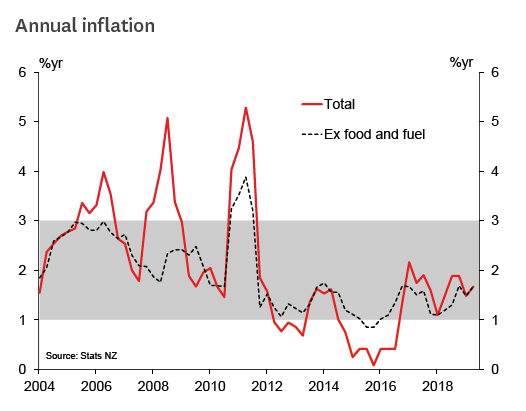
There was little to take out of today's inflation figures, with the 0.6% rise in the June quarter CPI right in line with forecasts. Almost half of the increase was due to shortterm volatility in petrol prices, which were 5.8% higher on average over the quarter. Inflation pressures elsewhere remained modest.
The annual inflation rate picked up from 1.5% to 1.7%. Some of that was again due to higher fuel prices. But the various measures of core inflation also picked up a little, with most of them within a 1.5-1.7% range. There is a consistent message coming through: inflation remains firmly within, but in the lower half of, the Reserve Bank's 1-3% target range.
A sustained move towards the 2% midpoint of the target would require stronger economic growth from here. That hasn't been forthcoming; in fact, the domestic economy has been slowing and the global environment has become more uncertain. The Reserve Bank had already judged that a lower OCR would likely be needed to meet its objectives, and today's figures will do nothing to change that stance.
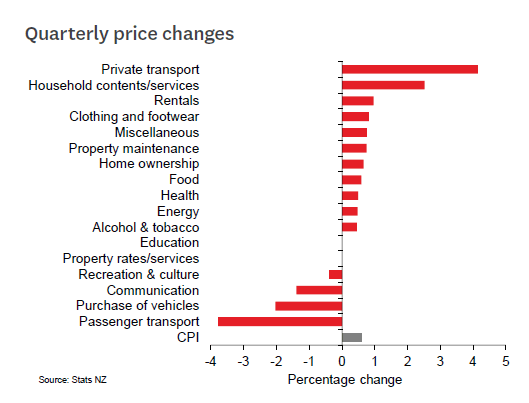
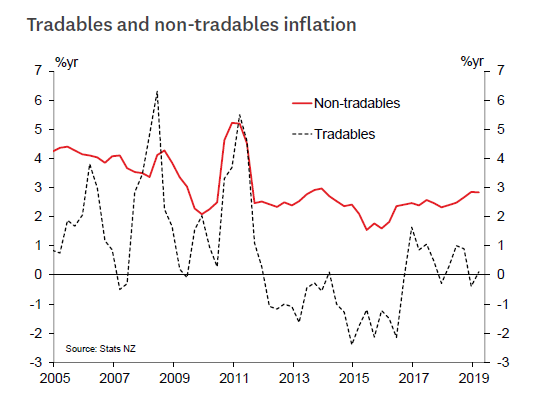
The details of the CPI showed that outside of fuel prices, tradables inflation remains weak, with prices little changed from a year ago. While there was a 2.5% jump in prices for household contents in the June quarter, that was largely reversing an unusually steep fall in the March quarter. Low global inflation and competitive pressures are continuing to hold down prices for imported goods.
In contrast, non-tradables inflation has picked up in the last few years, albeit gradually. Non-tradables prices rose 0.3% in the June quarter, a relatively low number resulting from seasonal declines in domestic airfares, car rentals and accommodation. The annual inflation rate held steady at 2.8%.
Notably, housing-related inflation pressures have softened in recent times as the housing market has cooled down. New dwelling prices rose by just 0.7% for the quarter, and real estate services rose by 0.5%.
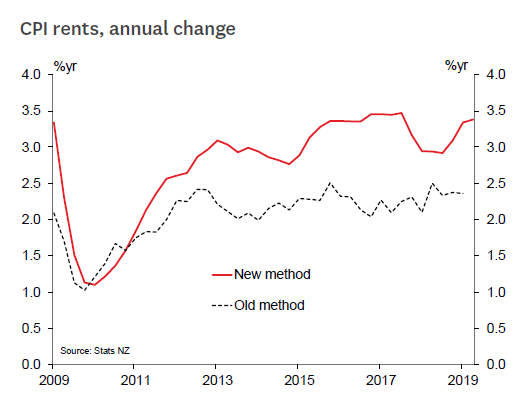
Rents rose by an unusually large 1% for the quarter. However, that doesn't represent an acceleration, but rather a change in the method used to calculate rents in the CPI. Stats NZ have provided an historic series for the new method, though they won't be using this to backdate the CPI. The new measure tends to rise faster than the old one, and given rent's weight in the CPI, it could add up to 0.1% to the annual inflation rate from here on.
Food prices were mixed. Fresh produce prices were subdued, but there was a notable rise in prices for eating out. The latter is likely due to the large 7.3% increase in the minimum wage in April.
The only notable surprise for us in the CPI was that airfares (both domestic and international) have continued to trend lower, despite rising fuel costs in the last couple of years. It may be that switching to newer, more fuel-efficient planes is outweighing the impact of the rise in world oil prices.
RBA Board Minutes Signal a Pause in the Easing Cycle
July RBA minutes confirm our expectation that the RBA will take a break from rate cuts. We continue to expect a third cut to be delivered in November.
The minutes of the July monetary policy meeting of the Reserve Bank Board confirm that the Board is still open to further monetary easing, although as we had expected, prospects for a third consecutive easing in August have been dampened.
The best way to assess the likelihood of a move in August is to compare the wording in the June minutes with the wording in the July minutes. In the June minutes, the key “considerations” section noted “members agreed that it was more likely than not that a further easing in monetary policy would be appropriate in the period ahead”. This very strong sentence was not repeated in the July minutes.
Furthermore the minutes do state that “the Board will continue to monitor developments in the labour market closely, and adjust monetary policy if needed”. In the June minutes, the “if needed” qualification was not used, merely saying instead “members agreed that in assessing whether further monetary easing was appropriate, developments in the labour market would be particularly important”.
Finally, my experience is that when a central bank decides to pause, it often refers back to previous policy decisions. In the final paragraph of the July minutes, the Board notes “this decision, together with the reduction in the cash rate decided at the previous meeting, would assist in reducing spare capacity in the economy”.
Other points which are worthy of noting are:
- The Board confirms that it expects that GDP growth will return to trend over coming years. That comment provides a fairly clear indication that the GDP forecasts that will be provided in the August Statement on Monetary Policy will maintain the view that GDP growth in 2020 will reach 2 ¾ per cent. Westpac expects that following further evidence around the economy’s momentum through 2019, this growth forecast will need to be revised down in the November Statement on Monetary Policy, paving the way for a further rate cut at the November meeting. In that regard, it is interesting that in previous communications, the dominant emphasis has been on reducing spare capacity in the labour market, the decision to cut rates was also impacted by the recent disappointing data on output growth, which is described as well below trend over the year to the March quarter. Despite the prospect of some lift in income growth from the legislated tax cuts, the outlook for consumption growth remains uncertain.
- The description of the housing market continues to be cautious. Conditions in Sydney and Melbourne are noted to have stabilised, although rising auction clearance rates were on low volumes, and more generally, turnover in the housing market had remained low.
- The Board explicitly dismisses any prospect of a further decline in interest rates “encouraging an unwelcome material pick-up in borrowing by households that would add to medium-term risks in the economy”. This is important, since lower rates are expected to support the economy through a more competitive currency and the freeing up of cash for borrowers, but any spill-over into excessive borrowing would always be seen as a constraint for policy.
- The focus on the labour market remains clear with the unemployment rate, the underemployment rate, and wages growth being the key indicators of spare capacity. The Board notes that developments in these variables continue to indicate that spare capacity was likely to remain in the labour market for some time. That observation indicates that the Board expects that a further easing in monetary policy will be “needed”.
Finally, it is worth noting that the Board specifically addresses the recent uplift in the Australian dollar. It points out that it is important to assess the currency effect on the basis that without the rate cut, the exchange rate would have been higher as other central banks continue to ease policy.
Conclusion
On May 24th, Westpac complemented its February call for two rate cuts in the second half of 2019 with the likelihood of a third cut. However, we expected that there would be some months break between the second and third cuts. With the first two cuts now having been delivered, and some clear signals from these minutes that the Board is likely to pause before further adjustments, we remain comfortable with our call that the next move will be in November.
The minutes confirm that the Board is prepared to move and probably expects to move again but prefers to wait a while to assess the impact of the first two cuts. Our forecasts for growth, inflation and the unemployment rate clearly point to the need for further stimulus, and we expect that the November meeting will provide that timing. However we do recognise that while growth and inflation remain key policy objectives, the labour market has the most immediate priority. With updates to conditions in the labour market being provided on a monthly basis, prospects for the next move being as early as September or October cannot be dismissed.