

Sample Category Title
Fed Harker: No immediate need to move interest rate in either direction
Philadelphia Fed President Patrick Harker told WSJ that "there's no immediate need to move rates in either direction at this point in my view". He noted that the economy "continues to be strong" with "very strong labor market". If the economy was "weakening substantially", he would support a rate cut. But "at this point, I do not see that".
Harker acknowledged that inflation below 2% target is a concern. But he added, "it's one that I don't see as an imminent crisis". Also, he believed "we can give it some time to move back up to 2%.
Additional, he didn't se December rate hike as a "particularly bad move" as it was not significant at that point. For now he thought the "prudent path" was to "hold steady and see how the economy evolves".
Gold – Pares Gains on Dollar Rebound
The dollar is continuing to enjoy a post-jobs report bounce today, up around 0.2%, as Fed interest rate cuts continue to dominate investors’ mindsets.
With global economic prospects increasingly in doubt as we head into another important earnings season, the Fed is quickly becoming the only game in town as far as markets are concerned.
Gold Daily Chart
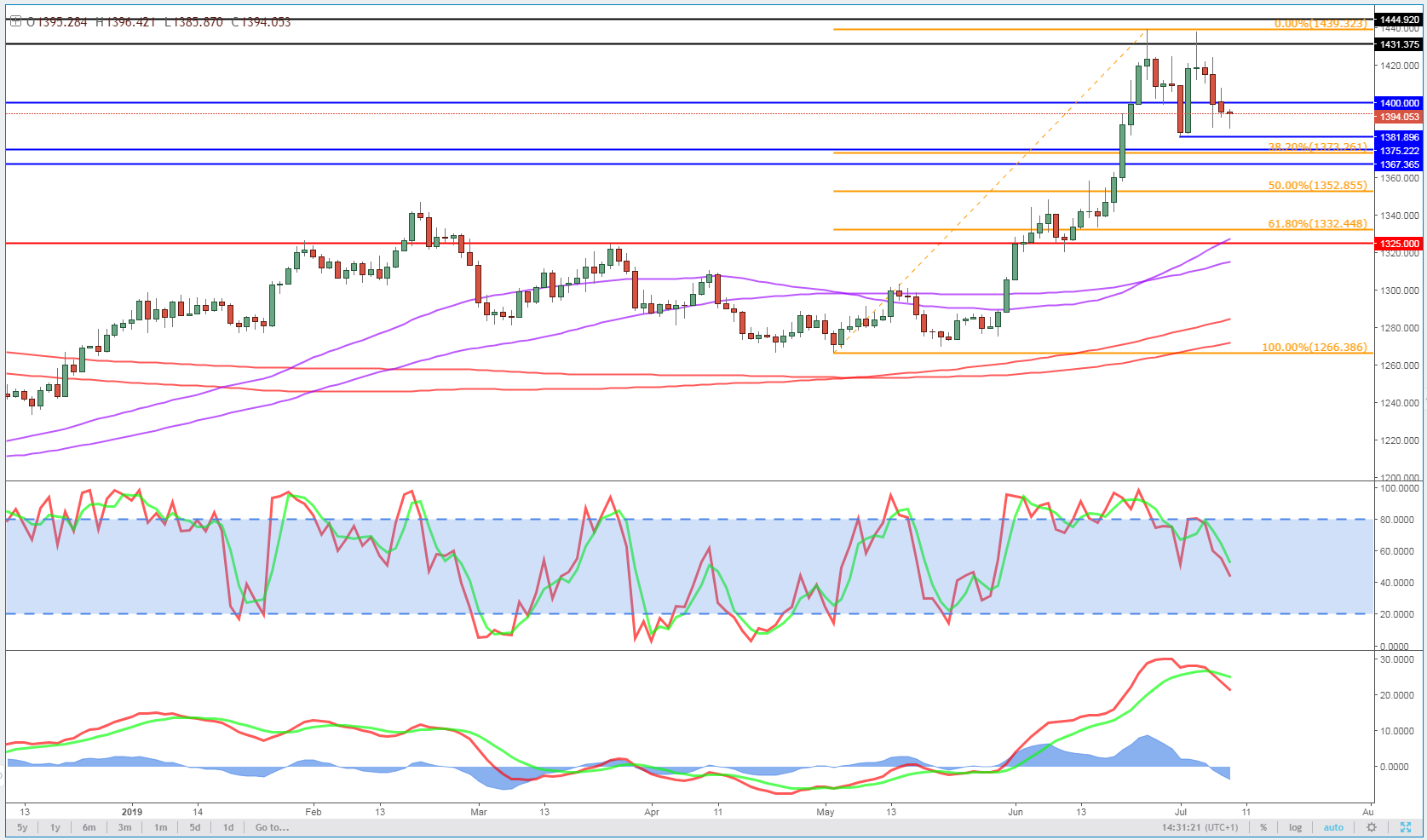
The belief that numerous cuts are coming has been very beneficial for gold prices, although this rally has since stalled just shy of $1,450. A break below $1,380 may signal more pain to come for the yellow metal, which would hardly be disastrous given that it was trading below $1,300 in late May. The rally that followed was very significant, rising almost 13% over the next few weeks.
Given that the last two peaks fell around the same level -around $1,438 – a double top may now be forming, with the neckline around $1,382. A break of this could be the catalyst for the next push lower, with a possible price projection – the size of the double top, projected below the neckline – of around $1,326. This roughly coincides with prior support and resistance and around the 61.8 fib level.
EUR/GBP Mid-Day Outlook
Daily Pivots: (S1) 0.8951; (P) 0.8962; (R1) 0.8971; More...
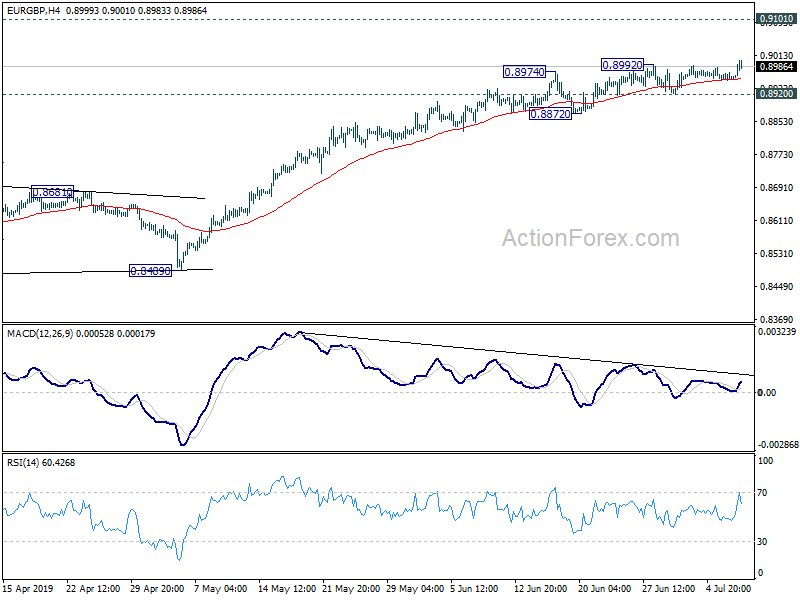
EUR/GBP's rise resumed by taking out 0.8992. Intraday bias is turned back to the upside for 0.9101 key resistance. Considering bearish divergence condition in 4 hour MACD, we'd look for topping signal as it approaches 0.9101 key resistance. On the downside, break of 0.8920 support will indicate short term topping. In this case, deeper pull back could be seen to 55 day EMA (now at 0.8844) first.
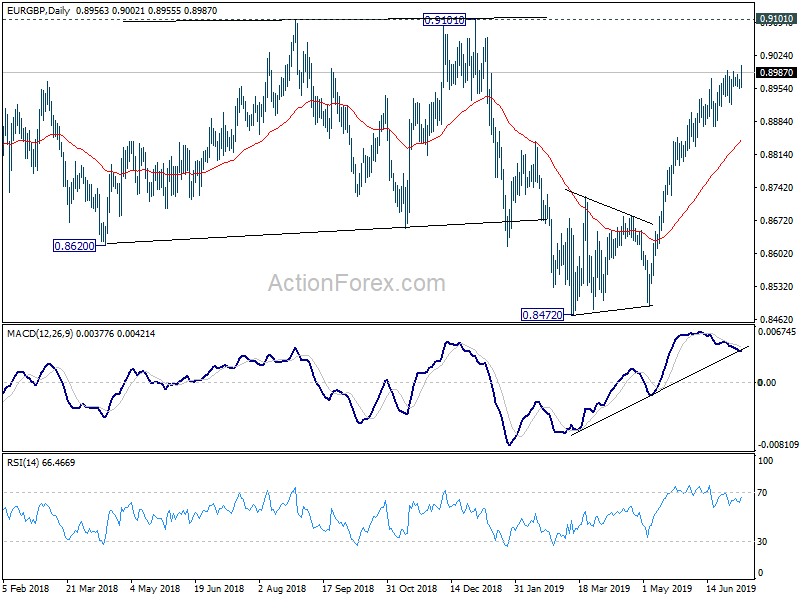
In the bigger picture, medium term decline from 0.9305 (2017 high) is seen as a corrective move. No change in this view. Current development argues that it might have completed with three waves down to 0.8472, just ahead of 38.2% retracement of 0.6935 (2015 low) to 0.9306 at 0.8400, after hitting 55 month EMA (now at 0.8527). Decisive break of 0.9101 resistance will confirm this bullish case. Nevertheless, as EUR/GBP is still staying inside long term falling channel, correction from 0.9305 could still extend to 0.8400 fibonacci level before completion, if upside is rejected by 0.9101.
EURAUD Runs Towards 23.6% Fibo; Bullish Outlook
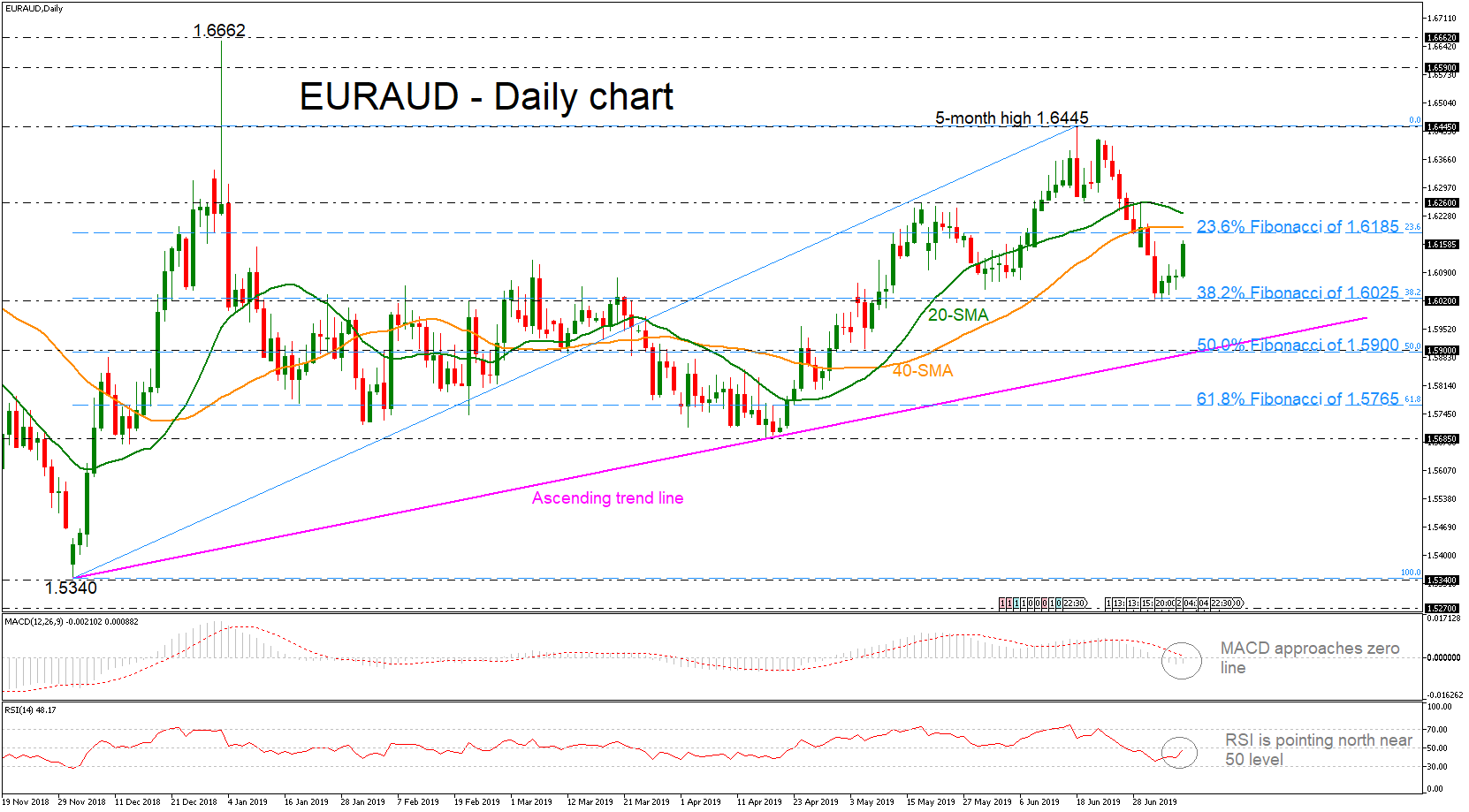
EURAUD finally reversed to the upside last Thursday after printing higher lows and higher highs in the preceding seven months to reach a five-month high of 1.6445 on June 18. Momentum indicators in the daily chart though are currently supporting that positive momentum is likely to strengthen in the short-term. Specifically, the RSI is picking up speed near 50 and the MACD is trying to surpass the zero line.
Further advances could then target the immediate area around the 23.6% Fibonacci retracement level of the bullish rally from 1.5340 to 1.6445 around 1.6185. Marginally above this level, the 40- and then the 20-simple moving averages at 1.6200 and 1.6237 could come in focus before the market challenges the 1.6260 resistance. Such move could also post a clear step higher, hitting the five-month high of 1.6445.
On the other hand, a decline could meet the 38.2% Fibo of 1.6025 and the 1.6020 support again. Below that, the 1.5900 psychological level is standing near the uptrend line, which encapsulates the 50.0% Fibonacci. If there is a successful drop below this handle, this would shift the bullish outlook to neutral, meeting the 61.8% Fibo of 1.5765.
In brief, EURAUD has been advancing over the last days and investors should be waiting for a jump above the short-term moving averages in the daily timeframe.
USD/JPY Mid-Day Outlook
Daily Pivots: (S1) 108.40; (P) 108.61; (R1) 108.93; More...
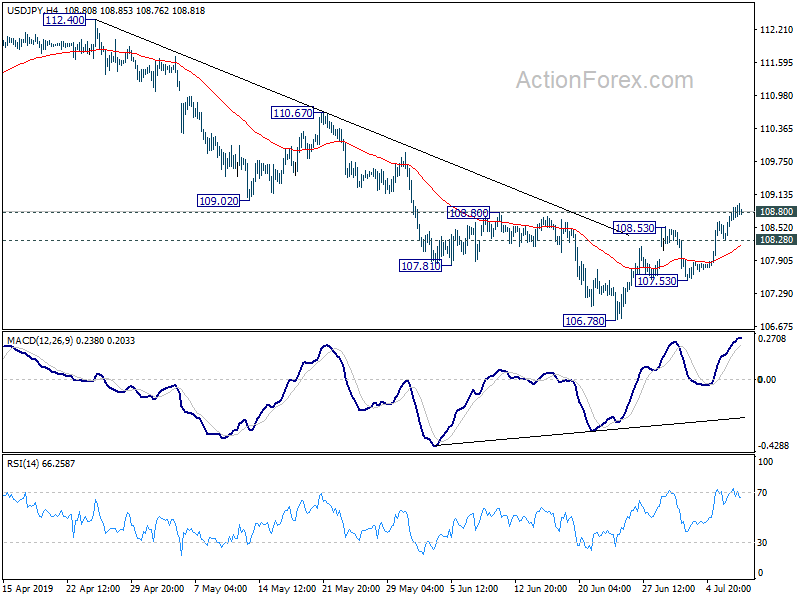
Focus remains on 108.80 resistance in USD/JPY. Sustained trading above there will confirm short term bottoming at 106.78. Further rise should then been seen to 110.67 resistance next. However, on the downside, break of 108.28 minor support will turn bias back to the downside for 107.53 support and then 106.78 low.
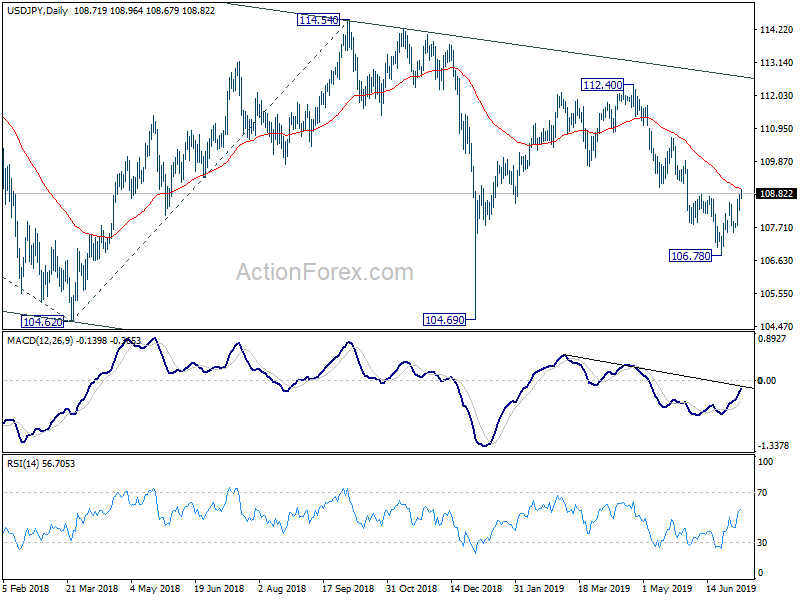
In the bigger picture, decline from 118.65 (Dec 2016) is still in progress, with the pair staying inside long term falling channel. Break of 104.62 will target 100% projection of 118.65 to 104.62 from 114.54 at 100.51. For now, we'd expect strong support above 98.97 (2016 low) to contain downside to bring rebound. In any case, break of 112.40 is needed to the first serious sign of medium term bullishness. Otherwise, further decline will remain in favor in case of rebound.
USD/CHF Mid-Day Outlook
Daily Pivots: (S1) 0.9910; (P) 0.9928; (R1) 0.9958; More...
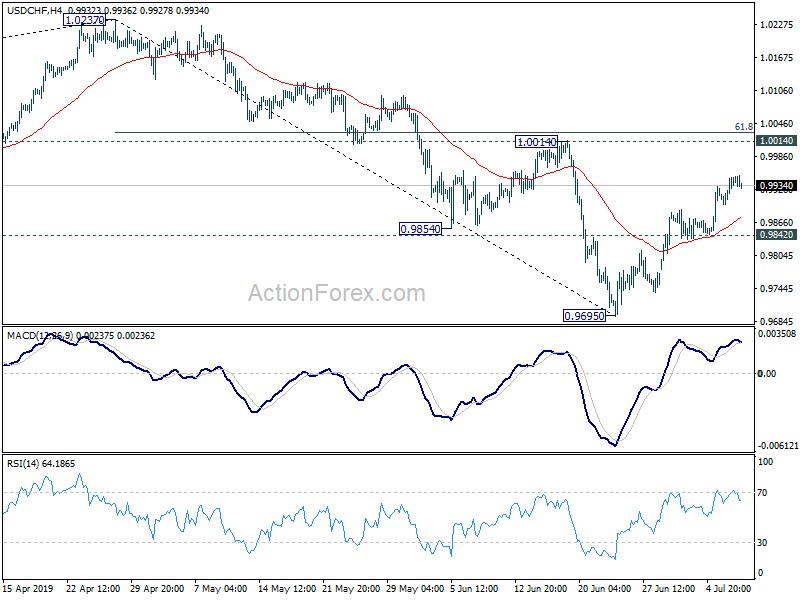
Intraday bias in USD/CHF remains mildly on the upside. Rebound from 0.9695 would target 1.0014 resistance. Upside could be limited by 61.8% retracement of 1.0237 to 0.9695 at 1.0030. On the downside, below 0.9842 minor support will turn bias back to the downside for retesting 0.9695 low instead. However, sustained break of 1.0030 will pave the way back to retest 1.0237 high.
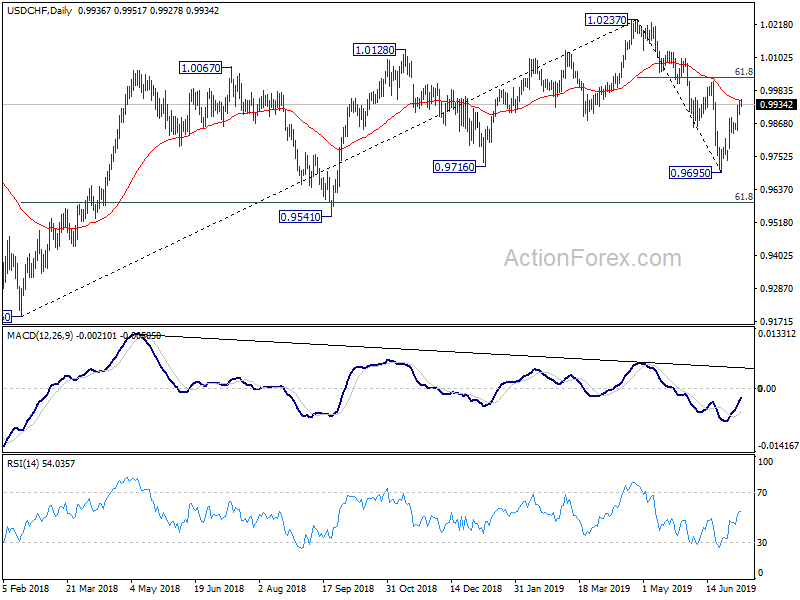
In the bigger picture, current development suggests that up trend from 0.9186 (2018 low) has completed at 1.0237 already. Deeper decline would be seen to 61.8% retracement of 0.9186 to 1.0237 at 0.9587 and below. For now, USD/CHF is seen as in long term range pattern between 0.9186 and 1.0342. Hence, we'd pay attention to bottoming signal below 0.9587. However, sustained break of 1.0014 will revive medium term bullishness and turn focus back to 1.0237 high.
EUR/USD Mid-Day Outlook
Daily Pivots: (S1) 1.1202; (P) 1.1219; (R1) 1.1230; More...
No change in EUR/USD's outlook and intraday bias remains on the downside. Firm break of 1.1181 support will confirm completion of rebound from 1.1107 at 1.1412. Further fall should then be see to retest 1.1107 low. On the upside, above 1.1268 minor resistance will turn intraday bias back to the upside for 1.1412 instead.
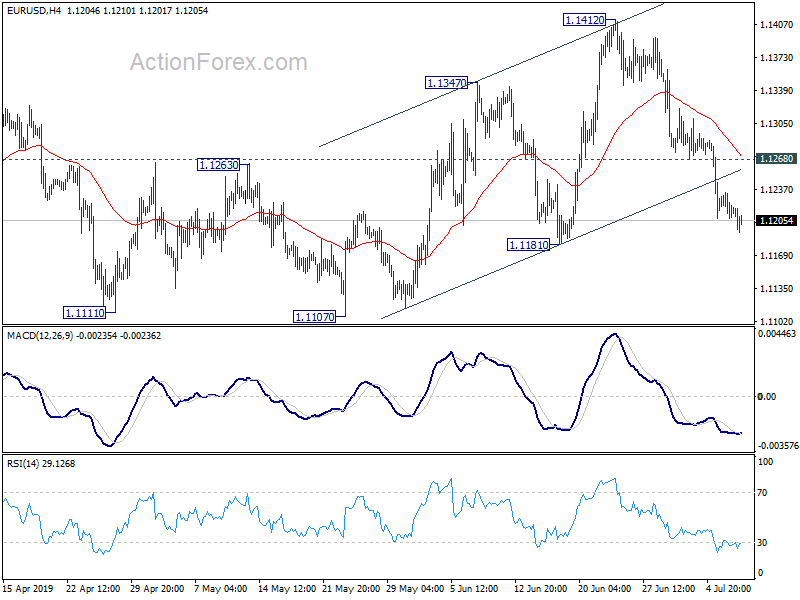
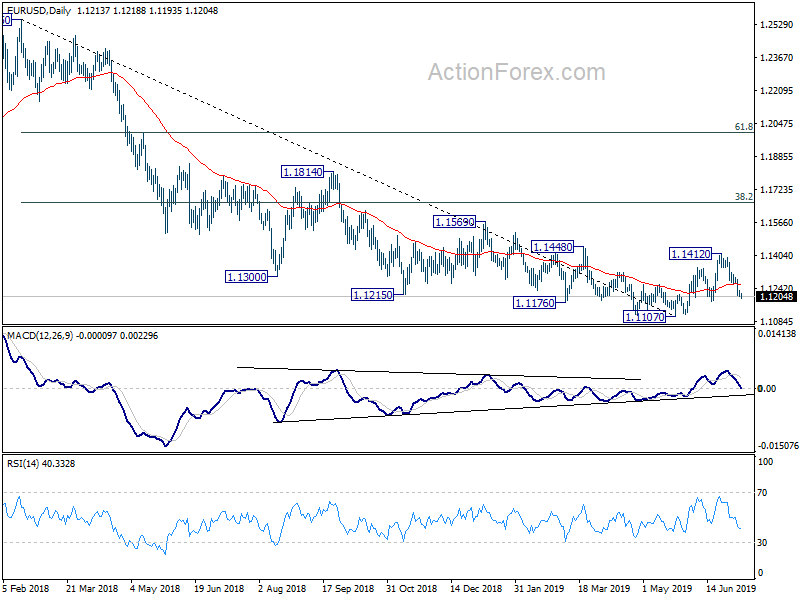
In the bigger picture, bullish convergence condition in daily and weekly MACD suggests that 1.1107 is a medium term bottom. However, rejection by 55 EMA retains medium term bearish. Outlook will be neutral for now. On the downside, break of 1.1107 will resume the down trend from 1.2555 (2018 high) to 78.6% retracement of 1.0339 to 1.2555 at 1.0813. Meanwhile, break of 1.1412 will resume the rebound to 38.2% retracement of 1.2555 to 1.1107 at 1.1660.
Sunset Market Commentary
Markets
Core bonds extended yesterday’s prelude, trading with a small downward edge in low volume circumstances. Negative risk sentiment on stock markets resulting from BASF’s profit warning, couldn’t boost bonds. It strengthens our hypothesis that the core bond rally is running out of steam, with room for consolidation or profit taking going into the FOMC meeting at the end of the month. Today’s eco calendar only contained June NFIB small business optimism which fell more or less as expected from 105 to 103.3. An avalanche of Fed speakers still feature today and later this week, but we deem it unlikely that they’ll alter the view of a 25 bps insurance rate cut to keep the US economy going. The US Treasury starts its mid-month refinancing operation later today which might cause some further underperformance of US Treasuries. US yield add less than 1 bp across the curve at the time of writing. Changes on the German yield curve are as unmeaningful. Peripheral yield spreads vs Germany narrow up to 6 bps. Italy outperforms after a successful syndicated tap of the 50-yr BTP (€3bn 2.8% Mar2067). The order book was in excess of €17bn. Greece underperforms (+11 bps) with some profit taking following this weekend’s expected parliamentary election win for New Democracy.
Trading in the major dollar cross rates remained technical in nature today as investors kept a cautious approach ahead of tomorrow’s hearing of Fed chair Powell. The dollar recently recouped some interest rate support against the likes of the yen and the euro as decent/solid US eco data caused investors to pare bets on aggressive Fed rate cuts anytime soon. Today, the news flow was thin and interest rate differentials also brought little guidance for USD trading. Still, investors were relucted to row against a US positive tide as Fed governor Powell might keep a balanced, even cautiously positive tone on the US economy even as he supports the idea of pre-emptive Fed rate cuts. EUR/USD dropped temporarily below the 1.12 barrier, but key support at 1.1181 was left intact. USD/JPY came with reach of the 109 big figure but the hurdle was a bit too high. The pair returned to the 108.75 area.
Sterling continued fighting an uphill battle today as persistent political uncertainty, signs of a sharp cooling of the UK economy and technical factors all conspired against the UK currency. Regarding the Brexit impasse, Parliament/Conservative MP’s are still preparing step to prevent the new UK Prime Minister from pushing through a no deal Brexit without Parliamentary approval. This morning, poor BRC retails sales (-1.6% Y/Y) completed a series of disappointing UK eco data of late, suggesting a standstill or even a potential contraction of Q2 UK growth. Recent poor eco data also raised the chance of the Bank of England to give up its call for a rate hike and joining the easing bias of most other central bankers. Last but not least, cable (1.2450) dropped below the 1.2506/1.2481 support area. The euro also isn’t in really good shape against the likes of the dollar. Still, EUR/GBP finally tested the 0.90 barrier, further worsening the global technical picture for the UK currency.
News Headlines
Hungarian inflation (-0.2% MoM, 3.4% YoY) cooled more than expected (0.0% MoM, 3.7% YoY) in June. The figure is grist to the mill of the Hungarian central bank, which kept a wait-and-see approach at the June meeting even though growth is solid and wages are increasing rapidly. The forint declined to EUR/HUF 325.6.
Polish MPC member Lon said the central bank should be ready to ease monetary policy if (the risk of) deflation is looming. He mentioned cutting rates from the current already historic low 1.50% as well as start using unorthodox monetary tools. His comments echo governor Glapinski’s personal view of seeing rate cuts as the next policy move.
US: Small Business Confidence Declines in June on Heightened Uncertainty
- The NFIB's small business optimism index declined 1.7 points to 103.3 in June, coming in just slightly ahead of consensus expectations for a 103.1 reading. The decline breaks four consecutive months of rising optimism.
- Movements among the survey's subcomponents were mixed, with six declining, three improving, and one remaining unchanged. Capital spending plans decreased (-4 points to 26%) as well as actual capital outlays, which was down 10 points to 54%, erasing last month's gain. Firms reporting higher sales, higher earnings and reporting 'now is a good time to invest' all declined by 6 points.
- Firms reporting inventories as 'too low' rose 4 points to a net of 0%, suggesting an overall balance of inventories. Additionally, those firms expecting credit conditions to ease increased by 2 points.
- Labor market indicators headed south in June with all indicators registering a decline relative to the previous month. The percent of firms with unfilled job openings and those planning to increase employment both fell by 2 points. Those who raised compensation over the past three months fell 6 points to 28%, while those planning to raise compensation fell by 3 points to 21%. Firms struggling to find qualified applicants also declined 4 points to 50%.
Key Implications
- Small business confidence hit a snag in June as rising uncertainty clouds the business horizon. The uncertainty index rose notably by 7 points to the highest level since March 2017. Firms reduced capital spending as profits declined and curbed expectations for higher sales volume and expansion. Labor market indicators, though still at historically high levels, also came off recent highs in June.
- The resurfacing of trade conflicts between the U.S. and its major trading partners, which are yet to be resolved, is having an impact on small businesses optimism via increased uncertainty. Firms also continue to note that a major constraint to business activity is an economy near full employment, which makes it difficult to find workers. This constraint is likely to persist for some time as the U.S. unemployment rate holds at historically low levels.
Canada: Homebuilding Impresses in June
- Canadian housing starts blew past expectations, springing 25% (m/m) higher in June to 245.7k (annualized) units. This follows a slightly downwardly revised 196.8k print in May (prior: 202.3k). On a six-month moving average basis, starts came in at 205.8k units, 5.3k higher than April.
- Multi-family starts advanced 31% (m/m) to 189.2k units, bouncing-back from April's decline. Single-detached starts were also higher, rising 8% to 56.5k units. However, despite June's rise, single-family construction remains stuck near multi-year lows. And, modest permit issuance in recent months points to more of the same moving forward.
- Provincially, the breadth of June's gain was impressive, with starts higher in every Province. After April's setback, starts bounced higher in Ontario (+17.3k to 66.3k). However, homebuilding has eased significantly in Ontario this year on a trend basis. In Quebec, housing starts picked up by 6k to 56.1k, as healthy housing demand is stoking construction. Notably, starts jumped to their highest level since at least 1990 in B.C. (+6.4k to 62.0k). In the Prairies, starts increased by 9.0k to 31.5k in Alberta while rising to their highest level since 2017 in Manitoba (10.1k). Meanwhile, starts increased by 0.5k to 2.9k units in Saskatchewan. Starts also jumped 9.0k to their highest level since 2012 in the Atlantic Region on much stronger building in PEI, Nova Scotia and New Brunswick and a pickup in Newfoundland and Labrador.
Key Implications
- Any way you slice it, June was an impressive month for homebuilding. Starts were up by double-digits in nearly every province and were higher in both the single-detached and multi-family segments. The upside surprise completes a robust second quarter that saw starts advance 20% quarter-on-quarter. Alongside rising home sales, this supports our call for residential investment to post a solid gain in Q2.
- June's strong report adds to the list of indicators confirming that economic growth in the second quarter was likely much stronger than the Bank of Canada had projected in their April Monetary Policy Report. We expect to see the Bank revise its near-term growth outlook upward in tomorrow's Monetary Policy Report.
- New housing construction in Canada continues to hold up well, in contrast to the resale market, which has cratered in recent years in the face of past interest rate increases and government policies. Homebuilding is being supported by robust population growth, strong labour markets, and past gains in pre-construction sales. That said, starts are moving gradually lower on a trend basis, with the 6-month average well off its near-term peak observed in late 2017. We anticipate some further moderation, as starts move closer to a more fundamentally supported level of around 200k. This view is consistent with permit data for May released this morning, which showed a 16% drop from April's elevated level.