Sample Category Title
Canada Homebuilding Bounced Higher in June
- Total house starts increased to 246k from 197k in May
- Gain widespread across regions
- Permit issuance slowed 234k in May after April surge
Canadian homebuilding continues to chug along at elevated levels – still suggesting that significantly slower resale markets over the last year have had limited spillovers into homebuilding activity. Part of the latest monthly jump may have had something to do with an earlier surge in permit issuance in B.C. in April. And that had more to do with a rush to get ahead of higher development costs in Vancouver than rising home demand on net. But starts excluding B.C. were also still up 30% in June to more-than-retrace a 20% drop in May. And permits issued in May (released separately today) remained elevated at an annualized 234k despite BC more-than-retracing a huge 71k surge the prior month.
We still think that homebuilding will ultimately drift lower going forward given the earlier easing in resale markets. Overall household spending is also likely to remain lackluster – but perhaps less than expected just a few months ago given recent declines in market interest rates. At a minimum, the housing data has been in line with our economic reports for Canada that broadly suggest economic growth has bounced back somewhat after bad weather and disruptions to oil production weighed on growth over the winter.
GBP/USD Mid-Day Outlook
Daily Pivots: (S1) 1.2499; (P) 1.2519; (R1) 1.2539; More....
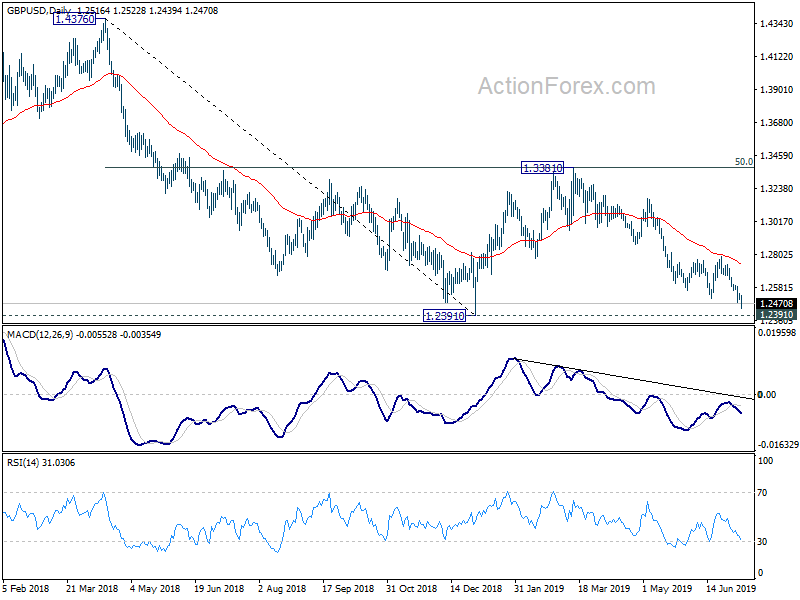
GBP/USD's decline extends to as low as 1.2439 so far today. Intraday bias remains on the downside for 1.2391 low. Firm break there will resume larger down trend. On the upside, above 1.2539 minor resistance will turn intraday bias neutral first. But near term outlook will stay bearish as long as 1.2783 resistance holds.
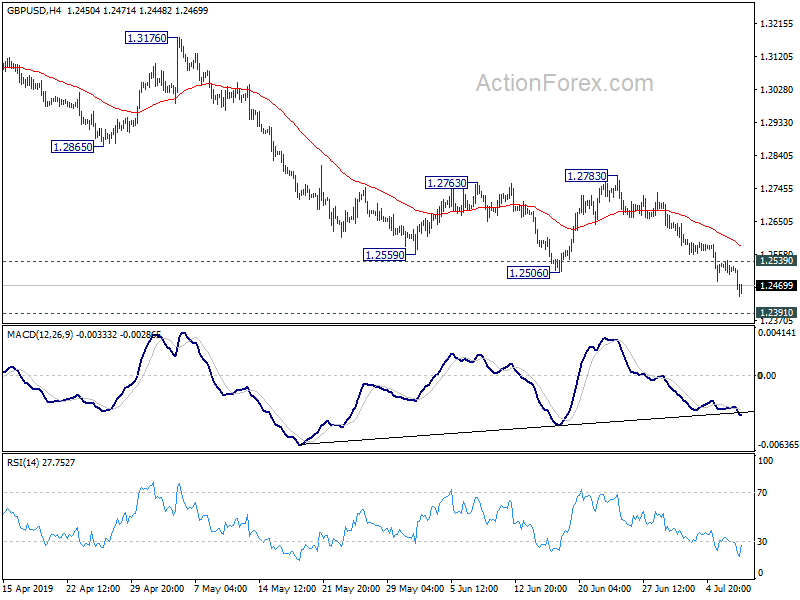
In the bigger picture, down trend from 1.4376 (2018 high) is still in progress. Break of 1.2391 would target a test on 1.1946 long term bottom (2016 low). For now, we don't expect a firm break there yet. Hence, focus will be on bottoming signal as it approaches 1.1946. In any case, medium term outlook will stay bearish as long as 1.3381 resistance holds, in case of strong rebound.
Dollar Stays Firm as Fed Powell Offers No Rate Clue Yet, Sterling Weak
Dollar, Swiss Franc and Yen remain the strongest ones for today. Risk aversion mode was turned on in European session and is carried forward to US session. Investors are turning cautious as expectation for Fed rate cut this month is being adjusted. Fed Chair Jerome Powell didn't comment on monetary policy today, and is saving his views for more discussion in his testimony. At this point, Australian Dollar remains the weakest one after poor business confidence data. Sterling follows as second weakest, awaiting GDP data tomorrow.
Technically, EUR/GBP's break of 0.8992 suggests rally resumption towards 0.9101 key resistance. However, as upside momentum is not too strong for the moment. We'd be cautious on topping around there. With general weakness in Sterling, GBP/USD is heading toward 1`.2391 low and sustained break will resume larger down trend. GBP/JPY is also eyeing 135.17 temporary low again as recovery was limited by 4 hour 55 EMA.
In Europe, currently, FTSE is down -0.26%. DAX is down -1.05%. CAC is down -0.46%. German 10-year yield is up 0.0085 at -0.356. Earlier in Asia, Nikkei rose 0.14%. Hong Kong HSI dropped -0.76%. China Shanghai SSE dropped -0.18%. Singapore Strait Times dropped -0.14%. Japan 10-year JGB yield rose 0.01 to -0.139.
WH Kudlow: Powell is safe at the present time
White House National Economic Council Director Larry Kudlow reiterated his view that Fed can "take back" its December rate hike. Also, he urged Fed to look at low inflation data, rather than strong job data in deciding the rate cut. Meanwhile, Kudlow also noted Trump is making "no effort" to remove Fed Chair Jerome Powell. And, "at the present time, yes he is safe".
Separately, Powell delivered opening remarks at "Stress Testing: A Discussion and Review," a Boston Fed research conference. But he didn't talk about monetary policy. Focus will turn to his two-day semiannual Congressional Testimony, which starts tomorrow.
Canada building permits dropped -13%, housing starts jumped to 246k
Canada building permits dropped -13.0% mom to CAD 8.2B in May, worse than expectation of -10.0% mom. Permits increased in six provinces and all territories. But they're not enough to offset the decreased in British Columbia.
Housing starts rose to 246k in June, up fro 197k and beta expectation of 209k. The national trend in housing starts increased primarily due to higher trending row and apartment starts, in urban areas.
From US, NFIB small business optimism drop to 103.3 in June, down from 105.0 but beat expectation of 10.1.
EU Dombrovskis: All member economies are set to growth this year and next
European Commission is scheduled to announce new economic forecasts tomorrow. Ahead of that Vice-President Valdis Dombrovskis said "all EU economies are set to grow this year and next," citing the forecast results. However, he also warned that "we see risks, especially external risks, on the rise". And resilience of EU economies could be tested if the risks materialized. He also emphasized "it's high time to do reform while keeping public finances sound."
Released in European session, Swiss unemployment rate dropped to 2.3% in June, down from 2.4%.
UK retail sales picture bleak on Brexit uncertainty
UK BRC like-for-like sales dropped -1.6% yoy in June, below expectation of -1.5% yoy. Total sales dropped -1.3% yoy. The data were worst in record for June since 1995. Helen Dickinson, Chief Executive of BRC, noted, "overall, the picture is bleak: rising real wages have failed to translate into higher spending as ongoing Brexit uncertainty led consumers to put off non-essential purchases."
She added: "Businesses and the public desperately need clarity on Britain's future relationship with the EU. The continued risk of a No Deal Brexit is harming consumer confidence and forcing retailers to spend hundreds of millions of pounds putting in place mitigations – this represents time and resources that would be better spent improving customer experience and prices. It is vital that the next Prime Minister can find a solution that avoids a No Deal Brexit on 31st October, just before the busy Black Friday and Christmas periods."
Australia NAB Business confidence unwound post election spike
Australia NAB Business Conditions improved from 1 to 3 in June, but remain below average. Business Confidence dropped from 7 to 2, largely unwound the bounce from 0 to 7 in May. NAB said "the recent run of results also suggest that the economy is unlikely to record a significant pickup in growth in Q2." Further, "forward orders also remain below average (and are negative), suggesting a near-term turn around in business activity is unlikely."
According to Alan Oster, NAB Group Chief Economist, "Business confidence appears to have unwound its spike in May, which we think was driven by a short-term election bounce and increased optimism around a renewed interest rate easing cycle by the RBA. While business conditions increased slightly in the month, they remain well below average after trending lower for over a year now. The decrease in conditions has been relatively broad-based across states and industries – suggesting that there has been sector wide loss of momentum over the past year".
GBP/USD Mid-Day Outlook
Daily Pivots: (S1) 1.2499; (P) 1.2519; (R1) 1.2539; More....
GBP/USD's decline extends to as low as 1.2439 so far today. Intraday bias remains on the downside for 1.2391 low. Firm break there will resume larger down trend. On the upside, above 1.2539 minor resistance will turn intraday bias neutral first. But near term outlook will stay bearish as long as 1.2783 resistance holds.
In the bigger picture, down trend from 1.4376 (2018 high) is still in progress. Break of 1.2391 would target a test on 1.1946 long term bottom (2016 low). For now, we don't expect a firm break there yet. Hence, focus will be on bottoming signal as it approaches 1.1946. In any case, medium term outlook will stay bearish as long as 1.3381 resistance holds, in case of strong rebound.
Economic Indicators Update
| GMT | Ccy | Events | Actual | Forecast | Previous | Revised |
|---|---|---|---|---|---|---|
| 23:01 | GBP | BRC Retail Sales Monitor Y/Y Jun | -1.60% | -1.50% | -3.00% | |
| 23:30 | JPY | Labor Cash Earnings Y/Y May | -0.20% | -0.60% | -0.10% | -0.30% |
| 23:50 | JPY | Japan Money Stock M2+CD Y/Y Jun | 2.30% | 2.60% | 2.70% | 2.60% |
| 01:30 | AUD | NAB Business Conditions Jun | 3 | 3 | 1 | |
| 01:30 | AUD | NAB Business Confidence Jun | 2 | 2 | 7 | |
| 05:45 | CHF | Unemployment Rate Jun | 2.30% | 2.40% | 2.40% | |
| 06:00 | JPY | Machine Tool Orders Y/Y Jun P | -38.00% | -27.30% | ||
| 10:00 | USD | NFIB Small Business Optimism Jun | 103.3 | 103.1 | 105 | |
| 12:15 | CAD | Housing Starts Jun | 246K | 209K | 202K | 197K |
| 12:30 | CAD | Building Permits M/M May | -13.00% | -10.00% | 14.70% | 16.00% |
WH Kudlow: Powell is safe at the present time
White House National Economic Council Director Larry Kudlow reiterated his view that Fed can "take back" its December rate hike. Also, he urged Fed to look at low inflation data, rather than strong job data in deciding the rate cut.
Meanwhile, Kudlow also noted Trump is making "no effort" to remove Fed Chair Jerome Powell. And, "at the present time, yes he is safe".
Separately, Powell delivered opening remarks at "Stress Testing: A Discussion and Review," a Boston Fed research conference. But he didn't talk about monetary policy. Focus will turn to his two-day semiannual Congressional Testimony, which starts tomorrow.
Canada building permits dropped -13%, housing starts jumped to 246k
Canada building permits dropped -13.0% mom to CAD 8.2B in May, worse than expectation of -10.0% mom. Permits increased in six provinces and all territories. But they're not enough to offset the decreased in British Columbia.
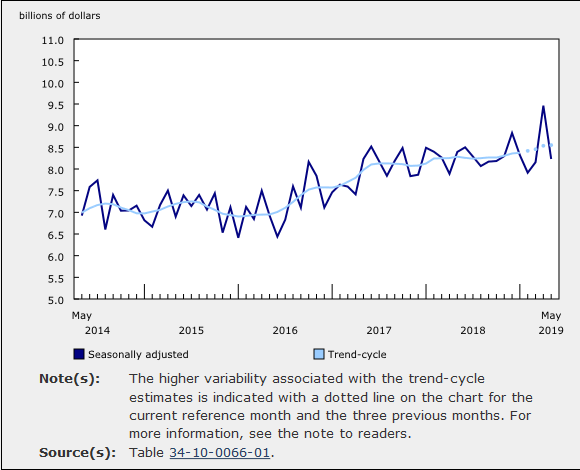
Housing starts rose to 246k in June, up fro 197k and beta expectation of 209k. The national trend in housing starts increased primarily due to higher trending row and apartment starts, in urban areas.
BTCUSD Forms a Failure Swing Bottom Pattern; Eases Below 2-Week High
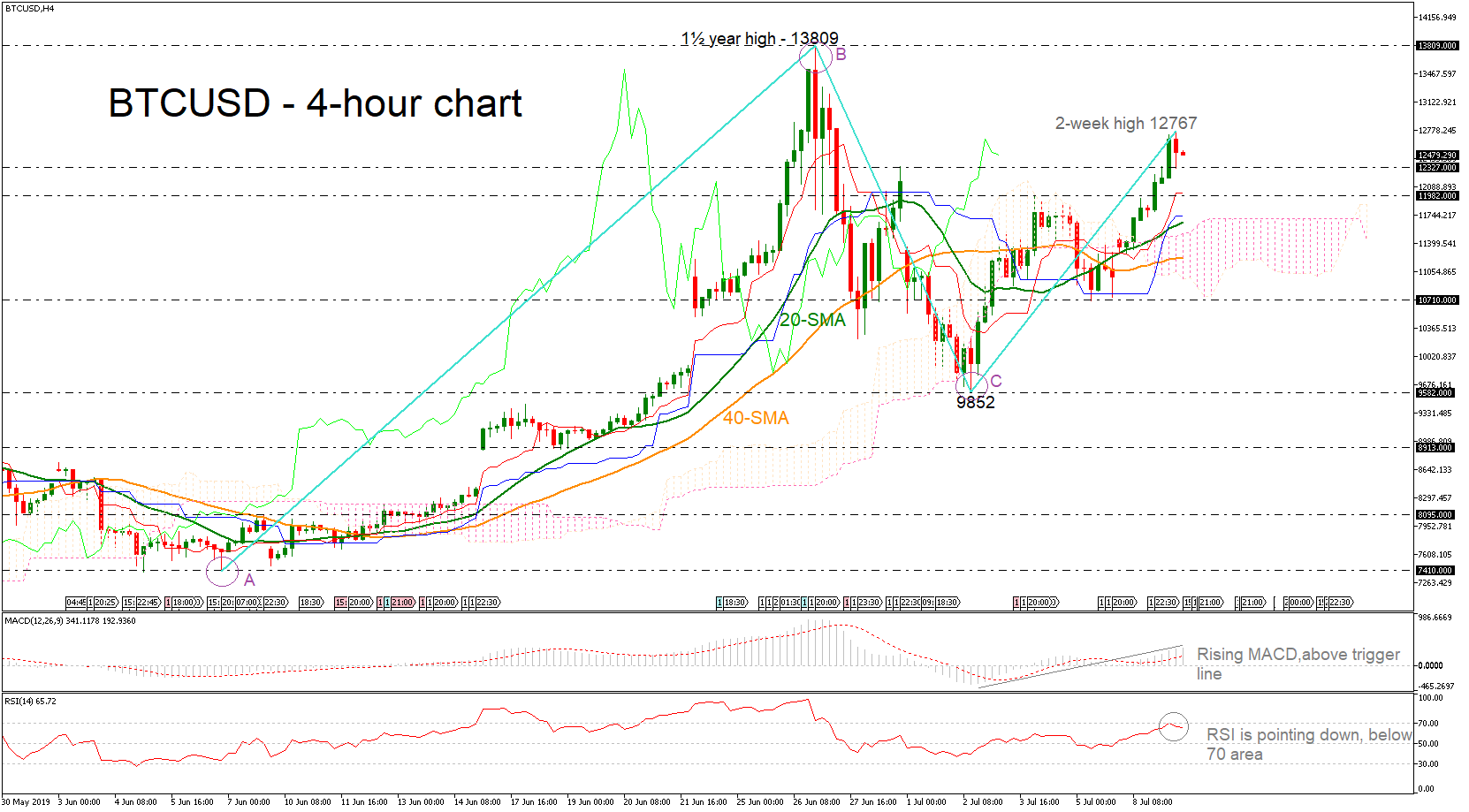
BTCUSD has been creating a failure swing bottom pattern and if the price jumps above the one-and-a-half-year high of 13809 would confirm the buying interest. The rebound on the 9582 support level helped the price to climb towards a two-week high of 12767, surpassing the Ichimoku cloud and the short-term moving averages.
However, the RSI indicator is forming a downside move following the pullback on the 70 level, while the MACD is still increasing distance above its trigger line.
More gains could send the price above intraday’s high until the 13809 peak, while a successful attempt above this level, could endorse the scenario for bullish rally until the 14842 minor resistance of the high on January 2018.
On the downside, the 11982 support level and the upper surface of the Ichimoku cloud near 11712 could be the immediate barriers. Should the price decisively close below this roof could extend declines until the 10710 area.
Summarizing, BTCUSD is looking cautiously positive in the short-term and bullish in the medium-term.
All Eyes on Powell’s Testimony in Huge Week for Dollar
It will be a pivotal week for the dollar. Fed chief Jay Powell will testify before Congress on Wednesday at 14:00 GMT, and the minutes from the latest FOMC meeting will be released at 18:00 GMT. The nation’s inflation data for June will follow on Thursday at 12:30 GMT. The risks around the dollar seem tilted to the upside this week, as Powell may push back against expectations for a July rate cut. Overall though, the outlook for the greenback remains gloomy.
The latest US payrolls report was strong enough to dispel expectations for an aggressive ‘double’ rate cut of 50 basis points (bps) in July, but markets remain convinced the Fed will still slash rates by a ‘regular’ 25 bps. In fact, that move is fully priced in already, as trade uncertainty and a darkening global outlook are seen as sufficient factors for policymakers to act, even if the US economy doesn’t appear to be in dire need of monetary stimulus.
To be fair, some indicators have indeed lost steam – for example inflation has been running a little below the 2% target, and manufacturing surveys show that tariffs have started to bite. Meanwhile, the Atlanta Fed GDPNow model projects annualized growth of only 1.3% in Q2, which marks a sharp slowdown from the 3.1% in Q1. Still, the data as a whole aren’t exactly screaming for rates to be lowered immediately, as most parts of the economy – and especially the consumer – remain healthy.
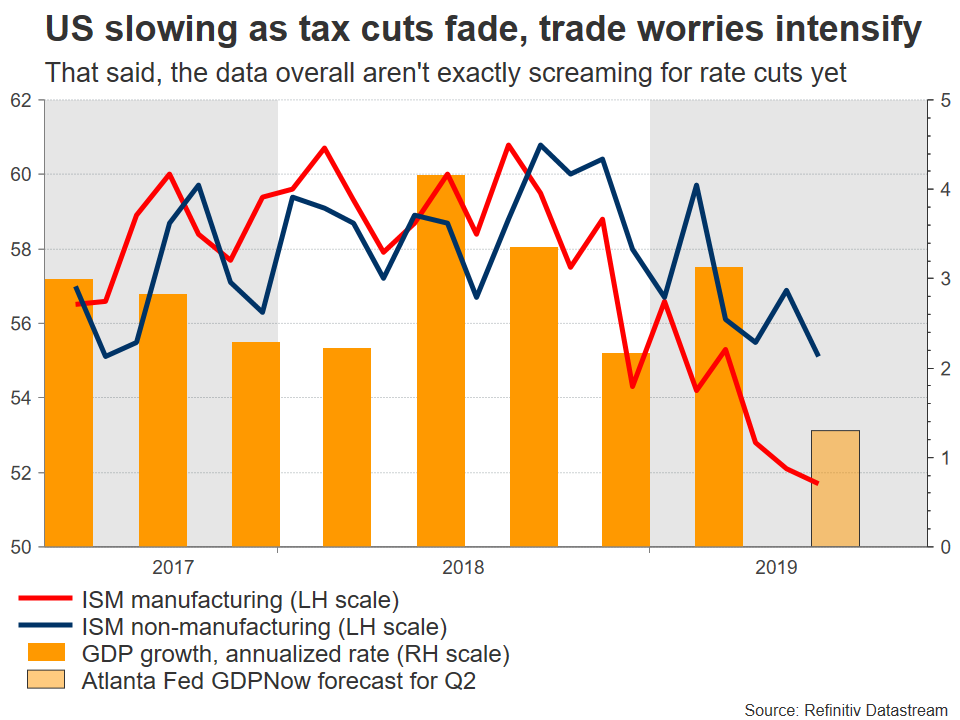
This generates an upside risk for the dollar this week. Fed Chairman Powell will appear before the House Financial Services Committee on Wednesday for his semiannual testimony, and the risk is that he pushes back against the market’s exceedingly dovish expectations by signaling that a July rate cut is not necessarily a done deal.
To be clear, this is a low probability but high impact outcome. After the June meeting Powell said: “an ounce of prevention is worth more than a pound of cure”, which clearly shows he is in favor of a precautionary rate cut. Yet, one cannot ignore that developments since then have been positive, with decent incoming data and a trade ceasefire. The point is that if Powell wants to keep any optionality about not cutting in July, this is his last chance.
The minutes of the Fed’s June meeting will be released a few hours later, but since that gathering took place before the strong payrolls data was released, the minutes may be seen as outdated. Similarly, even though the Fed chief will testify on Thursday too, this time before the Senate, his prepared remarks will be identical so if there is any action it will come from the subsequent Q&A session with lawmakers.
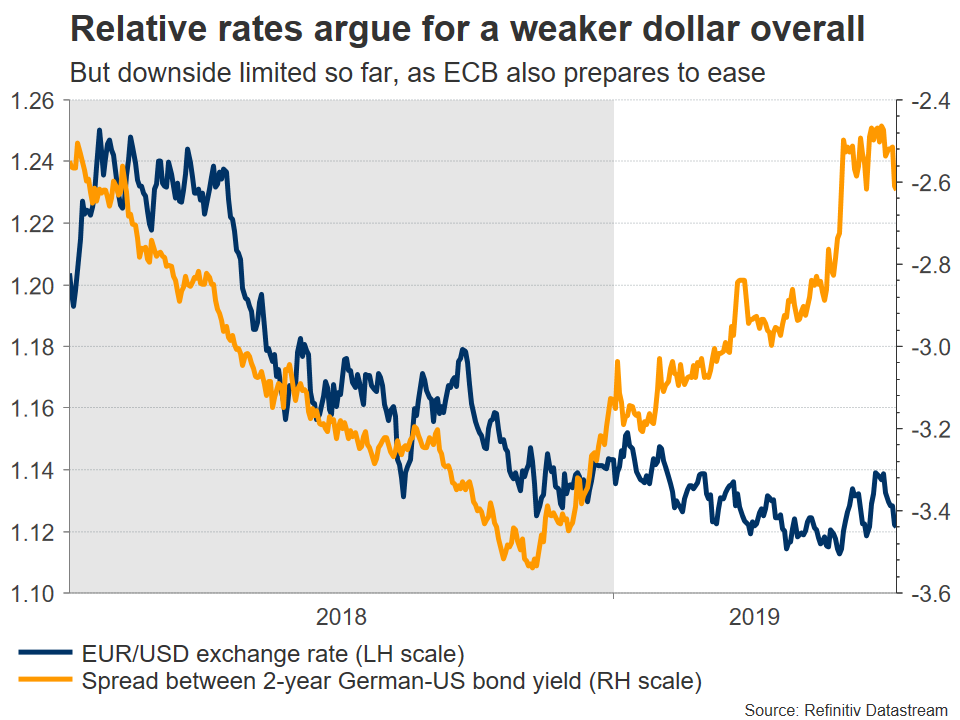
Perhaps attracting more attention on Thursday will be the CPI inflation data for June. Headline inflation is expected at 1.6% in yearly terms, slower than the 1.8% in May, while the core rate is projected unchanged at 2.0%. These figures will be among the final pieces of the puzzle ahead of the July meeting, elevating their importance.
In the big picture, even if the dollar recovers a little further this week, the currency’s broader outlook remains bleak. If central banks indeed start easing as aggressively as markets expect in the coming months, the greenback may be among the biggest losers by virtue of the Fed having much more room to cut rates than any of its peers – eroding the currency’s carry appeal.
Beyond the greenback, stocks could also move. If the prospect of a July cut indeed comes into doubt, that would likely push equities lower in the short term.
Note that on Thursday, besides Powell, we will also hear from the Fed’s Williams, Bostic, Quarles, and Kashkari.
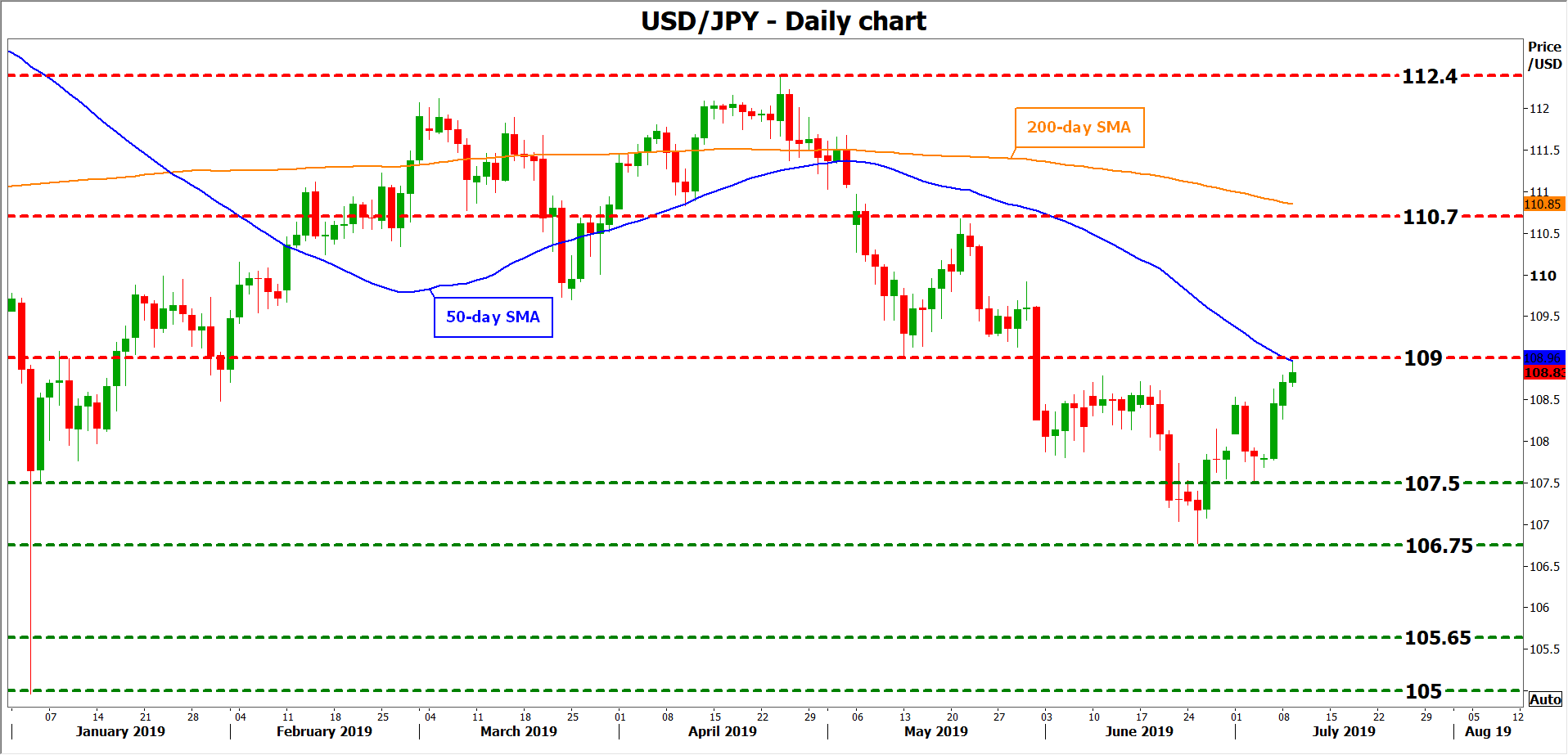
Taking a technical look at dollar/yen, a clear break above the 109.00 area could open the way for a test of 110.70 initially, the May 21 high.
On the flipside, another wave of declines could stall first near 107.50, the July 3 low. Even lower, attention would turn to the June trough of 106.75.
Risk-Off as Markets Await Powell; Oil, Gold, Bitcoin
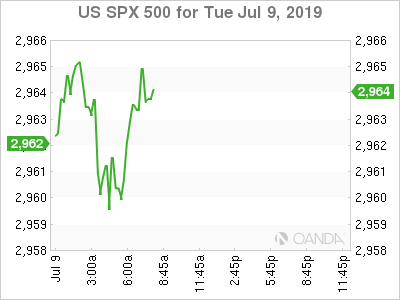
Financial markets remain on edge ahead of Fed Chair Powell’s crucial two days of House Congressional testimony that will begin on Wednesday. Friday’s robust employment report, along with today’s better-than-expected NFIB Small Business Optimism survey continue to highlight the labor market remains unusual strong this late in the 11-year long economic cycle. Powell is expected to keep the case for cutting rates open, but he could dash hopes for those expecting hints that we will see a commitment for more than one rate cut this year. This morning, Powell will also provide opening remarks at a Boston-Fed conference on stress tests.
Overnight, risk aversion remained the dominant theme after BASF, the world’s largest chemical maker cut their 2019 forecast because of the trade war. While a cut was expected by many analysts, the slashing of the 2019 EBIT forecast by 30% was considerably lower than what was feared. The global automotive industry downturn was particularly strong and markets will not see any relief until we see the US fully address the trade spat with Europe, which they are likely to do once they wrap up the trade war with China.
In Asia, Hong Kong leader Carrie Lam gave an interview to state that the China extradition bill is dead. The decision however is not a formal withdrawal of the bill and may be too late to derail Hong Kong protesters who want it completely withdrawn and are seeking democracy for Hong Kong. Lam could decide to bring back the bill with 12 days’ notice and that risk is likely to keep the weeks-long protests going strong.
As markets await the next update on the trade front, the situation remains tense between China and the US. Taiwan is set to acquire $2 billion of US weapons, in what China is claiming is a violation of international law.
US stocks markets are off the lows of the day, after Pepsico earnings delivered a slight beat that saw beverage seller affirm their 2019 targets. Treasury yields are slightly higher, with the 10-year yield up 1.0 basis point to 2.058%. The dollar is up against its major trading partners with the biggest gains against the British pound and Aussie dollar.
Oil
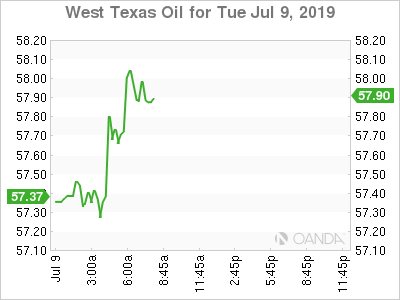
Crude prices are likely to see some support on fears of further tanker attacks or seizures in the Persian Gulf. Yesterday, a BP oil tanker that was due to travel from Iraq to Europe decided to stay put in fear that they could get seized by Iran.
Oil markets are also eagerly awaiting Fed Chair Powell’s testimony to Congress, which will provide confirmation the end of month meeting is live and that they will remain data dependent on how deep they will take this upcoming rate cutting cycle.
Commodity prices could see a strong move following Powell if focus on deflationary risks and triggers a dollar reversal.
Gold
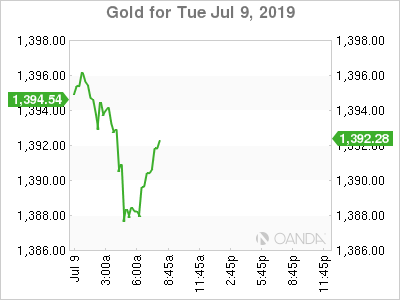
The strong dollar is temporarily derailing the bullion rally. The yellow metal is now down $50 from the June 25th high of $1,442.90. Gold was ripe for a pullback and buyers will welcome the current pullback. Even if Powell is not dovish enough with this week’s testimony, gold should find strong support around the $1,370 region.
Bitcoin
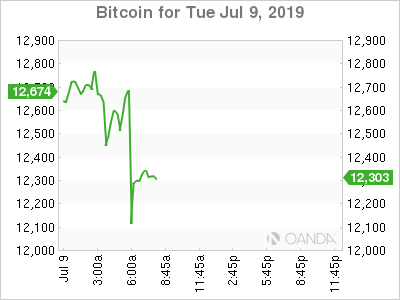
Cryptocurrencies are here to stay. US regulators have made progress in outlining how current securities rules will apply to digital tokens. The crypto space is likely to get crowded and we will see large financial institution launch their own competing coins in the very near future. Bitcoin will benefit from this increased regulation and should see further bullish momentum.
EU Dombrovskis: All member economies are set to growth this year and next
European Commission is scheduled to announce new economic forecasts tomorrow. Ahead of that Vice-President Valdis Dombrovskis said "all EU economies are set to grow this year and next," citing the forecast results.
However, he also warned that "we see risks, especially external risks, on the rise". And resilience of EU economies could be tested if the risks materialized.
He also emphasized "it's high time to do reform while keeping public finances sound."
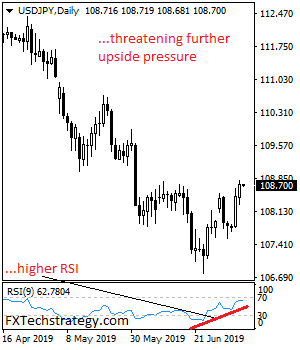
USDJPY Targets The 109.10 Resistance Area
USDJPY targets the 109.10 resistance area as it look for price extension. On the upside, resistance comes in at 109.50 level. Above this level will turn attention to the 110.00 level. Further out, we expect a possible move towards the 110.50 level. A cut through here will open the door for more gain towards the 111.00. On the downside, support comes in at the 108.50 level where a break will target the 108.00 level. Below that level will turn focus to the 107.50 level and then lower towards the 107.00 level. On the whole, USDJPY faces further upside threats in the days ahead.