

Sample Category Title
China Daily: US-China remain widely apart even on the conceptual level
On the Chinese side, the official China Daily welcomed the agreement between Trump and Xi to " make way for negotiations". However, it warned "agreement on 90 percent of the issues has proved not to be enough, and with the remaining 10 percent where their fundamental differences reside, it is not going to be easy to reach a 100-percent consensus, since at this point, they remain widely apart even on the conceptual level."
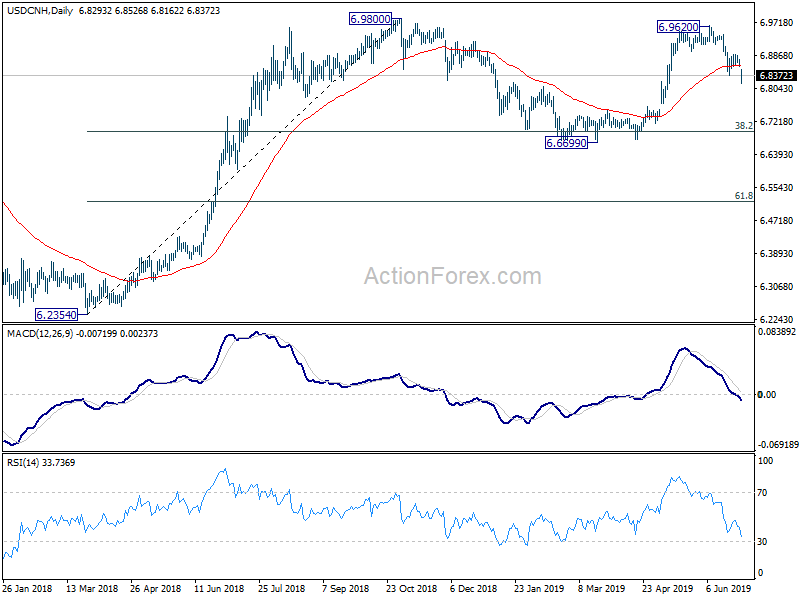
USD/CNH (offshore Yuan) drops sharply today and the Yuan rebounds on trade news. With 55 day EMA firmly taken out, the rise from 0.6699 should have completed at 0.6920, after failing 6.9800 resistance. Imminent pressure on breaking the psychologically important 7 handle is eased. Deeper fall could be seen back towards 6.6699 could be seen for the near term. But strong support should be seen around there to contain downside. Eventual break of 6.9800 is still expected at a later stage.
Trump claims winning, Kudlow talks down loosening of Huawei ban
A day after the meeting with Xi, Trump claimed on Sunday, in South Korea, that the US is "winning big because we have created an economy that is second to none". And, "we're collecting 25 percent on $250 billion, and China is paying for it, as you know, because, as you notice, our inflation hasn't gone up."
Trump further claimed that "China has devalued their currency in order to pay for the tariffs... And in addition to devaluing, they've also pumped a lot of money into their economic model... They've been pumping money in. We haven't. We've been retracting. We've been raising interest rates and they've been lowering interest rates."
Separately, the loosening up of Huawei ban triggered some criticism from Trump's Republican party. South Carolina Republican Senator Lindsay Graham warned "there will be a lot of pushback if it is a major concession."
But National Economic Council chairman Larry Kudlow tried to tone it down on Fox News Sunday. He said "all that is going to happen is Commerce will grant some additional licenses where there is a general availability" of the parts the company needs. And, companies "are selling products that are widely available from other countries ... This not a general amnesty ... The national security concerns will remain paramount."
Stocks jump on US-China trade talks, USD/CHF & USD/JPY rebounds not strong enough yet
Market sentiments are given a solid lift in Asia, after the Trump-Xi meeting in Japan ended up with agreement on no further escalations in tariffs for the time being. Trump agreed to loosen up the ban on Chinese tech giant Huawei while China agreed to buy large amount of American farm products. Additionally, Trump surprised the world by being the first sitting US president to visit the Demilitarized Zone between the two Koreas and met North Korean leader Kim Jong-un, for restarting nuclear talks.
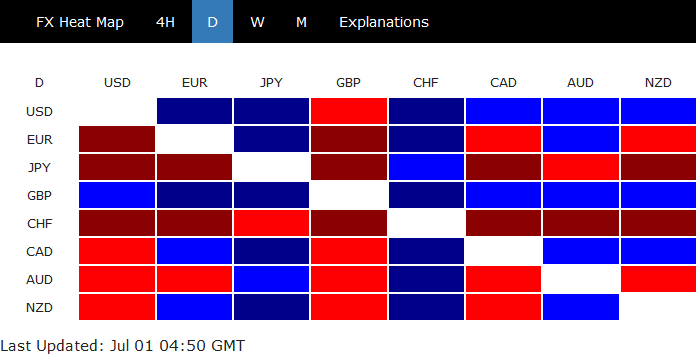
At the time of writing, Nikkei is up 1.95%, China Shanghai SSE is up 1.88%. Singapore Strait Times is up 1.26%. Hong Kong is on holiday. In the currency markets, Swiss Franc and Yen are overwhelmingly the weakest ones on return of risk appetite. But commodity currencies are not gaining much for now. Instead, Sterling and Dollar are the strongest ones.
Suggested readings:
- US-China Trade: Ceasefire a Reality But No Quick Fixes to Reach a Deal
- US-China Talks Back On Track And Oil Gets OPEC+ Boost
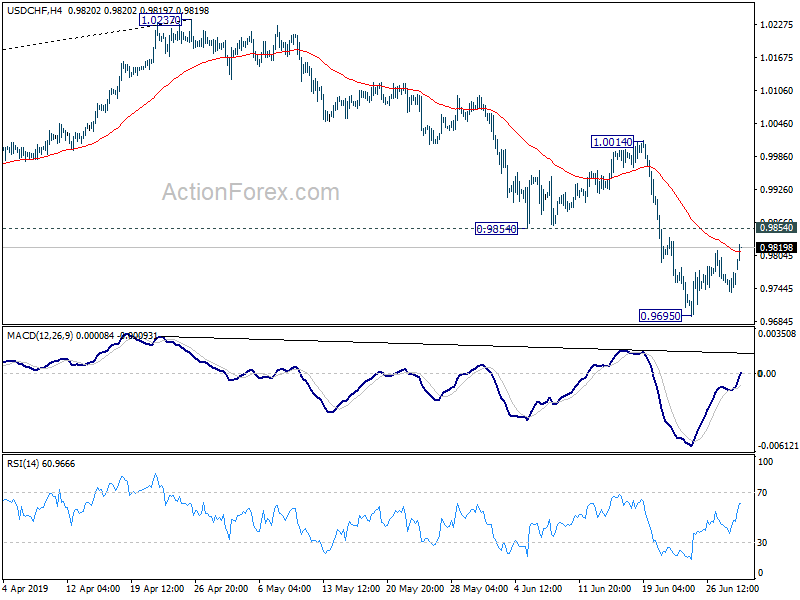
While but USD/CHF and USD/JPY rebound notably today, they're both limited below key near term resistance levels. Thus, such rebounds are still viewed as corrective for now and outlook in both pair stays bearish. USD/CHF will have to take out 0.9854 resistance decisively to confirm short term bottoming.
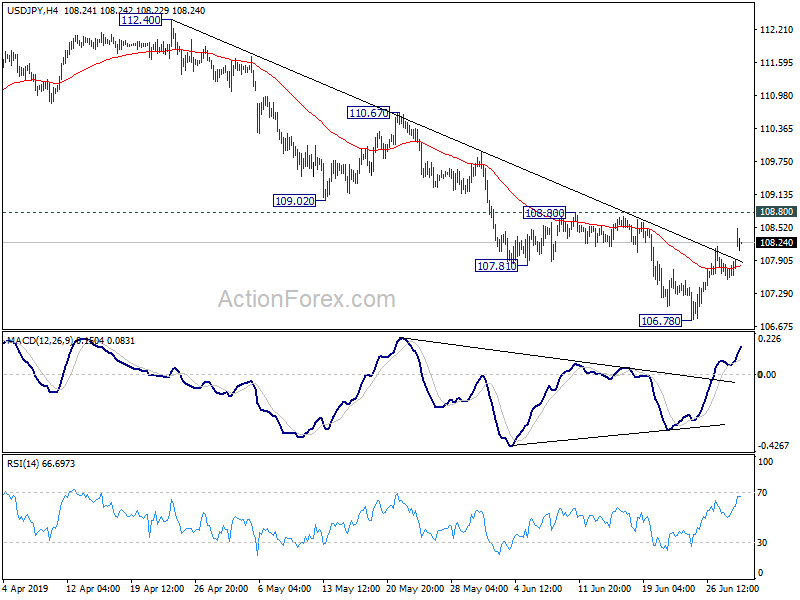
USDJPY's development is a bit more bullish with trend line broken. Also bullish convergence condition is seen in 4 hour MACD. But still, sustained break of 108.80 resistance is needed to confirm short term reversal.
EUR/USD Correcting Gains, Dips Remain Supported
Key Highlights
- The Euro gained momentum and traded towards 1.1420 against the US Dollar.
- EUR/USD is correcting gains, but remains well supported above 1.1300.
- The US Personal Income in May 2019 increased 0.5% (MoM), more than the +0.3% forecast.
- The US ISM Manufacturing Index in June 2019 could decline from 52.1 to 51.0.
EURUSD Technical Analysis
This past week, there was a strong rise in the Euro above 1.1300 against the US Dollar. The EUR/USD pair climbed above the 1.1340 resistance and even spiked above the 1.1400 level.
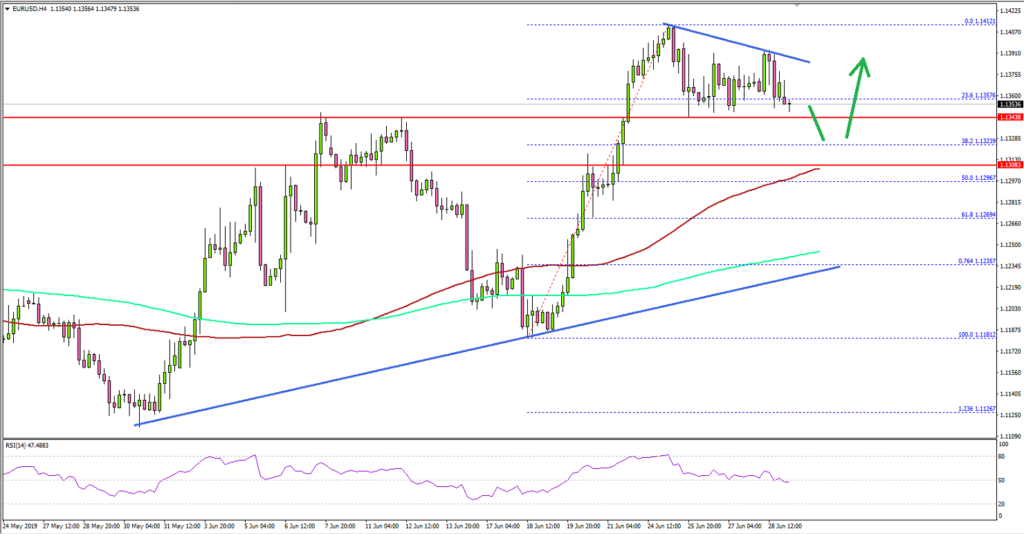
Looking at the 4-hours chart, the pair formed a new swing high near 1.1412 before it started a downside correction. It traded below the 1.1380 level and the 23.6% Fib retracement level of the upward move from the 1.1182 low to 1.1412 high.
On the downside, there are many supports near the 1.1340, 1.1320 and 1.1300 levels. The main support is near the 1.1300 level and the 100 simple moving average (red, 4-hours).
Besides, the 50% Fib retracement level of the upward move from the 1.1182 low to 1.1412 high is also near the 1.1296 level to act as a decent support. If there are more downsides, EUR/USD could even test the 1.1260 support area.
On the upside, the 1.1400 and 1.1410 levels are initial resistances. A break above the 1.1412 swing high might set the pace for more gains above the 1.1440 level.
Fundamentally, the US Personal Income report for May 2019 was released by the Bureau of Economic Analysis, Department of Commerce. The market was looking for a 0.3% rise in the personal income compared with the previous month.
The actual result was better than the forecast, as the US Personal Income increased 0.5% in May 2019, similar to the last reading. Looking at the Personal Spending, there was a drop from the last revised reading of 0.6% to 0.4% (similar to the forecast).
The report added:
Personal incomeincreased $88.6 billion (0.5 percent) in May according to estimates released today by the Bureau of Economic Analysis. Disposable personal income(DPI) increased $72.6 billion (0.5 percent) and personal consumption expenditures(PCE) increased $59.7 billion (0.4 percent).
Overall, EUR/USD seems to be correcting gains, but it remains well supported near 1.1340 and 1.1300. Similarly, GBP/USD might continue to find bids near the 1.2650 support.
Economic Releases to Watch Today
- Germany's Manufacturing PMI for June 2019 – Forecast 45.4, versus 45.4 previous.
- Euro Zone Manufacturing PMI June 2019 – Forecast 47.8, versus 47.8 previous.
- UK Manufacturing PMI for June 2019 – Forecast 49.2, versus 49.4 previous.
- US Manufacturing PMI for June 2019 – Forecast 50.1, versus 50.1 previous.
- US ISM Manufacturing Index for June 2019 – Forecast 51.0, versus 52.1 previous.
US-China Talks Back On Track And Oil Gets OPEC+ Boost
Global stock markets were flat in anticipation of what the sidebar meeting between President Trump and Xi at the G20 meeting would bring. After the 80-minute meeting, Trump said that negotiations are “back on track”.
The baseline scenario leading up to the G20 sit-down of the two leaders was just the restart of trade talks. Without a big announcement or details on how closer or far they are to reach a deal, there is a high probability that the outcome will be similar to the previous G20 meeting where another truce was announced.
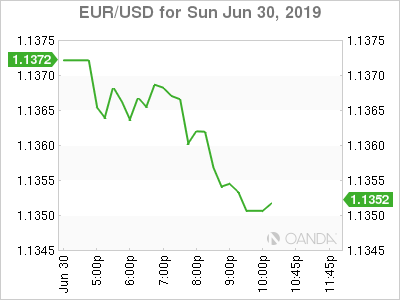
Fears of tariff escalation will ease, but current tariffs could remain unless real progress in made from both sides.
In their meeting in Osaka, everybody played their part without any additional drama and until more details emerge, we are back at square one. The road ahead looks complicated as China demands more equal treatment, and the US is pushing through on intellectual property protection.
The US dollar is mixed against major pairs at the end of trading on Friday. Commodity currencies lead the charge with the New Zealand dollar almost 2 percent up on the greenback. The Canadian dollar rose 1 percent as strong economic indicators play down the probability of an interest rate cut. The Fed clipped the dollar’s wings by signalling an upcoming benchmark rate cut.
Oil is positioned to rise after trade cease fire between China and the US. The OPEC+ had a more productive G20 summit with Russian President Putin announcing an extension to the production cut agreement that will be finalized later this week when the group meets in Vienna.
Markets will look forward to an action packed first week of July. The Organization of the Petroleum Exporting Countries (OPEC) will meet with major producers to finalize the extension discussed by Putin at the G20.
Manufacturing data in China and the US will not show any impact from the G20 meeting, but the indicator could change drastically going forward. Chinese factory activity was lower than expected at 49.4 and remains in contraction, with the newly announced truce between China and the US will have to deliver an agreement or else global manufacturing will continue to deliver soft data points.
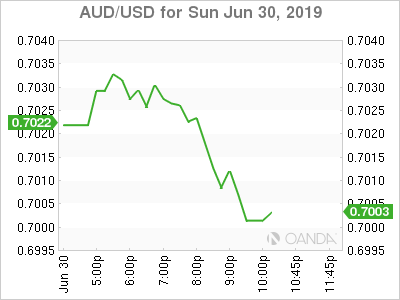
The Reserve Bank of Australia (RBA) could slash its rate to 1 percent as the central bank is part of the dovish choir of monetary policy makers that are back to their easing ways.
The week wraps up with the release of the U.S. non-farm payrolls (NFP) on Friday. US jobs are expected to bounce back after the disappointing March report that showed only a gain of 75,000. A range from 150,000 to 210,000 is forecasted with a bump in average hourly earning up to 0.3 percent.
OIL – Russia and Saudi Arabia Make Progress at G20
Oil finished the week mixed with West Texas Intermediate rising 1 percent but Brent losing 1.53 percent. Trade uncertainty ahead of get G20 added volatility to energy pricing. It was the main reason the OPEC and the other major producers pushed back their ministerial meeting to this week. Russia remains on the sidelines and seems only a big drop in oil prices would expedite an extension of the agreement to cut production to stabilize prices.
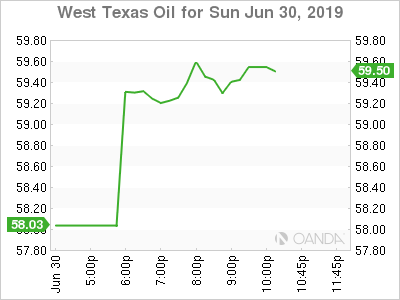
Crude prices have been pressured downward as the trade war between US-China was a negative factor on energy demand. Supply disruptions added support to prices, but the major factor was the OPEC+ which is why if Russia does not agree to an extension the initiate could be too much for Saudi Arabia to handle by itself.
Despite Trump and Xi getting back to the negotiation table on trade, Russia decided to go ahead with a production cut extension that could last 9 months.
GOLD – Gold Under Pressure from Positive Trump-Xi comments on Trade at G20
The most anticipated meeting at the G20 left market participant wanting more. The sit-down between Trump and Xi yielded a new round of talks with no clear date. The OPEC+ on the other hand was more productive and pretty much announced that the production deal will be extended. The group had delayed their ministerial meeting and after the US-China ceasefire they decided to go ahead with continuing to limit production output by up to 9 months.
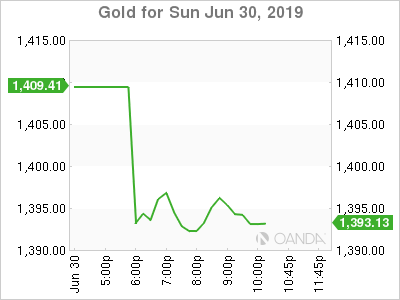
Gold rose 0.97 percent on Friday as the yellow metal is back on top as the favourite destination for investors seeking refuge from uncertainty. The willingness to cut rates from the Fed is keeping the dollar weak and gives the gold the upper hand as July gets underway. The market is pricing in a rate cut to be announced at the July Federal Open Market Committee (FOMC) that will put more downward pressure on the dollar.
Middle East tensions and the ongoing Brexit debate will be in the spotlight in July making a strong case for gold climbing higher as major central banks run back their easing monetary policy playbook.
Gold will be pressured as trade optimism reduces the appeal of the yellow metal as a safe haven, although given the macro headwinds it remains part of various diversification strategies. The lack of details on what has really changed from the US-China negotiations makes it hard to believe the new talks will have a different outcome, which is a positive for gold.
The next biggest obstacle for gold will be US economic indicators, if there is a significant rebound the Fed could hold the benchmark rate at its July meeting. The market has walked back the number and depth of the rate cuts after some less dovish comments from Fed members. If there are massive job and inflation gains in the NFP report, gold could fall as the rate cut narrative gets weaker.
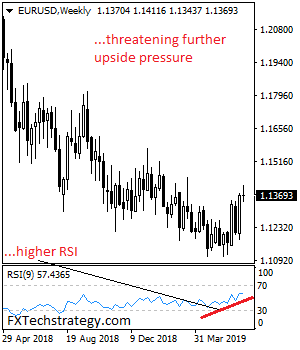
EURUSD Looks To Weaken Further Lower Towards 1.1282
EURUSD looks to weaken further lower towards 1.1282. Support comes in at the 1.1350 where a violation will turn risk to the 1.1300 level. A break below here will target the 1.1250 level. Further down, support sits at the 1.1200. Conversely, on the upside, resistance resides at 1.1400 level with a break through there opening the door for further upside towards the 1.1.1450 level. Further up, resistance comes in at the 1.1500 level where a violation will expose the 1.1550 level. All in all, EURUSD expects more weakness on correction.
USDCHF Turns Off Higher Level Prices
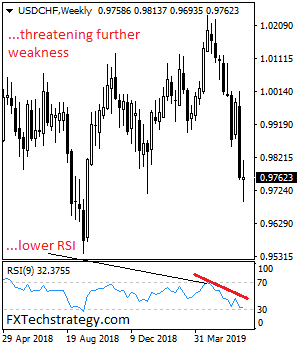
USDCHF turns off higher level prices leaving risks of more weakness on the cards. Resistance resides at the 0.9800 level. Above here, resistance lies at the 0.9850 level and then the 0.9900 level. Further out, resistance comes in at the 0.9950 level. On the downside, support is seen at the 0.9700 level with a turn below here opening the door for more decline towards the 0.9650 level. And then the 0.9600 level. Further down, support resides at the 0.9550 level. Its daily RSI is bearish and pointing lower suggesting further weakness. All in all, USDCHF remains weak and vulnerable on price rejection.
Eco Data 7/1/19
[php_everywhere instance="1"]
US-China Trade: Ceasefire a Reality But No Quick Fixes to Reach a Deal
- As widely expected, the Xi-Trump meeting ended with a ceasefire in the trade war. The export ban on Huawei was also lifted, at least partially.
- The ceasefire is good news in the sense that it confirms that both sides want to make a trade deal. President Trump's comments afterwards suggest he sees a trade deal as a key component of his election campaign.
- However, large obstacles remain to reach a deal that satisfies both sides and we still expect a rocky path ahead.
- We continue to look for high volatility in equity markets in the short term and do not see the ceasefire as a game changer for FX markets.
The ceasefire is a reality
As widely expected, the ceasefire became a reality. Here is what we know:
- There will be no new tariffs on China for now.
- The trade talks will restart.
- There is no deadline on a potential tariff increase, as was the case with the previous ceasefire, where tariffs were supposed to go up after three months if there was not enough progress in trade talks.
- Regarding the export ban on Huawei, the news was not very clear, but it seems there will be at least a partial lifting of the export ban. Initially Trump said he had told Xi that the Huawei issue would have to wait until the 'very end'. However, he also said, "we sell to Huawei a tremendous amount of product that goes into the various things they make and that is ok". A Chinese diplomat said: "As for Trump's comments that some restrictions on Huawei will be removed, we will of course welcome this if those words are put into action". Trump said during the press conference that there would be a meeting on Sunday on Huawei and the Commerce Department list. The interpretation by most media, including the Chinese, was that US companies could now sell to Huawei again.
In his press conference, Trump mentioned farmers as significant beneficiaries of a trade deal with China. Trump also mentioned the strong US economy. It suggests to us that Trump prefers a trade deal with China over no deal as part of his election campaign. It would help him keep the strong economy going and give important gifts to the farmers, who are crucial voters in several swing states.
During the press conference Trump said the US and China could be "strategic partners". However, this is very much at odds with every official US document made during his administration, which describes China as a revisionist power (most recently in the US 'Indo-Pacific Strategy'.
Where to go from here: A rocky path to a trade deal
We now expect a new round of high-level trade talks soon either in Washington or Beijing (mostly likely in Beijing, as they were in Washington last time.) We still expect negotiations to be difficult as the two sides seem far from each other on critical points. China has its' 'red lines', which are on points that the US side has seen as paramount for a deal.
Also, for now, Trump is not in a hurry to make a deal. Although the US economy has slowed, it is still quite robust. Stock markets have also remained strong with new highs reached lately.
The Chinese economy is suffering more, but China's 'red lines' are exactly that: areas where it will not move and where there is broad consensus in China that there should be no concessions. Hence, China will not budge when it comes to the US demand to change specific laws and when it comes to the need for a more balanced language and overall trade deal. Xi indicated this at the G20 meeting when he said China must "defend sovereignty, pride and core interests".
The bottom line is that while a ceasefire has been agreed to, we still expect a rocky path from here towards a trade deal and renewed escalation can still not be ruled out at some point. We do expect a trade deal to be struck during H2, though, as Trump should be able to get a deal he can sell as a big win to the US public. It would also be a deal that can benefit him in his election campaign, where he is likely to partly present himself as the guarantor of a strong economy and the one who delivered a significant improvement for US farmers and business opportunities in China.
What about equities? Good news mostly discounted, and damage already done to the business cycle
Equities are perhaps the most exposed asset class to the trade war. This means the ceasefire is a positive. The fact that markets have gone up since 5 May, even though it marked a re-escalation of the trade war (as Trump aborted the talks and tweeted that he would raise tariffs on USD200bn of Chinese products from 10% to 25%, effective 10 May), does not indicate that trade no longer matters. Rather, it is due to central banks, led by the Fed, signalling an aggressive monetary easing. That (at least in the eyes of the market) neutralised some of the negative effects from the trade conflict.
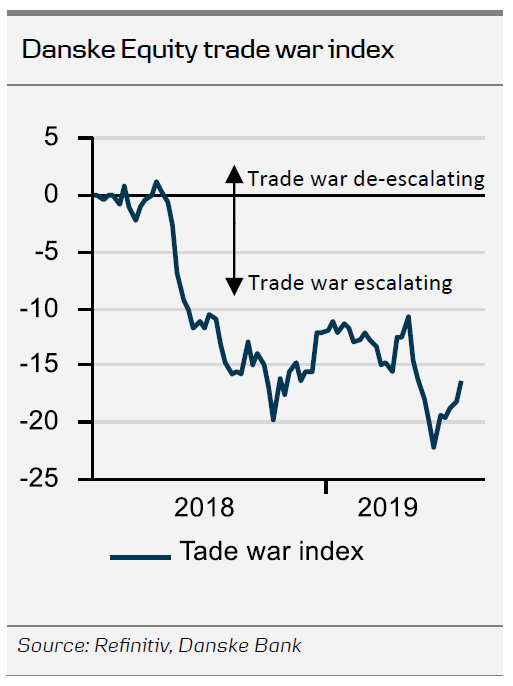
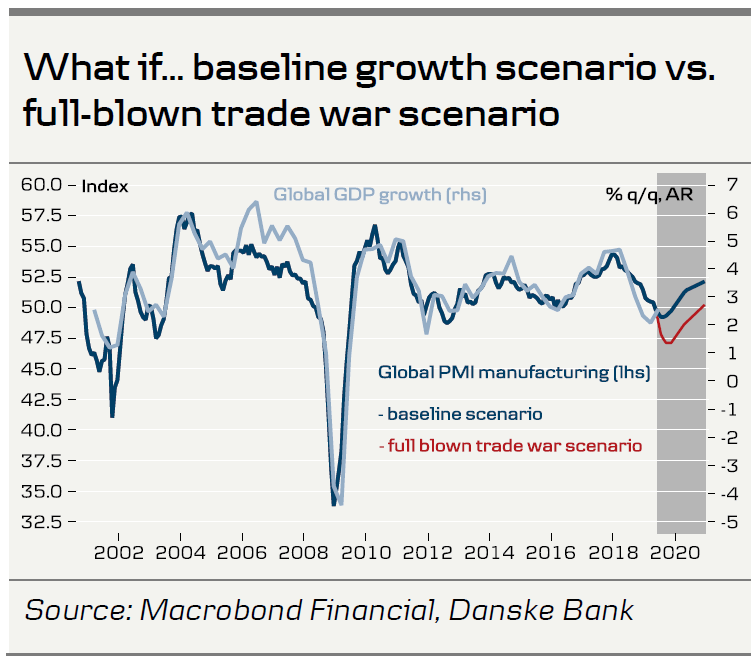
However, from an equities point of view, the base case of the G20 talks was also the best case, and an outcome that we think was much discounted. Even this 'best case' entails plenty of uncertainty, and regardless, we suspect a lot of the damage to the business cycle, the earnings cycle and confidence, is already done. Since the trade war started back in March 2018, production and confidence in manufacturing in particular has deteriorated. Plans for capital expenditure have been shelved. 5 May represents another hit, again clearly visible in most June confidence indicators (even though models and our leading indicators suggest they should have improved). This tells us that corporates are sensitive to trade issues. Many companies are also looking to move production to diversify their supply chain, but with adverse effects on productivity.
This spells risks for earnings – lower growth is a danger to the top line, weak productivity is a danger to margins. In two weeks the global earnings season will kick off. We have low expectations due to the above factors and we fear that analysts are behind the curve, failing to cut estimates enough. On aggregate, the outcome could disappoint for the first time in many years. There is a risk of an earnings recession in 2019. The trade war could also be the perfect excuse (scapegoat) for companies to lower guidance (lower guidance is usually the biggest trigger for a lower share price).
We thus continue to expect high volatility in the short term with a clear risk of equity drawdowns. Renewed escalation in the trade war can still not be ruled out.
However, taking a longer view, we also believe a deal will eventually be struck before year-end and provide impetus for the global economy to recover again in 2020. We therefore expect equities to outperform bonds on a 12-month horizon.
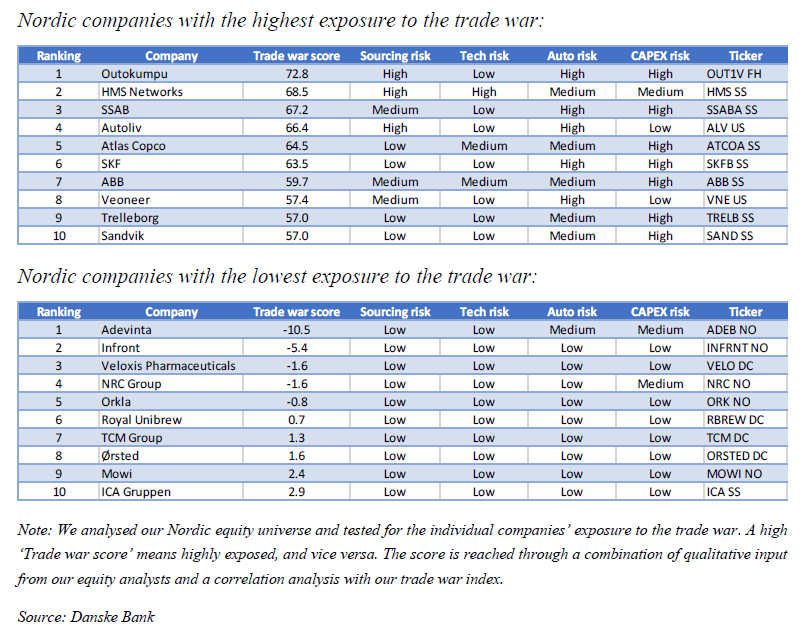
In our Nordic universe we have many companies exposed to the trade war, through several channels. Below is a summary of the most and least affected ones.
Ceasefire no game changer for FX markets
The ceasefire agreement is not a game changer for FX and commodity markets in our view. The USD should stay broadly unchanged. The lower probability of new US tariffs on China is negative for the USD, but a mitigating factor is that the odds the Fed will cut by 50bp in July will likely go down, which would be USD-positive. Commodity prices should stay well supported by the improved outlook for a trade deal. That in turn should benefit commodity currencies, the AUD, NZD, CAD and NOK. Finally, we could see this change in tone in the trade talks weigh a bit on the JPY.
RBA Preview – Another -25 bps Rate Cut Expected This Week
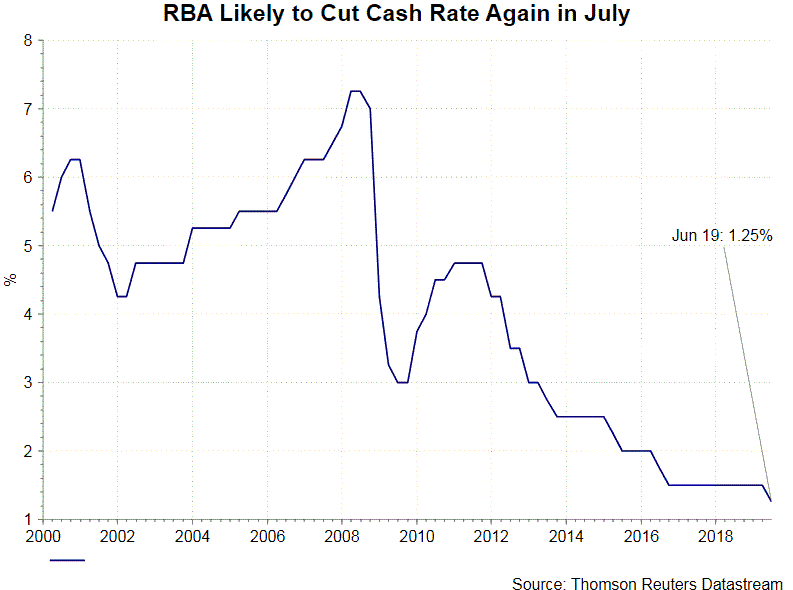
We expect to RBA to cut the cash rate, by -25 bps, to 1% in July. Although this would be earlier than RBA’s projection in the May SoMP, it is largely in line with market expectations, which has priced in about 70% of a rate cut in July. We believe a rate cut this week is appropriate due to two key reasons. First, the incoming data flow since the rate cut in June has remained soft. The close-watched unemployment rate missed consensus. Second, Governor Phil Lowe recent speech has been rather dovish. He noted that there is "a fair degree" of spare capacity in the economy. He added that fiscal stimulus is needed to accompany monetary easing, in order to achieve desired effect to the economy.
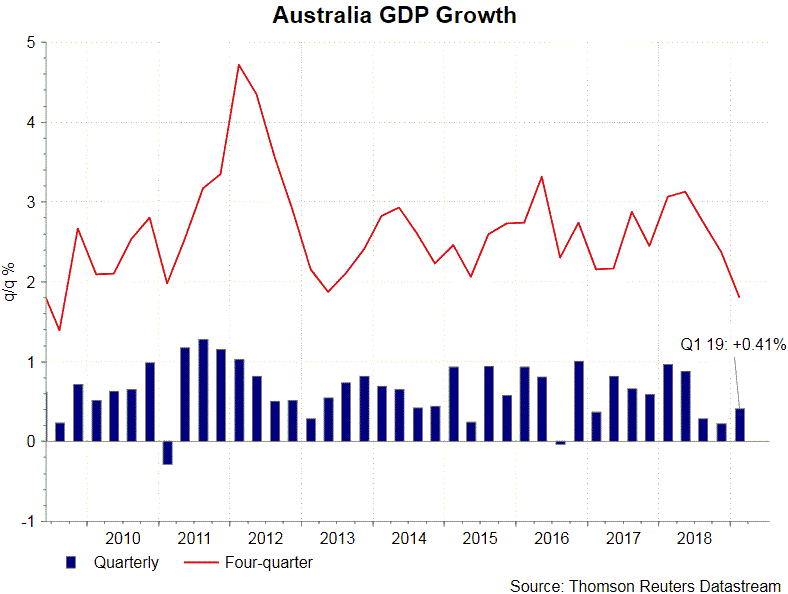
Real GDP expanded at an annualized rate of +0.4% q/q in 1Q19, improving from +0.2% in the prior quarter but missing consensus of +0.5%. On the job market, the May report shows strong payroll growth of +42.3K, compared with consensus of a +17.5K addition. However, the unemployment rate stayed unchanged at 5.2%, compared with consensus of 5.1%. This was mainly driven by the increase in participation rate to a record high of 66%. The report reveals that the momentum of job growth has remained strong. However, the spare capacity in the market is larger than expected. At the June meeting, the RBA revised lowered its expectation on the non-accelerating inflation rate of unemployment (NAIRU) to 4.5%- the level that can push to inflation to the 2-3% target - from 5% previously. This signals that more rate cuts are likely required to bring the unemployment rate to around that level.
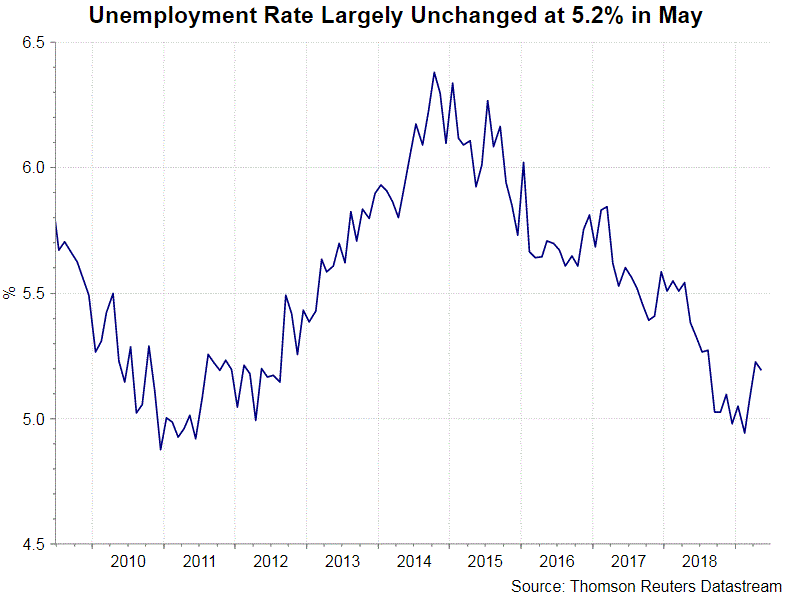
RBA has recently been preparing the market for a renewed easing cycle. At the June meeting minutes released on June 18, it was noted that “Given the amount of spare capacity in the labour market and the economy more broadly, members agreed that it was more likely than not that a further easing in monetary policy would be appropriate in the period ahead”. Last week, Governor Phil Lowe suggested at a panel discussion in Canberra that “most indicators suggest that there is still a fair degree of spare capacity in the economy”. Given the policy rate has been lowered to historically low levels, it is understandable that further rate cut could not have much impact. As Lowe noted that “fiscal policy, including through spending on infrastructure” and “structural policies that support firms expanding, investing, innovating and employing people” should be implemented together with further rate cuts.