

Sample Category Title
Aussie Drops On Stubborn Unemployment
Jobless rate unchanged
Australia's unemployment rate was unchanged a 5.2% in May, defying economists' expectations of a dip to 5.1%. An increase in the participation rate to 66.0% from 65.8% could partly explain the unchanged rate, but the market preferred to focus on the fact that is could be linked to a softening in the jobs market.
The employment change looked flattering on the headline, with a net 42,300 jobs added in the month, the biggest monthly increase since August 2018. However, the details showed that 39,800 of those were in the part-time category and a mere 2,400 linked to full-time jobs.
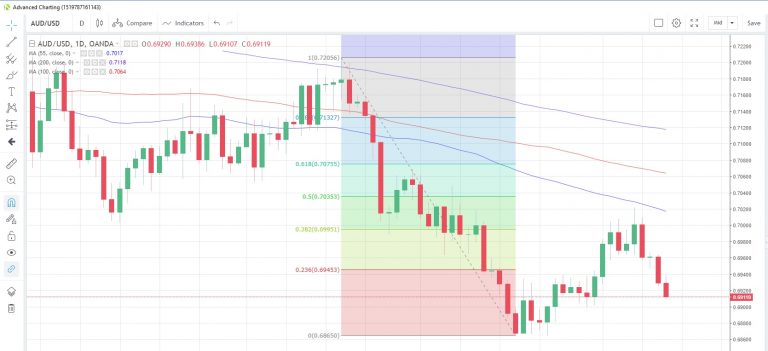
The market's focus was more on the unemployment rate and the part-time jobs rather than the booming headline and AUD/USD fell to an intra-day low 0f 0.6911, the weakest level this month, and is now holding at 0.6915. It was a similar picture in AUD/JPY, with the FX pair slumping to 74.77, the lowest since January 3. Aussie yields trended lower, with the three-year yield hitting record lows below 1%.
AUD/USD Daily Chart
Hong Kong stocks down for a second day
Hong Kong was expecting more protests today as the controversial extradition bill will be debated in the Legislative Council later this morning. However, it has just been announced that the debate will not go ahead today, either. Nevertheless, there is still likely to be a presence around the government buildings. Yesterday’s protests, which forced a postponement of the debate, turned violent with tear gas and rubber bullets used by police, causing about 70 injuries, according to press reports.
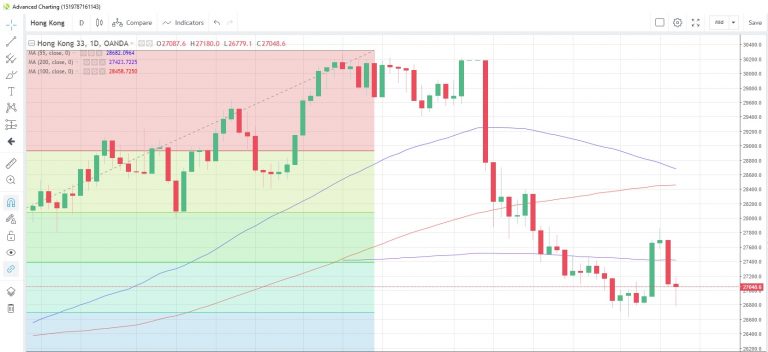
The HongKong33 index fell to the lowest since June 4 in morning trading and probably has eyes on the 61.8% Fibonacci retracement of the rally from October to April at 26,694. USD/HKD continues to trade just above 2019 lows struck yesterday, with short-term funding costs rising.
HK33HKD Daily Chart
German inflation seen unchanged
The final reading for Germany’s May consumer price index isn’t expected to show any revision today, remaining at +0.2% m/m and +1.4% y/y. Euro-zone industrial production is expected to continue its run in negative territory, with a -0.5% print, seasonally adjusted, expected following a 0.3% decline in March.
The US calendar has mostly second-tier data scheduled, including export and import prices and the weekly continuing jobless claims.
UK RICS house price balance rose to -10, but anecdotal insight shows political and economic concerns
UK RICS House Price Balance improved to -10 in May, up from -22. That is, 10% more respondents saw a fall rather than rise in May. This would indicate a deceleration in the pace of price declines in six months time.
Simon Rubinsohn, RICS Chief Economist, said: "Some comfort can be drawn from the results of the latest RICS survey as it suggests that the housing market in aggregate may be steading. However much of the anecdotal insight provided by respondents is still quite cautious, reflecting concerns about both the underlying political and economic climate."
Fed will hold interest rates this year according to consensus of a Reuters poll
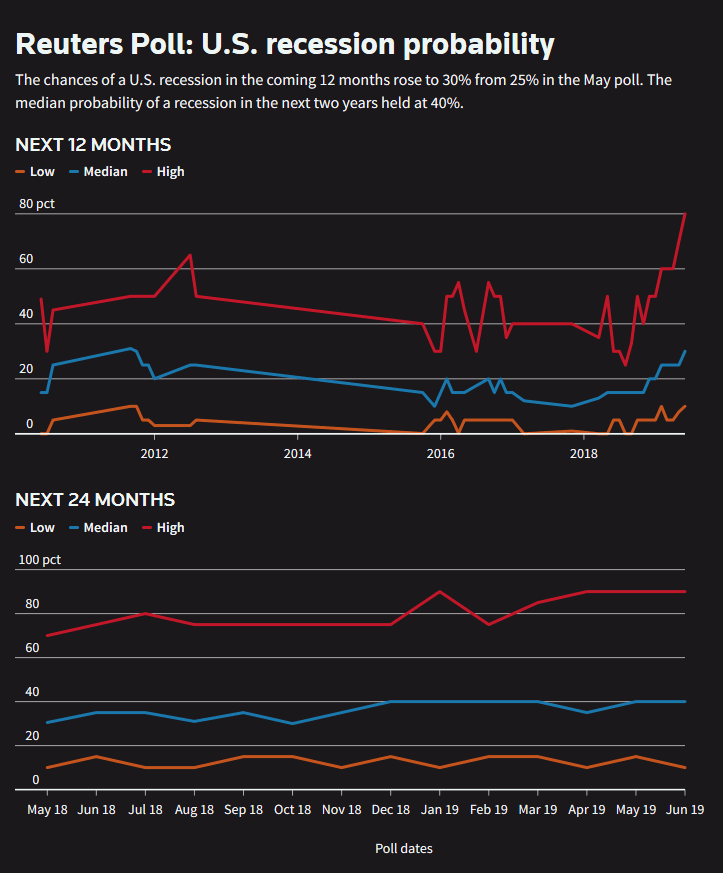
According to a Reuters poll in June 7-12 period over 100 economists, consensus is that Fed will hold interest rates at current 2.25-2.50% this year. However, median from a smaller sample showed 55% of one Fed cut this year, 40% for two. The median chance of a recession in the next 12 months increased slightly by 5% to 30%. But the range from 10% to 80% is huge. For the next two years, median chance stood at 40%, with range from 10% to 90%.
Opinions are divided as some point out that concerns are mainly on the risks to economic outlook, rather than the outlook. And the risks and uncertainty could turn out to be a lot weaker. Fed's decision remain data dependent and some strong numbers could push out a possible July rate cut. Meanwhile Fed could resume rate hikes next year should the risks not materialize.
However, the probability of a recession has risen due to trade tensions. The next round of tariffs against China is the "big, big concern". Some expected recession in second half of 2020 and an insurance rate cut by Fed is seen as not enough in this case. Fed could be forced to start a full blown cutting cycle next year.
Chinese officials delivered bullish comments, but interest rate and RRR cut said to be underway
At a financial forum in Shanghai, Chinese Vice Premier Liu He said there are plenty of policy tools to use to deal with the challenges the economy is facing. He also sounded confidence and said major macroeconomic indicators all remain within reasonable ranges. Meanwhile, China will roll out more strong measures on reforms in the near future.
In the same forum, Pan Gongsheng, head of the State Administration of Foreign Exchange, said the country's FX market is largely stable with FX reserves steadily rising. And, China is capable and confident of keeping its currency basically stable. Guo Shuqing, head of the China Banking and Insurance Regulatory Commission (CBIRC) reiterated there are plans to further open up its banking securities and insurance sectors.
Separately, the official China Daily said that more money and credit supply adjustment are under way to counter the downside risks of trade war. Measures could include cuts in interest rates or reserve ratio requirements. The newspaper noted the near for stronger measures to maintain liquidity in the financial market and support infrastructure investment
Market Morning Briefing: Euro-Yen Has Support At 122
STOCKS
Global equities have seen some dip within their recent upmove. Though there is room for more dip in the near-term, key supports coming up on the major indices like the Dow, DAX, Nikkei can limit the downside and push these indices higher again. On the domestic front, the Sensex and Nifty remains weak and vulnerable to fall within their sideways range.
Dow (26004.83, -43.68, -0.17%) has dipped to test 26000 as expected. As mentioned yesterday, we expect the supports at 26000 and 25750 to limit the downside and push the index higher again. While above 25750 the outlook is bullish for the Dow to break the resistance at 26250 and rise to 26500-26600.
DAX (12115.68, -40.13, -0.33%) has support in the 12020-12000 region. While above 12000, the near-term view remains bullish for a rise to 12300.
Nikkei (20953.04 -176.68, -0.84%) has declined below 21000 thereby negating our bullish view for a rise to 21500-21750. A dip to 20750 looks likely while the index remains below 21000.
Shanghai (2891.92, -17.46, -0.60%) continues to oscillate within its 2835-2950 sideways range. While below 2900, a dip to 2850-2835 is possible in the coming sessions. A breakout on either side of 2835 or 2950 is needed to get a clear view on the next direction of move.
Sensex (39756.81, -193.65 -0.48%) and Nifty (11906.20, -59.40, -0.50%) seems to lack strong and fresh buying interest. Sensex can fall to 39500-39300 within its 39300-40300 range while the Nifty can dip to test 11800 - the lower end of its 11800-12200 range.
COMMODITIES
Gold has bounced contrary to our expectation for a fall. It can remain range bound and move up within this range in the near term. Copper can continue consolidate sideways. Oil has declined sharply and keeps our bearish view intact. The US reporting an increase in its crude inventories for the second consecutive week has dragged the oil prices sharply lower. US inventories rose by 2.2 million barrels as against the market expectation for a draw-down of 471,000 barrels.
Gold (1333) has bounced above 1330 thereby negating our negative view for a fall to 1320-1310. A sideways move between 1320 and 1350 looks likely in the near term. Within this range, gold can rise to 1340-1345 in the coming sessions while it remains above 1330.
Though Silver (14.77) has bounced slightly, it lacks strength. It has cluster of resistances in the broad 14.80-15.0 region which are likely to cap the upside and keep the broader bearish view intact for a fall to 14.25-14.0 over the medium term.
Copper (2.64) dipped yesterday as expected and can test 2.62-2.60 on the downside. Though it sustains above 2.60, copper seems to lack strength. This leaves the bias negative for copper to break 2.60 and fall to 2.58 and 2.55 in the coming weeks.
Brent (60.24) has resumed its downtrend and fell to test 60 as expected yesterday. Now, while below 62 a test of 57 on the downside is on the cards. An interim bounce is possible from 57 before it eventually falls to test our long-term target level of 55.
Similarly, WTI (51.32) declined to test 51 as expected and retains our bearish view. A break below 50 can accelerate the fall initially to 48.5 and eventually to 45.
FOREX
Contrary to our expectation for a fall, the dollar has risen yesterday. The Euro and Euro-Yen has dipped but has key supports which can limit the downside and push it higher again. Dollar-Yen keeps our bearish view intact and can fall further. Pound continues to trade sideways.
Dollar Index (96.93) has bounced as against our expectation for a break below 96.5. We expect it to consolidate between 96.50 and 97 in the near term. A break above 97 will be bullish for a rise to 97.5 and 98 over the short term.
3c Euro (1.1296) has dipped below 1.1300. It can test 1.1270-1.1260 in coming sessions while it remains below 1.1310 and then can possibly reverse higher again.
Euro-Yen (122.32) has support at 122 which can limit the downside and push it higher again. The outlook remains bullish for the cross to test 124 in the coming days.
Dollar-Yen (108.26) has dipped further and keeps our bearish view intact. It can test 108 and an eventual break below it can accelerate the fall to 107. Immediate resistance is at 108.5 and the next significant resistance is at 109.
As expected, Aussie (0.6918) has declined below 0.6950 and is now heading towards 0.6900. A bounce from to 0.6950 from 0.6900 cannot be ruled out. But, a break below 0.69 can intensify the sell-off and drag it to 0.6865
Pound (1.2696) retains its 1.2650-1.2750 sideways range and has declined sharply after testing the upper end of this range. While above 1.2650 a rise to 1.2725-1.2750 is possible again. The bias remains positive within this range to seen an upside break above 1.2750 and a rally to 1.2800-1.2850 in the coming days.
USDCNY (6.9190) can consolidate between 6.90 and 6.94 in the near-term. While above 6.90, the outlook remains bullish for the pair to break 6.94 and rally towards 6.98 and 7.0 over the medium term.
USDINR (69.3450) has strong resistances at 69.40 and 69.55 which can cap the upside and take it lower to 69.15-69.10 in the coming sessions.
INTEREST RATES
The US yields have declined yesterday after the inflation data release. The US Core CPI has dipped to 2% in May from 2.07% a month earlier. The corrective bounce in the yields seems to have come to an end. Further dip from current levels will confirm the same. The 30Yr (2.60%) and 10Yr (2.10%) are poised at a key support. They can fall to 2.50% (30Yr) and 2.0% (10Yr) on a break below current levels. The 5Yr (1.85%) can test 1.80% and 1.75% while it remains below 1.90%.
The German yields have dipped slightly. However, the short-term view remains positive. The 30Yr (0.36%) can rise to 0.50% on a break above 0.40%. The 10Yr (-0.24) can test -0.10% on a break above -0.20% while the 5Yr (-0.60%) yield can rise to -0.50% in the short term.
The 10YR GOI (7.1720%) has resistance at 7.20% and can dip to test 7.10% in the near-term which could favor a fall in the Dollar-Rupee.
Australia: Labour Force, May (Election Month) A Mixed Bag
For May, a mixed set of results.
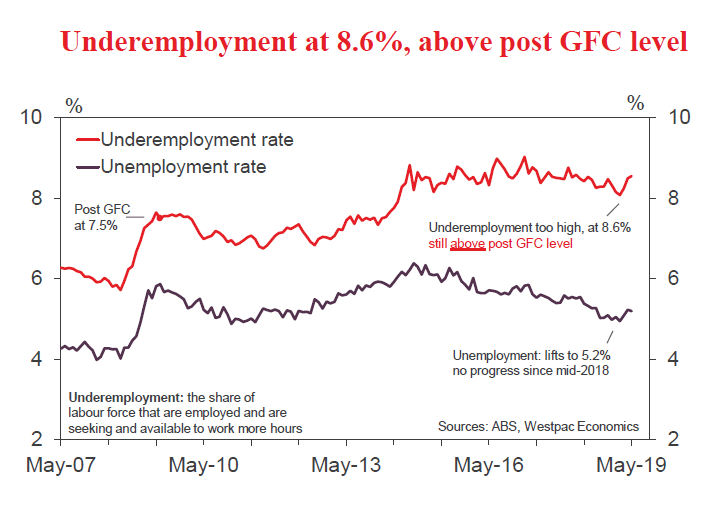
Hours worked, weakened, down by -0.3%. The unemployment rate held steady at 5.2%, while the underemployment rate rose further, to 8.6%.
Employment, exceeded expectations, up 42.3k, largely parttime, +39.8k. Employment by state was: NSW, +38.5k; Vic +28.6k; Qld +7.8k; SA, +4.4k; WA -4.0k, Tas -0.4k. In addition, employment for April was revised up, to +43.1k from +28.4k.
Comments
As noted above, employment gains exceeded expectations, +42.3k v’s market median +16k and Westpac +5k. However, hours worked weakened, contracting by 0.3% in the month. We’d note that if the lift in jobs in May was largely a spike associated with people working on the May 18 Federal election, it would be reasonable to expect hours worked to strengthen, not weaken.
The unemployment rate disappointed, holding steady at 5.2%, vs market median 5.1% and Westpac 5.2%. Unemployment has drifted higher in 2019, up from 5.0% at the start of the year. During 2018, some progress was made in reducing the unemployment rate, from 5.5% to 5.0% by September.
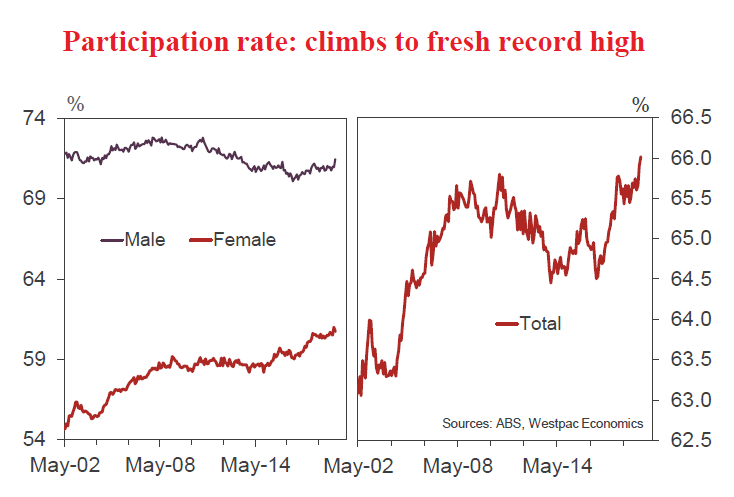
The labour supply is proving to be quite responsive, with the participation rate rising to a fresh record high. The participation rate climbed to 66.0%, up from 65.9% in April and from 65.7% in March.
This underscores that there is still considerable slack in the labour market.
Adding weight to this view, the underemployment rate now appears to be trending higher, rising to 8.6%, up from 8.5% in April and up from a low of 8.1% in February. This is back to the levels prevailing over the second half of 2017.
These mixed results may, in part, be due to sample rotation issues. The ABS notes that “In original terms, the incoming rotation group in May 2019 had a higher employment to population ratio than the group it replaced (64.0% in May, compared to 62.3% in April 2019), and was higher than the ratio for the entire sample (62.9%).”
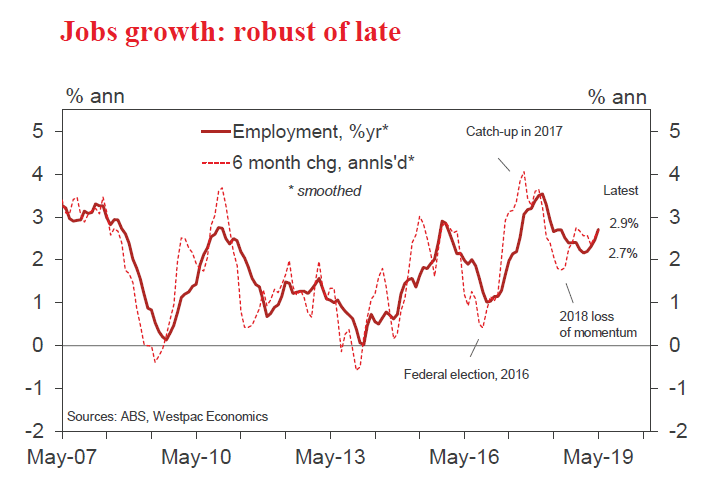
For now, jobs growth momentum remains robust. Employment is 2.9% higher than a year ago, with full-time employment up by 3.1% and part-time some 2.4% higher. Over the past six months, jobs growth is 2.7% annualised.
Looking ahead, we see the risk that jobs momentum slows, consistent with the weakening of domestic demand. In the year to mid-2018, domestic demand grew by a robust 3.2%, moderating to a 1.8% annualised pace over the second half of the year, and then slumping to only a 0.6% annualised pace in the opening quarter of 2019.
For the RBA, more needs to be done to bring the unemployment rate down and closer to 4.5%, or below, in order to gain some traction on lifting wages growth to a more sustainable path.
Daily Markets Broadcast
Wall Street drifts lower
US indices fell for a second day yesterday, pressured by the lack of news on the trade deal front and a weak banking sector as expectations for a Fed interest rate cut rose. Hong Kong is anticipating more protests as the extradition bill is due to be debated in the Legislature.
US30USD Daily Chart
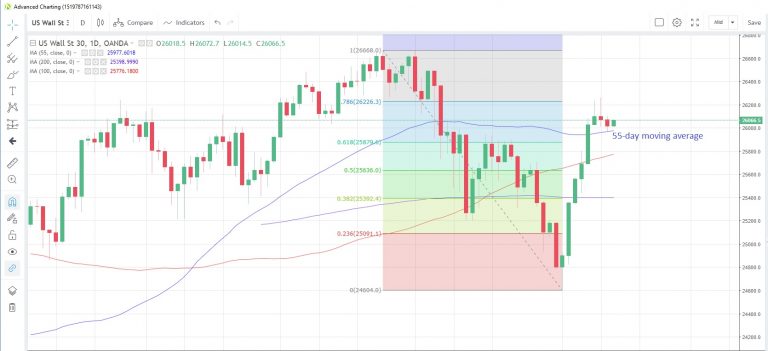
The US30 index slid for a second day yesterday amid muted volumes as below forecast CPI raised expectations for an earlier Fed rate cut, which weighed on banking counters
The index held above the 55-day moving average at 25,977
US consumer prices rose 1.8% y/y in May, below forecasts of a 1.9% gain and the weakest reading in three months. The probability of a cut at the June meeting rose to 21% while that for July is at 83.5%, according to pricing in the interest rate markets. There are no major data releases scheduled for today.
DE30EUR Daily Chart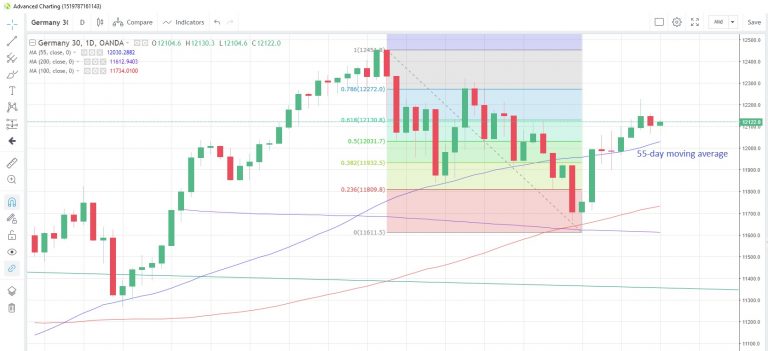
The Germany30 index snapped a three-day rising streak yesterday, taking its cue from Wall Street
The index is still above the 55-day moving average at 12,030, which has supported prices on a closing basis since June 3
German industrial production is expected to continue its run in contraction territory in April, with forecasts suggesting a reduction of -0.5% m/m (seasonally-adjusted) following a 0.3% decline in March.
HK33HKD Daily Chart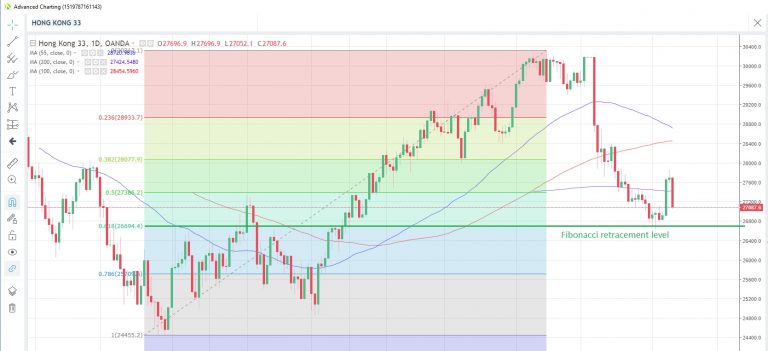
The HongKong33 index fell the most in more than a month yesterday as the protests against the extradition bill escalated, with tear gas and rubber bullets used on protesters
The index is likely eyeing the low of 26,629 struck earlier this month, which is near the 61.8% Fibonacci retracement of the October-April rally at 26,694
Legislative leader Carrie Lam refuses to pull the controversial bill and called for order. The HKMA stated that local financial markets were operating “in an orderly manner”, adding that Hong Kong banks were well capitalised.
Eco Data 6/13/19
[php_everywhere instance="1"]
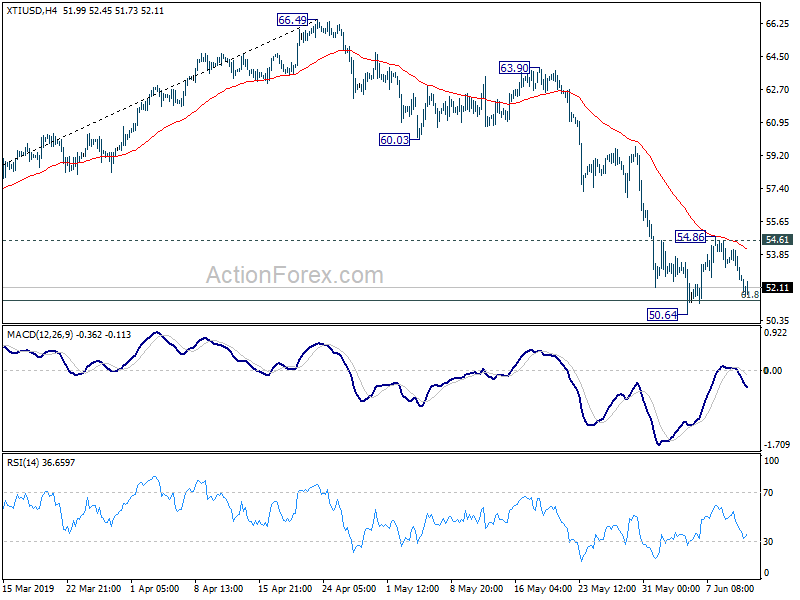
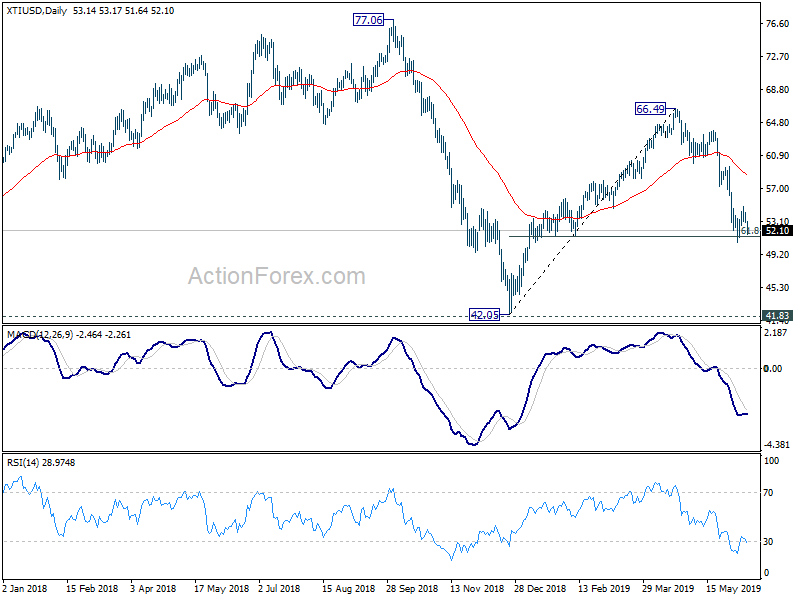
US oil inventories rose 2.2M barrels, WTI heading back to 50.64 support
US commercial crude oil inventories rose 2.2M barrels in the week ending June 7, above expectation of -1.0M barrels fall. At 485.5 million barrels, U.S. crude oil inventories are about 8% above the five year average for this time of year. WTI crude oil weakens mildly after the release.
Prior recovery from 50.64 was limited at 54.68 and failed to sustain above 54.61 minor resistance. It's also staying below falling 4 hour 55 EMA. Near term outlook remains bearish and further decline is still expected. Break of 50.64 and sustained trading below 61.8% retracement of 42.05 to 66.49 at 51.38 could pave the way to retest 42.05 low.
Falling Employment Growth, Rising Recession Risk?
Slower employment growth is associated with rising recession probabilities and weaker GDP in the Post-Great Recession era, which often indicate the need for more monetary policy accommodation.
Is an Accommodative Monetary Policy in the Near-Term?
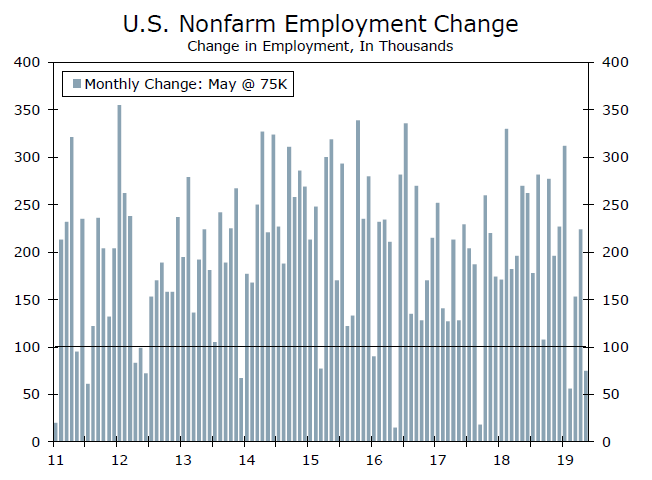
Job growth surprised to the downside in May as employers added only 75K jobs and the prior two months saw the largest downward net revision since 2010. The weakness in May was broad-based across industries including employment in education & health services, government payrolls and professional & business firms. The overall trend in hiring downshifted, which provides evidence of further weakening for growth.
In previous reports, we argued that there are seasonal distortions in the initial estimate of Q1 nonfarm payrolls data.1 Each year during the Post-Great Recession (PGR) era, one month of Q1 nonfarm payrolls typically has had a much larger or smaller change in payrolls than the other two months. We identify these outliers as "rogue-months."
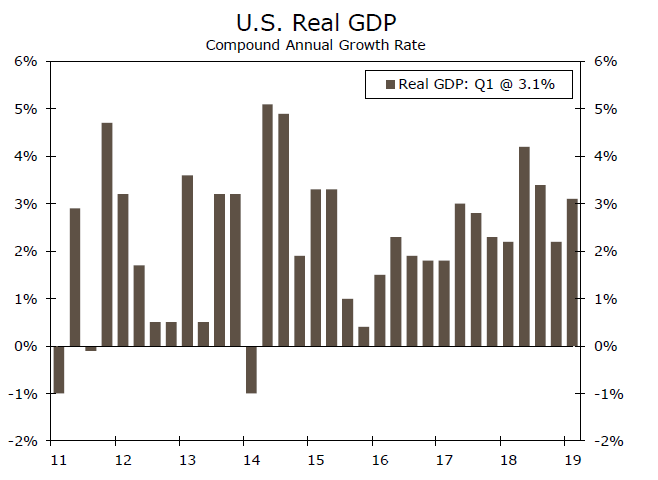
Outside of the first quarter, unusually volatile employment data is uncommon although it is typically attached to weaker GDP growth (top chart). For example, in 2011-2019 outside of the first quarter, nonfarm payroll data dipped below 100K in 2011, 2012, 2013 and 2016, consistent with slower GDP growth in those periods.2
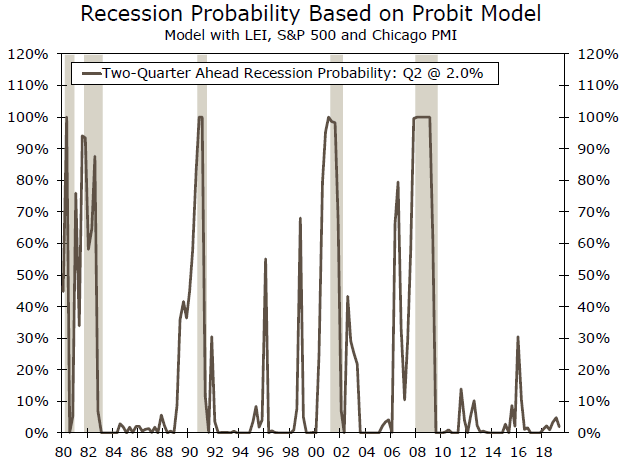
Additionally, weaker GDP growth rates are associated with higher recession probabilities. GDP growth figures fell into negative territory in Q1-2011 (-1.0%) and Q3-2011 (-0.1%). GDP growth also slowed in Q3-2012 and Q4-2012 (0.5% for each quarter). In 2016, the average growth rate edged down to 1.9%, the weakest in the 2014-2018 period (middle chart). The slowdown in GDP growth corresponded to heightened risk of recession from our Probit model. In 2011 our official Probit model predicted a double-digit chance of recession for the first time in the PGR era (bottom chart).3 Meanwhile, in 2012 and 2016 our model also predicted a double-digit risk of recession based on our predictors of the LEI, Chicago Employment Index and S&P 500.
Weakened employment and GDP growth is associated with rising recession probabilities, which often indicate the need for a more accommodative monetary policy. In November 2010 and September 2012 the Fed announced second and third rounds of the quantitative easing program as an effort to stimulate the weakening economy. In Q4-2015 the Fed projected three rate hikes in 2016, but ended up hiking only once at year-end in light of slower growth.
Overall, softer employment data and further weakening in the economy, could drive the Fed to be more cautious about the outlook for growth. We now expect two rate cuts later this year.
1 Please see "Seasonal Distortions Linger in Q1 Nonfarm Payrolls Data" (April 03, 2019).
2 We exclude 2010 because of Census-related distortions. September 2017 payrolls number was -33K because of Hurricanes Harvey & Irma.
3 Please see "Recession Update: Should We Worry?" (April 01, 2019).