

Sample Category Title
SNB to Hold Rates but Could Attempt to Push Back on Rising Swiss Franc
The Swiss National Bank will hold its quarterly policy meeting on Thursday with the announcement expected at 07:30 GMT. No changes in the Bank’s super low interest rates are being anticipated, but with the Swiss franc appreciating substantially in recent weeks on the back of growing global uncertainties such as trade frictions and Brexit, the SNB could toughen its language on the exchange rate.
Growth rebound at risk from rising uncertainties
The Swiss economy grew by a stronger-than-expected 0.6% quarter-on-quarter in the first three months of 2019, benefiting from easing trade tensions and a weaker currency. It represented a marked rebound from the significant slowdown seen in the second half of 2018. However, on the inflation front, price pressures remained muted well below 1% and the CPI rate fell to 0.6% in May.
With inflation unlikely to pick up substantially anytime soon, especially as the safe-haven franc is on the up again, and with growth prospects for the second quarter not looking particularly bright as trade tensions flare up once more, the conditions are all set for a very dovish SNB on Thursday. The central bank had already sharply lowered its conditional inflation forecast at its last meeting in March, suggesting that interest rates are unlikely to rise over the forecast period through the end of 2021.
Franc lifted by safe-haven demand
Trump’s trade war is a major source of uncertainty for the very open Swiss economy that’s hugely dependent on trade with the European Union. Apart from the negative impact on global growth, trade conflicts also tend to boost demand for safe assets and the Swiss franc, like the Japanese yen, is a favourite with investors due to Switzerland’s large current account surplus.
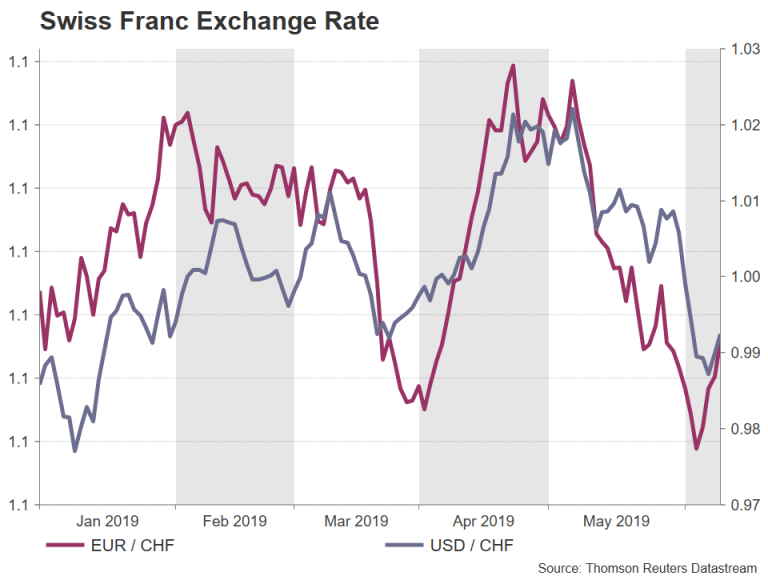
The franc has appreciated considerably since the beginning of May, notably against the euro, which is the primary concern for SNB policymakers. Euro/franc slid 3.1% from the high point on April 23 to the low point on June 3, before rebounding a little. A stronger franc is a major source of headache for the SNB as it not only weighs on prices but also hurts growth.
ECB delay a problem for the SNB
Complicating matters even more for the SNB is the potential delay in policy normalization by the European Central Bank. The ongoing slowdown in the Eurozone will probably force the ECB to ease policy in the coming months, with cutting rates being one option. If the ECB takes steps towards looser policy, it would be very difficult for the Swiss National Bank to maintain its current policy, as this would exacerbate the upside pressure on the franc.
At the March meeting, the SNB restated that the franc is “highly valued”. It’s possible the Bank will issue a more strongly worded statement at its June meeting regarding the exchange rate to make its unease clear to investors. SNB Chairman Thomas Jordan has repeatedly stressed the Bank’s readiness to intervene in the forex markets to keep the franc down and fresh warnings on Thursday could send the currency lower.
Dovish SNB a downside risk for the franc
Euro/franc faces immediate resistance at 1.1250 and could break above this level if Jordan sounds out fresh intervention warnings. Steeper gains are possible for the pair if the SNB makes a further dovish tilt by once again lowering its conditional inflation forecasts. This could send euro/franc towards the 23.6% Fibonacci retracement of the downleg from 1.2005 to 1.1117 at 1.1327.
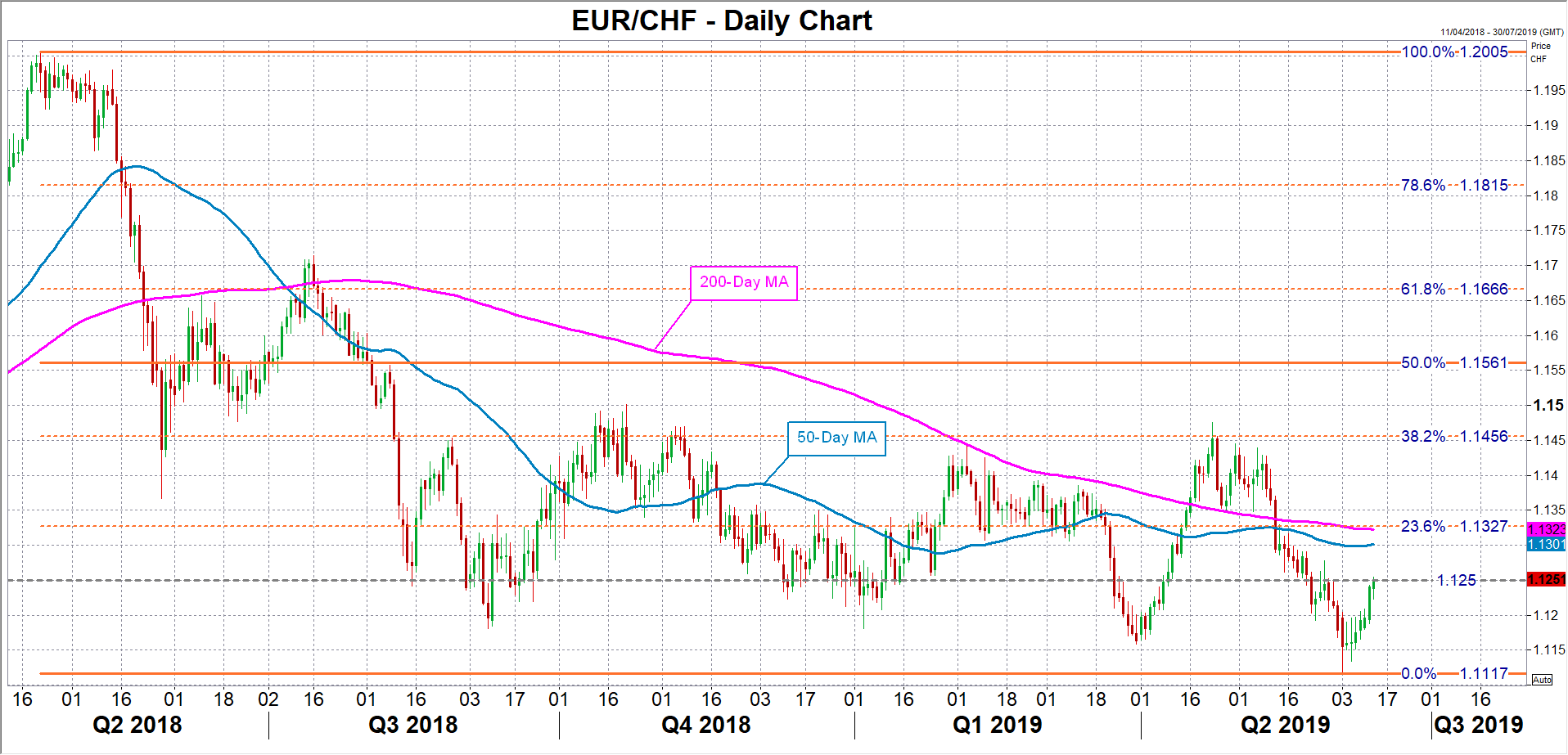
If the SNB fails to provide enough dovish signals, euro/franc might find itself heading back towards the 22-month low of 1.1117 hit on June 3.
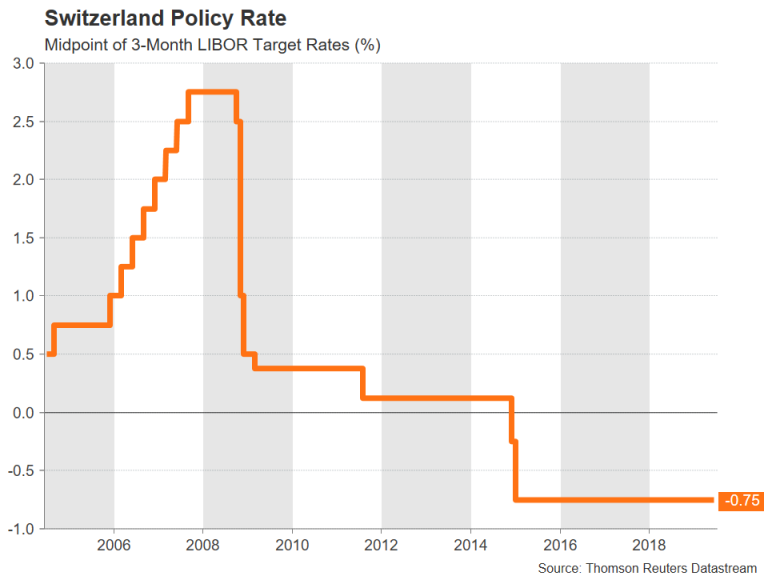
Looking beyond the June meeting, SNB policymakers will be closely monitoring how both domestic and overseas growth evolve in the coming months, in addition to the exchange rate, as well as keep one eye on the ECB. Investors are currently pricing about a 50% probability that the SNB will cut its policy rate by 25bps by March 2020 from the current record low of -0.75%. Those odds could rise if the SNB is overly dovish on Thursday.
Copper Futures Attempt to Break above Descending Channel
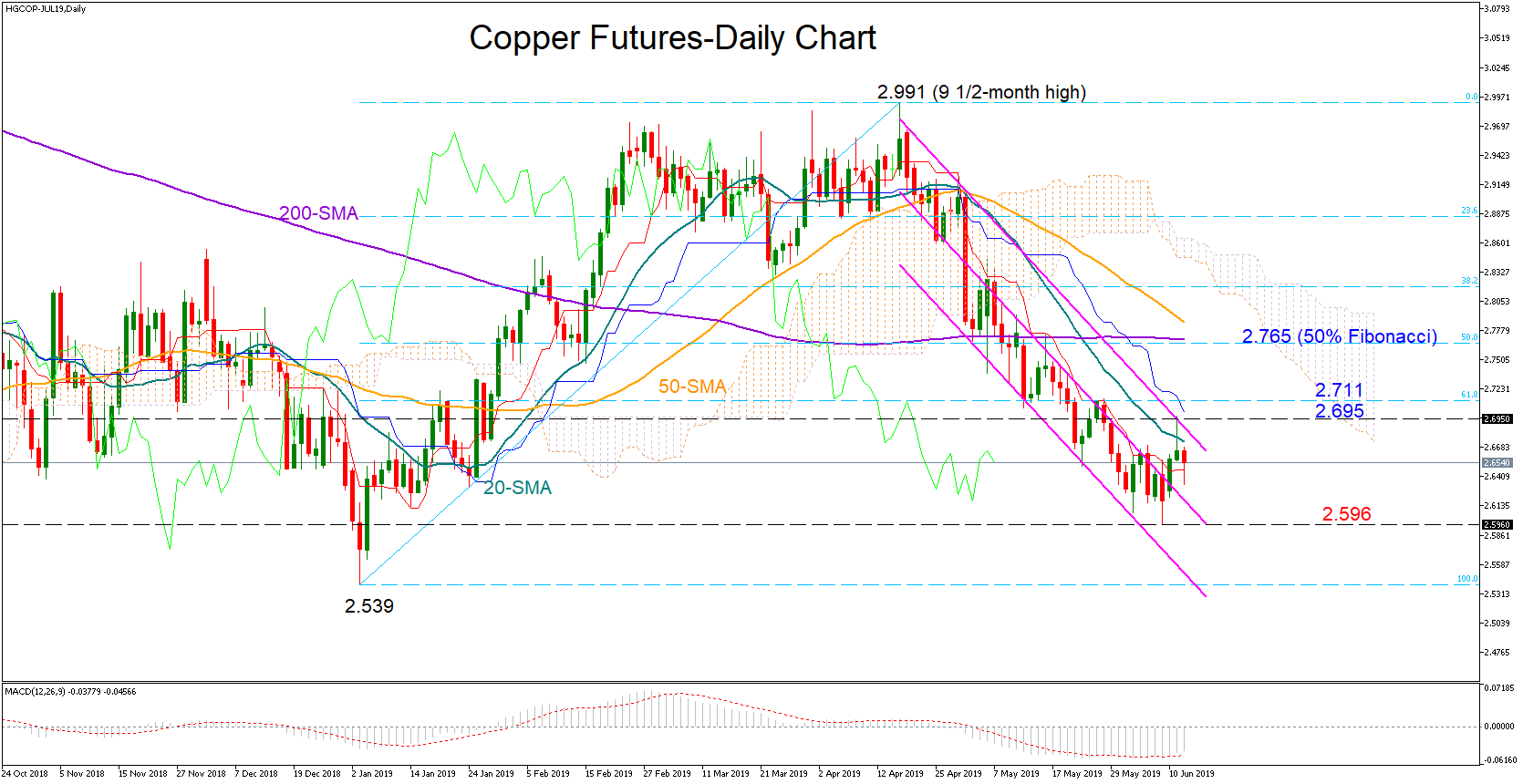
Copper futures for July delivery have unsuccessfully attempted to pierce the upper boundary of the one-month old descending channel (2.695) on Tuesday.
The positive momentum in the MACD signals that upside pressures may return in the short-term, but the price may first need to crawl comfortably above 2.711, the 61.8% Fibonacci retracement of the 2.539-2.991 bullish wave, to fuel a stronger buying interest. On the way up, the 50% Fibonacci and the 200-day simple moving average (SMA), could hostage the bulls. If not, then the 38.2% Fibonacci of 2.818 could next take control.
Staying within the channel, support could be initially detected near the previous trough of 2.596 before all eyes shift to the bottom of the channel and the January low of 2.539.
Meanwhile, the falling 50-day SMA, which is not far above the longer-term 200-day SMA raises the stakes for an even bearish outlook in the medium-term timeframe.
Sunset Market Commentary
Markets:
Peripheral countries profit from last week’s dovish signal from the ECB by stepping up issuance. ECB President Draghi said the central bank stands ready to ease if necessary. That could be by cutting policy rates (but adding mitigating measures), extending forward guidance or revamping asset purchases. Especially that latter prospect soothes peripheral bond investors. Today, ECB’s Villeroy reiterated that the ECB could do more if necessary. However, his comments hat little direct impact on German/EMU core yields The German yield curve declines between -0.4 bp (2-yr) and -0.8 bp (30-y). The Italian debt agency successfully launched a new 20-yr benchmark deal (Mar2040). The bond was prices to yield 12 bps over BTPS 2.95% Sep2038, tighter than +16 bps initial price takings and +14 bps initial guidance. The order book was in excess of €23.5bn, allowing the Treasury to print €6bn. The Spanish treasury launched a long 10-yr bond (Oct2029) at MS + 33 bps, tighter than MS +35 bps guidance and significantly lower than the MS + 65 bps for a new 10-yr Bond at the start of the year. Portugal tapped 2029 and 2034 bonds for a combined €1.3bn. The auction yield at the 10-yr tap was an all-time low for that tenor of 0.639%. US yields drifted lower from the start of trading this morning as risk sentiment deteriorated. US May CPI inflation (core 2.0%, headline 1.8%) was marginally softer than expected. US yields dipped briefly, but the move couldn’t be sustained. Still, the US yield curve bull steepens with the 2-y yield declining 4.1 bps while the 30-y is rising 1.1 bp.
EUR/USD trading was mainly technical in nature as there was no news important enough to push the pair outside the 1.1290/1.1350 consolidation pattern that reigned trading post payrolls. A new, albeit modest decline in US yields due the risk-off sentiment narrowed the USD-EMU (German) spread but a new attempt of EUR/USD to set a ‘post-payrolls’ top failed again. In the afternoon, US CPI also came out slightly softer than expected. US yields declined briefly, but EUR/USD still failed to clear the 1.1340/50 resistance. The decline of USD/JPY was also limited and short-lived. The dollar currently trades again off the intraday lows. EUR/USD is changing hands in the 1.1315 area. USD/JPY returned to the 108.50 area. Apparently there is currently already quite some Fed easing discounted in the dollar. More high profile (political?) news is probably needed to trigger a new sustained USD downleg.
Sterling bottomed/rebounded yesterday as a solid labour market report at least caused markets pondering the BoE rhetoric that a rate hike might be needed in a not-that-distant future. Today, sterling even got some support from the political scene. Boris Johnson in a speech for his campaign to become conservative leader and UK PM said that he wants Britain the leave the EU at the end of October. He prepares for a no deal Brexit, but is not aiming for that option. The latter was seen as less hawkish compared to other comments in the past and supported sterling. EUR/GBP drifted lower from the 0.8910 area to currently trade in the 0.8880 area. Today’s price action apparently confirms that already quite some bad news is discounted in sterling and that a further rebound of EUR/GBP to the 0.90/0.91 area might not be that evident short-term.
News Headlines:
Turkish central bank (CBRT) kept rates unchanged at 24% ahead of an election redo in Istanbul (June 23). The CBRT altered its statement to the dovish side however. It paved the way for a possible rate cut as soon as July, provided inflation continues to drop and geopolitical/trade tensions – which harmed the lira in the past – do not flare up.
US headline CPI slowed from 2.0% YoY (0.3% MoM) to 1.8% (0.1% MoM) in May as increased food prices were insufficient to offset the drop in energy. Core inflation (2.0% YoY, 0.1% MoM) also decelerated, slightly undershooting market expectations with shelter price increases halving compared to last month.
WTI Crude – Back Near Lows ahead of Inventories
Oil sinks ahead of EIA inventory data
Another large inventory build, reported by API on Tuesday, is piling further pressure on oil prices, as we await a more widely followed release from EIA later today.
Estimates suggest we may see a slight drawdown but that’s very much at odds with the near-five million barrel build that API reported. With oil now trading back near the recent lows, we could see a real test of whether there was actually any substance behind last week’s rebound.
WTI Daily Chart
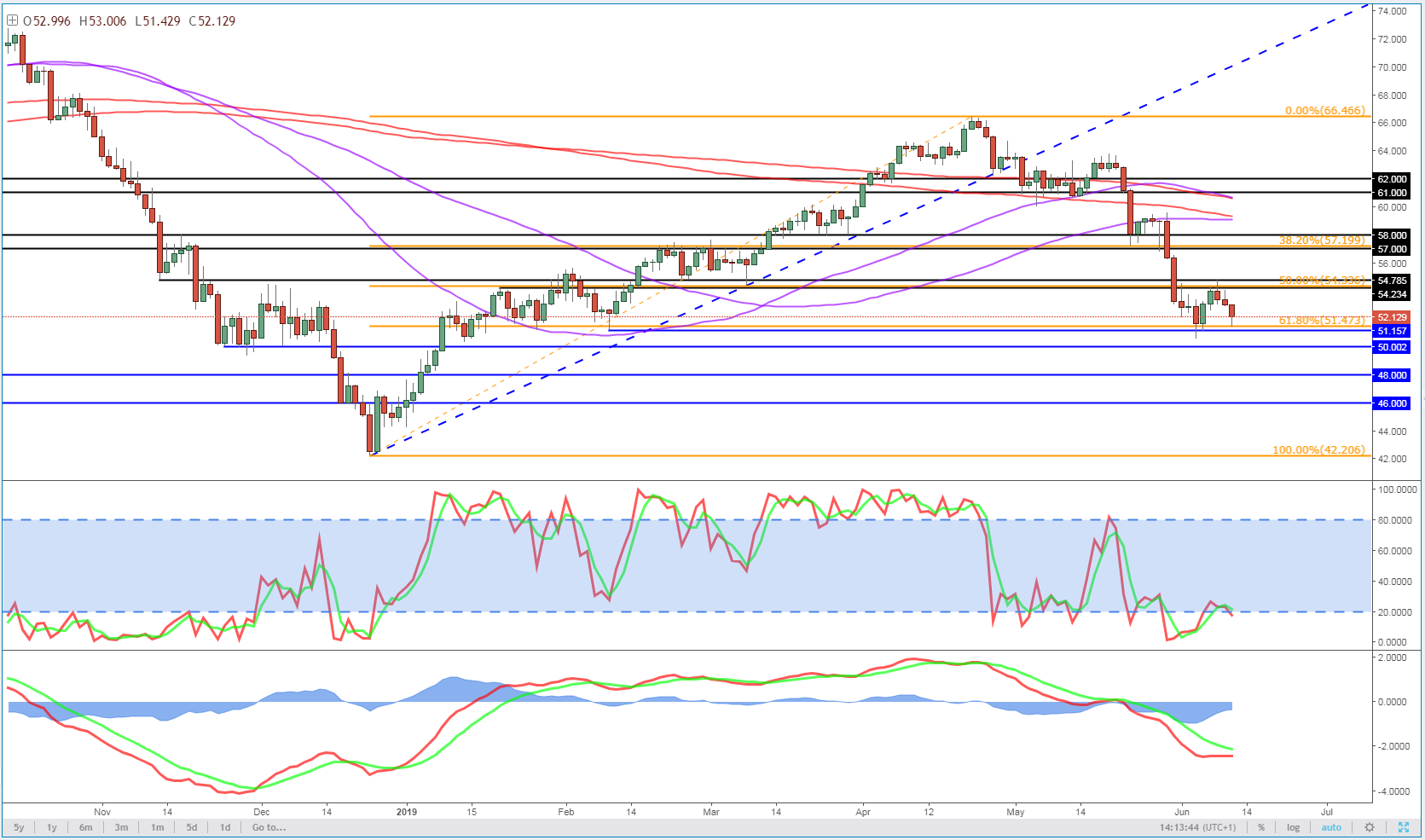
A break below $50 in WTI crude could be a very bearish signal in the near-term while at the same time likely being influential when it comes to OPEC+ meets to discuss output cuts early next month. It’s just a question of how low we go before traders sit up and pay attention to the cuts. We could see some support around $48 and $46 below, with the December low around $44 being the greatest test.
There are clearly significant forces working in both directions here but two of these – US/China trade war and OPEC+ extension – could be much clearer in a matter of weeks. Barring any clear indication of progress prior to this, a significant move in either direction may come up against resistance.
EUR/GBP – Leadership Race Weighs on Sterling
UK data encouraging but leadership race remains a drag on GBP
It’s all gone a little quiet in the UK recently, well, compared to the Brexit noise we’ve become accustomed to.
The Conservative leadership race has put Brexit on hold for now, which is handy as the new end of October deadline creeps ever closer. The number of candidates remains at 10 but with a number of the front-runners Brexiteers, it’s no surprise that the pound remains out of favour.
EURGBP Daily Chart
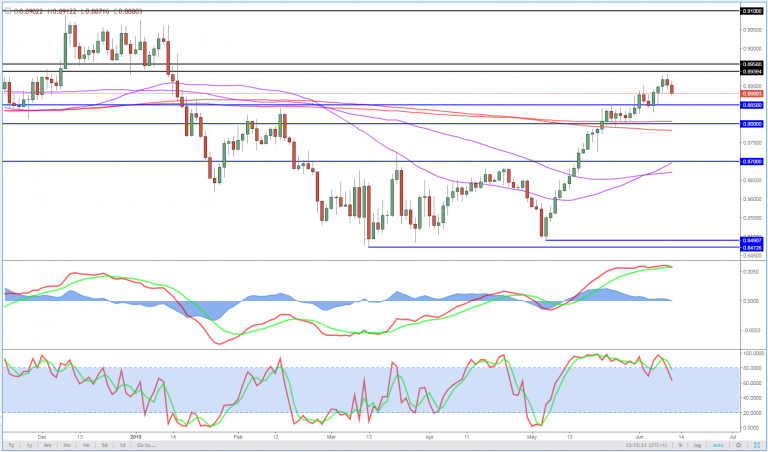
Boris Johnson is probably seen as the greatest risk for the currency and while we keep getting told that the favourite never wins, it’s not providing much comfort at the moment.
We have no UK data out today but what we have had so far this week has been mixed which is pretty consistent really. April was a bad month for the economy but was primarily driven by one-off factors which suggests we’ll return to modest growth soon enough.
The labour market data was far more encouraging and may well give policy makers at the BoE a decision to make later this year is Brexit can be resolved in an orderly and undisruptive manner.
BoE Interest Rate Probability

Source – Thomson Reuters Eikon
We are seeing a small bounce in the pound at the minute but as long as Brexiteers – particularly those that aren’t against no-deal – remain in the race, the rallies may feel like swimming against the tide. Of course, this always depends on what it’s trading against but even against a soft dollar, the pound is making hard work of it.
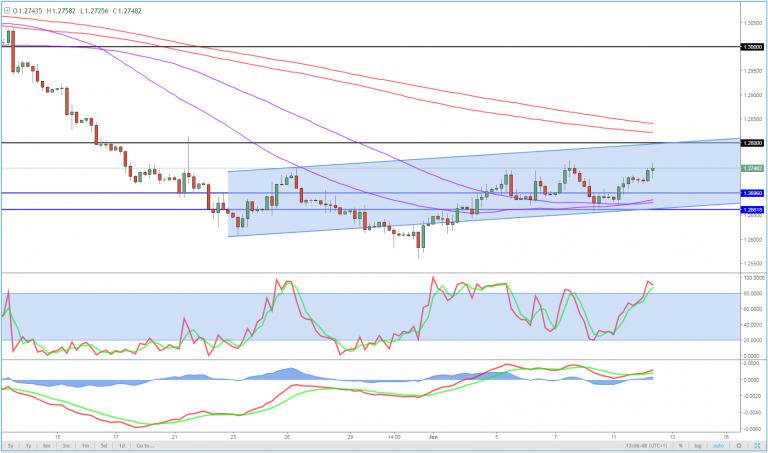
The next key level is 0.88, a break of which could be a near-term catalyst but for the reasons above, even this may be a slow decline. It’s also far from guaranteed that a break will happen. It could also find support around 0.8850 which has been an interesting level of support and resistance over the last few weeks and also coincides with the 55/89 simple moving average band which has tracked the pair higher. That said, the momentum indicators may tell us more if it does continue to drop and they currently look quite healthy.
EURGBP 4-Hour Chart
Dollar Whipsaws as US Inflation Remains Nonexistent
The US dollar initially weakened, and Treasuries rallied after US inflation readings showed softness across the board. With no headline inflation in place, the Fed’s decision to cut rates should be an easy one at the July meeting. Odds for a rate cut at the July 31st meeting rose to 75.9%, while the next week’s meeting remained around 20%. The Fed’s transitory effects could still be lingering and with core figures still hovering at the Fed’s target, the case for a June cut should be off the table. The core consumer price index which removes energy and food costs climbed 2% from a year earlier missing forecasts, but still posting its fourth straight monthly increase.
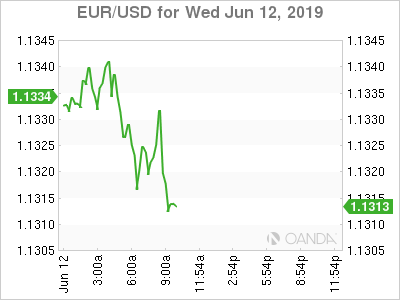
The dollar dropped 15 pips to the euro following the data but has settled near unchanged levels at 1.1318.
Fed funds futures are now indicating a rate of 1.725% at the end of the year. The yield on 10-year Treasuries slumped 2.8 basis points to 2.115%, while the dollar fell to the weakest levels in almost two months.
USD/JPY Mid-Day Outlook
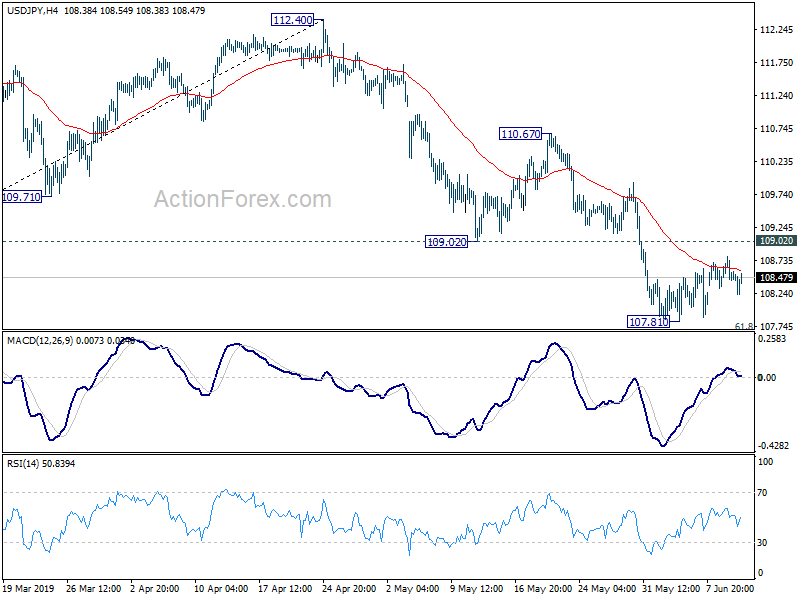
Daily Pivots: (S1) 108.30; (P) 108.56; (R1) 108.77; More...
USD/JPY is staying in consolidation from 107.81 and intraday bias remains neutral first. Upside of recovery should be limited by 109.02 support turned resistance to bring fall resumption. On the downside, sustained break of 61.8% retracement of 104.69 to 112.40 at 107.63 will pave the way back to 104.62/9 key support zone. Though, break of 109.02 support turned resistance will indicate short term bottoming and bring lengthier consolidations first.
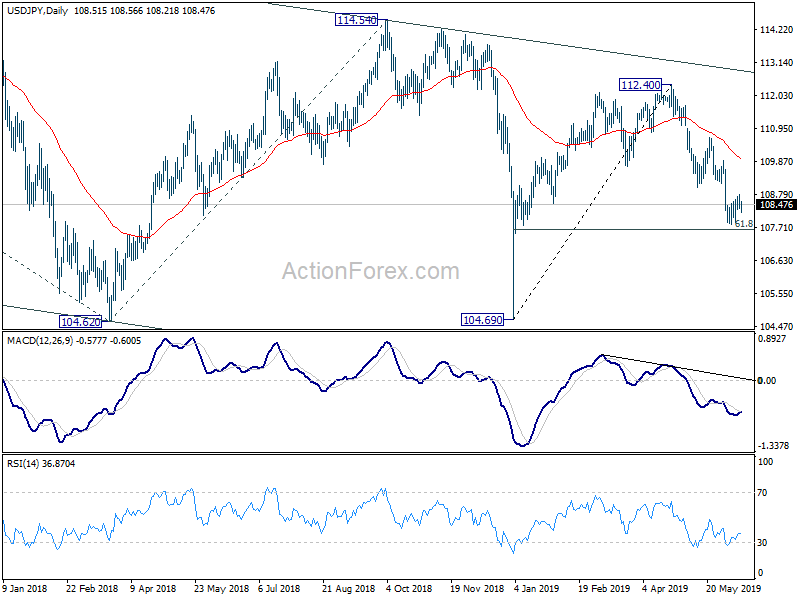
In the bigger picture, decline from 118.65 (Dec 2016) is still in progress, with the pair staying indicate long term falling channel. Break of 104.62 will target 100% projection of 118.65 to 104.62 from 114.54 at 100.51. For now, we'd expect strong support above 98.97 (2016 low) to contain downside to bring rebound.
USD/CHF Mid-Day Outlook
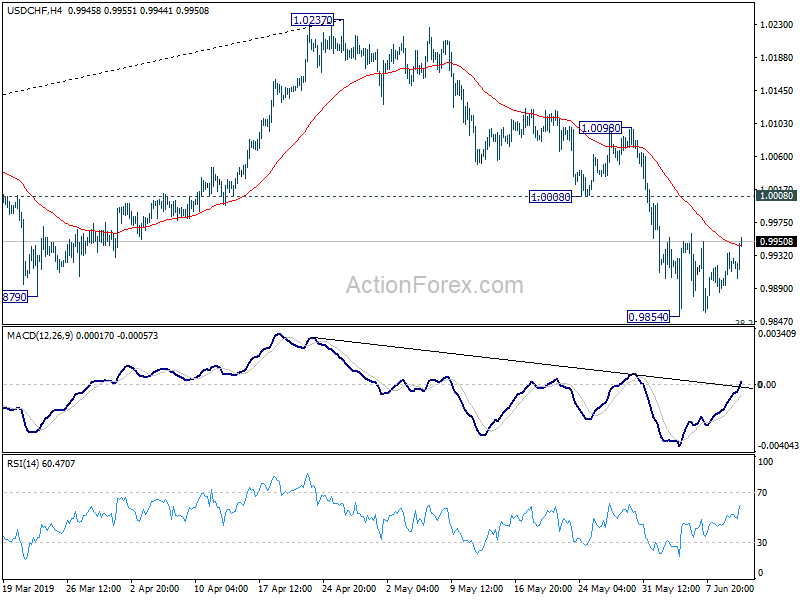
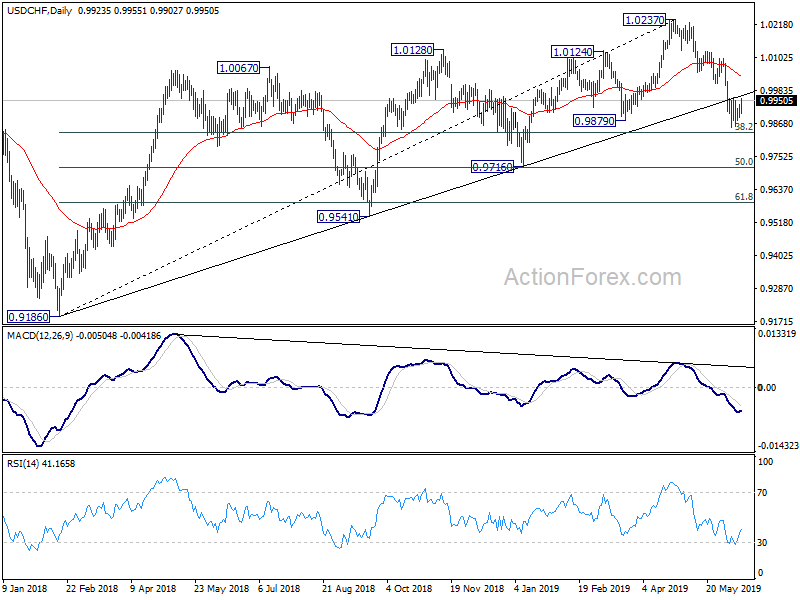
Daily Pivots: (S1) 0.9897; (P) 0.9917; (R1) 0.9945; More...
No change in USD/CHF's outlook as consolidation from 0.9854 is in progress. Intraday bias remains neutral for the moment. In case of another recovery, upside should be limited by 1.0008 support turned resistance and bring fall resumption. On the downside, break of 0.9854 will extend the decline from 1.0237 to 0.9716 cluster support (50% retracement of 0.9186 to 1.0237 at 0.9712).
In the bigger picture, USD/CHF's break of long term trend line support is the first indication of medium term reversal. Focus is now back on 0.9879 support. Sustained break should confirm that medium term up trend from 0.9186 has completed at 1.0237 already. Further fall should be seen to 0.9716 cluster support (50% retracement of 0.9186 to 1.0237 at 0.9712) next. Break will target 61.8% retracement at 0.9587.
GBP/USD Mid-Day Outlook
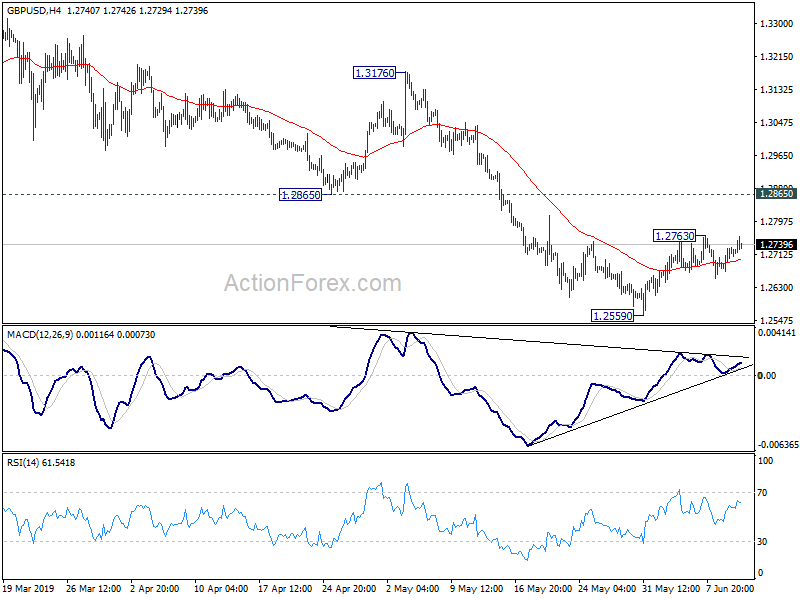
Daily Pivots: (S1) 1.2684; (P) 1.2709; (R1) 1.2747; More....
GBP/USD is staying below 1.2763 and intraday bias remains neutral first. On the upside, break of 1.2763 will extend the corrective rise from 1.2559. But in that case, upside should be limited by by 1.2865 support turned resistance to bring fall resumption eventually. On the downside, break of 1.2559 low will extend the decline from 1.3381 for 1.2391 low first.
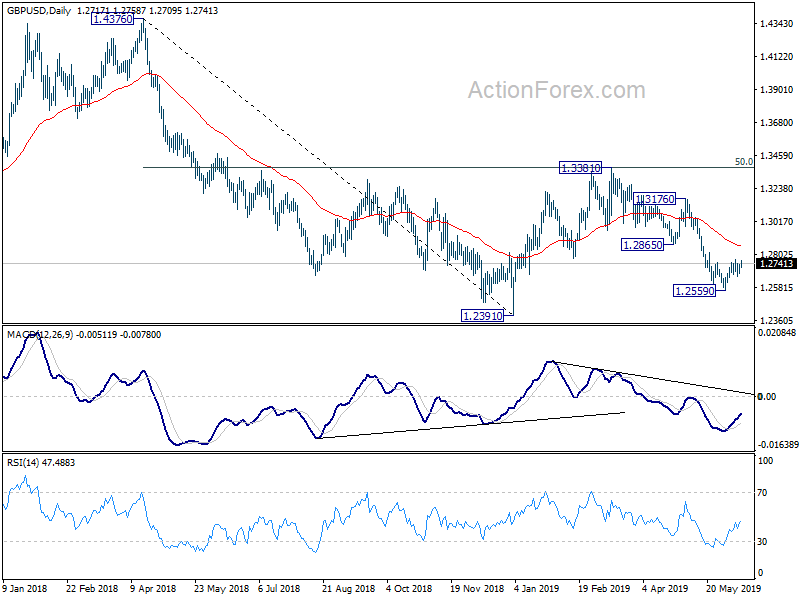
In the bigger picture, medium term decline from 1.4376 (2018 high) is possibly ready to resume. Decisive break of 1.2391 would target a test on 1.1946 long term bottom (2016 low). For now, we don't expect a firm break there yet. Hence focus will be on bottoming signal as it approaches 1.1946. In any case, medium term outlook will stay bearish as long as 1.3381 resistance holds, in case of strong rebound.
Limited Inflation Pressures in the U.S. Economy
- CPI prices rose a modest 0.1% (month-on-month) in May, in line with market expectations. The headline inflation rate lost a bit of momentum to 1.8% year-on-year (y/y), thanks to a normalization of energy prices.
- Core prices were softer than expected, up only 0.1% m/m for the fourth straight month. Core inflation lost momentum to 2.0% y/y.
- The loss of momentum in core inflation was seen in both goods and services. Core services inflation cooled to a 0.2% increase (m/m) in May after two months of hotter gains. Core goods prices also continue to fall (-0.1% m/m).
- Core inflation was held back by price declines for used cars and trucks (-1.4% m/m), recreation (-0.3%), and motor vehicle insurance. Shelter inflation also cooled a bit, up 0.2% in May (versus 0.4% in April). But, medical care inflation continues to be solid (+0.3% m/m). Apparel prices, which had fallen dramatically in the previous two months, were unchanged.
- Food prices rose 0.3% in May, taking year-on-year inflation higher to 2.0%, the highest it has been in four years.
Key Implications
- The weakness in inflation is starting to look less transitory. While core CPI inflation is still at 2.0%, the Fed's preferred measure has typically been a few ticks lower, and today's report does not bode well for an uptick in inflation there. If the Fed is looking for data to justify a more dovish stance at next week's policy meeting, this is it.
- We may see higher inflation readings in the months ahead thanks to increased tariffs on Chinese imports (see our recent report U.S. and China Exchanging Tariff Blows – Round 3). The Fed will try to look through these temporary prices increases when setting monetary policy, but that can be a tricky untangling job. Ultimately these higher tariffs cut purchasing power, and weigh on economic growth, which could weaken inflation in turn.