

Sample Category Title
Holidays Subdue Volatility
Holidays subdue volatility
With both the US and the UK closed for holidays overnight, financial markets enjoyed a quiet start to the week. European shares rose modestly following the European Union elections, which drew a collective sigh of relief from Brussels as voters shifted parties in a larger-than-average turnout, but stayed within the Liberal/Centrist comfort zone.
President Donald Trump said from Japan that the US wasn’t ready to make a trade deal with China yet but that things were progressing nicely with Japan. Canada also made initial steps to ratify the NAFTA mark two agreement, meaning, the US appears content to let China simmer while tidying up various other trade blocs for now.
Asian markets may enjoy a boost today as Bloomberg reports that Alibaba may be about to launch a USD20 billion share offering on the Hong Kong Stock Exchange. Exciting news for Hong Kong and perhaps a sign of things to come as Chinese companies look locally to raise funds instead of an unwelcoming and suspicious US. Cause and effect – two can play the trade war game.
On the data front, South Korean consumer confidence fell more sharply than expected today ahead of Taiwanese consumer confidence and Thailand’s industrial production later this morning. Markets will monitor this data closely for signs that the US-China trade friction is spilling over regionally.
FX
The dollar is modestly stronger today following a muted session overnight with both New York and London closed. Notably, the British pound (GBP) gave up the 1.2700 level and fell to 1.2680 as the rally following Prime Minster May’s resignation runs out of steam.
Regional currencies will probably be mostly unchanged following the overnight sessions, boosted by potential IPOs in Hong Kong on the one hand, but tempered by potentially weak local data and President Trump’s social media account on the other.
Equities
Equities are set for a boost this morning following a calm but positive session for stocks in Europe and the potential Alibaba offering on the Hong Kong exchange as reported by Bloomberg. Sentiment will remain fragile though with the US President still in Japan as trade talks continue there.
Oil
With WTI closed, Brent Crude rose 1% to USD70.00 a barrel overnight as a quiet news front allowed it to claw back last week’s losses slowly. However, Brent faces serious technical resistance in this area, being the break-out level from last week, and the rally still appears corrective in nature.
With ample inventories in the US and trade frictions still at the fore – albeit quiet for the moment – oil’s recovery is fragile, and traders should exercise caution at these levels.
Gold
Gold remained almost unchanged at USD1,285.00 an ounce, which is hardly a surprise with both New York and London closed. Bitcoin continues to steal gold’s safe-haven thunder leaving the precious metal marooned in a USD1,270.00 to USD1,290.00 an ounce range.
Eco Data 5/28/19
[php_everywhere instance="1"]
Australian Dollar Lower in Light-Holiday Trading
AUD/USD has posted slight losses in the Monday session. In North American trade, AUD/USD is trading at 0.6916, down 0.16% on the day. U.S markets are closed in the U.S. for the Memorial Day holiday, and there are no U.S. or Australian events on the calendar. On Tuesday, the U.S. releases CB Consumer Confidence. Investors are looking ahead to events later in the week, as Australia posts Private Capital Expenditure on Wednesday and the U.S. releases first-quarter GDP on Thursday.
Trade tensions between the U.S. and China escalated last week, but the Aussie managed to post gains. A trade deal between the two super-economies has not materialized, despite assurances from U.S. officials that substantial progress has been made. China has reacted angrily to U.S. sanctions on Huawei and has suspended trade talks with the U.S. Although negotiations will likely resume at some point, investors remains jittery, and this could weigh on the Australian dollar.
U.S. indicators ended the week on a disappointing note, as April durable goods orders were softer than expected. Durable goods orders slumped 2.1%, just below the estimate of -2.0%. This marked the sharpest decline since January 2018. The core reading slowed to 0.0%, down from 0.4% a month earlier. The U.S. economy has been performing well, and the economy will receive a report card on Thursday, with the release of Preliminary GDP for the first quarter, which is expected to post a strong gain of 3.1%. The initial GDP reading showed a gain of 3.2%, crushing the estimate of 2.2%. Will the revised release also beat expectations? If so, traders can expect the U.S. dollar to post broad gains.
British Pound Dips as Brexit Party Shines in UK European Elections
The pound has started the week with losses, erasing the gains seen on Friday. Currently, GBP/USD is trading at 1.2671, down 0.33% on the day. On the release front, markets are closed in both the U.S and U.K. for public holidays. On Tuesday, the U.S. releases CB Consumer Confidence. Investors are looking ahead to later in the week, as the U.S. releases first-quarter GDP on Thursday.
Elections to the European Parliament showed a dramatic surge in support for far-right parties across Europe, and the U.K. Brexit party was one of the day’s big winners. The party won 29 seats, compared to 10 for Labour and just 4 for the Conservatives. A chastised Prime Minister May tweeted that it “was a very disappointing night for the Conservatives”. The election results were a resounding backlash against the mainstream parties for their handling of Brexit, which has dragged on past the original deadline, with no solution in sight. For investors, the worst-case scenario is a no-deal exit, which could undermine the economy and send the British pound sharply lower. Unless May can pull a Brexit rabbit out of her hat, it will be up to her replacement, as yet unknown, to try and hammer out a withdrawal deal with Brussels.
U.S. indicators ended the week on a disappointing note, as April durable goods orders were softer than expected. Durable goods orders slumped 2.1%, just below the estimate of -2.0%. This marked the sharpest decline since January 2018. The core reading slowed to 0.0%, down from 0.4% a month earlier. The U.S. economy has been performing well, and the economy will receive a report card on Thursday, with the release of Preliminary GDP for the first quarter, which is expected to post a strong gain of 3.1%. The initial GDP reading showed a gain of 3.2%, crushing the estimate of 2.2%. Will the revised release also beat expectations? If so, traders can expect the U.S. dollar to post broad gains.
Sunset Market Commentary
Markets
European bonds records modest gains today. Financial markets are digesting the EU election results, while US/UK markets are closed for the day. Mainstream EU parties held better ground against the populist-nationalist wave than expected, but the election result is more fragmented the ever. Although equity markets opened with gains, EU bonds moved higher as well. The combination of US/UK markets being closed and an empty eco calendar lead to very low trading volumes. Italian BTP’s fell on rumours that the European Commission is considering a disciplinary procedure for Italy next week over its failure to rein in debt. That could lead to a €3.5bn penalty fine. The German yield curve is bull flattening with changes up to -2.7 bps (30-yr). Peripheral spreads over the German yield remained rather stable, with Greece (-20 bps) outperforming and Italy (+ 8 bps) underperforming. Current Greek PM Tsipras called snap elections as his Syriza party suffered a crushing defeat, in favor of the opposition party New Democracy. Investors hope a new government will shift the fiscal mix towards a more growth-friendly manner. In Belgium, the extreme-right Vlaams Belang became the second biggest in Flanders and the Federal election result suggest difficult coalition negotiations are ahead. However, that didn’t impact the Belgian yield spread.
Trading in the major FX cross rates was mostly contained to tight ranges. Liquidity was thin as US and UK markets were closed for a holiday. Early this morning, EUR/USD tried to extend last week’s rebound as the event risk of the EU parliamentary election had passed without causing a disorderly, anti-EU outcome. However, the move almost immediately ran in to resistance. EUR/USD settled in the 1.12 area. European equities traded with a positive bias but also didn’t help the single currency. In the afternoon, the euro even lost modest ground on headlines that the EU commission is considering disciplinary action against Italy for not complying with EU budget rules. EUR/USD is currently trading in the 1.1190 area. In technical trade, USD/JPY rebounded off last week’s correction low and is changing hands in the 109.50 area.
Sterling surprisingly gained some modest ground this morning even as the eurosceptic Brexit party of Nigel Farage succeded a landslide victory in the EU parliamentary election. However, one should give too much weight on today’s sterling price action as UK markets were closed for a holiday. Later in the session, in technical trade, sterling reversed earlier strength. EUR/GBP is again trading in the 0.8830 area. The outcome of the EU parliamentary election probably will make the issue of a potential no-deal Brexit a key point in the election race for a new leader of the conservative party. In this scenario, any sustained sterling gains look premature.
News Headlines
The European Commission approved the extension of Italy’s state guarantee scheme until May 2021 on Monday. The scheme provides Italian banks with a state guarantee on the least risky tranche in bad loan securitization sales. It was originally launched in 2016 and has allowed banks to sell about $50 bn euros of non-performing loans so far, according to EC estimates.
Germany’s Financial Stability Board has suggested the introduction of a countercyclical buffer of 0.25% for banks, the country’s Finance Ministry said today. It is meant as a precautionary measure to ensure lending should there be sustained economic downturn. Banks have one year to set aside the extra capital, starting from July 1.
The EC considers to propose a disciplinary procedure for Italy next week, a result of the country’s failure to rein in debt the way it first promised. Italy risks a $4 bn fine but the EC’s move is only one step in long process and a final decision may not come for months.
EUR/GBP Outlook: Cross Heads Higher as Pound Comes Under Fresh Pressure
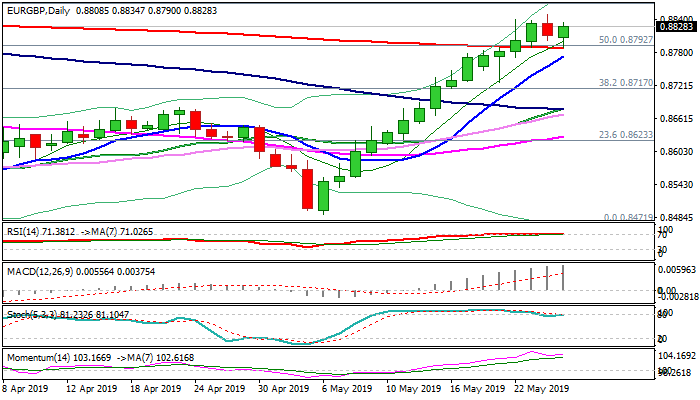
The cross regained traction and bounced from strong support at 0.8790 (200SMA/broken Fibo 50% of 0.9113/0.8471), which contained brief pullback from new 5 1/2 month high at 0.8850, posted last Friday. Sterling took a breather after steep fall in past three weeks, but prevailing negative tone on political turmoil and fears that the UK may leave EU without deal, keeps the cross well supported Strong bullish momentum, formation of 20/100SMA's bull-cross and 10SMA in steep ascend and approaching 200SMA, on track to form golden-cross, continue to underpin the action. Bulls eye pivotal barrier at 0.8868 (Fibo 61.8%), violation of which would generate strong bullish signal for extension towards psychological 0.90 resistance. Overbought daily studies continue to warn, but lack firmer signal, with bullish bias expected to remain intact and support dip-buying strategy while the price holds above broken 200SMA.
Res: 0.8850; 0.8868; 0.8900; 0.8962
Sup: 0.8790; 0.8773; 0.8726; 0.8678
Will the BoC Strike a More Confident Tone at its May Meeting?
The Bank of Canada (BoC) is widely expected to keep its policy unchanged on Wednesday at 14:00 GMT. Recent economic data and some remarks by Governor Poloz argue for a slightly more confident tone overall, which may lift the loonie. That said, simmering trade tensions and other risks will likely keep a lid on the optimism, implying that any positive reaction may be only modest.
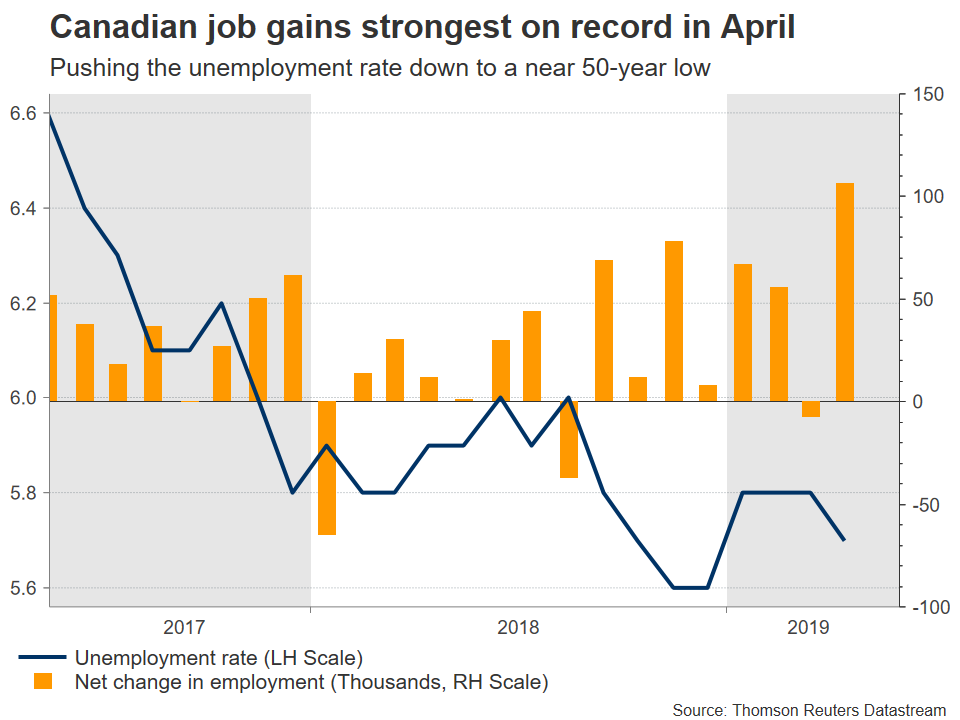
After hitting a soft patch earlier this year, the Canadian economy has shown clear signs of recovery in recent weeks, with incoming data being much stronger overall than what the BoC had projected in its latest forecasts. The labor market has been on a tear, with April marking the strongest month of job gains on record, and wages picking up steam. Likewise, retail sales have rebounded substantially, calming concerns around household consumption and thus around broader growth.
To be fair though, there are worrisome spots as well. Global trade tensions have escalated materially, oil prices have retreated, and the domestic housing market remains vulnerable. Perhaps more importantly, 5-year inflation expectations are declining again, which is a significant risk as the drop can become ‘self-fulfilling’ and drag actual inflation down too.
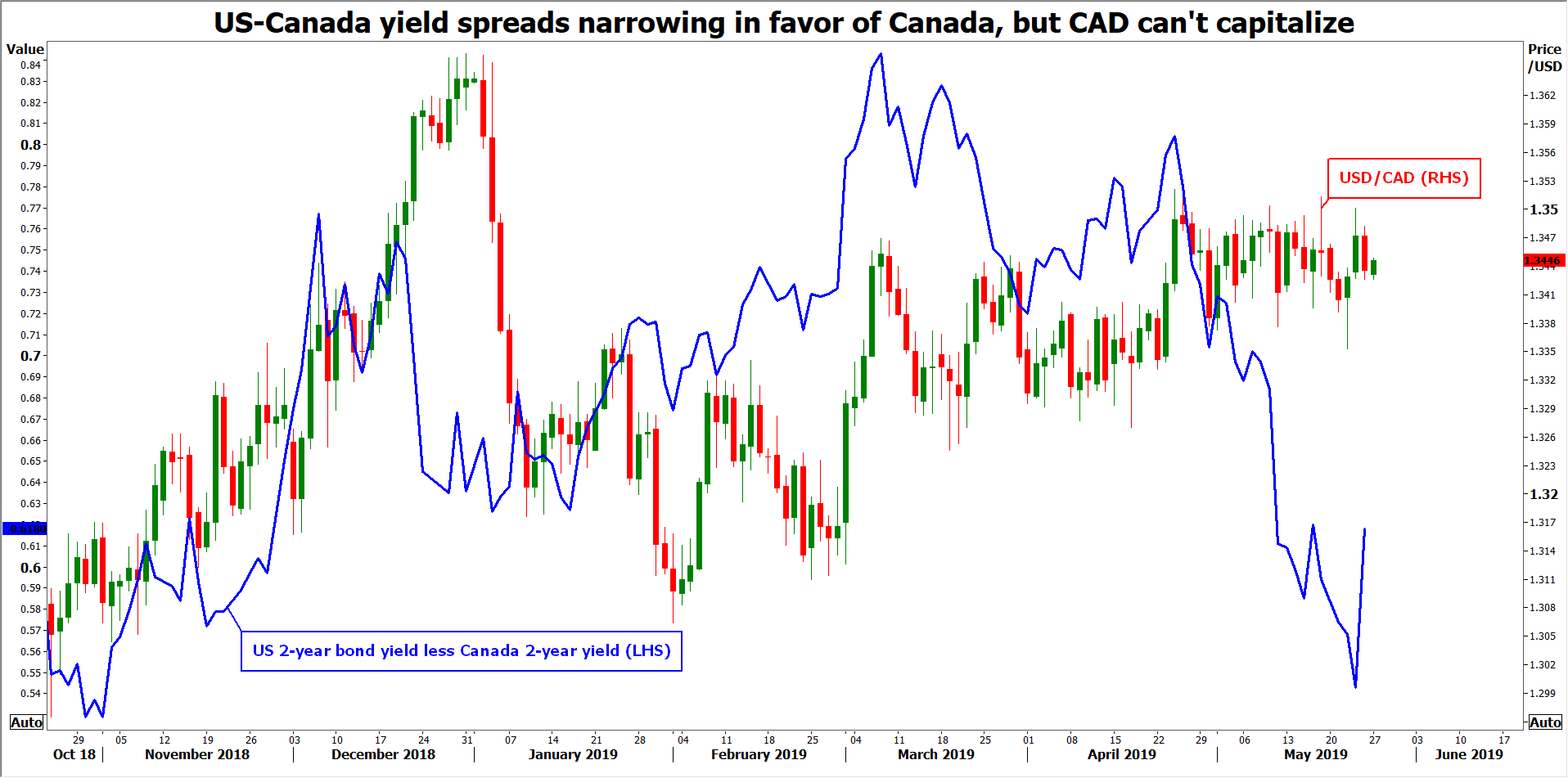
How are the markets reading all this? Admittedly, investors have focused mostly on the negatives. Bets for a rate cut have risen to signal roughly even odds for one by December, while the loonie has been trading nearly flat against the US dollar, unable to take advantage of a significant narrowing in US-Canada rate differentials in favor of Canada lately.
Against this backdrop, the BoC is unlikely to provide any strong policy signals this week, and instead may reiterate its neutral ‘wait-and-see’ stance. On the margin though, the tone of the accompanying statement could be slightly more confident, with policymakers highlighting that the economy is in much better shape than previously anticipated, even while acknowledging the external risks.
Also arguing for a slightly more hawkish spin, are some remarks by BoC Governor Poloz, who as recently as May 17 said he thinks the ‘natural tendency is for interest rates to still go up a bit’. Crucially, he made these comments after US-China tensions escalated again, but before the latest blockbuster retail sales data. In other words, he sounded confident while knowing all the bad news, but not all the good news, implying he may be even more confident in that view now.
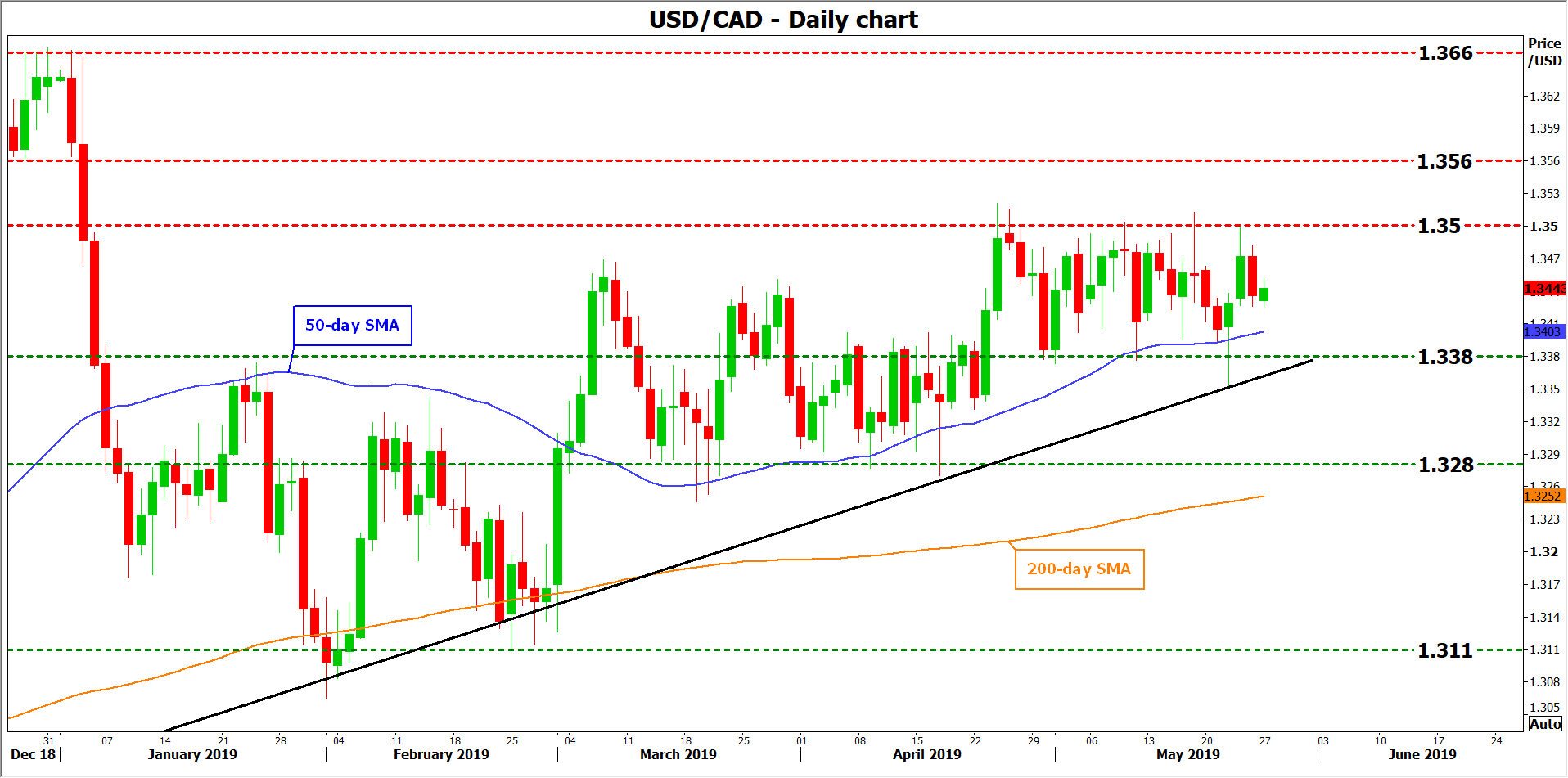
If the BoC does strike a slightly more cheerful tone, that could boost the loonie as rate-cut bets are unwound. Looking at dollar/loonie technically, support to declines may be found near 1.3380, an area that halted multiple declines in recent weeks, with a downside break opening the way for 1.3280.
On the flipside, if policymakers focus more on the downside risks, dollar/loonie could spike up as expectations for future rate cuts grow. Advances could stall at the 1.3500 handle, and if the bulls violate that region, attention would next turn to 1.3560.
The nation’s GDP data for Q1 are also coming out on Friday.
US 500 Index Turns Lower Between SMAs
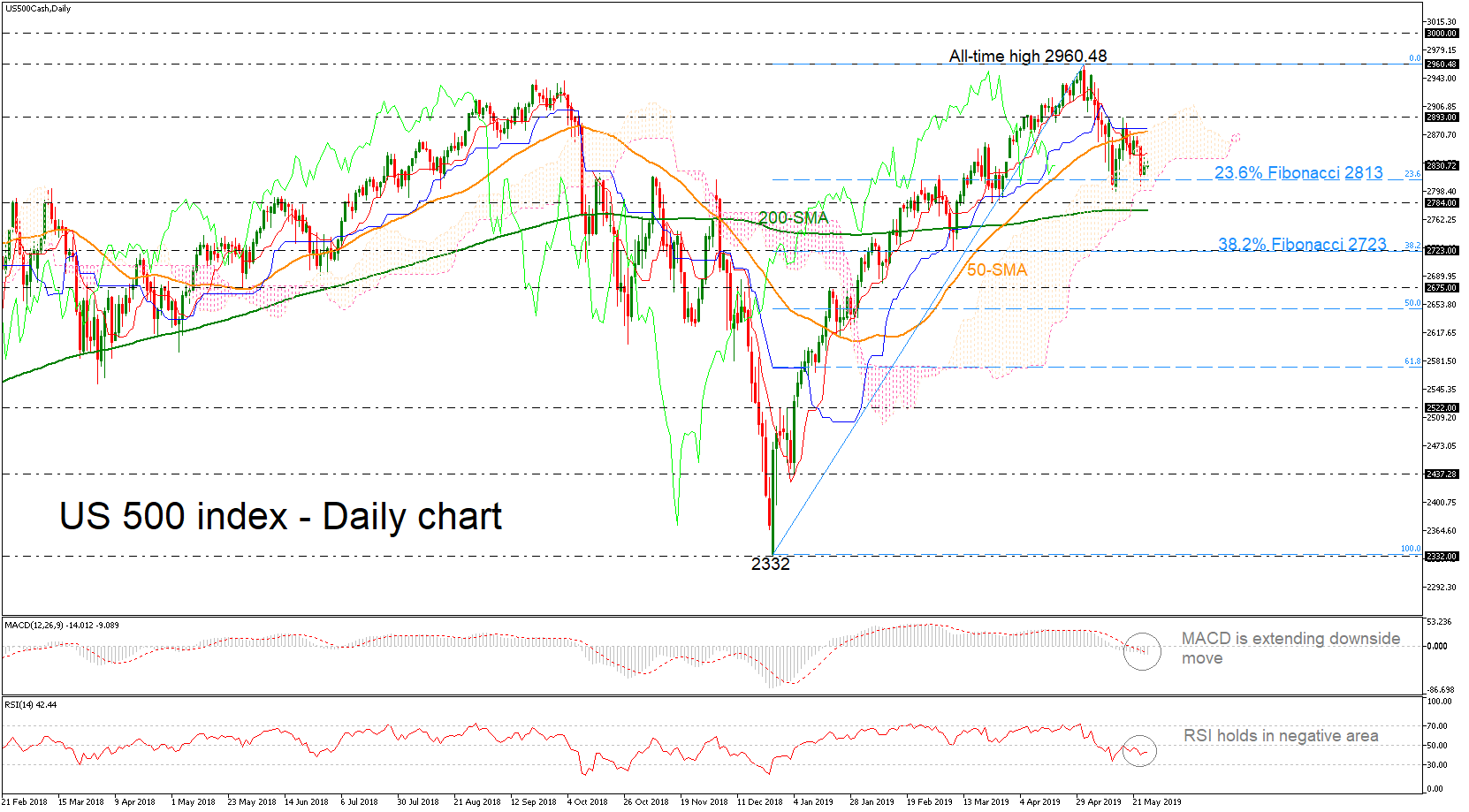
The US 500 stock index has declined considerably from the fresh all-time high of 2960.48, penetrating the Ichimoku cloud in the daily timeframe. The bearish correction picture in the short term is further supported by the MACD, which is falling below its red signal line and the RSI indicator which is turning slightly lower.
Should prices move lower, support could come at the 23.6% Fibonacci retracement level of the upleg from 2332 to 2960.48 around 2813 again. Below that, the 2784 is another major support before touching the 200-day moving average near 2774. A significant plunge below the 200-SMA could open the door for the 38.2% Fibonacci of 2723.
To the upside, initial resistance is coming from the 50-SMA currently at 2875 before meeting the 2893 resistance. More bullish speculation could meet the all-time high of 2960.48.
Summarizing, in the near-term, the momentum indicators point to a possible bearish retracement, however, the index is still creating higher highs and higher lows over the last four months, which augurs well for the medium-term. A decline below 200-SMA may turn traders’ attention to the downside.
DAX Points Higher after Dismal Week
The DAX has posted considerable gains in the Monday session. Currently, the index is at 12,078, up 0.56% on the day. On the release front, there are no German or eurozone events. On Tuesday, Germany releases Ifo Business Climate.
The votes have been tallied in the European parliamentary elections, as over 200 million voters went to the polls in 28 EU countries, including the U.K. The results were dramatic, as far-right parties across Europe made gains, at the expense of centrist parties. In France, Marine Le Pen’s National Rally party came in first, handing a stinging defeat to President Macron. In Germany, Chancellor Angela Merkel’s conservatives lost ground, and voters in the U.K sent a strong message to Labor and the Conservatives, as Nigel Farage’s Brexit party won the most seats. The ramifications are already being felt, as Greek Prime Minister Alexis Tsipras has called a general election after his Syriza party fared poorly in the EU elections. The euro has not shown much movement on Monday, but could face headwinds as investors digest the results.
Trade tensions between the U.S. and China escalated last week, which soured risk appetite. On Thursday, the DAX plunged 1.8%, its sharpest one-day drop since early February. A trade deal between the two super-economies has not materialized, despite assurances from U.S. officials that substantial progress has been made. China has reacted angrily to U.S. sanctions on Huawei and has suspended trade talks with the U.S. Although negotiations will likely resume at some point, risk apprehension remains high, and this could lead to further headwinds for the DAX.
BOC to Avoid Hinting Rate Hike Despite Improvement in Economic Data
We expect BOC to stay put - leaving the policy rate unchanged at 1.75%, at the upcoming meeting. Macroeconomic indicators released since the April meeting showed improvement. Governor Stephen Poloz said in an interview last week that interest rates are likely to still go up “a bit”, if recent economic slowdown proves temporary.
Yet, downside risks, such as re-escalation US-China trade war and decline in oil prices, remain. All in all, members should maintain the same neutral stance as the previous month. Note also that the upcoming meeting would not include press conference and updates on economic projections.
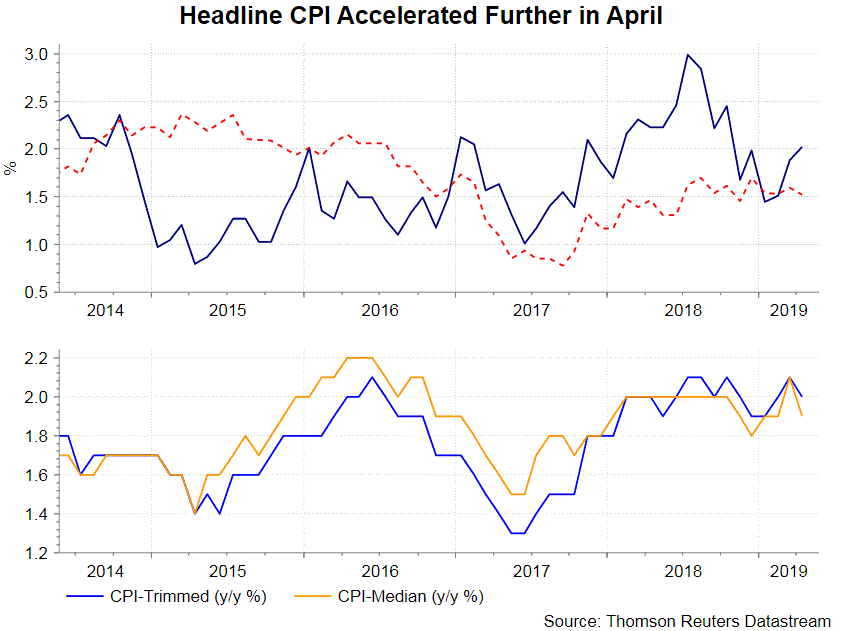
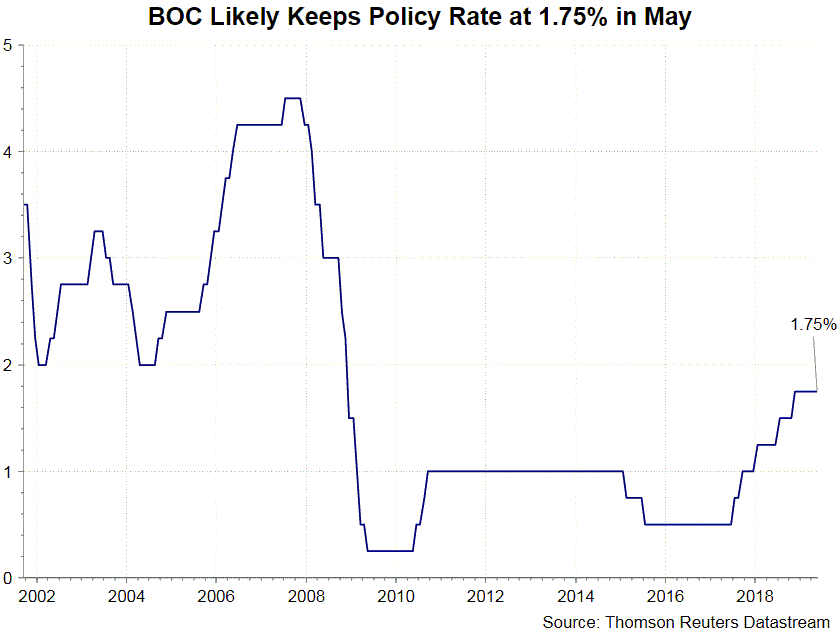 Headline CPI accelerated to +2% y/y in April, from +1.9% in March and +1.5% in February. Excluding gasoline and other energy prices, the reading came in at +2.3%. Core CPI eased to +1.5% y/y, from +1.6% in March. BOC’s preferred gauges of inflation – trimmed CPI, median CPI and common CPI - either eased pr stayed unchanged, giving an average reading of +1.9%, down slightly from March’s +1.97%.
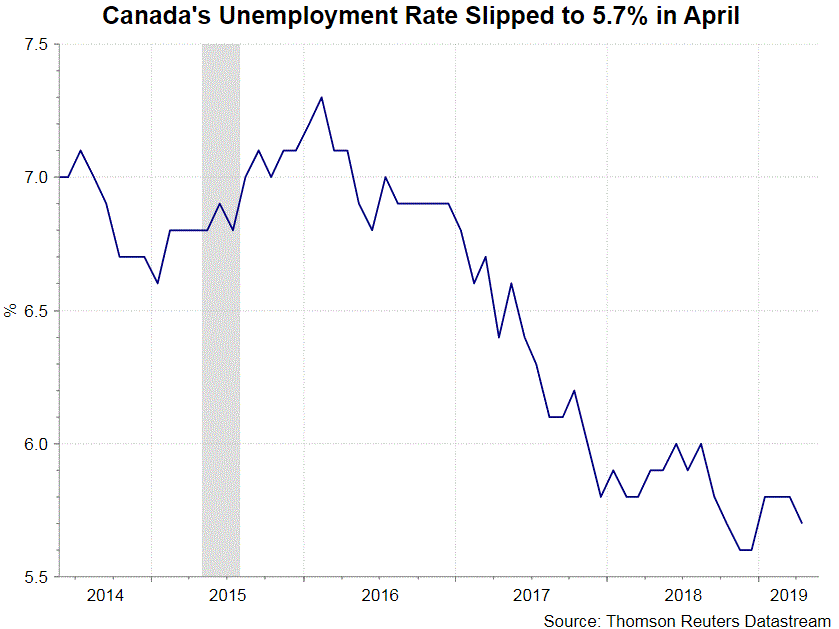
Concerning the job market, the unemployment rate slipped -0.1 percentage point to 5.7% in April. The number of payrolls rose +106.5K, compared with consensus of +10K and a -7.2K decline in March. Increases were seen in both full time and part time jobs. GDP contracted -0.1% m/m in February, after expanding +0.3% in January. This came in even weaker than consensus of no growth (+0%). The economy is expected to return to growth of +0.3% m/m in March. This would probably translate to an annualized growth of +0.7% q/q in 1Q19.
 Despite better economic data, some downside risks persist, if not intensify. Crude oil prices have slumped about -10% since the last meeting. This could have negative implications on Canadian dollar and Canadian economy. Members’ discussion at the previous meeting did not take into account the rapid escalation of trade war. Donald Trump’s announcement of increase of tariff on Chinese exports, and the chaos thereafter, happened after the meeting. Both oil market and trade policy are key issues BOC pledged to monitor in April.
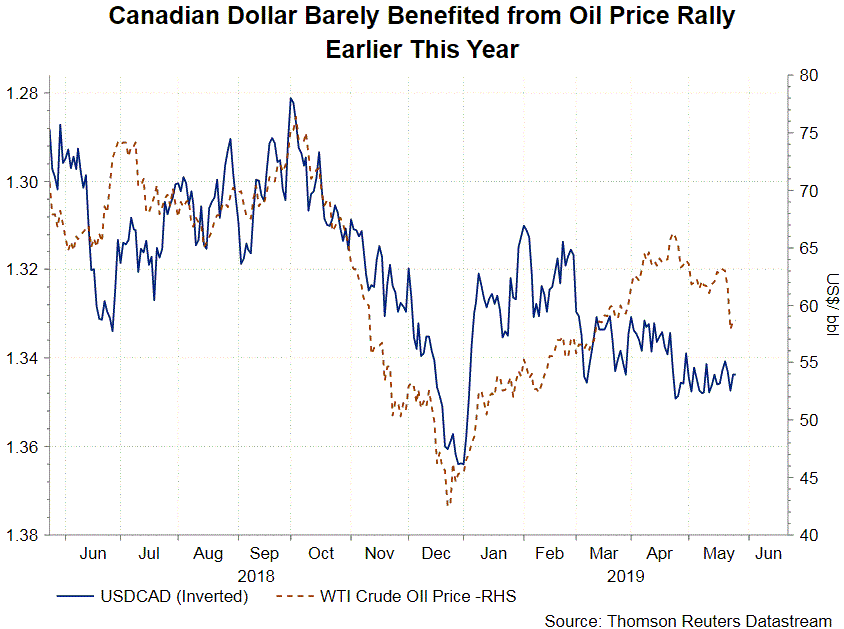
Governor Stephen Poloz sounded "hawkish" at Bloomberg interview last week. As he noted, “the natural tendency is for interest rates to still go up a bit”. Yet, “it depends on our forecast coming true that the slowdown is temporary and getting through all that and getting back on the track we were [on] say a year ago”. He added that he is uncertain about the size and timing of the rate hike.
Note, however, that such comments were echo of what he said at the press conference of the April meeting. Back then, he suggested that the members were “a little bit skeptical of some of the most-negative data”, though they believed these are a “temporary thing”. He added that “if our forecast is right, which I firmly believe it is, (then) what that means is that interest rates are more likely to go up than down over time”.
We expect BOC to retain the same tone as in April. Last month, the central bank removed any rate hike bias in the forward guidance. Rather, it suggested that “an accommodative policy interest rate continues to be warranted”. BOC also pledged to “evaluate the appropriate degree of monetary policy accommodation as new data arrive”, in particular “developments in household spending, oil markets, and global trade policy”. We expect the above stance to remain intact in May.