Sample Category Title
Australia Q1 Wages First Impressions, The WPI Continues To Disappoint
WPI +0.5%qtr vs 0.6%yr expected. The annual pace holds 2.3%yr and while Victoria wages are lifting as expected so far it is not enough to offset weakness elsewhere, particularly in NSW.
It is true that wage inflation has lifted off its record low of 1.9%yr in June 2017 but running at a 2.3%yr at March 2019 it can hardly be described as running at a breakneck pace. We expect wage inflation to drift higher from here - our forecasts have it peaking around 2¾ %yr in 2020 - but given how well contained the wage inflation is across the nation, and between sectors, even this modest increase looks optimistic with the risks to this forecast more to the downside than upside.
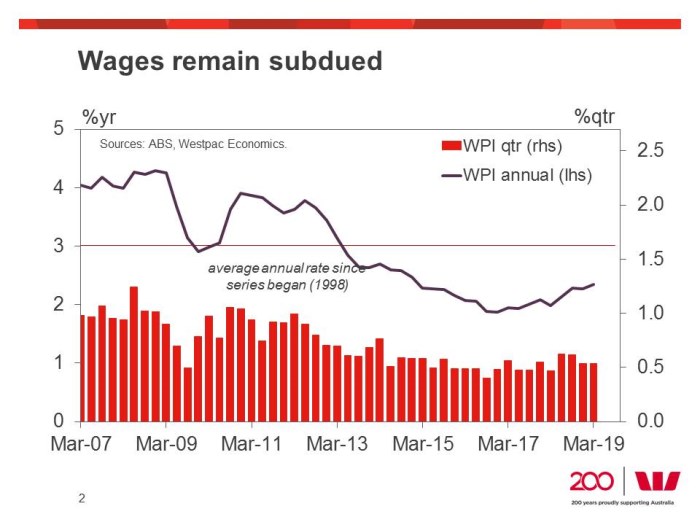
In the March quarter, total hourly wages ex bonuses rose 0.5% compared to a market median (and Westpac) expectation for 0.6%. The print was 0.54% at two decimal places with a 0.54% rise in private sectors wage rates and a smaller 0.45% rise in public wages - the smallest quarterly rise in public sector wages since March 2000. It appears that state governments, where revenues are under pressure from declining stamp duty collection, are pushing back against rising wage costs. 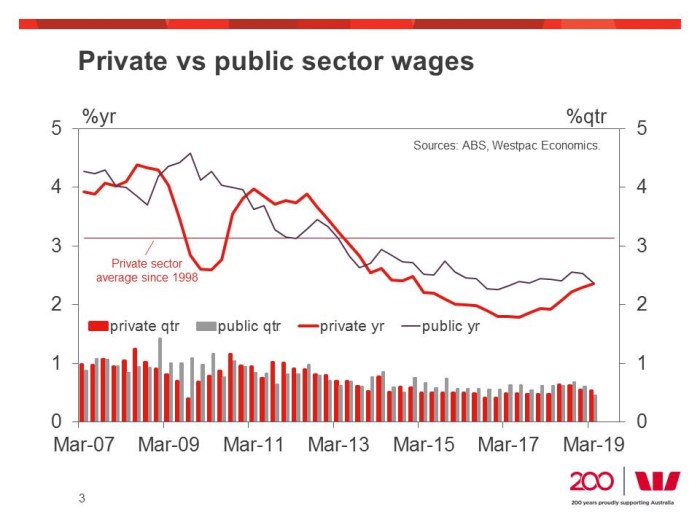
Private sector wages printed 0.54% in the last two quarters, but with base effects, the annual pace did drift a little higher to 2.4%yr - the fastest pace since December 2014 but still not exciting. Public sector wage inflation eased to 2.4%yr from a recent peak of 2.6%yr in September 2018, and on current trends, is likely to continue to moderate from here.
An annual pace of wages growth of 2.3%yr is a modest lift from the 2.1%yr pace it held from December 2017 to September 2018 which, in itself, was a very modest improvement from the record low of 1.9%yr in the four quarters before 2017 Q3. So while it is clear that wages have picked up a little and are off the record lows wage inflation is well contained and holding under the historical average.
Since 2018, Westpac watched the rapid fall in the Victorian unemployment rate, and because of this, we are now looking for signs of an acceleration in wage inflation there. In the March quarter, Victorian wages lifted 0.5%qtr, a moderation from the 0.8% gain in Q4, but with base effects, the annual pace was flat at 2.7%yr - the fastest pace by any state and the fastest pace in that state since December 2014.
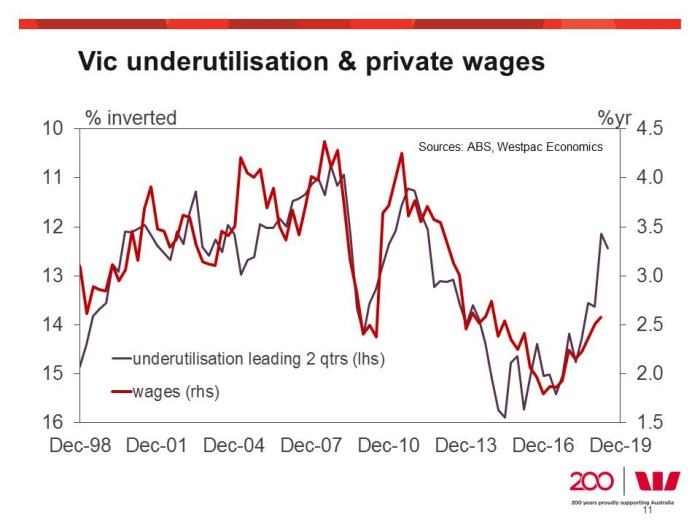
Contrast that with NSW, where wage inflation moderated to 2.3%yr from 2.4%yr. Tighter labour market conditions in Victoria appear to be generating some wage inflation unlike the state to its north. If this lift in Victorian wage inflation continues into 2020, we would expect this would lead to modest wages pressures in other states (particularly in NSW) as employers start competing for labour. But we would not overstate this as the overall impact is likely to be modest given that the improvement in the national labour market, as measured by the fall in underutilisation, has not been as significant as it is has been in Victoria. 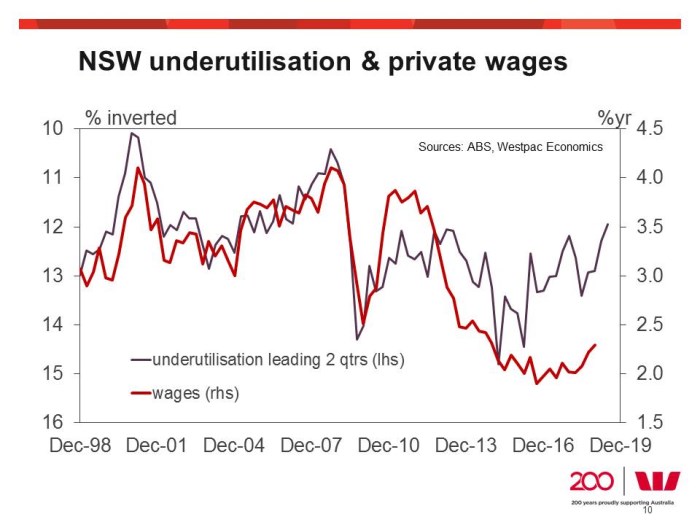
Private sector wages including bonuses continues to run at a faster pace than the measure excluding bonuses (2.7%yr vs 2.4%yr respectively). The faster pace growth of growth in variable compensation, which tends to be positively correlated with the economic cycle, suggests some upside risks for wages remains in place. However, the pace is slowing (from 2.8%yr in Q3 and Q4 of 2019) so this pressure is very modest and the increases in variable compensation may not be transferred to fixed compensation. 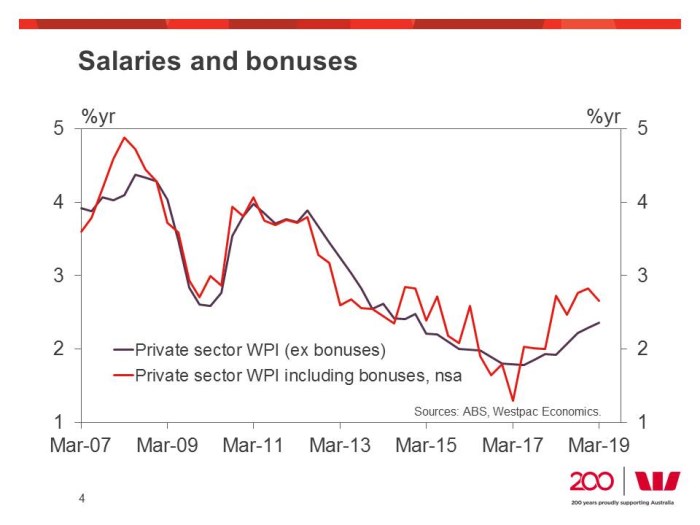
By industry the fastest gains in wages are still in the non-cyclical sectors, heath care, education & training and utilities, while mining has also seen a lift. Financial and professional services plus transport are starting to see some improvement but they remain at a very modest pace while retail, accommodation & food services, manufacturing and administration & support wages are slowing. 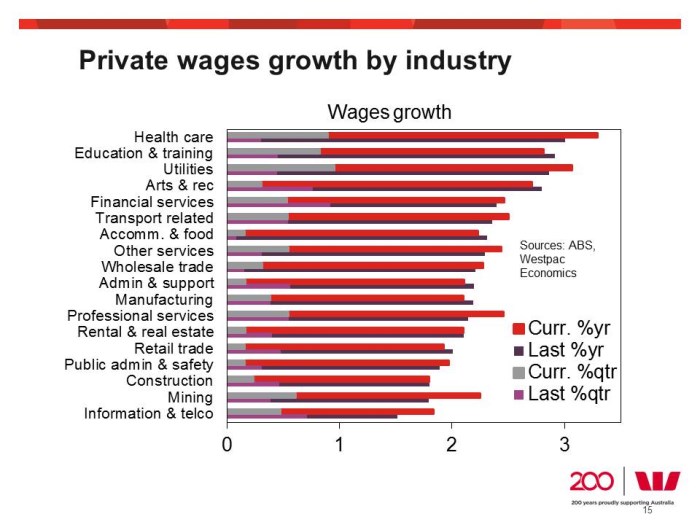
This is a disappointing update and one that will make us take a closer look at our forecast for wage inflation to get back to around 2¾%yr in 2020.
Euro-Zone’s Industrial Production Declined As Estimated In March
For the 24 hours to 23:00 GMT, the EUR declined 0.21% against the USD and closed at 1.1207.
On the data front, the Euro-zone's seasonally adjusted industrial production fell 0.3% on a monthly basis in March, declining for the second consecutive month and at par with market expectations. In the previous month, industrial production had registered a revised drop of 0.1%. Moreover, the region's ZEW economic sentiment index declined to a level of -1.6 in May, following a reading of 4.5 in the prior month.
Separately in Germany, the final consumer price index (CPI) climbed 2.0% on a yearly basis in April, meeting market expectations and confirming the preliminary print. The CPI had recorded a rise of 1.3% in the previous month. Further, the ZEW current situation index advanced to a level of 8.2 in May, more than market anticipations for a rise to a level of 6.3. The index had recorded a reading of 5.5 in the previous month. On the other hand, the nation's ZEW economic sentiment index unexpectedly dropped to a level of -2.1 in May, defying market consensus for a gain to a level of 5.0. In the prior month, the index had registered a reading of 3.1.
In the US, data showed that the NFIB small business optimism index rose to a level of 103.5 in April, surpassing market expectations for a rise to a level of 102.0. The index had registered a level of 101.8 in the prior month.
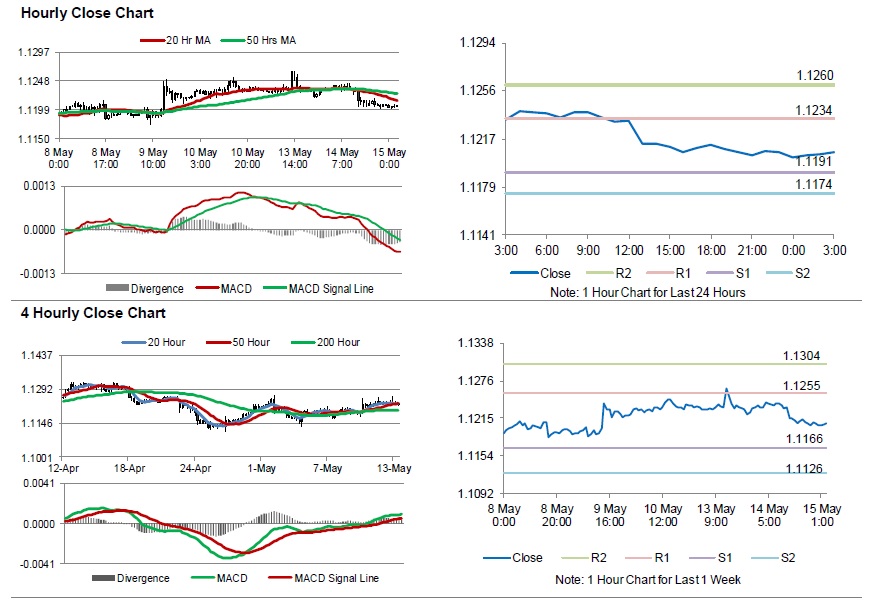
In the Asian session, at GMT0300, the pair is trading at 1.1207, with the EUR trading flat against the USD from yesterday's close.
The pair is expected to find support at 1.1191, and a fall through could take it to the next support level of 1.1174. The pair is expected to find its first resistance at 1.1234, and a rise through could take it to the next resistance level of 1.1260.
Looking ahead, investors would await the Euro-zone and Germany's gross domestic product (GDP) for 1Q, set to release in a few hours. Later in the day, the US Empire State manufacturing index and the NAHB housing market index, both for May along with advance retail sales, industrial production and manufacturing (sic) production, all for April, will keep the traders on toes. Additionally, US business inventories for March, will garner significant amount of investors' attention.
The currency pair is trading below its 20 Hr and 50 Hr moving averages.
UK’s ILO Unemployment Rate Eased To A 45-Year Low Rate In The January-March 2019
For the 24 hours to 23:00 GMT, the GBP declined 0.32% against the USD and closed at 1.2910.
Data showed that UK's ILO unemployment rate unexpectedly slid to a 45-year low rate of 3.8% in the January-March 2019 period and defying market consensus for an unchanged reading. The ILO unemployment rate had recorded a rate of 3.9% in the three months ended February 2019. Moreover, the nation's average earnings including bonus advanced 3.2% on an annual basis in March, undershooting market expectations for a gain of 3.4%. In the December-February 2019 period, the average earnings including bonus had recorded a rise of 3.5%.
In the Asian session, at GMT0300, the pair is trading at 1.2911, with the GBP trading marginally higher against the USD from yesterday's close.
The pair is expected to find support at 1.2888, and a fall through could take it to the next support level of 1.2865. The pair is expected to find its first resistance at 1.2950, and a rise through could take it to the next resistance level of 1.2989.
Amid lack of economic releases in UK today, traders would focus on global macroeconomic events for further direction.
The currency pair is trading below its 20 Hr and 50 Hr moving averages.
Japanese Yen Trading Slightly Higher In The Morning Session
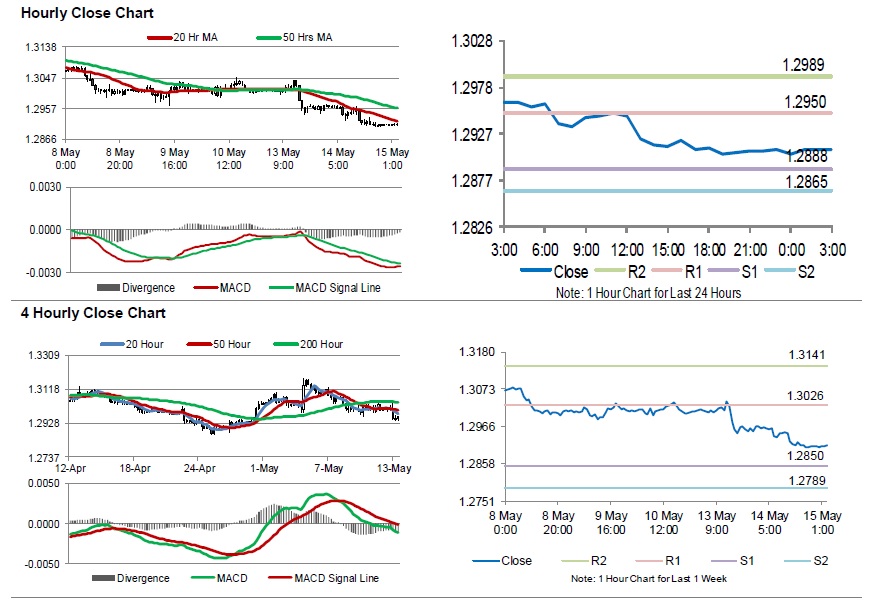
For the 24 hours to 23:00 GMT, the USD rose 0.36% against the JPY and closed at 109.65.
In the Asian session, at GMT0300, the pair is trading at 109.64, with the USD trading a tad lower against the JPY from yesterday’s close.
The pair is expected to find support at 109.46, and a fall through could take it to the next support level of 109.29. The pair is expected to find its first resistance at 109.79, and a rise through could take it to the next resistance level of 109.95.
Going forward, investors would closely monitor Japan’s machine tool orders for April, scheduled to release in a while.
The currency pair is showing convergence with its 20 Hr and 50 Hr moving averages.
Switzerland’s Producer And Import Prices Fell In April
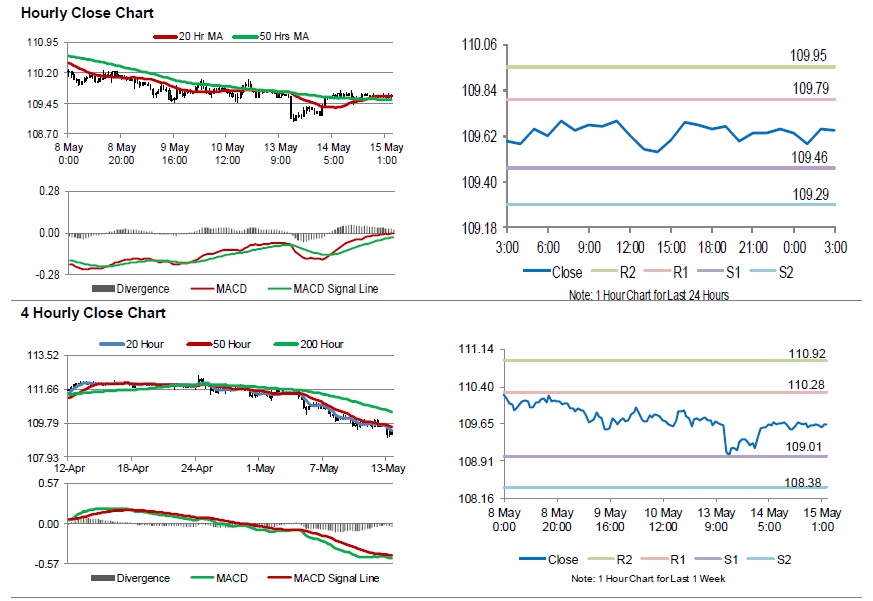
For the 24 hours to 23:00 GMT, the USD rose 0.32% against the CHF and closed at 1.0085.
In economic news, Switzerland's producer and import prices dropped 0.6% on a yearly basis in April, more than market expectations for a drop of 0.4% and compared to a fall of 0.2% in the previous month.
In the Asian session, at GMT0300, the pair is trading at 1.0085, with the USD trading flat against the CHF from yesterday's close.
The pair is expected to find support at 1.0063, and a fall through could take it to the next support level of 1.0040. The pair is expected to find its first resistance at 1.0102, and a rise through could take it to the next resistance level of 1.0118.
With no macroeconomic releases in Switzerland today, investors would look forward to global macroeconomic releases for further direction.
The currency pair is showing convergence with its 20 Hr and 50 Hr moving averages.
Loonie Trading A Tad Lower In The Asian Session
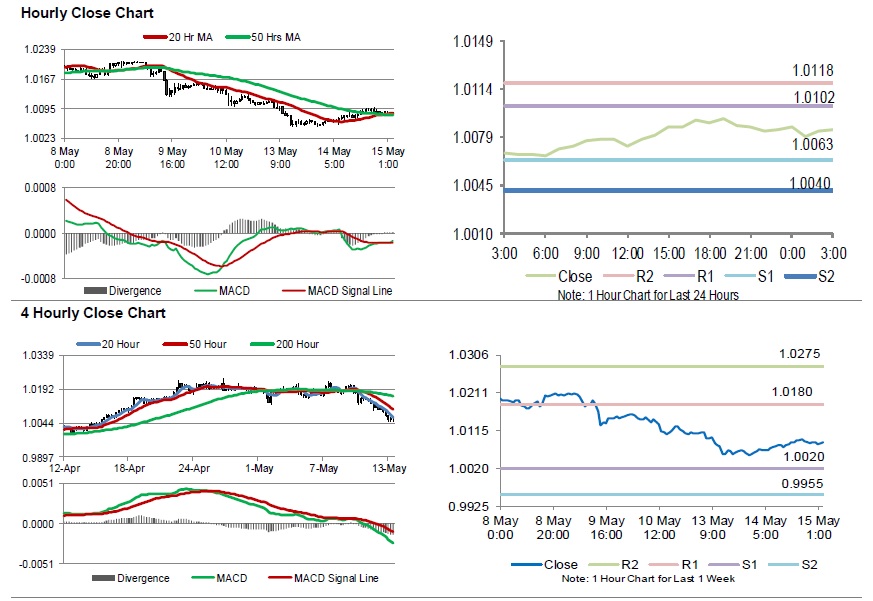
For the 24 hours to 23:00 GMT, the USD declined 0.18% against the CAD and closed at 1.3460.
In the Asian session, at GMT0300, the pair is trading at 1.3462, with the USD trading slightly higher against the CAD from yesterday’s close.
The pair is expected to find support at 1.3450, and a fall through could take it to the next support level of 1.3437. The pair is expected to find its first resistance at 1.3481, and a rise through could take it to the next resistance level of 1.3499.
Trading trend in the Loonie today, is expected to be determined by Canada’s existing home sales and the consumer price index, both for April, slated to release later in the day.
The currency pair is showing convergence with its 20 Hr and 50 Hr moving averages.
Australia’s Westpac Consumer Confidence Index Climbed In May
For the 24 hours to 23:00 GMT, the AUD declined 0.06% against the USD and closed at 0.6941.
LME Copper prices declined 0.6% or $35.5/MT to $6007.0/MT. Aluminium prices rose 1.5% or $26.5/MT to $1792.0/MT.
In the Asian session, at GMT0300, the pair is trading at 0.693, with the AUD trading 0.16% lower against the USD from yesterday's close.
Overnight data showed that Australia's Westpac consumer confidence index advanced 0.6% on a monthly basis, to a level of 101.3 in May, compared to a level of 100.7 in the previous month.
Elsewhere in China, Australia's largest trading partner, industrial production climbed 5.4% on a yearly basis in April, undershooting market expectations for a gain of 6.5%. Industrial production had recorded a rise of 8.5% in the prior month. Moreover, the nation's retail sales jumped 7.2% on a yearly basis in April, falling short of market consensus for a rise of 8.6%. In the previous month, retail sales had recorded an increase of 8.7%.
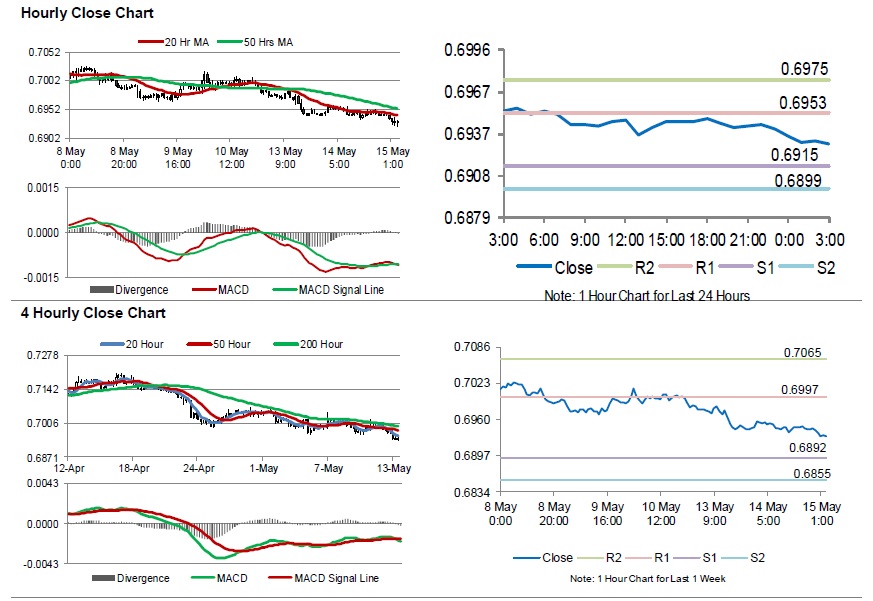
The pair is expected to find support at 0.6915, and a fall through could take it to the next support level of 0.6899. The pair is expected to find its first resistance at 0.6953, and a rise through could take it to the next resistance level of 0.6975.
Moving ahead, traders would await Australia's consumer inflation expectations for May and unemployment rate for April, scheduled to release overnight.
The currency pair is trading below its 20 Hr and 50 Hr moving averages.
Gold: Yellow Metal Extends Its Losses In The Asian Session
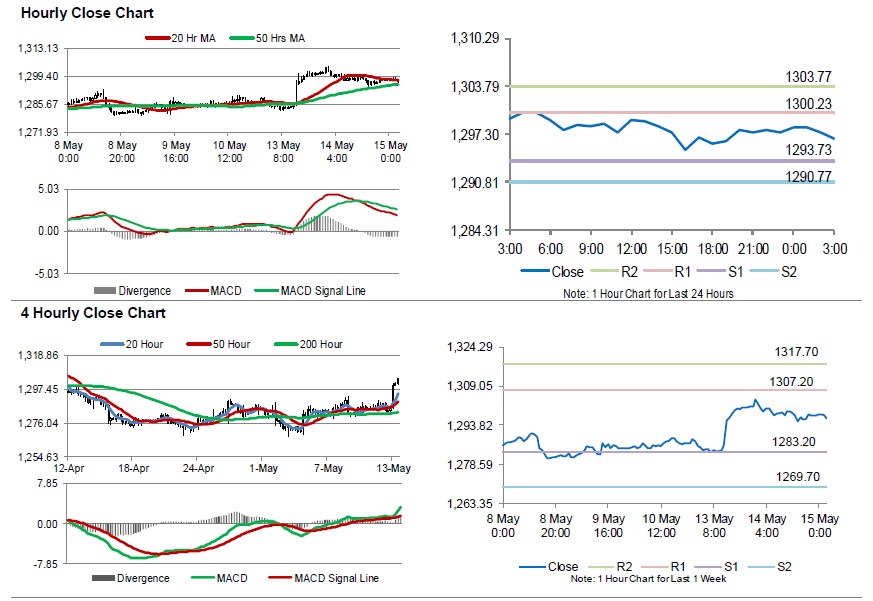
For the 24 hours to 23:00 GMT, Gold declined 0.26% against the USD and closed at USD1297.80 per ounce, amid optimism over trade talks between the US and China.
In the Asian session, at GMT0300, the pair is trading at 1296.70, with gold trading 0.08% lower against the USD from yesterday’s close.
The pair is expected to find support at 1293.73, and a fall through could take it to the next support level of 1290.77. The pair is expected to find its first resistance at 1300.23, and a rise through could take it to the next resistance level of 1303.77.
The yellow metal is showing convergence with its 20 Hr moving average and trading above its 50 Hr moving average.
Silver: White Metal Slightly Lower In The Morning Session
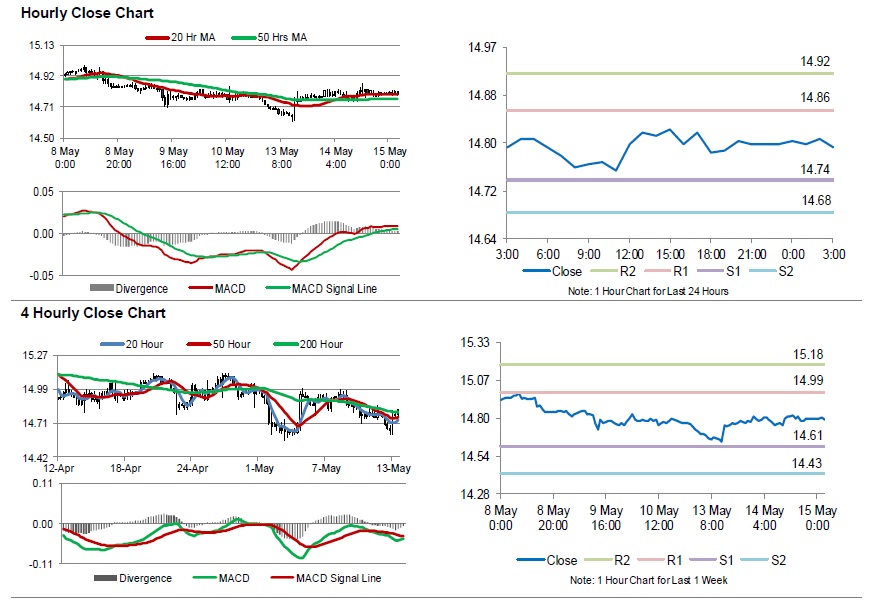
For the 24 hours to 23:00 GMT, Silver rose 0.14% against the USD and closed at USD14.80 per ounce.
In the Asian session, at GMT0300, the pair is trading at 14.80, with silver trading marginally lower against the USD from yesterday’s close.
The pair is expected to find support at 14.74, and a fall through could take it to the next support level of 14.68. The pair is expected to find its first resistance at 14.86, and a rise through could take it to the next resistance level of 14.92.
The white metal is showing convergence with its 20 Hr moving average and trading above its 50 Hr moving average.
Crude Oil: Oil Trading Higher, Ahead Of EIA’s Weekly Crude Oil Stockpiles Data
For the 24 hours to 23:00 GMT, Crude Oil rose 0.57% against the USD and closed at USD61.30 per barrel, amid worries over crude oil supplies, following reports of attacks on major Saudi facilities.
Separately, the American Petroleum Institute (API) reported that US crude oil inventories climbed by 8.6 million barrels to 477.8 million barrels in the week ended 10 May 2019.
In the Asian session, at GMT0300, the pair is trading at 61.42, with oil trading 0.20% higher against the USD from yesterday's close.
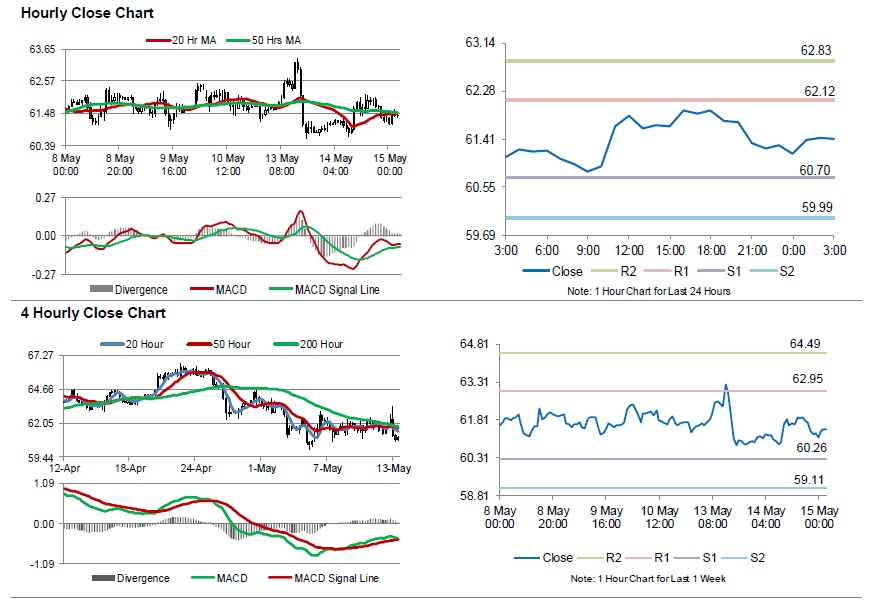
The pair is expected to find support at 60.70, and a fall through could take it to the next support level of 59.99. The pair is expected to find its first resistance at 62.12, and a rise through could take it to the next resistance level of 62.83.
Crude oil is showing convergence with its 20 Hr and 50 Hr moving averages.