Sample Category Title
Markets Stabilise Overnight
Markets stabilise overnight
Markets paused for breath overnight as soothing noises from President Trump on the state of trade play eased concerns and saw a slight reversal of the previous days’ risk aversion flows. The emphasis is in light though; sentiment remains fragile and subject to the whims of trade headlines on either news tickers or social media accounts.
Wall Street followed Europe’s lead with stock markets rising gently after Asia finished in a sea of red. The S&P rose 0.80%, the Nasdaq jumped 1.10%, and the Dow Jones was up 0.80%. Straight from the risk aversion unwind playbook, treasury yields rose slightly and gold eased, but the mighty dollar remained firm with the dollar index rising 0.20%. Oil rose after a drone strike on two Saudi Arabian Red Sea pumping stations.
Today’s data highlights are Australian Westpac Consumer Confidence at 08:30 Singapore time (SGT) and China Industrial Production at 10:00 SGT. Neither is likely to be market moving as trade issues rightfully command centre stage for the entire region.
Europe sees German and EU GDP this afternoon. The former being will be watched after yesterday’s weak German ZEW data. Despite the rally in European stocks last night, the euro (EUR) performed poorly as the street reprices Italian budget travails into an already underwhelming Euro-zone performance.
FX
The US dollar continued its march higher with the dollar index rising overnight. The EUR sagged 0.20% to 1.1200 as the Italians continue to jar nerves in the single-currency area. Unemployment in Great Britain fell to its lowest in 45 years overnight, in another rebuke to the Brexit apocalypse doomsayers, but could not save the British Pound (GBP). The GBP fell to 1.2900 as Theresa May runs out of time to get a cross-party Brexit deal together.
Regional currencies may show some signs of life after equities stabilised overnight, but the sentiment remains fragile at best, meaning flows will likely be light today.
Equities
A respectable performance by Europe and North American markets overnight will probably not be enough to flush the optimists out of hiding in Asia today. Although markets may etch some slight gains, one suspects a lot of money will remain on the sidelines as we await more clarity on the trade situation.
Oil
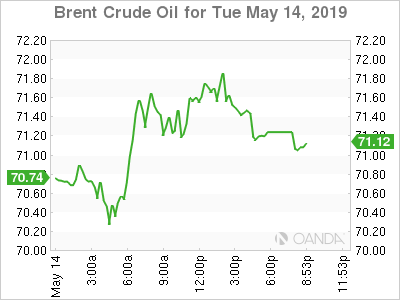
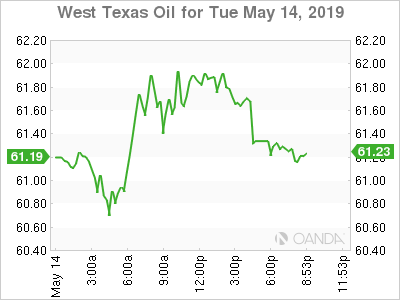
Oil spiked overnight following a drone attack on two Saudi Red Sea pumping stations, since claimed by Yemeni rebels. The attack followed the alleged sabotage of two Saudi tankers on the other side of the country a few days ago, which sent cold shivers through oil traders. Brent crude jumped 1.35% to USD71.25 a barrel while WTI rose 0.85% to USD61.30 a barrel.
Trade issues will continue to cap gains in Asia, but if anything, the incidents on opposite sides of Saudi Arabia will bring home how vulnerable the flow of oil is from the Middle East. An escalation of tensions with Iran may not be as fully priced in as everyone thought, including me.
Gold
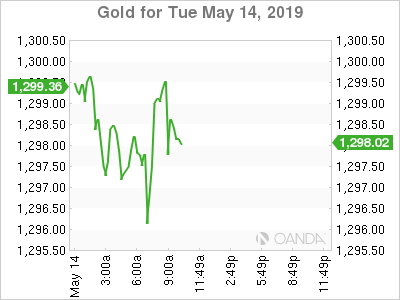
Gold gave up some of its gains overnight, falling just USD3 to USD1,297.00 an ounce. The gentle move lower reflected a tentative partial unwind of risk-aversion flows rather than a change in sentiment to gold itself. Gold should remain supported on dips in Asia today as the trade situation remains the only real game in town to investors.
USD/CAD Canadian Dollar Fails To Gain Traction Despite Higher Oil Prices
The Canadian dollar rose slightly by 0.06 percent as trade concerns eased, but not enough to change the narrative. The US is still on the offensive with a new round of tariffs in effect and working on a list of $300 billion in Chinese imports subject to tariffs. Without walking back those comments the Trump administration showed willingness to sit down and negotiate as even if they claim they would win a trade war, they would prefer a good deal with China. Stocks rebounded after the less combative statements and risk appetite for equities was higher.
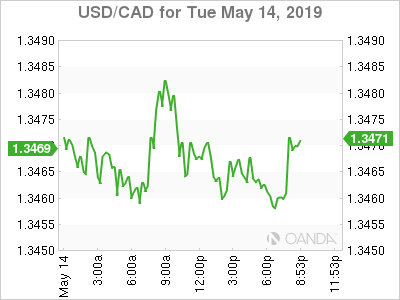
In the currency world the US dollar gained ground against safe havens like the Japanese yen and the Swiss franc. The British pound continues to lack traction awaiting any progress on Brexit proposals.
The EUR depreciated after a disappointing German ZEW report that turned negative as investor sentiment are pessimistic on the economy in the next six months. German GDP data tomorrow could further validate the outlook if it comes under the 0.4 percent forecast.
Canadian inflation will be the highlight of Wednesday’s economic calendar for CAD traders. A massive job gain in April could find it hard to translate into higher wages, so inflation is expected to remain stable. If the US decides to engage in a trade war with China two scenarios become clear.
A North American block, strengthening the USMCA to better integrate the economies of the US, Mexico and Canada in order to avoid inflationary pressures due to higher imports and a growth slowdown. The opposite scenarios would be to open up more trade war fronts and not ratify the USMCA taking the same combative stance against Canada which could put the loonie under pressure as the economy depends on trade with the US.
OIL – Oil Higher After Drone Attacks Reduce Saudi Arabia’s Output
Oil prices rose after Saudi Arabia reported a drone attack on one of its pipelines on Tuesday. Supply disruptions have kept crude higher, even as the US has ramped up production. The OPEC+ agreement to limit output is the biggest factor, but geopolitical disruptions like the US sanctions against Iran and Venezuela and the armed conflict in Libya are added to the situation in Saudi Arabia.
Saudi Arabia is seen as the main producer that could cover the gap in supply left by Iranian crude. US President Donald Trump has tweeted about the OPEC’s role in keeping prices lower if they increase their output.
The deal between OPEC and other major producers will reach its end in June, but it could be extended if participants deem the market has not reach price stability which was their main goal. Russia remains a big question mark as it has sacrificed its revenue to be part of the deal and could be ready to take advantage of higher prices ahead of even higher levels of US production causing another drop.
US production has increased dramatically to the point that the one-time net importer is now an exporter of energy products. Shale technology has tipped the scales of global production and threatens to reduce the influence that the OPEC has on the market. The decision from OPEC members to fight fire with fire and flood the market to drive shale operations into bankruptcy backfired and forced the group to reach out to non-OPEC members in order to have a significant impact on the market by collectively reducing their output.
GOLD – Gold Loses Safe Haven Appeal as Trade Concerns Ease
Gold lost 0.31 percent on Tuesday after China and the US both issued less aggressive comments hinting at a new round of talks. Trade war concerns eased and with them the support for the yellow metal as a safe haven.
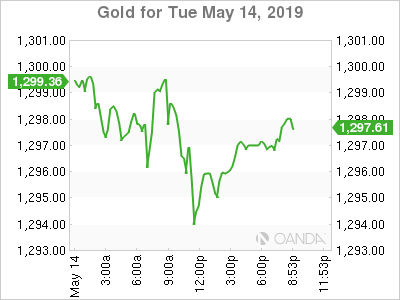
Gold will remain in the conversation as geopolitical risks remain with the ongoing trade negotiations as well as Brexit and the upcoming Australian elections.
A trade deal with China was thought to be in the final stages, but last week the US suddenly announced China had backtracked on previous commitments and set a Friday deadline for tariffs to rise to 25 percent and a new proposal on $300 billion of Chinese imports.
Eco Data 5/15/19
[php_everywhere instance="1"]
Trump trying to drag Fed into trade war with China, but no one cares
Trump is trying to politicize Fed and use it as a tool in the trade war with China. He tweeted "China will be pumping money into their system and probably reducing interest rates", to "make up" for the business they will be losing. And, if Fed ever did a "match", "it would be game over".
However, did Trump remember he said US is taking in billions of dollar from China? And the unexpected 3.2% growth was greatly helped by tariffs? Steel industry was booming after the tariffs? Productions will be moving back from China to the US? With those "winnings", Trump still sees problem in businesses that needs Fed to do something to "make up" with? His logic is, as usual, incomprehensible.
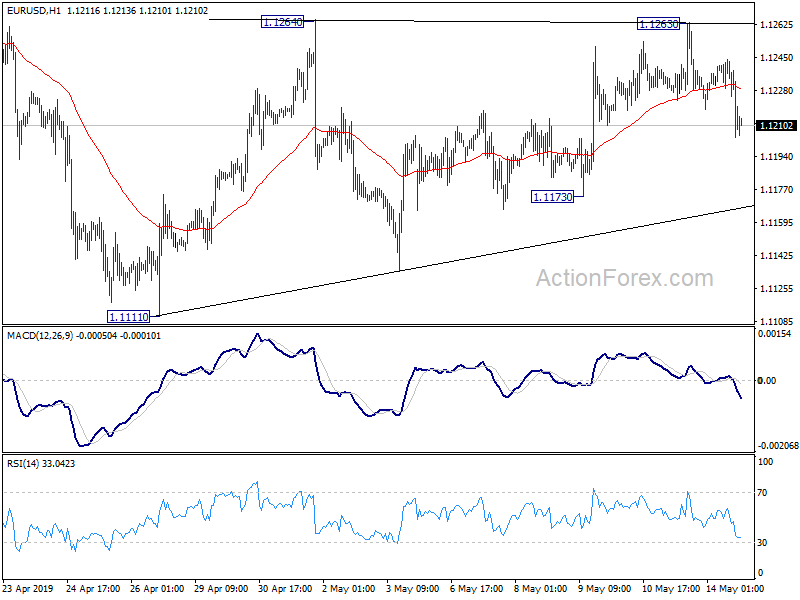
But anyway, judging the lack of reaction in EUR/USD, sensible investors clearly know what the politically independent would and wouldn't do.
https://twitter.com/realDonaldTrump/status/1128277703570984960
Chinese Industrial Output to Slow in April; Could Spark Growth Concerns as Trade Deal Looks Distant
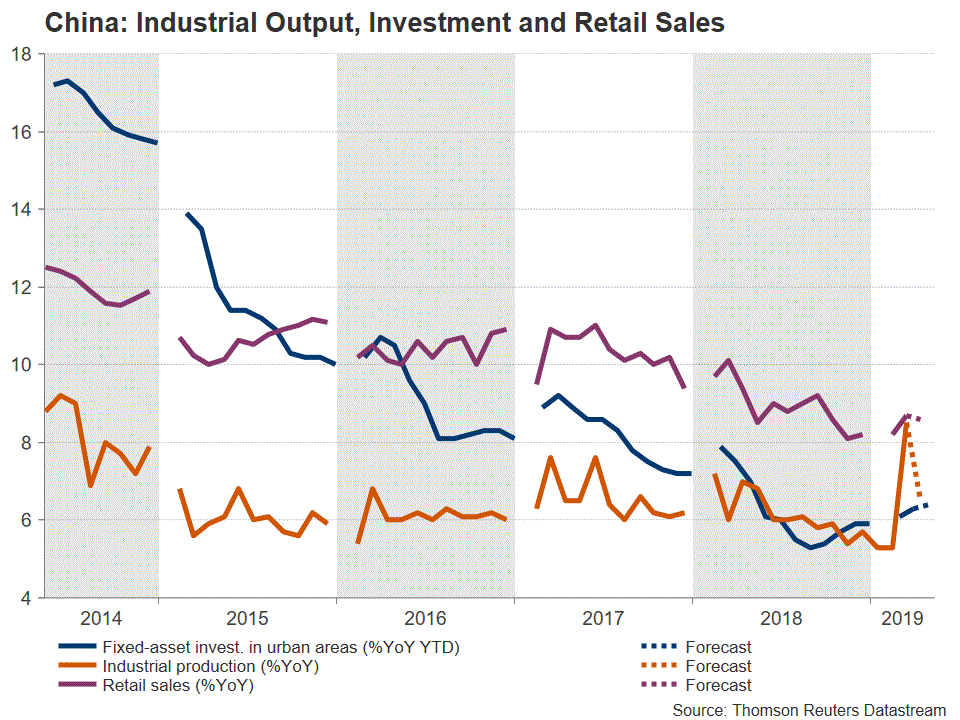
China will publish the latest stats on industrial output, fixed-asset investment and retail sales on Wednesday at 2:00 GMT. The data will be watched to assess whether the rebound observed in March carried through to April amid worries the economy could lose momentum again as trade tensions flare up. With a trade deal hanging in the balance, a discouraging set of figures would only add to the negative market sentiment.
Back in April, hopes that a rebound in growth is underway were lifted following a beat in the industrial output and retail sales numbers, as well as the first quarter GDP estimate, which was published alongside. But data published since then has underwhelmed, suggesting it may take a while longer before we see a sustained improvement in economic momentum.
China’s economy probably lost some steam in April
The next releases on industrial output, fixed-asset investment and retail sales will likely confirm that the economy lost some steam in April. Industrial production is expected to have increased by 6.5% year-on-year in April, slowing from the 8.5% rate seen in March, which was the fastest since July 2014. Retail sales are also forecast to have grown at a more moderate pace, rising by 8.6% y/y rate versus 8.7% growth in March. However, fixed-asset investment is expected to buck the trend to accelerate to 6.4% y/y in the year to April and extend its recovery from the lows reached in 2018.
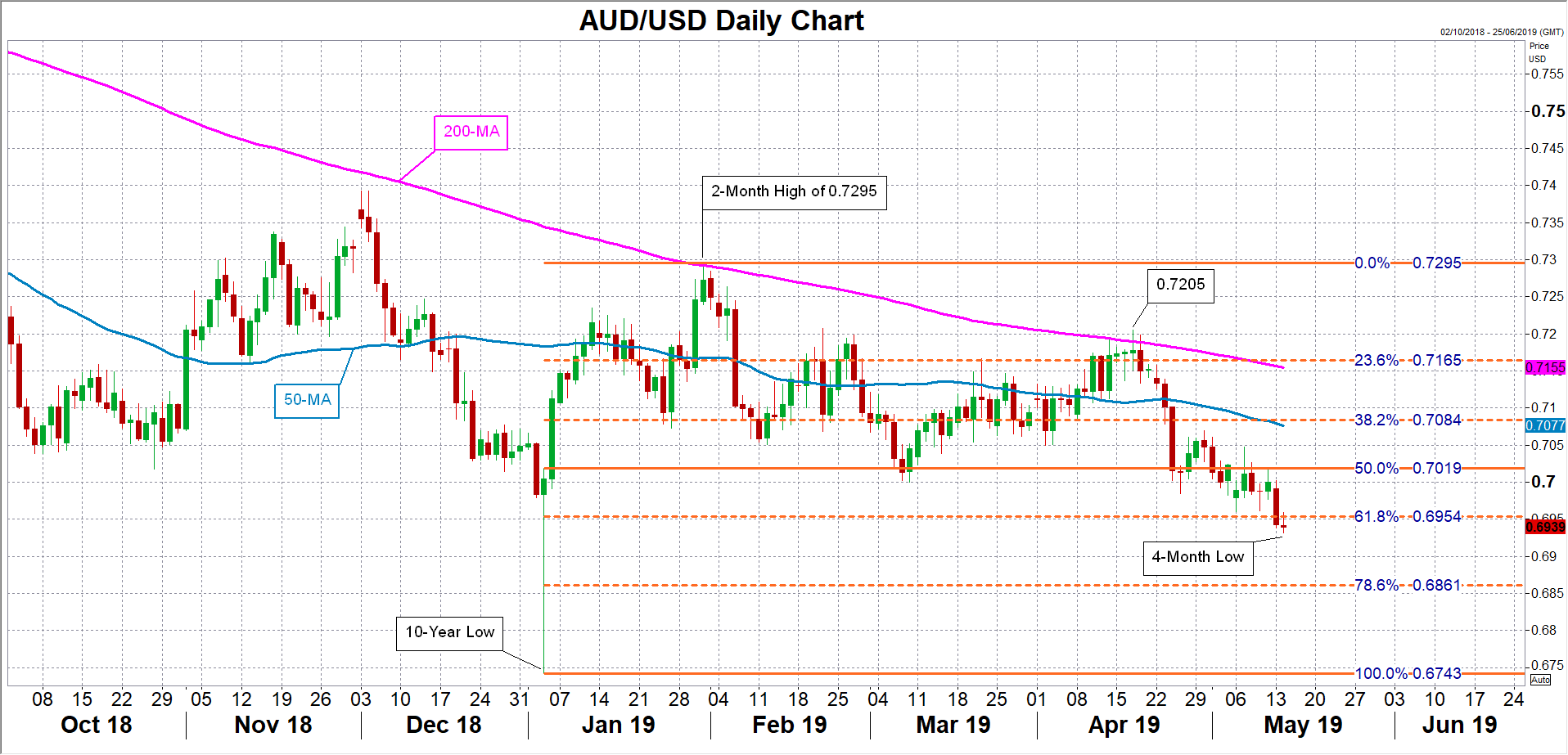
With markets still reeling from the dramatic breakdown in Sino-US trade talks, disappointing numbers on Wednesday risk deepening the sell-off in Chinese equities, as well as the Australian dollar, which is sensitive to China-related flows. The latest escalation in trade tensions pushed the aussie/dollar below the 61.8% Fibonacci retracement of the 0.6743-0.7295 upleg, at 0.6954, opening the way for the 78.6% Fibonacci at 0.6861 should the risk-off tone intensify.
Aussie could be pulled in different directions
But should the April data come in above expectations, aussie/dollar could recover towards the 50% Fibonacci at 0.7019. It should be noted, however, that domestic releases are on the agenda too from Australia on Wednesday and Thursday, not to mention the trade news flow, meaning the aussie could be pulled in different directions over the next few days.
The underlying tone for the aussie and other risk assets, though, will be dependent on trade developments, with investors keeping an eye out for the setting of the date of the next round of US-China trade talks. There’s a danger that even after the latest moves, investors are being complacent about the prospect of US and Chinese negotiators being able to strike an agreement anytime soon. One report according to Axios suggests differences between the two sides are so profound that a deal before the end of the year is unlikely.
FTSE Volatility Continues as Trade Tensions Rock Markets
The blue-chip FTSE is showing sharp swings this week. In the North American session, the pair is at 7,239, up 1.11% on the day. On Monday, the FTSE plunged 1.5%. In economic news, the U.K. released key employment numbers. Wage growth slowed to 3.2% in March, down from 3.5% a month earlier. This missed the estimate of 3.4% and was the lowest gain since September. The unemployment rate sparkled in March, dropping to 3.8%. This beat the estimate of 3.9%. Unemployment claims fell to 24.7 thousand in April, down from 28.3 thousand in March. Still, this was above the forecast of 24.2 thousand.
Trade tensions between the U.S. and China continue to rock global equity markets. The blue-chip FTSE index has been hit hard, falling 1.5% last week and falling sharply on Monday. The U.S. and China have exchanged tariffs on each other products, dampening hopes for a trade deal and weighing on risk appetite. Nervous investors have been dumping equities in favor of safe-haven assets, such as the U.S. dollar and the Japanese yen. On Friday, the U.S. raised tariffs on $200 billion in Chinese goods, from 10% to 25%. The move was announced a week ago, triggering sharp declines in the equity markets. The Chinese response was vigorous, with Beijing announcing earlier on Monday that it would slap tariffs on $60 billion of U.S products.
Despite the escalation in the trade war, talks between the U.S and China continue, with officials scheduled to hold the next round of talks in Beijing. The new tariffs do not apply to Chinese goods that left port prior to May 10, affording a 2-week window for negotiators before the tariffs take effect. The escalation in tensions has shelved a meeting between President Trump and Chinese President Xi, but the two leaders could meet at the G-20 summit in Japan in June.
Brexit may have been pushed off until October, but confusion and uncertainty over Britain’s departure from the EU remain. Prime Minister May, stymied by parliament in three attempts to pass a Brexit withdrawal bill, is now trying to reach an agreement with Labor leader Jeremy Corbyn in order to win approval for a withdrawal bill. However, this could prove to be a dead end for the embattled May. Corbyn is insisting on a customs union with the EU, which is anathema to many Conservative lawmakers, who fear such an arrangement will tie the U.K. to the EU for an indefinite period.
UK PM May: It’s imperative to bring forward Brexit deal to receive royal assent by summer recess
UK Prime Minister Theresa May's spokesman said the Cabinet has agreed today to continue negotiations with Labour regarding the Brexit deal. He noted that "Ministers involved in the negotiations set out details of the compromises which the government was prepared to consider in order to consider an agreement which would allow the UK to leave the EU with a deal as soon as possible."
Also, "Cabinet agreed to continue discussions with Labour to see what was possible. However it was agreed that it is imperative to bring forward the Withdrawal Agreement Bill in time for it to receive royal assent by the summer parliamentary recess."
US Retail Sales Eyed as Markets Price in a 2019 Fed Cut
The main event for the dollar this week will be the US retail sales for April, due on Wednesday at 12:30 GMT. Amidst an escalating trade conflict, markets have fully priced in a Fed rate cut by December, yet the dollar has barely retreated. This highlights that the greenback is still the ‘only game in town’, with a rebound in European growth needed to change that.
Market bets for a Fed rate cut in 2019 were pared back after Chairman Powell struck a fairly confident tone at the May policy meeting, but that optimism didn’t last long. A quarter-point rate cut by December is now more than fully priced in, despite the US economy staying solid and the Fed reluctant to signal its next move will be a cut.
In the shadow of a trade war
The ‘straw that broke the camel’s back’ and made a rate cut a done deal for investors, was the latest escalation in US-China trade tensions. Markets (correctly) believe the Fed will look through any increase in inflation owed to tariffs, as that would be a one-off effect that doesn’t warrant a policy response – and will instead focus on supporting economic growth, which may take a serious hit if tensions escalate further.
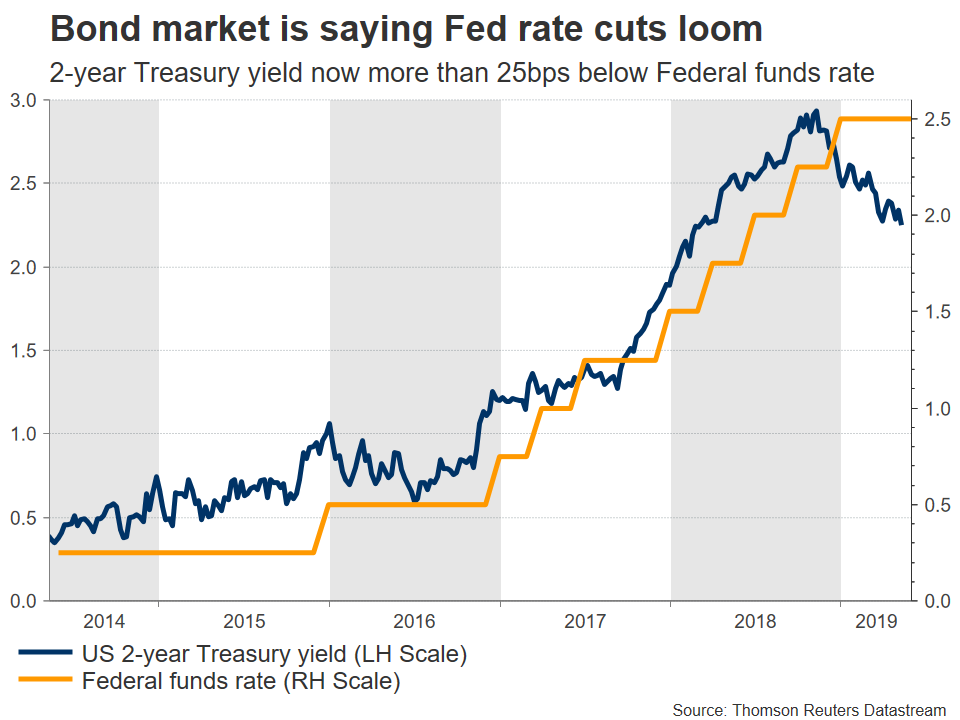
Retail sales set to cool, albeit from strong levels
Yet, this week’s data are expected to confirm that the US economy is still in good shape. In April, retail sales are projected to have risen by only 0.2% in monthly terms, but that follows a robust 1.6% surge in March. The core print, which excludes auto sales, is forecast at a much healthier 0.7%, from 1.2% previously.
But dollar holds strong as ‘there is no alternative’
Amid mounting bets for Fed cuts, one would have expected the greenback to weaken substantially, though that hasn’t transpired. Sure, the dollar index pulled back from its highs lately, but the tumble has been minor.
This resilience likely reflects a lack of interest for other major currencies. The euro isn’t appealing with the European economy so fragile, the pound is tormented by Brexit, and Japanese interest rates are so low the yen can’t gain traction without risk aversion. Trade uncertainty may have also helped keep the dollar afloat; recall that the US currency was the market’s favorite safe haven when tensions escalated last year.
European growth rebound needed before dollar weakens
Overall, even if Fed rate-cut expectations strengthen a little further, dollar strength is unlikely to abate materially until one of the narratives in the other major economies changes drastically – most importantly, the European growth story.
The greenback may also weaken if China goes for the ‘nuclear option’ in the trade dispute and starts selling its massive US bond holdings, but the situation is far from that point, suggesting the dollar may remain the ‘only game in town’ for a while longer.
Technical picture
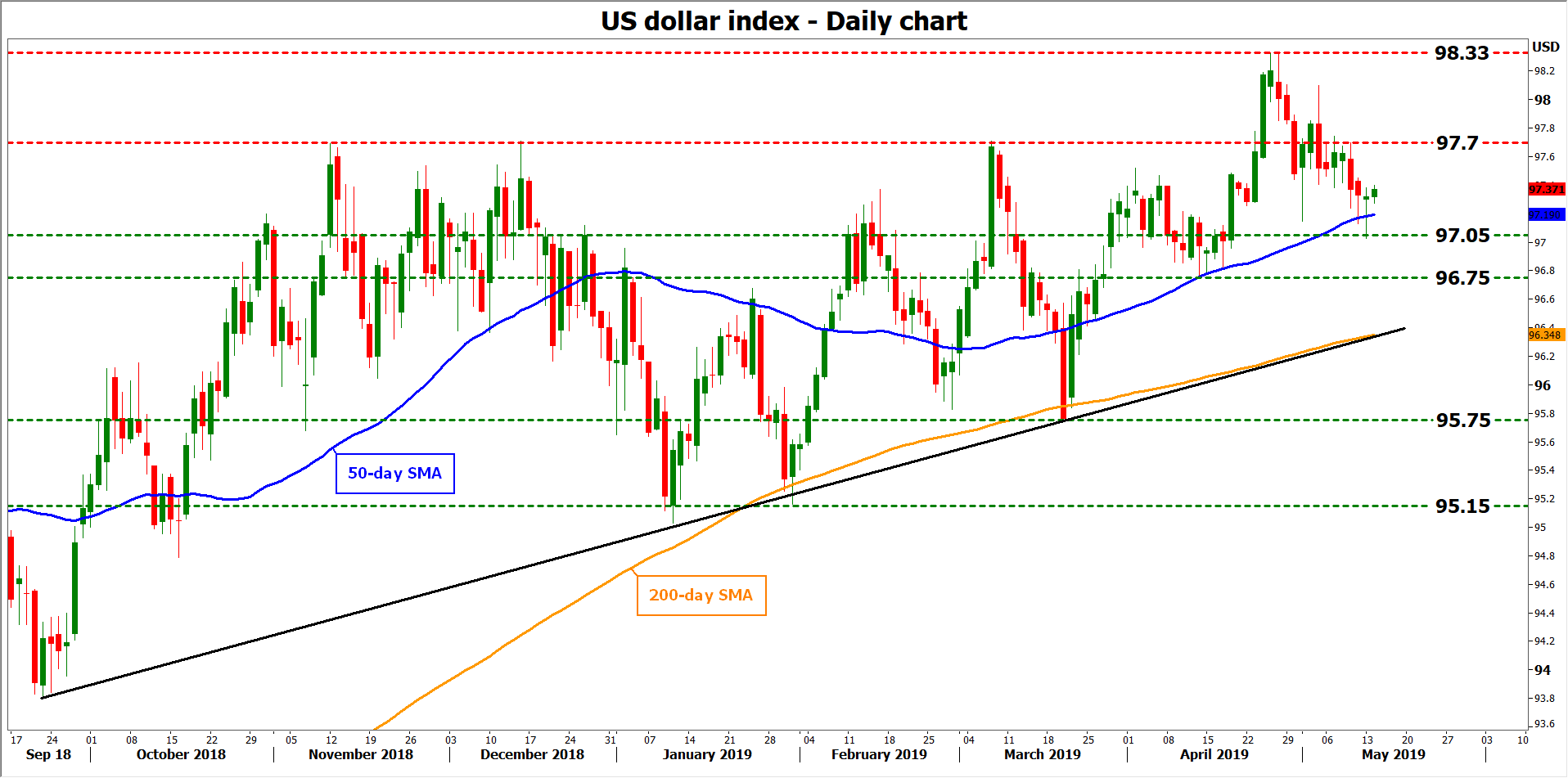
Looking at the dollar index technically, support to declines may be found near 97.05, the May 13 low, with a downside break turning the focus to 96.75.
In case of advances, an initial barrier for the bulls may be the 97.70 zone, which was the high back in February, with an upside break opening the door for the 2-year high of 98.33.
Sunset Market Commentary
Markets:
Global core bonds are mixed today with German Bunds outperforming US Treasuries. The risk-off that prevailed markets yesterday continued overnight but with clear signs of moderation. Core bonds opened lower. Despite the equity markets catching a breath today, bond markets resumed their uptrend. A disappointing German ZEW expectations result added to market pessimism. German Bunds already paired most of its intraday losses, when comments by Italian deputy PM Salvini pushed them into green territory. He said that Italy is ready to break EU fiscal rules if it’s necessary to boost employment. The German yield curve is moving lower with losses up to -1.2 bps (2-yr). US Treasuries haven’t been able so far to make up for intraday losses. The NFIB Small Business Optimism printed above expectations in April, but couldn’t rattle investors. Meanwhile, President Trump encouraged the Federal Reserve in a tweet to ‘match’ the actions of the PBoC, meaning lowering interest rates. The US yield curve is close to opening levels with changes in the range of +0.9 bps (30-yr) to +1.2 bps (10-yr). Peripheral credit spreads over the German 10-yr yield are stable with Italy (+2 bps) underperforming.
Global risk-off sentiment eased even as there is no sign of any profound progress in the US-China trade dispute yet. However, at least for now, the episode of reciprocal tariff hikes is apparently discounted. Equities rebounded and the decline in US yields halted. Market anticipation on (substantial) Fed rate cuts weighed on the dollar of late. In this perspective, the US currency received some breathing space today. EUR/USD settled in the 1.1230/40 area during the European morning session. This afternoon, the news flow turned slightly USD supportive and, even more, euro negative. US NFIB small business confidence was stronger than expected. Meanwhile, Italian PM Salvini openly advocated for Italy to break EU deficit rules if it would be necessary to reduce Italian unemployment. EUR/USD dropped from 1.1240 to fill bids in the low 1.12 area (currently 1.1215 area). The balance tilted from USD weakness to euro softness. USD/JPY initially rebounded on the better global sentiment, but returned part of the earlier gains this afternoon. The pair is trading in the 109.50 area.
EUR/GBP trended higher in the 0.86 big figure this morning as headlines suggested that the negotiations between the government and the labour opposition didn’t yield any progress. In this process, UK PM was said to lose further support within her Conservative party. EUR/GBP came within reach of the 0.87 barrier. UK labour data were OK, largely as expected. Sterling regained some ground. This afternoon, headlines indicated that the UK PM got some more time from her party to reach a deal with labour. At the same time, several influential members openly opposed the PM’s approach. Markets apparently have little faith on a positive outcome. Sterling is again losing ground this afternoon. EUR/GBP is trading in the 0.8685 area. Cable sliding in the 1.29 big figure (currently 1.2920 area).
News Headlines:
UK labour market data printed close to expectations. Employment rose by 99k in Q1 2019, below 140k consensus. The unemployment rate unexpectedly fell from 3.9% to 3.8%, a 44-yr low, while the employment rate remained at a record high 76.1. Wages rose by 3.3% Q/Qa, in line with forecasts.
Heavyweight NY Fed governor Dudley said that central banks will be severely challenged to achieve stable economies and well-anchored inflation expectations in a world where low investment and high savings put a lid on rates and where economic growth is slow.
Reuters reports that Italian deputy PM and Lega leader Salvini is ready to break EU fiscal rules if necessary to boost employment. “Until we arrive at 5% unemployment, we will spend everything that we should and if someone in Brussels complains, that won’t be our concern”.
Trump Still Optimistic; Drone Attacks on Saudi Stations
A barrage of tweets from President Trump along with comments from a White House dinner last night provided a brush of optimism that trade talks will have a happy ending for Americans. This morning, he reiterated his frustration with the Fed’s inability to deliver further easing, this time comparing them to the PBOC, who has been very active. Trump reiterated he will meet with President Xi at the G-20 summit, which is at the end of June, possibly indicating we will be at a standstill for talks.
The US announced they will prepare $300 billion of new tariffs that will basically cover all Chinese imports a move that would be catastrophic for all. Demand destruction and falling confidence would likely bring the US to a recession if we see a total collapse in talks. The tails risk is growing, but still not the expected outcome.
US stocks are poised to open higher following Monday’s massacre, with S&P 500 futures rallying 0.6% to 2,825 and the Nasdaq up 0.8% to 7,376. The US dollar is modestly higher against its major trading partners this morning.
- ZEW – German investor confidence remains depressed
- Brexit – May’s clock is running out
- Oil – Middle East tensions continue; drone attacks on pumping stations
- Bitcoin – Where are the short-sellers?
- Gold – Rally takes a pause as trade battle simmers
ZEW
The ZEW indicator of sentiment declined to -2.1 points in May, a missing forecasts by 7.1 points, highlighting a rising doubts on the economy over a challenging trade war environment. Following a surprise rise in exports for March, analysts were optimistic the ZEW survey would deliver a positive reading.
Germany reports first quarter GDP on Wednesday and while a rebound to an expansion of 0.4% is expected, many are attributing it to temporary factors such as weather.
Brexit
PM May is facing mounting pressure to abandon cross-party talks with Labour as 13 former ministers warn her that she will split the party. Her spokesman noted its imperative for the Brexit bill to get passed by summer recess. Talks appear to be ongoing and May is holding off giving a specific departure date for herself.
Oil
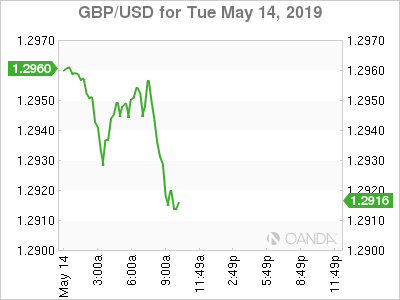
Middle East tensions are driving up crude prices again after two Saudi Aramco oil pumping stations for the East-West pipeline had been hit by two Iran-backed drones. Operations were halted and the initial assessment is that the damage was “limited”. Yesterday’s news of sabotage attacks in the Straight of Hormuz also drove oil higher, but eventually those gains were washed away from the global risk off sell off that stemmed from the China and US trade war uncertainty.
Saudi Arabia pipeline disruption will only contribute to market tightness and oil may continue to rise higher if we see constructive trade banter between China and the US. The announcement of a firm date for Mnuchin and Lighthizer to return to Beijing for further talks should provide another bid for crude.
Bitcoin
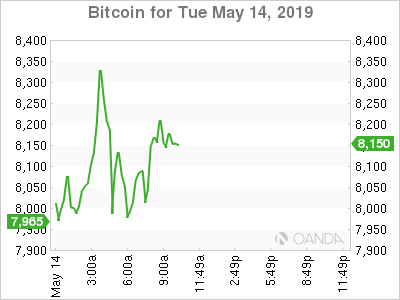
Bitcoin is back above $8,000, closer to $8,200 in fact, and many are puzzled how when all risk assets are taking a pounding. Where are the short sellers? The cryptocurrency is also benefitting for not having a target on its back as short sellers are seeing more attractive moves with global equities for the time being. The recent bump was somewhat attributed to growing institutional demand, but that is unlikely warrant a near 40% jump in 5 days. No stranger to tulip-mania, bitcoin could easily see the rug pulled out from them, but for now bullish momentum is in control.
Gold
The precious metal is slightly softer on the day, just below $1,300 an ounce as markets take a breather from the Monday risk-off move and focus on optimism a trade deal will happen, just much later than what markets were initially pricing in.