Sample Category Title
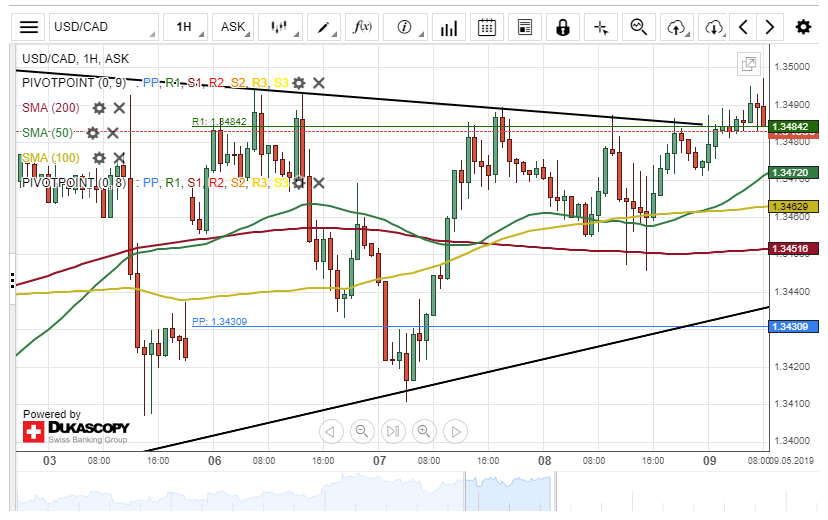
USD/CAD Awaits Canadian Trade Balance
During the first half of today's trading session, the US Dollar versus the Canadian Dollar broke a resistance level formed by the weekly pivot point at 1.3484. The Greenback continued to appreciating in an ascending channel pattern.
Most likely, the USD/CAD currency pair will surge towards a swing high of 1.3516 within this session. furthermore, technical indicators flash bullish signals on both the smaller and the larger time-frame charts.
However, Thursday's macroeconomic date releases scheduled at 12:30 GMT could change the overall positioning of the currency exchange rate.
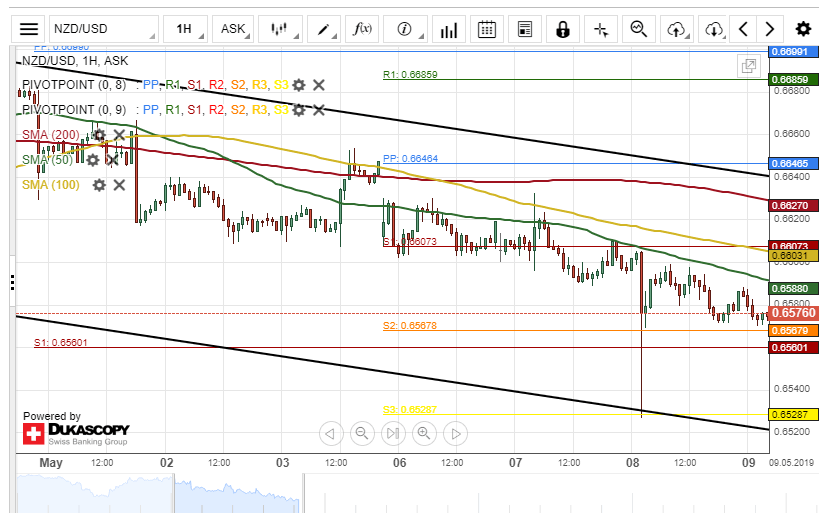
NZD/USD Awaits Fed Chair Speech
The New Zealand Dollar has been trading in a horizontal channel pattern against the US Dollar.
Everything being equal, it is likely that the NZD/USD currency pair will continue the decline during the following trading session. The potential targets for bearish traders will be at 0.6528.
However, the US Federal Reserve's Chairman Jerome Powell is due to deliver the opening remarks at the Fed's System Community Development Research Conference in Washington at 12:30 GMT, this could play a significant role in the currency exchange rate movement today.
EUR/JPY Downside Remains Open Below The POC Zone
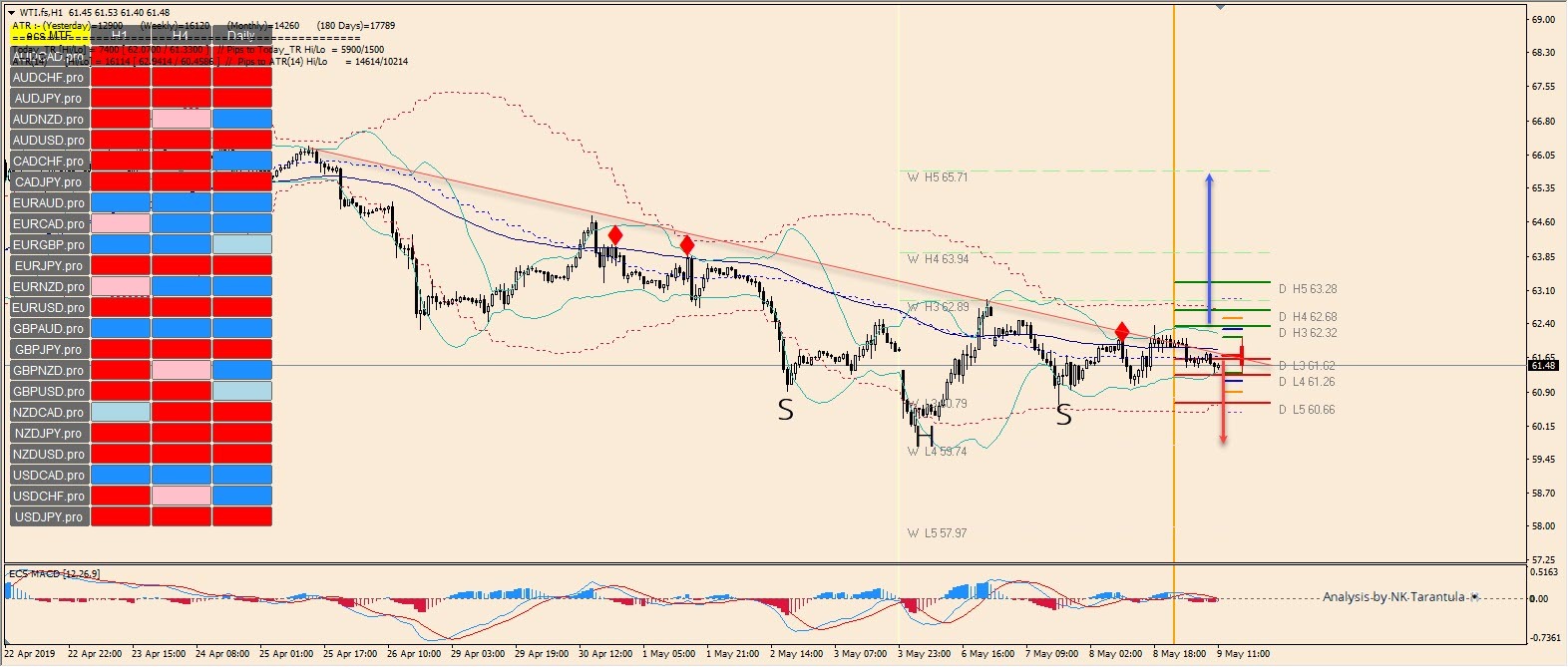
The WTI has formed a strong descending trend line indicating bearish pressure. However, there is an inverted Head and Shoulders pattern looming at support.
61.50-62.00 Zone might reject the price on a reversal bearish pattern due to a confluence if camarilla pivot, trend line and ATR. The target is 60.66. A clear breakout below 60.66 and the next target will be 59.74. Have in mind that 60.45 is the Daily ATR projection LOW, while 62.90 is the Daily ATR projection HIGH. Having that in mind, a close above 62.32 will be bullish for the WTI and the price could bounce towards 62.90 and 63.94. Strong H1 or 4h close above 63.94 points to more gains towards 65.71.
Oil Back In The Red After Inventory Bounce
Investors nervous about US/China talks
Equity markets are trading back in the red on Thursday, as hopes of a deal between the US and China were quickly dashed, albeit not squashed altogether, making the next 48 hours of talks all the more important for markets.
If people’s worst fears are realized and talks break down altogether, the market impact could be significant. One of the reasons we’ve seen such an incredible recovery from the fourth quarter sell-off has been the belief that it’s a case of when, not if, a deal will be reached. It was heavily priced in. The global shift from central banks towards a more accommodative stance has also been a major factor that could limit some of the downside but a breakdown in talks would be a massive blow.
Thankfully, a complete breakdown is not one of the more likely outcomes of this week’s talks. That’s not to say that we won’t see more tariffs imposed but the lines of communication will likely stay open. As it stands, the best likely outcome is probably a delay in tariffs and continuation of talks. That may temporarily support markets but the intensity of negotiations will have to be ramped up.
Oil back in the red after inventory bounce
Oil prices are back in negative territory in early European trade after being given a temporary boost a day earlier as EIA reported an expected inventory drawdown of just shy of four million barrels and overall risk appetite improved on the prospects of a deal. Those hopes were obviously short-lived as we found out later in the session and now we’re back in wait-and-see mode as talks get back underway.
With all eyes on Washington and no oil-related data due out until tomorrow, prices may now continue to simply reflect the swings in risk appetite that driving much of the market right now. Despite the shifts, we continue to trade around the recent lows which fall on a notable area of support for Brent and WTI – around $69-70 and $60-61, respectively – with a break of these potentially being the catalyst for sharper declines.
Gold on the rise again as trade stress kicks in
Gold is experiencing some safe haven demand again on Thursday, but continues to struggle around $1,290 where it failed to hold above yesterday. The late sell-off on Wall Street roughly coincided with the lows in gold yesterday and that buying pressure then picked up in Asia overnight as equity markets moved further into the red. Clearly anxiety over the potential breakdown in negotiations between the US and China – and the prospect of further tariffs from both sides - is taking its toll.
Obviously, risk appetite may experience a sudden u-turn over the next couple of days if the two countries work out their differences and new tariffs are postponed or cancelled altogether which would pressure gold prices, which further feeds into the uncertain outlook between now and the end of the week. A close above $1,290 could be a bullish signal for the yellow metal though, with $1,310 above here being the next area of interest. The lows around $1,265 is the obvious support zone below if talks improve, along with risk appetite.
Markets Decline, Losing Faith In A Trade Deal
The increase in tariffs for Chinese goods from the United States is considered by the markets as an almost inevitable fact as new details become available. As was to be expected, the parties turned out to be very uncompromising negotiators. The US says that China does not want to change the laws of the country to make a deal, and China, in turn, assures that the American side simply dictates its terms, leaving no room for compromise.
Even more dangerous: the endless trade negotiations clearly indicate an important change in the world order. After the Second World War, there was a consensus that free trade was a boon for all, and the world gradually removed barriers. But over the past few years, it seems that politicians have questioned this axiom for economists. Politicians uncompromisingly defend the interests of their countries. And the language of the economy becomes a relic of the past. And it makes us remember that this approach in the early 20th century ended in devastating world wars and the Great Economic Depression.
On the part of the markets, the deal is more needed by China, and its indices and currency are under serious pressure during this week. Nevertheless, in the longer term, the weakening of China’s growth is an equally significant problem for the United States itself, since this development of the situation risks turning into an accumulation of dangerous imbalances in the financial system.
Stocks
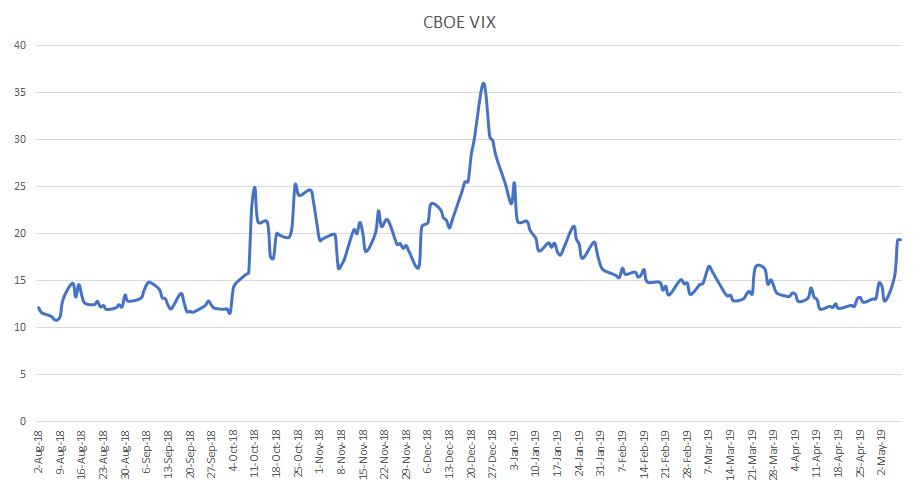
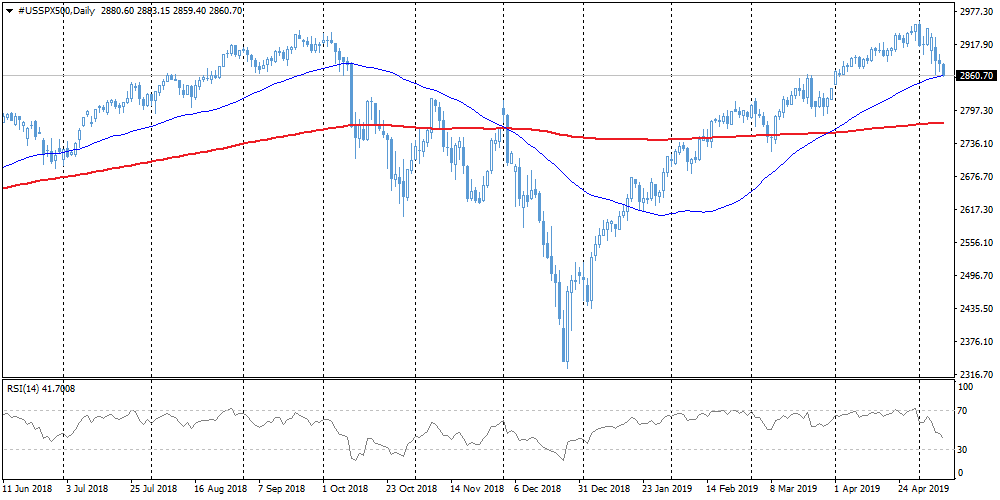
Shanghai China A50 has lost more than 8% since the beginning of the week, while the yuan has fallen by 1.4%. Very often, a currency decline is favourable for exporters, supporting indices. But this time we see a demand drop for Chinese assets due to fears of a significant drop in demand for Chinese goods due to fees. The US S&P 500 fell to monthly lows at 2860, having lost 3.2% since the beginning of the month. Index futures are now dangerously close to the 50-day moving average. A fall below may trigger a new short-term wave of pressure. It is too early to talk about the inevitability of further decline. On Wednesday, the VIX index remained close to Thursday levels, that is, the moods are still stable.
EURUSD
The eighth trading session in a row the pair crosses 1.1200 in both directions. Traders with the euro are still trying to ignore the worsening prospects for a trade deal with China, a decline in the pound and problems in Turkey. Last year, individually, each of these factors caused a noticeable weakening of the single currency. Apparently, at this moment, the euro receives support from a more positive, than forecasted, macro-statistics. But nevertheless, it is necessary to maintain caution, because Europe is still vulnerable to external shocks in the form of demand from China, thus, it is at any time able to tip the scales against the euro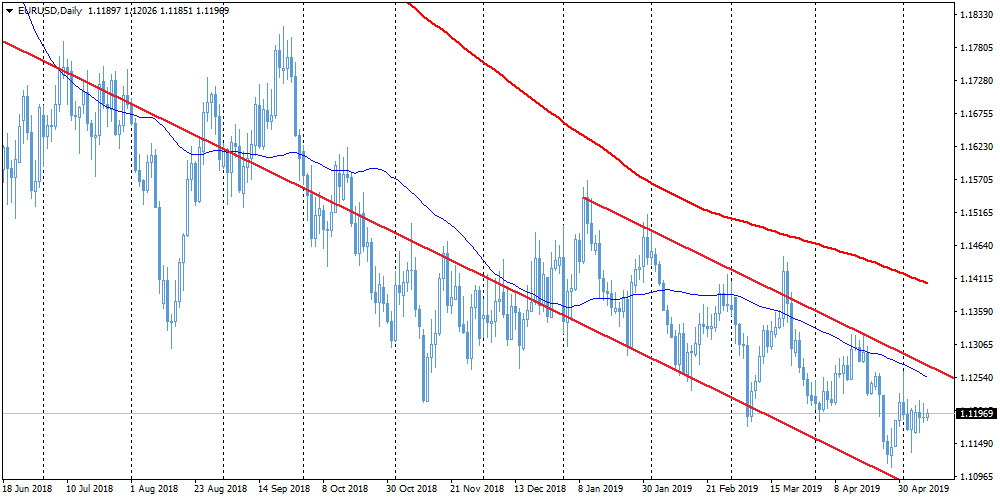
GBPUSD
The British pound offset all its growth gained at the end of last week and returned to 1.30 per dollar. The initial growth was driven by hopes of a May deal with Labour’s leader regarding Brexit terms. However, during the week these hopes faded. Moreover, there was news about the possible failure of these negotiations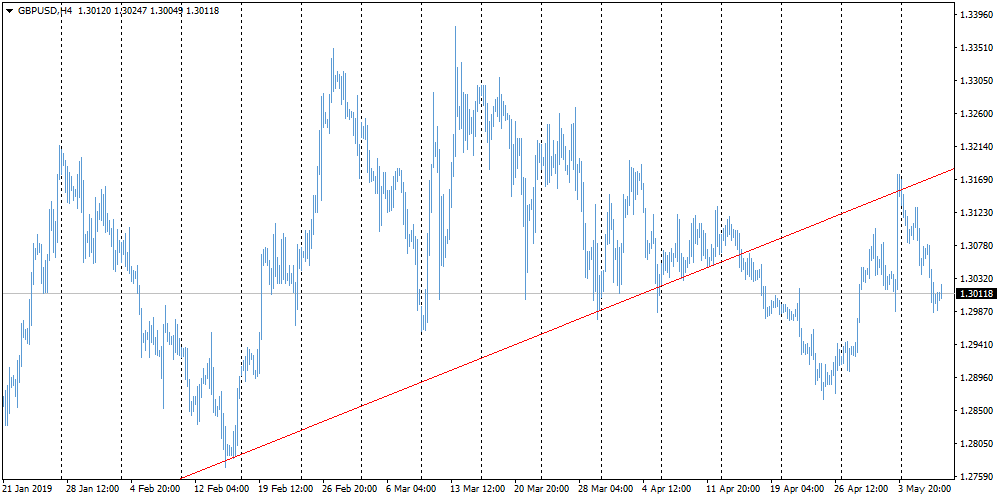
Forex Technical Analysis: EUR/USD, USD/JPY, GBP/USD
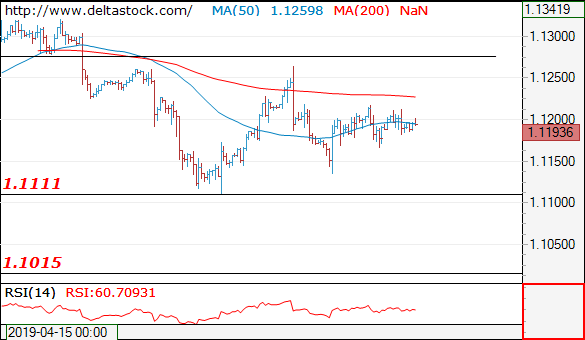
EUR/USD
Current level - 1.1193
The intraday bias is still neutral, but the outlook on the senior frames is bearish below 1.1270, for a wave downwards, to 1.1015.
| Resistance | Support | ||
| intraday | intraweek | intraday | intraweek |
| 1.1220 | 1.1330 | 1.1170 | 1.1010 |
| 1.1275 | 1.1450 | 1.1110 | 1.0860 |
USD/JPY
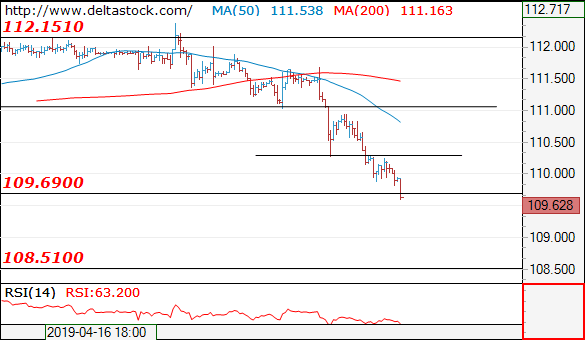
Current level - 109.62
The bias remains bearish, for a slide towards 108.50. Crucial on the upside is 110.30 hurdle.
| Resistance | Support | ||
| intraday | intraweek | intraday | intraweek |
| 110.30 | 113.20 | 108.50 | 108.50 |
| 111.65 | 114.50 | 108.50 | 107.40 |
GBP/USD
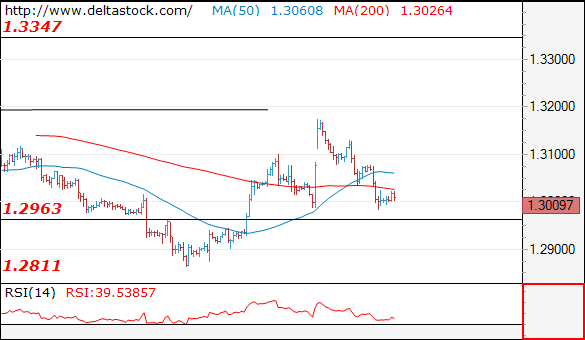
Current level - 1.3009
The downtrend is intact, heading towards a tight test of 1.2960 support area. Initial resistance lies at 1.3030, followed by the crucial high at 1.3080.
| Resistance | Support | ||
| intraday | intraweek | intraday | intraweek |
| 1.3030 | 1.3340 | 1.2960 | 1.2810 |
| 1.3080 | 1.3450 | 1.2960 | 1.2610 |
Elliott Wave Analysis: 10 Years Us Yields Looking Higher, While Stocks Keep Falling
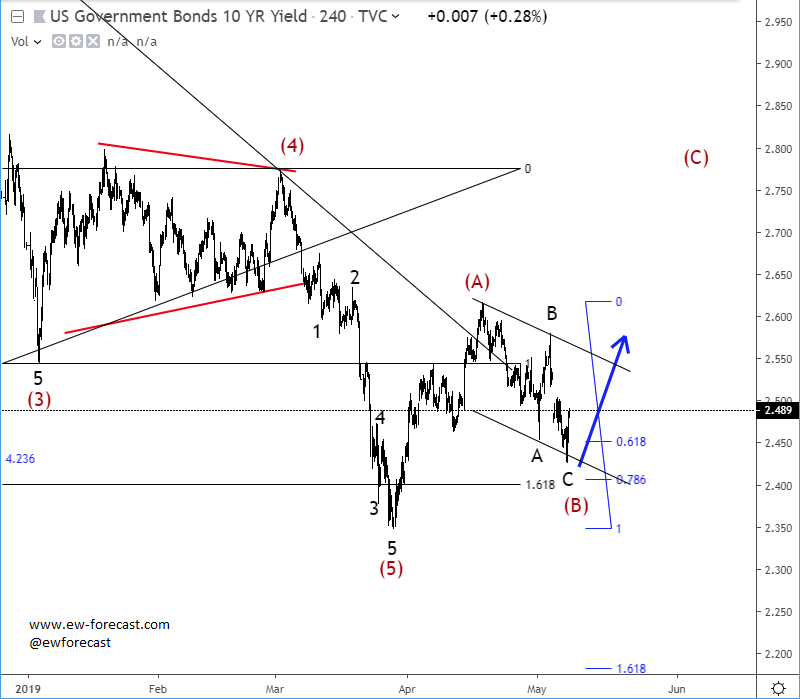
Stocks remain in risk-off mode for now, still seeking for a support while 10 year US notes trades at resistance. Today, we will look at 10 year US yields where price pattern is somehow clearer. We see a nice recovery from April lows followed by recent deeper three leg set-back that looks like a wave (B) so new leg up is expected; wave (C) back above 2.63.
10 Year US Yields, 4h
DAX remains bearish for now as recent recovery unfolded in three legs, so wave X might have unfolded, meaning that bulls will likely have to wait till next week. Current sharp drop that is in play from 12218 level can be part of an upcoming three-wave drop.
German DAX, 30Min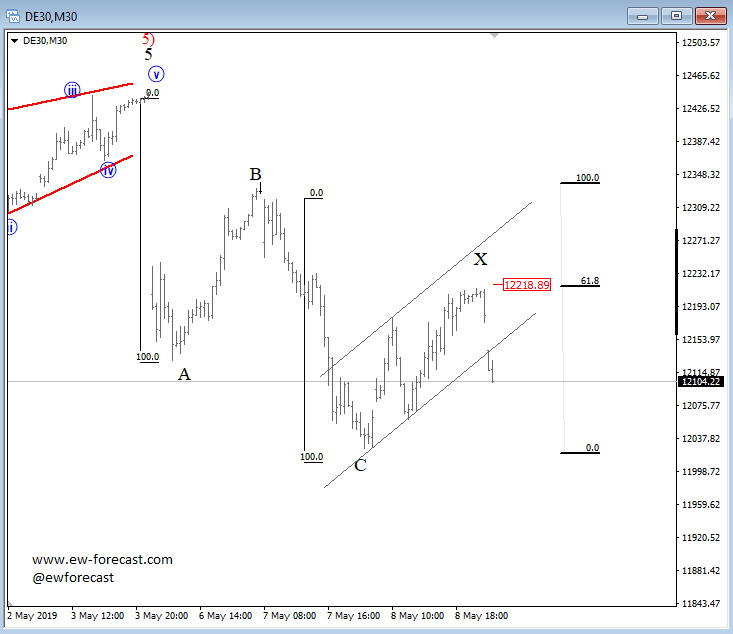
Truce Of Tariffs – What Will Happen When The Clock Strikes Midnight On Friday?
The coming hours will be absolutely crucial for markets. The paramount question of the day is – can the US and China strike a trade deal by midnight Friday in Washington, or will heightened tariffs kick in by 12:01AM?
Given the looming deadline, hope for a trade resolution appears to be waning. Asian currencies are falling against the US Dollar, while the Japanese Yen is gaining 0.1 percent at the time of writing. Risk-off mood is clearly taking a hold on equity markets across the region, as they are all trading in negative territory on Thursday morning, except for Australian and Thai stocks.
Over the course of Thursday, markets will be ultra-sensitive to any developments pertaining to US-China trade negotiations. In the lead-up to Chinese Vice Premier Liu He heading stateside for these crucial talks, US President Donald Trump claimed that Chinese officials “broke the deal”.
Should the high-stakes negotiations produce a market-positive outcome, averting increased tariffs which threaten to further drag down global growth, this may allow global markets to breathe a huge sigh of relief and allow riskier assets to pare losses. However, should the existing 10 percent tariffs on $200 billion worth of Chinese goods indeed be raised to 25 percent, prompting “necessary countermeasures” from China, that will be a major hit to risk appetite and will force investors to reallocate global portfolios, placing an immediate emphasis on safe-haven assets.
Gold to find support at $1,280 floor
Amid such fraught sentiment, Gold traders may be able to rely on the $1,280 level for support over the near-term, until there is further clarity on US-China trade ties. Having already breached the $1,290 level this week before moderating, Bullion may surge past that level once again, in the event that negotiations in Washington break down and higher US tariffs kick in.
Markets will also be mindful of potentially more tariffs being imposed “shortly” on a separate $325 billion worth of Chinese goods, as mentioned in President Donald Trump’s tweets. If that too comes to pass, it might pull the handbrake on the world’s economic expansion and give Gold prices another huge leg up.
Brent futures to test $69/bbl support line
Brent futures have declined by about seven percent since its year-to-date high of $74.75/bbl on April 25, and have already tested the $69/bbl support level at the start of the week, as traders appear primarily driven by concerns surrounding US-China trade ties.
Should trade negotiations between the world’s two largest economies crumble, dampening hopes of a global economic rebound, demand-side uncertainties may then come to the fore and upend OPEC+ producers’ attempts to rebalance the Oil markets. Even though sanctions on Iran and the respective crises in Venezuela and Libya already threaten to further tighten global supply, higher tariffs that curtail economic and trade activity could translate into faltering demand for Oil, which in turn may give OPEC+ the green light to extend production cuts into the second half of 2019.
GBPUSD Hits Bearish Target
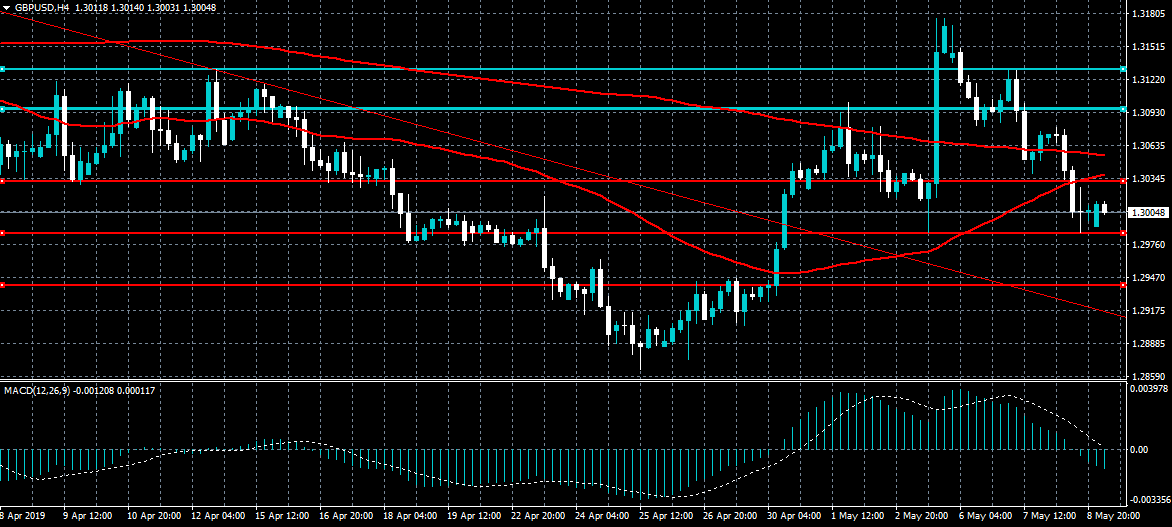
The British pound continues to erode recent trading gains against the US dollar, with the pair so far finding weekly technical support from the 1.2990 level. The GBPUSD par may have reached its immediate bearish target, although continued weakness below the 1.3000 level could prompt additional weakness. Bulls need to move price back above the 1.3064 resistance level to change the intraday sentiment towards the pair.
The GBPUSD pair is heavily bearish while trading below the 1.3064 level, key support is found at the 1.2990 and 1.2940 levels.
If the GBPUSD pair trades above the 1.3030 level, key intraday resistance is found at the 1.3064 and 1.3100 levels.
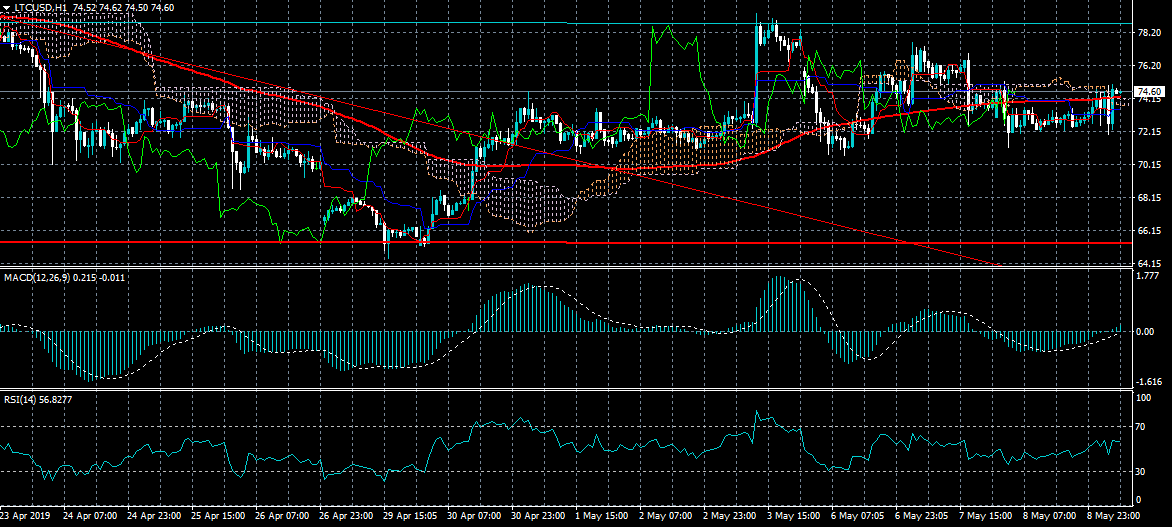
LTCUSD Bearish Pattern Forming
Litecoin is struggling for direction in early Thursday trade, with the sixth largest cryptocurrency failing to move higher despite numerous short-term upside attempts. The one-hour time frame is currently showing that a bearish head and shoulders pattern has formed. LTCUSD buyers now need to move price above the $80.00 resistance level to invalidate the bearish price pattern.
The LTCUSD pair is only bullish while trading above the $70.00 level, key resistance is found at the $80.00 and $99.00 levels.
If the LTCUSD pair trades below the $70.00 level, key support is found at the $65.00 and $58.00 levels.