

Sample Category Title
Volatility on DAX Continues as Trump Tariff Comments Rattle Investors
It has been a volatile week in the stock markets and the DAX index has been marked by wild swings. The index has slipped 2.6% since the end of last week. In economic news, there are no German or eurozone events, but that hasn’t stopped the sharp swings. Currently, the DAX is at 12,078, down 0.84% on the day. On Friday, Germany releases trade balance, with the surplus expected to rise to EUR 19.4 billion.
The ebb-and-flow in trade tensions between the U.S. and China continues this week, which has triggered sharp moves on global stock markets. On Tuesday, the DAX fell 1.6%, its worst daily performance since mid-March. The index reversed directions and gained close to 1.0% percent on Wednesday, but has surrendered these gains on Thursday. U.S. President Trump has threatened to slap new tariffs on China on Friday, but investors are hoping that the unpredictable Trump will cancel the tariffs, which will undoubtedly trigger counter-tariffs from China. Late Wednesday, Trump said that China “broke the deal” and this has caused sharp losses on global stock markets on Thursday. With talks between the sides resuming in Washington on Thursday, there could be further developments before the new tariffs take effect at midnight Friday.
The DAX slumped on Tuesday after the EU published a report which slashed the 2019 growth outlook for Germany. In February, the EU projected growth of 1.1%, but this has been drastically cut to 0.5%. The downgrade for the eurozone was minor, from 1.5% to 1.4%. The EU noted that the downside risks to the eurozone remain “prominent”, and noted that deadlines for the U.S-China trade talks and Brexit had come and passed, leaving significant uncertainty about the economic outlook. The report warned that “an escalation of trade tensions could prove to be a major shock.” The weak German forecast and pessimistic tone of the report unnerved investors and sent the DAX sharply lower.
Tariff Endgame
Trade negotiating tactics are clearly being used by both the U.S. and China. Give-and-take was to be expected by both sides as we near an ultimate conclusion to a trade deal. Recent obstacles have seen the risk of a total collapse grow, which means, we could be finally nearing a deal in this over year long trade war.
High-level talks will occur today ahead of the Friday deadline for increased tariffs on Chinese goods imposed by President Trump. At a rally in Florida, Trump noted he is ready to raise tariffs on Chinese imports Friday, adding there’s nothing wrong taking in $100 billion a year in duties.
Markets have been busy repricing both will we see an increase in tariffs from both sides and the risk to either stalled negotiations or a complete collapse of trade talks. The outlook on the tariff increase is growing, though we may see a promise for the increases to start at a later date, if China offers meaningful concessions.
While the base case remains for a deal to be reached, the timing is uncertain, but likely to occur by early June at the latest. If we see a disastrous outcome this week, we could see a 10% correction with US equities. A framework agreement is likely to see stocks attempt another run at making fresh record highs.
- Oil – Geo risks to keep crude supported
- Korea – North launches as need for sanction relief grows
- Norges – Finally a cb that will raise rates
- Gold – Firm ahead of trade negotiations
Oil
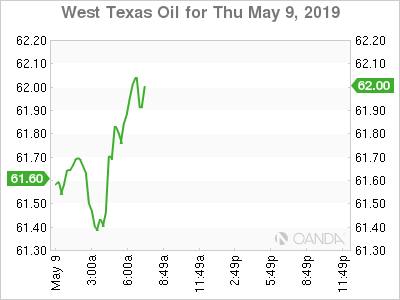
Geopolitical risks are likely to keep oil supported despite growth worries from a potential trade tariff increase. The increased tariffs would further put a dent in global growth and add to fears that the new norm will be a never-ending trade battle with President Trump at the helm. A total collapse in trade talks could deliver a strong blow to commodities, though that scenario is least likely.
Crude prices should see some support from supply risks from Libya and Venezuela, who both could lose half their production in a moments notice, which would translate to almost 1 million barrels a day lost in production.
Korea
North Korea launched its second test launch of weapons in less than a week, and after a two year pause. North Korean leader Kim Jong Un is in need of some US sanction relief and since talks fell apart in February, this act of defiance is aimed at setting up another meeting between Kim and Trump.
Norges
Norway’s central bank (Norges) kept policy unchanged at today’s meeting but they signaled the bank was likely to raise rates at the June meeting. The current monetary policy environment globally is one of accommodation, so it is refreshing to see a thriving economy with some inflation. Western Europe’s biggest oil exporter has a strong economy that has a 2.3% unemployment rate and inflation almost a full percentage point above target.
The Norges already raised rates at the March meeting and now a June hike is expected, but a third hike could be on the horizon, if global risk sentiment improves.
Gold
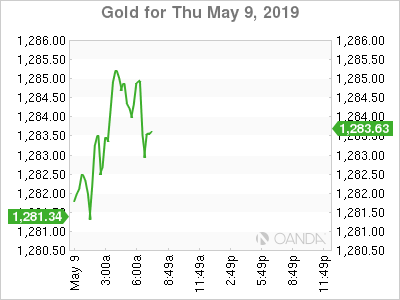
Despite all the uncertainties with next round high-level trade talks, gold has been able to deliver a meaningful rally. The yellow metal’s loss of safe-haven appeal will likely return if talks see a complete collapse, but that remains the lease likely scenario.
USD/TRY Outlook: Turkish Lira Hits New Multi-Month Low, Outlook Remains Negative
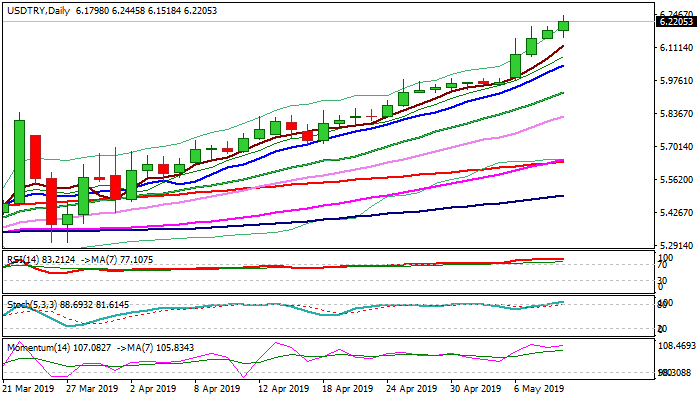
The USDTRY extends steep bullish acceleration for the fourth straight day and hits new multi-month high at 6.2445 (the highest since 24 Sep 2018) on Thursday.
Lira remains under strong pressure on internal political / economic issues, while rising risk aversion mode continues to boost dollar.
The pair rides on extended third wave of five-wave cycle from 2019 low at 5.1595, which cracked its FE 138.2% at 6.2377.
Bulls now focus key Fibo barrier at 6.3529 (61.8% retracement of 7.1074/5.1323) violation of which would generate strong bullish signal for extension towards med-term target at 6.50 zone.
Technical studies on larger timeframes are firmly bullish and support scenario, with corrective actions to be seen as positioning for fresh advance.
Rising 5SMA offers initial support at 6.1191, with deeper dips expected to find ground above ascending 10SMA (6.0364).
Res: 6.2445, 6.3000, 6.3529, 6.4000
Sup: 6.2000, 6.1518, 6.1191, 6.0739
EUR/USD – Euro Stuck In Tight Range
EUR/USD continues to drift, as the pair is unchanged this week. Currently, the pair is trading at 1.1189, down 0.03% on the day. On the release front, there are no German or eurozone events. The U.S. releases PPI and Core PPI, both of which are expected to slow to 0.2%. Unemployment claims are forecast to drop sharply to 215 thousand, after a reading of 230 thousand in the previous release. As well, Federal Reserve Chair Jerome Powell speaks at an event in Washington. On Friday, Germany releases trade balance and the U.S. posts consumer inflation reports.
On Tuesday, the European Commission lowered its 2019 growth forecasts for Germany and the eurozone, compared to the forecast back in February. The eurozone downgrade was minor, from 1.5% to 1.4%. However, the forecast for Germany was slashed from 1.1% to 0.5%. The EU noted that the downside risks to the eurozone remain “prominent”, and noted that deadlines for the U.S-China trade talks and Brexit had come and passed, leaving significant uncertainty about the economic outlook. The report warned that “an escalation of trade tensions could prove to be a major shock.” The weak German forecast and pessimistic tone of the report could dampen investor appetite for the euro, although the currency has held steady on Tuesday.
At last week’s Federal Reserve policy meeting, the Federal Reserve maintained its key interest rate and indicated that it was comfortable with current monetary policy and had no plans to raise or lower rates in the coming months. However, the U.S. economy has exceeded expectations, with a sparkling GDP of 3.2% in Q1, and a sharp nonfarm payrolls of 263 thousand. Will these sharp numbers make a rate hike more likely? The markets don’t think so. According to the CME Group, there is zero probability that the Fed will raise rates before 2020. Moreover there is a 60% likelihood that the Fed will cut rates before the end of 2019. This sentiment could weigh on the greenback, as rate hikes make the currency more attractive to investors.
Bonds, Yen, Gold In Demand On U.S Trade Threats
Thursday May 9: Five things the markets are talking about
The Sino-U.S trade war escalation remained front and center in capital markets overnight.
Global equities along with U.S stock futures continue to face pressure with time running out for U.S tariffs to escalate between the world’s two largest economies. Safe haven trading dominates proceedings with yen, gold and sovereign debt climbing as investors continue to seek sanctuary.
President Trump insists that China “broke the deal” and “will be paying for it.” His threat has many stock investors paying for it also. A ‘no broker’ trade deal has the potential to see equities give up another -10 to -20%. His comments overnight came ahead of the Chinese delegation’s arrival stateside today for ‘the’ final round of bilateral trade negotiations. China is expected to retaliate should the U.S push ahead with their tariff threats.
Elsewhere, Iran has set a two-month deadline for Europe to throw the country an economic lifeline amid U.S sanctions, otherwise it will abandon limits on uranium enrichment.
While in the U.K, PM Theresa has won a reprieve from her own Conservative Party, which has kept the rules on challenging for the leadership unchanged. In other words, Ms. May remains in place until Brexit is delivered.
On tap: The U.S. releases trade and producer-prices data this morning, along with Canada’s trade numbers (08:30 am EDT). Uber’s initial public offering is expected to price after trading closes in the U.S today.
1. Stocks sea of red
Asian equities fell to a two-month low overnight as investors wait to see whether Chinese and U.S trade negotiators are able to save an eleventh-hour trade deal in Washington this week.
In Japan, the Nikkei fell for a fourth consecutive session to end at its lowest level in six-weeks as investor caution dominates ahead of the talks stateside. The Nikkei share average dropped -0.93% Thursday. The benchmark index has lost -4.3% after hitting a 2019 high in the last week of April. The broader Topix lost -1.38%. All but two of its 33 subsectors finished in negative territory.
Down-under, Aussie stocks bucked the trend in Asia trading as Federal regulator’s moved to block a merger between the country’s third and fourth-largest telecommunications companies. The ASX 200 closed up +0.4% following six-drops in the prior eight trading days. Energy jumped +1.3% after the overnight rebound in oil prices while utilities jumped 2%. But materials lost -0.3%. In S. Korea, the Kospi index fell -2%.
In China and Hong Kong, major stock indexes closed at 11-week lows on Sino-U.S trade tensions. President Trump has vowed not to back down on his threat to increase tariffs by the end of the week in a no deal scenario. The blue-chip CSI300 index fell -1.9%, while the Shanghai Composite Index declined -1.5%. In Hong Kong, at the close of trade, the Hang Seng index was down -2.39%, its lowest close since March 8. The drop brought losses for the index to -5.9% for the week, while the Hang Seng China Enterprises index fell -2.27%.
In Europe, regional bourses trade lower across the board tracking lower Asian Indices and lower U.S Index futures as trade tensions and Brexit talks continue to weigh on markets.
U.S stocks are set to open in the ‘red’ (-0.78%).
Indices: Stoxx600 -0.75% at 379.60, FTSE -0.28% at 7,250.65, DAX -0.65% at 12,100.96, CAC-40 -1.16% at 5,354.87, IBEX-35 -0.56% at 9,175.00, FTSE MIB -0.74% at 21,047.50, SMI -0.75% at 9,549.50, S&P 500 Futures -0.78%
2. Oil falls as trade war outweighs inventory drop, gold higher
Oil are under pressure this morning as an escalating Sino-U.S trade battle is outweighing any upward pressure from a surprise decline in U.S inventories of crude.
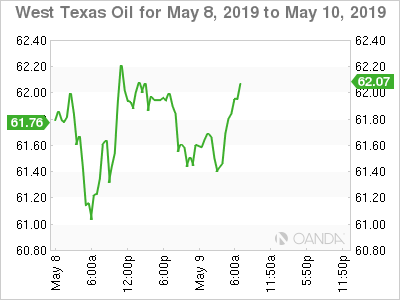
Brent crude oil futures are at +$69.72 a barrel, down -65c from Wednesday’s close and is heading for the second consecutive weekly loss. U.S West Texas Intermediate (WTI) crude futures are at +$61.43 per barrel, down -69c and set for a third week of losses.
With market hopes fading for a Sino-U.S trade agreement, globe growth worries now dominate proceedings and is putting upward pressure on ‘black’ gold.
Note: Higher tariffs are set to take effect on Friday, during Chinese Vice Premier Liu He’s two-day visit to Washington from today.
To date, oil prices have had some support from signs of “tighter global supply” on the back of production cuts by the OPEC+ – Brent and WTI have risen more than +30% year-to-date. Supplies have also been tightened by U.S sanctions on Venezuela and Iran.
Also providing support on these deeper pullbacks in crude prices this week is the surprise drawdowns in U.S inventories. Data stateside yesterday, from the EIA, showed that U.S crude oil stocks fell by -4M barrels in the week to May 3.
Ahead of Sino-U.S trade negotiations, gold prices are little changed. Spot gold has edged up +0.2% to +$1,283.41 per ounce, while U.S gold futures are also +0.2% higher at +$1,284.10. Panic flight to safety has yet to occur, expect the yellow metal to gyrate throughout trade talks.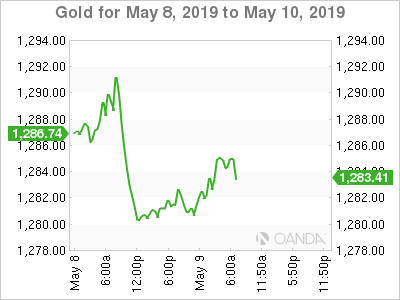
3. Sovereign debt remains in demand on trade concerns
Earlier this morning, Norway’s central bank (Norges) left their deposit rate unchanged at +1% as expected. The decision to keep policy steady was unanimous, however, policy makers did bring forward its next potential rate hike to June according to their statement. “The outlook and balance of risks suggests that the policy rate will be raised in June 2019”. The prior view was in H2 2019.
Note: Norges has raised the Deposit Rate on two occasions since Sept 2018 by a total of +50 bps. The last hike was back in March.
Elsewhere, the yield on two-year Treasuries has fallen -2 bps to +2.28%, while the yield on 10-year notes eased -1 bps to +2.45%. In Germany, the 10-year Bund yield fell -1 bps to -0.05%, its fifth straight decline, while down-under, Australia’s 10-year yield dropped -2 bps to +1.7145%.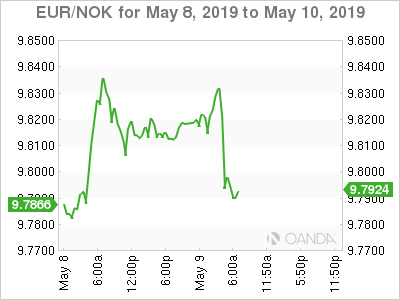
4. Rick aversion continues to dominate proceedings
Risk aversion theme has remained intact in the overnight session as US/China trade and Brexit talks looked increasingly more vulnerable.
USD/JPY (¥109.75) has tested its three-month lows below ¥109.60 as the Yen currency benefits from its traditional safe-haven status on market turmoil.
GBP/USD (£1.3001) tested below the psychological £1.30 level on speculation that PM May’s cross-party talks might not yield the positive results that many involved have been expecting.
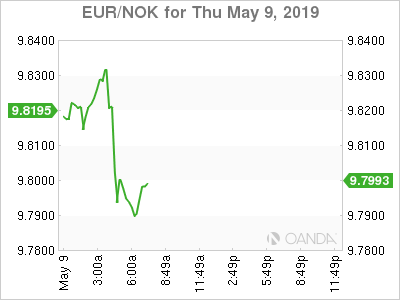
Norges Bank gave a “hawkish” hold in key rate decision as it brought its forward the guidance on the next potential hike forward. EUR/NOK (€9.7895) tested below €9.78 level on ‘hawkish’ guidance.
Consensus believes that China will likely see its FX reserves continue to decline should Sino-U.S trade tension escalate, as the authority might intervene to defend the yuan against the U.S. China will be willing to tolerate some devaluation to offset the tariff impact on Chinese exports. Beijing may need to undertake further easing measures to bolster confidence and to stabilize growth. The dollar is up +0.4% at ¥Y6.8125 ahead of the onshore close.
BTC Bitcoin has rallied above $6,000 overnight for the first time in six-months, padding the rebound following November’s plunge and adding to optimism that the worst of the cryptocurrency market’s selloff might be over.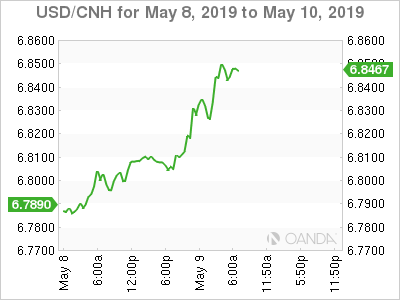
5. China inflation numbers – consumer and producer prices
Data overnight showed that China inflation picked up in April, but this was mostly due to supply-side factors and not stronger domestic demand.
Consumer price inflation rose to a six-month high of +2.5% y/y in April, up from +2.3% y/y in March and in line with expectations. The increase was driven by an acceleration in food price inflation, from +4.1% y/y to a three-year high of +6.1%.
Note: Disruptions to pork supply caused by African swine flu was mostly to blame – pork price inflation jumped to +14.4%.
Producer price inflation also picked up from +0.4% y/y, to a four-month high of +0.9%. This increase was partly due a growth in factory gate prices from +0.1% to +0.3%.
Note: Higher food inflation is expected to continue to push up CPI in the coming months, but, with economic growth unlikely to stage a strong recovery, the market does not see a higher PPI in the coming months.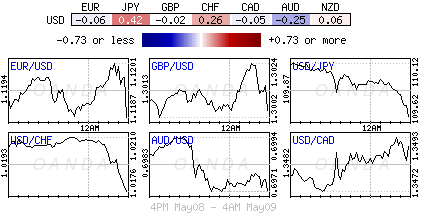
Risk Aversion Theme Continues To Peculate, Norges Remains Hawkish On Rate Guidance
Notes/Observations
- Risk aversion theme still mustering momentum as US/China trade and Brexit talks looked increasingly more vulnerable
- Norway Central Bank gives a hawkish hold in key rate decision as it brings forward the guidance on the next potential hike to Jun (from prior H2 2019)
- North Korea fires another projectile for the 2nd time this month after a 2-year pause
Asia:
- China Commerce Ministry indicated it may take countermeasures against new US tariffs
- China Apr New Yuan Loans (CNY): 1.020T v 1.200Te
- China Apr CPI at a 6-month high (YoY: 2.5% v 2.5%e)
- New Zealand Central Bank (RBNZ) Gov Orr stated that was too early to tell if another rate cut is needed as the recent rate cut got the central bank ahead of the curve
Europe/Mideast:
- UK 1922 Committee of Conservative MPs (back benchers) reportedly did not make change in party leadership rules
- UK 1922 Committee Chair Brady: PM May was aiming for a Brexit bill vote on Withdrawal Agreement before the May 23rd EU elections
- UK Cabinet Office Minister Lidington (de facto Dep PM): Brexit talks with Labour had been difficult at times
- DMO Chief Stheeman : loss of AA status for UK sovereign could lead reserve mangers to reassess
Americas:
- US President Trump: China "broke the deal" in trade talks; confirmed China Vice Premier was coming to US for trade talks; Don't worry on China it will all work out
- US 10-year Note auction saw the weakest bid-to-cover ratio in a decade at 2.17x
SPEAKERS/FIXED INCOME/FX/COMMODITIES/ERRATUM
Equities
- Indices [Stoxx600 -0.75% at 379.60, FTSE -0.28% at 7,250.65, DAX -0.65% at 12,100.96, CAC-40 -1.16% at 5,354.87, IBEX-35 -0.56% at 9,175.00, FTSE MIB -0.74% at 21,047.50, SMI -0.75% at 9,549.50, S&P 500 Futures -0.78%]
- Market Focal Points/Key Themes: European Indices trade lower across the board tracking sharply lower Asian Indices once again and lower US Index futures as trade tensions and Brexit talks continue to weigh on markets. On the corporate front shares of Arcelor Mittal decline sharply after sharp decline in profits; Metro reverses earlier gains in the week after Q2 earnings loss narrows, while Lehto Group, SLM Solutions, Jenoptik, Genmab, Continental and Schmolz + Bickenbach among other names declining on earnings. Meanwhile shares of Rhinemetall rise on earnings with Hapag Lloyd, ALK Abello and HeidelbergCement also bucking the overall trend. In other news Ocado gains following an update on its partnership with Morrisons, while StoreBrand, DWS Group and Ontex Group all lower on analyst downgrades. Looking ahead notable earners include Tapestry, Dr Pepper Keurig, Harsco, Care.com and Duke Energy among others.
Equities
- Consumer discretionary: METRO [B4B.DE] -1.5% (earnings), Superdry plc [SDRY.UK] +2% (trading update), Oriflame [ORI.SE] -11% (earnings)
- Financials: Unicredit [UCG.IT] -1.5% (earnings), Lehto Group [LEHTO.FI] -19% (profit warning)
- Telecom: Deutsche Telekom [DTE.DE] n/c (earnings)
- Industrials: Continental [CON.DE] -3% (final Q1 earnings), Jenoptik [JEN.DE] -6% (earnings), Hapag-Lloyd [HLAG.DE] +2.5% (earnings), SLM Solutions [AM3D.DE] -9% (earnings), BAE Systems [BA.UK] n/c (trading update), Barratt Developments [BDEV.UK] +0.5% (trading update)
- Technology: Dialog Semiconductor [DLG.DE] +0.5% (earnings), NNIT [NNIT.DK] -11% (profit warning), OHB AG [OHB.DE] +5.5% (earnings)
- Materials: ArcelorMittal [MT.NL] -4.5% (earnings), Rheinmetall [RHM.DE] +3.5% (earnings), HeidelbergCement [HEI.DE] +1.5% (earnings)
Speakers
- BOE's Saunders: Brexit uncertainty is a big drag on investment
- Norway Central Bank (Norges) Policy Statement noted that the decision to keep policy steady was unanimous. The outlook and balance of risks suggested that the policy rate would be raised in Jun 2019 (prior view was in H2 2019). Information overall indicated that the outlook for policy rate in period ahead was little changed since March report
- Italy Fin Min Tria stated that he did not believe that EU Commission would demand additional budget measures
- UK Justice Min Gauke: Timing of Brexit bill to depend on cross-party talks with labour; Govt want to bring the vote asap. Reiterated that Govt looking to leave the EU in a sensible manner. PM May exit would not change the Parliamentary arithmetic
- Philippines Central Bank policy Statement reiterates that inflation to remain within the target range for both 2019 and 2020 and that CPI risks were broadly balanced
- Philippines Central Bank (BSP) Gov Diokno: To discuss Reserve Requirement Ratio (RRR) during week of May 13th
- China Commerce Ministry (MOFCOM) spokesperson Geo Feng reiterated that hoped the US would meet China halfway on trade. Stressed that if US implemented tariffs then China would take necessary countermeasures. China would not succumb to pressure. Reiterated that dialogue was needed to resolve trade issues; no winners in any trade war
- North Korea said to fire an unidentified projectile (**Note: 2nd test this month after a 2-year pause)
Currencies/Fixed Income
- Risk aversion theme remained intacted in the session as US/China trade and Brexit talks looked increasingly more vulnerable
- USD/JPY tested 3-month lows below 109.60 as the Yen currency benefited from its traditional safe-haven status on market turmoil.
- GBP/USD tested below the 1.30 level as continued speculation that PM may's cross-party talks might not yield the positive results.
- Norway Central Bank gives a hawkish hold in key rate decision as it brought its forward the guidance on the next potential hike to Jun (from prior H2 2019). EUR/NOK tested be;ow 9.78 level in the aftermath of the revised guidance
Economic Data
- (SE) Sweden Maklarstatistik Housing Prices Y/Y: 1% v 0% prior; Apartments Y/Y: 1 v 0% prior
- (DK) Denmark Mar Current Account (DKK): 11.1B v 12.8B prior; Trade Balance: 4.3B v 6.3B prior
- (ZA) South Africa Apr Gross Reserves: $49.5B v $48.8Be; Net Reserves: $43.3B v $43.4Be
- (ES) Spain Mar Industrial Output NSA Y/Y: -0.1% v +0.1% prior; Industrial Output SA Y/Y: -3.1% v -1.2%e; Industrial Production M/M: -1.2% v +0.3%e
- (HU) Hungary Apr CPI M/M: 0.9% v 0.8%e; Y/Y: 3.9% v 3.9%e
- (HU) Hungary Mar Preliminary Trade Balance: €0.7B v €0.8B prior
- (CZ) Czech Mar National Trade Balance (CZK): 21.8B v 15.3Be
- (CZ) Czech Mar Industrial Output Y/Y: 0.1% v 0.8%e; Construction Output Y/Y: 11.6% v 5.8% prior
- (SE) Sweden Apr Average House Prices (SEK) 3.060M v 3.110M prior
- (NO) Norway Central Bank (Norges) left the Deposit Rates unchanged at 1.00% (as expected) but brings forward the next potential hike to Jun
- Philippines Central Bank (BSP) cuts Overnight Borrowing Rate by 25bps to 4.50% (as expecyed) for its 1st cur in 3 years
- FAO Apr World Food Price Index: 171.1 v 167.0 prior; M/M: 2.7% v 0.1% prior
- (GR) Greece Feb Unemployment Rate: 18.5% v 18.6% prior
Fixed Income Issuance
- (IE) Ireland Debt Agency (NTMA) opened its book to sell 2050 IGB bond; guidance seen +50bps to mid-swaps
- (PH) Philippines to sell EUR-denominate 8-year note; guidance seen +90-100bps to mid-swaps
- (ES) Spain Debt Agency (Tesoro) sold total €3.6B vs. €3.0-4.0B indicated range in 2024, 2029 and 2048 bonds
- Sold €1.02B in July 0.25% 2024 SPGB bond; Avg yield: 0.089% v 0.171% prior; Bid-to-cover: 2.91x (highest since Aug) v 2.24x prior
- Sold €1.78B in 1.45% Apr 2029 SPGB; Avg Yield: 0.936% v 1.121% prior, bid-to-cover: 1.40x v 1.35x prior
- Sold €800M in 2.7% Oct 2048 SPGB; Avg Yield: 2.119% v 2.362% prior; Bid-to-cover: 2.31x v 1.50x prior
- (ES) Spain Debt Agency (Tesoro) sold €482M vs. €250-750M indicated range in inflation-linked 0.7% Nov 2033 bond; Real
Looking Ahead
- (EU) EU leaders hold Informal Summit in Sibiu, Romania
- 05:30 (ZA) South Africa Mar Total Mining Production M/M: -1.3%e v -1.5% prior; Y/Y: -7.0%e v -7.5% prior; Gold Production Y/Y: No est v -20.6% prior; Platinum Production Y/Y: No est v 17.8% prior
- 05:00 (EU) Daily Euribor Fixing
- 05:30 (HU) Hungary Debt Agency (AKK) to sell bonds (3 tranches)
- 05:30 (PL) Poland to sell Bonds
- 05:30 (UK) DMO to sell £3.0B in 1.00% May 2024 Gilts
- 06:00 (IE) Ireland Apr CPI M/M: No est v 0.8% prior; Y/Y: No est v 1.1% prior
- 06:00 (IE) Ireland Apr CPI EU Harmonized M/M: No est v 0.8% prior; Y/Y: No est v 1.1% prior
- 06:00 (RO) Romania to sell Bonds
- 06:00 (RO) Romania to sell Bills
- 06:45 (US) Daily Libor Fixing
- 07:00 (ZA) South Africa Mar Manufacturing Production M/M: -0.6%e v -1.8% prior; Y/Y: -0.2%e v +0.6% prior
- 08:00 (BR) Brazil Mar IBGE Services Sector Volume Y/Y: 2.9%e v 3.8% prior
- 08:00 (BR) Brazil Mar Retail Sales M/M: 0.9%e v 0.0% prior; Y/Y: -2.3%e v +3.9% prior
- 08:00 (BR) Brazil Mar Broad Retail Sales M/M: +1.6%e v -0.8% prior; Y/Y: -1.9%e v +7.7% prior
- 08:00 (BR) Brazil CONAB Soybean Production Report
- 08:00 (UK) Baltic Bulk Index
- 08:30 (US) Apr PPI Final Demand M/M: 0.3%e v 0.6% prior; Y/Y: 2.3%e v 2.2% prior
- 08:30 (US) Apr PPI Ex Food and Energy M/M: 0.2%e v 0.3% prior; Y/Y: 2.5%e v 2.4% prior
- 08:30 (US) Apr PPI Ex Food, Energy, Trade M/M: 0.2%e v 0.0% prior; Y/Y: No est v 2.0% prior
- 08:30 (US) Initial Jobless Claims: 220Ke v 230K prior; Continuing Claims: 1.67Me v 1.671M prior
- 08:30 (US) Mar Trade Balance: -$50.2Be v -$49.4B prior
- 08:30 (CA) Canada Mar Int'l Merchandise Trade (CAD): -2.4Be v -2.9B prior
- 08:30 (CA) Canada Mar New Housing Price Index M/M: 0.0%e v 0.0% prior; Y/Y: 0.1%e v 0.1% prior
- 08:30 (US) Weekly USDA Net Export Sales
- 08:30 (US) Fed Chair Powell at conference
- 09:00 (MX) Mexico Apr CPI M/M: 0.1%e v 0.4% prior; Y/Y: 4.4%e v 4.0% prior; CPI Core M/M: 0.5%e v 0.3% prior
- 09:45 (US) Fed's Bostic (dove, non-voter) on Economic Outlook
- 10:00 (US) Mar Final Wholesale Inventories M/M: 0.0%e v 0.0% prelim; Wholesale Trade Sales M/M: 0.6%e v 0.3% prior Wholesale Inventories
- 11:30 (US) Treasury to sell 4-week and 8-week bills
- 12:00 (CA) Canada to sell 2-year bonds
- 13:00 (US) Treasury to sell 30-Year Bonds
- 13:15 (US) Fed's Evans (dove, voter) at Conference
- (IT) Italy Debt Agency (Tesoro) announces details for upcoming BTP auctions for Tuesday, May 14th
- 18:00 (CL) Chile Central Bank (BCCh) Interest Rate Decision: expected to leave Overnight Rate Target unchanged at 3.00%
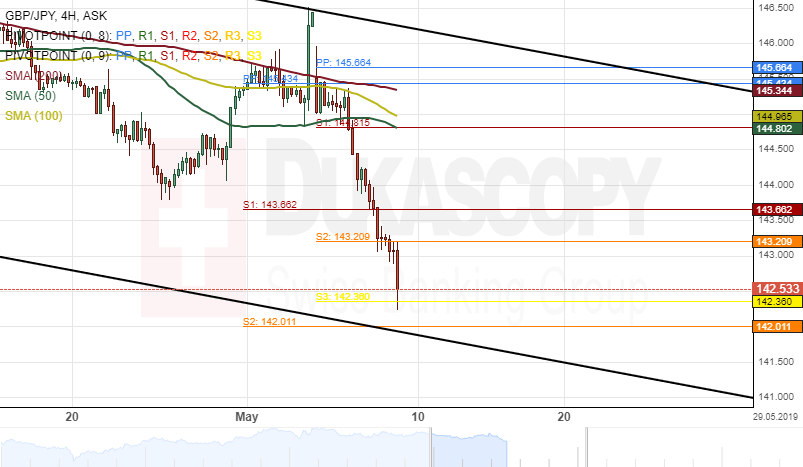
GBP/JPY 4H Chart: Bearish Sentiment
Since May 3, the British Pound has depreciated about 357 base points against the Japanese Yen. The pair was pressure south by the 50-, 100– and 200-hour simple moving averages.
Most likely, the decline could continue during the following trading sessions. The potential downside target for the exchange rate will be near a support cluster at 142.35.
If the support cluster holds as mentioned above holds, a possible bullish momentum could take control of the currency exchange rate within the coming days.
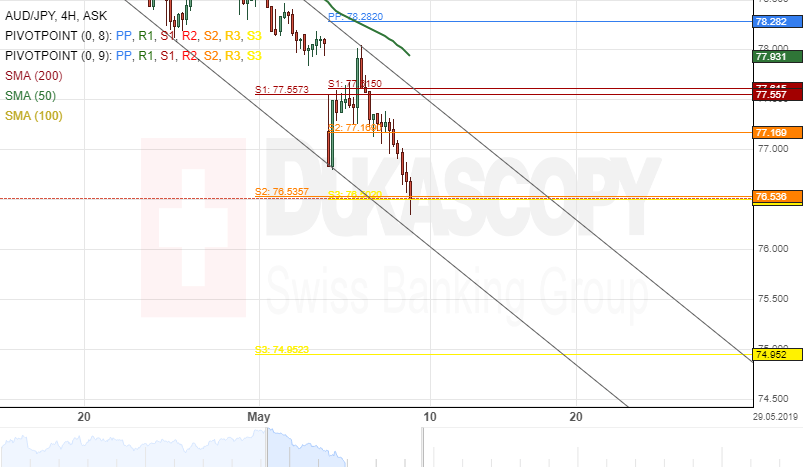
AUD/JPY 4H Chart: Meets Support Cluster
The Australian Dollar has depreciated about 405 base points against the Japanese Yen since the middle of April. The currency pair has revealed a new junior descending channel pattern.
Currently, the AUD/JPY exchange rate is testing a resistance cluster formed by the combination of the weekly and the monthly pivot points at 76.53.
If this support level holds, a surge towards the 50-hour simple moving average could be expected in the short-term.
Although, if the currency exchange rate passes the PPs, a decline towards the monthly S3 at 74.95 could follow during the following trading sessions.
The Escalation In The US-China Trade Conflict Is In The Spotlight
The US dollar slightly strengthened against a basket of major currencies. The dollar index (#DX) closed near current levels (+0.07%). The trade war between the US and China led to a sharp drop in stocks on world stock markets. Markets were under pressure due to the fact that yesterday, US President Donald Trump imposed sanctions on Iran's metals industry. The purpose of the deal is to deny Iran income from the export of products related to the production of iron, steel, aluminum, and copper.
Today, during the Asian trading session, mixed economic data have been published in China. Thus, the producer price index rose to 0.9% in April, while experts forecasted 0.6%. The consumer price index rose by 0.1% in April, which met investors' expectations.
Today, the delegation from China should arrive in Washington to conclude a trade agreement with the United States. However, whether countries will be able to reach an agreement is not yet known, especially in the light of Donald Trump's recent comments on that. Trump tweeted: "The reason for the China pullback & attempted renegotiation of the Trade Deal is the sincere HOPE that they will be able to "negotiate" with Joe Biden or one of the very weak Democrats, and thereby continue to ripoff the United States (($500 Billion a year)) for years to come… Guess what, that's not going to happen! China has just informed us that they (Vice-Premier) are now coming to the U.S. to make a deal. We’ll see, but I am very happy with over $100 Billion a year in Tariffs filling U.S. coffers…great for U.S., not good for China!"
The "black gold" prices have been declining due to the escalation of the trade conflict between the US and China. At the moment, futures for the WTI crude oil are testing the mark of $61.50 per barrel.
Market Indicators
- Yesterday, there was a variety of trends in the US stock market: #SPY (-0.14%), #DIA (+0.05%), #QQQ (-0.25%).
- The 10-year US government bonds yield is declining. At the moment, the indicator is at the level of 2.44-2.45%.
The news feed on 2019.05.09:
- Producer price index in the US at 15:30 (GMT+3:00).
Risk Appetite Weakens, JPY In Demand
Risk appetite remains low as tariffs loom
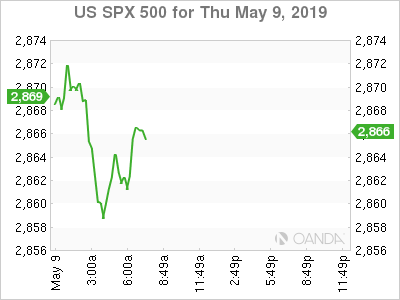
Equity futures erased yesterday gains after President Trump did toughen its language on China, saying that China “broke the deal” the two countries have been working on for months. S&P 500 futures resumed downtrend and are currently testing the 2,862 support, which correspond to the low from Tuesday as well as its 50-day moving average. Across the Atlantic, the sentiment is not much better with the German DAX sliding another 0.65% to 12,100 points. The SMI gave up 1% as it reached 9,520 points.
In the FX market, investors fled risky currencies and bought safe-haven ones such as the Japanese yen - up 0.40% against the greenback with USD/JPY testing the 109.57 support (low from February 6th) - while the Swiss franc added 0.22% against the buck. USD/CHF erased yesterday gains as it slid toward 1.0180.
The single currency quickly fell to 1.1175 before climbing its way back toward 1.1190 as the risk sentiment stabilise. It has been a nerve-wracking week for investors as Trump kicked in the hornets’ nest last Sunday as he expressed his frustration with the negotiation process. We believe that strained market conditions will prevail for the rest of the week, as Chinese negotiators are expected to land in Washington on Friday.
JPY in demand as fears of trade war escalation rises
Threat of a trade war escalation is increasing, and manufacturers would most certainly pay the price. This is the case of Japan, which suffered the consequences of a sharp slowdown in exports to China from January to March 2019, putting quarter-on-quarter GDP 2019 most likely flat in 1Q 2019 (prior: 0.50%) when published on 20 May 2019. Yet considering the succession of natural disasters from July to September last year, the Japanese economy has remained solid with manufacturing activities maintained in expansion territory and strong consumer spending maintaining growth positive. However, the impact of an increase in tariffs on $200 billion in Chinese imports Friday would not bode well for Japanese suppliers of components and materials, which would face lower demand from Chinese producers of American finished products, ultimately affecting exports and putting downward pressure on the economy. In addition, a sustained rise in JPY would not help to improve competitiveness.
JPY is in great demand as suggested by USD/JPY 1 month at-the-money implied volatility, given highest since mid-January 2019. USD/JPY (-0.36% intraday) is turning neutral year-to-date and approaching support at 109.71 (25/03/2019 low). Currently trading at 109.75, the pair is expected to rebound, approaching 110.10 short-term.