Sample Category Title
Eurozone Sentix investor confidence rose to 5.3, recession risk averted
Eurozone Sentix Investor Confidence rose to 5.3 in May, up from -0.3 and beat expectation of 1.1. Current Situation index rose from 3.8 to 11.0. Expectations index rose from -4.3 to -0.3, highest since March 2018. Sentix noted that the danger o recession in Eurozone is "averted". Global environment made a "significant contribution" to the positive development. Danger of unregulated Brexit has been averted until at least October. It also said the forthcoming elections in Europe will "take place in a relaxing economic environment".
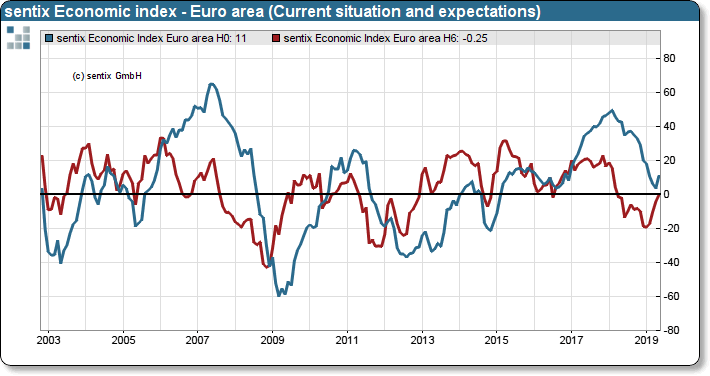
For Germany, Overall index rose to 7.9, up from 2.1, and hit the highest since November 2018. Current situation index rose from 10.5 to 18.3. Expectations index rose from -6.0 to -2.0, highest since February 2018. Sentix noted that the spark from the Chinese economy, which has recovered significantly since the start of the year, is "increasingly jumping over to the export-dependent German economy".
Trump Threatens New Tariffs, Markets Retreat
- Stocks fall, yen soars as Trump hints at new tariffs
- Dollar retreats after jobs data, but trade concerns provide support
- Sterling rebounds amid hopes for Brexit progress
Trump warns of new tariffs on China, dents risk appetite
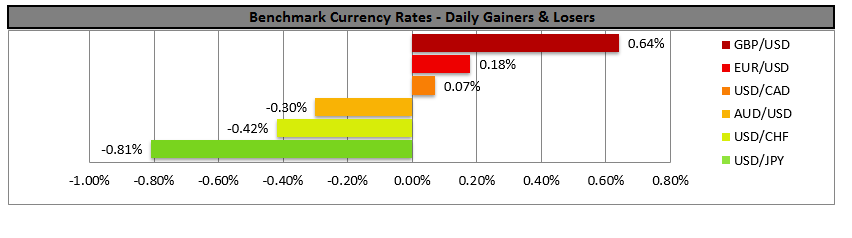
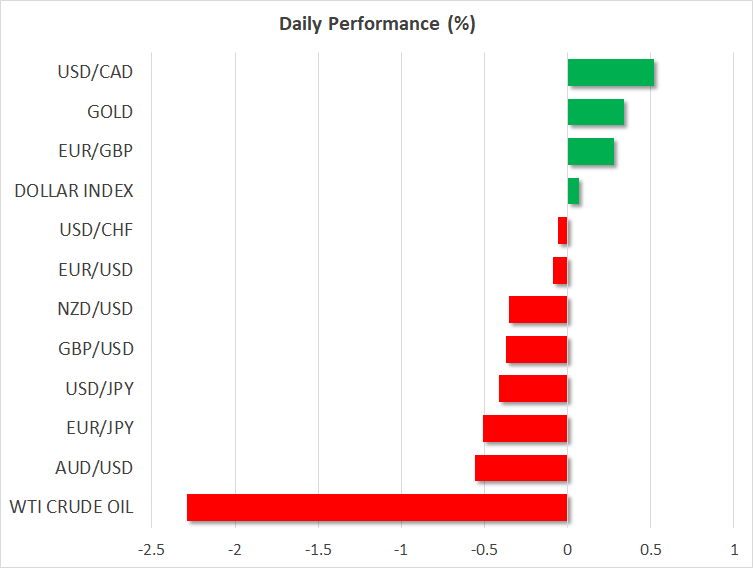
Risk aversion is the name of the game on Monday, with investors diverting funds away from riskier assets like stocks and towards safe havens such as the Japanese yen, amid fears that the US-China trade conflict is ready to re-escalate. President Trump said over the weekend that he is going to raise tariffs on $200bn of Chinese goods to 25%, from 10% currently, and that he will impose new levies on another $325bn worth of products ‘shortly’.
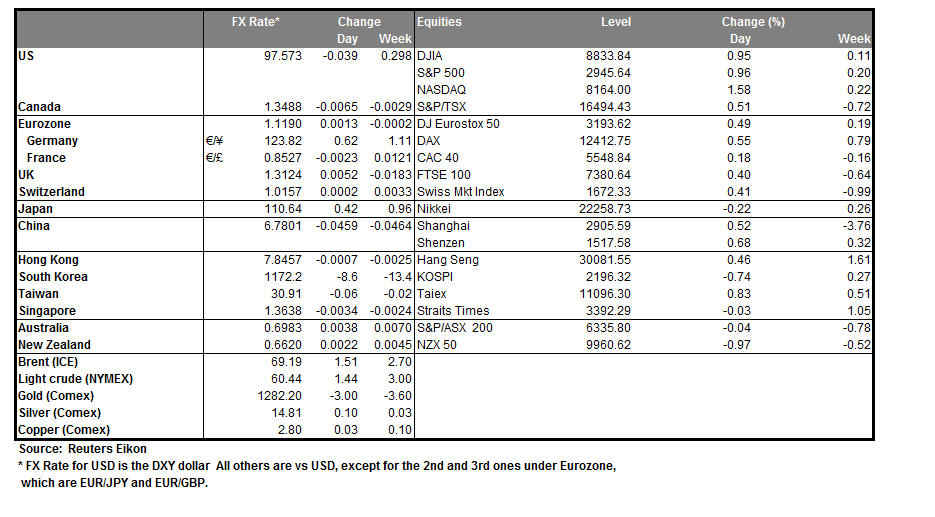
This is a major turnaround, as the popular narrative until now was that an accord is practically a done deal following months of optimistic rhetoric on both sides. Indeed, the market reaction was severe, with Chinese stocks falling by more than 5%, while futures tracking US indices like the S&P 500 are also pointing to a 2% lower open today. In the FX spectrum, the yen is outperforming while commodity currencies like the aussie and the kiwi are on the back foot.
Overall, a deal still seems more likely than not, though uncertainty has clearly returned and risk aversion may linger for a while. Trump wants to score a victory and wrap this up before the 2020 election race, while also boosting the stock market, so an agreement is still the most likely conclusion. However, the US President seems to be reverting back to his original methods of ratcheting up pressure first to generate negotiating leverage, implying that things could get worse before they get better from here.
Dollar retreats, but trade fears provide support
The US dollar pulled back on Friday, even despite another set of solid US employment data. Nonfarm payrolls rose by 263k in April, much more than the anticipated 180k, while the unemployment rate unexpectedly declined. The disappointing spot was wage growth, which held steady at 3.2% in yearly terms, missing the forecast for an acceleration to 3.3%.
The dollar tumbled immediately as investors tend to focus more on wage growth, and continued even lower after a disappointing ISM non-manufacturing PMI and some cautious-sounding remarks by Fed officials. As a result, the market probability for a Fed rate cut this year rose back up, yet the dollar is trading nearly unchanged against a basket of currencies on Monday. Renewed trade uncertainty seems to be fueling demand for the world’s reserve currency; recall that the greenback was the market’s favorite haven asset as tensions escalated last year.
Sterling roars back on hopes for Tory-Labour deal
The British pound soared across the board on Friday amid growing hopes that the nation’s two biggest political parties could reach an agreement soon to break the Brexit stalemate.
The latest headlines suggest that both the government and Labour are ready to compromise on a customs union arrangement, which would remove the need for the Irish backstop and therefore allow Brexit to move forward. Any official confirmation of that could be positive for the pound as uncertainty would fade and the risk of a no-deal may diminish. That said, downside risks still linger, with the most prominent one being the Tories replacing Theresa May with a hardline Brexiteer.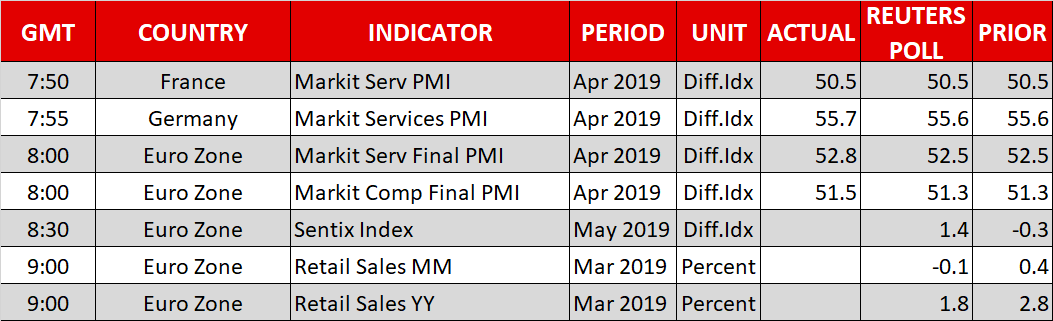
Chinese trade delegation still preparing to travel to US, but no indication on timeline
In wake of Trump's new tariff threats, Chinese Foreign Ministry spokesman Geng Shuang said a Chinese delegation was still preparing to travel to the US for another round of trade negotiations. However, there was no indication on the date of the trip, nor whether Vice Premier Liu He will lead the team.
Geng said in a press briefing that “we are now trying to get more information on the relevant situation." And, “what I can tell you is that the Chinese team is preparing to travel to the U.S. for trade talks.”
“What is of vital importance is that we still hope the United States can work hard with China to meet each other half way, and strive to reach a mutually beneficial, win-win agreement on the basis of mutual respect,” Geng added.
USD/JPY Outlook: Fresh Safe-Haven Demand Sent Yen To Five-Week High Vs Dollar
The Japanese yen was among top gainers in Asian session on Monday, as comments of President Trump over the weekend raised concerns about escalation of US/China trade conflict and prompted investors into safe-haven assets.
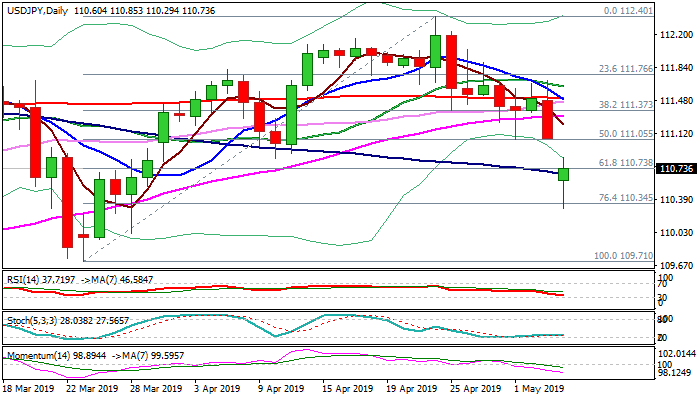
Thinner market due to Japan's holiday, also contributed to the action The USDJPY pair opened with big gap lower on Monday and fell through daily cloud, to find footstep at cloud base (110.30).
Extension of Friday's fall (the pair was down around 0.4%) threatens testing psychological 110.00 support and possible extension towards key near-term supports at 109.71/58 (25 Mar trough/weekly cloud base), if fresh bears clearly break below daily cloud.
Meanwhile, consolidation above new five-week low holds within daily cloud (110.30/81) as rising bearish momentum and daily MA's in full bearish setup formed multiple bear-crosses, maintain negative outlook.
Consolidation should ideally remain within daily cloud, but extended upticks need to stay below 111.05 (Friday's low/broken 50% of 109.71/112.40) to keep bears in play.
Conversely, filling today's gap would sideline downside risk and open way for further recovery towards a cluster of daily MA's at 111.30/60 zone.
Res: 110.81, 111.05, 111.30, 111.50
Sup: 110.63, 110.30, 110.00, 109.71
EUR/JPY Decline Likely To Continue
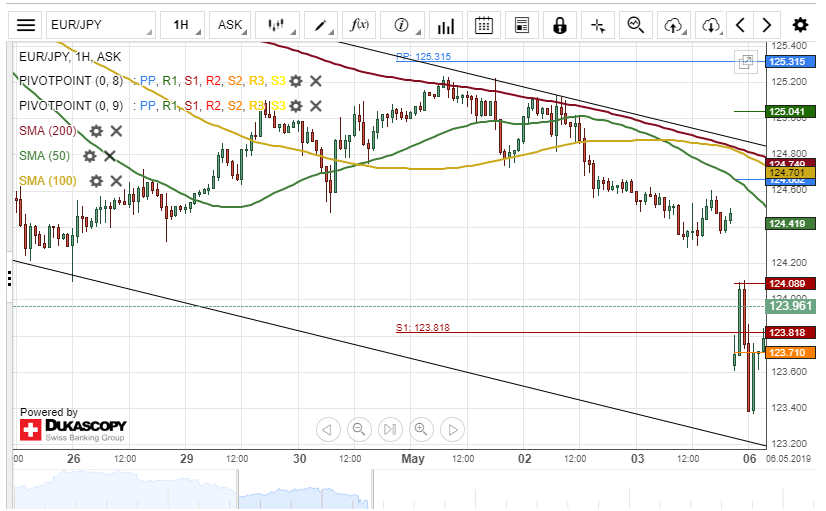
The common European currency has depreciated about 1.46% in value against the Japanese Yen since the beginning of May. The currency pair opened with a gap during the morning hours of today's trading session.
Everything being equal, it is likely that bears would drive the currency exchange rate further south within this session. The potential downside targets will be near the bottom border of a descending channel at 123.20.
However, given that the EUR/JPY exchange rate opens with a gap during Monday's trading session, from a theoretical point of view, the pair is expected to fill the gap within this session.
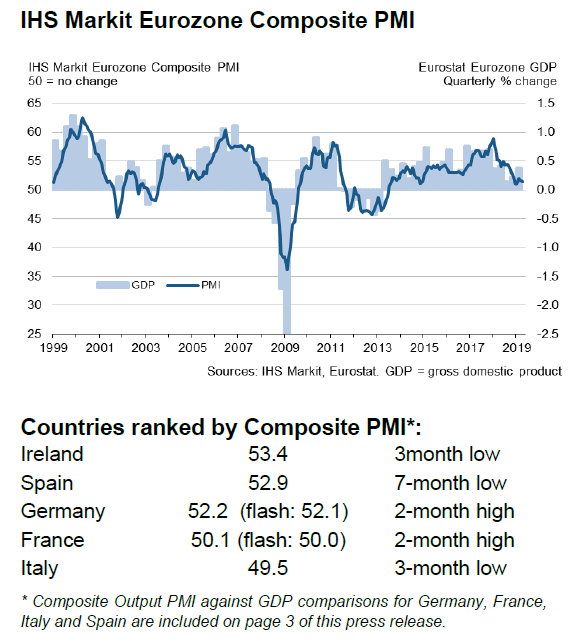
Eurozone PMI composite finalized at 51.5, suggests around 0.2% GDP growth in Q2
Eurozone PMI services was finalized at 52.8 in April, up from March reading of 53.3. Eurozone PMI composite was revised up to 51.5, down from March reading at 51.6. Looking at the members states, Italy PMI composite dropped to 49.5, 3-month low. Improvements were seen in France and Germany, as PMI composites hit 50.1 and 52.2 respectively, both at 3 month high.
Chris Williamson, Chief Business Economist at IHS Markit said:
“The final eurozone PMI for April came in slightly higher than the flash estimate, though still indicated that the economy lost a little momentum at the start of the second quarter and that growth remains worryingly lacklustre. The survey is indicative of the economy growing at a quarterly rate of approximately 0.2%, but manufacturing remained mired in its steepest downturn since 2013 and service sector growth slipped lower.
“In a month in which oil prices continued to rise, it was no surprise to see input cost inflation accelerating for the first time in six months. It is therefore disappointing to see average selling prices for goods and services showing the smallest monthly rise since August 2017, strongly hinting at weakened pricing power and lower core inflationary pressures as firms were often unable to pass higher costs on to customers.
“Weak demand remains the key to the lack of inflationary pressures. Although inflows of new orders for goods and services picked up further from the low-point reached back in January, the increase was among the smallest seen since late 2014. Worryingly, growth of output continues to run ahead of that of new orders, meaning even the modest current growth of business activity is only being sustained by firms eating into orders placed in prior months. Demand clearly needs to improve further to generate faster economic growth and give firms greater pricing power.”
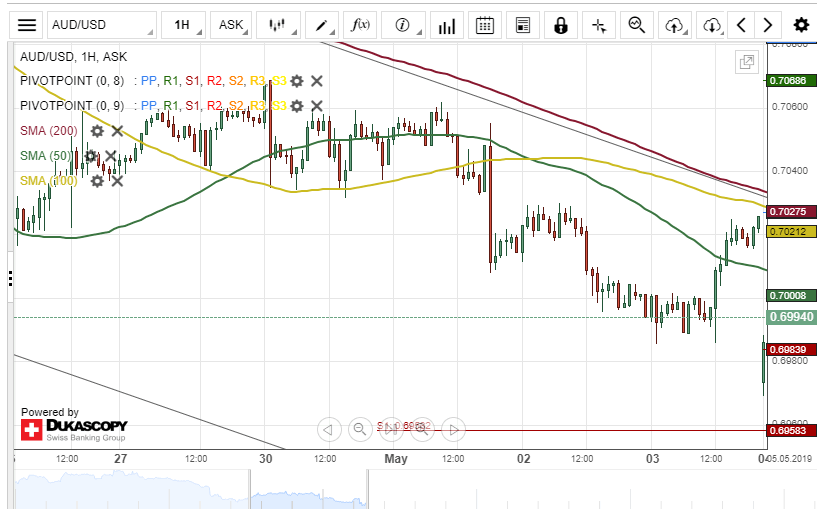
AUD/USD Sell Signals Today
The Australian Dollar has depreciated about 1.34% in value against the US Dollar since the beginning of May. The currency pair was pressured south by the 50-hour simple moving average.
As for the near future, it is likely that bullish traders would aim for a resistance level formed by the 100-hour SMA at 0.7022.
However, a resistance level set by the 50-hour SMA at 0.7002 could hinder such movement within this session.
Meanwhile, technical indicators suggest that bears could drive the currency exchange rate down today.
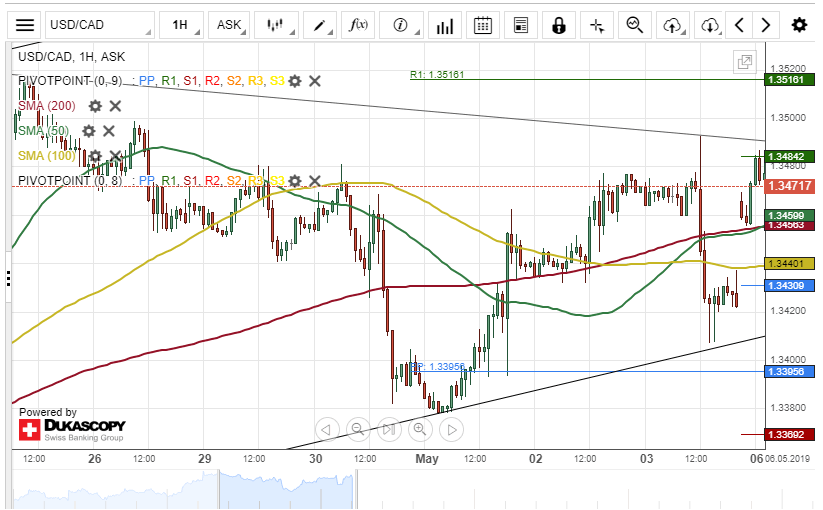
USD/CAD Moving Towards Target
The US Dollar has appreciated about 115 base points against the Canadian Dollar since the beginning of May. The currency pair has breached both the 50-, 100– and 200-hour SMAs during the period.
Bullish traders are likely to aim for a swing high at 1.3516 during the following trading session. However, the currency pair needs to surpass a resistance level formed by the upper boundary of a downtrend line at 1.3448.
Meanwhile, technical indicators flash buy signals on the daily time-frame chart. Therefore, the currency exchange rate will continue its upside movement during the following trading sessions.
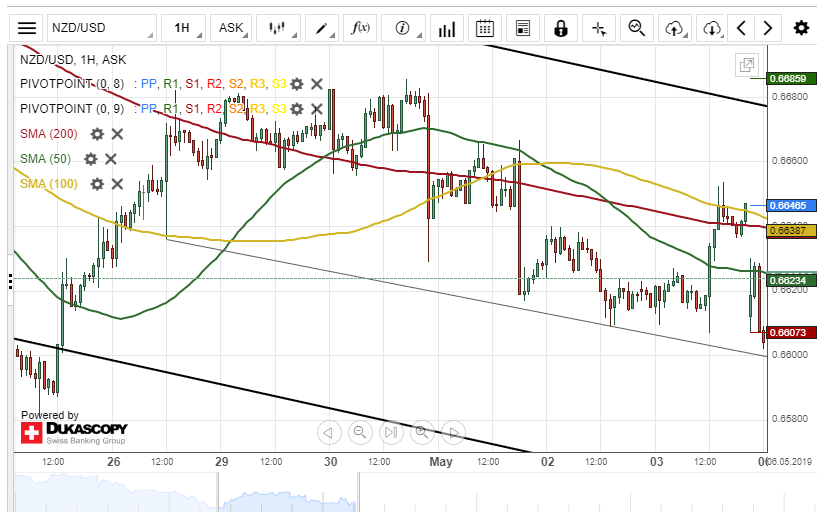
NZD/USD Pressure By Downside Risks
Downside risks have pressured the New Zealand Dollar versus the US Dollar since the beginning of May. The currency pair has depreciated about 1.22% in value during this short period.
From a theoretical point of view, it is likely that the exchange rate will continue its downward movement in the short-term. The possible target for the pair will be at the lower boundary of a downtrend channel.
Moreover, technical indicators demonstrate that the currency exchange rate will maintain the descending channel pattern during the following trading session.
Trump Threatens China With Tariff Hike
Yesterday, US President Trump threatened to hike tariffs on Chinese imports, raising tariffs from 10% to 25%. The US President, mounted pressure on China, as he considered that the US-Sino trade talks were moving too slowly. The tweets were regarded as a major shift from the US President's prior position, were he saw good progress in the negotiations. Media also reported that China considers cancelling Wednesday's negotiations in Washington. It remains to be seen whether the move is part of a negotiating tactic or if US president Trump is to follow through on his threats. In any case Trump's tweets definitely escalated the situation and the markets reacted accordingly. The development strengthened JPY which is considered as a safe haven, while at the same time plunged the AUD which is considered a close proxy to the Chinese yuan. USD/JPY opened with a negative gap during today's Asian session below the 110.90 (R1) support line (now turned to resistance), as the Yen strengthened by the developments. We could see the pair maintaining a wait and see position and we expect it to be sensitive to any further headlines regarding the US-Sino negotiations. Should there be further escalation we could see the JPY strengthening even further. If the pair comes under the selling interest of the market, it could break below the 110.30 (S1) support line and aim for the 109.75 (S2) support barrier. On the other hand, if there are buying orders, it could break the 110.90 (R1) resistance line, aiming for the 111.40 (R2) resistance level.
RBA's Interest rate decision
Tomorrow during the Asian session (04:30, GMT), RBA is to announce its interest rate decision. The bank is expected to remain on hold at +1.50% and currently the AUDOIS imply a probability of 60.81% of such a scenario. Should the bank remain on hold, we could see the market's attention turning to the accompanying statement. Given the current situation and weak Australian financial data, as well as the recent deterioration of the US-Sino relationships, we could see a dovish tone prevailing in the bank's accompanying statement. If the bank proceeds with a rate cut or maintains a dovish tone in its accompanying statement we could see the AUD weakening even further. AUD/USD dropped during today's Asian session as the AUD weakened due to Trump's threats, breaking below the 0.7000 (R1) support line (now turned to resistance). We could see the pair maintaining some bearish tendencies given to the recent developments, as well as in anticipation of the bank's interest rate decision. Should the bears take over the pair's direction, we could see it breaking the 0.6925 (S1) support line and aim for the 0.6840 (S2) support hurdle. Should the bulls dictate the pair's direction, we could see it breaking above the 0.7000 (R1) resistance line and aim for the 0.7065 (R2) resistance level.
Other economic highlights, today and early tomorrow
In the European morning, we get from Germany's final Services PMI for April and during tomorrow's Asian session we get Australia's retail sales growth rate and trade balance figure both for March. As for speakers, please note that the Philadelphia Fed President Harker and BoC governor Poloz are speaking today.
As for the rest of the week:
On Tuesday, we get from Germany March's factory orders growth rate and from the UK the Halifax house prices for March. On Wednesday, we get the RBNZ's interest rate decision along with China's Trade Balance for April. On Thursday, we get the China's CPI rates, the US PPI rates for April, and Canada's Trade balance March. On Friday, we get the UK GDP for Q1 and the US CPI rates for April.
USD/JPY H4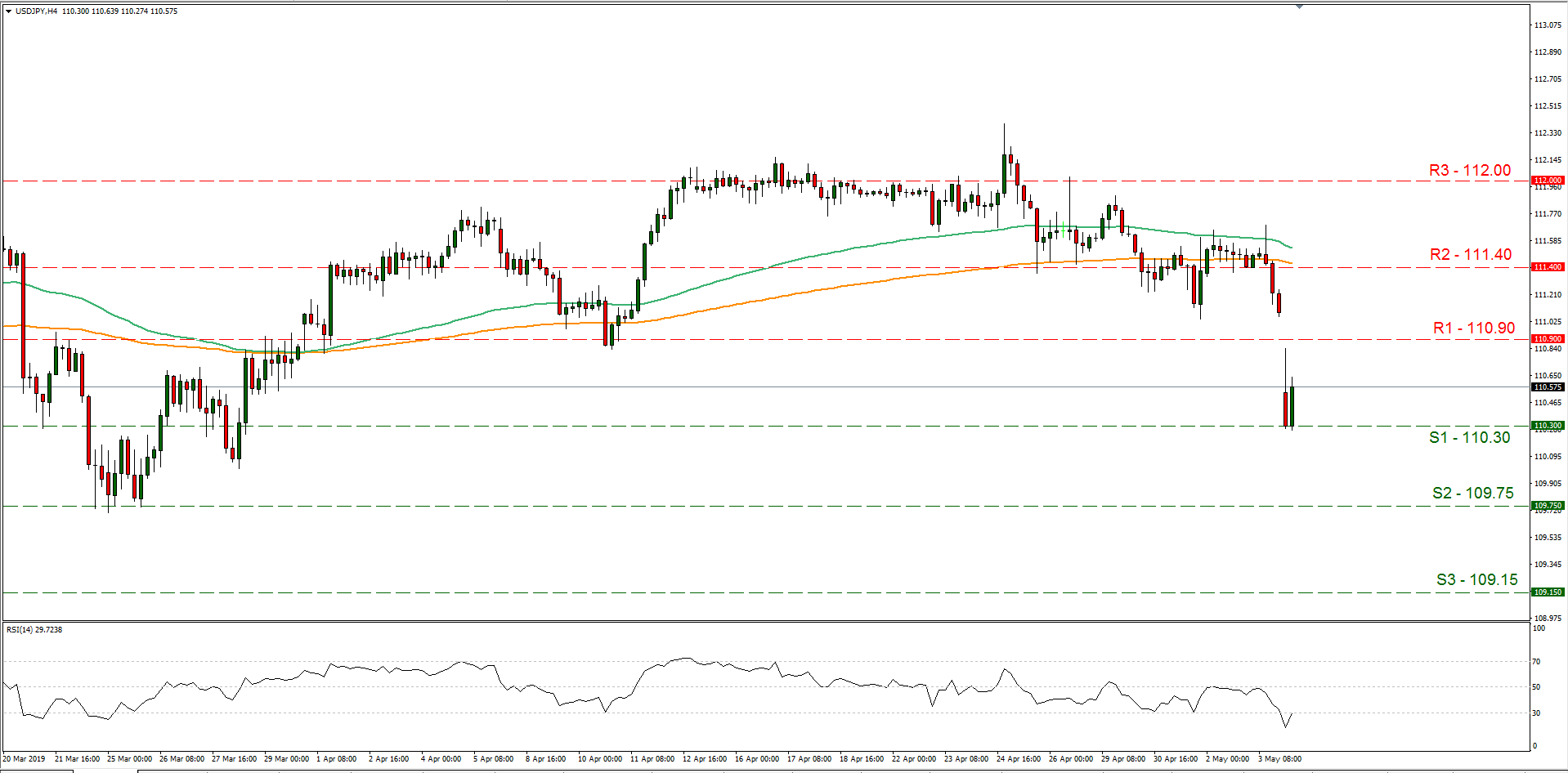
Support: 110.30 (S1), 109.75 (S2), 109.15 (S3)
Resistance: 110.90 (R1), 111.40 (R2), 112.00 (R3)
AUD/USD H4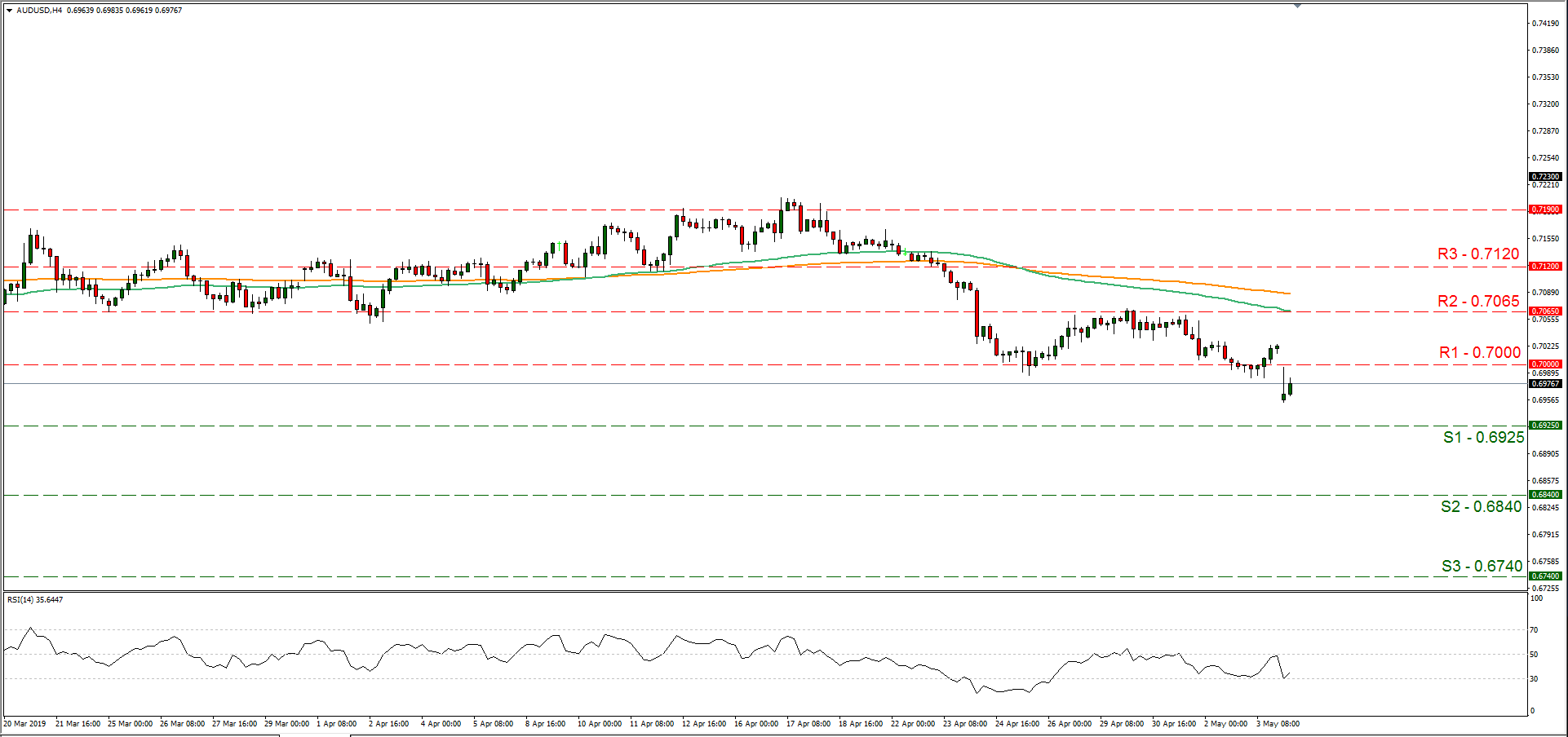
Support: 0.6925 (S1), 0.6840 (S2), 0.6740 (S3)
Resistance: 0.7000 (R1), 0.7065 (R2), 0.7120 (R3)