Sample Category Title
Yen and Dollar Stand Tall on US-China Trade War Threat
Imminent threat of full blown US-China trade war is the dominant theme in the global financial markets today. Chinese stocks were hardest hit, down the most in more than three years. Other Asian markets were generally down while Japan continued to enjoy its ultra-long 10-day holiday. European markets are also broadly pressured. Declines somewhat slowed after refrained response from China.
In the currency markets, Yen and Dollar remain the strongest one for today. At this point, Euro is the third strongest, with help from better than expected investor sentiment data and rebound in EUR/GBP. On the other hand, the Pound is the weakest one, paring some of last week strong gains. It's strength was built on optimism of a Brexit deal between Conservative and Labour. But they're have to deliver to solidify Sterling's strength. New Zealand and Australian Dollars are the next weakest, awaiting possible rate cut by respective central banks later in the week.
Technically, for now, the rally in Yen and Dollar somewhat halted after initial response to trade war news. Yen crosses and commodity currencies are staying generally vulnerable. EUR/JPY is pressing 123.39 key support and sustained break will confirm near term bearish reversal. Break of 144.80 minor support in GBP/JPY will bring deeper fall to key support at 143.72, and break there will also confirm bearish reversal. AUD/USD resumed recent decline from 0.7295 and focus will turn to tomorrow's RBA rate decision. A rate cut, or even a hints on rate cut, could send AUD/USD further lower.
In Europe, FTSE is on holiday. DAX is down -1.85%. CAC is down -1.93%. German 10-year yield is down -0.0162 at 0.012, staying positive. Earlier in Asia, Hong Kong HSI dropped -2.90%. China Shanghai SSE dropped -5.58%. Singapore Strait Times dropped -3.00%. Japan remains in 10-day holiday.
Trump blames China for USD 500B loss in trade every year, to escalate trade war
Trump continues his pressure on China with new tweet in the morning. He played victim again and said the US has been losing, “for many years”, USD 600 to 800B a year on Trade. And “with China we lose 500 Billion Dollars”. He added “sorry, we’re not going to be doing that anymore!”
Yesterday, Trump decided to escalate US-China trade war to full-blown level, instead of pushing for a long awaited agreement this week. In short, , Trump announced to raise the 10% tariffs on the USD 200B of “other goods” to 25%. Additionally, currently “untaxed” USD 325B will be tariffed at rate of 25%. That’s not a warning as White House Economic Adviser Larry Kudlow guessed, as there was not conditions attached. Trump’s tweet was simply an announcement.
Chinese trade delegation still preparing to travel to US, but no indication on timeline
In wake of Trump’s new tariff threats, Chinese Foreign Ministry spokesman Geng Shuang said a Chinese delegation was still preparing to travel to the US for another round of trade negotiations. However, there was no indication on the date of the trip, nor whether Vice Premier Liu He will lead the team.
Geng said in a press briefing that “we are now trying to get more information on the relevant situation.” And, “what I can tell you is that the Chinese team is preparing to travel to the U.S. for trade talks.”
“What is of vital importance is that we still hope the United States can work hard with China to meet each other half way, and strive to reach a mutually beneficial, win-win agreement on the basis of mutual respect,” Geng added.
Eurozone Sentix investor confidence rose to 5.3, recession risk averted
Eurozone Sentix Investor Confidence rose to 5.3 in May, up from -0.3 and beat expectation of 1.1. Current Situation index rose from 3.8 to 11.0. Expectations index rose from -4.3 to -0.3, highest since March 2018. Sentix noted that the danger o recession in Eurozone is “averted”. Global environment made a “significant contribution” to the positive development. Danger of unregulated Brexit has been averted until at least October. It also said the forthcoming elections in Europe will “take place in a relaxing economic environment”.
For Germany, Overall index rose to 7.9, up from 2.1, and hit the highest since November 2018. Current situation index rose from 10.5 to 18.3. Expectations index rose from -6.0 to -2.0, highest since February 2018. Sentix noted that the spark from the Chinese economy, which has recovered significantly since the start of the year, is “increasingly jumping over to the export-dependent German economy”.
Eurozone PMI composite finalized at 51.5, suggests around 0.2% GDP growth in Q2
Eurozone PMI services was finalized at 52.8 in April, up from March reading of 53.3. Eurozone PMI composite was revised up to 51.5, down from March reading at 51.6. Looking at the members states, Italy PMI composite dropped to 49.5, 3-month low. Improvements were seen in France and Germany, as PMI composites hit 50.1 and 52.2 respectively, both at 3 month high.
Chris Williamson, Chief Business Economist at IHS Markit said the final PMIs are " indicative of the economy growing at a quarterly rate of approximately 0.2%, but manufacturing remained mired in its steepest downturn since 2013 and service sector growth slipped lower."
Also released, retail sales rose 0.0% mom in March versus expectation of -0.1% mom. Australia TD Securities inflation rose 0.2% mom in April. China Caixin PMI services rose 0.1 to 54.5 in April, above expectation of 54.2.
USD/CHF Mid-Day Outlook
Daily Pivots: (S1) 1.0145; (P) 1.0180; (R1) 1.0200; More.....
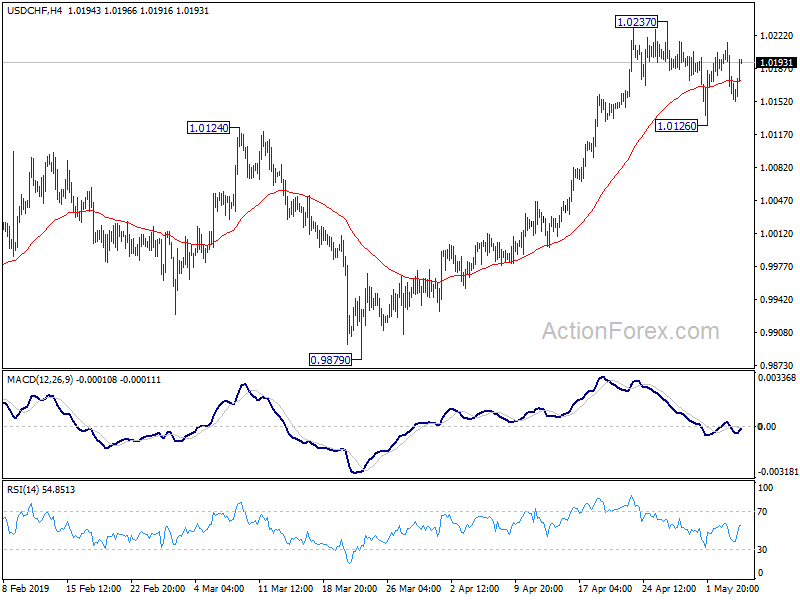
USD/CHF rebounds notably today but stays in range below 1.0237. Intraday bias remains neutral first and more consolidation could still be see. On the upside, break of 1.0237 will resume larger rise from 0.9186 to 1.0342 key resistance. However, break of 1.0126 will turn bias to the downside for deeper decline to 55 day EMA (now at 1.0066).
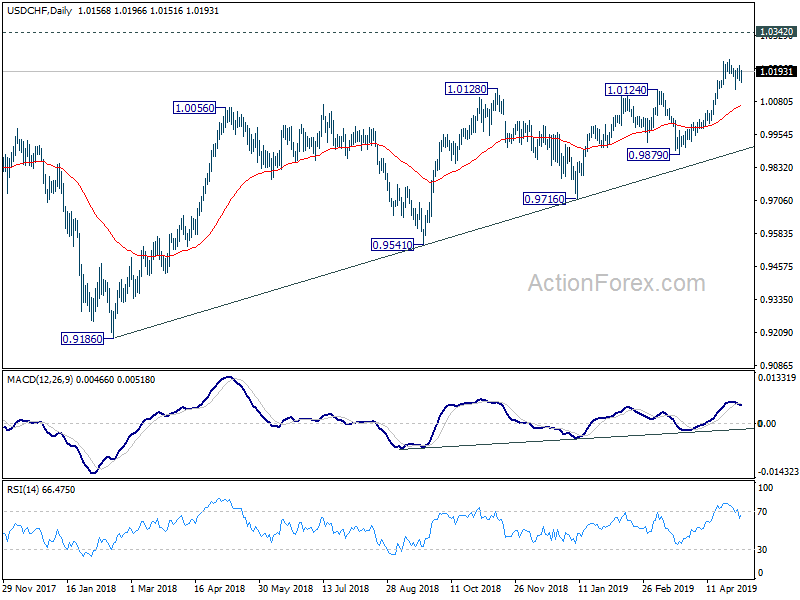
In the bigger picture, medium term up trend from 0.9186 is extending. Current rise should target 1.0342 resistance next. For now, we'd be cautious on strong resistance from there to limit upside, until we see medium term upside acceleration. On the downside, break of 0.9879 support is needed to indicate reversal. Otherwise, outlook will stay bullish in case of deep pull back.
Economic Indicators Update
| GMT | Ccy | Events | Actual | Consensus | Previous | Revised |
|---|---|---|---|---|---|---|
| 1:00 | AUD | TD Securities Inflation M/M Apr | 0.20% | 0.40% | ||
| 1:45 | CNY | Caixin China PMI Services Apr | 54.5 | 54.2 | 54.4 | |
| 7:45 | EUR | Italy Services PMI Apr | 50.4 | 54.4 | 53.1 | |
| 7:50 | EUR | France Services PMI Apr F | 50.5 | 50.5 | 50.5 | |
| 7:55 | EUR | Germany Services PMI Apr F | 55.7 | 55.6 | 55.6 | |
| 8:00 | EUR | Eurozone Services PMI Apr F | 52.8 | 52.5 | 52.5 | |
| 8:30 | EUR | Eurozone Sentix Investor Confidence May | 5.3 | 1.1 | -0.3 | |
| 9:00 | EUR | Eurozone Retail Sales M/M Mar | 0.00% | -0.10% | 0.40% | 0.50% |
AUDJPY Opens With Gap Down; Reaches 4-Month Low
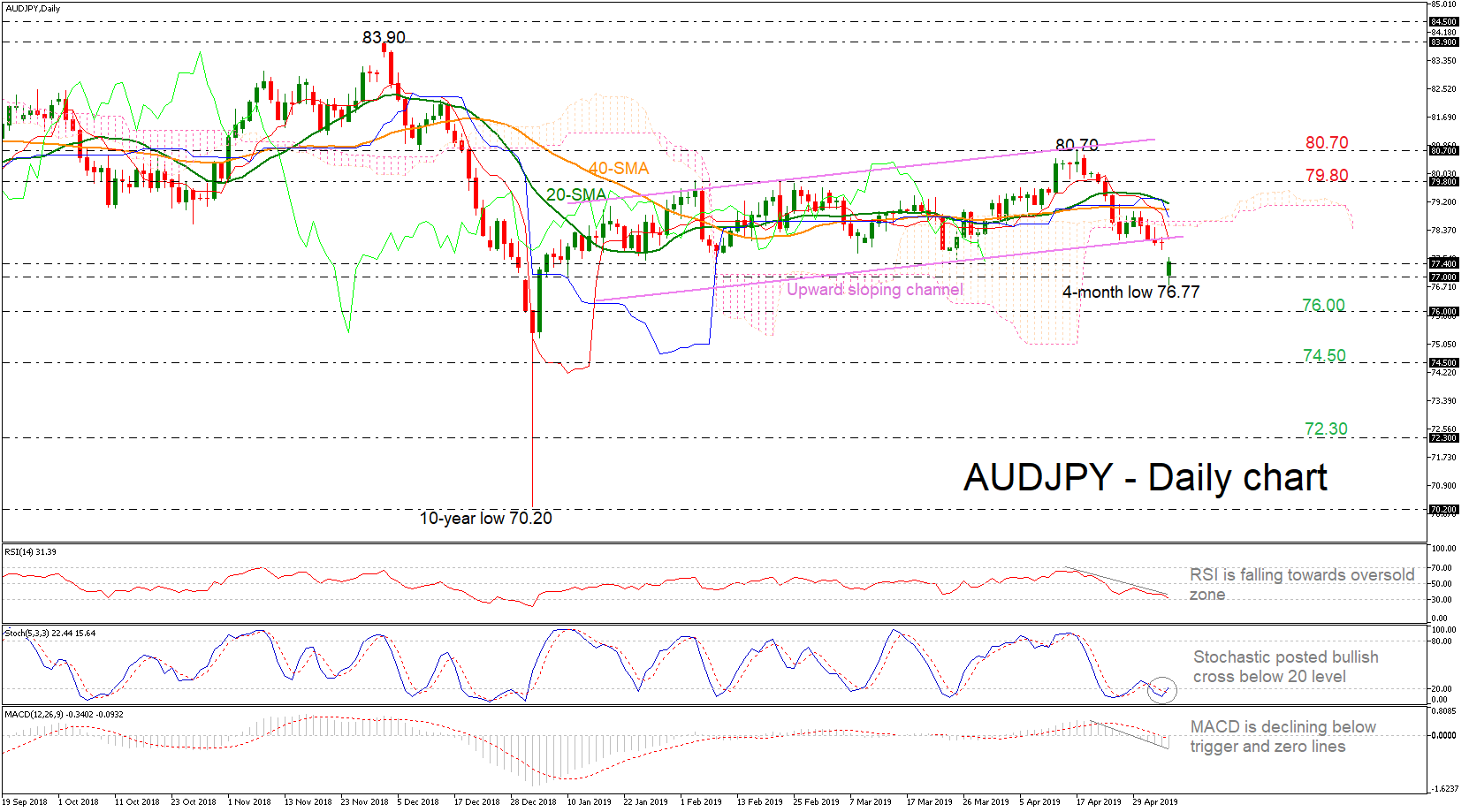
AUDJPY opened with a negative gap today, reaching a new four-month low of 76.77. The pair penetrated the upward sloping channel to the downside raising speculation that the downward move may continue in the daily chart. The price is holding beneath the Ichimoku cloud, while the MACD and the RSI are trending in the negative territory. Still, the stochastic oscillator, which posted a bullish cross within the %K and %D lines in the oversold zone, suggests that a rebound is possible in the short term.
Should the pair strengthen positive momentum as the stochastic indicator signals, resistance could come around the red Tenkan-sen line currently at 78.20 before attention turns to the 40- and 20-SMAs at 79.00 and 79.20 respectively. Above these levels, the next target could be the 79.80 barrier.
However, if prices fail to recoup the negative gap, the focus will shift to the 76.00 handle, taken from the low on September 2016. The 74.50 support registered on July 2017 could be the next key level to watch.
In brief, AUDJPY has been trading below the upward sloping channel today, increasing chances for more bearish actions.
Into US session: Yen and Dollar strongest as trade war threat prompts risk aversion
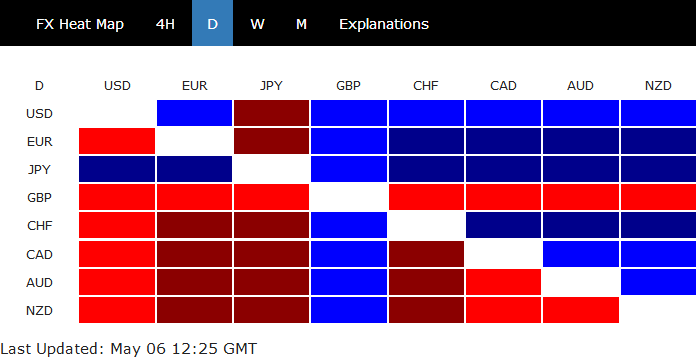
Entering into US session, Yen remains the the strongest on today, followed by Dollar. Risk aversion dominate the global financial markets as Trump decided to re-escalate US-China to full blown level and announced to raise tariffs on Chinese imports this Friday. Trump then double down with another tweet today, blaming Chines for US loss in trade and pledged not to take that anymore. China's response has been refrained so far, indicating that the delegation is still in preparation to travel to the US. That helps halting free fall in the risk markets.
For now, Euro is third strongest, partly helped by better than expected investor sentiment data. Sterling is the weakest one as it pares back some of last week's gain, additional pressured by rebound in EUR/GBP. Australian Dollar and New Zealand Dollar follow as next weakest. Both currencies are facing risks of central rate cuts this week, starting with RBA tomorrow.
In other markets, currently:
- DOW future is down -455 pts
- Gold is down -0.05%.
- WTI crude oil is down -0.88%.
In Europe:
- FTSE is on holiday.
- DAX is down -1.81%.
- CAC is down -1.87%.
- German 10-year yield is down -0.0106 at 0.018, staying positive.
Earlier in Asia:
- Hong Kong HSI dropped -2.90%.
- China Shanghai SSE dropped -5.58%.
- Singapore Strait Times dropped -3.00%.
- Japan remains in 10-day holiday.
Pound Volatility Continues in Thin Holiday Trade
GBP/USD has started the week with considerable losses, after posting sharp gains on Friday. Currently, GBP/USD is trading at 1.3106, down 0.52% on the day. British banks are close for the May Day holiday and there are no British events. On Tuesday, Germany releases factory orders and the EU posts its economic forecasts of member states. The U.S. will post JOLTS Jobs Openings.
The pound ended the week on a high note, soaring 1.1 percent. Investors reacted positively to the comments from BoE Mark Carney on Thursday. The BoE maintained interest rates, but BoE Governor Mark Carney had a hawkish message for the markets. Carney said that there could be a number of rate hikes from the bank, if Brexit is resolved and growth and inflation point higher. The markets have priced in just one rate hike until 2021, so Carney’s comments mark a vote of confidence in the British economy from the BoE. There was more positive news on Friday, as services PMI improved to 50.4 in April, up from 48.9 a month earlier.
In the U.S., the week ended with mixed employment numbers. Wage growth edged up to 0.2%, shy of the estimate of 0.3%. However, nonfarm payrolls sparkled, climbing to 263 thousand, up from 196 thousand a month earlier. The reading easily beat the forecast of 181 thousand. The unemployment rate dipped to 3.6% in April, down from 3.8% a month earlier. This marked the lowest unemployment rate since 1969.
China Shanghai SSE dropped -5.58% on trade war, next support at 2764
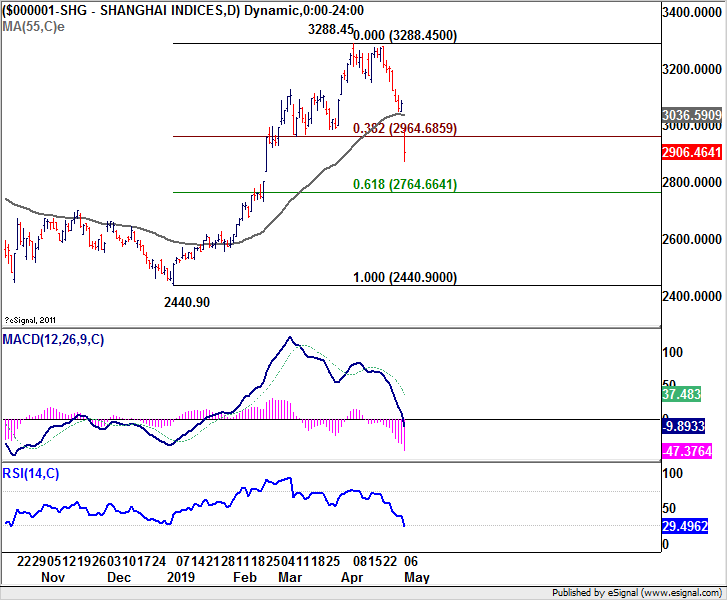
China Shanghai SSE suffered steep heavy selloff today as re-escalation of US-China trade war. The SSE dropped -5.58% to close at 2906.46, just barely held on to 2900 handle. For the near term, 38.2% retracement of 2440.90 to 3288.45 at 2964.68 was taken out with ease. Further decline is now expected to be seen back to 61.8% retracement at 2764.66.
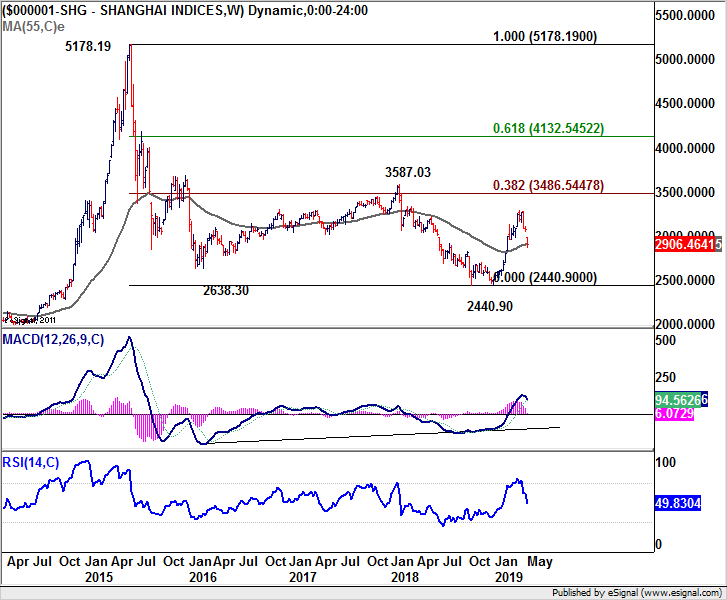
In the bigger picture, we're favoring the case that long term corrective fall from 5178.19 (2015 high) has completed with three waves down to 2440.90 (2019 low), on bullish convergence condition in weekly MACD. Hence, we'd expect strong support below above mentioned 2764.66 to contain downside and bring reversal. This will, for now remain the preferred case, unless of course, if 2440.90 is firmly taken out.
RBNZ Preview – Chance of Rate Cut Increases as Job Market and Inflation Disappoint
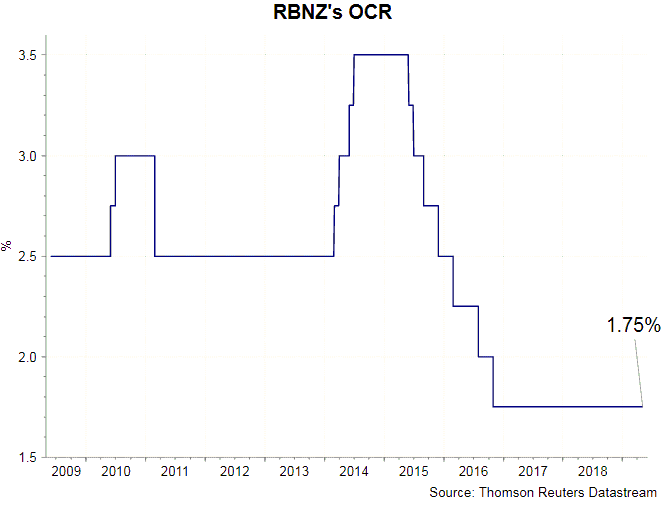
The market has priced in over 50% chance that the RBNZ would lower the OCR, by -25 bps, to 1.50% in May. Major economic indicators since the last meeting weakened. In particular, disappointing employment report and inflation in the first quarter appear to have increased the odds of a rate cut this week.
However, it is not yet a done deal. While the economic growth is slowing down, it is not freezing. It is not impossible for the central bank to wait for more data before making a decision. Whether the central bank cut the policy rate or not, we expect it to deliver a more dovish tone in the monetary policy statement. It would also revise lower the GDP growth and inflation forecasts. It would also lower the path of the OCR.
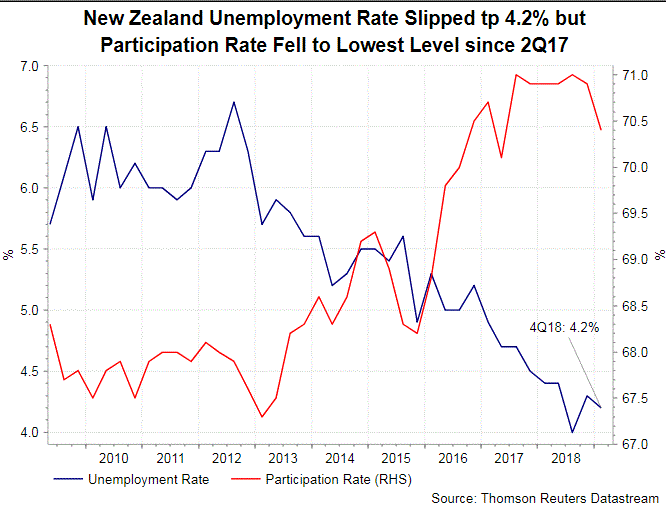
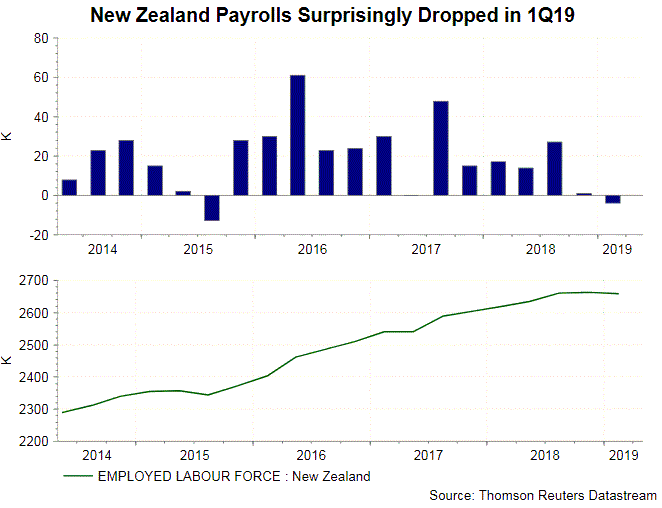
 The job market has shown signs of fatigue. Although the unemployment rate slipped to 4.2% in 1Q19 from 4.3% in the prior quarter, the participation rate dropped -0.5 percentage point to 70.4%, missing consensus of 70.9%. The fall in the participation rate to the lowest level since 2Q17 not only artificially sent lower the unemployment rate, but also has evidenced that job seekers have become more frustrated about the job environment. Yet, since the unemployment rate has continued to decline, the members should be able to retain the assessment that the “employment is near its maximum sustainable level”.
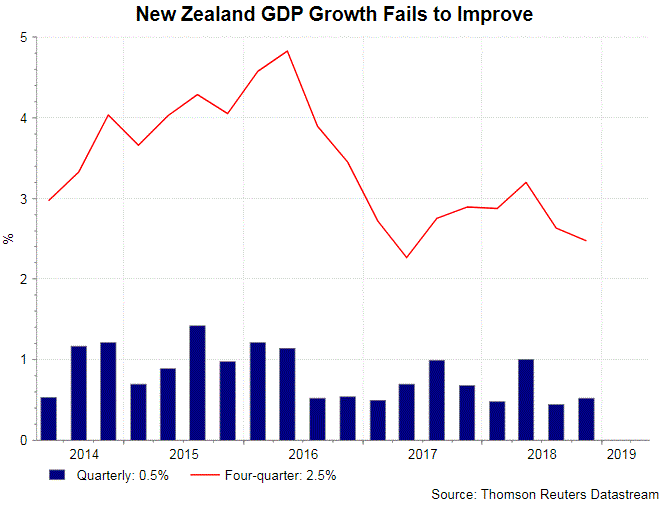
Inflation has continued to slow. Headline CPI decelerated significantly to +1.5% y/y in 1Q19, from +1.9% a quarter ago. The market had anticipated a more modest moderation to +1.7%. The fact that inflation has fallen below the midpoint of RBNZ’s target range of 1-3% should lead the central bank to deepen its dovish bias. On a separate note, GDP growth slowed to +2.3% q/q in 4Q18, weaker than RBNZ’s forecast of +2.7% and the slowest rate since 4Q13.
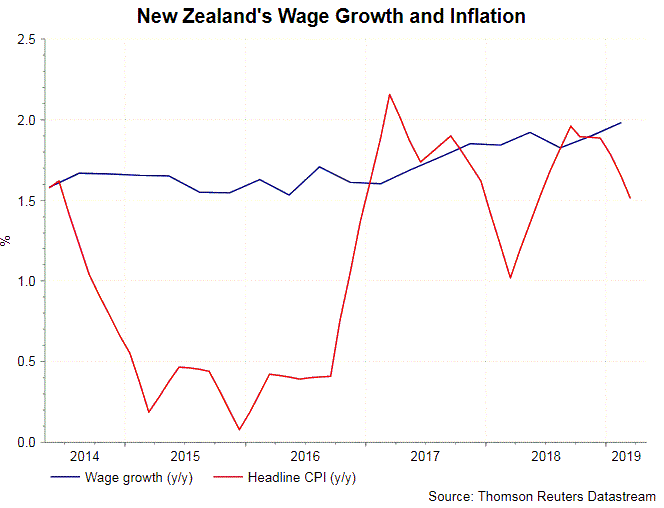
 Yet, there are other developments supporting a no change in the monetary policy. NZDUSD has fallen more than -3% since the March meeting. Such development, expansionary in nature, should be welcomed by the members. Meanwhile, despite sluggishness in wage growth, the annual rate of growth continues to improve gradually. This should be further boosted by the +7.3% increase in the minimum wage on April 1. An optimistic view is that higher wage could later be translated to higher household consumption, as major factor of GDP.
On net, the macroeconomic backdrop appears to justify a rate cut in May. In March, RBNA shifted its monetary stance to dovish from natural, noting that “given the weaker global economic outlook and reduced momentum in domestic spending, the more likely direction of our next OCR move is down”.
Assume a rate cut is announced this week, we expect a more dovish policy statement is accompanied, suggesting further reduction. Even if the central bank decides to stand on the sideline this week, it would deepen the dovish guidance, affirming further deterioration in the economic outlook suggests a rate cut is likely some time later. Whether the central bank cut the policy rate or not, we expect it to revise lower the GDP growth and inflation forecasts. It would also lower the path of the OCR.
Trump blames China for USD 500B loss in trade every year
Trump continues his pressure on China with new tweet in the morning. He played victim again and said the US has been losing, "for many years", USD 600 to 800B a year on Trade. And "with China we lose 500 Billion Dollars". He added "sorry, we're not going to be doing that anymore!"
Yesterday, Trump decided to escalate US-China trade war to full-blown level, instead of pushing for a long awaited agreement this week. In short, , Trump announced to raise the 10% tariffs on the USD 200B of "other goods" to 25%. Additionally, currently "untaxed" USD 325B will be tariffed at rate of 25%. That's not a warning as White House Economic Adviser Larry Kudlow guessed, as there was not conditions attached. Trump's tweet was simply an announcement.
https://twitter.com/realDonaldTrump/status/1125356705787850753
AUD/USD Outlook: Aussie Hit New Low As Sentiment Soured After Renewed US/China Trade Friction
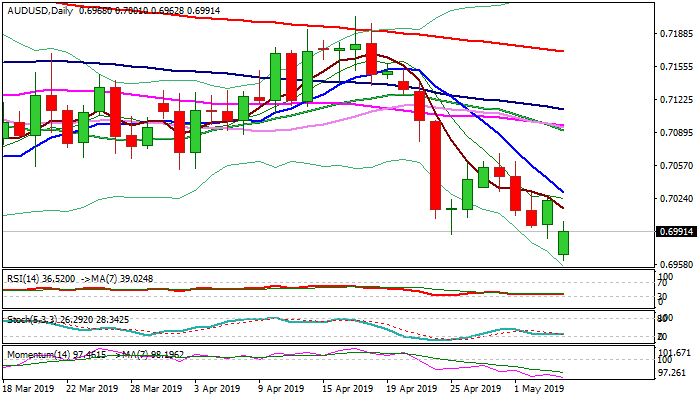
The Aussie dollar holds within choppy range above new two-month low at 0.6962, after strong gap-lower opening today, as Aussie was hurt by souring sentiment in US/China trade talks.
Fresh bears found footstep above key Fibo support at 0.6931 (61.8% of 0.6706/0.7295), violation of which would risk extension towards 0.6900 zone, where a number of stops is parked.
Firm bearish setup of daily/weekly studies maintains negative outlook which requires close below former low at 0.6988 (25 Apr).
Caution on bullish divergence on daily stochastic which gives initial signal of stronger recovery, but close above 0.6988 is seen as minimum requirement for such scenario.
Traders are focusing RBA policy meeting, due later this week, as economists are divided in forecasts for keeping rates on record low or cutting, following disappointing Q1 inflation data.
Res: 0.7000, 0.7014, 0.7029, 0.7068
Sup: 0.6962, 0.6931, 0.6900, 0.6850
USD/JPY Opens With A Gap
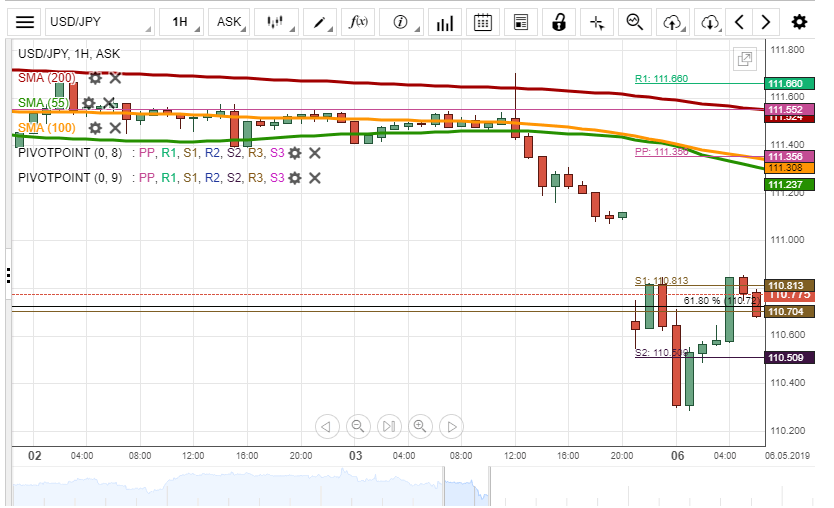
The USD/JPY started the week's trading with a large drop at the start of Monday's trading. It traded with large volatility until it finally found equilibrium near 110.70. In general, the rate has two possible scenarios.
In the bullish scenario the rate would pass the resistance of the weekly S1 at 110.81 and begin a surge up to the 55 and 100-hour simple moving averages near 111.25.
On the other hand, the currency rate might drop down to the 110.51 level. At that level the weekly S2 was located at.
Gold Breaks Resistance
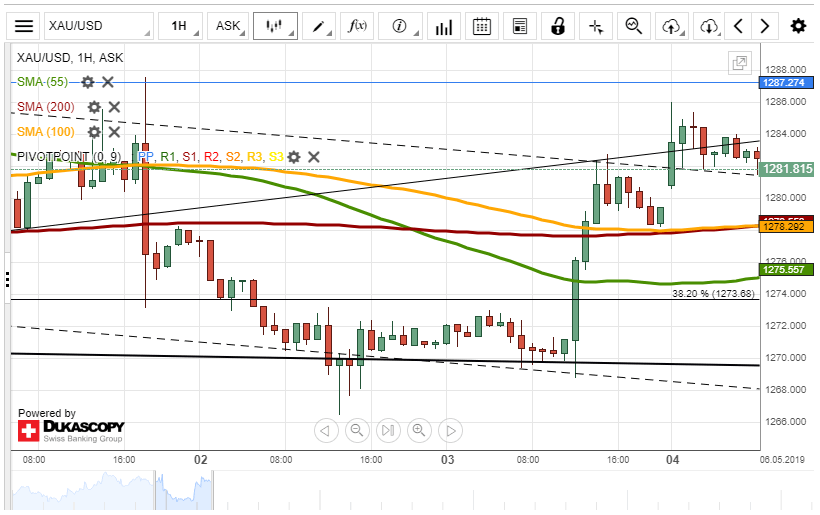
Gold started the week by surging and breaking the resistance of a descending channel pattern. The move was expected, as already on Friday the pair clearly bounced off the support of a dominant pattern and began to surge.
In regards to the near term future, Dukascopy Analytics expects a consolidation of the gains. Namely, the metal's price will remain unchanged by trading sideways.
Afterwards, the hourly simple moving averages would catch up and push the commodity price into the resistance of the monthly PP at 1,287.27