Sample Category Title
Lighthizer and Mnuchin noted erosion of commitment by China in trade talks
More information is now revealed on why US-China trade tensions suddenly heightened.US Trade Representative Robert Lighthizer complained China reneges on its commitment during that trade negotiations as "we felt we were on track to get somewhere". For now, significant issues remain unresolved in trade negotiations. He specifically criticized that "over the course of last week we have seen an erosion of commitments by China" And, "that in our view is unacceptable.”
Treasury Secretary Steven Mnuchin also noted that in the new draft of the agreement sent over from China during the weekend, China pulled back on language in the text on a number of issues. Such changes had the "potential to change the deal very dramatically". With the changes, China wanted to reopen areas that had already be negotiated. Mnuchin said “we are not willing to go back on documents that have been negotiated in the past".
The drastic change in China's commitment infuriated Trump, who announced to push US-China trade war to full blown level with a tweet on Sunday. He planned to raise tariffs on USD 200B of Chinese goods to 25% from 10%. Also, there will be 25% tariffs on currently "untaxed" USD 325B of Chinese goods shortly.
Daily Markets Broadcast
Wall Street set to decline further
US officials have confirmed President Trump’s threat to impose more tariffs on Chinese goods on Friday, due to apparent back-tracking on early promises by the Chinese. China officials say they are still heading to Washington this week. The Reserve Bank of Australia reviews its benchmark interest rate today.
US30USD Daily Chart
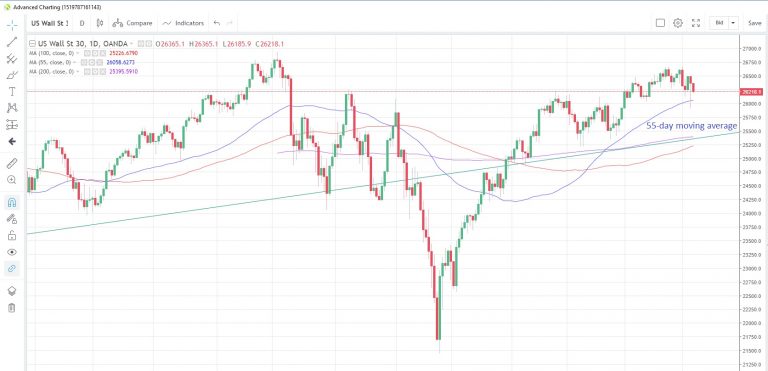
The US30 index pared back early losses but still finished in the red yesterday. Early activity today has seen further weakness after the confirmation of the tariff threat
The index is holding above the 55-day moving average at 26,058 after briefly breaking below it yesterday, the first time since January 23. The 200-day moving average is at 25,395
The IBD/TIPP economic optimism index is seen improving to 54.5 in May, according to the latest survey of economists. Fed’s Quarles is scheduled to speak.
DE30EUR Daily Chart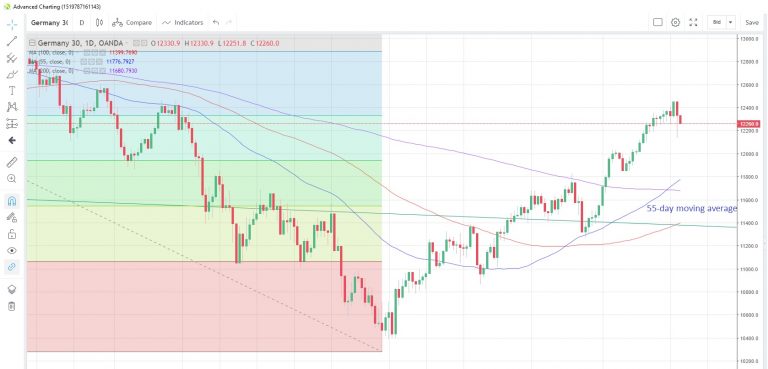
The Germany30 index looks poised for a second daily loss as it echoes weakness on Wall Street, despite an upward revision to the Markit German services PMI in April
The rising 55-day moving average is at 11,776, and has supported prices on a closing basis since February 8
German factory orders are expected to fall 6.2% y/y in March, an improvement from February’s -8.4% but it would be the 10th consecutive month of contraction.
AU200AUD Daily Chart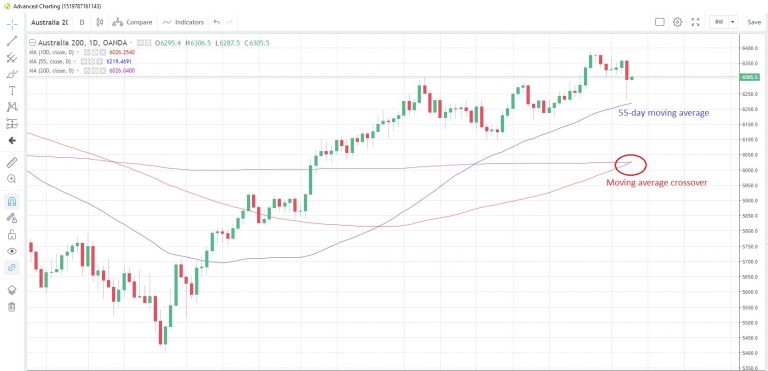
The Australia200 index is posting small gains ahead of the RBA meeting in a few hours after posting the biggest one-day decline in more than six weeks yesterday
The index is still holding above the 55-day moving average at 6,219, as it has done since January 8. The 100-day moving average is above the 200-day moving average for the first time since December 7. Some interpret this as a medium-term bullish signal
The RBA is widely expected to keep the benchmark rate unchanged at a record low of 1.5%. More interest will be focused on the accompanying statement to see whether the dovish expectations are confirmed or not.
Market Morning Briefing: Aussie Has Recovered Back To Trade At 0.70
STOCKS
Markets seems to be digesting Trump's tweet to increase tariffs on Chinese goods. Though equities tumbled have bounced back from their lows. We need to see how the market behaves for a few sessions to get a clarity. Sensex and Nifty are managing to hold their sideways range. But the weak earnings numbers and weak growth outlook keeps the bias negative for them to break the range on the downside.
As expected Dow (26438.48, -66.47, -0.25%) tested 26000 yesterday but has bounced back sharply. It needs to be seen whether it sustains above 26250 and breaks 26500 to revisit 26700 levels. Given the kind of volatiliy and uncertainty we can expect Dow to trade in the broad 26000-26700 range.
DAX (12286.88, -125.87, -1.01%) has to rise past 12300 to bring back the bullishness. Else it can fall back to 12100 levels and will remain bearish for a test of 12000.
Nikkei (22087.37, -171.36, -0.77%) has support at 21850 which can keep the uptrend intact for a test of 22500 over the medium term.
As expected Shanghai (2924.67, +18.21, +0.63%) has bounced after testing the 21-MA on the weekly (2873). It can test 2950-2980 in the coming sessions.
Sensex (38600.34, -362.92, -0.93%) and Nifty (11598.25, -114.00, -0.97%) retains their 38500-39500 and 11550-11800 range respectively. Sensex can test 39000 and Nifty can see 11700 in the near term and can reverse lower again. Broadly our bias remains bearish for these indices to break the range on the downside.
COMMODITIES
Risk appetite following Trump's tweet on Sunday to increase tariffs on Chinese imports and a sharp sell-off in the equities are helping gold to sustain higher. Copper is in a corrective rally. Oil has bounced but has key resistance which can halt the upmove and push it lower again.
Gold (1283.8) remains higher within its 1266-1292 range. The renewed trade US-China trade tension might allow the upside to extend beyond 1292 towards 1295-1300. However, the bigger picture is bearish to break 1266 and fall to 1260 and 1255.
Silver (14.93) has resistance at 15.05 which needs a close watch. A break above it can see 15.15-15.20 while a pull-back from there can test 14.80
The corrective rally in copper (2.83) can extend till 2.86-2.87 before a fresh fall begins targeting 2.80-2.78 levels again.
WTI (62.30) can test 63-64 while it sustains above 62. The downtrend can resume thereafter targeting 60 again.
Brent (70.28) can test 71 has room to move up even to 72 after which a fresh fall to 68-66 can be seen again.
FOREX
Dollar index (97.46) has support just below current levels and lower at 97. If the supports hold and produce a bounce, the index could rise towards 98-99 in the medium term. View is bullish.
Euro (1.1205) could test daily resistance near 1.1225-1.1230 over the next 1-2 sessions before again falling towards 1.12 or lower. Any rise beyond 1.1230 could be limited to 1.1250-1.13 on the upside and is likely to see an eventual fall in the longer run.
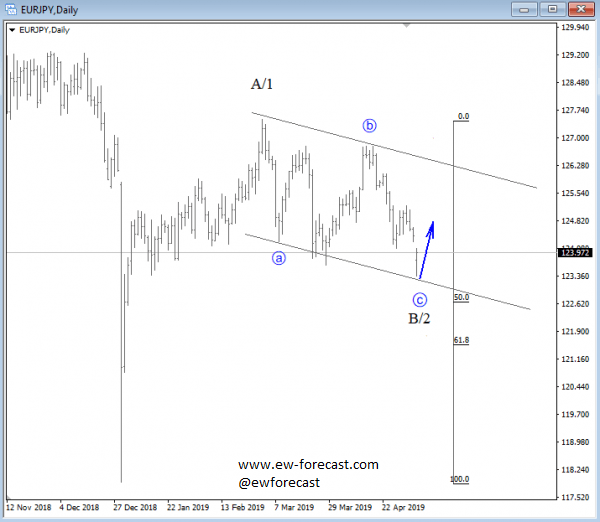
The Euro-Yen (124.05) has bounced well and could rise back towards 125 while support near 123.40/60 holds.
Dollar Yen (110.71) is trading below earlier support turned resistance at 111. While the pair trades below 111, there is scope for some ranged movement in the 111-110 region. Note important support is seen near 109.70-110.00 region that could be tested in the near term before dollar Yen bounces back towards 111.
Aussie (0.70) has recovered back to trade at 0.70. It would be important to see if Aussie rises up from here just now to again move up towards 0.71/72. Else a fall from here again could make it vulnerable to a fall towards 0.6950-0.6900.
USDCNY (6.7703) is trading higher today after closing at 6.76 yesterday. We continue to look for a rise towards 6.80/81 (wrongly mentioned as 7.80/81 yesterday) in the next few sessions.
Dollar-Rupee (69.4150) rose yesterday as major currencies weakened against the US Dollar. Trade within 69.50/60-69.25 looks possible just now. Charts suggest a possible break above 69.60 leading to a rise towards 69.65-69.97 in the near term. We would keep a close watch on the price action near immediate resistance at 69.50/60.
INTEREST RATES
The US Yields have fallen in line with our expectation. The 30Yr (2.89%) could fall towards 2.85%, 10Yr (2.48%) could fall towards 2.45/40%, while the 5Yr (2.27%) could test 2.25-2.20% in the near term. Yields look bearish just now.
The German-US 10YR (-2.47%) could rise towards -2.43/40% in the near term. -2.43/405 is an important near term resistance from where a rejection is possible. For now the yield spread is likely to rise in the coming sessions.
The US-JGB 10Yr (2.54%) has been falling from trend resistance and could fall further towards 2.50-2.45% in the coming sessions. This could be bearish for Dollar Yen in the near term.
Fed Harker and Kaplan see low inflation as transitory
Philadelphia Fed President Patrick Harker said yesterday that he saw current fall in inflation as "transitory. And he continued to see "one increase at most this year, possibly one, at most", regarding interest rates.
But he also emphasized that "If any component of the outlook were to affect my view on the appropriate path of monetary policy, it would be inflation." For now, "we're not there yet". Harker said "it would take more data to convince me" to change the policy path.
On trade, Harker also warned that tariff is "not a healthy thing for the economy overall". And trade tensions are part of an "umbrella of uncertainty" that is weighing on businesses and markets.
Separably, Dallas Fed President Robert Kaplan said current dip in inflation should be just transitory. And, he's not inclined to cut interest rate to deal with current sluggish inflation. Though, to him, there is no bias to move interest rate in either direction.
Kaplan also noted that trade uncertainty is impacting on firms' supply chains. And it has chilling effect on US industries. Though, trade uncertainty is not yet having material impact on US GDP. He's also concerned with deceleration in global economy.
GBP/USD Could Rebound Further Above 1.3200
Key Highlights
- The British Pound rebounded nicely and traded above 1.3150 against the US Dollar.
- A major bullish trend line is forming with support near 1.3035 on the 4-hours chart of GBP/USD.
- The Euro Area Retail Sales in March 2019 increased 1.9% (YoY), better than the 1.8% forecast.
- UK's BRC Like-for-Like Retail Sales in April 2019 could increase 2.4% (YoY).
GBPUSD Technical Analysis
This past week, the British Pound formed a strong support near 1.2920 against the US Dollar. As a result, the GBP/USD pair started an upward move and climbed above 1.3000, 1.3040 and 1.3100.
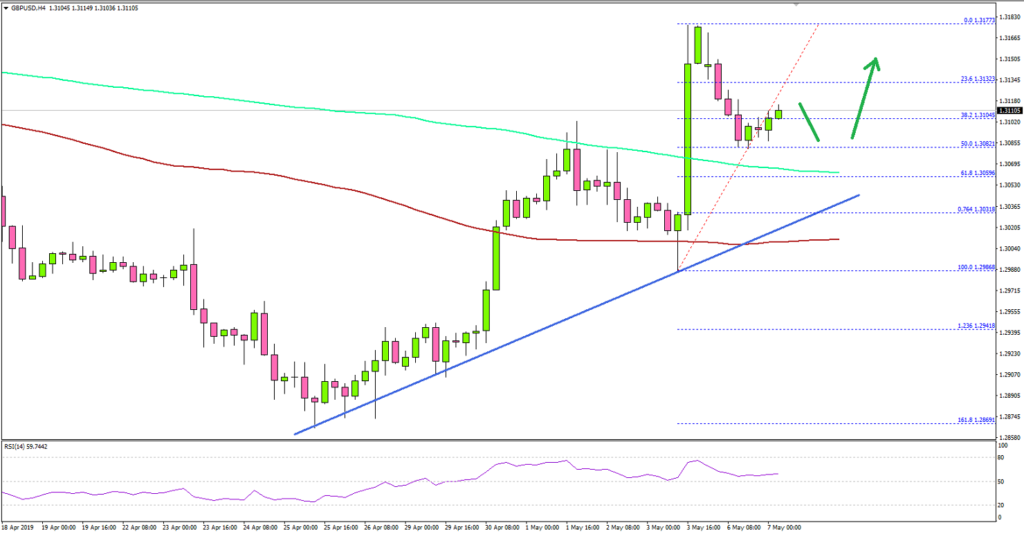
Looking at the 4-hours chart, the pair rallied sharply from the 1.2986 swing low. It broke the 1.3150 resistance level and settled well above the 100 simple moving average (red, 4-hours).
A new monthly high was formed at 1.3177 and recently the pair corrected lower. It broke the 1.3120 level and tested the 50% Fib retracement level of the last wave from the 1.2986 low to 1.3177 high.
On the downside, there are many supports near the 1.3050, 1.3040 and 1.3035 levels. There is also a major bullish trend line forming with support near 1.3035 on the same chart. Besides, the 76.4% Fib retracement level of the last wave from the 1.2986 low to 1.3177 high is near the 1.3031 level.
Only a daily close below the 1.3000 support and the 200 simple moving average (green, 4-hours) could start a fresh bearish wave in the near term. Conversely, the pair is likely to bounce back above 1.3140 and 1.3150.
On the upside, a clear break above the 1.3177 high might open the doors for a test of the 1.3200 resistance level. The next key resistances are near 1.3220 and 1.3245.
Looking at the other major pairs, EUR/USD is still struggling below the 1.1250 resistance level, and USD/JPY seems to be facing an increase in selling pressure.
Economic Releases to Watch Today
- UK Halifax House Prices for April 2019 (MoM) – Forecast -2.4%, versus -1.6% previous.
- US IBD/TIPP Economic Optimism Index May 2019 (MoM) – Forecast 54.2, versus 54.5 previous.
- UK BRC Like-for-Like Retail Sales April 2019 (YoY) – Forecast +2.4%, versus 1.1% previous.
Thunder From The Land Down Under
Thunder from the land down under
After a veritable stock-market bonfire in Asia yesterday – the Shanghai Composite fell 5.5% and Hong Kong’s Hang Seng dropped 2.9% – the European and North American markets spent the day convincing themselves that President Trump’s tariff tweets were a negotiation ploy to bring the Chinese back on message. As a result, they spent much of the day retracing Asia’s early losses, most notably on equities and oil.
Say what you want about the US President – and I know many do – but predictability and subtlety were never part of his election pledges. China has most certainly found this out the hard way and likely explains why they are still sending their full delegation to this week’s round of trade talks in Washington DC. I take much greater comfort in China’s pragmatism than the President’s Twitter account, but the markets should take a leaf from China’s playbook and not assume the President was merely bluffing. Bond yields fell overnight and stayed lower in a none-too-subtle warning to that effect.
Trump’s itchy social media trigger finger and its fallout should take a back seat in Asia this morning as attention turns to the land down under. Australia releases tier-one data at 0930 Singapore time in the form of retail sales and balance of payments, which is followed at 1230 Singapore time by the Reserve Bank of Australia’s (RBA) interest-rate decision. As a bellwether to global trade and with a strong correlation to China, Australian data is always watched closely – even more so with an impending election and a housing market taking on water.
However, yesterday’s shenanigans will not be enough to panic the central bank, and the RBA will take comfort in improving Asian data and the full-steam-ahead US economy. The domestic picture is far gloomier, but my base case remains that ahead of an election and with interest rates already at record lows, the RBA will want to keep its easing powder dry for as long as it possibly can. We can likely expect an unchanged rate decision but with a potentially much more dovish forward guidance than previously.
The Malaysian Central Bank also releases its latest interest rate decision this afternoon, and the markets appear to be leaning towards a 0.25% cut to 3% as inflation continues to be elusive. Like Australia, I suspect they will look to keep their powder dry and unchanged.
FX
The Aussie dollar has traded around its 0.7000 waterlines overnight, following the Monday open knee-jerk sell-off of the AUD and its New Zealand counterpart. Although the AUD never recovered its losses, at least they did not deepen, giving some solace to traders. This morning’s retail sales and balance of payments data will undoubtedly introduce some short-term volatility, but the RBA will be the main event. Markets will be looking for a more dovish central bank, and this could see the AUD come under more pressure this afternoon.
Elsewhere, the US dollar gave back much of its early safe-haven gains and finished mostly flat against the majors, with the dollar index unchanged. The Japanese yen continues to outperform on haven-buyer interest.
Regional currencies should enjoy some respite today as the tariff dust settles and we await new developments on the trade-talk front.
Equities
Regional markets should take heart from the rebound on Wall Street, where all three major indices finished only slightly lower. This leaves both Shanghai and Hong Kong primed for a possible corrective bounce given the scale of their sell-offs yesterday. Other regional markets could see toes tentatively dipped in the water as Asia takes a no-news-is-good-news approach.
Oil
Both Brent Crude and WTI staged a comeback worthy of a Rocky movie last night thanks to the US Department of Defence, which announced it was deploying a carrier strike group to the Middle East to warn Iran against attempting any mischief. I won’t let the fact the US usually has at least a couple of them in the general vicinity get in the way of a good story.
Suffice to say, oil rode a geopolitical surge, erasing early 2% sell-offs on both contracts. Brent Crude finished the day USD1.25% higher at USD71.75 a barrel, while WTI rallied 1.50% to reach USD62.90 a barrel.
With headlines and not fundamentals driving oil volatility at the moment, Asia traders will likely prefer to watch from the sidelines as events play out on the world stage elsewhere.
Gold
Gold initially surged on safe-haven buying early yesterday morning but could not maintain its gains, closing flat at USD1,280.00 an ounce. The inability of the yellow metal to move higher, even on surprise geopolitical event risk, should be somewhat worrying to gold bulls everywhere. The price action likely implies the worst is not yet over and that gold will find plenty of sellers on any rallies for now.
Eco Data 5/7/19
[php_everywhere instance="1"]
Aussie Slips Below 70 on Trump Comments, Markets Brace for RBA Rate Cut
AUD/USD has started the week with losses, dropping below the symbolic 70 line for the first time since mid-December. In the North American session, the pair is trading at 0.6994, down 0.41% on the day. On the release front, MI Inflation Gauge slowed to 0.2% in April, down from 0.4% a month earlier. ANZ Job Advertisements came in at -0.1%, after a sharp decline of 1.7% in the previous release. This marked the fifth decline in the past six months. Chinese Caixin Services PMI ticked up to 54.5, above the estimate of 54.3. There are no U.S. releases on Monday. Later in the day, Australia releases retail sales and trade balance. On Tuesday, the RBA is expected to cut the benchmark rate from 1.50% to 1.25%. The U.S. will release JOLTS Job Openings.
The Aussie is under pressure, and the headwinds could continue this week, as the RBA is widely expected to lower interest rates for the first time in 32 months. The slowdown in China has taken a toll on the Australian economy, and the RBA has been in dovish mode for some time, but has held off from lowering rates. Although the cut has been priced in by the markets, traders can expect the move to send the Australian dollar downwards.
President Trump sent the equity markets sharply lower on Monday, after threatening to raise tariffs on $200 billion worth of Chinese goods as early as Friday, from 10% to 25%. Trump sounded nonchalant about the trade talks, saying that even if an agreement wasn’t reached, the U.S. would benefit from the new tariffs. China has threatened to cancel the talks, so traders should be prepared for some swings in the currency markets in the coming days.
On Friday, the focus was on U.S. employment data in April. The numbers were mixed, as nonfarm payrolls were strong, but wage growth remained soft. Average Hourly Earnings edged up to 0.2%, up from 0.1%. However, this missed the estimate of 0.3%. Nonfarm payrolls sparkled, climbing to 263 thousand, up from 196 thousand a month earlier. The reading easily beat the forecast of 181 thousand. The unemployment rate dipped to 3.6% in April, down from 3.8% a month earlier. This marked the lowest unemployment rate since 1969.
GOLD Recovery Threats Remain Intact Despite Price Hesitation
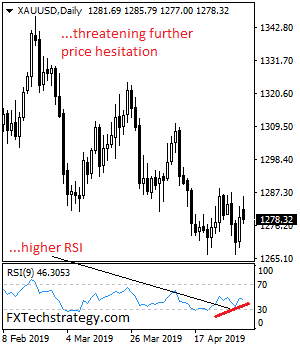
GOLD recovery threats remain intact despite price hesitation during Monday trading session. On the downside, support comes in at the 1,270.00 level where a break will turn attention to the 1,260.00 level. Further down, a cut through here will open the door for a move lower towards the 1,250.00 level. Below here if seen could trigger further downside pressure targeting the 1,240.00 level. Conversely, resistance resides at the 1,290.00 level. Further out, resistance resides at the 1,300.00 level where a break will aim at the 1,310.00 level. A turn above there will expose the 1,320.00 level. Further out, resistance stands at the 1,330.00 level. All in all, GOLD recovery threats remain intact though facing price hesitation.
Bulls Can Take EUR/JPY Over At The 122.5/122.0 Area
EURJPY is trading in a bigger, three-wave reversal up from December of 2018 lows. We labelled a completed wave A/1, which can now be followed by a temporary three-wave a-b-c pullback labelled as wave B/2, with possible support zone here at the lower side of a corrective channel range around the 122.5/122.0 region, where Fibonacci ratios of 50.0 and 61.8 can slow bears down, and can react as turning point zones for wave C/3 up back above wave A/1 swing high.
EURJPY, Daily