Sample Category Title
Aussie Jumps After Hawkish RBA Statement
Yesterday, US stocks made a comeback after seeing large losses earlier in the day. The Dow ended the day down by 67 points, which was better than the 500-point loss earlier on. The recovery came as investors concluded that a US trade deal with China was still on the table. This is because Donald Trump has used threats before in trade negotiations. Still, traders will continue to pay close attention to the ongoing happenings on trade. In Asia, stocks remained lower. The Japanese Nikkei lost 1.1%, taking a delayed hit after the country’s market opened following a 10-day break as the new Emperor took the throne.
The price of crude oil was mixed in early trading as investors waited for more data. Yesterday, prices declined sharply after the Trump announcement of US tariffs. Prices made a recovery and ended the day above the open. Today, the price of Brent declined while that of WTI rose slightly. Today, investors will receive US inventory data from the American Petroleum Institute (API). Last week, data showed an increase in inventories of more than 6.81 million barrels. Tomorrow investors expect the inventories to show an increase of more than 744K barrels.
The Australian dollar rose sharply after the RBA delivered its interest rates decision. The pair rose to an intraday high of 0.7045. The bank sounded more hawkish than most investors were expecting explaining how inflation had risen by 1.3% and in underlying terms, was at 1.6%. For the year, the bank expects it to rise by 1.75% and 2% in 2020. In an official statement, the bank said that:
The Board judged that it was appropriate to hold the stance of policy unchanged at this meeting. In doing so, it recognized that there was still spare capacity in the economy and that a further improvement in the labor market was likely to be needed for inflation to be consistent with the target. Given this assessment, the Board will be paying close attention to developments in the labor market at its upcoming meetings.
Before the rate decision, the country reported that retail sales declined by -0.1% in the first quarter. This was worse than the expected gain of 0.3%. This was the lowest growth rate in seven years. On trade, the country’s trade surplus rose to $4.94 billion, which was higher than the expected $4.49 billion.
XBR/USD
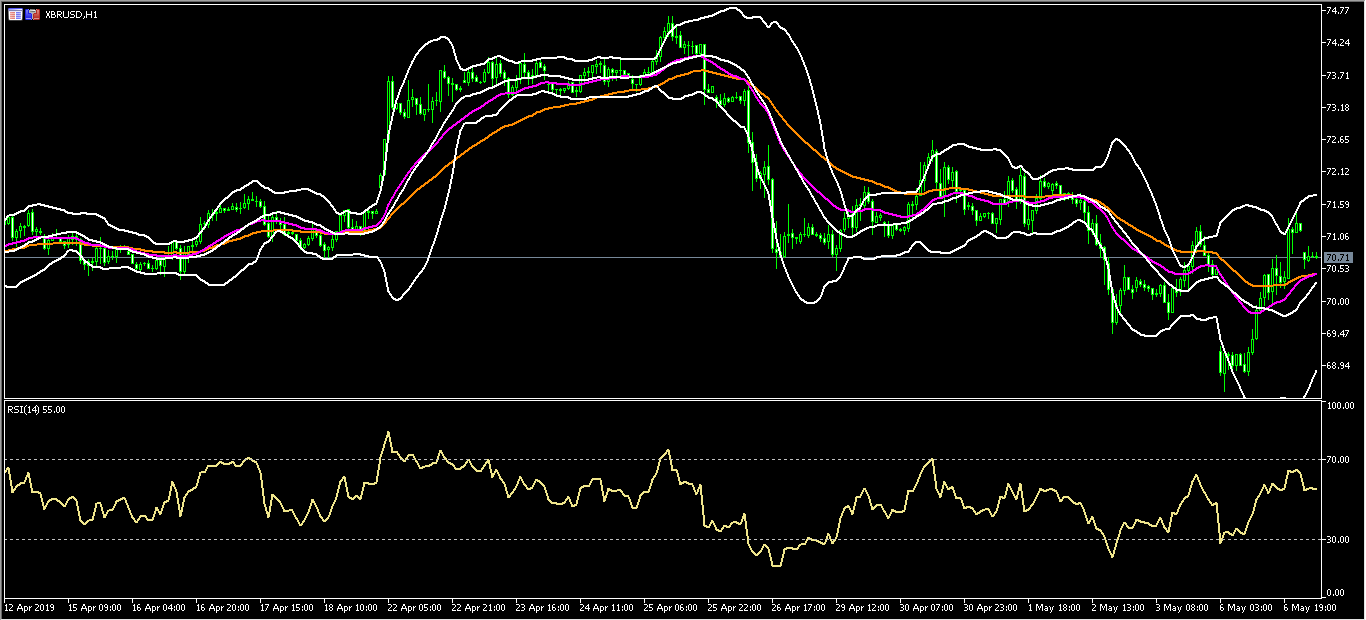
The XBR/USD pair declined to an intraday low of $70.53, which was the lowest level since yesterday. On the hourly chart, this price is slightly higher than the 50-day and 25-day moving averages. The 14-day RSI has remained unmoved at the 50 level, while the price remains between the upper and middle line of the Bollinger Bands. It is also along the 38.2% Fibonacci Retracement level. Today, the pair could retest the 50% Fibonacci level of 71.60.
EUR/USD
The EUR/USD pair rose to an intraday high of 1.1205 in the Asian session. The pair is slightly above the 25-day and 50-day moving averages. The price is slightly below the 50% Fibonacci retracement level and is above the important support shown below. There is a possibility that the pair will continue to move higher to test the 50% Fibonacci level of 1.1220.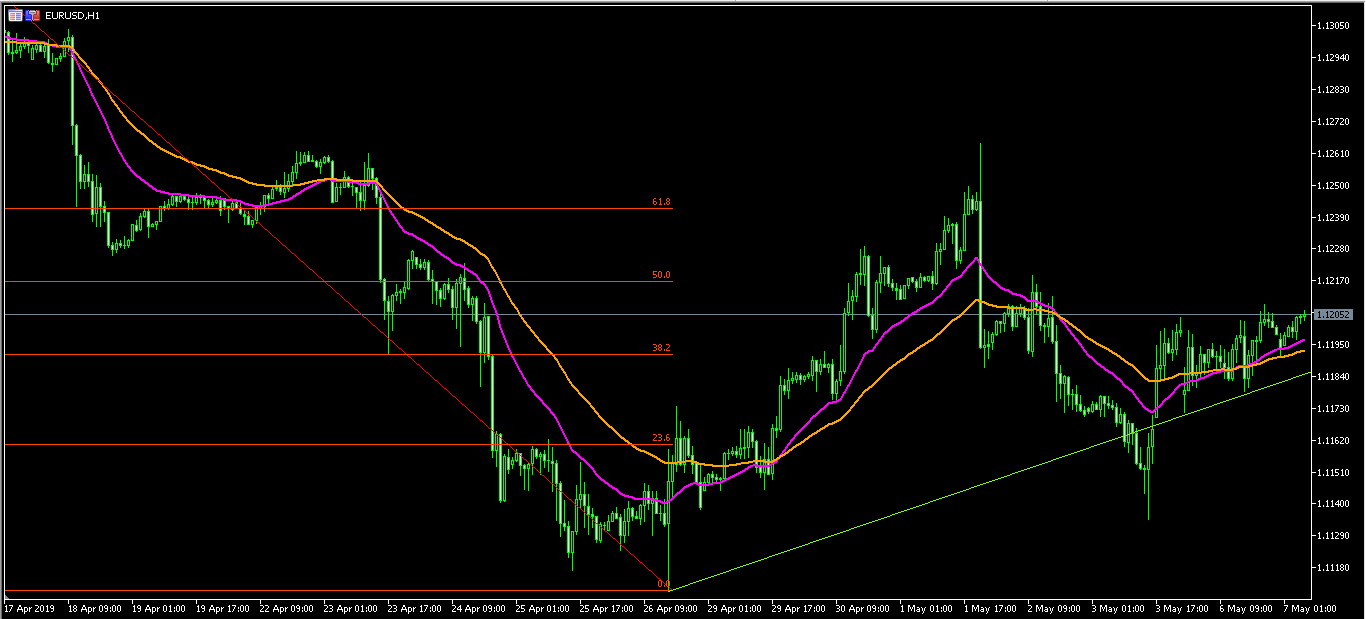
AUD/USD
The AUD/USD pair rose sharply after the RBA decision. It reached a high of 0.7045. This was the highest level since May 1. On the hourly chart, the pair is much higher than the 25-day and 50-day moving averages while the RSI has shot up above the overbought level of 70. The volumes indicator has risen too. There is a likelihood that the pair will test the 50% Fibonacci level of 0.7085.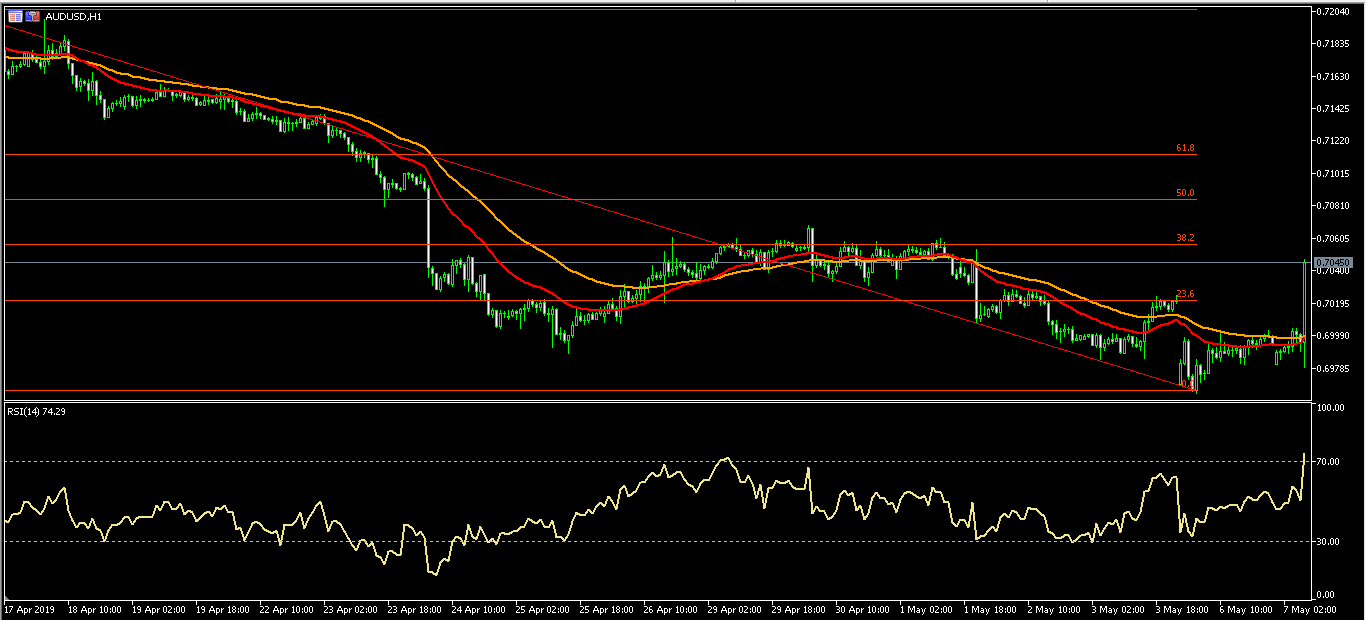
Aussie Dollar And Bond Yields Rise On Unchanged RBA
General Trend:
- Shanghai Composite rises less than 1.5% in early trade after over 5.5% decline during Monday’s session
- Trade-sensitive Shanghai Telecom Services index rises over 1% after dropping more than 9% on Monday
- Nikkei 225 declines upon return from Golden Week holiday, price action driven by catchup effect and recent earnings
- Iron ore futures rise as Vale mine resumption was blocked by court; Aussie iron ore miners gain
- South Korea Kospi drops after return from holiday as markets assess recent news related to North Korea and US/China trade
- On Monday US equities were resilient after Trump's tariff threat, concerns were eased as China is still planning to visit the US for talks according to analysts (Nikkei)
- Philippines CPI extends downward trend in April, central bank expected to meet on Thursday (consensus is for rate cut)
- China Commerce Ministry remains quiet on trade talks with the US
- China monthly FX reserves expected to be released later today
- Fast Retailing due to report monthly sales after Nikkei close
- RBNZ due to hold policy meeting tomorrow (consensus is for 25bps rate cut)
- Toyota Motor expected to report results on Wednesday
Headlines/Economic Data
Australia/New Zealand
- ASX 200 opened +0.2%
- (AU) RESERVE BANK OF AUSTRALIA (RBA) LEAVES CASH RATE TARGET UNCHANGED AT 1.50%; NOT EXPECTED, updates CPI and GDP outlooks
- (AU) AUSTRALIA MAR RETAIL SALES M/M: 0.3% V 0.2%E; Q1 Retail Sales Ex-Inflation Q/Q -0.1% V 0.3%E
- (AU) Australia Mar Trade Balance (A$): 4.95B v 4.5Be; Exports M/M: -2.0% v 0% prior; Imports M/M: -1.0% v -1.0% prior
- (NZ) Reserve Bank of New Zealand (RBNZ) Q2 Inflation Expectation Survey: 1-year: 1.9% v 1.8% prior; 2-year: 2.0% v 2.0% prior
- GNC.AU Long-Term Asset Partners withdraws A$10.42/share A$3.3B offer for company
- AGI.AU Guides H2 Pretax A$4M, weaker performance (prior saw improved performance), results impacted by intense competitive market pressures and delays to new product approvals
Japan
- Nikkei 225 opened -0.3%
- (JP) JAPAN APR FINAL PMI MANUFACTURING 50.2 V 49.5 PRELIM (first expansion in 3 months)
- 6752.JP Targeting by 2021 to have Rev in newly created China and Northeast Asia segment of ¥1.0T, +40% from 2018 levels - Nikkei
- 9984.JP Said to be considering listing its Vision Fund - Japan press
- (JP) Japan Economy Min Motegi: Some output sectors showing weakness from China slowing; reiterates wants to agree to trade package with US
Korea
- Kospi opened -1.1%
- (US) Pres Trump tweets: "Just spoke to Prime Minister Abe of Japan concerning North Korea and Trade. Very good conversation!"
- (KR) Bank of Korea (BOK) Gov Lee: Monitoring global financial markets, will act to stabilize markets if needed; no need to overact on uncertainties over US/China trade talks
- (KR) South Korea Fin Min Hong: Policy focus is on curbing downside risks to markets from North Korea and US-China trade talks; Wll make swift policy response should market volatilities widen
- 017670.KR Reports Q1 (KRW) Net 379.2B v 381.2Be; Op 322.1B v 325.5B y/y; Rev 4.34T v 4.18T y/y
- (KR) South Korea sells KRW850B v KRW850B indicated in 3-yr Govt bonds, avg yield 1.705%, bid to cover 3.22x
China/Hong Kong
- Hang Seng opened +0.4%; Shanghai Composite opened +0.3%
- (US) Trade Rep Lighthizer: confirms US will raise China tariffs effective 12:01ET on Friday if no deal; confirms China was reneging on commitments; We've had no contact with China's Liu in 24 hours; have seen 'erosion in commitments' in last week; does not know why China position shifted - comments to reporters
- (CN) China Foreign Ministry spokesperson Geng Shuang: Hopes US can meet China halfway on trade talks; Chinese team preparing to travel to US this week; declines to answer on trade talks timing; Delegation still preparing for US trip (yesterday after the close)
- (CN) Analysts speculate that China PBOC and the Govt may increase pace and size of its stimulus to boost consumption amid increased trade tensions – SCMP
- (CN) China PBoC Open Market Operation (OMO): Injects CNY20B in 7-day Reverse Repos v CNY20B prior; Net injects CNY20B v CNY20B prior
- (CN) China PBoC sets yuan reference rate: 6.7614 v 6.7344 prior (weakest fix since Feb 19th)
- (CN) Global Times Op Ed: China is ready for temporary breakdown in trade talks
- (CN) Some analysts expect China auto industry to be supported by used car exports, notes start of China's program to export used vehicles - China Daily
Other Asia
- (PH) Philippines Apr CPI M/M: 0.3% v 0.1% prior; Y/Y: 3.0% v 3.1%e
- 2354.TW Chairman Gou: Would shut down factories in China and move them elsewhere if China threatens the company’s manufacturing facilities there if he is elected Taiwanese president; reshaping supply chain for US, will move some manufacturing facilities to US
North America
- APC Board Determines Revised Proposal From Occidental Constitutes A "Superior Proposal" to Chevron's proposal
- (US) Fed's Kaplan (dove, non-voter): Not yet inclined to lower rates to deal with inflation; no bias to next rate move being up or down, Trade uncertainty is impacting supply chains, Trade uncertainty has not yet had material impact on GDP
- VALE Brucutu mine resumption has been stopped by new court decision; Guides FY19 iron ore and pellets sales at mid to low end of guidance of 307-332M tons
- (MX) US to impose 17.5% tariff on tomatos from Mexico
Europe
- (UK) EU's Barnier: EU is willing to revise Brexit blueprint on future EU/UK ties
Levels as of 1:20 ET
- Nikkei 225, -1.7%, ASX 200 +0.2%, Hang Seng -0.1%; Shanghai Composite -0.4%; Kospi -1.9%
- Equity Futures: S&P500 -0.6%; Nasdaq100 -0.7%, Dax -0.5%; FTSE100 -0.3%
- EUR 1.1214-1.1189 ; JPY 110.85-110.58 ; AUD 0.7048-0.6947 ;NZD 0.6631-0.6595
- Gold +0.1% at $1,284/oz; Crude Oil +0.3% at $62.45/brl; Copper +0.2% at $2.835/lb
China VP Liu to visit US on May 9-10 despite new tariff threats
The Chinese Ministry of Commerce confirmed that Vice Premier Liu He will travel to the US on May 9-10 to resume trade negotiations despite re-escalated tariff threats. That's a slight delay comparing to the original plan of traveling to the US on Wednesday. According to the MOFCOM's statement, the visit was by invitation of US Trade Representative Robert Lighthizer and Treasury Secretary Steven Mnuchin.C
Japan PMI manufacturing finalized at 50.2, recent drop in momentum potentially subsided for now
Japan PMI manufacturing was finalized at three-month high at 50.2 in April, back above 50 too. Markit noted that new orders and output continued to fall, but to lesser extends. Meanwhile, employment growth picked up and business confidence improved.
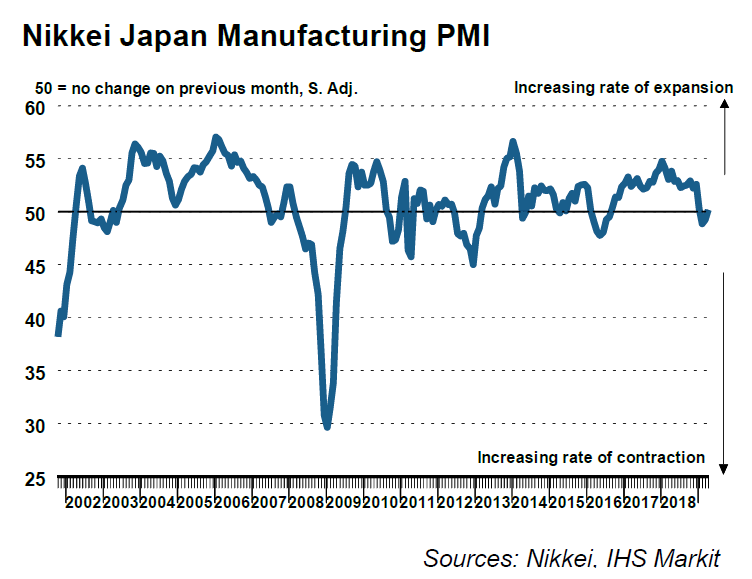
Commenting on the Japanese Manufacturing PMI survey data, Joe Hayes, Economist at IHS Markit, which compiles the survey, said:
“A pick-up in the Japan Manufacturing PMI to a three-month high will be a welcome sign that the recent drop in momentum has potentially subsided for now. New orders and output both declined in April, but to lesser extents, while business confidence continued to climb from its near-record low in February. Given the difficulties faced by firms in semi-conductor and automobile-related industries in recent months, it bodes well that anecdotal evidence indicated that stronger optimism was in part driven by more upbeat forecasts for these two key Asian industries.”
GBPUSD Bulls Back In Play After Reaching 6-Week Low
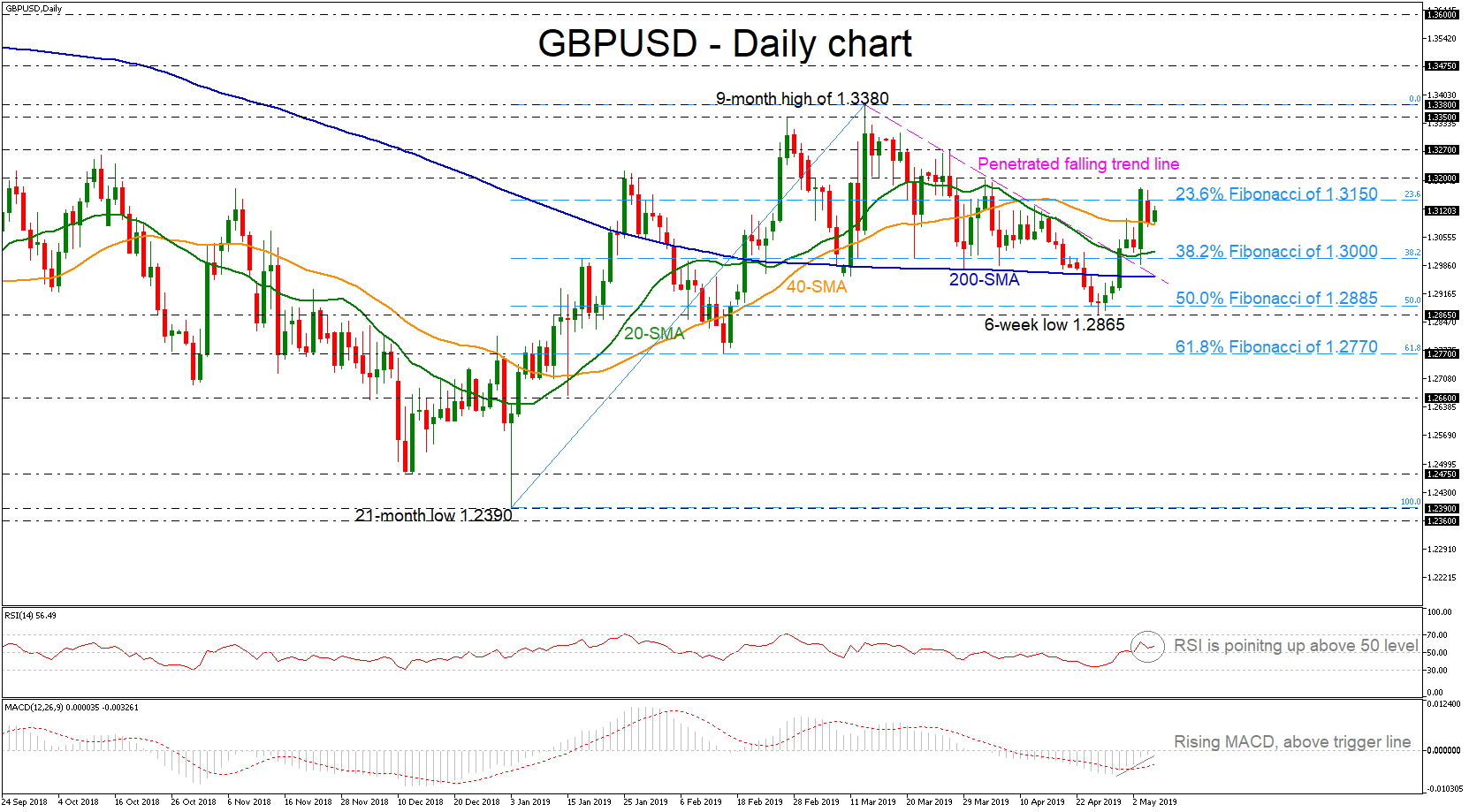
GBPUSD has found strong support at the six-week low of 1.2865 on April 25, shifting the short-term negative bias to bullish. Also, cable penetrated the descending trend line to the upside and it jumped above the 23.6% Fibonacci retracement level of the upleg from 1.2390 to 1.3380 around 1.3150 but it pared some of those gains in the next session.
Currently, the pair is standing above the moving averages, while the RSI indicator is sloping up in the positive area, suggesting more gains. The MACD oscillator is trying to enter the bullish region with weak momentum but it successfully climbed above its red trigger line.
More bullish actions above the 23.6% Fibonacci could drive the pair higher, meeting the 1.3200 handle, taken from the highs on April 3. Should the pair manage to strengthen its positive momentum, the next resistance could come around 1.3270 before resting near the 1.3350 – 1.3380 resistance zone.
However, if prices are unable to break again the 23.6% Fibonacci in the next few daily sessions, the risk would shift back to the downside, below the 20- and 40-simple moving averages (SMAs), challenging the 38.2% Fibonacci of 1.3000. A drop below this handle could open the way for the flat 200-SMA, which stands at 1.2960 ahead of the 50.0% Fibonacci of 1.2885.
Concluding, the recent bias remains bullish in the near term, after the upside break of the falling trend line, while in the medium-term, traders should be waiting for a rally above the nine-month high of 1.3380 for fresh long positions.
RBA Holds Rates Steady in Line with Westpac’s Forecast
Westpac correctly forecast that the RBA would remain on hold at the May Board meeting. The Bank was clearly less concerned about the March quarter Inflation report and emphasised the importance of developments in the labour market. Westpac continues to expect rate cuts at the August and November Board meetings.
The Reserve Bank Board decided to leave the cash rate unchanged at 1.50%.
This was Westpac’s forecast, although markets were uncertain, with around a 50% probability priced in for a rate cut and 14/26 market economists forecasting a cut (Bloomberg survey 3 May).There are two main reasons behind this decision. Firstly, the RBA’s response to the recent March quarter inflation report was not as negative as had been expected. In its preview, Westpac pointed out that the RBA had moved from forecasting underlying inflation as the average of the weighted median and the trimmed mean to forecasting just the trimmed mean.
In the March inflation report, the trimmed mean printed an increase of 0.3% for the quarter, compared to the RBA’s likely forecast of 0.4% - only a 0.1ppt miss. Today, the RBA lowered its trimmed mean forecast for 2019 from 2 per cent to 1 ¾ per cent, and for 2020 from 2 ¼ per cent to 2 per cent. That is only a ¼ ppt reduction in the forecast. As we pointed out in our preview, that reduction compares to a 1 ppt reduction in the forecast from 2 ½ per cent to 1 ½ per cent in May 2016 (in response to a similarly low inflation report for the March quarter). Governor Stevens cut rates in response to that forecast change at the May 2016 Board meeting.
The second issue of importance was the Board’s noting in the April meeting minutes that “members also discussed the scenario where inflation did not move any higher and unemployment trended up, noting that a decrease in the cash rate would likely be appropriate in these circumstances”.
Today’s Governor’s Statement strongly emphasised the importance of the labour market, “it [the Board] recognised that there was still spare capacity in the economy and a further improvement in the labour market was likely to be needed for inflation to be consistent with the target. Given this assessment, the Board will be paying close attention to developments in the labour market at its upcoming meetings”. As this comment emphasises, the second condition nominated in the April minutes is yet to be fulfilled. It is also important from a timing perspective to note the term “upcoming meetings”. That suggests to us that a common view held by some economists of a move in June can be ruled out. This condition around the labour market will need more than one employment report to establish a trend.
We feel that this statement fits well with our view that the next move will be a cut in August. Firstly, we expect that the June quarter inflation report will print trimmed mean growth of around 0.4%. With the first six months of the year contributing 0.7ppts to the annual rate for 2019, it is unlikely it will be possible to persist with the 1 ¾ per cent( 2019) - 2 per cent( 2020) scenario and a 1 ½ per cent( 2019) – 1 ¾ per cent( 2020)scenario will be adopted by the RBA for its August meeting. Recognition that inflation will hold below the bottom of the 2-3 per cent target band for 2019 and 2020 will signal the need for further policy easing.
We also expect that developments in the labour market over the next three months will disappoint the RBA. It is not entirely clear whether they will be satisfied with a stable 5 per cent unemployment rate which the Governor notes is their forecast for the next year, or they require a sustained lower unemployment rate, as noted in the concluding paragraph stating that a further improvement in the labour market is needed. Either way Westpac expects to see a deterioration in the labour market over the next 6 months.
We expect that this sequence of weak inflation and softening labour market data will persist throughout 2019, which is consistent with our growth forecast of 2.2% compared to trend of 2 ¾ per cent. That profile remains consistent with the need for further stimulus at the November meeting following the August cut
Supporting our outlook for the labour market is our research showing that the cyclical sectors of the economy are already in jobs decline although this is being supported by ongoing jobs growth in the non- cyclical sectors.
Conclusion
Westpac forecast that rates would remain steady at today’s meeting.
However we anticipate that developments around domestic demand; the labour market; and underlying inflation will establish a clear case for cuts in both August and November.
This view has been held since February 21.
Elliott Wave View Expecting AUD/JPY
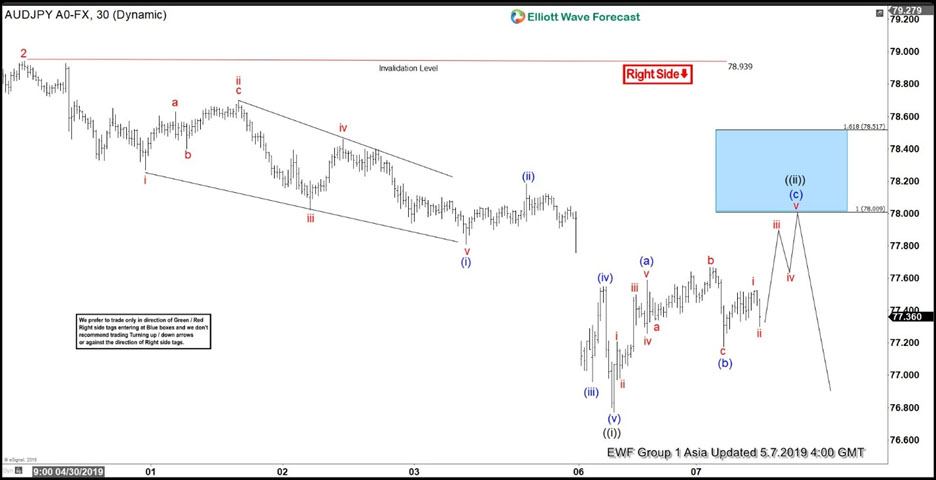
AUDJPY shows an incomplete Elliott Wave sequence from April 17, 2019 high, favoring more downside. The 100% target can reach as low as 75.7 – 76.3. In the chart below, the bounce to 78.94 ended wave 2. Wave 3 is currently unfolding as an Elliott Wave impulse with wave ((i)) of 3 ended at 76.77. The internal of wave ((i)) subdivided as another impulse structure of lesser degree. Wave (i) of ((i)) ended at 77.81 and wave (ii) of ((i)) ended at 78.18. Down from there, wave (iii) of ((i)) ended at 76.96, wave (iv) of ((i)) ended at 77.55, and wave (v) of ((i)) ended at 76.77.
Wave ((ii)) is in progress to correct cycle from 4/30 high as a zigzag Elliott Wave structure. Up from 76.77, wave (a) of ((ii)) ended at 77.59 and subdivided as 5 waves impulse. Wave (b) of ((ii)) ended at 77.17 and subdivided as an expanded flat. Expect wave (c) of ((ii)) to reach 78 – 78.5 before pair resumes lower again. We don’t like buying the pair and expect rally to fail at the blue box as far as pivot at 78.94 high stays intact.
AUDJPY 1 Hour Elliott Wave Chart
China Confirms Trade Talks In Washington This Week
Market movers today
Markets will continue to focus on the renewed trade uncertainty caused by Trump's recent tweets. For more see comments below.
In Sweden, the Riksbank minutes from the April meeting are published this morning at 09:30 CEST. Production data for March is also due out. For more details see page 2.
In Europe, the spring economic forecasts from the EU Commission are published at 11:00 CEST. Particular focus will be on fiscal policy and projections for Italy.
In the UK, cross-party negotiations continue over Brexit. The historical lack of trust between the Conservative and Labour parties and the large divisions on Brexit within both parties continue to complicate things.
In Germany , factory orders in March are due out at 08:00 CEST.
Selected market news
Yesterday, Trump continued his series of hawkish trade tweets , as he said the US is losing USD500bn on trade with China, adding "we're not going to be doing that any more".
Market sentiment rebounded slightly yesterday as hopes of an imminent trade deal were revived after China confirmed that trade talks would move on this week despite the US raising tariffs . The US Trade Representative told reporters that China's top negotiator Liu He was still coming to Washington for trade talks starting Thursday (instead of Wednesday) and confirmed that tariffs would go rise on Friday 12:01am, see CNBC .
US Treasury Secretary Steven Mnuchin said the tariffs would be reconsidered if the trade talks get back on track . Markets (and we) initially feared that the tariff increase would derail the trade talks and China would stay away this week. According to Lighthizer, the US team saw an erosion of commitments from China that led to the decision to increase tariffs. According to Mnuchin, the Chinese wanted to renegotiate elements that had already been finalised and the US is not prepared to do that. Apparently, China is not willing to change its laws as part of a deal, but to some extent that probably reflects that China has already implemented some of the things the US wants. The new foreign investment law, among other things, bans technology transfer, raises IPR protection and declares that Chinese and foreign firms should be treated equally.
It is still up in the air how the road to a trade deal will be. But we believe a deal will be reached by the end of Q2. The last bits left in the trade talks are also the most difficult. But one way or the other, we expect the two sides to find a solution, as the alternative of no deal would be very unattractive for countries.
The Australian central bank left its cash rate unchanged at 1.5% this morning, in line with our expectation but against consensus of a cut. The central bank recognises that there is still spare capacity in the economy and that it is "paying close attention to the developments in the labour market". The Australian dollar rose on the announcement.
Euro-Zone’s Services Sector Activity Dropped To A 3-Month Low Level In April
For the 24 hours to 23:00 GMT, the EUR rose 0.12% against the USD and closed at 1.1200.
On Friday, data showed that the Euro-zone's preliminary consumer price index (CPI) rose 1.7% on an annual basis in April, compared to a climb of 1.4% in the prior month. Market participants had expected the CPI to record a gain of 1.6%.
In the US, data indicated that the non-farm payrolls advanced 263.0K in April, compared to market consensus for an increase of 190.0K. Non-farm payrolls had registered a revised rise of 189.0K in the previous month. Meanwhile, the US final Markit services PMI eased to a level of 53.0 in April, compared to a level of 55.3 in the previous month. The preliminary figures and market participants had envisaged the PMI to fall to a level of 52.9. Moreover, the nation's non-manufacturing PMI unexpectedly declined to a level of 55.5 in April, compared to a level of 56.1 in the previous month. Markets had anticipated the PMI to advance to a level of 57.0. Also, the US unemployment rate surprisingly slid to a level of 3.6% in April, defying market expectations for an unchanged reading. Unemployment rate had recorded a reading of 3.8% in the previous month.
Yesterday, the Euro-zone's final services PMI fell to 52.8 in April, registering its lowest level in 3 months, amid slowdown in the manufacturing and services sector and following a level of 53.3 in the prior month. The preliminary figures and market consensus had expected the PMI to drop to a level of 52.5.
On the other hand, the region's seasonally adjusted retail sales climbed 1.9% in March, surpassing market expectations for a rise of 1.8%. In the prior month, retail sales had risen by a revised 3.0%. Further, the Sentix investor confidence index advanced to a level of 5.3 in May, higher than market expectations for a rise to a level of 1.2 and notching its highest level in 2019. The index had registered a level of -0.3 in the prior month.
Separately, in Germany, the final services PMI climbed to a level of 55.7 in April. The preliminary figures and market participants had anticipated the PMI to advance to a level of 55.6.
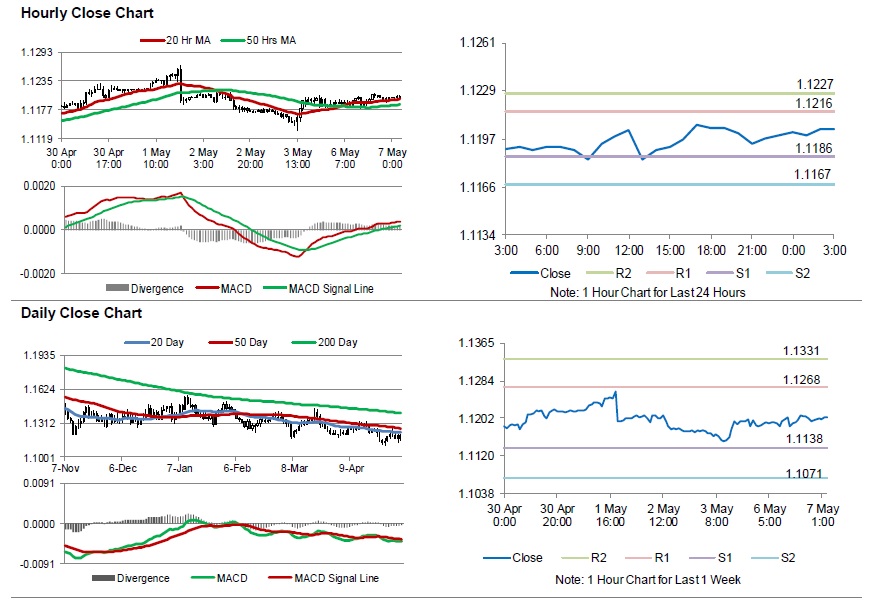
In the Asian session, at GMT0300, the pair is trading at 1.1204, with the EUR trading slightly higher against the USD from yesterday's close.
The pair is expected to find support at 1.1186, and a fall through could take it to the next support level of 1.1167. The pair is expected to find its first resistance at 1.1216, and a rise through could take it to the next resistance level of 1.1227.
Looking ahead, traders would await the Germany's construction PMI for April and factory orders for March, slated to release in a few hours. Later in the day, the US JOLTS Job Openings along with the consumer credit for March, will be on investors radar.
The currency pair is trading above its 20 Hr and 50 Hr moving averages.
Sterling Reverses Its Losses In The Asian Session
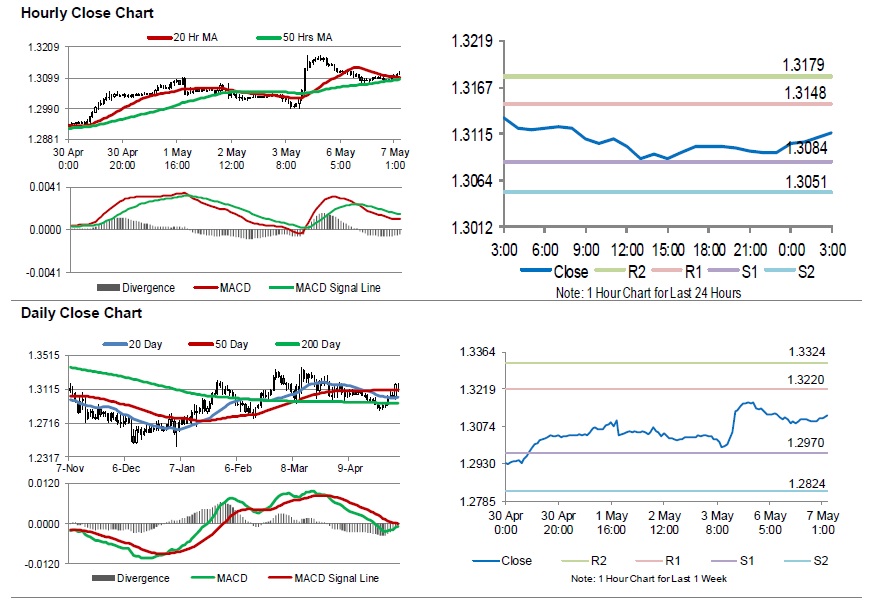
For the 24 hours to 23:00 GMT, the GBP declined 0.39% against the USD and closed at 1.3094.
On Friday, UK’s services PMI expanded to a level of 50.4 in April, compared to a reading of 48.9 in the prior month. Market participants had envisaged the PMI to advance to a level of 50.3.
In the Asian session, at GMT0300, the pair is trading at 1.3117, with the GBP trading 0.18% higher against the USD from yesterday’s close.
The pair is expected to find support at 1.3084, and a fall through could take it to the next support level of 1.3051. The pair is expected to find its first resistance at 1.3148, and a rise through could take it to the next resistance level of 1.3179.
Moving forward, investors would keep an eye on UK’s Halifax house prices index for April, slated to release in a few hours.
The currency pair is trading above its 20 Hr and 50 Hr moving averages.