

Sample Category Title
Japan’s Manufacturing PMI Expanded To A 3-Month High In April
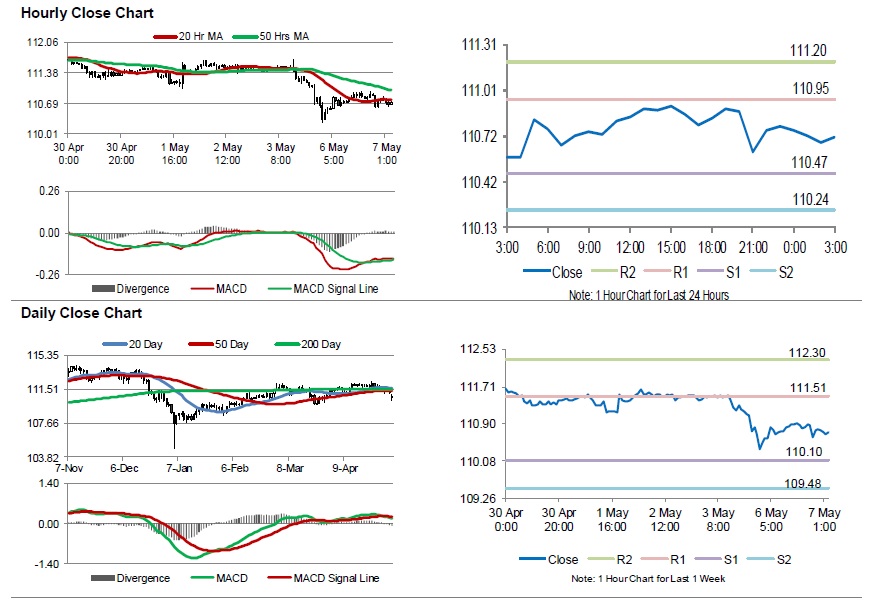
For the 24 hours to 23:00 GMT, the USD rose 0.25% against the JPY and closed at 110.78.
In the Asian session, at GMT0300, the pair is trading at 110.71, with the USD trading 0.06% lower against the JPY from yesterday's close.
Overnight data indicated that Japan's final manufacturing PMI expanded to a 3-month high level of 50.2 in April, compared to a level of 49.2 in the prior month. The preliminary figures had indicated an advance to 49.5.
The pair is expected to find support at 110.47, and a fall through could take it to the next support level of 110.24. The pair is expected to find its first resistance at 110.95, and a rise through could take it to the next resistance level of 111.20.
Going forward, traders would closely monitor the Bank of Japan's March policy meeting minutes along with Japan's Nikkei services PMI for April, set to release overnight.
The currency pair is trading below its 20 Hr and 50 Hr moving averages.
Swiss Franc Trading Slightly Higher In The Morning Session
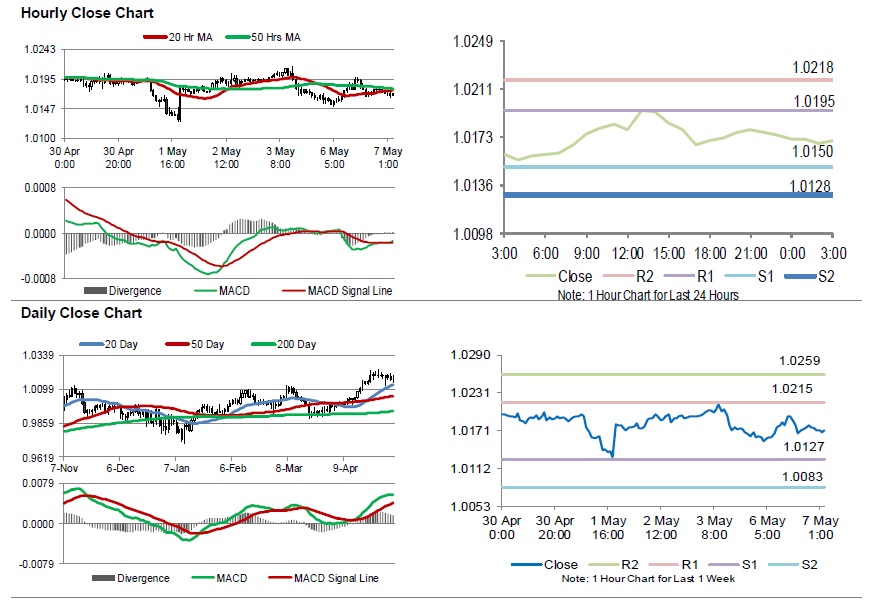
For the 24 hours to 23:00 GMT, the USD rose 0.12% against the CHF and closed at 1.0175.
On the data front, Switzerland’s consumer price index (CPI) advanced 0.2% on a monthly basis in April, at par market expectations. In the previous month, the CPI had advanced 0.5%.
In the Asian session, at GMT0300, the pair is trading at 1.0171, with the USD trading a tad lower against the CHF from yesterday’s close.
The pair is expected to find support at 1.0150, and a fall through could take it to the next support level of 1.0128. The pair is expected to find its first resistance at 1.0195, and a rise through could take it to the next resistance level of 1.0218.
The currency pair is trading below its 20 Hr and 50 Hr moving averages.
Loonie Extends Its Gains In The Asian Session
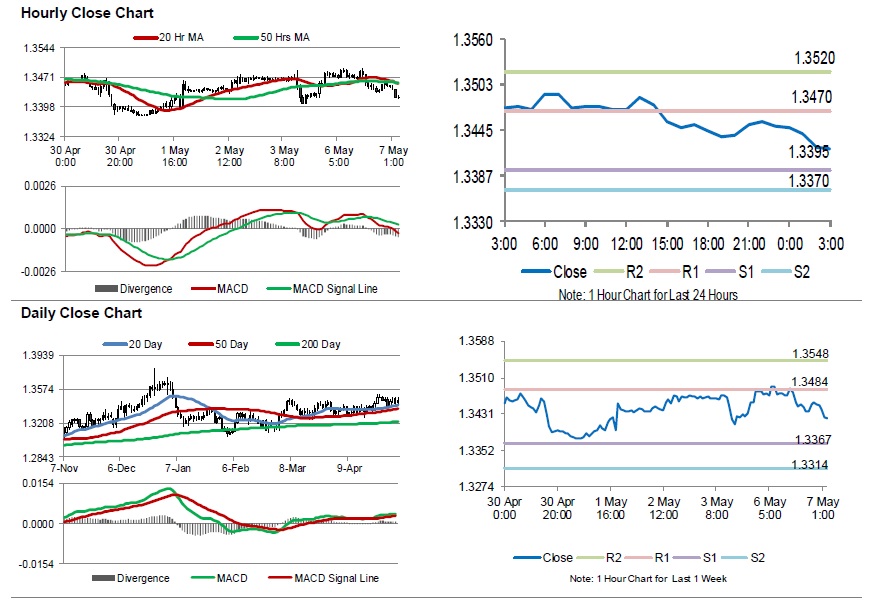
For the 24 hours to 23:00 GMT, the USD declined 0.21% against the CAD and closed at 1.3451.
The Bank of Canada’s Governor Stephen Poloz, in his speech, sounded optimistic over the growth of housing market, amid various challenges and stated that a supple mortgage market would support the nation for creating a better financial system.
In the Asian session, at GMT0300, the pair is trading at 1.3421, with the USD trading 0.22% lower against the CAD from yesterday’s close.
The pair is expected to find support at 1.3395, and a fall through could take it to the next support level of 1.3370. The pair is expected to find its first resistance at 1.3470, and a rise through could take it to the next resistance level of 1.3520.
Trading trend in the Loonie today is expected to be determined by Canada’s Ivey purchasing managers’ index for April, scheduled to release later in the day.
The currency pair is trading below its 20 Hr and 50 Hr moving averages.
RBA Held Its Key Interest Unchanged At 1.5%
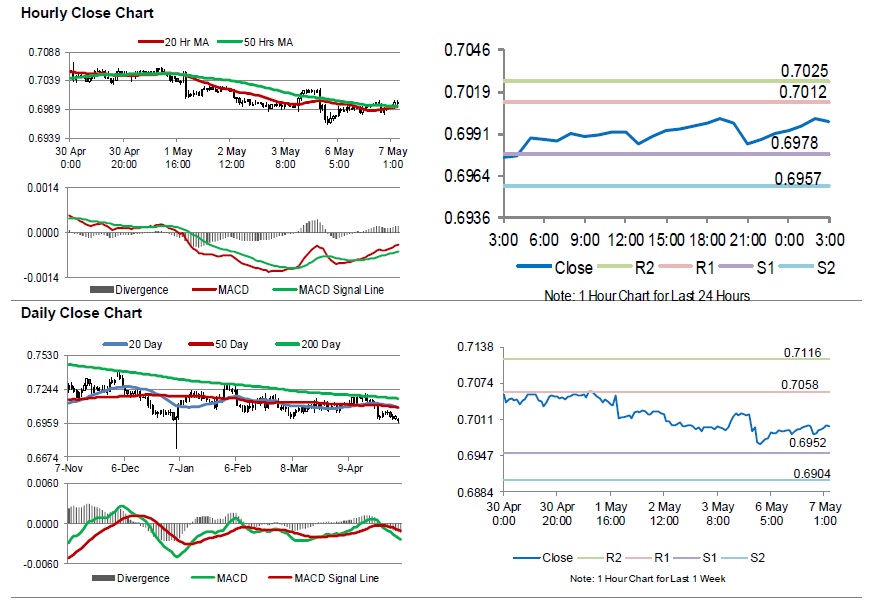
For the 24 hours to 23:00 GMT, the AUD rose 0.26% against the USD and closed at 0.6991.
LME Copper prices remained unchanged at $6180.0/MT. Aluminium prices remained steady at $1783.5/MT.
In the Asian session, at GMT0300, the pair is trading at 0.6999, with the AUD trading 0.11% higher against the USD from yesterday’s close.
Overnight data showed that Australia’s seasonally adjusted trade surplus narrowed to AUD4,949.0 million in March, compared to a revised surplus of AUD5,140.0 million in the previous month. Market participants had anticipated the nation to post a surplus of AUD4,480.00 million. Moreover, the nation’s seasonally adjusted retail sales climbed 0.3% on a monthly basis in March, following a revised rise of 0.9% in the prior month. Market participants had expected retail sales to record a gain of 0.2%.
On the contrary, the nation’s AIG performance of construction index contracted to a level of 42.6, following a reading of 45.6 in the previous month.
The Reserve Bank of Australia (RBA), in its latest policy meeting, opted to leave its benchmark interest rate unchanged at 1.5%, with prospects for further rate reduction in June. The RBA Governor Philip Lowe stated that they would closely monitor the labour market to observe a rise in unemployment in order to slash the interest rates in the forthcoming policy meetings.
The pair is expected to find support at 0.6978, and a fall through could take it to the next support level of 0.6957. The pair is expected to find its first resistance at 0.7012, and a rise through could take it to the next resistance level of 0.7025.
Amid lack of macroeconomic releases in Australia today, investors would focus on global macroeconomic releases for further direction.
The currency pair is showing convergence with its 20 Hr and 50 Hr moving averages.
Gold: Yellow Metal Reverses Its Losses In The Morning Session
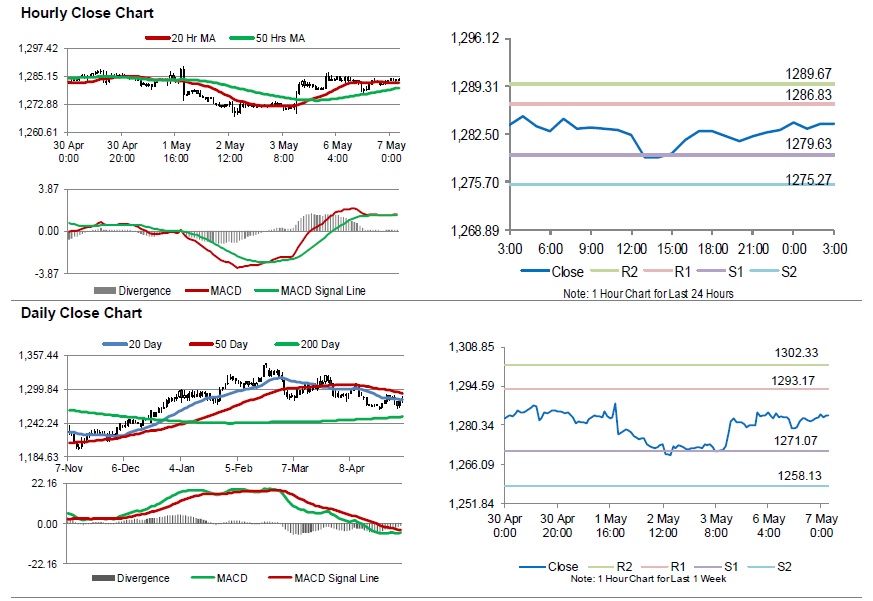
For the 24 hours to 23:00 GMT, Gold declined 0.09% against the USD and closed at USD1282.80 per ounce.
In the Asian session, at GMT0300, the pair is trading at 1284.00, with gold trading 0.09% higher against the USD from yesterday’s close.
The pair is expected to find support at 1279.63, and a fall through could take it to the next support level of 1275.27. The pair is expected to find its first resistance at 1286.83, and a rise through could take it to the next resistance level of 1289.67.
The yellow metal is trading above its 20 Hr and 50 Hr moving averages.
Silver: White Metal Trading A Tad Higher In The Asian Session
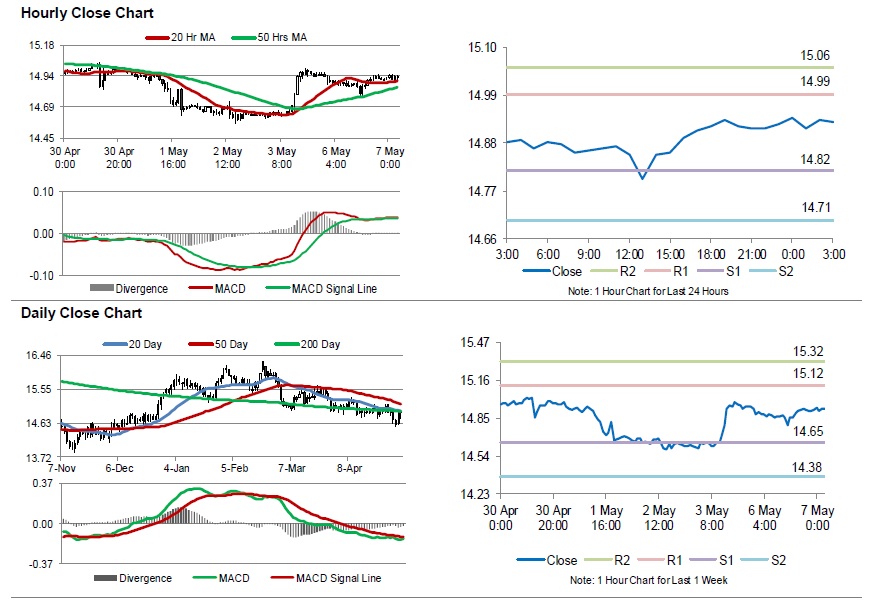
For the 24 hours to 23:00 GMT, Silver rose 0.17% against the USD and closed at USD14.93 per ounce.
In the Asian session, at GMT0300, the pair is trading at 14.93, with silver trading marginally higher against the USD from yesterday’s close.
The pair is expected to find support at 14.82, and a fall through could take it to the next support level of 14.71. The pair is expected to find its first resistance at 14.99, and a rise through could take it to the next resistance level of 15.06.
The white metal is trading above its 20 Hr and 50 Hr moving averages.
Crude Oil: Oil Trading Higher, Ahead Of API’s Weekly Crude Oil Stockpiles Data
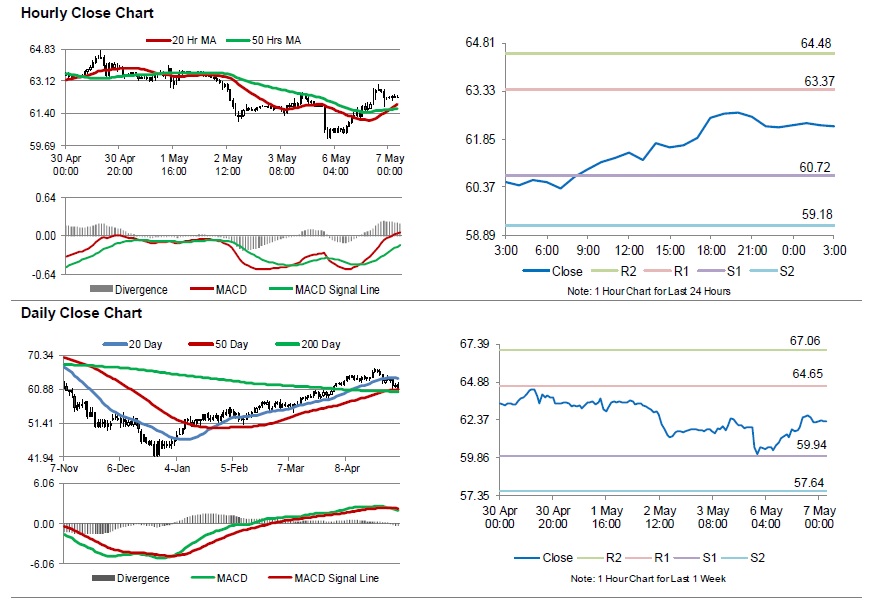
For the 24 hours to 23:00 GMT, Crude Oil rose 2.72% against the USD and closed at USD62.21 per barrel, after US decided to tighten sanctions on Iranian oil, thereby reigniting geopolitical tensions in the Middle East.
In the Asian session, at GMT0300, the pair is trading at 62.25, with oil trading 0.06% higher against the USD from yesterday's close.
The pair is expected to find support at 60.72, and a fall through could take it to the next support level of 59.18. The pair is expected to find its first resistance at 63.37, and a rise through could take it to the next resistance level of 64.48.
Moving ahead, investors will keep a close watch on the weekly crude oil inventories data from the American Petroleum Institute (API), due later in the day.
Crude oil is trading above its 20 Hr and 50 Hr moving averages.
(RBA) Statement by Glenn Stevens, Governor: Monetary Policy Decision
At its meeting today, the Board decided to leave the cash rate unchanged at 1.50 per cent.
The outlook for the global economy remains reasonable, although the risks are tilted to the downside. Growth in international trade has declined and investment intentions have softened in a number of countries. In China, the authorities have taken steps to support the economy, while addressing risks in the financial system. In most advanced economies, inflation remains subdued, unemployment rates are low and wages growth has picked up.
Global financial conditions remain accommodative. Long-term bond yields are low, consistent with the subdued outlook for inflation, and equity markets have strengthened. Risk premiums also remain low. In Australia, long-term bond yields are at historically low levels and short-term bank funding costs have declined further. Some lending rates have declined recently, although the average mortgage rate paid is unchanged. The Australian dollar is at the low end of its narrow range of recent times.
The central scenario is for the Australian economy to grow by around 2¾ per cent in 2019 and 2020. This outlook is supported by increased investment in infrastructure and a pick-up in activity in the resources sector, partly in response to an increase in the prices of Australia's exports. The main domestic uncertainty continues to be the outlook for household consumption, which is being affected by a protracted period of low income growth and declining housing prices. Some pick-up in growth in household disposable income is expected and this should support consumption.
The Australian labour market remains strong. There has been a significant increase in employment, the vacancy rate remains high and there are reports of skills shortages in some areas. Despite these positive developments, there has been little further progress in reducing unemployment over the past six months. The unemployment rate has been broadly steady at around 5 per cent over this time and is expected to remain around this level over the next year or so, before declining a little to 4¾ per cent in 2021. The strong employment growth over the past year or so has led to some pick-up in wages growth, which is a welcome development. Some further lift in wages growth is expected, although this is likely to be a gradual process.
The adjustment in established housing markets is continuing, after the earlier large run-up in prices in some cities. Conditions remain soft and rent inflation remains low. Credit conditions for some borrowers have tightened over the past year or so. At the same time, the demand for credit by investors in the housing market has slowed noticeably as the dynamics of the housing market have changed. Growth in credit extended to owner-occupiers has eased over the past year. Mortgage rates remain low and there is strong competition for borrowers of high credit quality.
The inflation data for the March quarter were noticeably lower than expected and suggest subdued inflationary pressures across much of the economy. Over the year, inflation was 1.3 per cent and, in underlying terms, was 1.6 per cent. Lower housing-related costs and a range of policy decisions affecting administered prices both contributed to this outcome. Looking forward, inflation is expected to pick up, but to do so only gradually. The central scenario is for underlying inflation to be 1¾ per cent this year, 2 per cent in 2020 and a little higher after that. In headline terms, inflation is expected to be around 2 per cent this year, boosted by the recent increase in petrol prices.
The Board judged that it was appropriate to hold the stance of policy unchanged at this meeting. In doing so, it recognised that there was still spare capacity in the economy and that a further improvement in the labour market was likely to be needed for inflation to be consistent with the target. Given this assessment, the Board will be paying close attention to developments in the labour market at its upcoming meetings.
RBA stands pat at 1.50%, revised down growth and inflation forecasts
Australian Dollar rebounds after RBA left cash rate unchanged at 1.50%, rather than delivered a rate cut as some expected. While, keeping interest rate on hold, the central bank did lay down the criteria in labor market development as condition for policy action in response to subdued inflation.
RBA acknowledged that Q1 inflation data were "noticeably lower than expected". And, "further improvement in the labour market was likely to be needed for inflation to be consistent with the target". Thus, the central bank said it will be "paying close attention to developments in the labour market at its upcoming meetings.
With the new economic projections, RBA is expecting around 2.75% growth in 2019 and 2020. That's a slightly downward revision from February's around 3% in 2019 and by a little less in 2020.
Underlying inflation is expected to be at 1.75% this year and 2% in 2020. Headline inflation is expected to be at around 2% in 2019. There were also slight downward revision from February's projection of 2% in 2019 and 2.25% in 2020.
Full statement below.
Statement by Philip Lowe, Governor: Monetary Policy Decision
At its meeting today, the Board decided to leave the cash rate unchanged at 1.50 per cent.
The outlook for the global economy remains reasonable, although the risks are tilted to the downside. Growth in international trade has declined and investment intentions have softened in a number of countries. In China, the authorities have taken steps to support the economy, while addressing risks in the financial system. In most advanced economies, inflation remains subdued, unemployment rates are low and wages growth has picked up.
Global financial conditions remain accommodative. Long-term bond yields are low, consistent with the subdued outlook for inflation, and equity markets have strengthened. Risk premiums also remain low. In Australia, long-term bond yields are at historically low levels and short-term bank funding costs have declined further. Some lending rates have declined recently, although the average mortgage rate paid is unchanged. The Australian dollar is at the low end of its narrow range of recent times.
The central scenario is for the Australian economy to grow by around 2¾ per cent in 2019 and 2020. This outlook is supported by increased investment in infrastructure and a pick-up in activity in the resources sector, partly in response to an increase in the prices of Australia's exports. The main domestic uncertainty continues to be the outlook for household consumption, which is being affected by a protracted period of low income growth and declining housing prices. Some pick-up in growth in household disposable income is expected and this should support consumption.
The Australian labour market remains strong. There has been a significant increase in employment, the vacancy rate remains high and there are reports of skills shortages in some areas. Despite these positive developments, there has been little further progress in reducing unemployment over the past six months. The unemployment rate has been broadly steady at around 5 per cent over this time and is expected to remain around this level over the next year or so, before declining a little to 4¾ per cent in 2021. The strong employment growth over the past year or so has led to some pick-up in wages growth, which is a welcome development. Some further lift in wages growth is expected, although this is likely to be a gradual process.
The adjustment in established housing markets is continuing, after the earlier large run-up in prices in some cities. Conditions remain soft and rent inflation remains low. Credit conditions for some borrowers have tightened over the past year or so. At the same time, the demand for credit by investors in the housing market has slowed noticeably as the dynamics of the housing market have changed. Growth in credit extended to owner-occupiers has eased over the past year. Mortgage rates remain low and there is strong competition for borrowers of high credit quality.
The inflation data for the March quarter were noticeably lower than expected and suggest subdued inflationary pressures across much of the economy. Over the year, inflation was 1.3 per cent and, in underlying terms, was 1.6 per cent. Lower housing-related costs and a range of policy decisions affecting administered prices both contributed to this outcome. Looking forward, inflation is expected to pick up, but to do so only gradually. The central scenario is for underlying inflation to be 1¾ per cent this year, 2 per cent in 2020 and a little higher after that. In headline terms, inflation is expected to be around 2 per cent this year, boosted by the recent increase in petrol prices.
The Board judged that it was appropriate to hold the stance of policy unchanged at this meeting. In doing so, it recognised that there was still spare capacity in the economy and that a further improvement in the labour market was likely to be needed for inflation to be consistent with the target. Given this assessment, the Board will be paying close attention to developments in the labour market at its upcoming meetings.
Australia retail sales rose 0.3%, trade surplus narrowed to AUD 4.95B
Australia retail sales rose 0.3% mom in March, above expectation of 0.2% mom. February's growth was revised up from 0.8% mom to 0.9% mom. In seasonally adjusted terms, there were rises in Victoria (0.7%), Queensland (0.6%), New South Wales (0.2%), Tasmania (0.4%), South Australia (0.1%), and the Northern Territory (0.7%). The Australian Capital Territory was relatively unchanged (0.0%) and Western Australia (-0.7%) fell in seasonally adjusted terms in March 2019.
Trade surplus narrowed to AUD 4.95B in March, down from AUD 5.14B but beat expectation of AUD 4.49B. Goods and services exports dropped -2% to AUD 39.34B. Good and services imports dropped -1% to AUD 34.39B.