Sample Category Title
USD/JPY Daily Outlook
Daily Pivots: (S1) 110.43; (P) 110.70; (R1) 111.13; More...
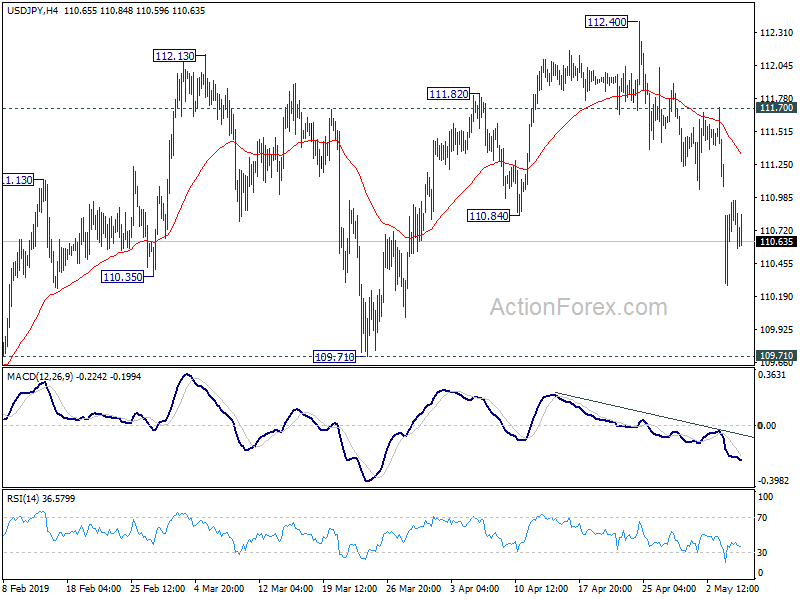
At this point, intraday bias in USD/JPY stays on the downside despite mild recovery. Current decline from 112.40 is still in progress for 109.71 support. As noted before, rebound from 104.69 has completed at 112.40 on bearish divergence condition in daily MACD. Decisive break of 109.71 will confirm this bearish case and target retesting 104.69 low. On the upside, break of 111.70 resistance is needed to confirm completion of the fall. Otherwise, outlook will now remain cautiously bearish in case of recovery.
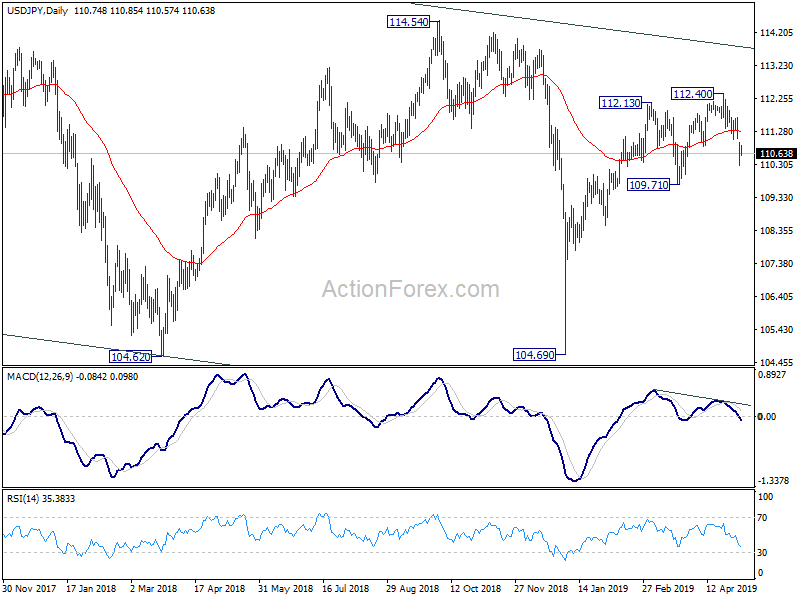
In the bigger picture, medium term outlook in USD/JPY remains a bit mixed as it's staying inside falling channel from 118.65, but there are signs of bullish reversal. On the upside, break of 114.54 resistance will revive the case the corrective fall from 118.65 has completed with three waves down to 104.69. And whole rise from 98.97 (2016 low) is resuming for 118.65 and above. However, sustained break of 109.71 will raise the chance that fall from 118.65 is still in progress for another low below 104.62.
RBA Remains On Hold And AUD Strengthens
The AUD strengthened against the USD as RBA released its interest rate decision to remain on hold at +1.50%. In its accompanying statement the bank stated that it sees the risks for global trade to be tilted to the downside while domestically uncertainty remains. The bank also expects the economy at +2.75% in 2019 and underlying inflation at +1.75%, while it commented that the AUD is at the lower end of its narrow range. Finally it should be noted that the bank still sees further space capacity in the economy. We expect the AUD to maintain the momentum it has gained especially should there be favorable data from China the next days. AUD/USD rose upon the release of RBA's interest rate decision and broke above the 0.7000 (S1) resistance line (now turned to support). We could see the Aussie maintaining momentum and the pair could have some bullish tendencies today. Should the bulls dictate the pair's direction, we could see the pair breaking the 0.7065 (R1) resistance line and aim for the 0.7120 (R2) resistance level. Should the bears take over, we could see the pair breaking the 0.7000 (S1) support line and aim for the 0.6925 (S2) support barrier.
RBNZ Interest rate decision
Tomorrow during the Asians session (02:00, GMT) New Zealand's RBNZ is expected to announce its interest rate decision. The bank is expected to cut rates by 25 basis points reaching +1.50% and currently NZD OIS imply a probability of 57.10% for such a scenario. On the one hand the slowing CPI and GDP growth rates along with the employment change figure dropping into the negatives suggest caution. Also not that the previous interest rate decision showed a clear dovish bias, paving the way for a rate cut. On the other hand analysts point out that indicators show the economy cooling off, but that it has not tanked yet and that remaining on hold may be more appropriate. Also the bank will be releasing its quarterly monetary statement policy which along with the accompanying statement could shed more light in the bank's future intentions. Should the bank lower its rates, we could see the NZD weakening, should it remain on hold we could see it getting some support. NZD/USD maintained a sideways movement yesterday near the 0.6610 (R1) resistance line. We could see the pair showing little volatility in the today and expect Kiwi traders to expect RBNZ's interest rate decision for direction. Should the pair come under the selling interest of the market, we could see the pair breaking the 0.6565 (S1) support line and aim for lower grounds. Should the market favor the Kiwi's long positions, we could see the pair clearly breaking the 0.6610 (R1) and aiming if not breaking the 0.6650 (R2) resistance hurdle.
Other economic highlights, today and early tomorrow
In the European morning, we get from Germany's industrial orders growth rate for March and UK's Halifax House Prices for April. In the American session we get Canada's Ivey PMI for April and the API weekly crude oil inventories figure. In tomorrow's Asian session, besides RBNZ's interest rate decision, we get China's trade balance figure for April. Please bear in mind that in the American session Fed's Quarles and Dallas Fed president Kaplan are scheduled to speak, while in tomorrow's Asian session, the BoJ is to release the minutes of its meeting in March.
NZD/USD H4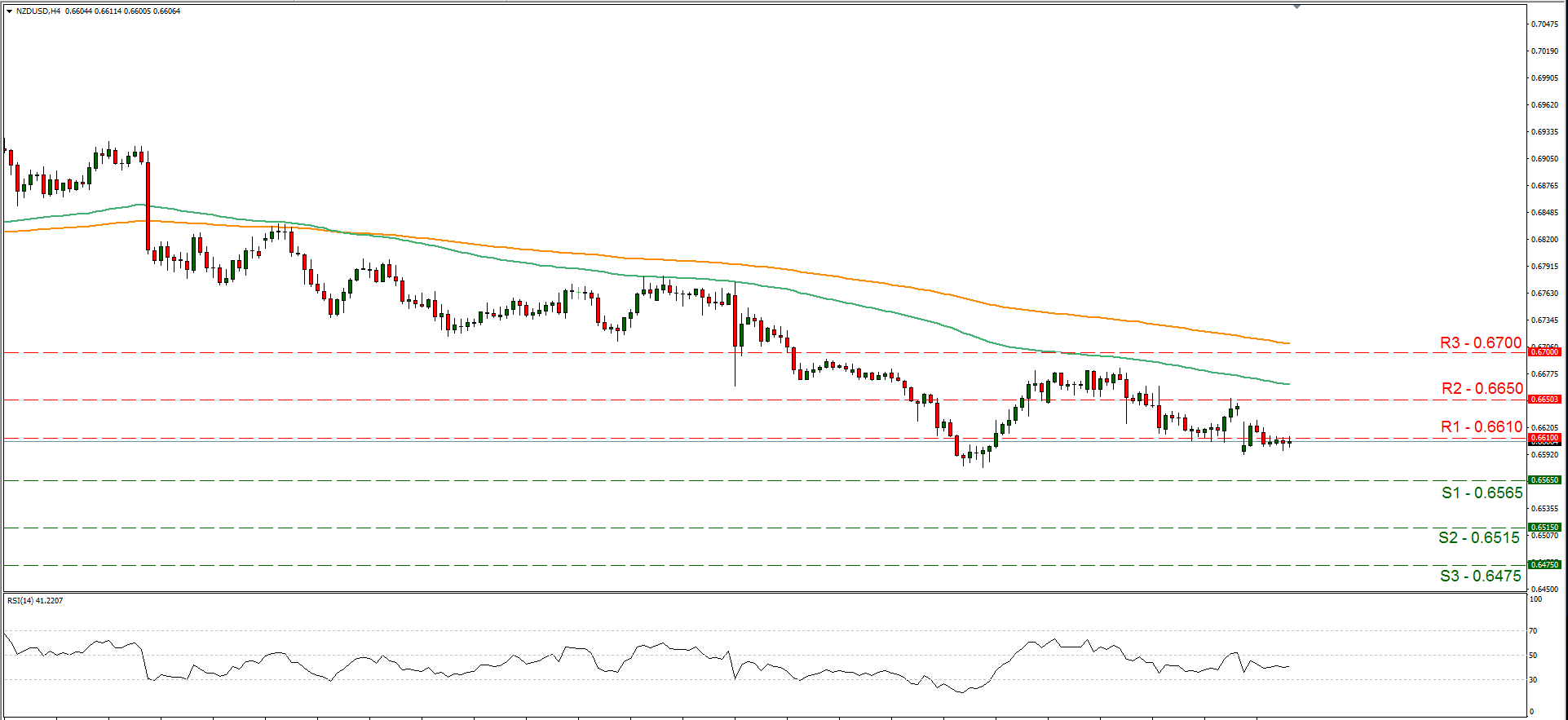
Support: 0.6565 (S1), 0.6515 (S2), 0.6475 (S3)
Resistance: 0.6610 (R1), 0.6650 (R2), 0.6700 (R3)
AUD/USD H4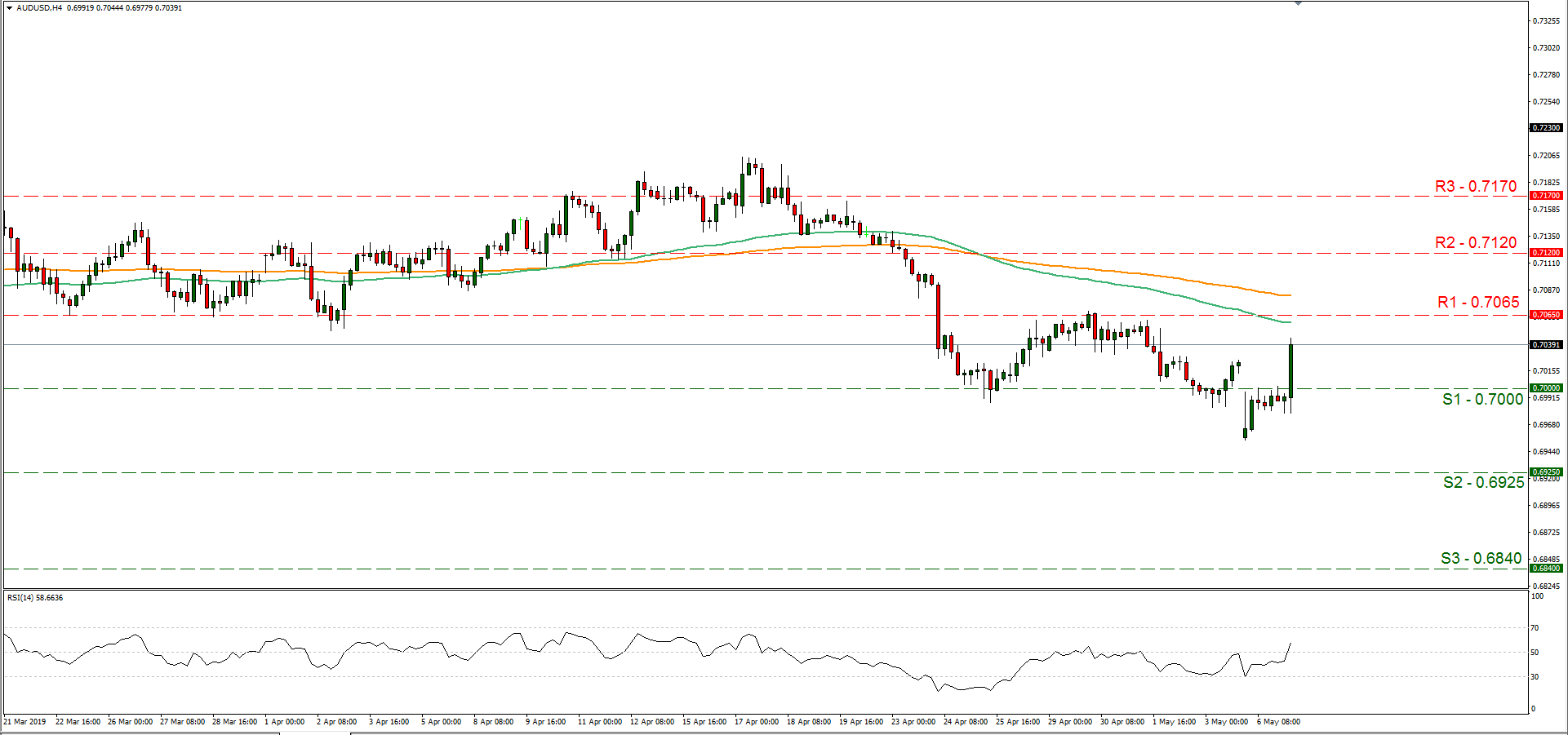
Support: 0.7000 (S1), 0.6925 (S2), 0.6840 (S3)
Resistance: 0.7065 (R1), 0.7120 (R2), 0.7170 (R3)
Stocks Don’t ‘Buy’ Trump’s Threats, RBA Holds Fire
- US stocks stage comeback as markets doubt Trump's tariff threats
- Aussie soars after RBA remains on hold
- RBNZ decides next – may also disappoint those looking for a cut
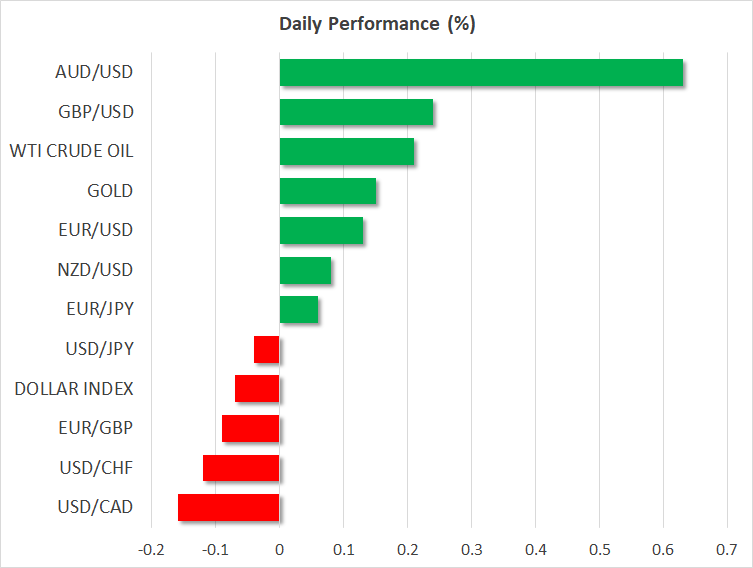
Stocks bounce back as traders doubt Trump will escalate
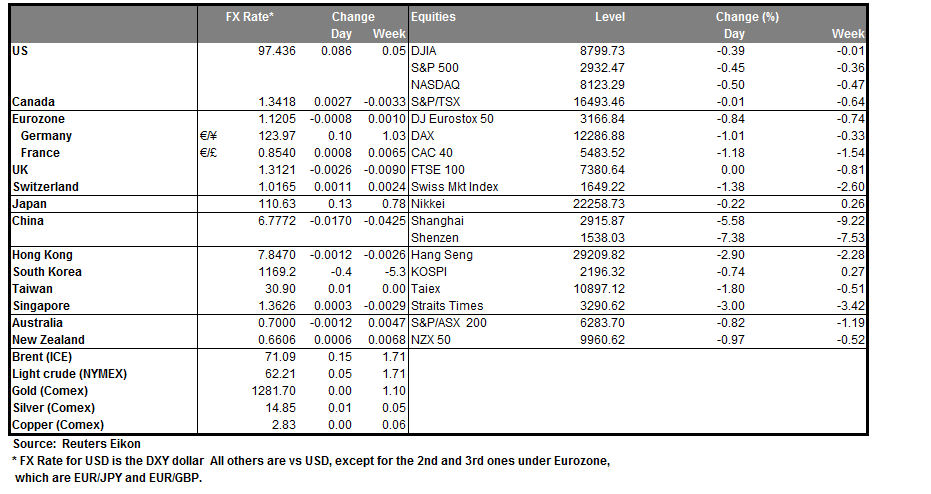
All eyes remain on the US-China trade conflict. Risk sentiment recovered yesterday as the session progressed, with US stock markets recouping most of their early losses to close only modestly lower. It seems investors didn't really 'buy' Trump's tariff threats, perhaps concluding that this is merely posturing aimed at raising the pressure on China. Yet, the top US trade negotiator – Robert Lighthizer – confirmed after Wall Street's closing bell that the existing tariffs will indeed be raised on Friday.
That sent futures tracking the likes of the S&P 500 back down, but only briefly, with sentiment bouncing back again after headlines reaffirming that China's Vice Premier Liu He will visit Washington on Thursday, as planned. The fact that his trip was not cancelled probably rekindled some hopes for a de-escalation of the situation.
As for what happens next, it appears increasingly likely that the existing tariffs may indeed be raised this week, though the bar for introducing new levies on the remaining imports from China may be quite high. Trump wants to walk that fine line between pressuring Beijing, but not so much that China walks away from the negotiating table entirely. The bottom line is that recent price action suggests another escalation will probably be avoided, which seems like an overoptimistic conclusion for now.
Aussie jumps as RBA keeps its easing powder dry
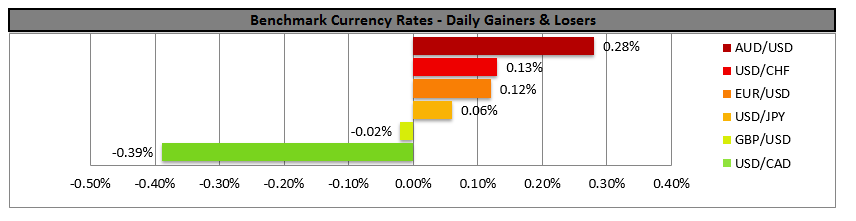
The Australian dollar is outperforming on Tuesday, after the RBA kept its policy unchanged, disappointing those looking for an immediate rate cut. Even though the central bank kept a future rate cut very much on the table, highlighting it will pay close attention to developments in the labor market, the aussie still soared given that investors were pricing in roughly even odds for a rate cut today.
A full quarter-point cut is still priced in by August, which shows that traders believe it's a matter of when, not if, the RBA will ease. Combined with the prospect for further escalation in the US-China trade conflict soon, the outlook for the aussie doesn't appear especially bright in the near term – though a lot will depend on incoming data.
RBNZ could follow in the RBA's footsteps
Now, the central bank torch is passed to the Reserve Bank of New Zealand (RBNZ), which concludes its own policy meeting early on Wednesday. Even though the forecast from economists is for a rate cut, investors are not convinced, with market pricing assigning only a ~45% chance for one. Indeed, it's a close call but on the margin, it seems more likely that the RBNZ could also keep its easing powder dry and perhaps postpone any action for the summer months, effectively buying itself some more time to examine incoming data.
If that is the case, the immediate reaction in the kiwi may be higher. That being said, the Bank is also likely to accompany any on-hold decision with clear signals that rates will probably be cut soon, so any positive reaction in the kiwi could prove short-lived, and may even reverse before long.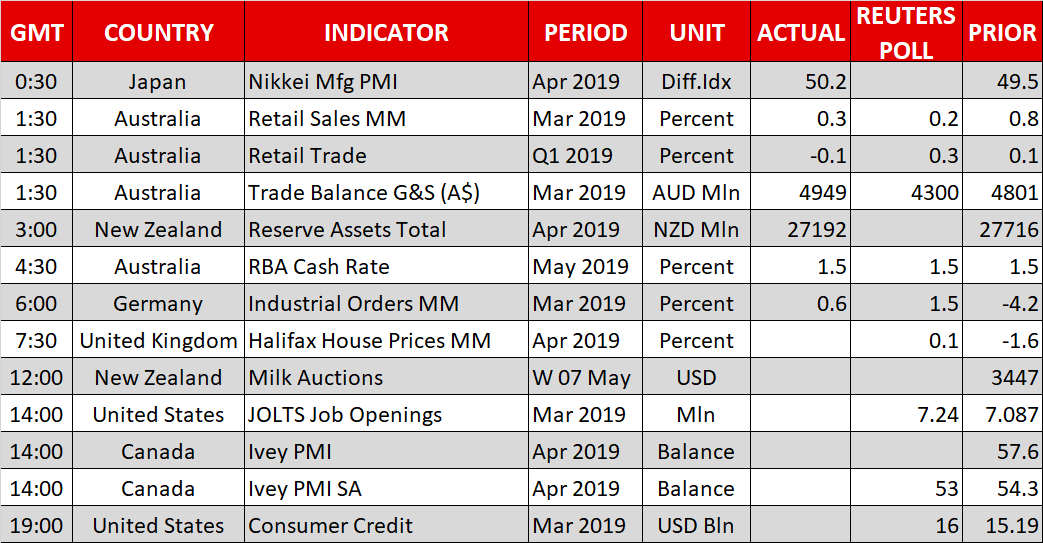
USD/CAD Daily Outlook
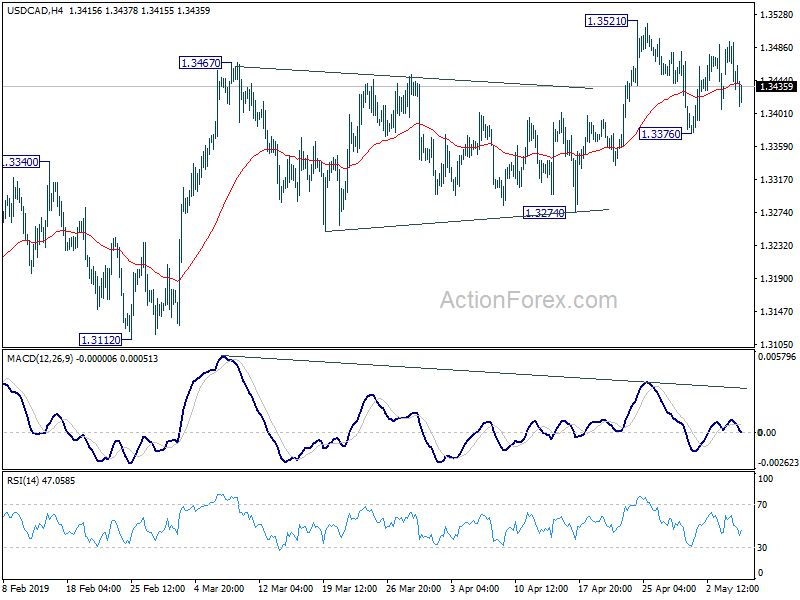
Daily Pivots: (S1) 1.3423; (P) 1.3459; (R1) 1.3486; More...
USD/CAD is staying in consolidation from 1.3521 and intraday bias remains neutral first. More sideway trading could be seen first but further rise is in favor as long as 1.3274 support holds. On the upside, break of 1.3521 will resume the whole rise from 1.3068 to retest 1.3664 high. On the downside, below 1.3376 will turn bias to the downside for 1.3274 support. Break will indicate that choppy rebound from 1.3068 has completed at 1.3521. Near term outlook will be turned bearish for retesting 1.3068 support.
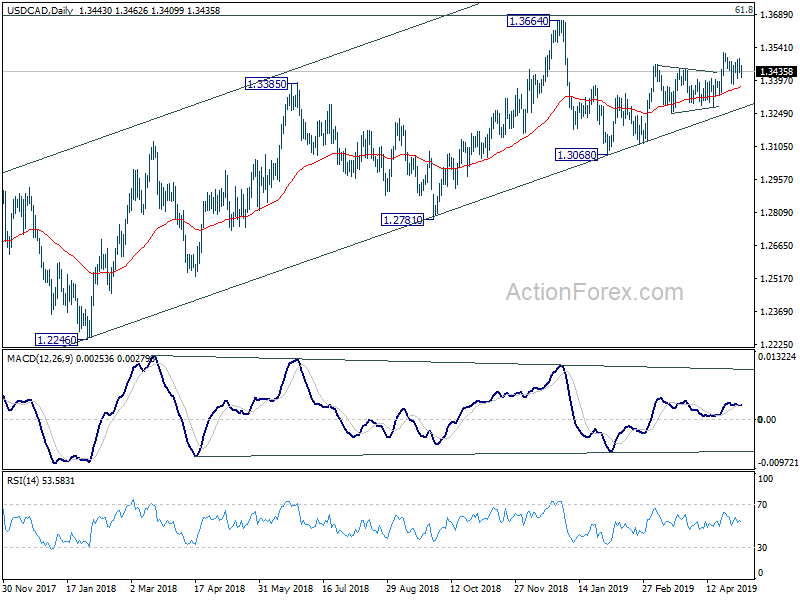
In the bigger picture, USD/CAD is staying well inside medium term rising channel (support at 1.3272). Thus, the up trend from 1.2061 (2017 low) should be in progress. On the upside, decisive break of 61.8% retracement of 1.4689 (2016 high) to 1.2061 at 1.3685 will pave the way to 78.6% retracement at 1.4127 next. This will remain the favored case as long as 1.3068 support holds. However, sustained break the channel support will be the first sign of medium term reversal. Firm break of 1.3068 would confirm.
WTI Oil Futures Form A Golden Cross Pattern
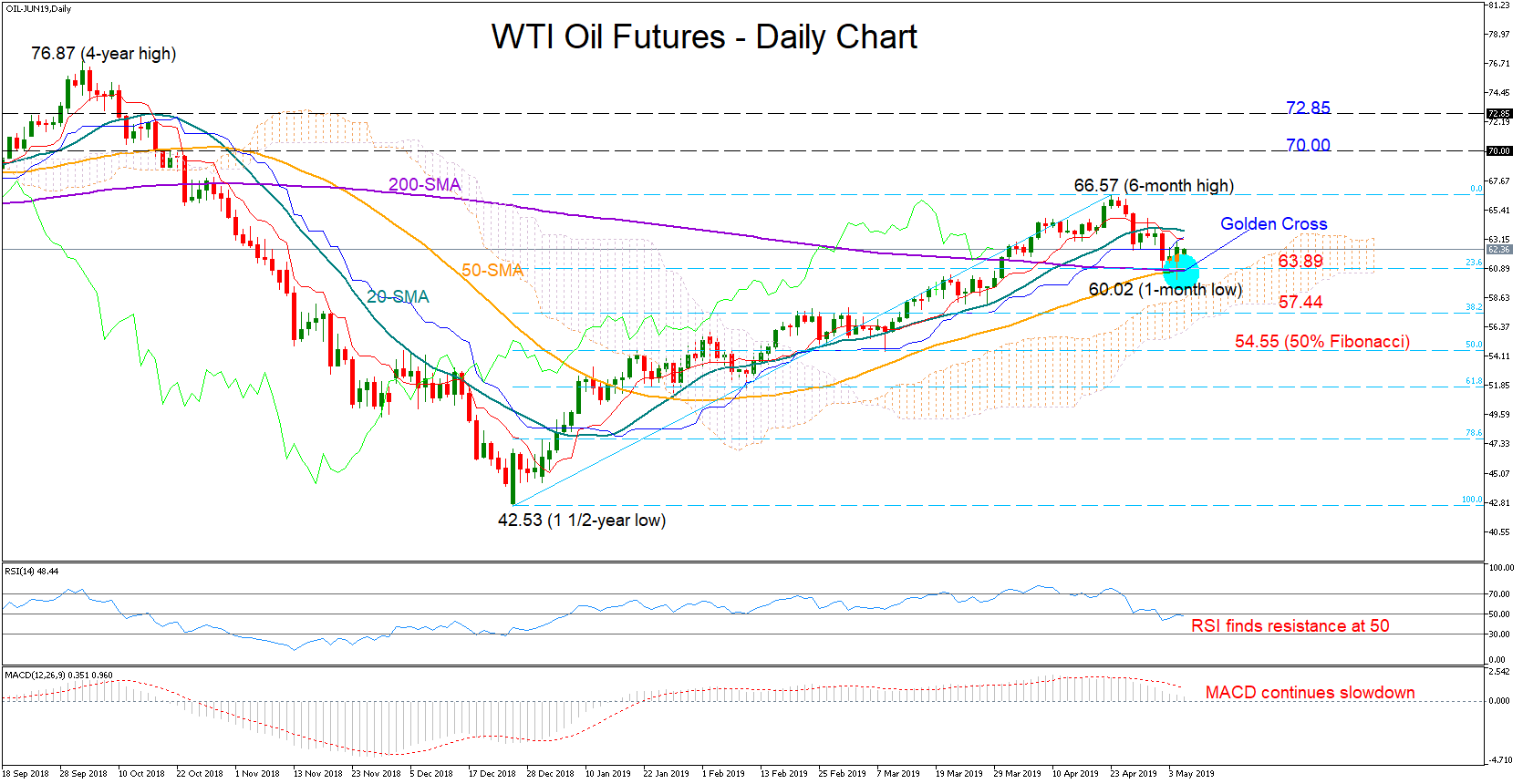
WTI oil futures managed to close with marginal gains on Monday after falling below the longer-term 50 and 200-day simple moving averages (SMA) to touch a one-month low of 60.02. The short-term bias, though, remains neutral-to-negative as the MACD is losing steam below its red signal line and moving towards zero, while the RSI seems to be unable to return above its 50 neutral mark.
In the medium-term picture, the news is more positive thanks to the golden cross formation by the 50- and the 200-day SMAs which indicates that a bull run may be on the horizon. Yet investors would like to see a larger distance between the lines to consider the signal more seriously.
Should the price overcome barrier between the red Tenkan-sen (63.29) and the 20-day SMA (63.80), positive momentum could probably last until the 6-month high of 66.57. Beating significantly that top, the way could open towards the 70 mark, while higher, a break above the 72.85 resistance level could provide more comfort to the bulls to keep going.
On the downside, the 23.6% Fibonacci retracement line drawn from the 1 ½-year low of 42.53 to the recent peak of 66.57 could act as support (66.89). A failure to hold above this level and therefore above the 50- and the 200-day SMAs could strengthen the sell-off towards the 38.2% Fibonacci of 57.44, while a decline under the 50% Fibonacci of 54.55 may have a bigger negative impact on the sentiment.
In brief, WTI oil futures are currently facing a neutral-to-bearish risk in the short-term, while in the medium-term picture, the outlook could improve further if the golden cross proves sustainable.
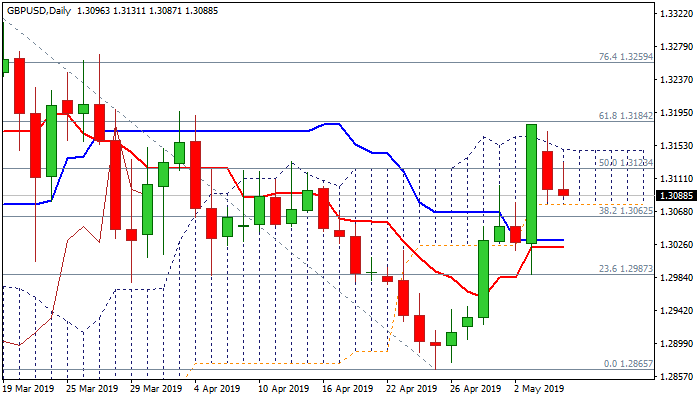
GBP/USD Outlook: Extended Consolidation Within Daily Cloud Awaits Fresh Brexit News
Cable holds in choppy and directionless mode within daily cloud following Monday's pullback from new one-month high and close in red. Huge bullish daily candle from last Friday when pound surged on renewed hopes for Brexit deal, continues to underpin, as daily studies remain bullish. Bullish bias is expected to stay in play for renewed attempt towards key barrier at 1.3184 (Fibo 61.8% of 1.3381/1.2856) while daily cloud base (1.3077) and Fibo 38.2% of 1.2865/1.3179 (1.3060) hold dips. Bearish signal can be expected on firm break lower. Markets will be closely watching for any news from UK Tory and Labor parties Brexit talks which continue today.
Res: 1.3103, 1.3131, 1.3179, 1.3184
Sup: 1.3087, 1.3077, 1.3060, 1.3042
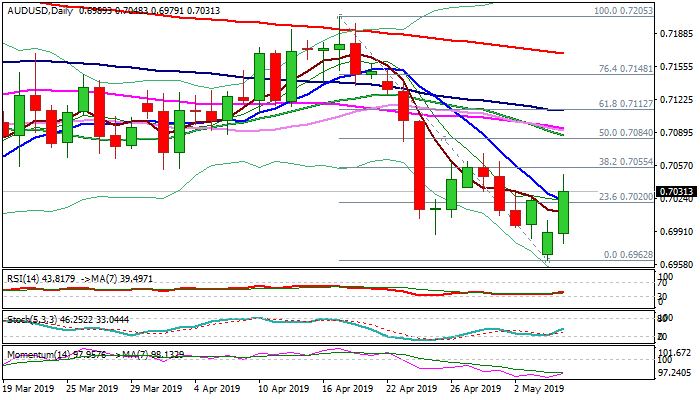
AUD/USD Outlook: Aussie Rallied After RBA Stayed Pat But Overall Picture Is Bearish
The Aussie surged 0.7% in Asia on Tuesday after RBA left interest rates unchanged at record low but left the door opened for easing, as inflation in Q1 remained weak and retailers showed the worst results in seven years, despite Mar figure coming above expectations. Fresh bulls face pivotal barriers at 0.7055/68 (Fibo 38.2% of 0.7205/0.6962), with sustained break here needed to sideline immediate downside risk and signal stronger recovery. Overall picture remains firmly bearish and eyes key target at 0.6931 (Fibo 61. 8% of 0.6706/0.7295), with current rally seen as positioning. Recovery should ideally stay capped under 0.7055/68 barriers, but stronger upticks towards a cluster of converged falling daily MA's at 0.7087/97 zone (20/30/55SMA) cannot be ruled out, before bears regain control. South-heading MA's and negative momentum on larger timeframes (daily/weekly) supports scenario. Only sustained break above 0.7112 (Fibo 61.8% of 0.7205/0.6962 / 100SMA) would neutralize and shift focus higher.
Res: 0.7048, 0.7068, 0.7087, 0.7097
Sup: 0.7022, 0.7000, 0.6979, 0.6962
Markets Hang On To Hope That US-China Trade Talks Not Derailed
Markets appear to be holding on to hope that US-China trade negotiations will not be derailed, amid reports that this week’s trade talks in Washington will still take place. Such a positive interpretation of recent events helped the Dow recover most of its losses before ending 0.25 percent lower, while the S&P 500 fell 0.45 percent on Monday. Stock markets in China, Singapore, and Australia steadied on Tuesday, although Japan’s Nikkei 225 and South Korea’s KOSPI came back from their respective holidays to trade lower by over one percent respectively as both played catch up to the previous day’s selloff across the region.
Currency markets also continue to digest the prospect of higher US tariffs on Chinese imports as soon as Friday, as tweeted by President Donald Trump, with emerging market currencies like the Chinese Yuan, South Korean Won, and the Indonesian Rupiahextending their declines against the US Dollar. Meanwhile,safe haven assets such as the Japanese Yen and Gold are holding on to Monday’s gains.
US-China trade tensions are set to be at the forefront of the market’s collective mind this week, as the slightest development or headline stemming from discussions in Washington could trigger knee-jerk moves by traders and investors.Amid such highly sensitive market conditions, volatility is expected to be the order of the day. Should the existing 10 percent US tariffs on some $200 billion worth of Chinese goods indeed be hiked to 25 percent come Friday, that may trigger another selloff in riskier assets, as investors try and anticipate what higher barriers to trade may do for the already moderating global growth outlook.
Central banks in focus amid trade tensions flare-up
Given renewed concerns over trade ties between the world’s two largest economies, attention will also turn to central banks that have previously highlighted external downside risks while adopting a dovish bias. The central banks of Australia, New Zealandand Malaysia are all expected to make their respective monetary policy decisions this week.
With US-China trade tensions having already weighed on the global economy, some of these central banks may opt for a pre-emptive rate cut, which could in turn put more downward pressure on their respective currencies.Amid continued US Dollar resilience at this point in time, emerging market currencies may find it tough to carve out gains in the near-term, as risk-off sentiment also continues to cast a cloud over regional assets.
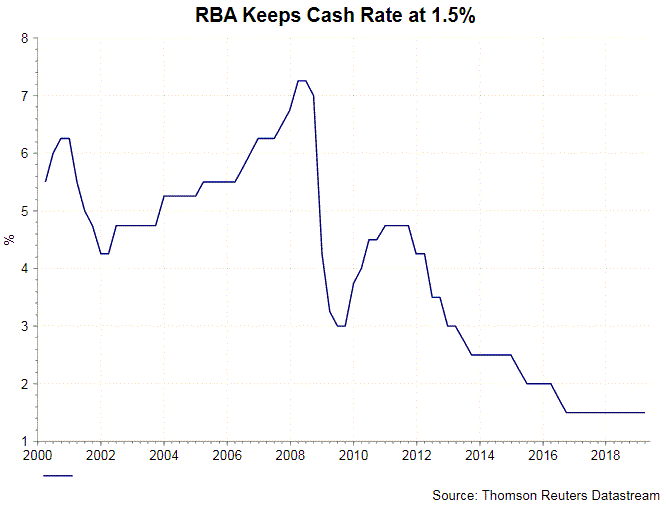
RBA Left Rate at 1.5%. Pledged to Monitor Job Market
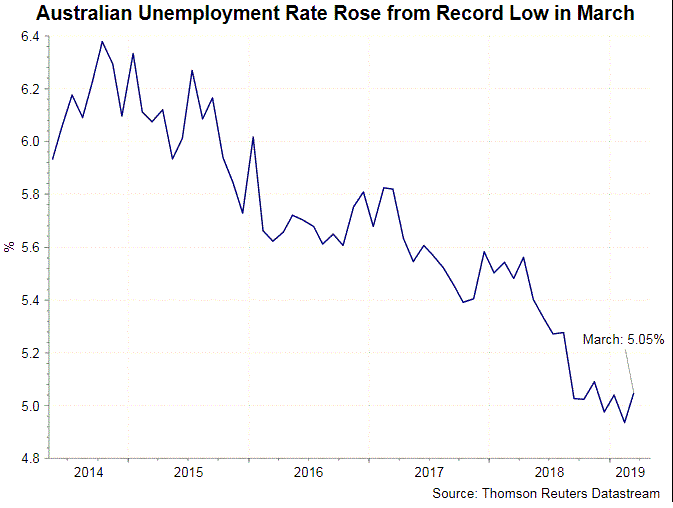
RBA left the cash rate unchanged at 1.5% in May. Yet, the accompanying statement remained dovish, citing sharp deceleration in core inflation, decline in house price and subdued household consumption as key areas of concerns. On the monetary policy outlook, the members would monitor the employment situation closely, as further improvement should help lift inflation. In our opinion, it is likely that RBA would lower the policy rate if the unemployment rate climbs up to 5.2-5.5% - the levels seen in the second and third quarter of 2018. Such scenario would cause further deterioration in inflation, as well as the property market.
 Policymakers viewed more cautiously about the global and domestic economic developments. Globally, the central bank noted that “the risks are tilted to the downside”. This was compared with April’s reference that “downside risks have increased”. It indicated that inflation remained “subdued”, in contrast with April’s acknowledgement that core inflation has picked up. Regarding its largest trading partner, RBA noted that China has “taken steps to support the economy, while addressing risks in the financial system”, removing the language about China’s easing policies and slowdown in economic growth. We believe this was driven by China’s stronger-than-expected economic data for 1Q19. Depending on the trade negotiations between US and China, the headwind facing the latter’s growth slowdown could once again cause panic in Australia’s economy.
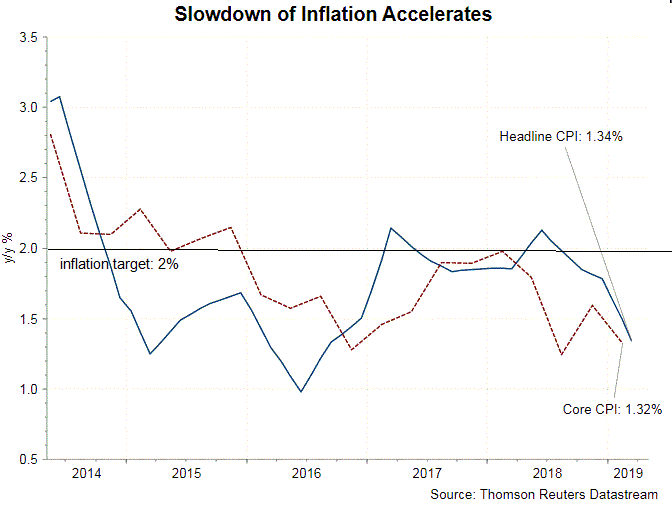
Domestically, the major concern comes from inflation. RBA described the first quarter inflation as “noticeably lower than expected”, suggesting “subdued inflationary pressures across much of the economy”. Weak price levels have been driven by “lower housing-related costs” and policy measures “affecting administered prices”. Still, the members expect to pick up “gradually”, with the core inflation to reach +1.75% this year, +2% in 2020 and a little higher after that. Headline CPI is expected to be “around +2% this year, boosted by the recent increase in petrol prices”.
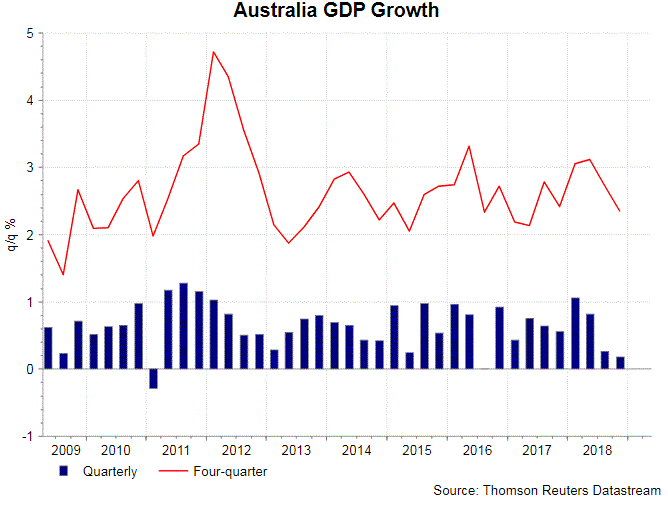
RBA retained the central scenario for GDP growth at 2.75% for 2019 and 2020. Yet, it is likely that we will see downward revisions in the upcoming Statement of Monetary Policy on Friday. The key drag on GDP growth comes from household consumption”. According to RBA, weak consumption has been “affected by a protracted period of low income growth and declining housing prices”. It forecast that “some pick-up in growth in household disposable income is expected and this should support consumption”.
Similar to other advanced economies, the job market remained resilient. While reaffirming the developments of significant increase in employment, high the vacancy rate and skills shortages in some areas, RBA is also aware of the little progress in further decline in the unemployment rate. It forecasts the unemployment rate to stay “broadly steady” at around 5% “over this time” and “remain around this level over the next year or so, before declining a little to 4.75% in 2021”
 In the forward guidance, RBA affirmed that it is “appropriate” to stand on the sideline. As future monetary policy depends on upcoming data, RBA would pay close attention to developments in the labour market as further improvement in the employment situation would help absorb spare capacity and boost inflation.
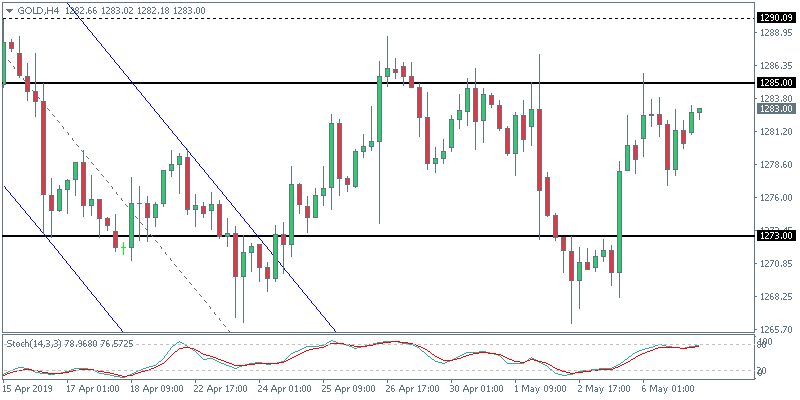
Gold Settles Into Range
The precious metal posted modest gains on Monday. But price action remains somewhat biased to the upside. The retest of the 1285 level will be crucial as it could potentially give way for further upside gains in price. Gold prices caught a bid amid renewed risk-off sentiment in the market. Fed members, Quarles will be speaking at an event later today.
Can Gold Breakout Higher?
The retest to the 1285 handle will be crucial as it could lead to a possible breakout above this level. This will shift the bias to the upside with the 1290 region being the next level of resistance. A daily close above yesterday's high of 1285.74 could potentially confirm this view. Alternately, failure to close with gains today could push gold prices to maintain the sideways range within 1285 and 1273 levels.