Sample Category Title
EUR/USD – Euro Drifting In Light-Data Session, German Factory Orders Expand
EUR/USD continues to show limited movement this week. Currently, the pair is trading at 1.1203, up 0.03%. It’s a quiet day on the release front, so traders should not expect much movement from the pair on Tuesday. German factory orders posted a gain of 0.6%, ending a nasty streak of four straight declines. However, this reading was shy of the estimate of 1.6%. The EU released its economic forecasts of member states. In the U.S., the highlight is JOLTS Jobs Openings. On Wednesday, Germany releases industrial production and the ECB releases the minutes of its April policy meeting.
The week started with positive economic data, but the euro was unchanged on Monday. Eurozone services PMI have been stronger than manufacturing PMIs, and continued to point to expansion in April. German services PMI improved to 55.7, just above the estimate of 55.6. This marked the strongest score since September. The eurozone release dipped to 52.8, but still beat the forecast of 52.5. Eurozone Sentix Investor Confidence jumped to 5.3, well above the estimate of 1.1. As well, retail sales slowed to 0.0%, above the estimate of -0.1%.
With the eurozone continuing to post lukewarm data, the ECB is in no rush to alter its monetary policy. Rate-setters are in a dovish mood, and the bank recently stated that it had no plans to raise rates prior to the spring of March 2020. The U.S. economy is in much better shape, but the Federal Reserve has shifted to dovish stance so far this year. At last week’s rate meeting, Fed chair Powell said that rate moves could go either way. Economic data will play a major factor in what direction rates move. Recent numbers have looked strong – GDP for Q1 jumped 3.2%, and nonfarm payrolls was unexpectedly strong in April. If this positive trend continues, the Fed could raise rates later this year, and the divergence with the ECB would likely boost the dollar, at the euro’s expense.
Tariff Man Has Risk Doubters Seeking Shelter
Tuesday May 7: Five things the markets are talking about
Global equities were mixed overnight as a slew of trade headlines continued to batter markets. U.S Treasury yields have managed to back up a tad while the U.S dollar confines itself to “non-volatile” trading range against G10 currency pairs.
Nevertheless, investor sentiment remains tenuous as President Trump’s latest threat to raise tariffs on Chinese goods this Friday from +10 to +25% has certainly shocked financial markets and fueled worries that this week’s trade talks may be derailed. China’s Vice Premier Liu He has indicated that he and a delegation would still visit the U.S for trade talks on May 9 and 10.
Down-under, the Reserve Bank of Australia (RBA) left rates on hold, defying expectations it could become the first G10 central bank to enter an easing cycle. The emphasis now shifts to Reserve Bank of New Zealand (RBNZ) later this evening (10:00 pm EDT). The market is pricing in a roughly a +50% chance of one. If it happens, expect the NZD to pullback towards its seven-month lows of NZ$ $0.6425.
On tap: China releases trade data this evening, and the U.S. does so on Thursday. South Africa holds national elections tomorrow while China reports on inflation Thursday and the U.S. releases their April CPI report Friday.
1. Stocks pare their Sino-U.S tariff losses
In Asia, the Nikkei was the biggest loser as domestic markets reopened following 10-days of holidays. Missing out on Trump’s tariff threats to China, the Nikkei closed down -1.5% as 27 of the 33 Topix sectors fell. Some electronics and machinery stocks saw big declines on weak guidance issued ahead of the holiday.
Down-under, Australian stocks lost most of their gains after the RBA declined to cut interest rates to help support a ‘slowing’ domestic economy. It was an even split on a cut, but after rising as much as +0.9% intraday, the benchmark ASX 200 stock index ended with just a +0.2% gain. In S. Korea, the Kospi was down -0.88%, however, after North Korea conducted a round of missile tests on Saturday.
In China, equities staged a “mild technical rebound” but remained volatile after their worst drop in more than 36-months yesterday. The benchmark Shanghai Composite was +0.7% higher, while the blue-chip CSI 300 rose +0.98%. In Hong Kong, the Hang Seng was up +0.5%.
In Europe, regional bourses are trading mixed, paring earlier highs, following a generally higher session in Asia after China’s Vice Premier Liu said he will visit the U.S this week for trade talks.
U.S stocks are set to open in the ‘red’ (-0.46%).
Indices: Stoxx600 -0.18% at 386.20, FTSE -0.58% at 7,338.05, DAX -0.30% at 12,250.30, CAC-40 -0.44% at 5,459.56, IBEX-35 +0.20% at 9,350.10, FTSE MIB +0.27% at 21,466.50, SMI -0.10% at 9,648.50, S&P 500 Futures -0.46%
2. Oil mixed as Sino-U.S trade war drags on prices, gold higher
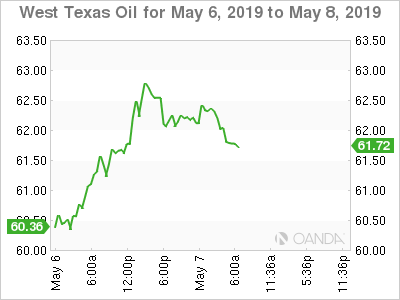
Oil prices trade mixed, pressured by concerns that the escalating Sino-U.S. trade dispute could slow the global economy, while sanctions on Iran and Venezuela is helping to keep the market on edge.
Brent crude oil futures are at +$71.12 per barrel, down -12c, or -0.2%, below Monday’s close. U.S West Texas Intermediate (WTI) crude futures were at +$62.30 per barrel, up +5c above yesterday’s settlement.
Prices have come under pressure by investor worries that the stalling U.S-China trade talks could dent global fuel consumption.
On the supply side, oil markets remain tense as the U.S tightens sanctions on Iranian oil exports, indicating yesterday that it would also boost its military presence in the Middle East.
Note: U.S sanctions have already halved Iranian crude oil exports over the past year to below +1M bpd, and future shipments are expected to drop to as low as +500K bpd by the end of the month.
Also providing pressure on prices is U.S data showing an increase in production. U.S crude production has already surged by more than +2M bpd since early 2018, to a record +12.3M bpd. This has made the U.S the world’s biggest producer.
However, data from Baker Hughes last Friday showed that the number of rigs drilling for gas in the U.S fell by -3 to +183 in the week to May 3, while oil-directed drilling rigs rose by +2 to 807.
Ahead of the U.S open, gold prices remain somewhat better bid as President Trump threatens to hike tariffs on Chinese imports has pushed investors to seek insurance in ‘safe-haven’ assets. Spot gold is up +0.2% at +$1,283.41 per ounce, while U.S gold futures are up +0.1% to +$1,284.50 an ounce.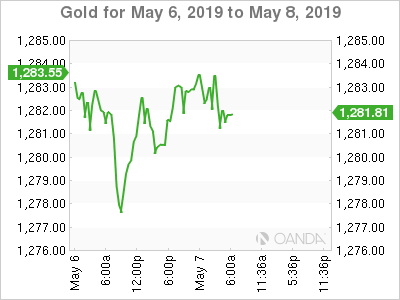
3. Sovereign yields are confined to tight ranges
The German 10-year Bund has fallen this morning, pushing back yields despite being well supported, albeit with low volumes. Over the past 24-hours, the markets reaction to the renewed trade tension was quite muted and mainly confined to equity markets. The 10-year Bund yield has rallied to +0.021%. The spread between the 10-year German government Bunds and the Italian government BTP’s has widened slightly – some from rising BTP yields and some from falling Bund yields.
Reserve Bank of Australia (RBA) ignored market pressure to cut in the shape of weak inflation and a slowing domestic economy. Rather, RBA Governor Lowe said, “the job market will steer policy as more unemployment declines are needed to get inflation to the central bank’s 2-3% target range.”
Note: An Aussie senate election is next week, and some had speculated a rate cut would have to wait until afterward to avoid political entanglements.
Elsewhere, the yield on 10-year Treasuries has increased +2 bps to +2.49%. In the U.K, the 10-year Gilt yield has fallen -3 bps to +1.193%, while in Japan’s 10-year JGB yield fell -1 bps to -0.049%.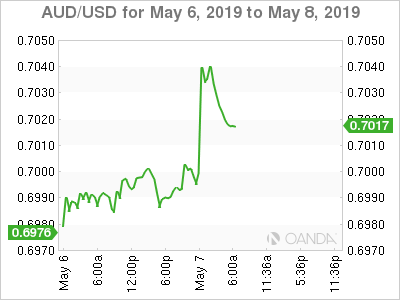
4. Risk on trying to find momentum
The AUD (A$0.7035) rallied after the RBA failed to cut interest rates overnight. However, Aussie ‘bears’ believe the currency strength won’t last if U.S-China trade tensions escalate – AUD is “the main G10 currency in the firing line if risk sentiment sours. Rate cut odds have now been pushed out to August.
New Zealand’s Institute of Economic Research does not believe that the Reserve Bank of New Zealand (RBNZ) will cut rates later this evening (10:00 pm EDT). If it does happen, Kiwi ‘bulls’ are looking for the NZD to pullback toward last October’s low of NZ$0.6425.
In Turkey, ongoing political uncertainty has pushed the USD up nearly +2% against TRY ($6.1695, up +1.59%). Yesterday; Turkey’s national election board canceled results of the Istanbul mayoral race that President Recep Tayyip Erdogan’s ruling party lost five weeks ago and ordered a rerun. The market believes that the Central Bank of the Republic of Turkey (CBRT) has limited FX ammo to fight a weakening TRY – so we are back in the scope of CBRT needing to hike rates to prevent the lira going much weaker.
China’ yuan (-0.3% to ¥6.7939 offshore) weakened further against the dollar outright overnight, but the pace of losses has slowed, as the market digests Trump’s tariff threats. The onshore yuan also fell -0.3% to ¥6.7789.
GBP (£1.3088, down -0.1%) is a tad softer as the prospect of a cross-party Brexit deal is lacking market optimism.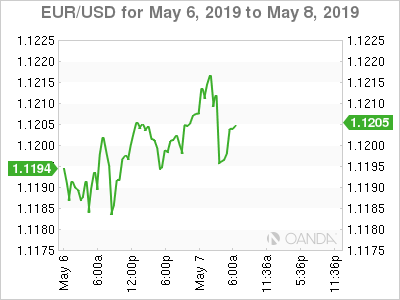
5. German manufacturing orders missed forecasts in March
Data this morning from Germany’s Federal statistical Office showed that German manufacturing orders picked up slightly in March, but not enough to compensate the previous months steep fall and held back by weak domestic demand for capital goods.
Total orders for the key sector rose +0.6% m/m, versus market expectations of a +1.2% rise.
“The slight order increase in March is not least due to bulk orders,” the German economics ministry said. Stripping out volatile demand for big ticket items, manufacturing orders would have registered another monthly decline, the ministry added.
Compared year over year, order volumes dropped -6.0%.
Note: Industrial activity in Germany turned down in H2 2018 amid weaker foreign demand and partly reflecting temporary disruptions to production in the key automobile and chemical industries.
“On the whole, the order situation in the manufacturing sector indicates that industrial activity will remain subdued in the coming months,” the economics ministry said.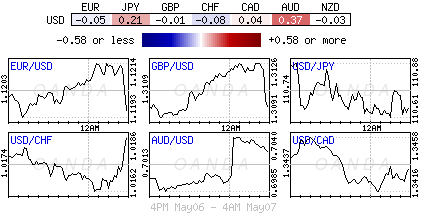
USD/TRY Outlook: Turkish Lira Falls Further On Political Turmoil
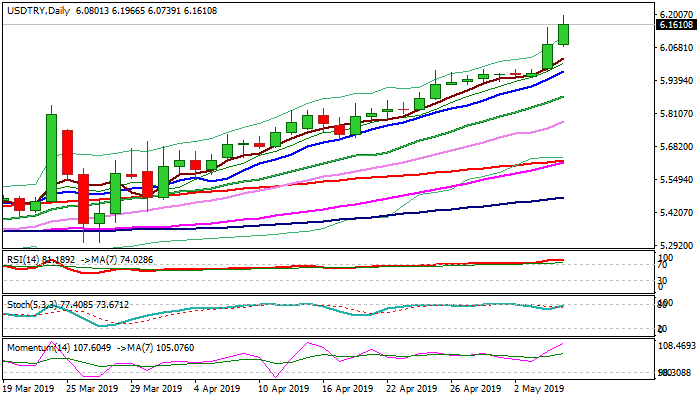
Turkish lira fell further on Tuesday and hit new 2019 low against the dollar, trading at the lowest since early Oct 2018.
Lira was down 3.5% since Monday's opening, with fresh selling being sparked by decision of Turkey's election board to re-run elections in Istanbul.
The latest event added to existing negative mode for lira on weakening economy and high inflation that prompted investors to exchange lira for foreign currencies.
The USDTRY's fresh bullish extension broke above important Fibo barrier at 5.1198 (50% retracement of 7.1074/5.1323) and came ticks ahead of round-figure 6.20 barrier.
Bulls eye target at 6.2286 (4 Oct 2018 lower top) and may extend towards pivotal Fibo barrier at 6.3529 (Fibo 61.8%) as negative sentiment was further soured by decision for repeated elections in Istanbul that would deepen current political turmoil.
Bullish daily/weekly studies support scenario, with brief technical corrections expected to precede fresh advance. Broken Fibo barrier at 6.1198 now acts as solid support (which requires verification on daily close above), followed by today's low at 6.0739. Rising 5SMA (6.0270) and broken psychological 6 barrier are expected to hold extended dips.
Res: 6.2000, 6.2286, 6.3000, 6.3529
Sup: 6.1198, 6.1000, 6.0739, 6.0270
Markets, US/China Trade, Gold, Oil
Investors calmer as dust settles on US/China setback
It won't come as a surprise to anyone to learn that attention is primarily on US/China trade talks again on Tuesday, after the prospect of a deal on Friday quickly turned into the threat of new tariffs.
This may all just be last minute wrangling as both sides dot the I's and cross the t's and look to gain final concessions but investors are nonetheless quite wary about the possibility of talks collapsing so late in the day. A deal was pretty much priced in, with the rhetoric of recent months very much being focused around the timing of a deal rather than the prospect of one but that has suddenly changed.
The initial response to the latest development was understandably very negative but as the dust settled and it became clear that talks will continue this week, the hysteria passed and investors instead went into self-preservation mode telling themselves that surely this is only a negotiating tactic. Surely months of talks can't collapse this late in the day. The chances are they're probably right but the tone of the negotiations now appears to have become less friendly which means the deal is in jeopardy.
Trade developments bullish for gold?
Gold was one of the unsurprising early winners on Monday, as the initial sell-off in equity markets triggered some safe haven flows. These gains faded as the day went on and investors became generally more calm about the prospects for trade talks but this could be a bullish factor for the yellow metal in the coming days. The dollar has generally performed quite well during any escalation of the trade war and we did see some early support which may have acted as a slight headwind for gold.
It will be interesting to see in the coming days whether gold sees additional support if fears become reality and new tariffs are imposed. Price action in gold has been very interesting of late and could be further complicated by these trade talks. The yellow metal has appeared to give bearish signals on a few occasions but fails to deliver upon this in any significant way. Just last week we appeared to be heading for new lows and a test of $1,260 and price immediately rebounded. The bulls are in no mood to give up easily and this may only invigorate them.
Was oil really responding to US/Iran reports?
Oil markets appeared to bounce back on Monday on fears of a potential flare up in the Persian Gulf between the US and Iran. Whether this did in fact play into the price action in oil markets is another thing, with the rebound also happening to coincide with a rebound in overall risk appetite. It also occurred around a notable support area in both Brent and WTI which suggests to me the reports are just a convenient story to explain something that would have happened regardless.
There could be a cross-party brexit deal in UK, but not this week
According to a BBC’s political editor Laura Kuenssberg, there is a way for the UK government and opposition to compromise on a Brexit deal. however, it's unlikely to be reached this week. Kuenssberg tweeted that “Senior govt source says it IS possible though to see a way to a deal, but unlikely to be resolved this week." But the aim is “to set out a path to get the Withdrawal Bill to Commons with a fair wind.”
Foreign Secretary Jeremy Hunt indicated to BBC radio that he's "not a believer in a customs union" as a "sustainable long-term solution" of Brexit. It's clear that customs union is the way Labour would like to go forward with. Hunt urged that "this is a time when we have to be willing to make compromises on all sides because the message of last week was that voters for both main parties are very, very angry about the fact Brexit hasn’t been delivered.”
The US Currency Is Under Pressure Due To The Trade Conflict Between The US And China
The US dollar slightly strengthened against a basket of major currencies during yesterday's trading. However, the US currency is under pressure due to news of the complicated relationship between the United States and China. The US Trade Representative, Robert Lighthizer, said that US duties of 10-25% on Chinese goods $200 billion worth would be introduced on Friday. He noted that the United States decided to raise duties since China tried to revise the almost ready trade agreement. The dollar index (#DX) closed in the positive zone (+0.10%).
The Australian dollar strengthened significantly against the US currency after the publication of optimistic data from Australia. The Reserve Bank of Australia left the interest rate unchanged at 1.50%, as experts expected. Also, a report on retail sales was published, which rose by 0.3% in March, although experts expected growth by 0.2%.
It also became known that the British Prime Minister Theresa May prepared a "scenario" in case of second Brexit referendum. The official hopes that the UK will be able to exit the EU without an additional vote, but she is ready for the parliament to demand such an option.
The "black gold" prices are rising slightly. At the moment, futures for the WTI crude oil are testing the mark of $62.15 per barrel. At 23:30 (GMT+3) API weekly crude oil stock will be published.
Market Indicators
- Yesterday, the bullish sentiment was observed in the US stock market: #SPY (-0.41%), #DIA (-0.26%), #QQQ (-0.61%).
- The 10-year US government bonds yield is declining. Currently, the figure is at the level of 2.48-2.49%.
The news feed on 2019.05.07:
- JOLTS job openings at 17:00 (GMT+3).
China: Adding tariffs can’t resolve any problem
Chinese Foreign Ministry spokesman Geng Shuang said in a regular press briefing that “adding tariffs can’t resolve any problem" of trade conflicts. “Talks are by their nature a process of discussion. It’s normal for both sides to have differences. China won’t shun problems and is sincere about continuing talks,” he added.
Shuang also said “We hope the U.S. side can work hard with China, to meet each other halfway, and on the basis of mutual respect and equality, resolve each other’s reasonable concerns, and strive for a mutually beneficial, win win agreement.”
Vice Premier Liu He will still travel to the US on May 9-10 to resume trade negotiations despite re-escalated tariff threats. That's a slight delay comparing to the original plan of traveling to the US on Wednesday.
It's widely reported that China reneged on the commitments it made, explicitly with the new draft agreement sent to the US over the weekend. Both US Trade Representative Robert Lighthizer and Treasury Secretary Steven Mnuchin confirmed that. And it's seen as the trigger for Trump to declare trade war escalation to full blown level this Friday.
Mnuchin also confirmed that “the entire economic team ... are completely unified and recommended to the president to move forward with tariffs if we are not able to conclude a deal by the end of the week.”
GBP/AUD 4H Chart: Sell Signals
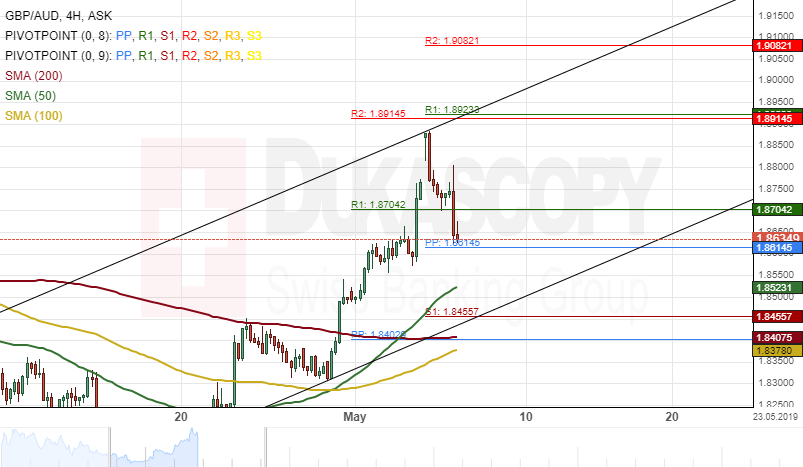
The British Pound has been appreciating in an ascending channel pattern against the Australian Dollar since the middle of April. The currency pair tested the upper boundary of the channel pattern at 1.8876 during Monday's trading session.
After hitting the upper band of the ascending channel, the exchange rate began to decline. The pair is currently testing a support line formed by the weekly pivot point at 1.8614.
As for the near future, it is likely that the GBP/AUD currency exchange rate will continue to edge lower. The potential downside target will be near the 50-hour simple moving average at 1.8518.
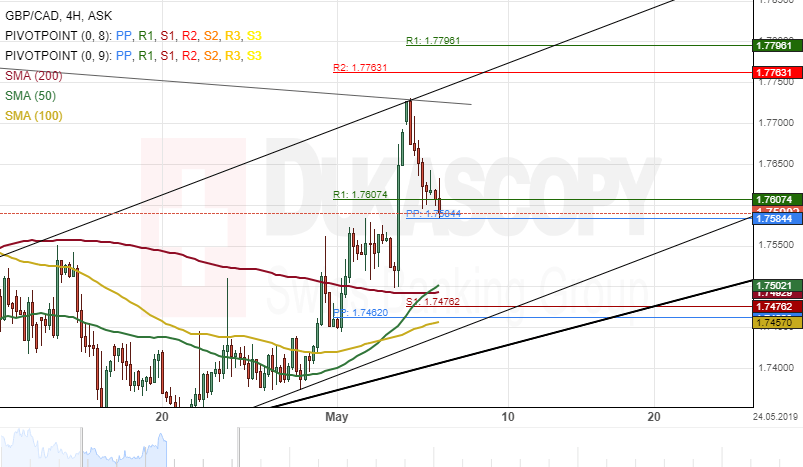
GBP/CAD 4H Chart: Expects Pullback
Upside risks have dominated the British Pound versus the Canadian Dollar since the middle of April. The currency pair has appreciated about 400 base points during the last three weeks.
Everything being equal, it is likely that the exchange rate makes a pullback towards a support cluster formed by the combination of the 50– and 200– hour SMAs at 1.7498 within this week's trading sessions.
If the support cluster holds, the GBP/CAD currency exchange rate will continue its bullish momentum in the shorter term.
Meanwhile, technical indicators flash buy signals on both the smaller and the larger time frames chart.
USDJPY Struggling With 110.90
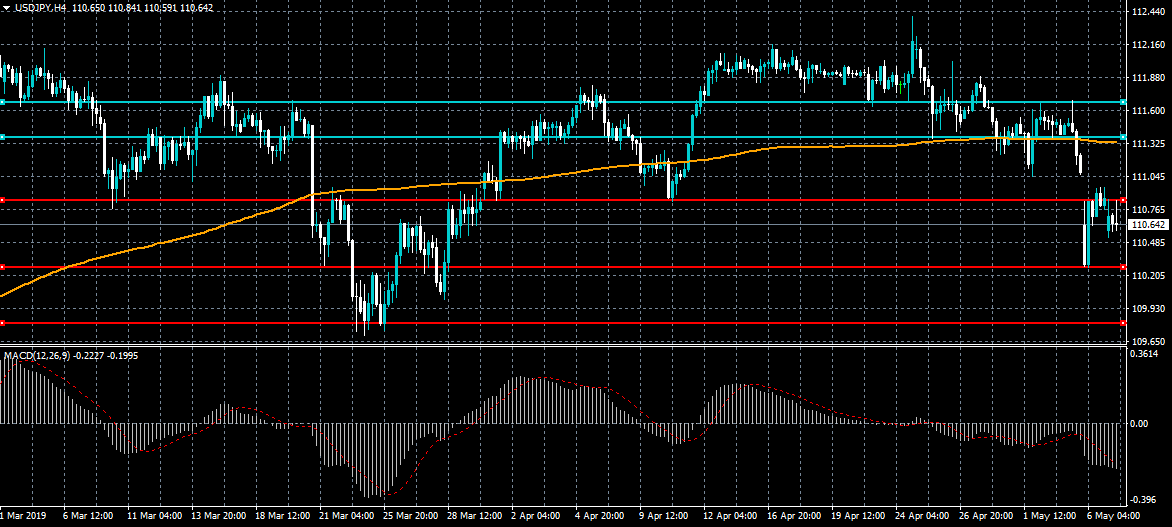
The US dollar is struggling to move higher against the Japanese yen currency as trade tensions between the US and China continue to drive risk-off trading sentiment. The USDJPY pair has reversed from the 110.90 resistance level and may soon target the 110.25 level. If sellers move price below the 110.00 level the bullish inverted head and shoulders pattern on the four-hour time frame will be invalidated.
The USDJPY pair is bearish while trading below the 110.90, key intraday support is found at the 110.25 and 109.80 levels.
If the USDJPY pair trades above the 110.90 level, key intraday resistance is found at the 111.10 and 111.30 levels.