Sample Category Title
Eco Data 5/8/19
[php_everywhere instance="1"]
Markets Remain Rattled that the Tariff Man is Coming on Friday
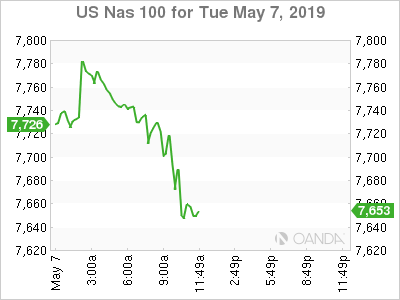
Trade talks will go on as planned, but expectations are low for enough progress to derail President Trump’s promise to raise current tariffs of 10% on $200 billion of Chinese goods to 25%. Trump’s deadline of Friday is delivering a see of red to risk assets. US equities are down over 1% across the board with the Nasdaq leading the way lower with a 1.5% decline. The market still believes a trade deal will get done in due time but uncertainty of enough progress for this week’s deadline is putting a dent in risk appetite.
- RBA – No Cut, No Easing Bias
- EUR – Sinks as EU forecasts catch up to the street’s view
- Stocks – Trade worries linger
- Oil – Down on trade worries
- Gold – Not much of a safe-haven
EUR
The euro sank to the lows of the day after the EU Commission released the Spring Economic Forecasts. Playing catch up to the street’s views, EU growth now seen at 1.3%, with Germany now expected to only see 0.5% growth in 2019. The key takeaway is that downside risks to the outlook remain prominent. Hurting the outlook are Brexit risks, trade wars and continued softer than expected data from Germany.
RBA
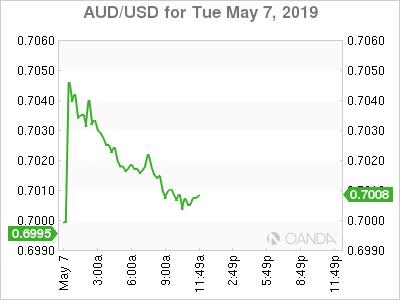
The Reserve Bank of Australia (RBA) rate decision decided to hold rates steady in hopes the labor market will drive the growth with inflation. The Bank is still expected to deliver a cut this year, but they may wait a couple meetings before doing so. The Australian dollar jumped almost 50 pips following the statement release but the gains were short-lived as the overall risk-off market environment put a damper on high-beta currencies. The RBA meeting did not deliver a rate cut, not a explicit easing bias, so we could see markets need to see further softer Australian data points before seeing downward momentum accelerate.
Stocks
US stocks are having a broad-based selloff on escalating trade concerns. The rebound in Asia was short-lived as the market reprice the optimism for enough trade progress to derail Trump’s tariff threat. Skepticism is high that enough progress will not be made by the Friday deadline and fears are growing that the trade war might drag into 2020. If we see the US increase tariffs at the end of the week, China will retaliate, and global growth will take a big hit.
A wrath of negative headlines earlier in Europe did not help with risk appetite. EU Commissions Spring Forecast downgrades further detailed softness in the region and the release of German factory orders showed the fifth straight miss with the consensus expectations.
The US stocks markets are all trading down by around 1.5%, with the Nasdaq leading the way lower with a 1.7% decline.
Oil
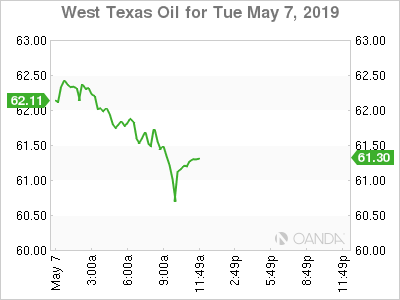
Risk aversion is dragging commodities lower, but the move may be overdone with crude prices. Geopolitical risks are likely to provide some support for oil prices and the focus is likely to shift back to Iranian sanctions, Russia’s pipeline disruption, Venezuelan falling exports and the Libyan conflict.
West Texas Intermediate crude appears to still see technical buying ahead of the $60 a barrel. If we see crude stabilize here, initial resistance will come from the $63.50 region.
Gold
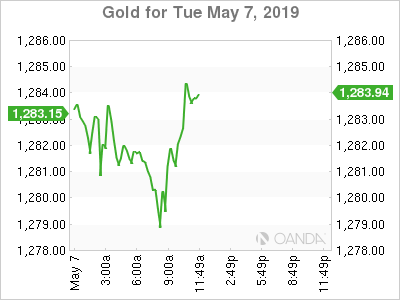
A see of red with global stock markets is still not good enough of a catalyst to drive a strong move higher with gold prices. The precious metal remains capped by $1,290 and that is surprising considering the amount of risk aversion flows global markets are seeing. Gold is poised for its third consecutive daily gain, but the move is unimpressive and will not gain the attention of momentum traders until we see a recapturing of the $1,300 level.
DOW and 10-year yield in steep decline again on trade concerns
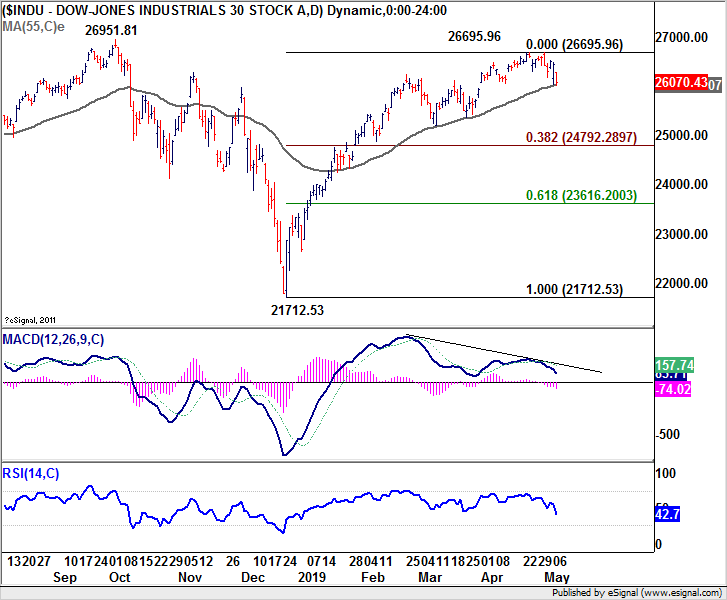
Risk aversion re-intensifies again in US session on trade war concerns. At the time of writing, DOW is down -1.46%. NASDAQ is down -1.75% and S&P 500 is down -1.44%. Yesterday, it appeared that DOW had drawn strong support from 55 day EMA and rebounded. But technically outlook turns rather bad with today's steep decline.
In the background, bearish divergence condition is already seen in daily MACD. 26696.96 is reasonably close to historical high at 26951.81, It's an ideal timing for a near term reversal. A close below 55 day EMA (now at 26013) today, and sustained trading below there ahead, will suggest that rise from 21712.53 has completed. And even in the relatively bullish scenario, DOW should at least have a test on 38.2% retracement of 21712.53 to 26695.96 at 24792.28 ahead.
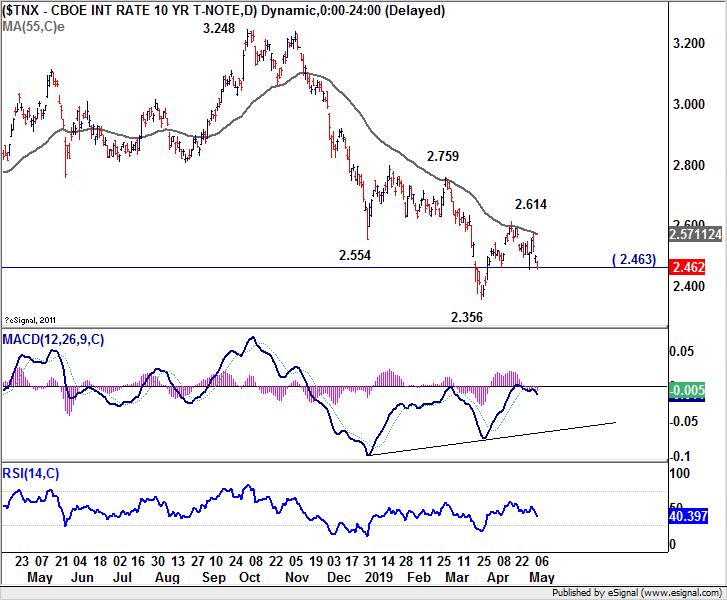
Technical developments in 10-year yield also turns bad again after some false dawns. Rejection by 55 day EMA again dampened the case of bullish reversal. Meanwhile, 2.463 support is back in focus. A close below this level today should confirm completion of the corrective recovery from 2.356. And larger down trend would then be ready to resume through 2.356 low.
Aussie Jumps (Briefly) after RBA Surprise Move
AUD/USD posted gains close to 1.0% on Tuesday, but has given up most of these gains. The sharp rise was in response to the unexpected decision by the Reserve Bank of Australia to hold rates at 1.50%. Other Australian releases were also positive. Retail sales slowed to 0.3%, beating the estimate of 0.2%. The trade surplus increased to A$4.95 billion, above the forecast of A$4.49 billion. In the U.S., there were no major events. JOLTS Job Openings improved to 7.49 million, beating the estimate of 7.35 million.
The RBA held the course on Tuesday, surprising the markets, which had expected the bank to cut rates to 1.25%. The markets had priced in a rate cut at close to 50%, so the decision to hold rates helped boost the Aussie in the Asian session. However, AUD/USD was unable to consolidate and gave up most of these gains in European trade. The Australian economy has been damaged by the economic slowdown in China, which is Autralia’s largest trading partner. Inflation fell to 0.0% in the fourth quarter, its lowest level in three years. This weak release raised speculation of a rate cut, but the RBA continues its wait-and-see stance, hopeful that the economy will find its feet without the help of a rate cut.
U.S. President Donald Trump sent shock waves across the equity markets, after announcing on Sunday that the U.S. would raise tariffs on $200 billion worth of Chinese goods as early as Friday, from 10% to 25%. On Monday, Chinese officials had said it would cancel the talks, but this turned out to be an empty threat. Chinese Vice Premier Liu He is scheduled to lead a Chinese delegation to Washington. Will the new U.S. tariffs be rescinded? Treasury Secretary Steve Munchin said that the tariffs could be cancelled when the talks resume, so the markets could quickly rebound from the current slide.
RBNZ Forecast to Ease, But May Hold Its Fire Instead
The RBNZ will announce its decision early on Wednesday, at 02:00 GMT. The forecast from economists is for a rate cut, but investors are not convinced, with market pricing assigning only a ~40% chance for one. Indeed, the Bank may hold its fire for now and postpone any cut until the summer. The kiwi will probably spike higher in that case, though any positive reaction could be short-lived.
The Reserve Bank of New Zealand (RBNZ) adopted a clear easing bias when it last met in March, indicating that the next move in interest rates will likely be lower given weakness in both the domestic and the global outlook. Since then, developments have been mostly discouraging, with inflation and wage growth slowing in Q1, while the labor market cooled. Likewise, business confidence remains extremely low, spelling downside risks for business investment and therefore for future growth.
It’s not all bad news, though. Prices for commodities New Zealand exports, like dairy and milk products, are rising. Meanwhile, the kiwi is trading much lower than what the RBNZ had estimated in its latest forecasts, which combined with rising oil prices, paints a brighter picture for future inflation. A weaker currency raises import prices, exerting upward pressure on overall inflation. More importantly, China’s economy seems to be stabilizing after a barrage of stimulus, though recent news that the US could soon impose new tariffs will probably keep a lid on such optimism.
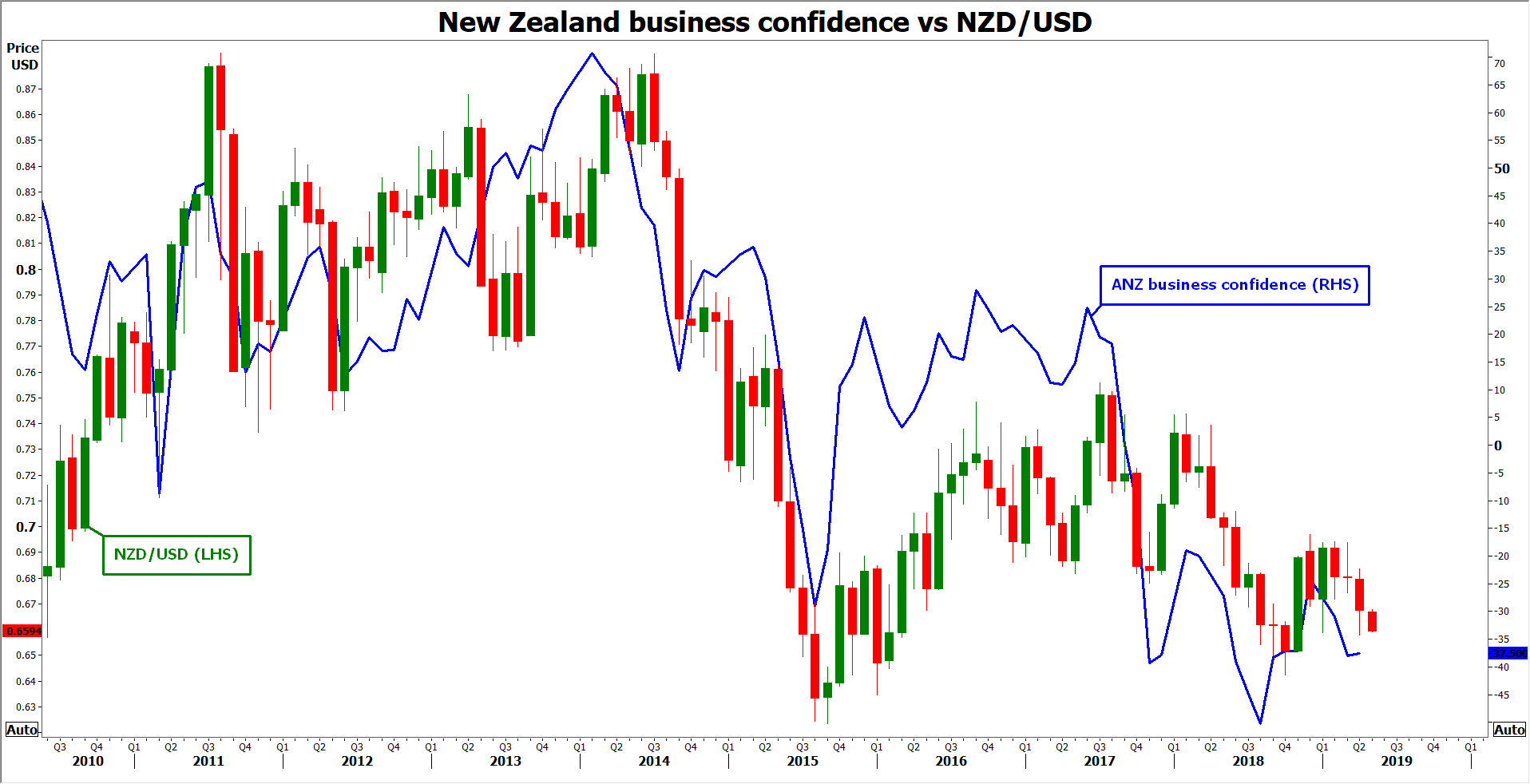
This brings us to this week’s meeting. Markets seem uncertain of whether the RBNZ will cut rates right now, assigning a ~40% chance for a cut tomorrow. Yet, a rate cut by August is more than fully priced in, which shows that traders believe it’s a matter of when, not if, the RBNZ will ease.
It’s a close call, but risks seem tilted towards the RBNZ postponing any rate cut for the summer, effectively buying itself some time to examine more data before acting. The economy is softening, but not dramatically, so there’s little pressure to cut rates immediately. Since this meeting is accompanied by new forecasts, the Bank could still keep the easing narrative alive by projecting a lower path for interest rates, consistent with its dovish language.
As for the market reaction, if the Bank indeed keeps rates unchanged for now, the initial reaction in the kiwi will likely be higher. That said, if the RBNZ also reinforces market expectations for future cuts by revising down its rate forecasts, any positive reaction could be relatively short-lived.
Another factor arguing for the kiwi to gradually reverse lower, even in case of an on-hold decision, is the risk of further escalation in the US-China trade conflict. Markets have largely shrugged off such concerns so far, effectively betting that Trump is only posturing to gain negotiating leverage – which may be wishful thinking.
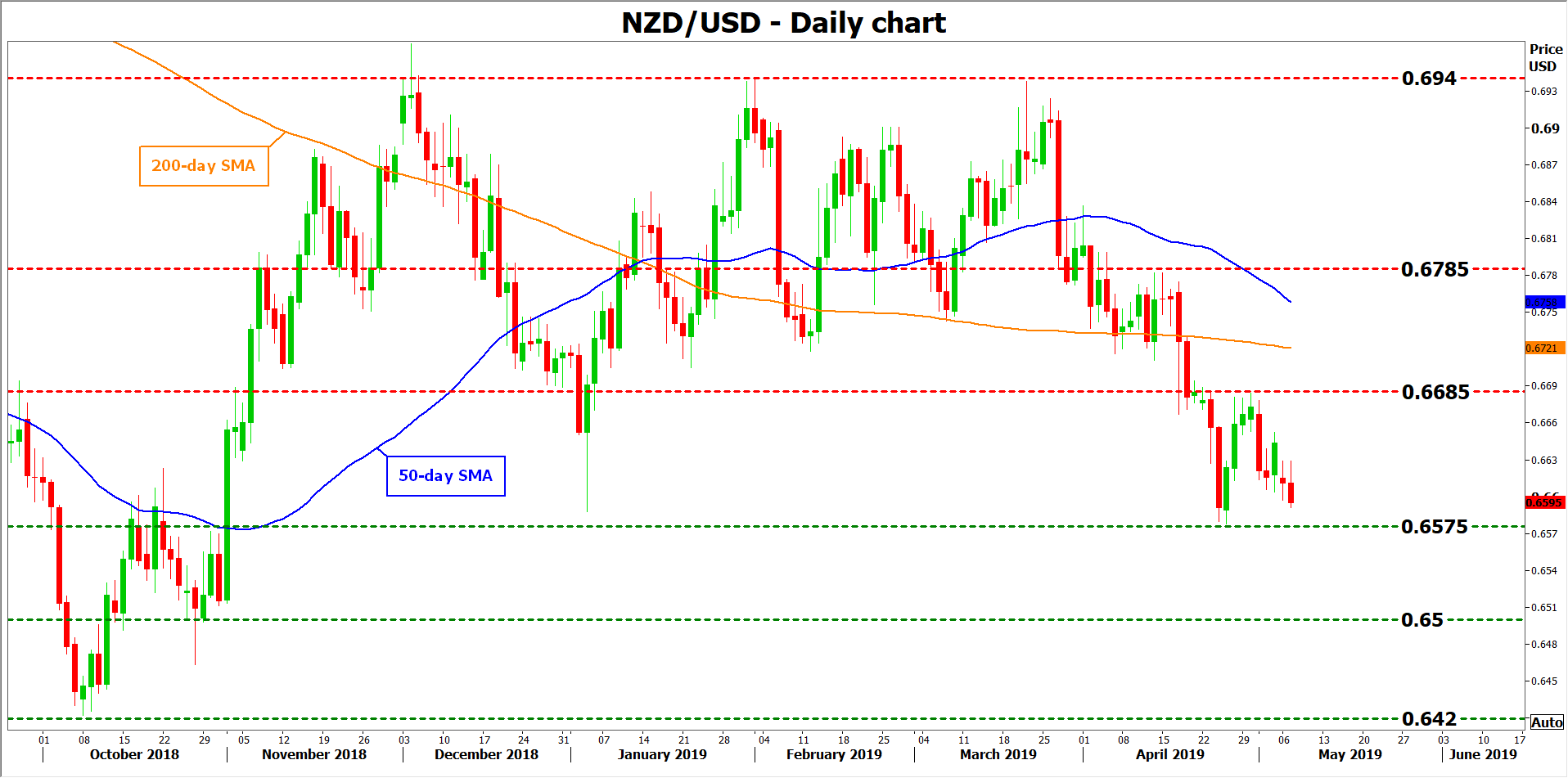 Technically, initial resistance to advances in kiwi/dollar may be found around 0.6685, the April 30 high, with an upside break aiming for the 200-day simple moving average (SMA) at 0.6721.
On the flipside, if the Bank does cut rates, the pair could fall below 0.6575 to test the 0.6500 handle. Even lower, attention would turn to the October lows near 0.6420.
USDTRY Flirts With 7-Month High; Extends Positive Move
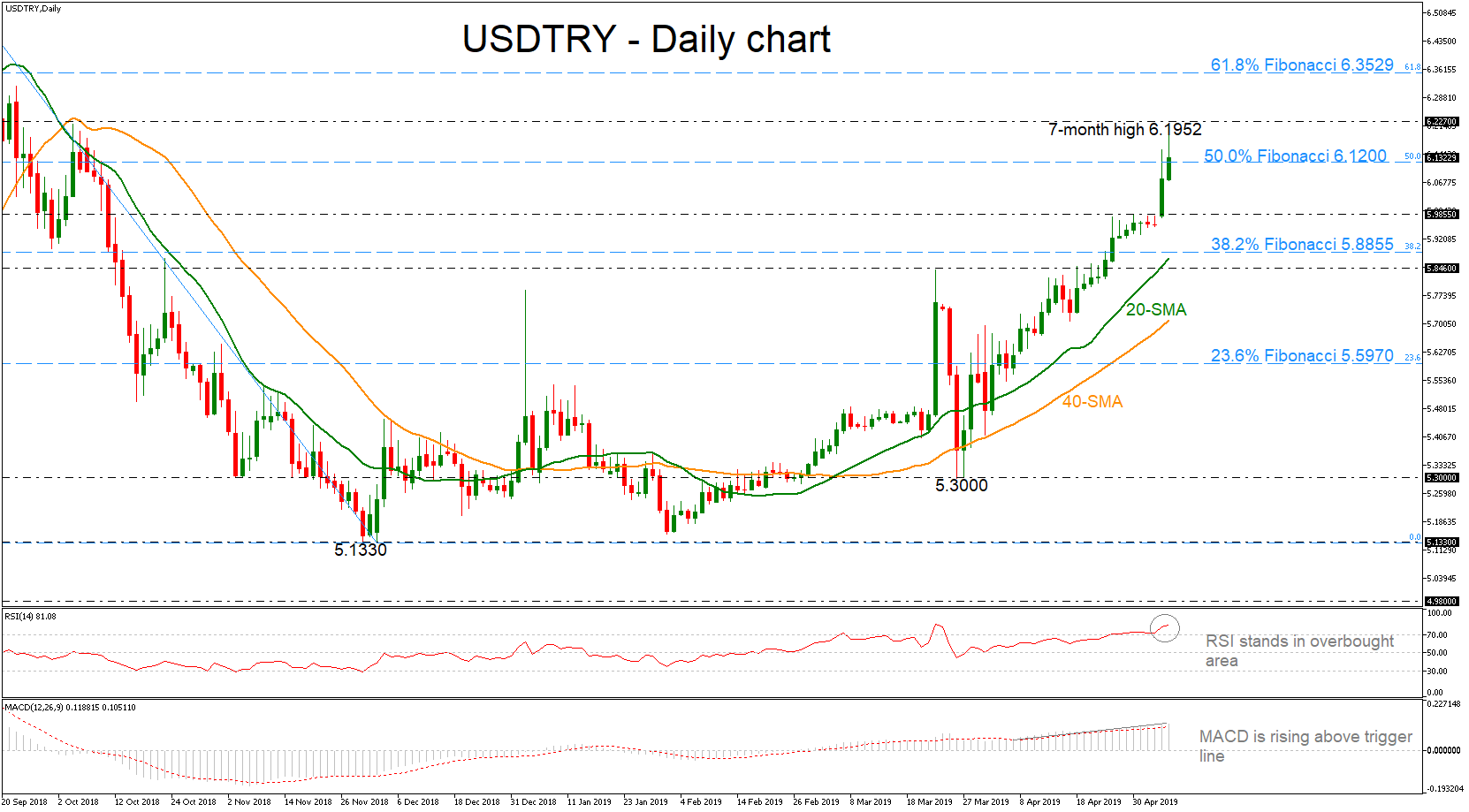
USDTRY has been in a flying mode today, reaching a new seven-month high of 6.1952. Looking at the technical indicators, the RSI is still hovering in the overbought area, suggesting a possible overstretched market in the daily chart, while the MACD rose above the trigger line, confirming the recent bullish tendency in price action.
If the market edges higher, the bullish action may pause initially near the 6.2270 resistance, registered on October 2018, while further gains could send prices until the 61.8% Fibonacci retracement level of the downleg from 7.1135 to 5.1330 around 6.3529.
On the other hand, dropping below the 50.0% Fibonacci of 6.1200 could see losses extending towards the 5.9855 support area. Even lower, the bears could stall around the 38.2% Fibonacci of 5.8855, slightly above the 20-day simple moving average (SMA).
The recent bullish action turned the weak momentum to a more aggressive one, with the price increasing distance above the shorter-term moving averages, so we could expect further improvement in the market.
Sunset Market Commentary
Markets
Global core bonds are losing ground today with German Bunds outperforming US Treasuries. Core bonds still profited overnight from US president Trump’s vow to raise and extend US tariffs on Chinese goods by Friday. Lower-than-expected German factory orders for March had limited to no impact. Little before EU openings, China confirmed Vice Premier Liu He will still travel to Washington on Thursday to continue trade talks, despite Trump’s renewed threat, causing core bonds to pair opening gains. However, the message was insufficient to turn sentiment around as EU equities moved lower and German Bunds moved higher throughout the day. German Bunds found new support as the European Commission cut its growth forecasts for the euro area, especially for Germany, and warned that the ongoing trade tensions threaten to make the outlook even worse. The German yield curve is moving lower with changes up to -4.4 bps (10-yr). With an empty US eco calendar and risk sentiment in today’s driver’s seat, US Treasuries tracked German Bunds today. The US yield curve is moving lower with changes in the range of -0.9 bps (10‑yr) and -1.8 bps (2-yr). Peripheral spreads over the German 10-yr yield are widening with Greece (+5 bps) and Italy (+4 bps) underperforming. The European Commission warned that Italy’s fiscal situation will worsen, as it forecasts economic growth at just 0.1% this year and a widening of the budget deficit to 3.5% of GDP next year.
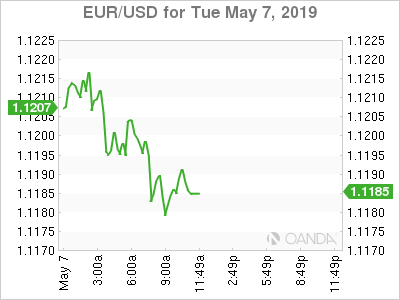
EUR/USD wasn’t much affected by an overall negative sentiment today and hovered near 1.12 opening levels. The pair kicked off the trading session on decent footing, shrugging off disappointing German factory orders (0.6% MoM, -6.0% YoY), even eking out small gains in the low 1.12 area. EUR/USD returned to opening levels during (early) lunch hours as markets were awaiting the new set of spring forecasts by the European Commission. The downgraded growth projections were a chill reminder of the precarious economic environment, yet they didn’t come as a huge surprise. The euro lost additional ground vs. the dollar after the release and as US early birds digested the EC report but the move stays orderly. EUR/USD is filling bids at 1.118 at the time of writing.
EUR/GBP simply continued yesterday’s upward trajectory, thereby undoing all of sterling’s Friday gains. Markets were speculating on a sense of urgency in the minds of Theresa May and Jeremy Corbyn after their parties suffered heavy losses in local elections. However, an agreement had not yet been reached, May communicated today. But talks will resume in late afternoon, so keep an eye on headlines escaping the room. Negotiations will be wrapped up by the end of this week, with or without a deal. Meanwhile, markets are in wait-and-see mode, slightly scaling back bets on a positive outcome. EUR/GBP is currently trading at 0.857, up from 0.855. Cable is changing hands in the mid 1.30/31’s.
News Headlines
The European Commission cut the EMU growth forecasts for this year from 1.3% to 1.2% and for 2020 from 1.6% to 1.5%. This year’s German projection was slashed from 1.1% to 0.5%. Escalating trade tensions threaten to make the outlook even worse. The Italian budget deficit is now expected to rise to 2.5% of GDP and significantly breach the EU’s limit (3%) in 2020 (3.5%). The country’s debt ratio should by then be over 135% of GDP. The Italian statistics agency Istat suggested that the outlook may improve in coming months.
German factory orders disappointed in March, rebounding only by 0.6% M/M in March (vs 1.4% M/M forecasts) following a disappointing first two months of the year (-2.1% and -4% respectively). Total domestic orders slid 4.2%, compared with a 4.2% jump in export demand.
GBP/JPY Mid-Day Outlook
Daily Pivots: (S1) 144.68; (P) 145.52; (R1) 146.04; More...
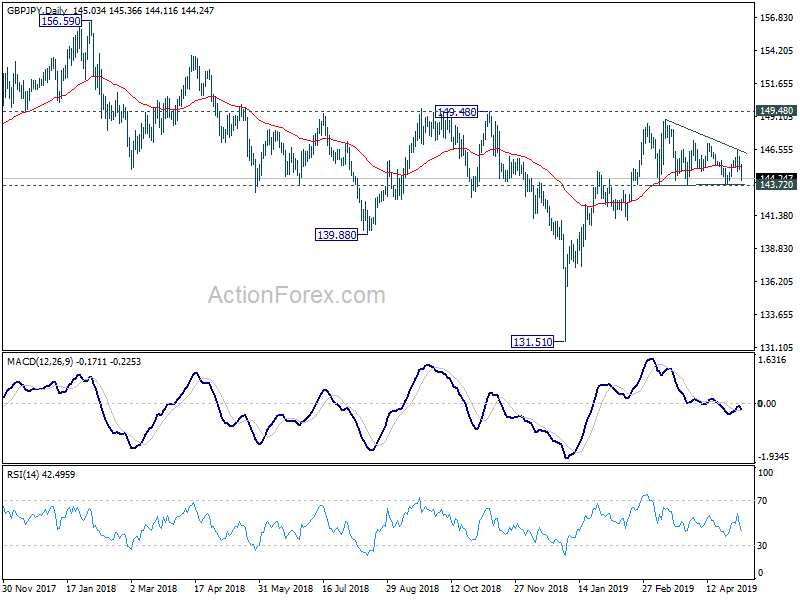
Break of 144.80 minor support suggests that rebound from 143.76 has completed at 146.50 already. Intraday bias in GBP/JPY is turned back to the downside for 143.72 key support level. Decisive break there will be a strong sign of bearish reversal. That is, whole rebound from 131.51 has completed. Deeper fall should then be seen to 141.00 key support for confirmation.
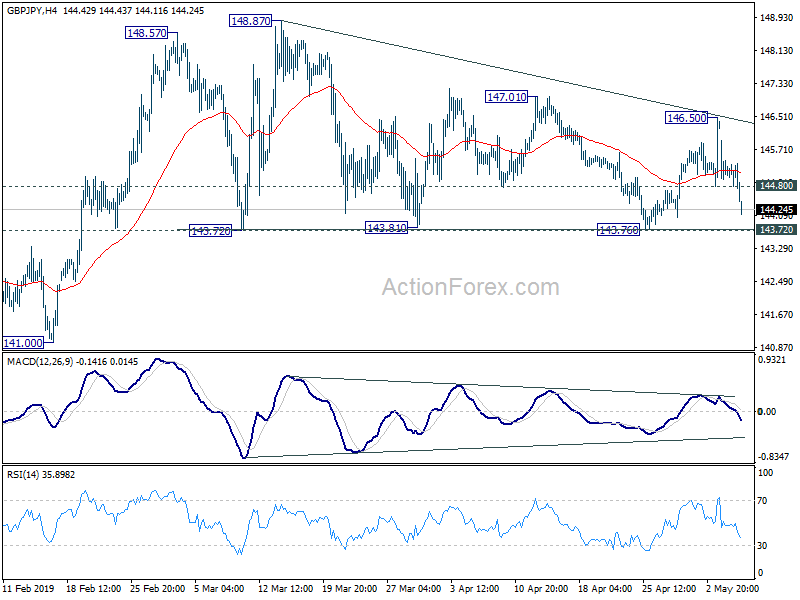
In the bigger picture, focus is staying on 149.98 key resistance. Decisive break there should confirm that medium term fall from 156.59 (2018 high) has completed at 131.51 already. Rise from 131.51 is then seen as the third leg of the corrective pattern from 122.36 (2016 low). GBP/JPY should then target 156.59 and above. However, rejection by 149.98 will retain medium term bearishness and could extend the fall from 156.59 through 131.51 to 122.36.
EUR/USD Mid-Day Outlook
Daily Pivots: (S1) 1.1177; (P) 1.1193 (R1) 1.1218; More.....
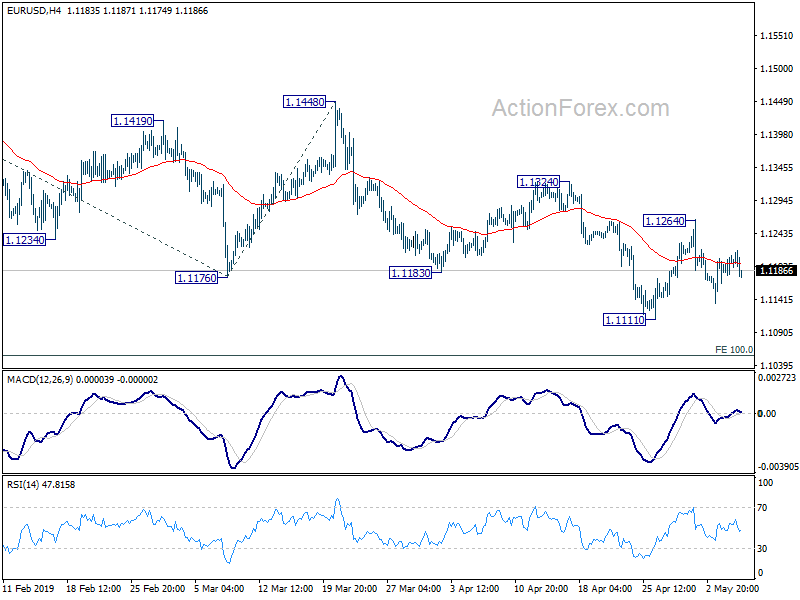
Intraday bias in EUR/USD remains neutral and consolidation from 1.1111 might extends further. Still, as long as 1.1324 resistance holds, near term outlook remains cautiously bearish and further decline is expected. On the downside, break of 1.1111 low will target 100% projection of 1.1569 to 1.1176 from 1.1448 at 1.1105 next.
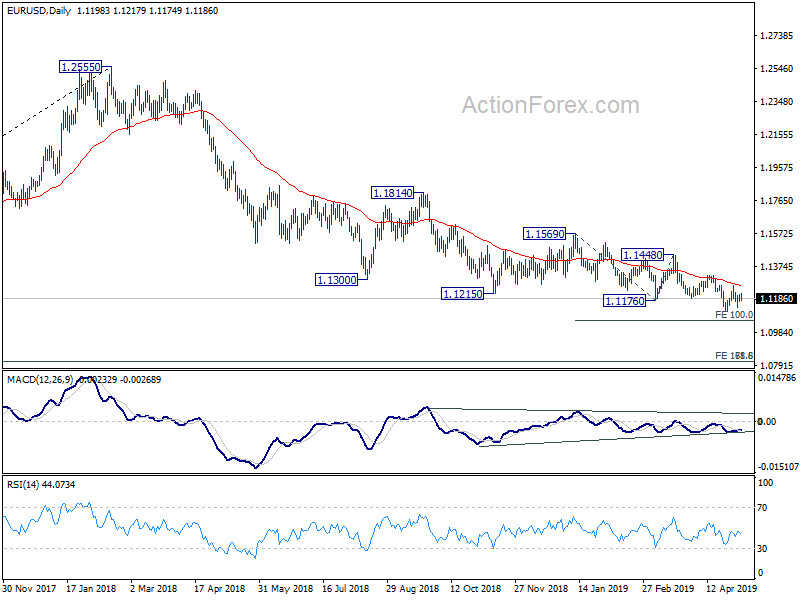
In the bigger picture, down trend from 1.2555 (2018 high) is still in progress. Current fall should now target 78.6% retracement of 1.0339 (2016 low) to 1.2555 (2018 high) at 1.0813. Sustained break there will pave the way to retest 1.0339. On the downside, break of 1.1448 resistance is needed to be the first sign of medium term bottoming. Otherwise, outlook will stay bearish in case of rebound.
GBP/USD Mid-Day Outlook
Daily Pivots: (S1) 1.3062; (P) 1.3116; (R1) 1.3152; More...
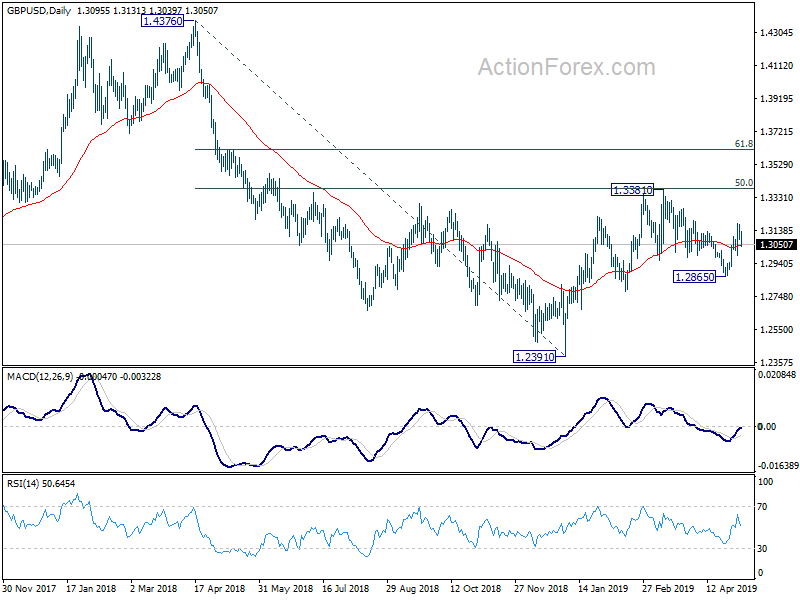
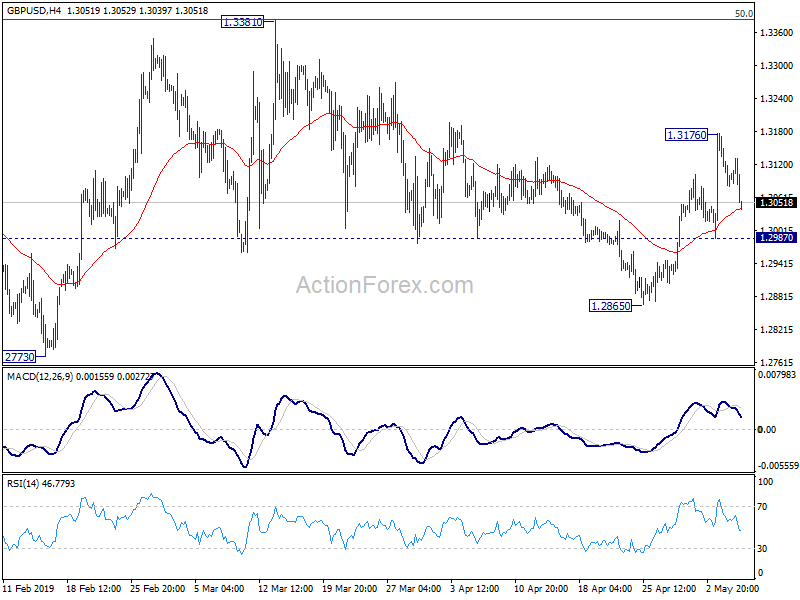
GBP/USD's retreat from 1.3176 temporary top extends lower today but stays above 1.2987 minor support. Intraday bias remains neutral and further rise remains in favor. As noted before, corrective decline from 1.3381 should have completed at 1.2865 already. On the upside, above 1.3176 will target a retest on 1.3381 high next. On the downside, below 1.2987 minor support will dampen this bullish view and turn bias back to the downside for 1.2865 support instead.
In the bigger picture, medium term decline from 1.4376 (2018 high) halted and made a medium term bottom after hitting 1.2391. Rebound from 1.2391 is seen as a corrective move for now. In case of another rise, strong resistance could be seen around 61.8% retracement of 1.4376 to 1.2391 at 1.3618 to limit upside. On the downside, break of 1.2773 support will suggests that such corrective rise is completed and bring retest of 1.2391 low first.