

Sample Category Title
Market Morning Briefing: Aussie Has Been Slowly Rising For The Past 3-Sessions From 0.6962
STOCKS
Trump's tweet over the weekend continues to weigh on the equities. The sell-off continues. Nervousness seems to be turning high in the market as seen from the volatility index.
The CBOE Volatility Index (19.32) has surged from around 13 (on Friday, before Trump's tweet)) to 19.32 now. The charts suggets the possibility of further rise to 28-29 indicating more fall is on the cards in the equity segment.
Dow (25965.09 -473.39 (-1.79%) has bounced a key support at 25800. Failure to rise past 26000 will be bearish for a fall to 25500 or even 25000 in the coming weeks. Need a close watch.
DAX (12092.74, -194.14, -1.58%) has tumbled failing to rise past 12300. The outlook is bearish to test 11900 in the near term.
Nikkei (21584.26, -339.46, -1.55%) has declined below the support at 21850 and looks vulnerable for a fall to 21000 on a break below 21500.
Shanghai (2886.66, -39.75, -1.36%) has declined below 2900 and is bearish to test 2800 in the short term.
As expected, Sensex (38276.63, -323.71 -0.84%) and Nifty (11497.90, -100.35, -0.87%) have broken their range below 38500 and 11550 respectively. The outlook is now bearish . Sensex can test 38000 while the Nifty can fall to 11350-11300.
COMMODITIES
Risk aversion in the market is helping gold and silver to hold up. They can move higher in the coming days. Copper is consolidating within its downtrend. Oil remains bearish and can fall further in the near term.
Gold (1287.5) is getting support in the 1280-1278 region. It can break 1290 and rise to 1295-1300 in the near term.
Similarly, Silver (14.95) can break its resistance at 15.03 and rise to 15.15-15.20 in the coming days.
Copper (2.80) is consolidating between 2.78 and 2.84. A test 2.86 is possible before we see a fresh fall to 2.70 in the short term.
The expected bounce before a fresh fall in the Brent (69.53) has not happened. The bearish outlook is intact. Brent can break 68 and fall to 66-65.
WTI (61.91) is relatively stable than Brent. However, the outlook is bearish for a fall to 60-58 while it remains below 64.
FOREX
Overall Dollar strength could come into play against major currencies. Euro could test 1.1225/30 before falling off from there while the Aussie, Yen and Euro-Yen could also strengthen. The Indian Rupee looks weak towards 69.80.
Dollar Index (97.47) is almost stable near levels seen yesterday. 98-99 is a possibility for the near term.
Euro (1.1203) could test daily resistance near 1.1225-1.1230 over the next 1-2 sessions before again falling towards 1.12 or lower. Overall broad range of 1.13-1.11 could be seen in the near term.
The Euro-Yen (123.27) looks bearish in the near term while below 123.50 and could eventually test lower levels of 122 in the near term. Medium term view for EUR-JPY is bearish while the pair sustains below 124.00/123.50.
Dollar Yen (110.03) has come down sharply as expected and could test 109.70 on the downside soon before bouncing back from there. Note that 109.70-110.00 is an important near term support zone.
Aussie (0.7021) has been slowly rising for the past 3-sessions from 0.6962. While Aussie remains above 0.70, it could continue to rise towards 0.7050/0.7100 in the near term.
USDCNY (6.7683) is trading lower today after testing 6.78 yesterday. The fall could be limited to 6.76 just now which could be a decent interim support. A bounce from 6.76 could take it higher towards 6.80 on the upside. Any unexpected events from the Trump-China trade scenario this week could again induce a sharp rise in USDCNY. Weakness in Yuan could continue for the next week as well.
Dollar-Rupee (69.4350) was almost stable yesterday and while the immediate channel support on the daily candles hold, Dollar-Rupee could be bullish in the near term. We keep possibility of a rise towards 69.60/65 and maybe even higher towards 69.75/80 as the preferred view just now. A fall towards 69 envisaged in the recent readings could be delayed for now. USDINR offshore NDF trades at 69.63, indicating a possible gap up opening today on the OTC markets.
INTEREST RATES
The US Yields continue to trade lower and look bearish for the near term. The 30Yr (2.87%) could fall towards 2.85%, 10Yr (2.46%) could fall towards 2.45/40%, while the 5Yr (2.27%) could test 2.25-2.20% in the near term. Yields look bearish just now.
The US-JGB 10Yr (2.51%) is down from 2.54%. The spread looks bearish and could fall in the near term indicating some more Yen strength going forwards.
The German yields have fallen. The 5Yr (-0.4566%), 10Yr (-0.036%) and the 30YR (0.615%) are trading lower from yesterday’s levels of -0.434%, -0.009% and 0.637% respectively. Near term looks bearish for the German yields.
The Indian 10Yr GOI (7.4790%) is likely to test 7.40% on the downside before it attempts a bounce back towards 7.50% or higher in the longer run. Near term looks weak.
RBNZ Cut Policy Rate to 1.5%, Resuming Rate Cut for the First Time since 2016
For the first time since November 2016, RBNZ lowered the OCR, by +25 bps, to 1.5% in May. At the monetary policy statement, it indicated that “a lower OCR is necessary to support the outlook for employment and inflation consistent with its policy remit”. Some banks, including ANZ and Kiwibank, have also reduced their lending rates as a result. Both NZD and bond yields slumped. At this meeting, the central bank has affirmed a dovish stance on the economic outlook. The rate cut has marked the resumption of the easing cycle and a few more rate cuts should be expected in the coming year.
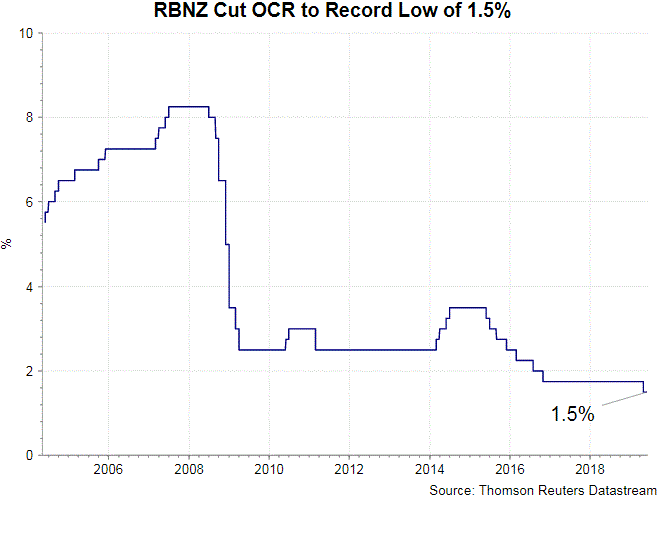
The members have turned more pessimistic over the global and domestic economic developments than the February meeting. They acknowledged that global growth slowdown since mid-2019 has trimmed demand from the country, adding that the outlook remains uncertainty.
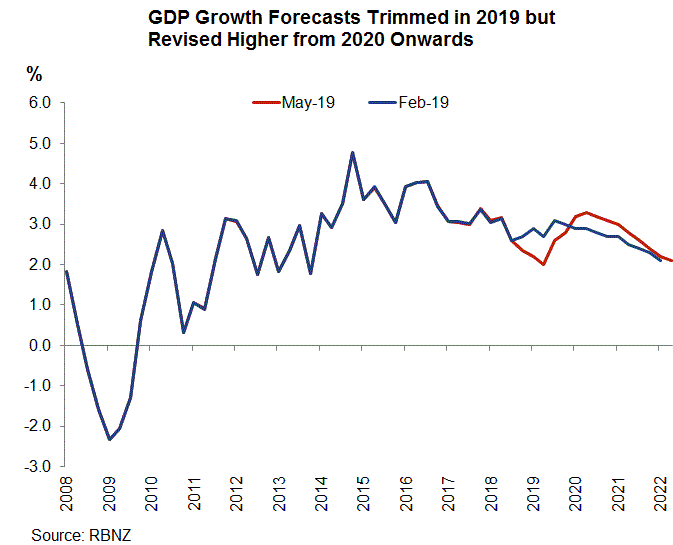
Domestically, growth has also slowed from 2H18. Sluggish growth in household spending was driven by a number of factors including “lower net immigration” and “continuing house price softness in some areas”. Business investment was also tempered by “ongoing low business sentiment, tighter profit margins, and competition for resources”. Back in February, the members were still hopeful that growth would be lifted by low interest rates and government spending. As such, RBNZ has slashed GDP growth forecast for 2019 while revising higher the estimates from 2020 to 2022.
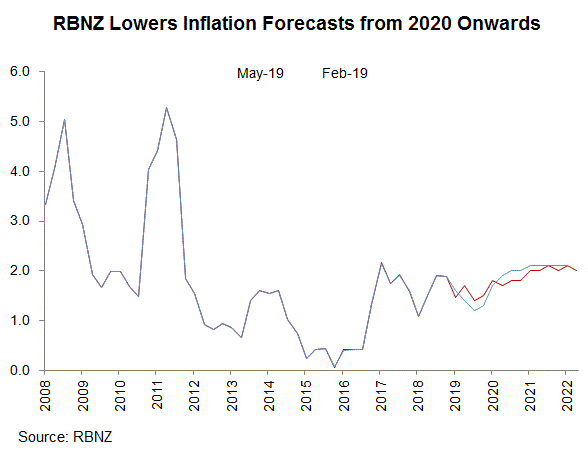
Expectations of deterioration of employment and very slow improvement in inflation are key drivers of the rate cut decision. While reaffirming that employment is near its maximum sustainable level, the central bank raised concerns that the growth outlook would be “more subdued”. It also expects inflation to “rise only slowly” as “capacity pressure is expected to ease slightly in 2019”.
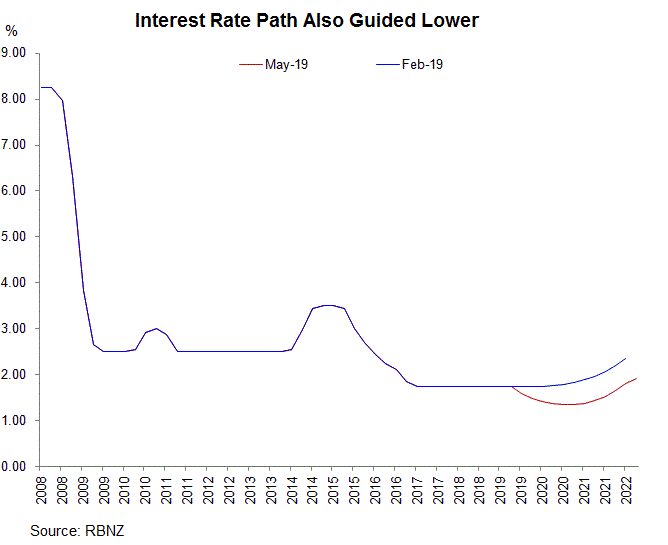
At the concluding statement, RBNZ suggested that “a lower OCR now is most consistent with achieving our objectives and provides a more balanced outlook for interest rates”. In February, the central bank still noted that the next move could be up or down. The rate cut in May has made RBNZ the first advanced economy to resume its easing cycle. As suggested in the MPS, another rate cut could come in early 2020. The policy rate might bottom at 1.36% in the second half of next year, before recovering to 1.93% by mid-2022. In February, the MPS forecast no rate cut and the policy rate would rise to 2.36% by early 2022.
Tariff-Geddon Taxes Global Markets
Tariff-geddon taxes global markets
The fallout from the Trump’s threatened Friday tariff-geddon gathered pace overnight. Wall Street retreated sharply as expectations increased of a U.S.-China trade talk stalemate in a somewhat delayed reaction to Sunday’s social media bombshell. Unsurprisingly, U.S. Treasury yields moved lower, and the U.S. Dollar and Japanese Yen (JPY) ratcheted higher as investors rotated into safer harbours at the expense of emerging markets. On Wall Street it was a sea of red with the S&P 500 falling 1.65 per cent, the Nasdaq falling 1.96 per cent and the Dow Jones falling 1.79 per cent.
It has and continues to be the author’s thesis that global bond markets have been signalling a global slowdown is coming for some time. There are slowdowns, and there are slowdowns. The U.S.-China trade deal is the critical determinant of how deep or shallow the downturn will be. With global interest rates mostly at or near record lows except for the United States, the world’s central banks are ill-placed to cut rates to stimulate growth as they reap the harvest of their excessively easy monetary policies of the last ten years. In this context, the importance of the trade deal can be clearly noted.
If stocks were falling like birds from the sky overnight, it is another flightless bird from down under, the Kiwi, that will have Asia’s attention initially this morning. At 10 am Singapore time, the Reserve Bank of New Zealand (RBNZ), will in all likelihood cut rates to record lows of 1.50%. A rate cut has been baked into the New Zealand Dollar’s (NZD) price for some time now; the real interest will in the statement and press conference one hour later. There we will see if the cut is one and done or there are further cuts in the pipeline. The RBNZ’s conundrum is a familiar one to many central banks, an economy cruising along nicely but elusive inflation still ten years after the global financial crisis.
China’s trade balance is also released at 1100 Singapore time but will in all likelihood be ignored. Asia prefers to look nervously at Wall Street’s overnight losses and that dirty two-word phrase, trade talks.
Currencies
The JPY rallied strongly against the dollar with Japan’s return from the extended Golden Week break, putting it in a club of one. USD/JPY has fallen 0.50 per cent overnight to 110.20 with the JPY’s haven credentials being well and truly put on the table. Yen typically rallies in times of stress and its strength this week is a clear warning shot of potential volatility ahead.
Elsewhere, it was business as usual as greenback bulldozed all before it as high yield haven currency of choice for 2019. The fall in U.S. Treasury yields overnight is clearly signalling the U.S. bond market as the harbour of choice for investors to let the storms past and that will continue to support the greenback.
With the Australian and New Zealand Dollars hovering above key supports, emerging Asia currencies will likely feel the chill winds as well in today’s session as part of a global EM retreat.
Equities
Both Hong Kong and China managed small bounces yesterday after Monday’s heavy losses. That is unlikely to be the case today given Wall Street’s heavy sell-off overnight. In all likelihood, Asia’s stock markets will be a sea of red today as investors focus on global growth threats and head for the doors.
Regional stock markets are particularly vulnerable to trade-talk jitters given their high beta to trade with China. With the trade talks restarting tomorrow in Washington D.C., we will need to see concrete progress and quickly to lift Trump’s tariff-geddon on Friday. Until then, it is hard to see the monsoon clouds hanging over Asia’s regional markets clearing.
Oil
Oil followed the trade talk playbook to the letter with both Brent Crude and WTI crumpling on global growth fears. Brent fell 2.45 per cent to $ 69.50 a barrel closing below $70.00 support. WTI fell 1.75 per cent to $61.15 a barrel with the $60.00 a barrel region next in its sights.
Following the FX and equity playbook, it is hard to see Asia being anything but downcast on oil’s prospects and positioning itself accordingly. Black gold will remain gloomy until we get more clarity from Washington D.C this week.
Gold
Gold managed an asthmatic 0.35 per cent rally to $1284.50 overnight in yet another underwhelming performance that will have bulls very concerned. Gold should be benefiting from the turmoil in global markets, but stubbornly refuses to gain a shred of upside momentum. $1300.00 may as well be a million miles away and if Friday’s tariff-geddon is avoided or postponed one cannot help but feel concerned for gold’s prospects.
NZDUSD and NZDJPY spike lower after RBNZ cut, more downside ahead
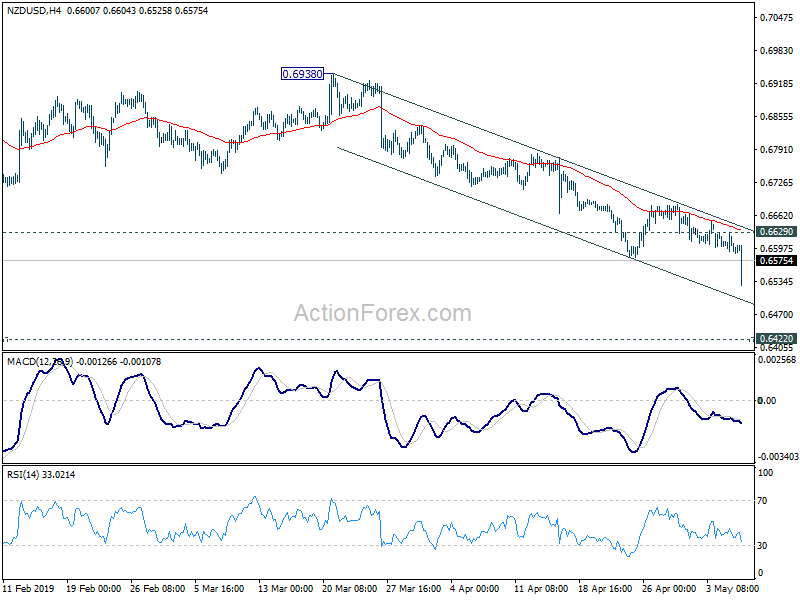
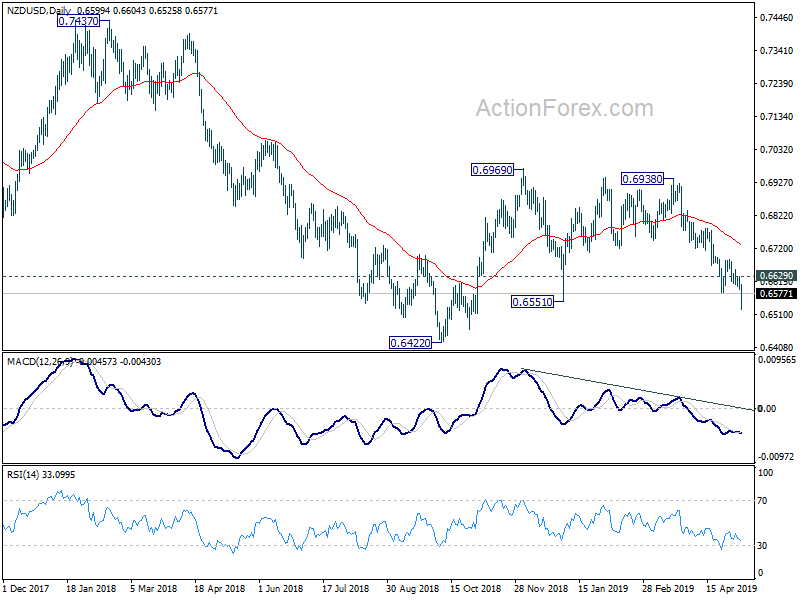
Both NZD/USD and NZD/JPY spike lower after RBNZ rate cut even though they quickly pare back some losses. For NZD/USD, breach of 0.6551 support further affirms a bearish case. That is, consolidation pattern from 0.6422 has complete with three waves to 0.6938. And, larger down trend from 0.7558 (2017 high) might be ready to resume. For now, near term outlook in NZD/USD will stay bearish as long as 0.6629 resistance holds. 0.6422 low is next target.
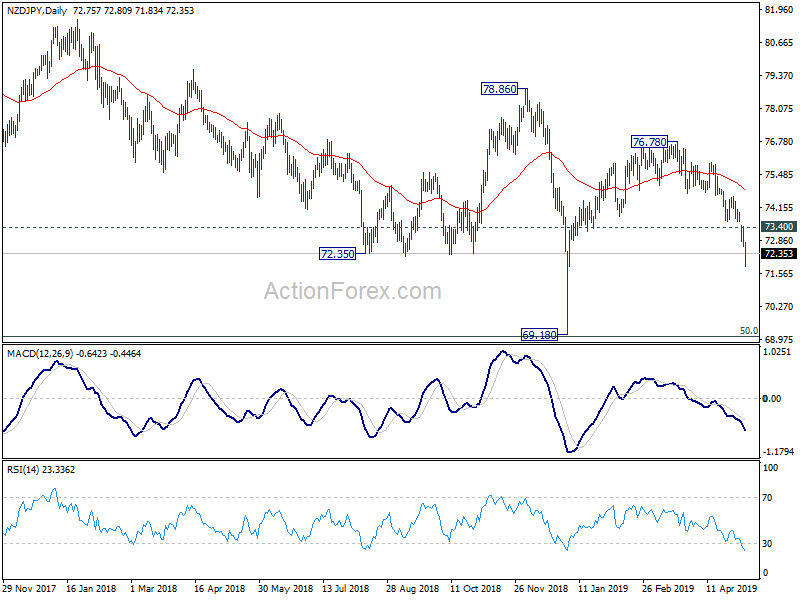
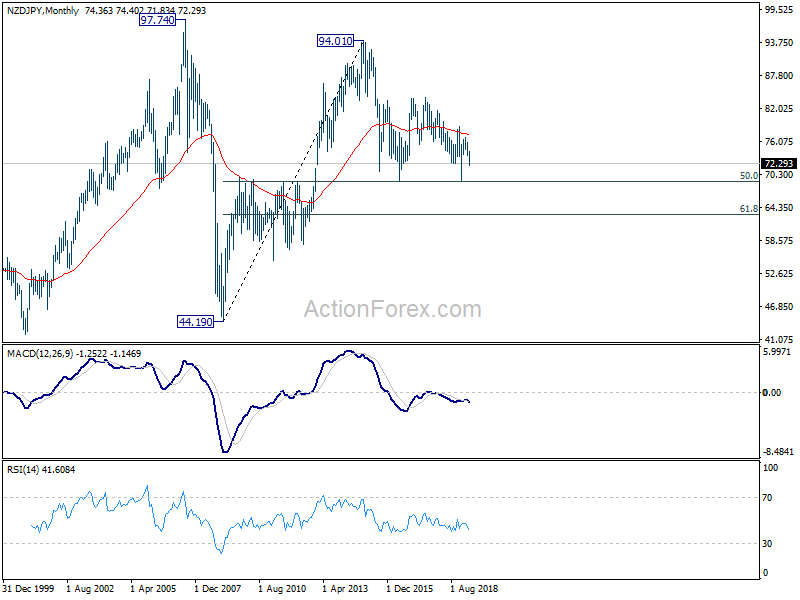
NZD/JPY's sharp fall solidifies that case that corrective rebound from 69.18 has completed at 76.78 already. Near term outlook will stay bearish as long as 0.7340 resistance holds. Deeper decline should be seen back to retest 69.18 low. However, this level is close to a key long term fibonacci level. That is 50% retracement of 44.19 (2009 low) to 94.01 (2014 high) at 69.18. We'll pay attention to bottoming signal there.
Daily Markets Broadcast
Stocks tumble on trade war standoff
US indices fell uniformly yesterday amid fears about Trump’s tariff threat. Safe haven assets were in demand as investors rotated out of equities. The Reserve Bank of New Zealand holds its rate meeting today and is widely expected to trim the benchmark rate by 25 bps to 1.50%.
US30USD Daily Chart
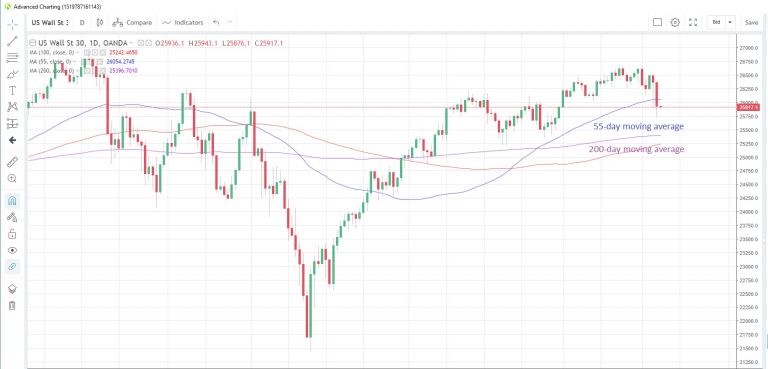
The US30 index posted the biggest one-day loss since January 3 yesterday as the implications of the tariff threat were considered
The index closed below the 55-day moving average at 26,054 for the first time since January 17. The 200-day moving average is at 25,396
The IBD/TIPP economic optimism index jumped to 58.6 in May, well above economists’ forecasts, and the highest reading since Oanda began monitoring the series in 2010.
DE30EUR Daily Chart
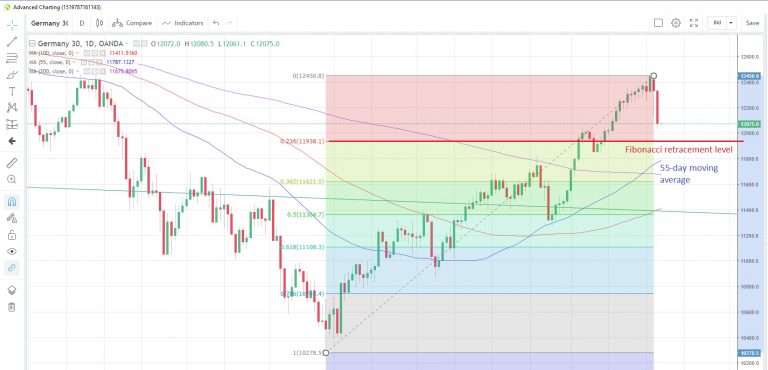
The Germany30 index fell the most in 6-1/2 weeks yesterday amid rising concerns about a possible US-China trade war standoff
The 23.6% Fibonacci retracement of the rally since December is at 11,938. The rising 55-day moving average is at 11,787, and has supported prices on a closing basis since February 8
German industrial production is expected to fall 0.5% m/m in March, according to the latest survey of economists. Factory orders fell a less-than expected 6.0% in the same month, data released yesterday showed. It was still the 10th consecutive month of contraction.
XAU/USD Daily Chart
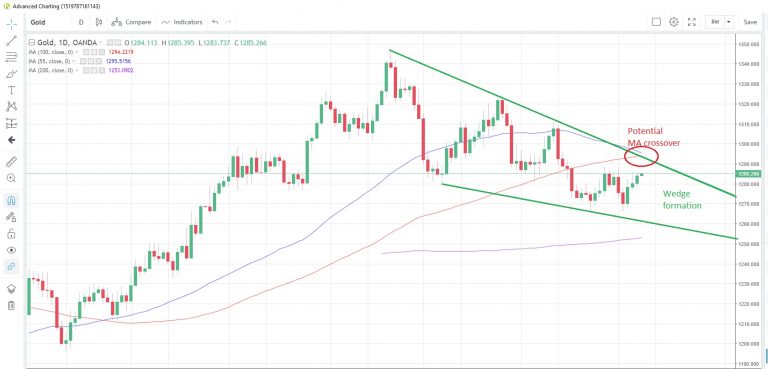
Gold looks poised for its fourth consecutive daily gain today as its safe haven status is enhanced amid the tumult on Wall Street
Gold is trading within an unfolding wedge formation, awaiting a breakout either way. The 55-day moving average at 1,295.5 looks set to cross below the 100-day moving average at 1,294.2 later this week. This could be interpreted as a longer-term bearish signal
The World Gold Council has reported that Exchange-traded Funds’ gold holdings fell 2% in April, bringing total net flows for 2019 into negative.
Crude Oil Price Remains At Risk Of More Losses
Key Highlights
- Crude oil price started a downward move after it broke the $63.40 support against the US dollar.
- There is a key bearish trend line formed with resistance at $61.85 on the 4-hours chart of XTI/USD.
- The IBD/TIPP Economic Optimism Index increased from 54.2 to 58.6 in May 2019.
- The EIA Crude Oil Stockpiles figure is likely to change by 0.744M, compared with the last 9.934M.
Crude Oil Price Technical Analysis
After a strong rise, crude oil price faced selling interest near the $66.50 level against the US Dollar. The price started a steady drop and traded below the $65.00 and $64.00 support levels.
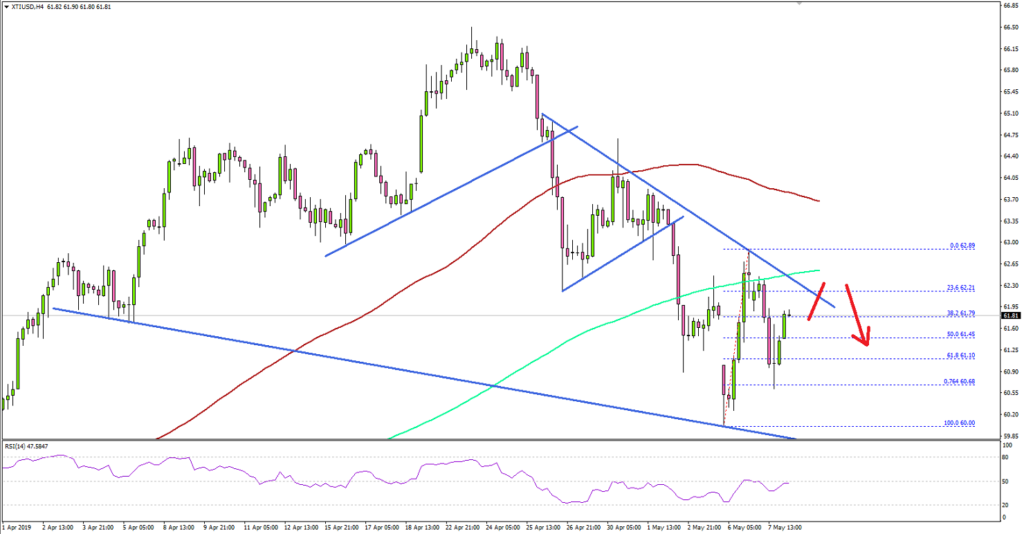
Looking at the 4-hours chart of XTI/USD, the price moved into a bearish zone below the $63.40 support level. During the decline, there was a break below couple of connecting bullish trend lines, plus the 100 (red) simple moving average (4-hours).
The price even settled below the $62.20 level and the 200 (green) simple moving average (4-hours). A swing low was formed at $60.00 and the price recently corrected higher.
However, it topped near the $62.90 level and declined below the 61.8% Fib retracement level of the last wave from the $60.00 low to $62.89 high. On the downside, the main support is near the $60.00 level and a connecting trend line.
If there is a daily close below $60.00, the price could drop significantly below the $58.00 and $56.00 levels. On the upside, there is a key bearish trend line formed with resistance at $61.85 on the same chart.
A successful close above the $62.00 and $62.20 levels is must to kick start a fresh increase towards the $64.00 and $65.00 levels in the near term.
Looking at major pairs, EUR/USD was confined in a range below the key 1.1250 resistance and GBP/USD corrected lower below the 1.3080 level.
Economic Releases to Watch Today
- Germany's Industrial Production for March 2019 (MoM) – Forecast -0.5%, versus +0.7% previous.
- US Producer Price Index March 2019 (YoY) – Forecast +1.9%, versus +1.9% previous.
RBNZ projects below target inflation for longer, sees need for more easing
In the latest economic projections, RBNZ projected that inflation will stay below target for longer then in February MPS. CPI won't breaks 2% level until 2022. CPI forecasts for 2019 and 2021 were both revised down. On growth, RBNZ sees slower GDP growth in 2019 and 2020. But GDP growth is expected to pick up solidly in 2021 before dipping in 2022.
On the net, RBNZ sees the need for further rate cut with average OCR hitting 1.4% in 2021 before bottoming.
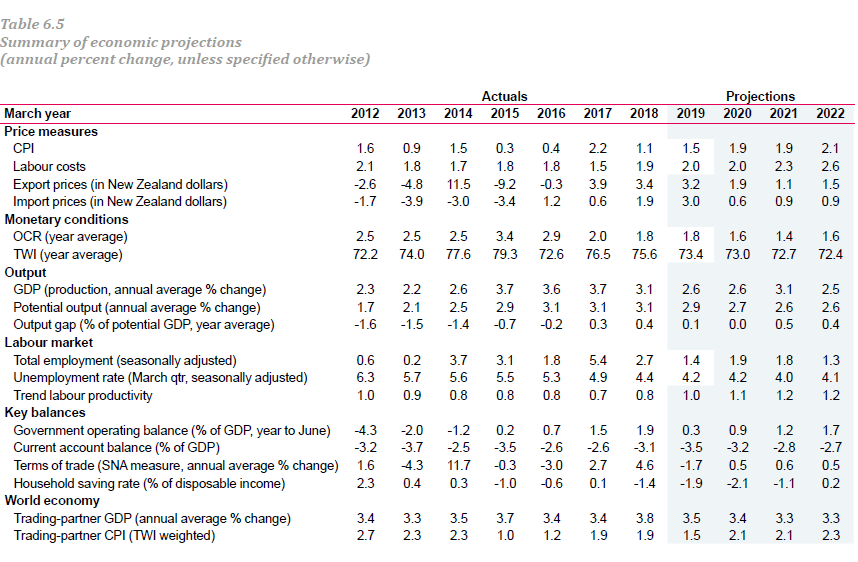
OCR year average (vs Feb projections):
- 2019 at 1.8% (unchanged);
- 2020 at 1.6% (revised down from 1.8%);
- 2021 at 1.4% (revised down from 1.8%);
- 2022 at 1.6% (revised down from 2.2%);
CPI (vs Feb projections):
- 2019 at 1.5% (revised down from 1.6%);
- 2020 at 1.9% (revised up from 1.7%);
- 2021 at 1.9% (revised down from 2.1%);
- 2022 at 2.1% (unchanged).
GDP growth(vs Feb projections):
- 2019 at 2.6% (revised down from 2.8%);
- 2020 at 2.6% (revised down from 2.9%);
- 2021 at 3.1% (revised up from 2.8%);
- 2022 at 2.5% (revised up from 2.3%);
RBNZ cuts OCR to 1.50% as widely expected, full statement
RBNZ lowers official cash rate by -25bps to 1.50% as widely expected. In the accompanying statement, RBNZ noted that:
There was a "consensus" that lower path of OCR relative to February MPS was "appropriate". That reflects "weaker domestic spending" and "projected ongoing growth and employment headwinds". A key downside risk to growth was "larger than anticipated slowdown in global economic growth, particularly in China and Australia, New Zealand's largest trading partners."
Meanwhile, outlook for inflation is below the target mid-point for "longer than projected" in the February MPS. Also, slower global growth would reduce "imported inflation". That was a "downside risk" to the inflation outlook.
Full statement below:
Official Cash Rate Reduced to 1.5 Percent
Tena koutou katoa, welcome all.
The Official Cash Rate (OCR) has been reduced to 1.5 percent.
The Monetary Policy Committee decided a lower OCR is necessary to support the outlook for employment and inflation consistent with its policy remit.
Global economic growth has slowed since mid-2018, easing demand for New Zealand's goods and services. This lower global growth has prompted foreign central banks to ease their monetary policy stances, supporting growth prospects.
However, there is uncertainty about the global economic outlook. Trade concerns remain, while some other indicators suggest trading-partner growth is stabilising.
Domestic growth slowed from the second half of 2018. Reduced population growth through lower net immigration, and continuing house price softness in some areas, has tempered the growth in household spending. Ongoing low business sentiment, tighter profit margins, and competition for resources has restrained investment.
Employment is near its maximum sustainable level. However, the outlook for employment growth is more subdued and capacity pressure is expected to ease slightly in 2019. Consequently, inflationary pressure is projected to rise only slowly.
Given this employment and inflation outlook, a lower OCR now is most consistent with achieving our objectives and provides a more balanced outlook for interest rates.
Meitaki, thanks.
Record of Meeting
The Monetary Policy Committee agreed on the economic projections outlined in the May 2019 Statement in order to provide a sound basis on which to form its OCR decision.
The Committee noted that inflation is currently slightly below the mid-point of the inflation target, and that employment is broadly at the targeted maximum sustainable level. However, the members agreed that given the recent weaker domestic spending, and projected ongoing growth and employment headwinds, there was a need for further monetary stimulus to meet its objectives.
The Committee agreed that the risks to achieving its consumer price inflation and maximum sustainable employment objectives were broadly balanced around the projection. Possible alternative outcomes were noted on the upside and downside.
A key downside risk relating to the growth projections was a larger than anticipated slowdown in global economic growth, particularly in China and Australia, New Zealand's largest trading partners. The Committee agreed that the projections adequately captured the observed global slowdown and its impact on domestic employment and inflation.
The Committee noted that additional stimulus from central banks had underpinned growth and reduced the likelihood of a more-pronounced slowdown. With some indicators of global growth improving in recent months, a faster recovery in global growth was possible. However, on balance, the Committee was more concerned about a continued slowdown rather than a faster recovery.
The Committee discussed other potential risks to domestic spending. The members acknowledged the importance of additional spending from households, businesses, and the government, to meet their inflation and employment targets. However, they noted several important uncertainties.
The Committee noted upside and downside risks to the investment outlook. Capacity pressure could see investment increase faster than assumed. On the downside, if sentiment remained low as profitability remains squeezed, investment might not increase as anticipated over the medium term. It was also noted that firms' ability to invest is constrained by the current competition for resources.
A potential source of additional demand discussed by the Committee included government spending being higher than currently projected, in view of the current strength of the Crown balance sheet. This view was balanced by the impact of any increase in government investment being delayed, for example due to timing of the implementation of new initiatives and current capacity constraints in the construction sector. The implications for monetary policy remain to be seen.
Some members noted that with lower mortgage rates and easing of loan-to-value requirements, any possible pick-up in the housing market could support household spending growth more than anticipated. The Committee noted that employment is currently near its maximum sustainable level. However, it was agreed that the outlook for employment growth is more subdued and capacity pressure is expected to ease slightly in 2019.
The Committee agreed that overall risks to the inflation projection were balanced. The Committee noted the outlook for inflation is below the target mid-point for longer than projected in the February Statement.
The recent period of rising domestic inflation was discussed. The Committee noted that the near-term outlook was more subdued due to lower capacity pressure. It was also noted that cost pressures remain elevated, and that there is a risk firms may pass these costs on as higher consumer prices by more than assumed. However, it was agreed that inflation expectations remain well anchored at the mid-point of the target range.
The Committee also noted the relatively subdued private sector wage growth, despite businesses suggesting that the inability to find labour is a significant constraint on their growth. The Committee noted the limited pass-through of the nominal wage growth to consumer price inflation.
Some members noted slower global growth reducing imported inflation was a downside risk to the inflation outlook.
The Committee reached a consensus that, relative to the February Statement, a lower path for the OCR over the projection period was appropriate. The lower path reflected the economic projections and the balance of risks discussed, and is consistent with both inflation and employment remaining near the Committee's objectives.
After discussing the relative benefits of holding the OCR and committing to a downward bias, versus cutting the OCR now so as to establish a more balanced outlook for interest rates, the Committee reached a consensus to cut the OCR to 1.50 percent.
Attendees
Reserve Bank staff: Adrian Orr, Geoff Bascand, Christian Hawkesby, Yuong Ha
External: Bob Buckle, Peter Harris
Observer: Gabriel Makhlouf
Secretary: Chris McDonald
Apologies: Caroline Saunders
More Information
Download the May 2019 Monetary Policy Statement (PDF 1.75MB)
(RBNZ) Official Cash Rate Reduced to 1.5 Percent
Tena koutou katoa, welcome all.
The Official Cash Rate (OCR) has been reduced to 1.5 percent.
The Monetary Policy Committee decided a lower OCR is necessary to support the outlook for employment and inflation consistent with its policy remit.
Global economic growth has slowed since mid-2018, easing demand for New Zealand's goods and services. This lower global growth has prompted foreign central banks to ease their monetary policy stances, supporting growth prospects.
However, there is uncertainty about the global economic outlook. Trade concerns remain, while some other indicators suggest trading-partner growth is stabilising.
Domestic growth slowed from the second half of 2018. Reduced population growth through lower net immigration, and continuing house price softness in some areas, has tempered the growth in household spending. Ongoing low business sentiment, tighter profit margins, and competition for resources has restrained investment.
Employment is near its maximum sustainable level. However, the outlook for employment growth is more subdued and capacity pressure is expected to ease slightly in 2019. Consequently, inflationary pressure is projected to rise only slowly.
Given this employment and inflation outlook, a lower OCR now is most consistent with achieving our objectives and provides a more balanced outlook for interest rates.
Meitaki, thanks.
Record of Meeting
The Monetary Policy Committee agreed on the economic projections outlined in the May 2019 Statement in order to provide a sound basis on which to form its OCR decision.
The Committee noted that inflation is currently slightly below the mid-point of the inflation target, and that employment is broadly at the targeted maximum sustainable level. However, the members agreed that given the recent weaker domestic spending, and projected ongoing growth and employment headwinds, there was a need for further monetary stimulus to meet its objectives.
The Committee agreed that the risks to achieving its consumer price inflation and maximum sustainable employment objectives were broadly balanced around the projection. Possible alternative outcomes were noted on the upside and downside.
A key downside risk relating to the growth projections was a larger than anticipated slowdown in global economic growth, particularly in China and Australia, New Zealand's largest trading partners. The Committee agreed that the projections adequately captured the observed global slowdown and its impact on domestic employment and inflation.
The Committee noted that additional stimulus from central banks had underpinned growth and reduced the likelihood of a more-pronounced slowdown. With some indicators of global growth improving in recent months, a faster recovery in global growth was possible. However, on balance, the Committee was more concerned about a continued slowdown rather than a faster recovery.
The Committee discussed other potential risks to domestic spending. The members acknowledged the importance of additional spending from households, businesses, and the government, to meet their inflation and employment targets. However, they noted several important uncertainties.
The Committee noted upside and downside risks to the investment outlook. Capacity pressure could see investment increase faster than assumed. On the downside, if sentiment remained low as profitability remains squeezed, investment might not increase as anticipated over the medium term. It was also noted that firms' ability to invest is constrained by the current competition for resources.
A potential source of additional demand discussed by the Committee included government spending being higher than currently projected, in view of the current strength of the Crown balance sheet. This view was balanced by the impact of any increase in government investment being delayed, for example due to timing of the implementation of new initiatives and current capacity constraints in the construction sector. The implications for monetary policy remain to be seen.
Some members noted that with lower mortgage rates and easing of loan-to-value requirements, any possible pick-up in the housing market could support household spending growth more than anticipated. The Committee noted that employment is currently near its maximum sustainable level. However, it was agreed that the outlook for employment growth is more subdued and capacity pressure is expected to ease slightly in 2019.
The Committee agreed that overall risks to the inflation projection were balanced. The Committee noted the outlook for inflation is below the target mid-point for longer than projected in the February Statement.
The recent period of rising domestic inflation was discussed. The Committee noted that the near-term outlook was more subdued due to lower capacity pressure. It was also noted that cost pressures remain elevated, and that there is a risk firms may pass these costs on as higher consumer prices by more than assumed. However, it was agreed that inflation expectations remain well anchored at the mid-point of the target range.
The Committee also noted the relatively subdued private sector wage growth, despite businesses suggesting that the inability to find labour is a significant constraint on their growth. The Committee noted the limited pass-through of the nominal wage growth to consumer price inflation.
Some members noted slower global growth reducing imported inflation was a downside risk to the inflation outlook.
The Committee reached a consensus that, relative to the February Statement, a lower path for the OCR over the projection period was appropriate. The lower path reflected the economic projections and the balance of risks discussed, and is consistent with both inflation and employment remaining near the Committee's objectives.
After discussing the relative benefits of holding the OCR and committing to a downward bias, versus cutting the OCR now so as to establish a more balanced outlook for interest rates, the Committee reached a consensus to cut the OCR to 1.50 percent.
Attendees
Reserve Bank staff: Adrian Orr, Geoff Bascand, Christian Hawkesby, Yuong Ha
External: Bob Buckle, Peter Harris
Observer: Gabriel Makhlouf
Secretary: Chris McDonald
Apologies: Caroline Saunders
More Information
Download the May 2019 Monetary Policy Statement (PDF 1.75MB)
USD/CAD Canadian Dollar Loses Ground On Trade War And Oil
The Canadian dollar is lower against the greenback. The loonie is under pressure as trade war concerns have pressured oil prices lower and has made the dollar a safer destination for investors. The confirmation from US trade representative that tariffs could come into effect on Friday added to the woes of the Canadian currency dropping a further 0.18 percent on Tuesday.
Large crude inventories in the US and trade war escalation have energy prices under pressure despite ongoing sanctions against Venezuela and Iran. The OPEC+ pact to cut production has stabilized prices and even served as a steady platform for higher prices, but as the end of the agreement ends there are high probabilities that Russia might not sign up again, leaving Saudi Arabia with a heavy load to carry.
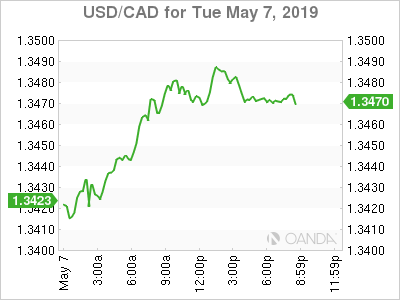
The US has pressured OPEC members to close the supply gap created by Iran and Venezuela disruptions and a Russian exit would put the Saudi’s in a difficult spot by themselves.
The Canadian economic calendar will feature high profile data until Thursday with the trade balance data and Friday with the anticipated employment report. Trade negotiations between the US and China will steal the spotlight if there are any significant developments that could either increase risk aversion or increase appetite for riskier assets.
The US dollar is mixed against major pairs. The Japanese yen and the Australian dollar are trading higher while the greenback has risen against the New Zealand dollar, euro, pound, Swiss franc and the Canadian dollar.
OIL – Trade War Pressures Energy Prices
Energy prices dropped as trade war concerns put downward pressure on global energy demand. The US and China appeared to be close to a trade deal ending their dispute until last weekend it was revealed that that China was walking back some of its commitments which sparked tariff threats from the US that could go into effect this Friday.
The market has found a way to cover the supply gaps caused by sanctions against Venezuela and Iran and the lack of strong signals from the OPEC+ on an extension to the production cuts beyond June have left prices sensitive to inventory data.
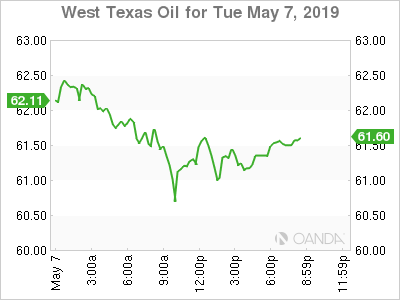
Higher US crude inventories and the uncertainty of the US-China trade talks which resume on Thursday will keep prices under pressure with higher US production expected.
GOLD – Gold Higher on Safe Haven Flow
A rise in volatility after the trade war comments boosted gold prices as investors sought the safety of the yellow metal. The sudden negative comments from the US on China’s changes to their trade talks triggered a selloff in equity markets worldwide. Despite the market reaction the Chinese delegation is still headed to Washington for the next round of talks on Thursday and Friday.
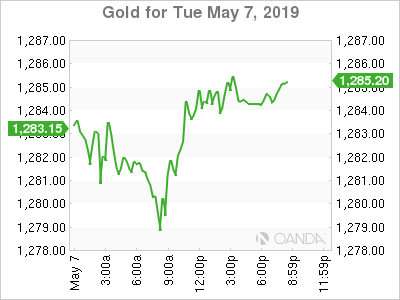
Gold was also bid by the news of the US military ready to deploy air support for troops in the Middle East.
Commodities were mixed after the news of a disagreement between China and the US on their trade talks. Positive comments were plenty as the two super powers sat down to negotiate, but the lack of details on the proceedings came back to haunt markets as the US returned to a combative tone by threatening to increase tariffs against Chinese goods.
STOCKS – Global Growth Concerns Hit Stocks
Global stocks fell as investors remain anxious about the outcome of a trade deal between the US and China. Everything seemed to be headed to a positive announcement, but this weekend comments from the US eroded confidence that a deal can be struck and a new Friday deadline looms.
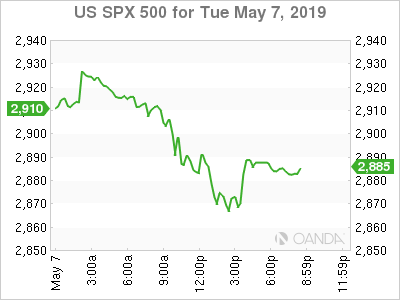
Previous trade disagreements have resulted in sell offs, and this week closely resembles the end of 2018 and early 2019 as markets hit a wall with investors flocking to safe havens as risk factors became unavoidable in the short term.
Global growth was impacted by a rise of trade tariffs and disappointing economic indicators in major economies have not changed the narrative. Apple made sure to mention the negative connotations of a protectionist agenda in January and market sentiment forced the U.S. Federal Reserve to pause its interest rate hike plans.