

Sample Category Title
Silver: White Metal Trading On A Stronger Footing This Morning
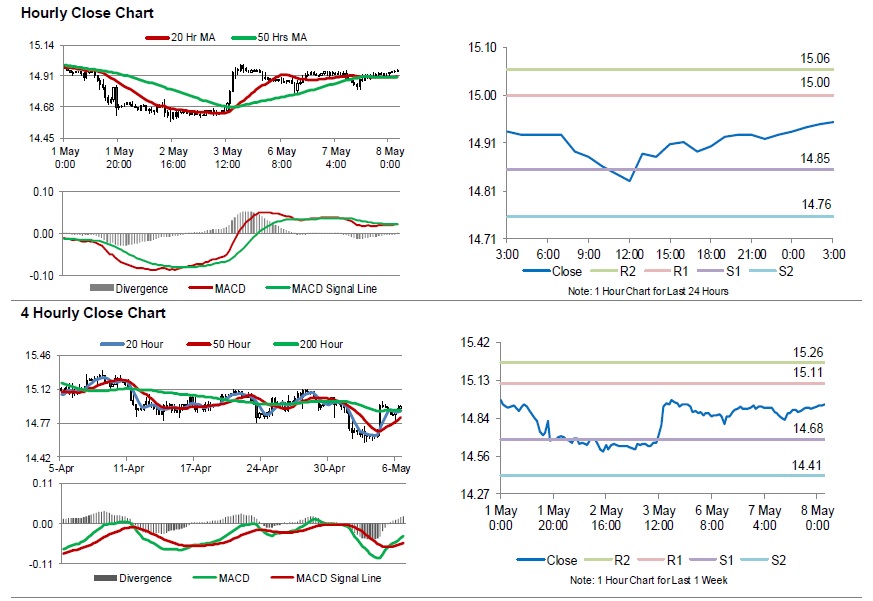
For the 24 hours to 23:00 GMT, Silver traded flat against the USD and closed at USD14.93 per ounce.
In the Asian session, at GMT0300, the pair is trading at 14.95, with silver trading 0.17% higher against the USD from yesterday’s close.
The pair is expected to find support at 14.85, and a fall through could take it to the next support level of 14.76. The pair is expected to find its first resistance at 15.00, and a rise through could take it to the next resistance level of 15.06.
The white metal is trading above its 20 Hr and 50 Hr moving averages.
Crude Oil: Oil Trading Higher, Ahead Of EIA’s Weekly Crude Oil Inventories Data
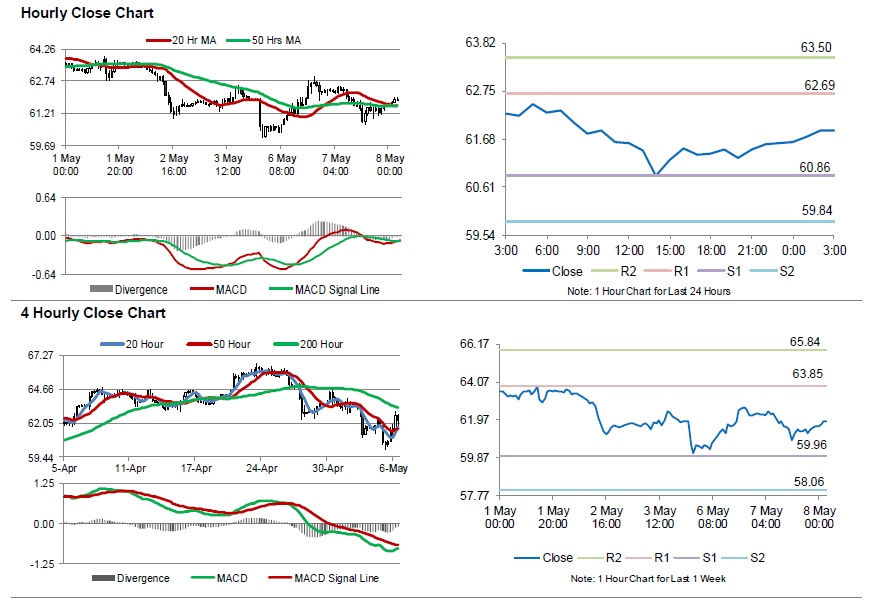
For the 24 hours to 23:00 GMT, Crude Oil declined 1.00% against the USD and closed at USD61.59 per barrel, after the American Petroleum Institute (API) reported that US crude oil inventories advanced by 2.8 million barrels in the week ended 03 May 2019. Moreover, the Energy Information Administration (EIA), in its monthly Short-term Energy Outlook, lifted its oil US crude production projections for 2019 to 12.45 million barrels per day and its 2020 output forecasts to 13.38 million barrels per day.
In the Asian session, at GMT0300, the pair is trading at 61.87, with oil trading 0.45% higher against the USD from yesterday's close.
The pair is expected to find support at 60.86, and a fall through could take it to the next support level of 59.84. The pair is expected to find its first resistance at 62.69, and a rise through could take it to the next resistance level of 63.50.
Crude oil is trading above its 20 Hr and 50 Hr moving averages.
USD/JPY Daily Outlook
Daily Pivots: (S1) 109.98; (P) 110.43; (R1) 110.70; More...
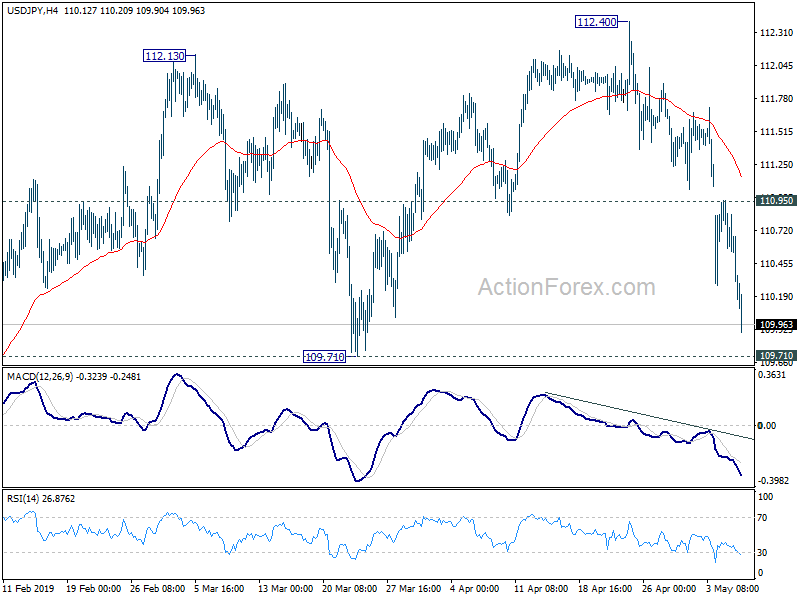
USD/JPY drops sharply to as low as 109.90 so far today. Intraday bias remains on the downside for 109.71 support next. As noted before, rebound from 104.69 has completed at 112.40 on bearish divergence condition in daily MACD. Decisive break of 109.71 will confirm this bearish case and target retesting 104.69 low. On the upside, break of 110.95 resistance is needed to confirm completion of the fall. Otherwise, outlook will now remain cautiously bearish in case of recovery.
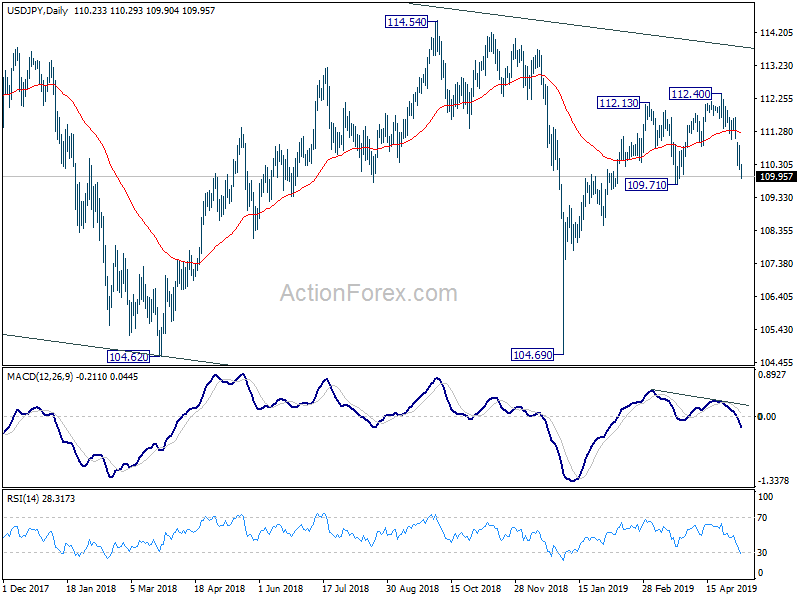
In the bigger picture, medium term outlook in USD/JPY remains a bit mixed as it's staying inside falling channel from 118.65, but there are signs of bullish reversal. On the upside, break of 114.54 resistance will revive the case the corrective fall from 118.65 has completed with three waves down to 104.69. And whole rise from 98.97 (2016 low) is resuming for 118.65 and above. However, sustained break of 109.71 will raise the chance that fall from 118.65 is still in progress for another low below 104.62.
New Zealand Dollar Tumbles on RBNZ Dovish Rate Cut, Yen Firm as Global Stocks Tumble on Trade War
Yen remains the strongest one for today, extending this week's rally on risk aversion. Following steep decline in the US, Asian markets open broadly lower and stay pressured. Threat of full-blown trade war continues to weigh on investors' sentiments. New round of tariffs on Chinese imports is ready to be imposed during Chinese Vice Premier Liu He's visit to Washington on May 9-10. It's unsure how Liu could turn around the situation after China reneged on its own commitments in the negotiations.
In the currency markets, Australian Dollar is currently the second strongest for today, benefiting somewhat from the rally in AUD/NZD. Euro is the third strongest. Meanwhile, New Zealand Dollar is clearly the weakest one following RBNZ's dovish rate cut. Dollar is paring some gains, as weighed down by decline in treasury yields. Over the week, though, Yen is the strongest, followed by Euro Dollar. Kiwi is the weakest, followed by Sterling and Canadian.
Technically, Yen crosses will remain the main focus for today. USD/JPY is on track to 109.71 support. Decisive break there will confirm near term bearish reversal. EUR/JPY has already taken out 123.39 support to indicate reversal. The question now it's whether EUR/JPY would accelerate towards 118.62 low. GBP/JPY is now pressing 143.72 key support and looks set to take out it firmly to confirm bearish reversal too. EUR/USD, USD/CHF, USD/CAD and AUD/USD are staying in established range, awaiting breakout.
In Asia, Nikkei is back from holiday, trading down -1.72%. Hong Kong HSI is down -0.70%. China Shanghai SSE is surprisingly resilient and is down only -0.11%, staying above 2900 handle. Singapore Strait Times is down -0.95%. Japan 10-year JGB yield is down -0.0029 at -0.054. Overnight, DOW dropped -1.79%. S&P 500 dropped -1.65%. NASDAQ dropped -1.96%. 10-year yield dropped -0.052 to 2.448. Break of 2.463 support could now pave the way to 2.356 low.
RBNZ cuts OCR to 1.50%, projects below target inflation for longer, sees need for more easing
RBNZ lowers official cash rate by -25bps to 1.50% as widely expected. In the accompanying statement, RBNZ noted that:
There was a “consensus” that lower path of OCR relative to February MPS was “appropriate”. That reflects “weaker domestic spending” and “projected ongoing growth and employment headwinds”. A key downside risk to growth was “larger than anticipated slowdown in global economic growth, particularly in China and Australia, New Zealand’s largest trading partners.”
In the latest economic projections, RBNZ projected that inflation will stay below target for longer then in February MPS. CPI won’t breaks 2% level until 2022. CPI forecasts for 2019 and 2021 were both revised down. On growth, RBNZ sees slower GDP growth in 2019 and 2020. But GDP growth is expected to pick up solidly in 2021 before dipping in 2022. On the net, RBNZ sees the need for further rate cut with average OCR hitting 1.4% in 2021 before bottoming.
OCR year average (vs Feb projections): 2019 at 1.8% (unchanged); 2020 at 1.6% (revised down from 1.8%); 2021 at 1.4% (revised down from 1.8%); 2022 at 1.6% (revised down from 2.2%);
CPI (vs Feb projections): 2019 at 1.5% (revised down from 1.6%); 2020 at 1.9% (revised up from 1.7%); 2021 at 1.9% (revised down from 2.1%); 2022 at 2.1% (unchanged).
GDP growth(vs Feb projections): 2019 at 2.6% (revised down from 2.8%); 2020 at 2.6% (revised down from 2.9%); 2021 at 3.1% (revised up from 2.8%); 2022 at 2.5% (revised up from 2.3%).
More on RBNZ:
- RBNZ Cut Policy Rate to 1.5%, Resuming Rate Cut for the First Time since 2016
- First Impressions: RBNZ Cuts the OCR to 1.50%
- RBNZ Cut Rates To A Historic Low | NZD/USD
- RBNZ projects below target inflation for longer, sees need for more easing
BoJ Minutes: Firm domestic demand offset drag from overseas slowdown
Minutes of the March 14/15 BoJ meeting noted that members "concurred" that the economy will continue to its "moderate expansion". "domestic demand was likely to follow an uptrend", including fixed investment and private consumption. That should offset weakness in exports and product as dragged down by overseas slowdown.
On prices, members reiterated that CPI 'continued to show relatively weak developments compared to the economic expansion and the labor market tightening." But CPI is still "likely to increase gradually" toward 2% target.
On monetary policy, members agreed that it was "appropriate" to persistently continue with the powerful monetary easing under the current guideline. On member warned of the "side effects" of maintaining current easing. One member warned that if downside risks were materializing, BoJ should be prepared to make policy responses. One member also noted the importance to "preemptive policy responses" in case of phase shift in developments.
Also from Japan, monetary base rose 3.1% yoy in April versus expectation of 3.6% yoy.
China trade surplus shrank again as exports contracted in April
China's trade surplus shrank again in April to USD 13.84B, down from USD 32.67B and missed expectation of USD 34.56B. Exports dropped -2.7% yoy versus expectation of 3.0% yoy. On the other hand, imports rose 10.3% yoy versus expectation of -3.0% yoy.
In CNY terms, trade surplus narrowed sharply to CNY 93.57B, down from 221.23B, missed expectation of CNY 216.75B. Exports grew merely 3.1% yoy versus expectation of 8.0% yoy. Imports rose 10.3% yoy versus expectation of 3.0% yoy.
Elsewhere
UK BRC retail sales monitor rose 3.7% yoy in April versus expectation of 2.4% yoy. Swiss will release unemployment rate in European session. Germany will release industrial production. ECB will also publish monetary policy meeting accounts. Later in the day Canada housing starts will be featured.
USD/JPY Daily Outlook
Daily Pivots: (S1) 109.98; (P) 110.43; (R1) 110.70; More...
USD/JPY drops sharply to as low as 109.90 so far today. Intraday bias remains on the downside for 109.71 support next. As noted before, rebound from 104.69 has completed at 112.40 on bearish divergence condition in daily MACD. Decisive break of 109.71 will confirm this bearish case and target retesting 104.69 low. On the upside, break of 110.95 resistance is needed to confirm completion of the fall. Otherwise, outlook will now remain cautiously bearish in case of recovery.
In the bigger picture, medium term outlook in USD/JPY remains a bit mixed as it's staying inside falling channel from 118.65, but there are signs of bullish reversal. On the upside, break of 114.54 resistance will revive the case the corrective fall from 118.65 has completed with three waves down to 104.69. And whole rise from 98.97 (2016 low) is resuming for 118.65 and above. However, sustained break of 109.71 will raise the chance that fall from 118.65 is still in progress for another low below 104.62.
Economic Indicators Update
| GMT | Ccy | Events | Actual | Consensus | Previous | Revised |
|---|---|---|---|---|---|---|
| 23:01 | GBP | BRC Retail Sales Monitor Y/Y Apr | 3.70% | 2.40% | -1.10% | |
| 23:50 | JPY | BOJ Minutes Mar | ||||
| 23:50 | JPY | Monetary Base Y/Y Apr | 3.10% | 3.60% | 3.80% | |
| 02:00 | NZD | RBNZ Rate Decision | 1.50% | 1.50% | 1.75% | |
| 03:00 | NZD | RBNZ Press Conference | ||||
| 03:00 | CNY | Trade Balance (USD) Apr | 13.8B | 33.7B | 32.6B | |
| 03:00 | CNY | Imports (USD) Y/Y Apr | 4.00% | -2.00% | -7.60% | |
| 03:00 | CNY | Exports (USD) Y/Y Apr | -2.70% | 3.00% | 14.20% | |
| 03:00 | CNY | Trade Balance (CNY) Apr | 94B | 235B | 221B | |
| 03:00 | CNY | Imports Y/Y (CNY) Apr | 10.30% | -3.00% | -1.80% | |
| 03:00 | CNY | Exports Y/Y (CNY) Apr | 3.10% | 8.00% | 21.30% | |
| 05:45 | CHF | Unemployment Rate Apr | 2.40% | 2.40% | ||
| 06:00 | EUR | German Industrial Production M/M Mar | -0.50% | 0.70% | ||
| 11:30 | EUR | ECB Monetary Policy Meeting Accounts | ||||
| 12:15 | CAD | Housing Starts Apr | 194K | 193K | ||
| 14:30 | USD | Crude Oil Inventories | 9.9M |
EUR/USD Climbing Higher While USD/JPY Tumbles
EUR/USD is currently trading nicely above the 1.1160 and 1.1180 support levels. USD/JPY declined heavily recently and broke the 110.80 and 110.50 support levels.
Important Takeaways for EUR/USD and USD/JPY
- The Euro corrected lower recently and tested the 1.1160-1.1165 support area.
- There is a major bearish trend line in place with resistance near 1.1208 on the hourly chart of EUR/USD.
- USD/JPY declined heavily and settled below the key 110.50 support area.
- There is a key bearish trend line formed with resistance at 110.35 on the hourly chart.
EUR/USD Technical Analysis
The Euro started a fresh upward move after testing the 1.1135 level against the US Dollar. The EUR/USD pair broke the 1.1150 and 1.1160 resistance levels to move into a positive zone.
The pair traded as high as 1.1217 on FXOpen and recently corrected below the 1.1180 level. However, the 1.1160-1.1165 area acted as a support and the pair bounced back. It is now trading above the 1.1185 level and the 50 hourly simple moving average.
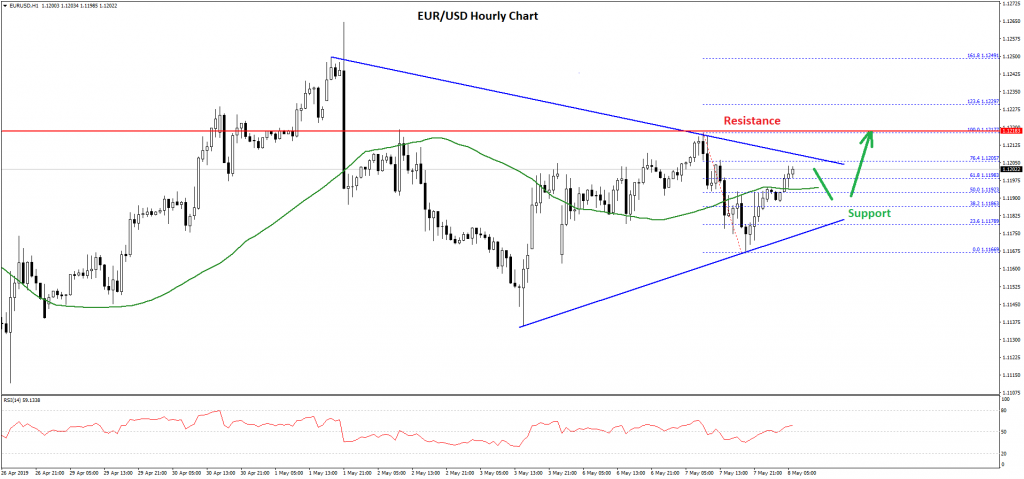
There was a break above the 50% Fib retracement level of the recent decline from the 1.1217 high to 1.1166 low. On the upside, there is a major resistance formed near 1.1208-1.1210. There is also a major bearish trend line in place with resistance near 1.1208 on the hourly chart of EUR/USD.
At the moment, the pair is near the 76.4% Fib retracement level of the recent decline from the 1.1217 high to 1.1166 low. A clear break above the trend line and the 1.1210 level may push the price towards the 1.1220 resistance.
Any further gains above 1.1220 is likely to lead the Euro towards the 1.1250 level. On the downside, an initial support is near the 1.1190 and the 50 hourly SMA. However, the main support is near the 1.1180 level and a connecting bullish trend line.
A daily close below 1.1180 and 1.1165 is likely to push EUR/USD back in a bearish zone in the near term towards 1.1120.
USD/JPY Technical Analysis
The US Dollar started the week on a negative note below 111.00 against the Japanese Yen. The USD/JPY pair opened with a gap lower and broke the key 110.80 support level to enter a bearish zone.
There was a steady decline and the pair settled below the 110.50 level and the 50 hourly simple moving average. During the decline, the pair formed a few bearish patterns on the hourly chart and recently traded as low as 109.96.
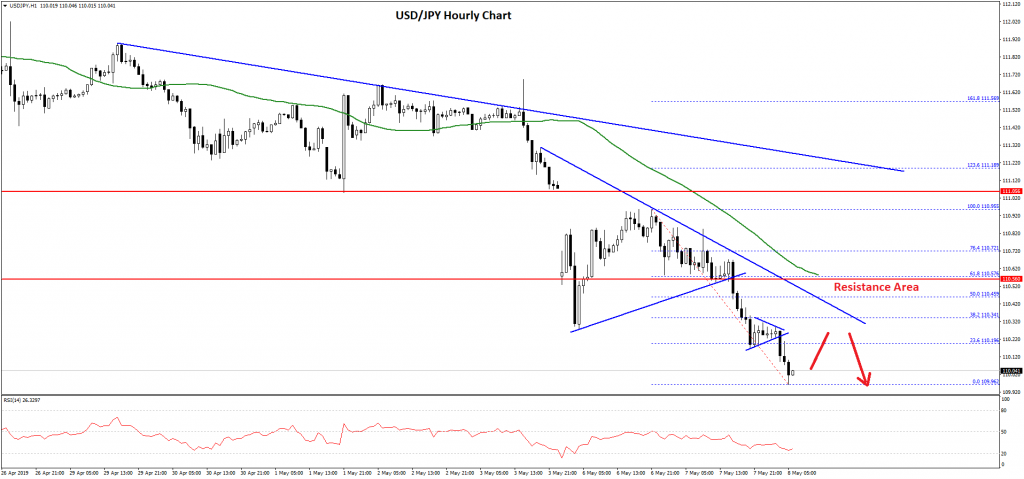
It is currently trading in a bearish zone, with an immediate resistance near 110.20, and the 23.6% Fib retracement level of the recent decline from the 110.95 high to 109.96 low.
On the upside, there is a key bearish trend line formed with resistance at 110.35 on the hourly chart. The trend line is close to the 38.2% Fib retracement level of the recent decline from the 110.95 high to 109.96 low.
The next key resistances are near the 110.50 and 110.55 levels. The 50 hourly simple moving average is also positioned near the 110.55 level. Therefore, a decent recovery won’t be easy in the near term.
On the downside, an initial support is near 110.00, below which USD/JPY could decline towards the 109.80 level or even test the 109.60 support.
Kiwi Tumbles As RBNZ Cuts Rates
NZD/USD touches six-month low
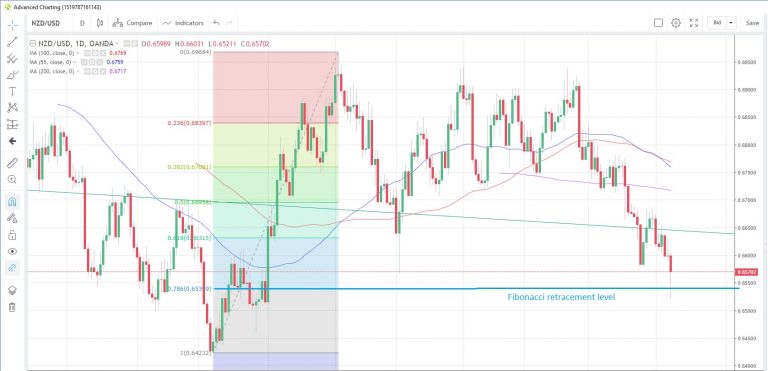
The Reserve Bank of New Zealand cut its benchmark rate by 25bps to a record low 1.5%, its first cut since November 2016, at its rate meeting this morning. Most economists and analysts had expected such a decision yet NZD/USD fell more than 1% to 0.6521, the lowest since November 1, as the accompanying statement suggested there was room for further cuts going forward.
In its published rate path, it sees the Official Cash Rate (OCR) at 1.36% in June 2020 (the previous estimate was 1.81%). In addition, inflation forecasts were marked lower to 1.7% in 2020 from 2.0% previously. RBNZ Governor Orr said that a lower OCR is necessary to support the outlook for employment and inflation consistent with its policy remit.
NZD/USD spiked lower to 0.6521 but quickly pared losses to sit at 0.6580. Prior to the announcement it was trading just above 0.6600.
NZD/USD Daily Chart
China's imports surge in April
China's imports rose 4.0% y/y in US dollar terms, beating economists' expectations of a 2.1% contraction. That was the biggest expansion in six months. However, the data series also highlighted that imports of iron ore, the backbone of Australia's exports to China, were 340 million tons year-to-date. That was the lowest total since February 2016.
Exports fell 2.7% y/y and so the trade surplus narrowed to $13.8 billion, well under forecasts of $34.6 billion. China's trade surplus with the US increased to $21.0 billion in April from $20.5 billion, bringing the year-to-date total to $83.7 billion. That compares with $62.7 billion for the same period last year.
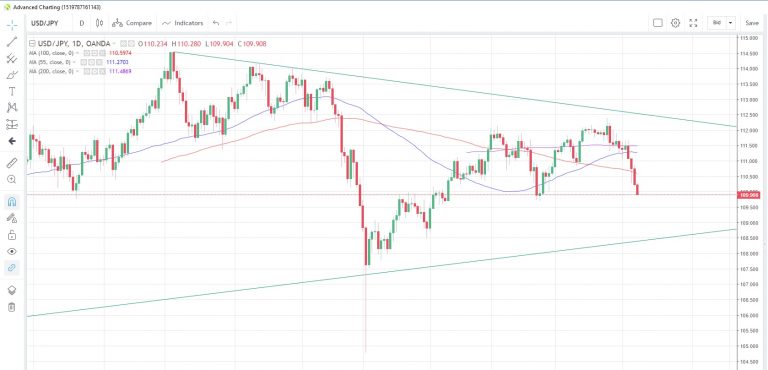
The reaction in currency markets was quite muted, with AUD/USD rising a mere 6 pips to an intra-day high of 0.7026. USD/JPY edged lower to 109.92, the lowest since March 26, but that was more a function of safe-haven yen buying on the back of potential trade war issues rather than the China trade data.
USD/JPY Daily Chart
Speeches overtake data
Today's data calendar is filled more with central banker speeches rather than data. Starting with Bank of England's Ramsden, ECB's Draghi comes up next to be followed by Fed's Brainard in the US session.
On the data front, it will be interesting to see if Germany's industrial production can echo the better-than-expected factory orders data for March, which was released yesterday. UK's Halifax house prices are seen improving in April, while Canada's housing starts are also expected to edge up to 196.4k from 192.5k.
USDJPY Sets Up To Weaken Further On Bear Pressure
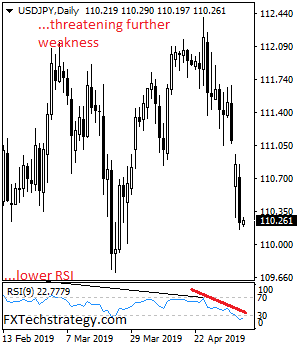
USDJPY looks to weaken further as it retains it still faces downside pressure risk. On the upside, resistance comes in at 111.00 level. Above this level will turn attention to the 111.50 level. Further out, we expect a possible move towards the 112.00 level. A cut through here will open the door for more gain towards the 112.50. On the downside, support comes in at the 110.50 level where a break will target the 110.00 level. Below that level will turn focus to the 109.50 level and then lower towards the 109.00 level. On the whole, USDJPY faces more downside pressure.
China trade surplus shrank again as exports contracted in April
China's trade surplus shrank again in April to USD 13.84B, down from USD 32.67B and missed expectation of USD 34.56B. Exports dropped -2.7% yoy versus expectation of 3.0% yoy. On the other hand, imports rose 10.3% yoy versus expectation of -3.0% yoy.
In CNY terms, trade surplus narrowed sharply to CNY 93.57B, down from 221.23B, missed expectation of CNY 216.75B. Exports grew merely 3.1% yoy versus expectation of 8.0% yoy. Imports rose 10.3% yoy versus expectation of 3.0% yoy.
First Impressions: RBNZ Cuts the OCR to 1.50%
First impressions of the RBNZ's May Monetary Policy Statement.
The Reserve Bank reduced the OCR to 1.50% at today’s Monetary Policy Statement.
The statement was bang in line with our expectations.
The press release consisted of a justification for cutting the OCR – low inflation, slowing domestic economy, and global risks. There was nothing at all in the press release to indicate what the RBNZ is thinking about future OCR moves.
The RBNZ forecasts the OCR to drop to 1.4% by March 2020 – this is roughly equivalent to half a further cut. This allows for the possibility of further OCR cuts, but does not commit the RBNZ.
Our interpretation is that the RBNZ is genuinely open minded about whether to cut the OCR again or not.
We judge the probability of a follow-up OCR cut in June as low. August is more of a live possibility, but our current forecast is that the RBNZ will keep the OCR on hold at 1.5% until mid-2020, when it will reduce the OCR again.
The OCR cut caused two year swap rates to fall 15 basis points and the exchange rate to fall 0.7 cents.
Mortgage rates have plunged over the past two months, and today’s OCR cut will cause them to fall further. We think the consequence will be an upturn in the housing market, starting in the second half of 2019.
BoJ Minutes: Firm domestic demand offset drag from overseas slowdown
Minutes of the March 14/15 BoJ meeting noted that members "concurred" that the economy will continue to its "moderate expansion". "domestic demand was likely to follow an uptrend", including fixed investment and private consumption. That should offset weakness in exports and product as dragged down by overseas slowdown.
On prices, members reiterated that CPI 'continued to show relatively weak developments compared to the economic expansion and the labor market tightening." But CPI is still "likely to increase gradually" toward 2% target.
On monetary policy, members agreed that it was "appropriate" to persistently continue with the powerful monetary easing under the current guideline. On member warned of the "side effects" of maintaining current easing. One member warned that if downside risks were materializing, BoJ should be prepared to make policy responses. One member also noted the importance to "preemptive policy responses" in case of phase shift in developments.