Sample Category Title
USD/JPY Mid-Day Outlook
Daily Pivots: (S1) 110.43; (P) 110.70; (R1) 111.13; More...
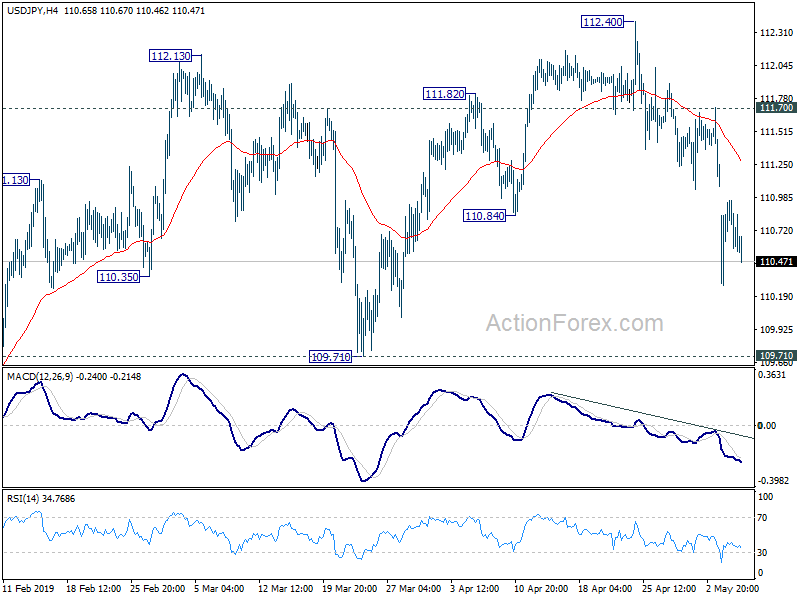
No change in USD/JPY's outlook and intraday bias remains on the downside. Current fall from 112.40 should extend to 109.71 support. As noted before, rebound from 104.69 has completed at 112.40 on bearish divergence condition in daily MACD. Decisive break of 109.71 will confirm this bearish case and target retesting 104.69 low. On the upside, break of 111.70 resistance is needed to confirm completion of the fall. Otherwise, outlook will now remain cautiously bearish in case of recovery.
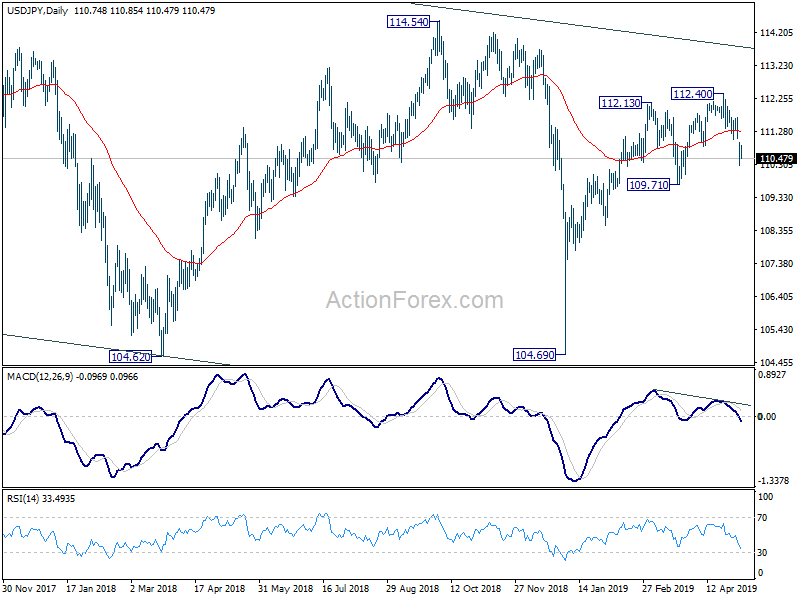
In the bigger picture, medium term outlook in USD/JPY remains a bit mixed as it's staying inside falling channel from 118.65, but there are signs of bullish reversal. On the upside, break of 114.54 resistance will revive the case the corrective fall from 118.65 has completed with three waves down to 104.69. And whole rise from 98.97 (2016 low) is resuming for 118.65 and above. However, sustained break of 109.71 will raise the chance that fall from 118.65 is still in progress for another low below 104.62.
EUR/USD Outlook: EC Downgrades Outlook and Sends Euro Lower
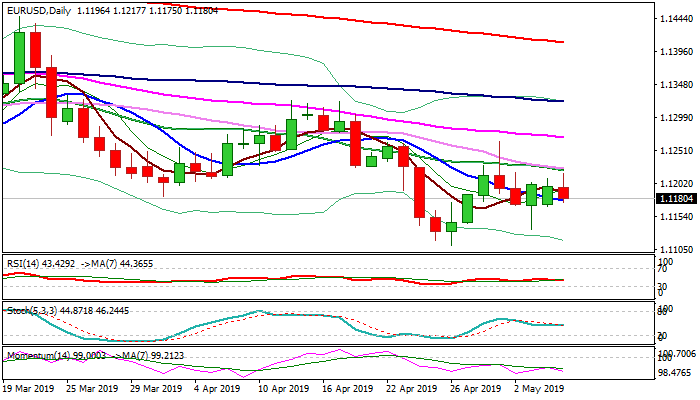
The Euro stands at the back foot at the beginning of US trading on Tuesday, as the weakness started in early European session on weaker than expected German data and accelerated after the European Commission in its report, downgraded outlook for the EU and Germany. With dollar remaining steady from safe-haven buying on the newest tensions in US/China trade dispute, near-term outlook for Euro is negative. Fresh weakness probes below 10SMA (1.1177) and pressures more significant Fibo support at 1.1170 (61.8% of 1.1111/1.1264) loss of which would generate strong bearish signal and risk further weakness towards 1.1147 (Fibo 76.4%) and 1.1134 (last Friday's spike low). Sideways-moving daily Kijun-sen, which repeatedly capped upside attempts, marks pivotal barrier at 1.1217, close above which would sideline downside risk.
Res: 1.1206; 1.1217; 1.1229; 1.1264
Sup: 1.1170; 1.1147; 1.1134; 1.1111
USD/CHF Mid-Day Outlook
Daily Pivots: (S1) 1.0154; (P) 1.0175; (R1) 1.0200; More.....
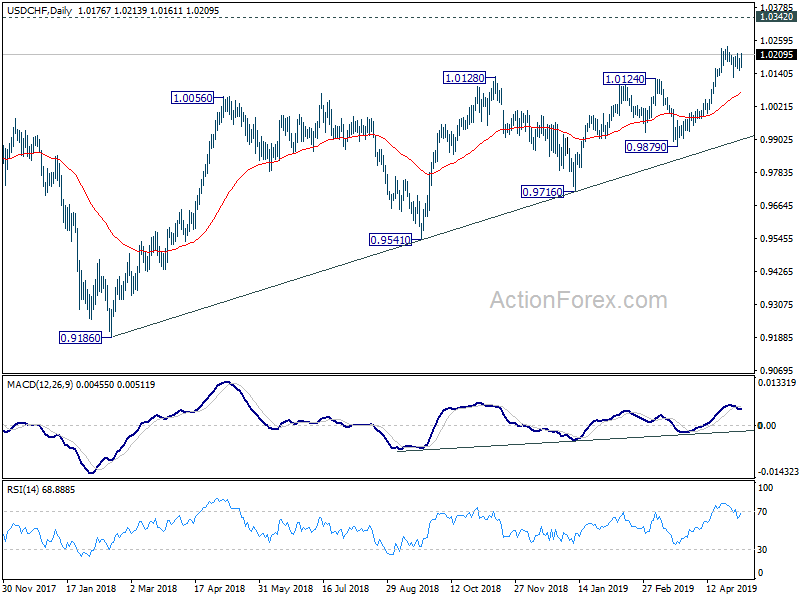
USD/CHF rebounds notably today but stays in range of 1.0126/0237. Intraday bias remains neutral first and more sideway trading could be seen. On the upside, break of 1.0237 will resume larger rise from 0.9186 to 1.0342 key resistance. However, break of 1.0126 will turn bias to the downside for deeper decline to 55 day EMA (now at 1.0066).
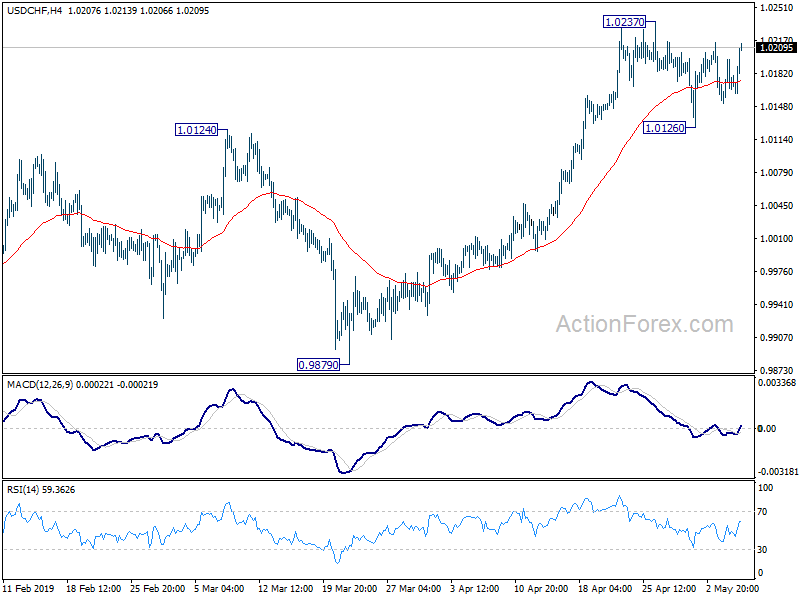
In the bigger picture, medium term up trend from 0.9186 is extending. Current rise should target 1.0342 resistance next. For now, we'd be cautious on strong resistance from there to limit upside, until we see medium term upside acceleration. On the downside, break of 0.9879 support is needed to indicate reversal. Otherwise, outlook will stay bullish in case of deep pull back.
Yen and Dollar Take Spotlights on Risk Aversion, Trade War Concerns Stay
Risk aversion remains the dominant theme in the global financial markets on trade war threats. In particular, German 10-year yield turns negative again on safe haven flows. Based on currently available information, the trigger for Trump's escalation was China's pull back on its commitments in the negotiation progress. And it's a general consensus in the the trade team that tariffs is the only way to go if no deal could be sealed this week. Hence, even though Chinese Vice Premier Liu travel to the US on May 9-10, it's unsure what he could do to bring negotiations back on track and avert the new tariffs on Friday.
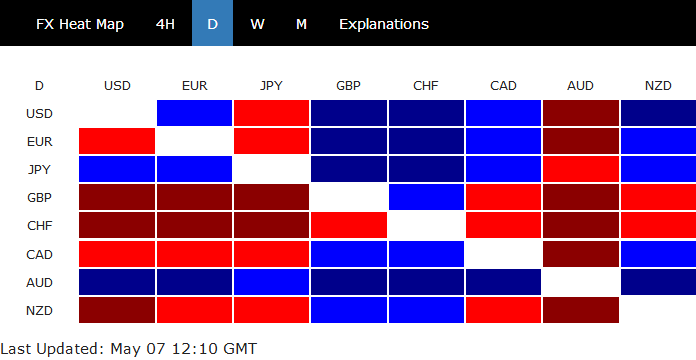
In the currency markets, Yen is currently the strongest one, picking up steam on falling stocks and yields. Australian Dollar is lucky as the second strongest, thanks to RBA standing pat. But it's post RBA rally has been limited since the central bank was actually laying the ground work for rate cuts down the road, subject to developments in the job markets. Dollar is the third strongest. Sterling and Swiss Franc are the weakest ones.
Technically, GBP/JPY's break of 144.80 minor support now puts focus back to 143.72 key support. Decisive break there will indicate near term bearish reversal. EUR/GBP's break of 0.8568 now suggests that at least another recovery would be seen before larger down trend resumes through 0.8472 key support. EUR/USD, USD/CHF, USD/CAD and AUD/USD are staying in familiar range. But Dollar seems to be heading for a test on resistance levels in these pairs soon.
In Europe, currently, FTSE is down -1.08%. DAX is down -0.61%. CAC is down -0.80%. German 10-year yield is down -0.040 at -0.030, turns negative again. Earlier in Asia, Hong Kong HSI rose 0.52%. China Shanghai SSE rose 0.69%. Singapore Strait Times rose 0.67%. Japan remains on holiday.
China VP Liu to visit US on May 9-10 despite new tariff threats
Chinese Vice Premier Liu He will still travel to the US on May 9-10 to resume trade negotiations despite re-escalated tariff threats. That's a slight delay comparing to the original plan of traveling to the US on Wednesday. According to the MOFCOM's statement, the visit was by invitation of US Trade Representative Robert Lighthizer and Treasury Secretary Steven Mnuchin.
Chinese Foreign Ministry spokesman Geng Shuang said in a regular press briefing that “adding tariffs can't resolve any problem” of trade conflicts. “Talks are by their nature a process of discussion. It's normal for both sides to have differences. China won't shun problems and is sincere about continuing talks,” he added. Shuang also said “We hope the U.S. side can work hard with China, to meet each other halfway, and on the basis of mutual respect and equality, resolve each other's reasonable concerns, and strive for a mutually beneficial, win win agreement.”
It's widely reported that China reneged on the commitments it made, explicitly with the new draft agreement sent to the US over the weekend. Both Lighthizer and Steven Mnuchin confirmed that. And it's seen as the trigger for Trump to declare trade war escalation to full blown level this Friday. Mnuchin also confirmed that “the entire economic team … are completely unified and recommended to the president to move forward with tariffs if we are not able to conclude a deal by the end of the week.”
Eurozone growth projected to bottom lower in 2019, but rebound still expected in 2020
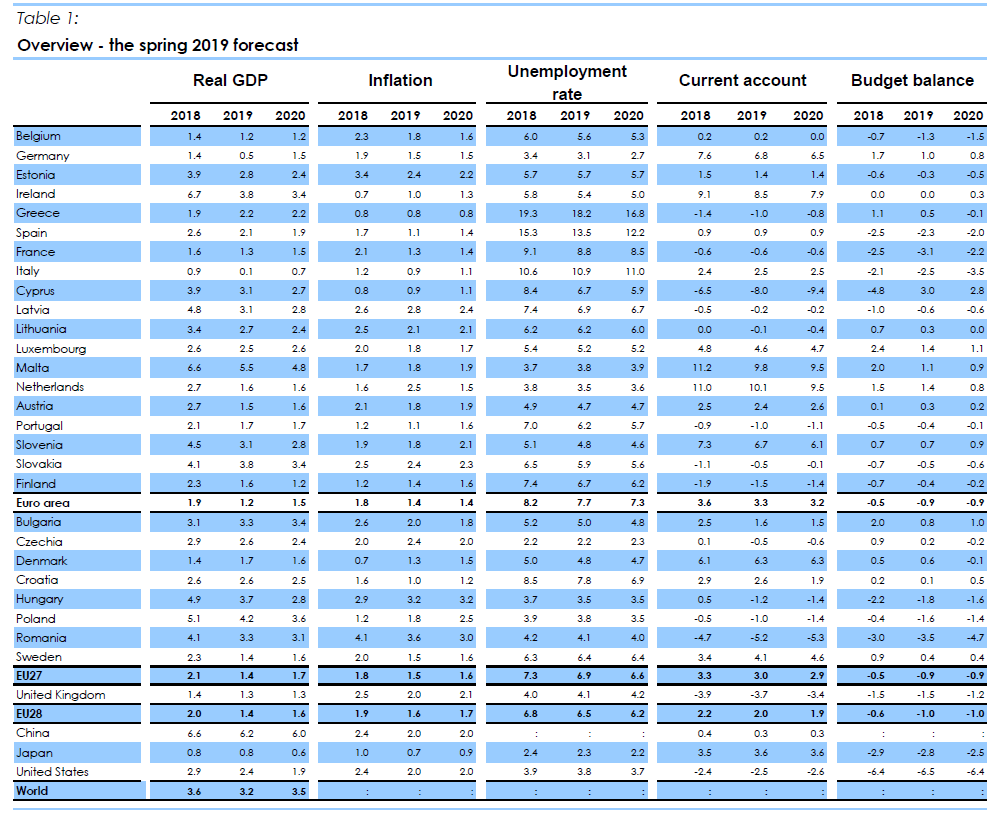
In the latest Spring Economic Forecasts, European Commission downgrade 2019 Eurozone GDP growth projections slightly by -0.1%. Though, it would be the seventh year of growth in a row. And despite continuing global uncertainties, domestic dynamics are expected to support the European economy. More importantly, the Commission expects growth to bottom in 2019 and pick up again in 2020.
Eurozone projections (Winter forecasts):
- 2019 GDP at 1.2% (downgraded from Winter forecast at 1.3%)
- 2020 GDP at 1.5% (downgraded from 1.6%)
- 2019 HICP at 1.4% (unchanged)
- 2020 HICP at 1.4% (downgraded from 1.5%)
Germany projections:
- 2019 GDP at 0.5% (downgrade from 1.1%)
- 2020 GDP at 1.5% (downgraded from 1.7%)
France projections:
- 2019 GDP at 1.3% (unchanged)
- 2020 GDP at 1.5% (unchanged)
European Commission Vice President Valdis Dombrovskis said: “The European economy is showing resilience in the face of a less favourable external environment, including trade tensions. Growth is set to continue in all EU Member States and pick up next year, supported by robust domestic demand, steady employment gains and low financing costs. Yet risks to the outlook remain pronounced. On the external side, these include further escalation of trade conflicts and weakness in emerging markets, in particular China. In Europe, we should stay alert to a possible ‘no-deal Brexit', political uncertainty and a possible return of the sovereign-bank loop.”
Commissioner Pierre Moscovicisaid: “The European economy will continue to grow in 2019 and 2020. Growth remains positive in all our Member States and we continue to see good news on the jobs front, including rising wages. This means that the European economy is holding up in the face of less favourable global circumstances and persistent uncertainty. Nonetheless, we should stand ready to provide more support to the economy if needed, together with further growth-enhancing reforms. Above all, we must avoid a lapse into protectionism, which would only exacerbate the existing social and economic tensions in our societies.”
There could be a cross-party Brexit deal in UK, but not this week
According to a BBC's political editor Laura Kuenssberg, there is a way for the UK government and opposition to compromise on a Brexit deal. however, it's unlikely to be reached this week. Kuenssberg tweeted that “Senior govt source says it IS possible though to see a way to a deal, but unlikely to be resolved this week.” But the aim is “to set out a path to get the Withdrawal Bill to Commons with a fair wind.”
Foreign Secretary Jeremy Hunt indicated to BBC radio that he's “not a believer in a customs union” as a “sustainable long-term solution” of Brexit. It's clear that customs union is the way Labour would like to go forward with. Hunt urged that “this is a time when we have to be willing to make compromises on all sides because the message of last week was that voters for both main parties are very, very angry about the fact Brexit hasn't been delivered.”
RBA stands pat at 1.50%, revised down growth and inflation forecasts
Australian Dollar rebounds after RBA left cash rate unchanged at 1.50%, rather than delivered a rate cut as some expected. While, keeping interest rate on hold, the central bank did lay down the criteria in labor market development as condition for policy action in response to subdued inflation.
RBA acknowledged that Q1 inflation data were "noticeably lower than expected". And, "further improvement in the labour market was likely to be needed for inflation to be consistent with the target". Thus, the central bank said it will be "paying close attention to developments in the labour market at its upcoming meetings.
With the new economic projections, RBA is expecting around 2.75% growth in 2019 and 2020. That's a slightly downward revision from February's around 3% in 2019 and by a little less in 2020.
Underlying inflation is expected to be at 1.75% this year and 2% in 2020. Headline inflation is expected to be at around 2% in 2019. There were also slight downward revision from February's projection of 2% in 2019 and 2.25% in 2020.
Australia retail sales rose 0.3%, trade surplus narrowed to AUD 4.95B
Australia retail sales rose 0.3% mom in March, above expectation of 0.2% mom. February's growth was revised up from 0.8% mom to 0.9% mom. In seasonally adjusted terms, there were rises in Victoria (0.7%), Queensland (0.6%), New South Wales (0.2%), Tasmania (0.4%), South Australia (0.1%), and the Northern Territory (0.7%). The Australian Capital Territory was relatively unchanged (0.0%) and Western Australia (-0.7%) fell in seasonally adjusted terms in March 2019.
Trade surplus narrowed to AUD 4.95B in March, down from AUD 5.14B but beat expectation of AUD 4.49B. Goods and services exports dropped -2% to AUD 39.34B. Good and services imports dropped -1% to AUD 34.39B.
Other data released today include Germany factory orders which rose 0.6% mom in March, lower than expectation of 1.5% mom. Swiss foreign currency reserves rose to CHF 772B in April versus expectation of CHF 756B. Japan PMI manufacturing was finalized at 50.2 in April.
USD/CHF Mid-Day Outlook
Daily Pivots: (S1) 1.0154; (P) 1.0175; (R1) 1.0200; More.....
USD/CHF rebounds notably today but stays in range of 1.0126/0237. Intraday bias remains neutral first and more sideway trading could be seen. On the upside, break of 1.0237 will resume larger rise from 0.9186 to 1.0342 key resistance. However, break of 1.0126 will turn bias to the downside for deeper decline to 55 day EMA (now at 1.0066).
In the bigger picture, medium term up trend from 0.9186 is extending. Current rise should target 1.0342 resistance next. For now, we'd be cautious on strong resistance from there to limit upside, until we see medium term upside acceleration. On the downside, break of 0.9879 support is needed to indicate reversal. Otherwise, outlook will stay bullish in case of deep pull back.
Economic Indicators Update
| GMT | Ccy | Events | Actual | Consensus | Previous | Revised |
|---|---|---|---|---|---|---|
| 00:30 | JPY | PMI Manufacturing Apr F | 50.2 | 49.5 | 49.5 | |
| 01:30 | AUD | Trade Balance (AUD) Mar | 4.95B | 4.49B | 4.80B | 5.14B |
| 01:30 | AUD | Retail Sales M/M Mar | 0.30% | 0.20% | 0.80% | 0.90% |
| 03:00 | NZD | RBNZ 2-Year Inflation Expectation Q2 | 2.00% | 2.00% | ||
| 04:30 | AUD | RBA Rate Decision | 1.50% | 1.25% | 1.50% | |
| 06:00 | EUR | German Factory Orders M/M Mar | 0.60% | 1.50% | -4.20% | -4.00% |
| 07:00 | CHF | Foreign Currency Reserves (CHF) Apr | 772B | 756B | 756B | |
| 14:00 | CAD | Ivey PMI Apr | 51.5 | 54.3 |
EURNZD Trades around 4-month High; 200-SMA Acts as Strong Obstacle
EURNZD recorded a fresh four-month high of 1.6987 earlier today, finding resistance near the 200-day simple moving average (SMA). The RSI and the MACD are increasing distance above the 50 level and the zero line respectively, increasing speculation for more upside pressure in the short-term.
In case the pair maintains its short-term direction to the upside after the bounce off the 18-month bottom of 1.6885, the bulls will probably challenge the 50.0% Fibonacci retracement level of the downleg from 1.7925 to 1.6885 around 1.7110. A break higher could last until the 1.7200 handle, taken from the peak on January 3.
On the flipside, a decline below the 38.2% Fibonacci of 1.6915 may drive the price towards the 1.6850 support and the 20-day SMA near 1.6805. Beneath the latter, the 1.6725 barrier and the 23.6% Fibonacci of 1.6675, which coincides with the 40-day SMA are coming into view.
Summarizing, if the price surpasses the 200-day SMA, it could open the door for more bullish orders until the next resistance.
Eurozone growth projected to bottom lower in 2019, but rebound still expected in 2020
In the latest Spring Economic Forecasts, European Commission downgrade 2019 Eurozone GDP growth projections slightly by -0.1%. Though, it would be the seventh year of growth in a row. And despite continuing global uncertainties, domestic dynamics are expected to support the European economy. More importantly, the Commission expects growth to bottom in 2019 and pick up again in 2020.
Eurozone projections (Winter forecasts):
- 2019 GDP at 1.2% (downgraded from Winter forecast at 1.3%)
- 2020 GDP at 1.5% (downgraded from 1.6%)
- 2019 HICP at 1.4% (unchanged)
- 2020 HICP at 1.4% (downgraded from 1.5%)
Germany projections
- 2019 GDP at 0.5% (downgrade from 1.1%)
- 2020 GDP at 1.5% (downgraded from 1.7%)
France projections
- 2019 GDP at 1.3% (unchanged)
- 2020 GDP at 1.5% (unchanged)
Valdis Dombrovskis, Vice-President for the Euro and Social Dialogue, also in charge of Financial Stability, Financial Services and Capital Markets Union, said: “The European economy is showing resilience in the face of a less favourable external environment, including trade tensions. Growth is set to continue in all EU Member States and pick up next year, supported by robust domestic demand, steady employment gains and low financing costs. Yet risks to the outlook remain pronounced. On the external side, these include further escalation of trade conflicts and weakness in emerging markets, in particular China. In Europe, we should stay alert to a possible ‘no-deal Brexit', political uncertainty and a possible return of the sovereign-bank loop.”
Pierre Moscovici, Commissioner for Economic and Financial Affairs, Taxation and Customs, said:“The European economy will continue to grow in 2019 and 2020. Growth remains positive in all our Member States and we continue to see good news on the jobs front, including rising wages. This means that the European economy is holding up in the face of less favourable global circumstances and persistent uncertainty. Nonetheless, we should stand ready to provide more support to the economy if needed, together with further growth-enhancing reforms. Above all, we must avoid a lapse into protectionism, which would only exacerbate the existing social and economic tensions in our societies.”
Into US session: AUD maintains post RBA gains, JPY and USD follow on risk aversion
Entering in to US session, Australian Dollar remains the strongest one for today. RBA's decision to keep cash rate unchanged at 1.50% is giving the Aussie some support. But upside is so far limited as it's clear that RBA is laying the ground work for rate cuts down the road, subject to developments in the job markets.
Yen is following as the second strongest as risk sentiments remain generally cautious. Dollar follows as the third strongest. Chinese Vice Premier Liu He will travel to the US on May 9-10 for another round of trade negotiations. But it's a general consensus in Trump's trade team that after China reneges on its commitments, more tariff is the only way to go if no deal could be sealed this week. Meanwhile, Swiss Franc is the weakest one, followed by Sterling.
In other markets, currently:
- DOW future is down -180pts on trade pessimism.
- Gold is down -0.23%.
- WTI crude oil is down -1.06%.
In Europe:
- FTSE is down -1.05%.
- DAX is down -0.70%.
- CAC is down -0.81%.
- German 10-year yield is down -0.0364 at -0.025, turned negative again.
Earlier in Asia:
- Hong Kong HSI rose 0.52%.
- China Shanghai SSE rose 0.69%.
- Singapore Strait Times rose 0.67%.
- Japan remains on holiday.
British Pound Under Pressure after Rough Start to Week
GBP/USD has ticked lower on Tuesday, after starting the week with considerable losses. Currently, GBP/USD is trading at 1.3062, down 0.27% on the day. There are no major events on the schedule. Today’s highlight is U.S. JOLTS Jobs Openings, which is expected to climb to 7.35 million.
With Brexit extended until October, the focus is now on Theresa May – will she survive as Prime Minister? There are growing calls on May to set a resignation date, and that end-date could be hastened if she reaches a cross-party deal with the Labor party. There has been speculation that May is looking to enter a new customs union with Brussels, infuriating many of her Tory colleagues, who see such an arrangement has blocking the U.K. from pursuing an independent trade policy. Brexit talks between London and Brussels are set to resume, but the track record indicates that the parties will have a tough time closing the gaps in their positions.
On Sunday, U.S. President Donald Trump said that the U.S. would raise tariffs on $200 billion worth of Chinese goods as early as Friday, from 10% to 25%. Trump sounded nonchalant about the trade talks, saying that even if an agreement wasn’t reached, the U.S. would benefit from the new tariffs. On Monday, Chinese officials had said it would cancel the talks, but this turned out to be an empty threat. Chinese Vice Premier Liu He is scheduled to lead a Chinese delegation to Washington. Will the new U.S. tariffs be rescinded? Treasury Secretary Steve Munchin said that the tariffs could be cancelled when the talks resume.
Keep Watch on Lira and Rand While Questions Elsewhere Rest on Whether Investors Have Under-Priced Trump’s Tariff Threat
Smoke continues to linger across market sentiment following the smoke grenade President Trump launched over the weekend with the threat of adding further tariffs on Chinese imports at the end of the week. The mixed performance of Asian markets coupled with little change to European shares as of writing highlights that investors are still clouded by smoke, and not sure how to position themselves given the new escalation. I stand on the side of the table that the risk of higher tariffs on Chinese imports, and a potential resolution are both under-priced.
Understandably however, investors cannot dodge the unpredictable bullets that are being shot from the gun of President Trump and I would suggest over the near-term to focus attention on the prospects of volatility in other asset classes, like the Turkish Lira and South African Rand.
The Rand behaved unusually quietly at the start of the week, particularly considering the spectacular sell-off in Asian markets. This is a rare occurrence for a currency that so often acts as the ultimate investor proxy for taking on risk in a portfolio. The lack of action in the Rand does suggest that investors are sitting on the side lines ahead of the elections. While the local currency remains exposed to election risks, external drivers in the form of US-China tensions will influence the currency’s valuation. If a resolution to the US-China trade tensions is agreed, this will be a welcome development for the Rand and many other emerging market currencies. However, the Rand could find itself exposed to downside risks if tariffs on Chinese imports get raised higher on Friday.
When it comes to the Turkish Lira we cannot rule out the risk of expecting sustained selling momentum on the currency following the bizarre news that the Istanbul election will be re-run. This decision represents another severe swerve for investor confidence in Turkey, at a time where the Lira has already received a pounding from other political risks and central bank independence concerns.
Away from the view on Lira and Rand over coming days, lessons of the past do suggest the next move for wider global markets will be swayed by whether the threat from President Trump to increase tariffs on China were a negotiating tactic.
Given the constant back and forth over trade negotiations, investors are at risk of becoming complacent and increasingly numb to new developments.
Complacency can be understood, especially when considering how Donald Trump has made bold threats in the past only to soften the rhetoric at the last moment. However, there is investor fatigue from the trade tension theme and numbness resides from how long this situation has been prolonged.
I do feel that with global market sentiment remaining fragile and global growth fears still rampant in headlines, that Trump may be forced to think twice before moving ahead with any tariff hikes that escalate tensions further.
The endgame is to expect market risk sentiment to swing back and forth as investors digest the news flow over the final three days of trading for the week.
While a US-China breakthrough deal seems unlikely following Trump’s recent threat, it is still the base-case outcome investors are hoping for to buy stocks.
Reserve Bank of Australia stand pat
The Reserve Bank of Australia defied market expectations by keeping interest rates unchanged at 1.5% in May.
With inflation in Australia below the central bank’s 2-3% target, repeated weakness in household spending and domestic conditions shaky, it was widely expected that the central bank would cut rates to support growth. While today’s decision may temporarily prevent the Australian Dollar from weakening, the central bank could be seen acting in the future if domestic conditions remain depressed and external risks compound to the headwinds.
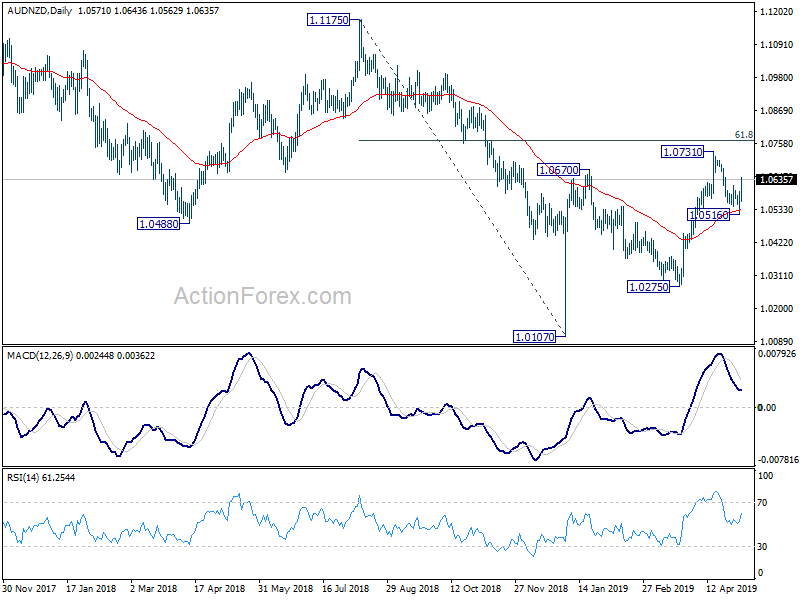
AUD/NZD rebounds from 55 day EMA, RBNZ to fuel more upside
AUD/NZD rises strongly today after RBA kept interest rate unchanged at 1.50%, even though some expected a cut. Technically, strong support was seen at 55 day EMA. The development suggests that fall from 1.0731 is merely a correction and has completed at 1.0516. Further rise should now be seen back to 1.0731 resistance. Decisive break will resume whole rise from 1.0107 . In that case, 61.8% retracement of 1.1175 to 1.0107 at 1.0767.
The above mentioned will very much depends on RBNZ deliver it's widely expected rate cut tomorrow. Major economic indicators since the last meeting weakened. In particular, disappointing employment report and inflation in the first quarter appear to have increased the odds of a rate cut this week. We'll know shortly. More on RBNZ in RBNZ Preview – Chance of Rate Cut Increases as Job Market and Inflation Disappoint.