

Sample Category Title
Swiss Franc Reverses Its Gains In The Morning Session
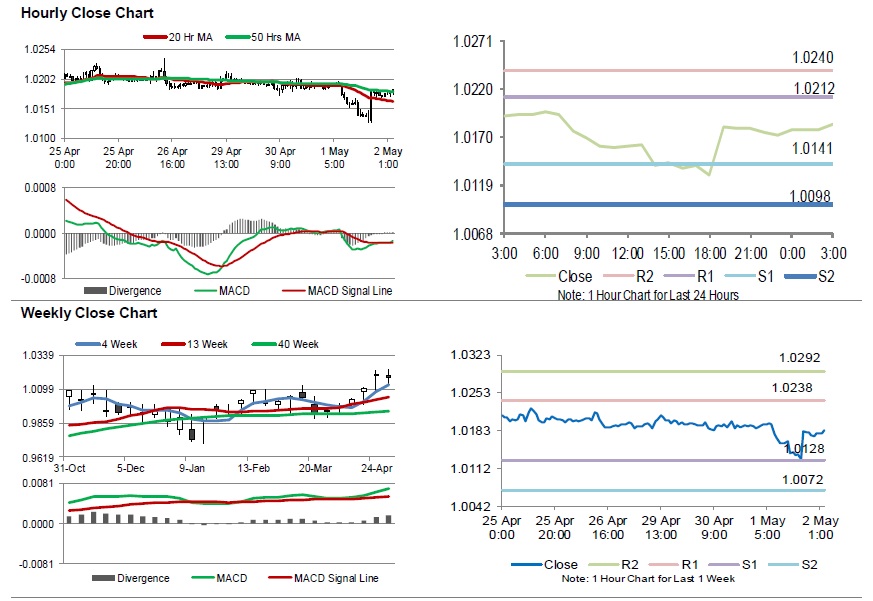
For the 24 hours to 23:00 GMT, the USD declined 0.20% against the CHF and closed at 1.0172.
In the Asian session, at GMT0300, the pair is trading at 1.0183, with the USD trading 0.11% higher against the CHF from yesterday’s close.
The pair is expected to find support at 1.0141, and a fall through could take it to the next support level of 1.0098. The pair is expected to find its first resistance at 1.0212, and a rise through could take it to the next resistance level of 1.0240.
Trading trend in the Swiss Franc today is expected to be determined by Switzerland’s real retail sales for March and the Markit manufacturing PMI for April, set to release in a while.
The currency pair is trading above its 20 Hr moving average and showing convergence with its 50 Hr moving average
Canada’s RBC Manufacturing PMI Contracted In April
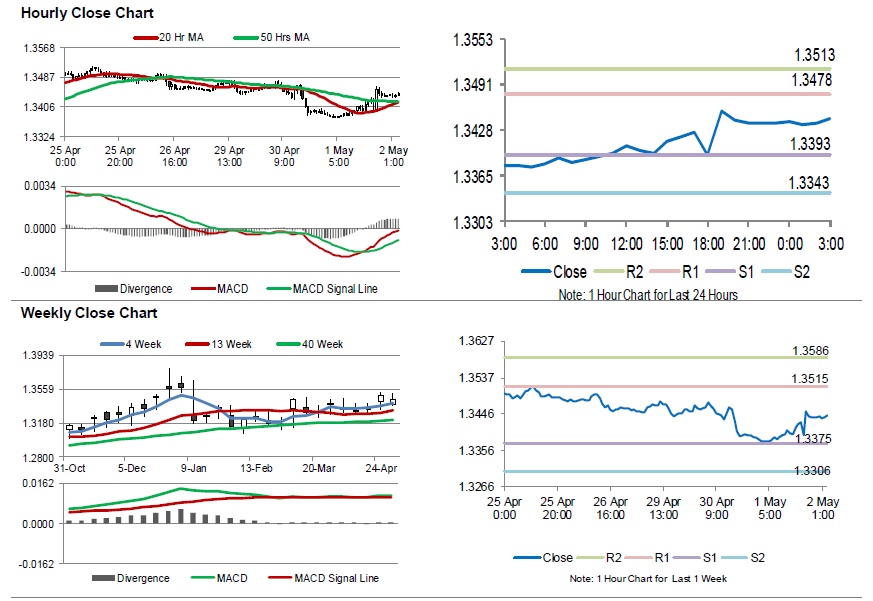
For the 24 hours to 23:00 GMT, the USD rose 0.37% against the CAD and closed at 1.3438.
In economic news, Canada's RBC manufacturing PMI declined to a level of 49.7 April, following a level of 50.5 in the prior month. Meanwhile, the nation's MLI leading indicator rose 0.2% on a monthly basis in March, compared to a flat reading in the prior month.
In the Asian session, at GMT0300, the pair is trading at 1.3444, with the USD trading slightly higher against the CAD from yesterday's close.
The pair is expected to find support at 1.3393, and a fall through could take it to the next support level of 1.3343. The pair is expected to find its first resistance at 1.3478, and a rise through could take it to the next resistance level of 1.3513.
Amid lack of economic releases in Canada today, traders would focus on global macroeconomic events for further direction.
The currency pair is trading above its 20 Hr and 50 Hr moving averages.
Aussie Trading Higher In The Asian Session
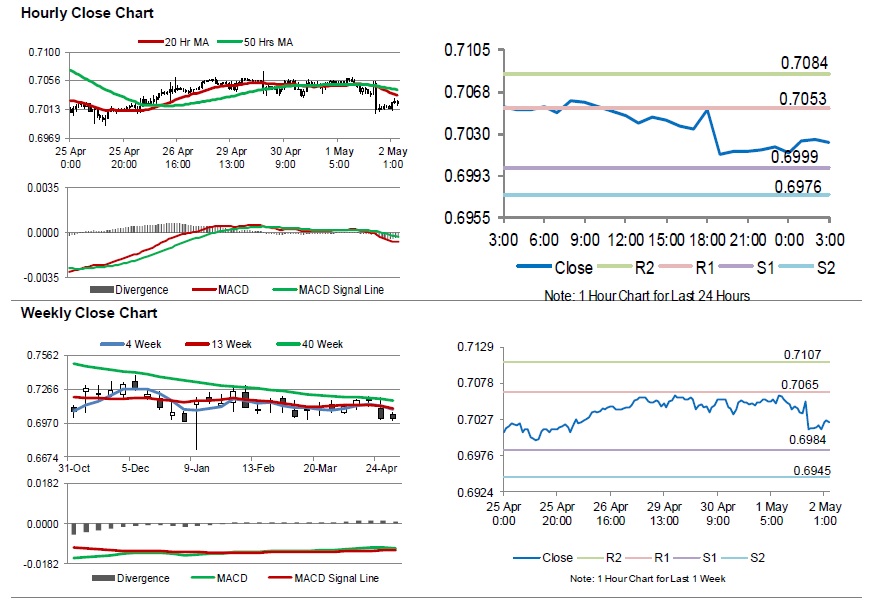
For the 24 hours to 23:00 GMT, the AUD declined 0.40% against the USD and closed at 0.7018.
LME Copper prices declined 0.7% or $44.0/MT to $6398.0/MT. Aluminium prices declined 1.9% or $33.5/MT to $1775.5/MT.
In the Asian session, at GMT0300, the pair is trading at 0.7022, with the AUD trading 0.06% higher against the USD from yesterday’s close.
The pair is expected to find support at 0.6999, and a fall through could take it to the next support level of 0.6976. The pair is expected to find its first resistance at 0.7053, and a rise through could take it to the next resistance level of 0.7084.
Looking ahead, investors would await Australia’s AiG performance of service index and CBA services PMI for April along with building approvals for March, slated to release overnight.
The currency pair is trading below its 20 Hr and 50 Hr moving averages.
Gold: Yellow Metal Extends Its Losses In The Morning Session
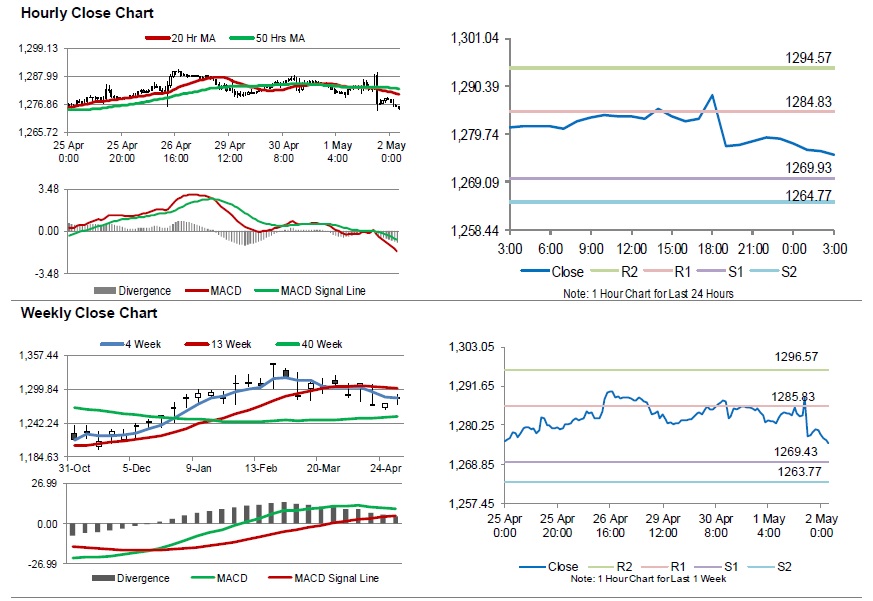
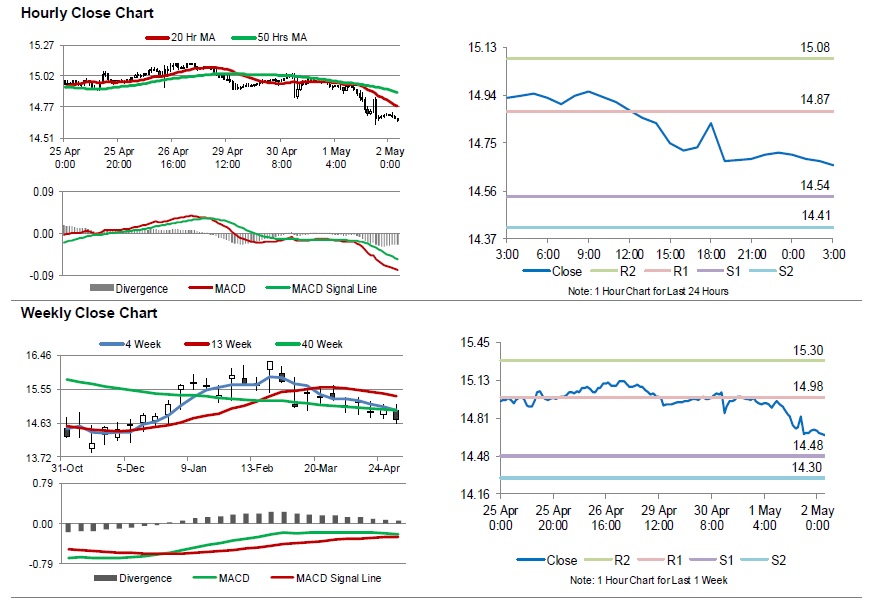
For the 24 hours to 23:00 GMT, Silver declined 1.70% against the USD and closed at USD14.71 per ounce, tracking losses in gold prices.
In the Asian session, at GMT0300, the pair is trading at 14.66, with silver trading 0.34% lower against the USD from yesterday’s close.
The pair is expected to find support at 14.54, and a fall through could take it to the next support level of 14.41. The pair is expected to find its first resistance at 14.87, and a rise through could take it to the next resistance level of 15.08.
The white metal is trading below its 20 Hr and 50 Hr moving averages.
Sterling maintains gains as focus turns to BoE Super Thursday
Sterling is trading as the strongest one for the week and is maintain gains. Focus turns to BoE "Super Thursday". Bank Rate is widely expected to be kept at 0.75%. Asset purchase target should be held at GBP 435B. Decisions should be made by unanimous 9-0 votes.
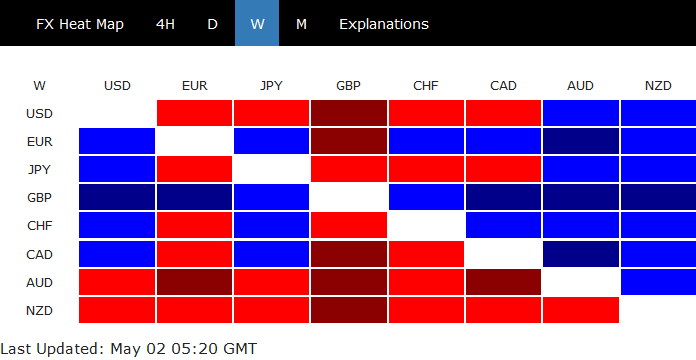
Economic development appeared to be positive in Q1, both domestically in UK and globally. But the resilience in UK GDP appeared to be boosted by pre-Brexit stockpiling. Momentum could dissipate easily in Q2, which was seen in the fall in April PMI manufacturing already. Headline CPI steadied at 1.9% yoy in March, which was within BoE's target range. Such developments shouldn't prompt any change in BoE's policy. Adding to that, Brexit uncertainty is prolonged after UK was granted flexible extension until October 31.
The more interest things to note would be in the new economic projections in the quarterly inflation report. But for now, the figures are rather academic given that the form of Brexit is yet to be known.
Here are some suggested readings on BoE:
Silver: White Metal Trading On A Weaker Footing This Morning
For the 24 hours to 23:00 GMT, Silver declined 1.70% against the USD and closed at USD14.71 per ounce, tracking losses in gold prices.
In the Asian session, at GMT0300, the pair is trading at 14.66, with silver trading 0.34% lower against the USD from yesterday’s close.
The pair is expected to find support at 14.54, and a fall through could take it to the next support level of 14.41. The pair is expected to find its first resistance at 14.87, and a rise through could take it to the next resistance level of 15.08.
The white metal is trading below its 20 Hr and 50 Hr moving averages.
Crude Oil: Oil Trading Lower In The Asian Session
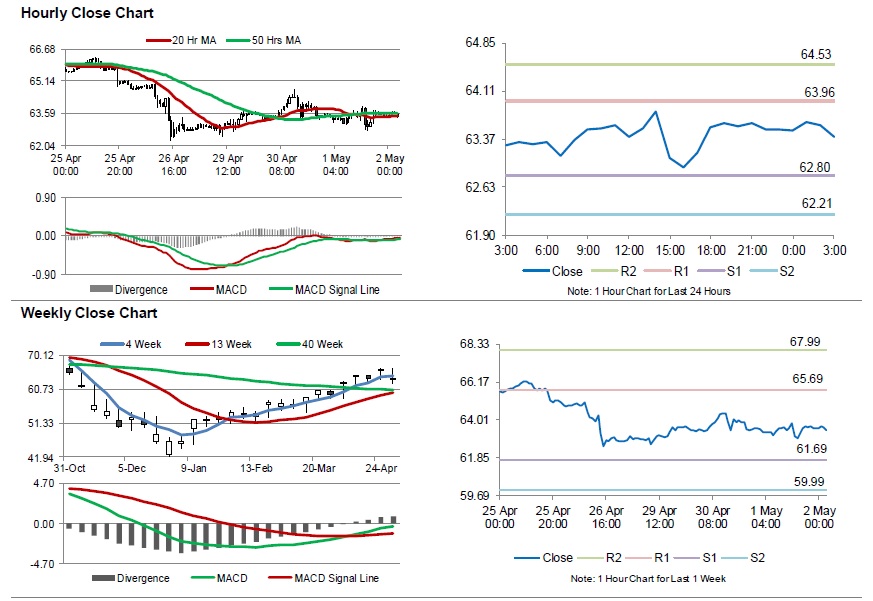
For the 24 hours to 23:00 GMT, Crude Oil rose 0.08% against the USD and closed at USD63.52 per barrel, amid escalation in Venezuela’s political turmoil.
Separately, the Energy Information Administration (EIA) report indicated that US crude oil stockpiles surged 9.9 million barrels to 470.6 million barrels in the week ended 26 April 2019.
In the Asian session, at GMT0300, the pair is trading at 63.40, with oil trading 0.19% lower against the USD from yesterday’s close.
The pair is expected to find support at 62.80, and a fall through could take it to the next support level of 62.21. The pair is expected to find its first resistance at 63.96, and a rise through could take it to the next resistance level of 64.53.
Crude oil is showing convergence with its 20 Hr and 50 Hr moving averages.
Dollar and yield rebounded as Fed Powell talked down rate cuts
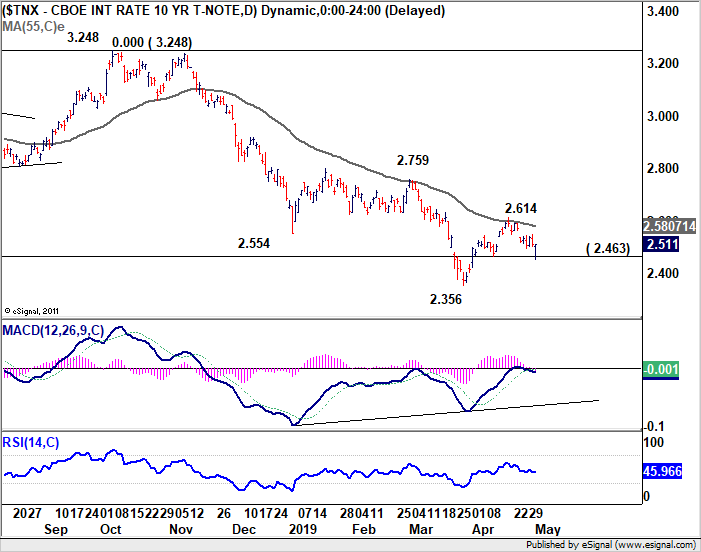
Dollar and treasury yields rebounded overnight after Fed Chair Jerome Powell talked down the chance of a rate cut after Fed kept interest rate unchanged at 2.25-2.50% as widely expected. In particular, 10-year yield hit as low as 2.455 earlier in the day but closed up 0.002 at 2.511, regained 2.5 handle. DOW closed down -0.61%, S&P 500 lost -0.75% and NASDAQ dropped -0.57%.
In the post meeting press conference, Powell noted that "our policy stance is appropriate at the moment" and emphasized "we don't see a strong case for moving it in either direction. Fed acknowledged that both headline and core inflation were running below targets. But Powell said that's mostly due to transient factors. He predicted inflation to pick rise back to 2% target ahead.
Here are some suggested readings on FOMC:
- Fed Judges Weak Inflation as Transitory, Dismissing Rate Cut Chance
- Northern Exposure: FOMC Hold to Sanguine View of Outlook
- Fed Holds Rate Target and Guidance Steady, Onboarding Mixed Economic Data
- Fed Leaves Rates Unchanged in May, Notes Deceleration in Inflation
- FOMC Recap: Technical Tweaks Do Little To Dissuade Doves
- Fed chair Jerome Powell press conference live stream
- Fed stands pat, acknowledges below target inflation, but maintains patient stance
10-year yield recovered strongly after breaching 2.463 key near term support. But still, risk will stay on the downside as long as 2.614 resistance holds. Rebound from 2.356 is likely completed after hitting 55 day EMA. Sustained break of 2.463 should resume larger down trend from 3.248.
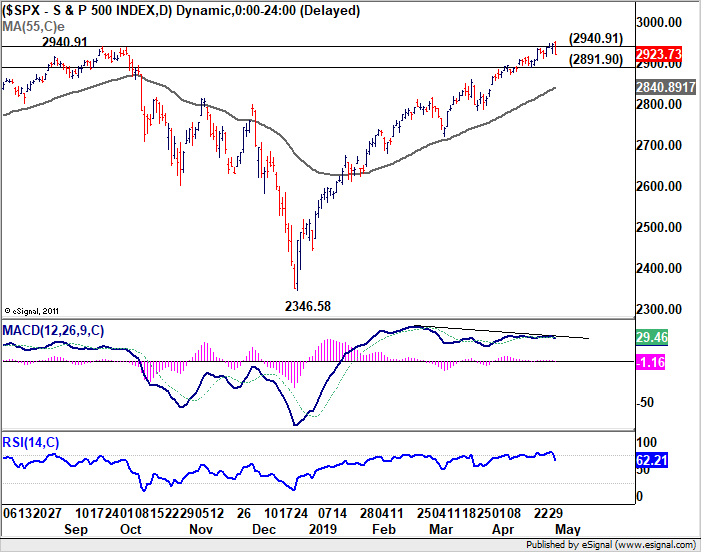
S&P 500 edged to historical intraday high at 2954.13 but reversed to close down -0.75% at 2923.73. SPX continued to lose upside momentum as seen in daily MACD. We maintain the view that it's not resuming long term up trend despite breaching 2940.91 key resistance. Thus, near term reversal should be around the corner and break of 2891.90 support should at least confirm short term topping. Nevertheless, for sure, sustain trading above 2940.91 will prove our view wrong.
Northern Exposure: FOMC Hold to Sanguine View of Outlook
Optimism over labour market and growth clear; inflation expected to return to target.
The April/ May FOMC meeting saw the Committee hold firm to their constructive but cautious view of the economic outlook. That inflation’s underperformance of the 2.0%yr medium-term target was highlighted in the decision statement initially supported market pricing of rate cuts in late-2019 and 2020. However, in the press conference Chair Powell subsequently made clear that this miss is regarded by the Committee as transitory, and hence is of no consequence for policy.
On activity, the decision statement continued to characterise the labour market as strong – a view we wholeheartedly agree with given the 180k month-average gain of 2019 is consistent with a further decline in the unemployment rate from its already historically-low level of 3.8% towards 3.5%.
With respect to GDP growth, the change in the wording of the statement from “growth of economic activity has slowed from its solid rate in the fourth quarter” to “economic activity rose at a solid rate” is also positive, pointing to a belief that the March quarter deceleration in domestic final demand will prove temporary. Justifying this view, Chair Powell emphasised in the press conference that the partial data for consumption and business investment had picked up of late.
This commentary indicates that the FOMC’s view on domestic final demand is as robust as their overall GDP forecast from the March 2019 meeting – an above-trend 2.1% gain expected in 2019 – despite the soft March quarter detail.
Although it received little attention in today’s communications, it should also be noted that risks associated with financial conditions and the global economy have also dissipated in recent months.
Most notably, households have received twin-benefit from the marked reduction in the US 10-year yield (which determines the 30-year mortgage rate) from a high of 3.26% to 2.50% currently and the related strong rally in equity markets.
For business, there is also cause to be more comfortable over the outlook, with trade negotiations between China and the US remaining constructive and the IMF pointing to still-robust growth in the global economy over 2019 and 2020. Both views are in line with our own expectations.
With regards to inflation, the Committee’s decision statement certainly showed more concern, with core PCE inflation (excludes food and energy) said to have “declined” to now be “running below 2 percent”.
However, in the subsequent press conference, Chair Powell repeatedly made clear that core PCE inflation’s unexpected weakness was believed to be transitory and hence of no significance for the stance of policy for the foreseeable future.
Primary justification for confidence in the outlook for core inflation came from the Dallas Federal Reserve’s trimmed mean measure holding at 2.0%yr despite the PCE exclusion measure having fallen to just 1.6%yr. Chair Powell went on to highlight that the disinflation reported by core PCE came from a number of one-off transitory factors as was the case in 2017 – after which core inflation rose to be in line with the medium-term target in 2018.
Looking ahead, we believe the underlying macroeconomic picture is supportive of core PCE inflation again returning to target. As above, momentum in the labour market remains robust and is set to sustain the wage growth uptrend of recent years. Along with above-trend activity growth, this momentum in wages should see underlying consumer inflation strengthen.
This view does not however mean that we foresee the FOMC turning hawkish. After years of inflation underperformance, with activity growth slowing back towards trend, and given global risks are still tilted to the downside, further rate hikes would only be warranted if inflation materially surprised to the upside over a protracted period.
We continue to see little risk of such an outcome and therefore of the FOMC doing anything other than remaining on hold for the foreseeable future – through both 2019 and 2020.
Fed Judges Weak Inflation as Transitory, Dismissing Rate Cut Chance
FOMC members decided unanimously to keep the target range for the fed funds rate unchanged at 2.25-2.50%. Meanwhile, the IOER was lowered to 2.35% from 2.4%. The slight change in the accompanying statement showed a more upbeat assessment on the economic developments, despite softening inflation. It was Chair Jerome Powell’s comments at the press conference that triggered strong reaction in the bond and FX markets. US 2-Year Treasury yield rebounded to 2.3%, after falling to a one-month low of 2.268% in the prior day. USD index (DXY) also gained for the first time since April 25. Powell’s speech, attributing softening inflation to transitory factors, aimed mainly at pouring cold water on the doves who have been pricing in a rate cut later this year. There have been no new updates on the balance sheet reduction progress.
The Fed noted that economic activity since the last meeting “rose at a solid rate”. At the March meeting, the members acknowledged that “growth of economic activity has slowed from its solid rate in the fourth quarter”. US GDP surprised to the upside, growing +3.2% q/q annualised in 1Q19. On employment, the members noted that “job gains have been solid, on average, in recent months, and the unemployment rate has remained low”. This was largely a repeat of March’s reference but with the phrase “Payroll employment was little changed in February” omitted. The Fed acknowledged that both headline and core inflation ran “below 2%”, while in March it indicated that both measures remained “near 2%”. Indeed, inflation has continued to slow in the first quarter of the year. Core PCE eased to +1.6% y/y in March, compared with February's +1.7%. On the forward guidance, it is reiterated that “the Committee will be patient as it determines what future adjustments to the target range for the federal funds rate may be appropriate to support these outcomes”.
As Powell elaborated at the press conference, the members “suspect that some transitory factors may be at work” regarding the recent slowdown in inflation. As such, the baseline view remains that, “with a strong job market and continued growth, inflation will return to 2% over time and then be roughly symmetric around our longer-term objective”. Meanwhile, Powell suggested that risks to global economic outlook “have moderated somewhat”, as evidenced in improvements in European and Chinese data, the temporarily- reduced risk of a disorderly Brexit, as well as the progress in trade talks with China.
The meeting signaled that inflation has to accelerate to a sufficiently high level for a rate hike. In a similar vein, it has to decelerate to a sufficiently low for rate cut. Both scenarios seem unlikely in the medium-term. We expect the Fed stand on the sideline for the rest of the year. At the meeting, the Fed announced a technical change to the interest rate paid on required and excess reserve balances (IOER), cutting it by 5 basis points to 2.35%. This aims at helping to keep the effective Fed funds rate within the target range. It should not by any means be considered as a easing measure.