Sample Category Title
GBP/USD Mid-Day Outlook
Daily Pivots: (S1) 1.2956; (P) 1.3003; (R1) 1.3081; More....
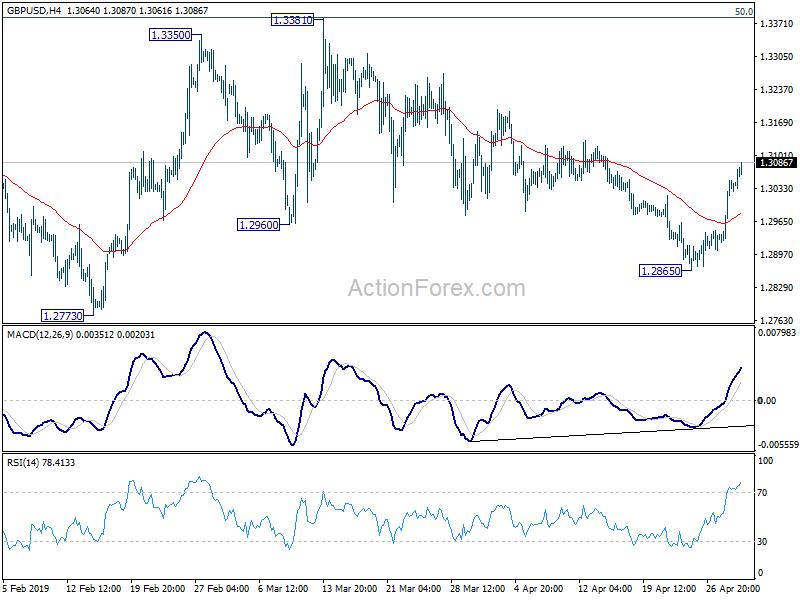
GBP/USD's rise from 1.2865 is in progress and intraday bias remains on the upside. Current development suggests that corrective pull back from 1.3381 has completed at 1.2865. Also, with 1.2773 key support intact, near term bullishness is retained. Further rise should be seen back to retest 1.3381 first. Break will resume whole rebound from 1.2391. On the downside, though, break of 1.2865 will target 1.2773 key support.
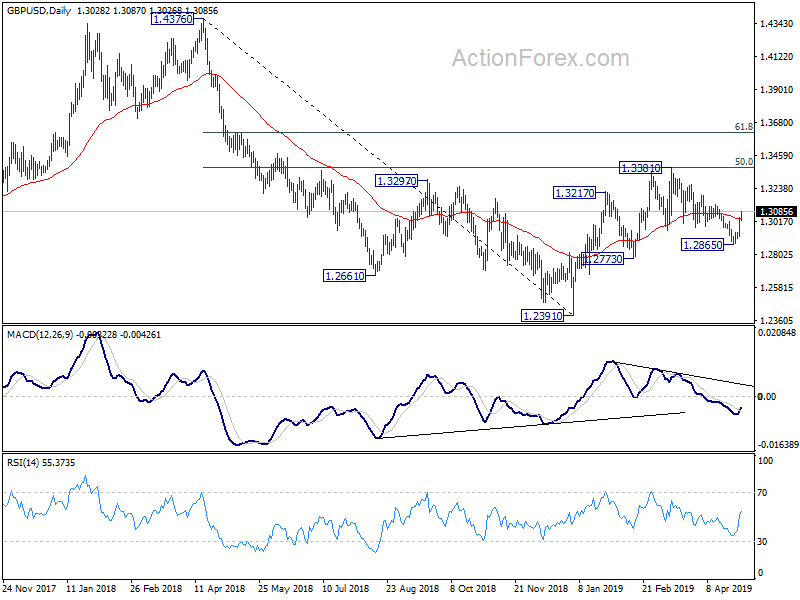
In the bigger picture, medium term decline from 1.4376 (2018 high) halted after hitting 1.2391. The structure of the rebound from 1.2391 suggests that it's a corrective move. In case of another rise, strong resistance could be seen around 61.8% retracement of 1.4376 to 1.2391 at 1.3618 to limit upside. On the downside, break of 1.2773 support will suggests that such corrective rise is completed and bring retest of 1.2391 low first.
USD/JPY Mid-Day Outlook
Daily Pivots: (S1) 111.19; (P) 111.46; (R1) 111.71; More...
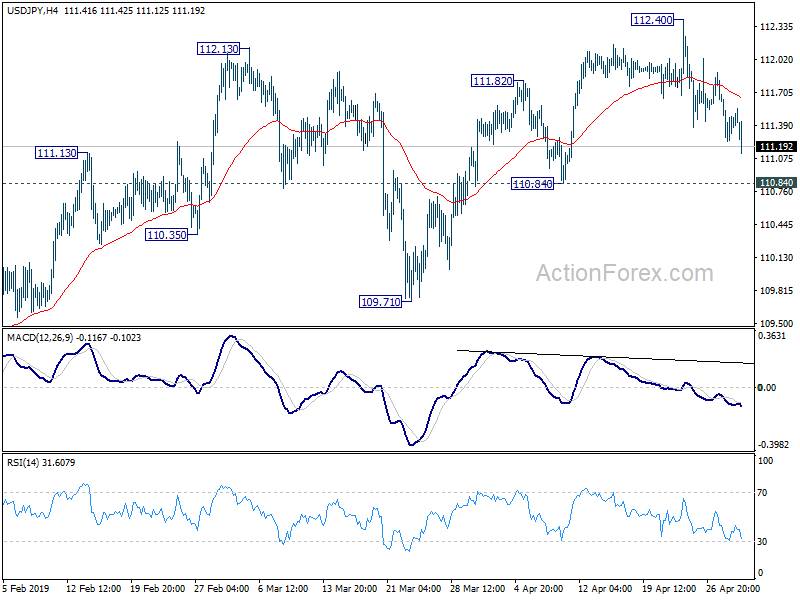
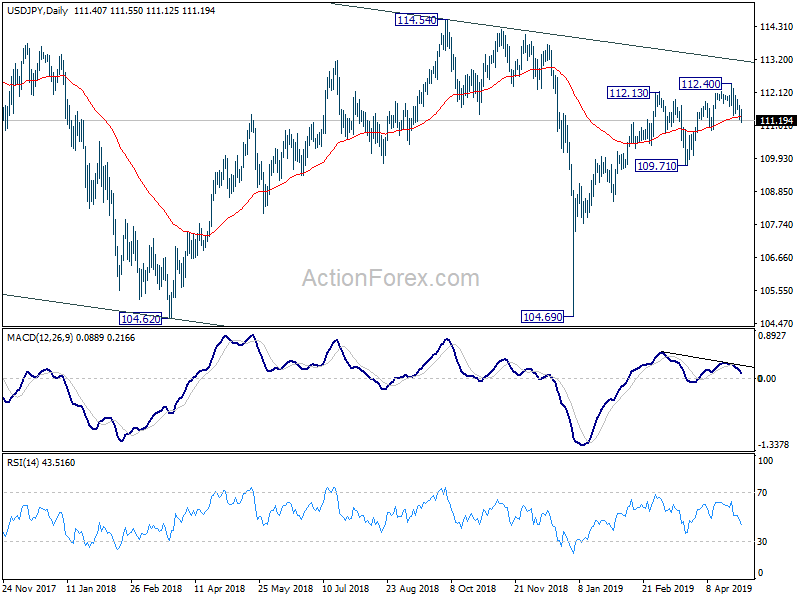
Intraday bias in USD/JPY remains mildly on the downside as fall from 112.40 is targeting 110.84 support. Decisive of 110.84 will add to the case of bearish reversal and target 109.71 support and below. In any case, break of 112.40 is needed to confirm rise resumption. Otherwise, risk will stay mildly on the downside in case of recovery.
In the bigger picture, medium term outlook in USD/JPY remains a bit mixed as it's staying inside falling channel from 118.65, but there are signs of bullish reversal. On the upside, break of 114.54 resistance will revive the case the corrective fall from 118.65 has completed with three waves down to 104.69. And whole rise from 98.97 (2016 low) is resuming for 118.65 and above. But before that, outlook stays neutral first.
USD/CHF Mid-Day Outlook
Daily Pivots: (S1) 1.0175; (P) 1.0190; (R1) 1.0205; More...
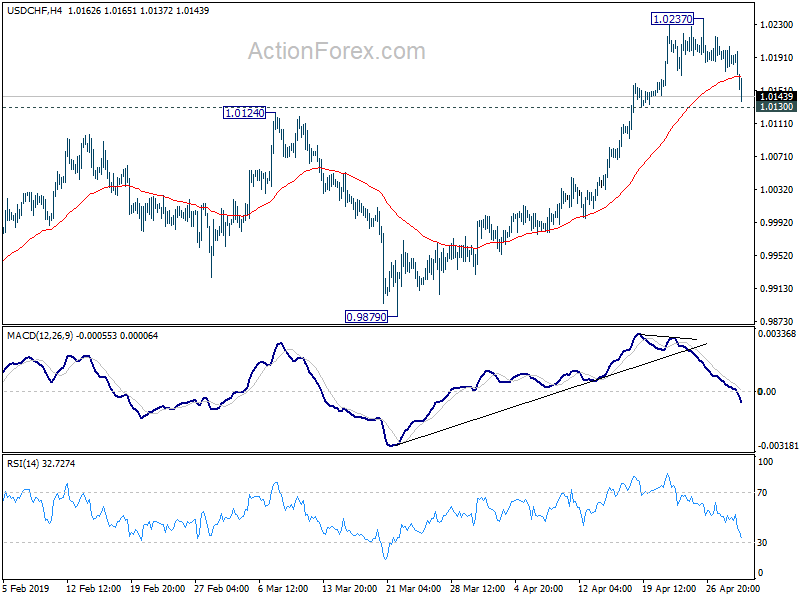
USD/CHF drops sharply in early US session but stays above 1.0130 minor support. Intraday bias remains neutral first. We'd still expect strong support from 1.0130 to contain downside to bring rise resumption. Break of 1.0237 will resume larger up trend to 1.0342 key resistance. However, sustained break of 1.0130 will confirm short term topping. In that case, deeper pull back would be seen back to 55 day EMA (now at 1.0053) and below.
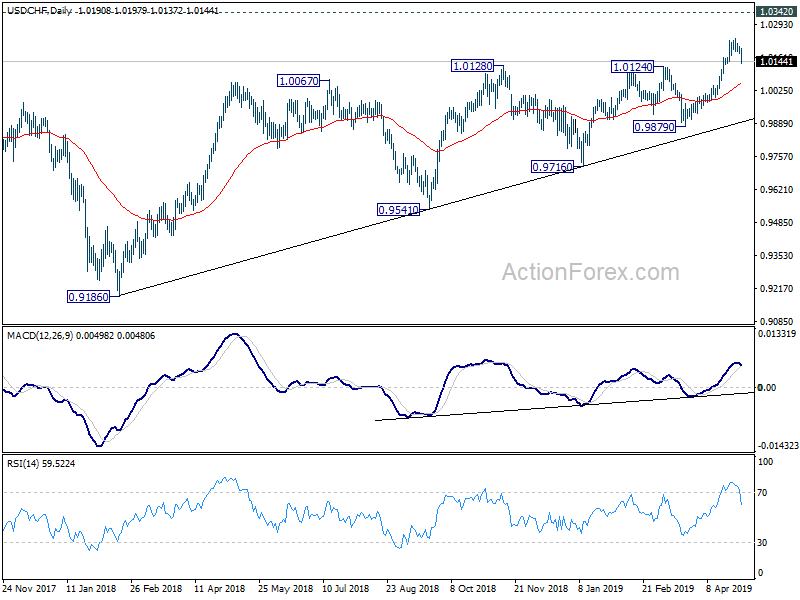
In the bigger picture, medium term up trend from 0.9186 is extending. Current rise should target 1.0342 resistance next. For now, we'd be cautious on strong resistance from there to limit upside, until we see medium term upside acceleration. On the downside, break of 0.9879 support is needed to indicate reversal. Otherwise, outlook will stay bullish in case of deep pull back.
Dollar Ignores Strong ADP, Drops on Weak ISM, Looks to Fed for Rescue
Economic data released from the US are mixed today. ADP report shows much stronger than expected growth in private sector jobs. However, ISM manufacturing points to deep cool down in the manufacturing sector, with deteriorating new orders, prices and employment. Dollar chooses to react to the negative one and suffers steep selling after ISM. 10-year yield also tumbles pass 2.5 handle to as low as 2.475. But stocks are relatively steady.
In the currency markets, European majors are generally the strongest ones today, led by Swiss Franc. Sterling shrugs off decline in UK manufacturing PMI. At this point, commodity currencies are the weakest, lead by New Zealand Dollar, which is pressured by weak job data. Dollar is mixed but is vulnerable for deeper selloff. The greenback will need something upbeat from Fed chair Jerome Powell to halt the decline.
Technically, 1.0130 in USD/CHF will be an immediate focus now. Decisive break will at least confirm short term topping and bring deeper pull back. USD/JPY's fall might accelerate should treasury yield dips further. Break of 110.84 support will add to the case of bearish reversal. GBP/USD has already confirmed short term bottoming yesterday. While EUR/USD is held well below 1.1324 resistance, it's starting to look a bit vulnerable for stronger rally.
US manufacturing expanding, but at recent historic lows
US ISM manufacturing dropped to 52.8, down from 55.3 and missed expectation of 55.0. Price paid index dropped sharply to 50.0, down from 54.3 and missed expectation of 55.7. Employment index dropped to 52.4, down from 57.5. New orders tumbled to 51.7, down from 57.4.
ISM noted that comments from the panel reflect continued expanding business strength, but at the softest levels since the fourth quarter of 2016. New Orders Index softening to the low 50s. Exports orders contracted for the first time since February 2016. trade elements are in contraction territory. The PMI has been inching down since November 2018. The manufacturing sector is expanding, but at recent historic lows.
US ADP employment grew 275k, service sector strong
US ADP private employment grew strongly by 275k in April, well above expectation of 181k. Looking at the details, jobs in goods-producing sector rose 52k. Jobs in service-providing sector rose 223k.
"April posted an uptick in growth after the first quarter appeared to signal a moderation following a strong 2018," said Ahu Yildirmaz, vice president and co-head of the ADP Research Institute. "The bulk of the overall growth is with service providers, adding the strongest gain in more than two years."
Mark Zandi, chief economist of Moody's Analytics, said, "The job market is holding firm, as businesses work hard to fill open positions. The economic soft patch at the start of the year has not materially impacted hiring. April's job gains overstate the economy's strength, but they make the case that expansion continues on."
Dollar to listen to Powell's comments on growth in inflation
Fed is widely expected to keep federal funds rate unchanged at 2.25-2.50%. Also, Fed will, without a doubt, maintain its patient stance regarding any monetary policy adjustment. The major focus is whether Fed Chair Jerome Powell would dismiss talks of rate cut as premature. Or he'll sound concerned with sluggish inflation and indicate openness on lowering interest rates.
Some suggested readings on FOMC:
- Traders Eye Fed's Decision
- FOMC Preview: IOER Cut Possible, But Neutral Outlook Likely For Another Month
- Fed Meets as Rate-Cut Bets Mount
- FOMC Preview -Fed to Reiterate Patience Rhetoric Despite Strong First Quarter Growth, Focus on Soft Inflation
US Mnuchin concluded productive trade meetings with China Liu, next round in Washington
US Treasury Secretary Steven Mnuchin said he has concluded "productive meetings" with Chinese Vice Premier Liu He in Beijing. And, the discussions will continue in Washington next week. But there is so far no details regarding any progress made. Trade Representative Robert Lighthizer is quiet as usual on the topic.
Earlier, China Banking and Insurance Regulatory Commission said it will further open up the banking an insurance sectors. And it plans to issue 12 new measures soon. The measures include dropping the USD 10B asset requirements for foreign companies to set up a legal entity in the country. The USD 20B asset requirements for foreign banks to set up a branch will also be removed. Approval procedures for foreign banks to conduct Yuan businesses will be removed.
UK PMI manufacturing dropped to 53.1, upturn eased at start of Q2
UK PMI manufacturing dropped to 53.1 in April, down from 55.1 and matched expectation of 53.1. Markit noted that new export business declines. Also, stock-building continues at solid, yet slower, pace.
Rob Dobson, Director at IHS Markit, said: "The upturn in the UK manufacturing sector eased at the start of the second quarter. Growth of output and new orders slowed, leading to job cuts for the third time in the past four months. The trend in new export business was especially weak, as high stock holdings at clients and slower global economic growth led to reduced demand from key markets such as the European Union, the USA and China. There were also reports of overseas clients acting now to re-route their supply chains away from the UK in advance of Brexit."
"Manufacturers' outlook remained relatively upbeat, however, with over 50% forecasting their output will be higher in 12 months' time. Companies plan to use new product launches, new technologies and improved marketing strategies to drive growth forward in the coming months. However, Brexit uncertainty continues to weigh on plans, as some firms remain concerned about future growth prospects and the likely impact on output and demand from the unwinding of inventory positions later in the year."
Also released from UK, M4 money supply dropped -0.5% mom in March versus expectation of 0.3% mom. Mortgage approvals dropped -3k to 62k in March. BRC shop price index rose 0.4% yoy in April.
EU Katainen: Situation of British in European Parliament before Brexit looks very messy
European Commission Vice-President Jyrki Katainen complained that the prospects of British candidates getting into European Parliament just months ahead of Brexit creates a "messy" situation. He said "the UK has been given a deadline (to leave the EU) which is later in the autumn but the Commission president might be elected before that ... It looks very messy at the moment."
He added: "We have to make sure all MEPs have the same rights and responsibilities because we cannot be in a situation where some MEPs have a partial mandate ... But a temporary majority may cause lots of questions and troubles."
ECB de Guindos: Interest rates to stay low even once monetary policy normalizes
ECB Vice-President Luis de Guindos reiterated the central bank's accommodative stance in an event in London today. He said "the low interest rate environment is with us for the foreseeable future and is caused in large part by durable structural factors". He added, "even once monetary policy normalizes, interest rates are likely to remain below levels that were common in previous decades."
On Brexit, he said "I hope we will be able to take advantage of the new period of time that British government, parliament have at its disposable to reach an orderly Brexit. On Italy, he said "the main recommendation is to pursue reforms that improve the effectiveness of the economy."
Australia AiG PMI improved to 54.8, but employment and wage indices dropped
Australia AiG Performance of Manufacturing Index rose 3.8 pts to 54.8 in April, indicating faster growth. All subsectors except machinery & equipment, and metal products improved. Top concerns for manufacturers in April included the upcoming Federal election, high energy prices, high input costs (due to drought, a low dollar and high commodity prices) and tighter credit conditions.
Employment index dropped sharply by -5.1 pts to 51.5. The release also noted ABS data indicated that total manufacturing employment fell dramatically over summer, with a reduction in employment of 41,600 over the three months to February 2019 (-6.3% q/q, trend). Average wage index dropped -3.5 to 57.7, indicating lower wage pressures across the manufacturing sector. Also, this wage index has been trending down since peaking at September 2018.
New Zealand employment dropped -0.2% qoq in Q1, NZD dips
New Zealand Dollar drops notably today after weaker than expected job data. Employment contracted -0.2% qoq in Q1, below expectation of 0.5% qoq growth. Unemployment rate dropped to 4.2%, down from 4.3% and matched expectations. But labor force participation rate dropped -0.5% to 70.4%. Labor cost index rose 0.3% qoq, below expectation of 0.5% qoq.
Today's data shouldn't change RBNZ's view that New Zealand is current staying at maximum sustainable employment. The reduced momentum in job growth and sluggish wage would provide little support to the already low inflation reading. Weak CPI is a key factor around the case of RBNZ rate cut in near term, probably in May, but the meeting remains live.
USD/CHF Mid-Day Outlook
Daily Pivots: (S1) 1.0175; (P) 1.0190; (R1) 1.0205; More...
USD/CHF drops sharply in early US session but stays above 1.0130 minor support. Intraday bias remains neutral first. We'd still expect strong support from 1.0130 to contain downside to bring rise resumption. Break of 1.0237 will resume larger up trend to 1.0342 key resistance. However, sustained break of 1.0130 will confirm short term topping. In that case, deeper pull back would be seen back to 55 day EMA (now at 1.0053) and below.
In the bigger picture, medium term up trend from 0.9186 is extending. Current rise should target 1.0342 resistance next. For now, we'd be cautious on strong resistance from there to limit upside, until we see medium term upside acceleration. On the downside, break of 0.9879 support is needed to indicate reversal. Otherwise, outlook will stay bullish in case of deep pull back.
Economic Indicators Update
| GMT | Ccy | Events | Actual | Forecast | Previous | Revised |
|---|---|---|---|---|---|---|
| 22:30 | AUD | AiG Performance of Manufacturing Index Apr | 54.8 | 51 | ||
| 22:45 | NZD | Employment Change Q/Q Q1 | -0.20% | 0.50% | 0.10% | |
| 22:45 | NZD | Unemployment Rate Q1 | 4.20% | 4.20% | 4.30% | |
| 22:45 | NZD | Labor Cost Private Sector Q/Q Q1 | 0.30% | 0.50% | 0.50% | |
| 23:01 | GBP | BRC Shop Price Index Y/Y Apr | 0.40% | 0.90% | ||
| 08:30 | GBP | Mortgage Approvals Mar | 62K | 64K | 64K | 65K |
| 08:30 | GBP | Money Supply M4 M/M Mar | -0.50% | 0.30% | 0.30% | |
| 08:30 | GBP | PMI Manufacturing Apr | 53.1 | 53.1 | 55.1 | |
| 12:15 | USD | ADP Employment Change Apr | 275K | 181K | 129K | 151K |
| 13:30 | CAD | Manufacturing PMI Apr | 49.7 | 50.5 | ||
| 13:45 | USD | Manufacturing PMI Apr F | 52.6 | 52.4 | 52.4 | |
| 14:00 | USD | ISM Manufacturing Apr | 52.8 | 55 | 55.3 | |
| 14:00 | USD | ISM Prices Paid Apr | 50 | 55.7 | 54.3 | |
| 14:00 | USD | ISM Employment Apr | 52.4 | 57.5 | ||
| 14:00 | USD | Construction Spending M/M Mar | -0.90% | 0.10% | 1.00% | 0.70% |
| 14:30 | USD | Crude Oil Inventories | 9.9M | 1.3M | 5.5M | |
| 18:00 | USD | FOMC Rate Decision (Lower Bound) | 2.25% | 2.25% | ||
| 18:00 | USD | FOMC Rate Decision (Upper Bound) | 2.50% | 2.50% |
WTI OIL Outlook: Oil Price Holds Positive Tone ahead of Crude Inventories Report
WTI oil price holds steady on Wednesday, following strong upside rejection on Tuesday and subsequent fall that was accelerated by strong build in US crude stocks (API report showed 6.8 mln bls build vs expected rise of 1.5 mln bls).
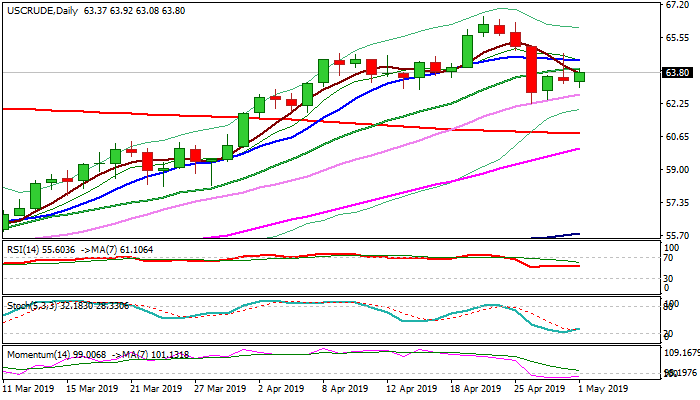
On the other side, escalation of crisis in Venezuela and tightening US sanctions on Iran, partially offset negative impact from weak crude stocks data. Daily techs are still mixed but stochastic reversed higher, momentum is flat and rising 30SMA repeatedly contained pullback from new 2019 high at $66.58, generating initial signal that corrective action might be over.
Focus turns towards EIA crude inventories report (1.4 mln bls build f/c vs previous week's rise of 5.4 mln bls).
Better than expected release would add to support from political unrest in Venezuela that threatens for stronger disruption in oil supply.
Close above pivotal barriers at $63.92/$64.02 (Fibo 38.2% of $66.58/$62.27 pullback/20SMA) would generate strong bullish signal for extension of recovery from $62.27 low towards pivotal barriers at $64.42 (10SMA) and $64.93 (Fibo 61.8%).
Rising 30SMA ($62.72) continues to underpin and guards correction low at $62.27.
Sustained break below these supports would generate strong bearish signal for extension of corrective leg from $66.58 high.
Res: 63.92; 64.02; 64.42; 64.93
Sup: 63.08; 62.72; 62.27; 61.81
ISM manufacturing dropped to 52.8; New orders, prices, employment declined
Dollar is suffering more selling pressure after weaker than expected April ISM manufacturing report. The headline index dropped to 52.8, down from 55.3 and missed expectation of 55.0. Price paid index dropped sharply to 50.0, down from 54.3 and missed expectation of 55.7. Employment index dropped to 52.4, down from 57.5. New orders tumbled to 51.7, down from 57.4.
ISM noted that:
- Comments from the panel reflect continued expanding business strength, but at the softest levels since the fourth quarter of 2016.
- Demand expansion continued, with the New Orders Index softening to the low 50s, the Customers' Inventories Index remaining at a 'too low' status, and the Backlog of Orders Index improving its prior month performance.
- Consumption (production and employment) continued to expand, but at lower levels, resulting in a combined decrease of 8.6 points.
- Inputs — expressed as supplier deliveries, inventories and imports — were higher this month, primarily due to inventory growth exceeding consumption, resulting in a combined 1.5-percentage point improvement in the Supplier Deliveries and Inventories Indexes.
- Imports contracted during the period.
- Overall, inputs reflect a more stable business environment, confirmed by the Prices Index at zero price growth, or unchanged.
- Exports orders contracted for the first time since February 2016. The PMI® trade elements are in contraction territory. The PMI® has been inching down since November 2018. The manufacturing sector is expanding, but at recent historic lows.
Into US session: Europeans higher, commodities lower, Dollar mixed ahead of FOMC
Entering into US session, Dollar remains mixed as traders await FOMC statement. The markets were generally quiet today with many centers on holiday. Much stronger than expected ADP job report couldn't provide any support to the greenback. Instead, the key for Dollar is whether Fed Chair Jerome Powell would dismiss talks of rate cut as premature. Or he'll sound concerned with sluggish inflation and indicate openness on lowering interest rates.
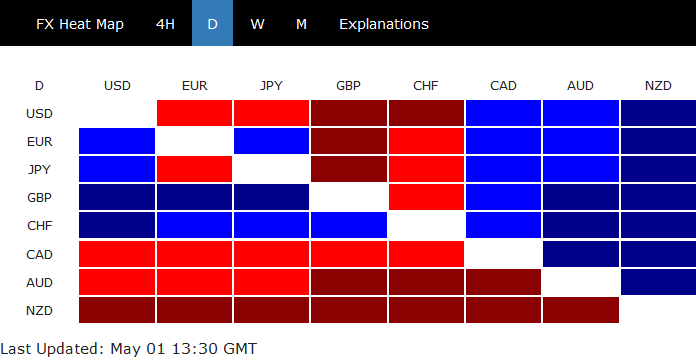
At the time of writing, Swiss Franc is the strongest one for today, followed by Sterling. Pound shrugs off decline in PMI manufacturing in April. It's extending this week's rebound, in particular against Dollar, Euro and Yen. Euro is the third strongest. Meanwhile, New Zealand Dollar is the weakest one after poor job data, followed by Aussie and then Canadian.
Some suggested readings on FOMC:
- Traders Eye Fed's Decision
- FOMC Preview: IOER Cut Possible, But Neutral Outlook Likely For Another Month
- Fed Meets as Rate-Cut Bets Mount
- FOMC Preview -Fed to Reiterate Patience Rhetoric Despite Strong First Quarter Growth, Focus on Soft Inflation
In other markets:
- DOW open slightly higher, up around 50 pts at initial trading.
- FTSE is down -0.07%.
- German, France, Singapore, Hong Kong, Japan, China markets were all closed
FTSE Unchanged as British Manufacturing PMI Within Expectations, BoE Decision Next
The FTSE index is showing limited movement on Wednesday. In the North American session, the pair is at 7,418, down 0.01% on the day. In economic news, British BRC Shop Price Index slowed to 0.4% in April, after a strong gain of 0.9% in the March release. British manufacturing PMI dropped to 53.2, just above the estimate of 53.1. points. Net Lending to Individuals improved to GBP 4.7 billion, above the estimate of GBP 4.5 billion. Investors will be keeping a close eye on the Federal Reserve, which releases its rate statement. On Thursday, the Bank of England will set the benchmark rate and the U.K. releases Construction PMI.
It’s a busy week for central banks, as the Federal Reserve sets the benchmark rate on Wednesday, with the Bank of England following suit on Thursday. The BoE is likely to stay pat and maintain rates at 0.75% for a seventh straight month. However, a dovish policy summary could weigh on investor sentiment, and the BoE has plenty to worry about. Recent British numbers have been lukewarm, and Brexit will continue to weigh on the pound, even with the extension until October. Consumers remain pessimistic about the economic outlook and uncertainty over Brexit, and this gloomy mood has also affected consumer spending.
The Federal Reserve is expected to stay on the sidelines and maintain rates at a range between 2.25-2.50 percent. Investors will be focused on the rate statement, looking for clues regarding the next rate move. The Federal Reserve has said it expects to hold interest rate levels for the rest of the year, and the most recent inflation numbers will reinforce that stance, as the Fed target of 2.0% remains elusive. GDP and consumer spending are looking bright, but nonetheless there is no danger of the economy overheating, so the Fed can afford to leave rates at the current level for the near future.
The Calm before the FOMC
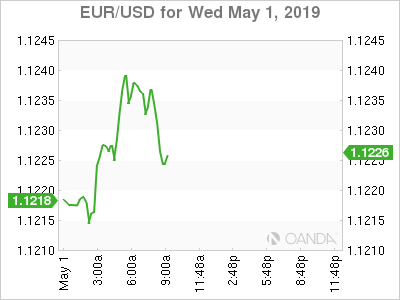
Early trade is seeing light flows as most of Asia and European equity markets are closed in observance of the May 1st holiday. After yesterday’s close, stocks got a boost after better than expected results out of Apple. Yes, they posted their second consecutive decline in earnings and revenue, but it was much better than what was feared. Apple basically erases the weakness that we saw the day before from Alphabet’s sour results. The dollar did get a small boost on the better than expected results from the ADP report. The private sector is showing hiring remains strong as April showed 275,000 jobs created, much higher than the 180,000 forecast. The report highlighted that the economic soft patch at the start of the year has not materially impacted hiring. The dollar has modest losses to the euro and British pound and slight gains to the commodity currencies.
- FOMC – How patient on inflation will they be?
- Trump – Wants 1% cut and more QE
- Stocks – Mixed earnings could put a temporary cap on this rally
- Oil – Lower on stockpiles surge and Maduro still controls military
- Gold – Dovish induced Fed rally may stall
Fed
The FOMC is widely expected to hold policy unchanged and affirm their patient pledge. They may acknowledge the inventory affect to the recent GDP surprise, but should emphasize they will need to see more data points. The markets will heavily focus on their concern with soft inflation. It is possible the Fed could decide to hint at the possibility of easing if inflation worsens. The Fed will also need to reiterate their independence from the President. Trump’s recent calls for 1% cut on interest rates and more QE will likely be ignored by the Fed.
Trump
President Trump is determined to keep on telling the Fed how to keep supporting the economy. Hardly anyone is taking some of the suggestions seriously, but it appears Trump will gladly blame the Fed for any softness with the economy over the next year or more importantly around the election.
His twitter account has been busier than ever. Yesterday’s tweets include “China is adding great stimulus to its economy while at the same time keeping interest rates low. Our Federal Reserve has incessantly lifted interest rates, even though inflation is very low, and instituted a very big dose of quantitative tightening. We have the potential to go up like a rocket if we did some lowering of rates, like one point, and some quantitative easing. Yes, we are doing very well at 3.2% GDP, but with our wonderfully low inflation, we could be setting major records &, at the same time, make our National Debt start to look small!
Trump is asking for the Fed to cut interest rates by 100 basis points and to deliver more QE. This is more political posturing, but in the end, he may be right about calling for a rate cut.
Stocks
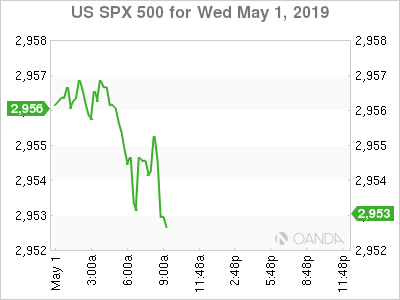
Mixed earnings results will unlikely be a catalyst for the next push higher with stock prices. While the Fed is on hold, a trade deal is coming, and Treasury yields have stabilized, we could see US stocks run temporary run out of momentum here. Earnings results continue to come in mixed. Early in the morning, CVS and Hilton Worldwide surged after raising their respective forecasts, while Yum Brands sold off after delivering roughly in-line results.
Oil
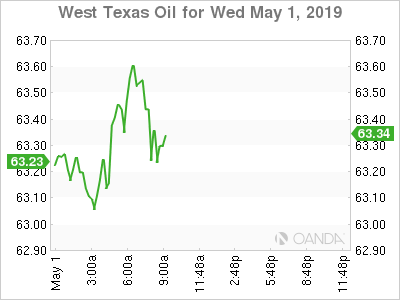
Crude prices sold off after both a strong inventory gain and after Venezuelan President Maduro seemed to maintain a strong grasp over his military support.
The weekly API oil inventory report showed a build of 6.8 million barrels, up from the draw of 3.1 million barrels we saw last week.
Venezuela, which holds the world’s biggest cruder reserves is likely to see continued protests that are led by opposition leader Juan Guaido, but the markets may wait to see if he can muster up a significant amount of military support before pricing in heightened tension that could drive up oil prices. It appears for now, Maduro has a strong hold of the military. It is unclear if the political situation will change anytime soon.
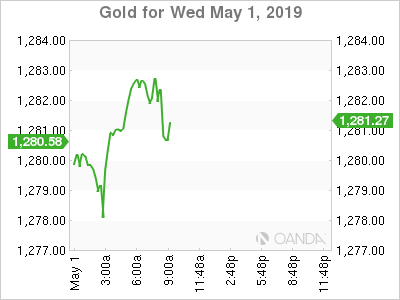
Gold
The precious metal remains steady ahead of key FOMC rate decision and press conference. Easy monetary policy could provide a boost for the yellow metal, but it may not be substantial as expectations remain high for a final trade deal to take place within the next month.
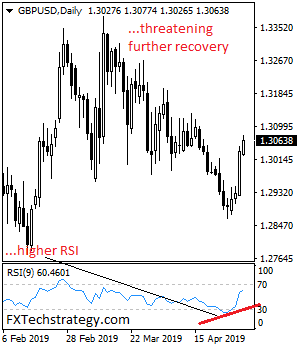
GBPUSD Faces Further Price Recovery Higher On Correction
GBPUSD faces further price recovery higher on correction. Support lies at 1.3000 as it look for more weakness. Below that level will open the door for more decline towards 1.2950 level. Further down, support comes in at the 1.2900 level where a break will turn focus to the 1.2850 level. Further down, support lies at the 1.2800 level. On the upside, resistance stands at the 1.3100 with a turn above here allowing for additional strength to build up towards the 1.3150 level. Further out, resistance stands at the 1.3200 level followed by the 1.3250 level. On the whole, GBPUSD faces further recovery higher on correctio.