Sample Category Title
Fed Remains on Hold; Cuts IOER; Maintains Patient Pledge
The Fed kept rates interest rates steady and stuck to the patient script. The Fed reiterated that they will be patient as it determines what future adjustments to the target range for the federal funds rate may be appropriate to support these outcomes. The Fed did not give any queues to any policy moves or reactions to the recent run of low inflation.
A technical adjustment was delivered with the Fed lowering the IOER rate 5 basis points to 2.35%, a tool used to control the benchmark rate. The IOER should not be interpreted as a dovish signal.
The dollar extended its declines while Treasuries extended gains on the day following the uneventful FOMC decision.
The US economy is at full employment and growth still looks fine, so rate cut bets at this late stage in the cycle might start seeming unusual. But that is where we are. Fed fund futures are still pricing in a 50/50 chance they will cut at the September meeting.
Fed stands pat, acknowledges below target inflation, but maintains patient stance
FOMC left federal funds rate unchanged at 2.25-2.50% as widely expected, on unanimous vote. On inflation, Fed acknowledged that headline and core inflation "are running below 2 percent." But "longer-term inflation expectations are little changed."
It maintained that "sustained expansion of economic activity, strong labor market conditions, and inflation near the Committee's symmetric 2 percent objective as the most likely outcomes."
Fed also maintained its patient stance on future interest rate adjustments.
Full statement below.
Federal Reserve Issues FOMC Statement
Information received since the Federal Open Market Committee met in March indicates that the labor market remains strong and that economic activity rose at a solid rate. Job gains have been solid, on average, in recent months, and the unemployment rate has remained low. Growth of household spending and business fixed investment slowed in the first quarter. On a 12-month basis, overall inflation and inflation for items other than food and energy have declined and are running below 2 percent. On balance, market-based measures of inflation compensation have remained low in recent months, and survey-based measures of longer-term inflation expectations are little changed.
Consistent with its statutory mandate, the Committee seeks to foster maximum employment and price stability. In support of these goals, the Committee decided to maintain the target range for the federal funds rate at 2-1/4 to 2-1/2 percent. The Committee continues to view sustained expansion of economic activity, strong labor market conditions, and inflation near the Committee's symmetric 2 percent objective as the most likely outcomes. In light of global economic and financial developments and muted inflation pressures, the Committee will be patient as it determines what future adjustments to the target range for the federal funds rate may be appropriate to support these outcomes.
In determining the timing and size of future adjustments to the target range for the federal funds rate, the Committee will assess realized and expected economic conditions relative to its maximum employment objective and its symmetric 2 percent inflation objective. This assessment will take into account a wide range of information, including measures of labor market conditions, indicators of inflation pressures and inflation expectations, and readings on financial and international developments.
Voting for the FOMC monetary policy action were: Jerome H. Powell, Chair; John C. Williams, Vice Chair; Michelle W. Bowman; Lael Brainard; James Bullard; Richard H. Clarida; Charles L. Evans; Esther L. George; Randal K. Quarles; and Eric S. Rosengren.
(FED) Federal Reserve Issues FOMC Statement
Information received since the Federal Open Market Committee met in March indicates that the labor market remains strong and that economic activity rose at a solid rate. Job gains have been solid, on average, in recent months, and the unemployment rate has remained low. Growth of household spending and business fixed investment slowed in the first quarter. On a 12-month basis, overall inflation and inflation for items other than food and energy have declined and are running below 2 percent. On balance, market-based measures of inflation compensation have remained low in recent months, and survey-based measures of longer-term inflation expectations are little changed.
Consistent with its statutory mandate, the Committee seeks to foster maximum employment and price stability. In support of these goals, the Committee decided to maintain the target range for the federal funds rate at 2-1/4 to 2-1/2 percent. The Committee continues to view sustained expansion of economic activity, strong labor market conditions, and inflation near the Committee's symmetric 2 percent objective as the most likely outcomes. In light of global economic and financial developments and muted inflation pressures, the Committee will be patient as it determines what future adjustments to the target range for the federal funds rate may be appropriate to support these outcomes.
In determining the timing and size of future adjustments to the target range for the federal funds rate, the Committee will assess realized and expected economic conditions relative to its maximum employment objective and its symmetric 2 percent inflation objective. This assessment will take into account a wide range of information, including measures of labor market conditions, indicators of inflation pressures and inflation expectations, and readings on financial and international developments.
Voting for the FOMC monetary policy action were: Jerome H. Powell, Chair; John C. Williams, Vice Chair; Michelle W. Bowman; Lael Brainard; James Bullard; Richard H. Clarida; Charles L. Evans; Esther L. George; Randal K. Quarles; and Eric S. Rosengren.
Japanese Yen Gains Ground, Investors Eye FOMC Rate Statement
USD/JPY continues to lose ground this week. In Wednesday’s North American session, the pair is trading at 111.16, down 0.24% on the day. On the release front, there are no Japanese events this week, so U.S. indicators will have a magnified effect on the direction of the pair. In the U.S., it was a mixed day. ADP nonfarm payrolls soared to 275 thousand, crushing the estimate of 181 thousand. Will the official nonfarm payrolls follow suit on Friday? ISM Manufacturing PMI slowed to 52.8, shy of the estimate of 55.0 points. Later, the FOMC will set the monthly benchmark rate and release a rate statement. On Thursday, the U.S. posts unemployment claims.
After an aggressive stance in 2018, the Federal Reserve has become dovish, reflecting a slower U.S. economy. The Fed is projected to stay on the sidelines and maintain rates at a range between 2.25-2.50 percent. The Fed hasn’t raised rates since December and has signaled that it could freeze rates until next year. The most recent inflation numbers will reinforce that stance, as the Fed target of 2.0% remains elusive. The Core PCE Price Index, which is the Federal Reserve’s preferred gauge for inflation, came in at 0.0% in March and 0.1% in February (the two events were released on Tuesday due to the government shutdown earlier this year). On an annualized basis, the indicator gained 1.6%, just shy of the estimate of 1.7%. GDP and consumer spending are looking bright, but nonetheless there is no danger of the economy overheating, so the Fed can afford to leave rates at the current level for the near future.
US 10-year yield resumes free fall, 2.463 support in focus
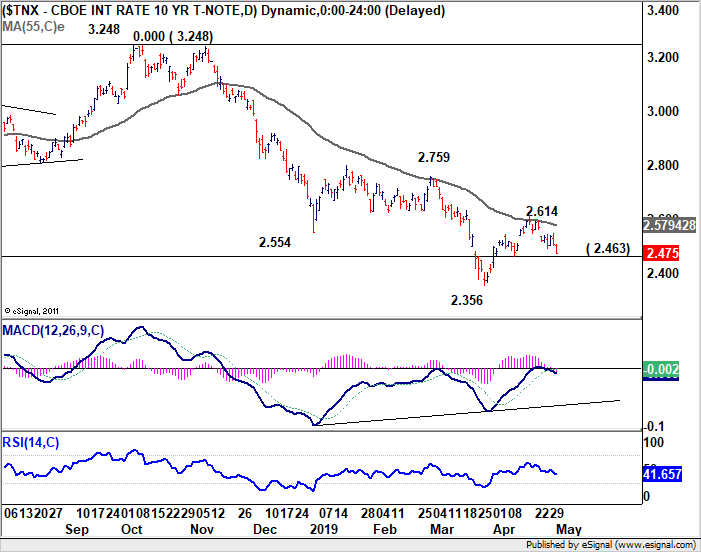
US 10-year yield resume recent free fall today and breaks 2.5 handle with ease. At the time of writing, it's down -0.034 at 2.475. As noted before, TNX has likely completed the corrective recovery from 2.356 at 2.614, after rejection by 55 day EMA. Focus is now immediately on 2.463 support. Firm break there would confirm this bearish view. Larger decline from 3.248 should then be resuming.
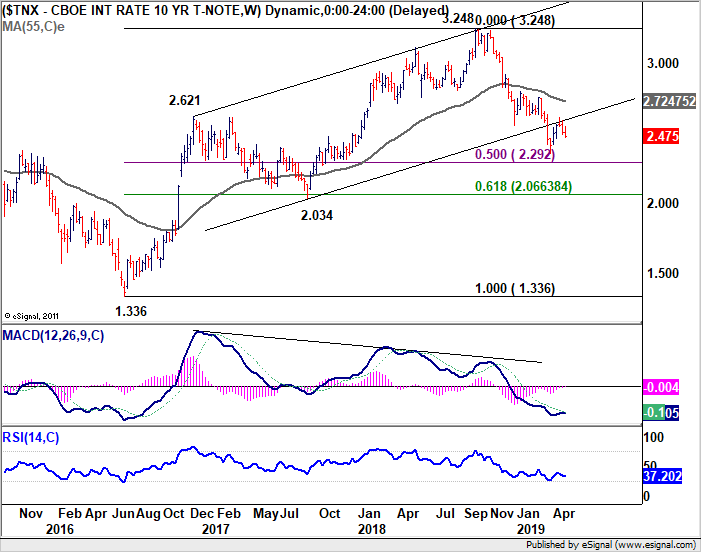
And, in the bigger picture, TNX was also rejected by long term channel support turned resistance, and held well below 55 week EMA. Break of above mentioned 2.463 near term support will likely send TNX to 50% retracement of 1.336 to 3.248 at 2.292. We'll then see if bullish convergence condition in daily MACD could contain downside there.
U.S. Manufacturing Activity Decelerated in April
- The Institute for Supply Management (ISM) manufacturing index shed 2.5 points to 52.8 in April, a worse outturn than the consensus view that called for a relatively steady 55.
- Three of the five subcomponents that comprise the headline index drove April's decline. New orders led the way lower, shedding 5.7 points to 51.7. Employment almost fully reversed March's surge higher, dropping 5.1 points leaving the index at 52.4. Production declined 3.5 points to 52.3. In contrast, inventories improved (+1.1 to 52.9), as did supplier deliveries (+0.4 to 54.6).
- The trade components of the report weakened for the second consecutive month, with both dipping into contraction. New export orders dropped 2.2 points to 49.5, and import orders shed 1.3 points to leave the index at 49.8. Export orders last contracted in February of 2016, while import orders last contracted in January of 2017.
- Keeping with the decelerating theme, prices paid (not seasonally adjusted) fell 4.3 points to 50 – on the edge of contraction. Since November, declining price pressures have reflected lower prices of aluminum and steel products (prices have now normalized near pre-tariff levels), and crude oil/gas.
- Thirteen of eighteen manufacturing industries reported growth in April, down from sixteen in March. Apparel, leather, and allied products, primary metals, wood products, petroleum and coal products, and transportation equipment were the five industries that reported a contraction in the month.
Key Implications
- Manufacturing industry output has been lumpy since the middle of last year, but today's report suggests that activity has softened more than expected. In fact, although U.S. manufacturing output continues to expand, April's print is the slowest pace of expansion since October 2016. That said, comments from survey respondents suggest that Mexican border delays may have contributed to weaker activity in April. Respondents also say that the inventory build is due to expectations of a pickup in orders later this year, as many are optimistic about the demand outlook, both domestic and abroad. There's also some concern voiced about tariffs acting to boost prices and contributing to component shortages, while Brexit may be a factor that could delay shipments through the UK. Aluminum products and electronic component shortages continue, and the shortage of skilled labor is a key concern in the machinery industry.
- All told, today's report highlights how the U.S. manufacturing sector continues to face challenges. However, activity elsewhere appears to have continued to stabilize in April. Although China's manufacturing sector weakened a touch as new export orders faded, it remained in expansion territory for the second consecutive month. Although April's flash PMIs for Europe signaled that manufacturing activity in the region is still struggling to regain momentum after contracting for several months (final April PMIs for the region and most of the world will be published tomorrow morning), some regions are showing a pickup in output. Key to the recovery in global manufacturing sector in the months ahead will be ongoing progress in U.S. trade talks with China, while also avoiding a broadening of trade tensions with other trade partners.
Aussie Dips as ADP Nonfarm Payrolls Sparkle
AUD/USD has posted slight losses on Wednesday, as the pair continues to trade quietly this week. Currently, the pair is at 0.7041, down 0.13% on the day. On the release front, Australian AIG manufacturing index improved to 54.8, pointing to expansion in the manufacturing sector. Commodity prices continued to accelerate, with a gain of 14.4%. In the U.S., ADP nonfarm payrolls soared to 275 thousand, crushing the estimate of 181 thousand. Will the official nonfarm payrolls follow suit on Friday? On the manufacturing front, ISM Manufacturing PMI slowed to 52.8, shy of the estimate of 55.0 points. Later, the FOMC will set the monthly benchmark rate and release a rate statement. On Thursday, the U.S. posts unemployment claims and Australia releases building approvals.
The U.S-China trade war has weighed heavily on the Australian economy, as China is Australia’s number one trading partner. China is gripped by a slowdown, and April manufacturing data was soft. Manufacturing PMI slowed to 50.1, missing the forecast of 50.7 points. The unofficial Caixin Manufacturing PMI followed the same trend, falling to 50.2. This missed the estimate of 51.0. Both indicators point to stagnation in the manufacturing sector, with readings barely in expansion territory. With the markets braced for a sharp drop of 12.5% in building approvals on Thursday, the Aussie could hit some headwinds this week.
Cable Rallies on Expectations for BOE to Deliver a Hawkish Hold
At a time when central banks around the world are moving away from pursuing tightening policies and instead adopting a more patient approach, the Bank of England may go against the trend which makes Thursday’s meeting all the more interesting. The UK central bank has been on pause since August, with the uncertainty of Brexit casting considerable doubt over the economic outlook and therefore the bank’s response to what is an otherwise healthy economy and labour market. Policy makers will probably be among the most frustrated at the Brexit extension as not only does it not provide clarity, it prolongs the period of economic uncertainty which could weigh on the outlook.
- Hawkish hold expected despite Brexit angsts from six-month extension
- Latest forecasts could see some tweaks to growth and inflation
- Will Haldane join Saunders dissent in voting for a rate hike
But what does this mean for its policy outlook? That is what we’re hoping to learn on Thursday. Other central banks have very much been leaning towards a more accommodative stance in light of the global slowdown and growing risks but the BoE may not fall in line. Of course, it would be easy to do so but it could be argued that the central bank has delayed for long enough and the data simply does not justify such low interest rates.
Unemployment below 4%, average earnings rising by 3.5% and inflation printing around the BoE’s target doesn’t exactly warrant crisis era stimulus. But then these aren’t normal times and the outlook is undoubtedly foggy, to borrow a term from Governor Carney. This is what makes Thursday’s meeting so interesting, no one really knows what to expect.
Price action in the pound in recent weeks doesn’t suggest a rate hike has been priced in this year, or that traders see it as likely. The delay triggered some profit taking in the pound as this is the bare minimum that was priced in and broadly speaking, the positives and negatives of it probably cancel each other out.
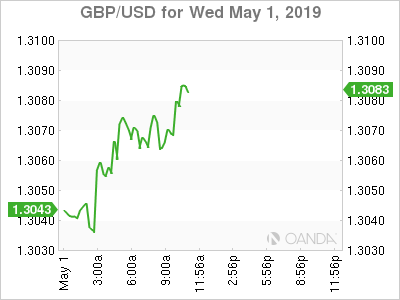
All of this makes Super Thursday all the more interesting. Not only should we get clarity on the outlook for interest rates in the uncertain Brexit world we now live in, but there is the potential for the central bank to be more hawkish or dovish than we currently perceive. This is quite unusual and could trigger a lot of volatility in the currency.
The fact that we have a rate announcement, minutes, new economic projections and a press conference with Carney and his colleagues is an added bonus that should ensure we have a much better idea of what to expect this year than we currently do.
This could very well be the most interesting BoE event that we’ve had in a very long time.
MARKET WRAP: Equities Moved Higher; Gold Steady Ahead of Fed
*Volume remained on the low side today due to the bank holiday *No action expected from the Fed but there may be a surprise *S&P500 made another all time high
Stocks
- The S&P 500 Index moved higher by 0.11 percent as of 15:20 in London. The index made another record high thanks to the improvement in the consumer confidence number which came in at 129 Est 126.
- The Stoxx Europe 600 Index dropped 0.05 percent while the FTSE declined 0.35 percent.
- The MSCI EM Index moved lower by 0.05 percent.
Currencies
- The Dollar Spot Index remained sensitive ahead of the Fed monetary policy decision and traded lower by 0.60 percent.
- The Euro stayed well below the critical level of 1.13 but continued to recover its losses and gained 0.20 percent to $1.1240.
- The Japanese yen soared by 0.11 percent to 111.20 per dollar.
- The British pound remained above the 1.30 mark and gained 0.27 percent to $1.3077.
Bonds
- The yield on 10-year Treasuries moved lower by two basis points to 2.47 percent.
- Britain’s 10-year yield dropped by one basis point to 1.17 percent.
Commodities
- Crude oil continued its retracement and declined 0.38 percent to $63.64 a barrel.
- Gold remained unchanged ahead of Jerome Powell statement on the monetary policy and remained at $1,284 an ounce.
EUR/AUD Mid-Day Outlook
Daily Pivots: (S1) 1.5840; (P) 1.5896; (R1) 1.5962; More...
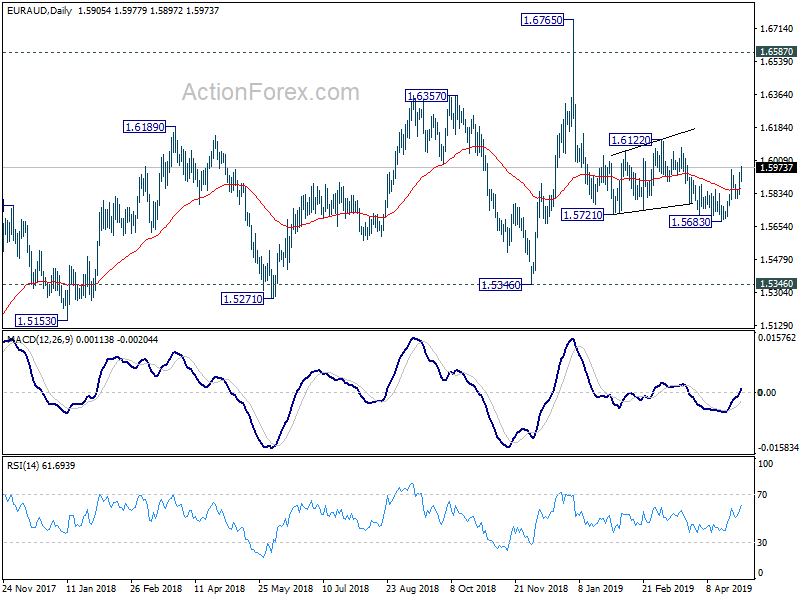
EUR/AUD's break of 1.5959 indicates resumption of rise from 1.5683. Intraday bias is turned back to the upside for 1.6122 resistance. as noted before, correction from 1.6765 should have completed with three waves down to 1.5683. Break of 1.6122 should confirm and bring retest of 1.6765 high next. Near term outlook will now remain cautiously bullish as long as 1.5806 support holds, in case of retreat.
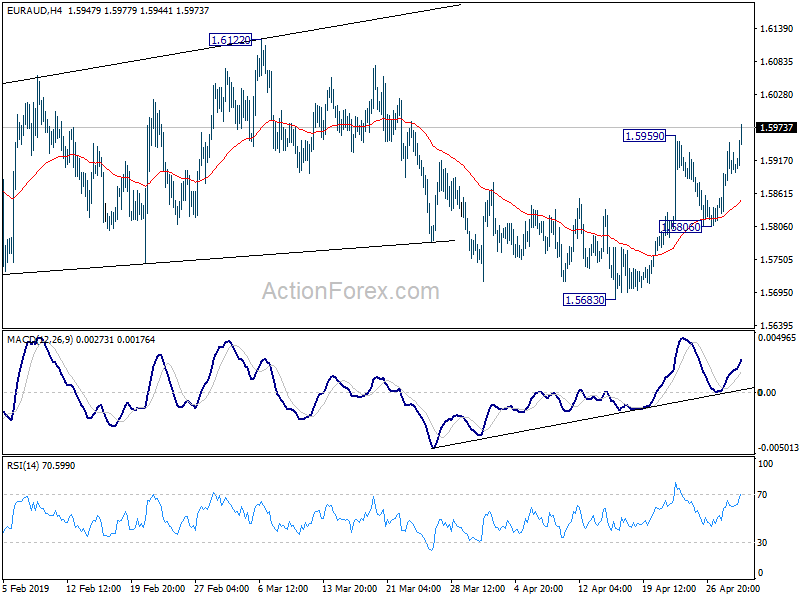
In the bigger picture, as long as 1.5346 support holds, outlook will still remain bullish. Uptrend from 1.1602 (2012 low) is expected to resume sooner or later. Break of 1.6765 will target 61.8% retracement of 2.1127 (2008 high) to 1.1602 at 1.7488 next. However, firm break of 1.5346 key support will indicate trend reversal, with bearish divergence condition in weekly MACD, and turn outlook bearish.