

Sample Category Title
XAU/USD Might Break 1,300.00
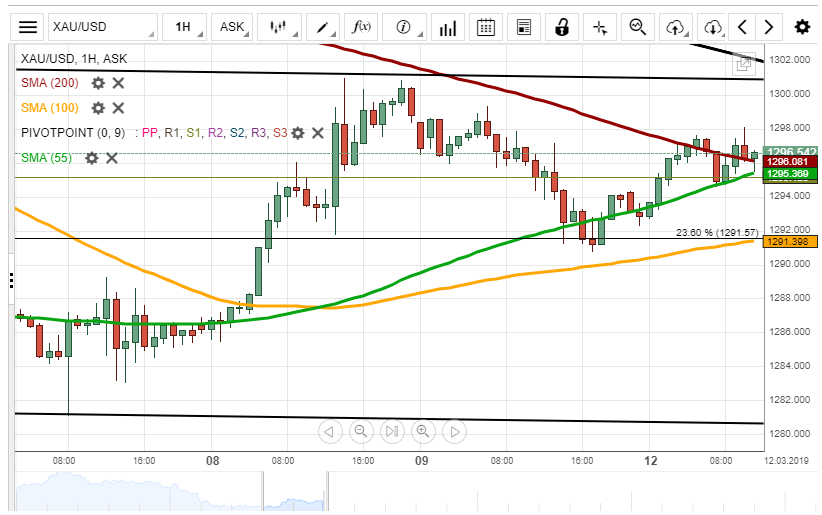
During Monday's trading session, the support level of the 23.60% Fibo at 1,292.00 helped the yellow metal to end the trading session at the 1,290.00 level. During Tuesday's morning hours, the 55-hour simple moving average supported gold to break through the resistance level of the 200-hour SMA to be located at the 1,296.200 mark.
In regards to the near-term future, most likely, most of the technical indicators will support the yellow metal to surge towards the upper boundary of the medium pattern at the 1,300.00 level.
Moreover, if the rate will reach the pattern line, it is expected, that gold might surge reach the 1,310.00 level.
NZD/USD Narrow Ascending Channel Prevails
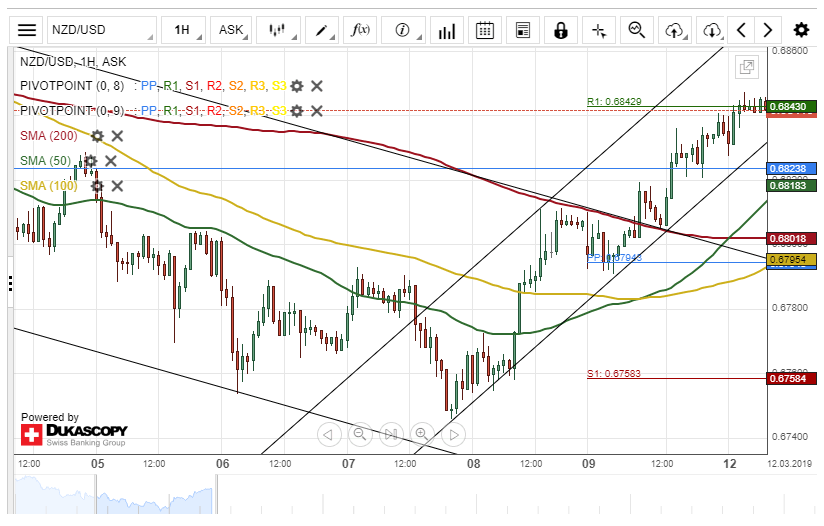
The New Zealand Dollar appreciated about 49 base points against the US Dollar on Monday. The currency pair revealed a new junior ascending channel pattern during the end of yesterday's trading session.
As for the near future, it is likely that the junior ascending channel pattern will guide the currency exchange rate towards a swing high of 0.6904 during the following trading session.
However, technical indicators flash strong sell signals on the daily time frame chart. Therefore, a decline towards a support level formed by the 50-hour simple moving average at 0.6811 could be expected within this session.
AUD/USD Outlook: Recovery Runs Out Of Steam Ahead Of Daily Cloud Top/Key Fibo Barrier
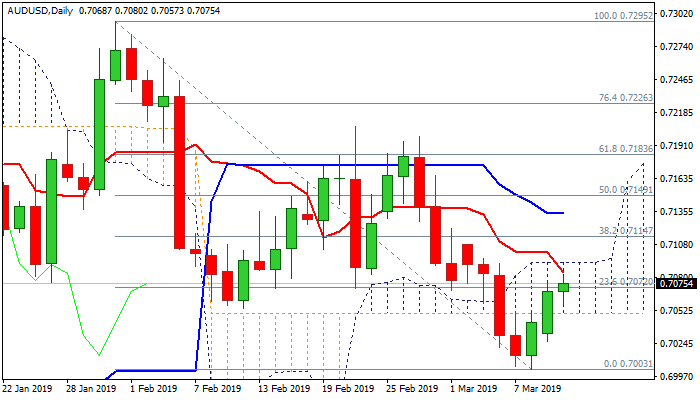
Recovery from 0.70 base extends into third straight day but bulls face headwinds at 0.7084/93 barriers (falling Tenkan-sen/daily cloud top).
Break here is needed to open nearby pivot at 0.7114 (Fibo 38.2% of 0.7295/0.7003) and generate signal for continuation of recovery.
Weaker than expected Australian business confidence in Feb and Jan home loans weigh on near-term sentiment, following absence of positive reaction on Brexit talks improvement and China stimulus talks.
Failure to emerge above daily cloud would weaken near-term structure, while return and close below cloud base (0.7050) would shift focus lower and risk retest of 0.70 base.
Res: 0.7084, 0.7093, 0.7114, 0.7133
Sup: 0.7050, 0.7026, 0.7000, 0.6931
USDJPY Further Bullish Above 111.60
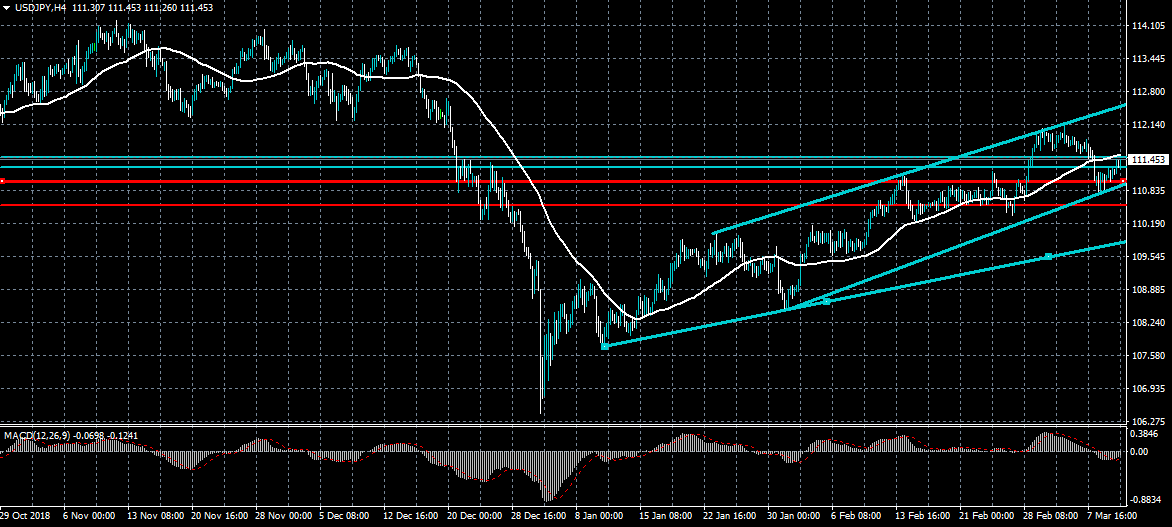
The US dollar is pushing higher against the Japanese yen currency on Tuesday, with bulls performing a strong recovery from key trendline support. If the USDJPY pair breaks above the 111.60 level, traders should expect further upside towards the 112.00 level. Sustained technical failure around the 111.60 level may provoke sellers to move price back towards the 111.10 support level.
If the USDJPY pair trades above the 111.60 level, buyers may test towards the 112.00 and 112.50 resistance levels.
Technical failure around the 111.60 level may provoke sellers to test back towards the 111.30 and 111.10 support levels.
EURUSD Approaching Corrective Target
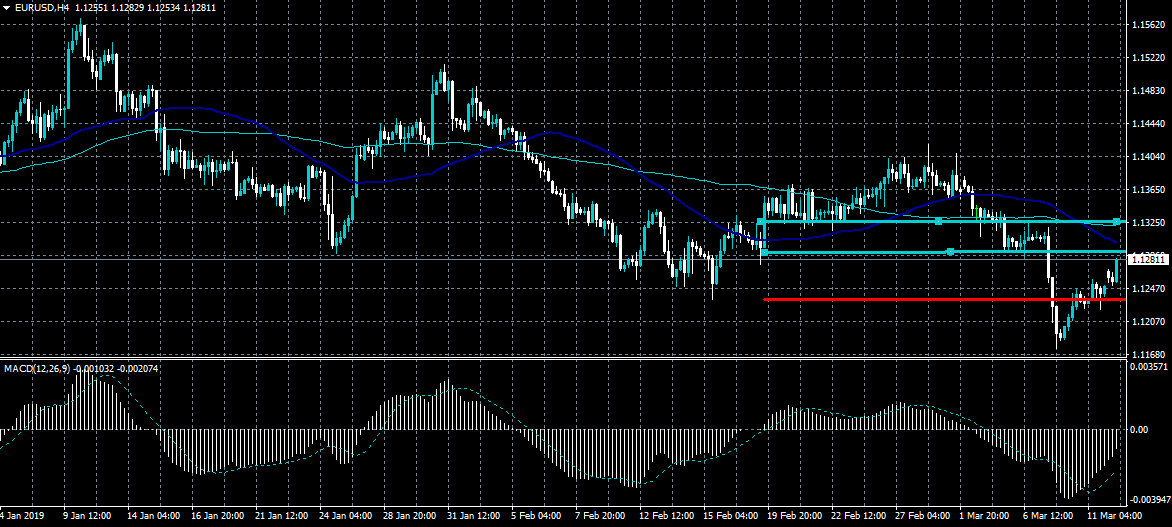
The euro has continued to advance against the US dollar during the European trading session, with the pair approaching its initial corrective target. If buyers force price above the 1.1290 level, further upside towards the 1.1325 resistance level still remain possible. The MACD indicator on the four-hour time frame is also showing that the upside correction in the EURUSD pair is still underway.
The EURUSD pair is intraday bullish while trading above the 1.1230 level, key technical resistance is found at the 1.1290 and 1.1325 levels.
If the EURUSD pair fails around the 1.1290 level, sellers may test back towards the 1.1260 and 1.1230 levels.
Brexit Optimism Spikes Sterling
Optimism takes over. Sterling is the big winner among G10 currencies as traders appear convinced that a breakthrough in Brexit talks is happening. EUR/GBP is trading at ranges not seen since May 2017 while the cable appreciated by 1.60% since the start of the week. Yet PM May will be facing tough challenges at today's House of Commons appearance, after facing a first defeat in 15 January 2019 Withdrawal Agreement vote, where UK MPs rejected the deal by 230 votes, the biggest defeat in modern British government history.
Indeed, 17 days before official divorce day and almost one month after first MPs vote, no material changes of Brexit deal have been acknowledged, despite May's attempt to get further concessions in Strasburg on Monday relating to the British backstop. But instead, three documents which are supposedly “meaningful legal assurances” on EU side and “legally binding” according to May have been provided – this remains far from MPs instruction to replace the backstop by alternative arrangements, an argument the Labour Party will make use of when dismissing the arrangement. UK government top lawyer Attorney General Geoffrey Cox is expected to provide a thorough analysis of the add-on documents at the House of Commons and assess whether the content is enforceable (or not) – an announcement UK MPs will be counting on to take their final decision.
Accordingly, although the agreement appears at sight, we consider the binding dimension of recent documents as essential to allow a major reversal. For now, it seems that the scenario tends more towards a second vote session on Wednesday, where UK MPs will be (1) deciding whether or not it wants to leave the EU without a deal (most likely rejected) and (2) ask for a delay of a few months by way of an extension of article 50.
Short-term, we expect EUR/GBP to bounce back along 0.85555 while a major breakthrough could well push the pair along major support at 0.84852 (31/03/2017 low).
EUR/USD bounces back as investors digest Draghi's speech
After a rough week, where the main event was Draghi's dovish speech, the single currency has been trading on a firmer footing and erased partially losses. Since last Friday, EUR/USD rose more than 0.85%, from 1.1177 to 1.1276, as investors slowly digest the new outlook for interest rates. Indeed, a couple of days after the announcement that the ECB would put on pause its tightening process, market participants realized that the Federal Reserve was also on pause. Therefore, if interest rate differential is already priced in and is not expected to change any time soon, what investors should focus on? Let's have a look at growth prospect for both countries.
The FOMC has revised its growth outlook substantially to the downside. At its December meeting, the Fed lowered its growth forecast for 2019 from 2.5%y/y to 2.3% - not a major change, I agree. However, yesterday Atlanta Fed issued fresh growth forecast, which are based on domestic retail sales data, for the first quarter. Economic growth is expected to ease to a 0.2% annualized rate. Looking at the Atlanta GDP Now previous estimations using different output, GDP growth for the first quarter is estimated to be somewhere between 0.2% and 0.5%, which is still much lower than what the Fed calculated in December.
Across the Atlantic, The European Central Bank trimmed its growth forecast for 2019 to 1.5% from 1.8% - a 0.3% downside adjustment. Based on both central banks' estimates. It seems that the euro area would bear the brunt of the slowdown, which should be ultimately be dollar positive. However, we believe that US growth is widely overestimated, mostly because the positive effect of the tax cut implemented by the Trump administration will fade away, while the cost of debt servicing will channel revenue away from investment and thus growth generation. Indeed, higher interest rates means higher interest payments. Against such a backdrop, we anticipate that the single currency will continue to appreciate against the buck - even though it would be a bumpy road – and will reach 1.15 by the summer and 1.24 at the end of the year.
GOLD Retains Upside Pressure On Corrective Recovery
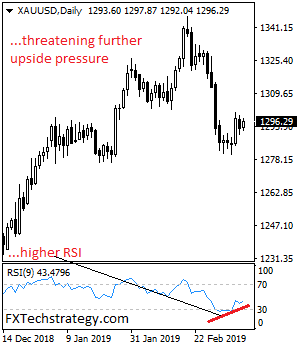
GOLD retains upside pressure on corrective recovery following its price halt on Friday. This development leaves GOLD targeting the 1,314.00 resistance zone in the days ahead. Further out, resistance resides at the 1,320.00 level where a break will aim at the 1,330.00 level. A turn above there will expose the 1,340.00 level. Further out, resistance stands at the 1,350.00 level. Its daily RSI is pointing higher suggesting further strength. On the downside, support comes in at the 1,290.00 level where a break will turn attention to the 1,280.00 level. Further down, a cut through here will open the door for a move lower towards the 1,270.00 level. Below here if seen could trigger further downside pressure targeting the 1,260.00 level. All in all, GOLD looks to move further higher in the days ahead.
Dollar Playing Second Fiddle To Brexit
Tuesday March 12: Five things the markets are talking about
Global equities have extended yesterday's gains, along with U.S futures, as the broad risk-on attitude across markets continues.
Treasuries prices are under pressure and the ‘big' dollar has edged a tad lower, while sterling is climbing ahead of this afternoons crucial Brexit vote.
Markets are pricing in that today's “meaningful” vote (03:00 pm EDT) on the Brexit withdrawal deal will either pass or fail by a small enough margin to keep the deal alive.
At a joint press conference yesterday evening, U.K PM Theresa May and EU Commission President Jean-Claude announced a revised Brexit deal.
Currently, the odds of the ‘new' deal passing a Parliament vote have jumped to +30% from +10%. Expect trading sterling (£1.3204) and gilts to get messy, until we know where the U.K stands.
On tap: A slew of data from China this week (retail sales, investment, credit and industrial production) is expected to give the market a fresh insight on the impact of monetary stimulus. The BoJ will also meet to set policy. This morning, its U.S retail sales (0:8:30 am EDT).
1. Stocks get the green light
Global stocks continue to climb, after reassuring comments on the weekend from Fed Chair Powell and on signs that the U.S and China are nearing a trade deal.
In Japan, the Nikkei share average surged to a six-day high overnight, as a combination of a tech-led rally stateside Monday combined with a weaker yen led to broad-based buying. The Nikkei ended the day up +1.79%, its highest close since March 6. The broader Topix gained +1.52%.
Down-under, Aussie shares reversed course and edged lower overnight, as gains in mining and energy stocks were offset by losses in financials after the sector came under further political scrutiny. The S&P/ASX 200 index ended down -0.1%. The benchmark declined -0.4% on Monday. In S. Korea, the Kospi index rallied +0.89% after the European Commission agreed to changes in a Brexit deal. It's the biggest daily gain since Feb. 20
In China and Hong Kong, equities edged higher as China and the U.S appear to edge closer to a trade deal but worries about domestic economic headwinds have capped gains. At the close, the Shanghai Composite index was up +1.1%, while the blue-chip CSI300 index was up +0.7%. In Hong Kong, the Hang Seng index was up +1.5%, while the Hang Seng China Enterprises index rose +1.7%.
In Europe, regional bourses trade mostly flat across the board. The FTSE 100 is underperforming on continued strength in the pound.
U.S stocks are set to open in the ‘black' (+0.2%).
Indices: Stoxx600 +0.90% at 373.92, FTSE -0.22% at 7,115.25, DAX -0.03% at 11,540.37, CAC-40 +0.17% at 5,274.98, IBEX-35 +0.03% at 9,174.30, FTSE MIB -0.21% at 20,594.50, SMI +0.81% at 9,336.20, S&P 500 Futures +0.21%
2. Oil rises as Saudi deepens OPEC supply cuts, gold higher
Oil prices remain better bid, as Saudi Arabia appeared to deepen OPEC's supply cuts aimed at tightening markets, although gains are being capped by the ongoing surge in U.S supply and worries over the global economy.
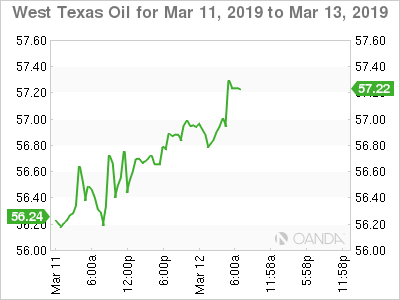
Brent crude futures are at +$66.82 per barrel, up +24c, or +0.4%, while U.S West Texas Intermediate (WTI) crude oil futures are at +$57.08 per barrel, up +29c, or +0.5%, from Monday's close.
Oil prices have been receiving broad support in 2019 from supply cuts by OPEC aimed at tightening markets. Yesterday, Saudi Arabia announced further plans to cut its crude oil exports in April to below +7M bpd, while keeping its output “well below” +10M bpd. That compares to production of around +10.14M bpd last month.
Also supporting prices is the political and economic crisis in OPEC-member Venezuela. The lack of electricity is making it very difficult to pump and produce crude.
Despite the gains, markets are being held back by revisions to global growth by OECD and G7 central banks.
Note: OPEC meets in Vienna on April 17-18, with another gathering scheduled for June 25-26, to discuss supply policy.
Crude prices are also being supported by Baker Hughes' latest weekly report showing the number of U.S rigs drilling for new oil production stateside fell by nine to 834.
This is the third consecutive week of declines as U.S oil producers trim their 2019 spending budgets. Nevertheless, because the overall U.S drilling level remains relatively high, the market still expects U.S crude output to rise above +13M bpd sooner than later.
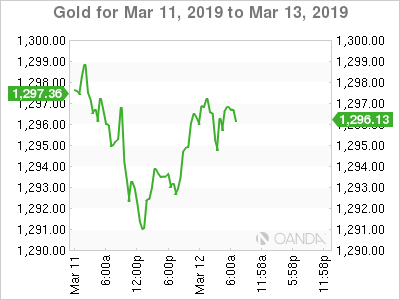
Ahead of the U.S open, gold prices have rallied as the dollar weakened against the pound after the E.C accepted amendments to the UK's Brexit deal, although gains are limited as the agreement also supported sentiment for riskier assets. Spot gold has rallied +0.1% to +$1,294.90 per ounce, while U.S gold futures added +0.3% to +$1,294.70 an ounce.
3. Brexit deal hopes push German Bund yields away from lows
Yields on Tier 1 eurozone government bonds have backed up on hopes that PM Theresa May could be close to securing approval for her Brexit deal dented demand for safe-haven assets.
Germany's benchmark 10-year Bund yield has rallied +2.5 bps to +0.09% – moving away from its two-year lows hit last week in the wake of a “dovish” ECB.
It's a similar story across the region with other highly rated sovereign yields also backing up +1-2 bps.
The yield on 10-year Treasuries has advanced +2 bps to +2.66%, the biggest rise in more than a week, while in the U.K, the 10-year Gilt yield has increased +6 bps to +1.235%, the biggest increase in almost two weeks.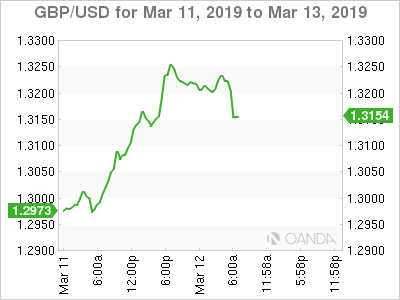
4. Dollar playing second fiddle to Brexit
Sterling (£1.3214) has found support as markets are pricing in today's meaningful vote on the U.K's draft Brexit withdrawal deal will either pass or fail by a small enough margin to keep the deal alive. If the revised Brexit deal doesn't pass through parliament, sterling is expected to fall, but the move would likely be capped, because the possibility of Article 50 being extended still leaves open the options of a “softer” Brexit.
EUR/USD (€1.1280) is being pushed up by the rising pound. However, the ‘single' unit is not expected to rise significantly further because German industrial production data, due tomorrow, is expected to stay weak.
The Japanese yen has fallen -0.1% to ¥111.34, the largest fall in a week.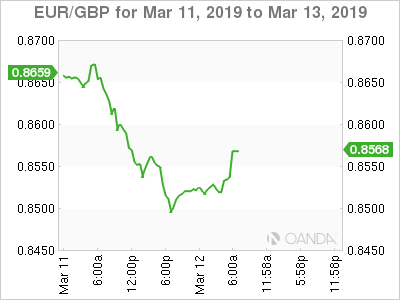
5. U.K economy rebounded in January
Data out of the U.K this morning showed that their economy rebounded in January after a weak December, keeping growth on an even path despite the ongoing political drama surrounding Brexit.
The ONS said the U.K economy grew at an annualized rate of +1.1% in the three months through January, up from a revised +0.9% in the three months through December. Growth in January alone was +0.5%, reversing a -0.4% contraction in December.
Digging deeper, the expansion was driven by healthy growth in the services sector, especially wholesale and retail trade, which offset a poor three months for industrial production and construction.
Note: Uncertainty over the country's future ties weighed on investment last year, causing the economy to turn in its weakest annual performance in seven-years.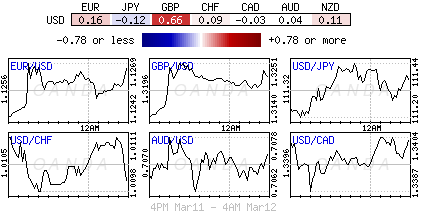
EUR/USD – Euro Is Nearing Back 1.13
EUR/USD has posted gains in the Tuesday session. Currently, the pair is trading at 1.1277, up 0.28% on the day. On the release front, there are no German or eurozone events. In the U.S., consumer inflation is expected to remain soft, with CPI and Core CPI projected at 0.2%. On Wednesday, the eurozone releases industrial production and the U.S. publishes PPI and durable goods orders data.
The euro dropped sharply following the ECB’s dovish rate statement last week, but has since recovered most of those losses. Investor sentiment towards the U.S. dollar has slipped after a dismal nonfarm payroll report on Friday. The U.S. economy managed to create only 20,000 jobs in February, nowhere near the forecast of 180 thousand. If consumer inflation numbers miss expectations, the euro could continue to gain ground. Inflation in the U.S. remains well below the Federal Reserve target of 2.0%, and is a key reason why the Fed can afford to stay dovish and maintain interest rate levels.
The German manufacturing sector continues to post dismal numbers. Industrial production fell 0.8% in January, missing expectations. The indicator managed only two gains in the second half of 2018 and has started 2019 with a decline. Last week, factory orders plunged 2.6%, marking a third successive decline. The U.S-China trade war has dampened global growth, which has reduced the demand for German exports and weighed heavily on manufacturing activity. Eurozone manufacturing has also struggled, and the negative trend is likely to continue if there is no breakthrough in the U.S-China trade talks.
New Brexit Vote: Second Referendum Or No-Deal
On Tuesday, March 12, the British Parliament will hold a second vote on the adoption of the Brexit plan, agreed with the EU. The January 15 vote ended in a resounding failure, considered the worst in the last century.
It is predicted that this time again there will be fewer supporters than opponents. The comments of parliamentarians point to dissatisfaction with the fact that the EU did not make any meaningful concessions by proposing the same conditions with slightly different formulations.
The refusal to accept the updated May’s plan will lead to the fact that on Wednesday, March 13, the British Parliament will have to decide whether to leave the EU without a deal, the so-called No-deal Brexit. Informal polls show that parliamentarians are against an unorganized exit.
If so, then on Thursday, March 14, they will have to vote in favour or against postponing the exit from the EU, which is now adopted at the level of the law on March 29.
In addition, in the following days, the question of the need for a new referendum may be raised again. Previously, this idea was repeatedly rejected, but a clear impasse in the discussion of the Brexit issue increases the chances of a new referendum.
A new referendum and prospects that Britain residents may change their minds are potentially good news for the British pound. In this regard, all votes and discussions in parliament this week will be considered from this perspective.
Markets and lawmakers were frightened by the prospect of exit without a deal during the previous months. However, as we see, this was not enough to push for a deal, and the issue of border control conditions in Ireland remained unresolved. An increase in the chances of exit without a deal can cause a serious blow to the pound since it implies the greatest damage to the economy in the coming months and quarters.